“We too are founders… We too are makers of a nation”
–Robert H. Jackson
Robert Houghwout Jackson (Feb 13, 1892 – Oct 9, 1954) was an American lawyer, jurist, and politician who who served as U.S. Solicitor General under Franklin D. Roosevelt and was later appointed as an Associate Justice of the Supreme Court from 1941 until his death in 1954. Wikipedia
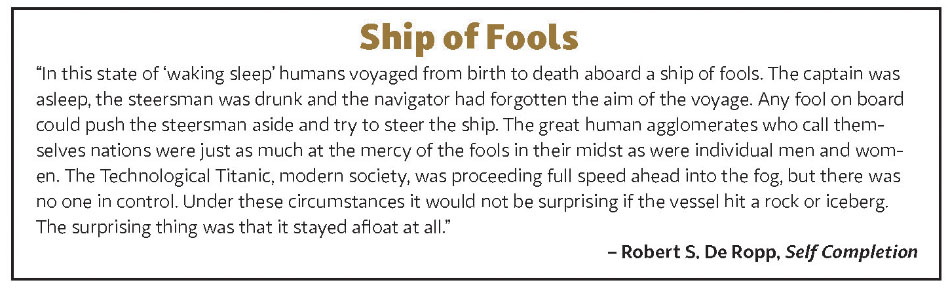
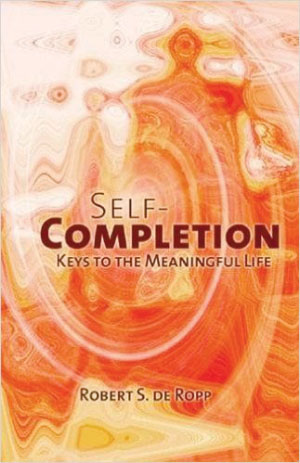
Biochemist, author, spiritual teacher, kayaking fisherman, founder of an intentional community, misanthrope – Robert de Ropp was a complex man. Within him, the scientist, the magician, the missionary, the domestic oaf, hermit and warrior jostled for position. Practical and forthright, and distrustful of wide-eyed spirituality, he nevertheless became widely known to seekers in the 1960s. Books like Drugs and the Mind, The Master Game, Warrior’s Way and Self-Completion helped many to bridge the gap between drug experiences and disciplined spirituality.
Born in England in 1913, he came from an aristocratic background, but the early death of his mother in the post-WWI influenza epidemic and the subsequent lack of interest shown by his father resulted in a bizarre childhood.
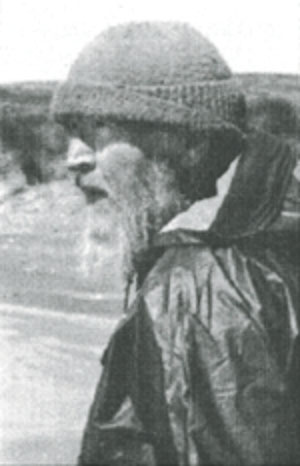
Rare photo of Robert de Ropp
His father was a Lithuanian Baron who in the 1920s lost most of his money in ill-advised financial ventures. At the age of 12, de Ropp, who had until that point been advancing through the elite English school system, found himself dumped for two years at the family seat in Lithuania. The mansion itself had not been maintained and, having been shelled in the war, was close to a ruin. Robert rattled around in a freezing cold, rat-infested great house that could accommodate fifty people. The neglected estate was run by the peasant families who had been there for generations, if not centuries. In place of his Oxbridge-oriented classical education the half-starving de Ropp found himself receiving a practical schooling in fishing and traditional agriculture from the old retainers.
With little warning he found himself extricated by his father only to be resettled once again, this time in the Australian outback, where he found himself working in a hopelessly misjudged farming venture. When this went bottoms up he made his way to Port Adelaide where he tried unsuccessfully to drown himself. Somehow, the fourteen-year-old managed to get back to England by himself with ten shillings in his pocket. Via a family connection he was taken in by the composer Ralph Vaughan Williams, whose pastoral pieces are now a mainstay of popular classic music radio programming. Finally achieving some stability, Robert studied science and became a molecular biologist.
Robert would only have occasional contact with his father, who lived until 1973. William de Ropp was a fascinating figure in his own right. A Germanic Lithuanian aristocrat, he became a confidante of Hitler and enjoyed close contact with him in the mid-1930s. William de Ropp had close connections with high-ranking British figures who were in favour of appeasing Hitler. He was actually being employed as a double agent who was able to obtain considerable intelligence for the British on Hitler’s ambitions and the state of the Luftwaffe.
Encountering Ouspensky & Gurdjieff
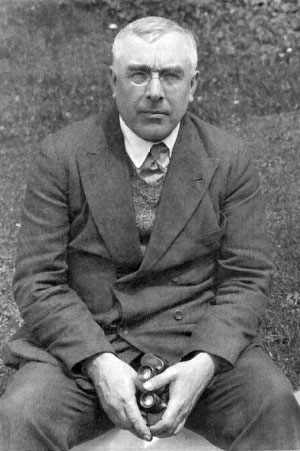
P.D. Ouspensky (1878–1947) was a Russian mathematician and esotericist known for his expositions of the early work of the Greek-Armenian teacher of esoteric doctrine George Gurdjieff.
In the 1930s Robert de Ropp got to know the novelist Aldous Huxley and his friend Gerald Heard who taught meditation. Heard was one of the first westerners to teach eastern meditation styles but de Ropp found his approach over-emotional. Not so P.D. Ouspensky, who seemed free from sentimentality and pretentiousness. After a hesitant start, de Ropp joined Ouspensky’s groups and began the work (based in the teachings of G.I. Gurdjieff), which, with development and adaptation, would dominate his inner spiritual life.
De Ropp was tough and well-prepared for the physical exertions that form part of the Gurdjieff work. G.I. Gurdjieff taught that man (humans) has no single indivisible ‘I’. Desires, thoughts, feelings, urges, pass constantly through us, each of them claiming the title of ‘I’ temporarily. Certain typical clusters of these ‘I’s form somewhat separate personalities. Each personality may have a separate set of concerns that collect together, representing the different aspects of one’s concerns or the separate contexts in which one must relate to other human beings. As an example, many adolescents experience a taste of this when they experience the discomfort of recognising that the way they behave with family may be very much at odds with the way they behave with friends.
De Ropp found this to be a key to self-understanding. Obviously disposed to coming up with new categories, as we shall see in other areas of his writing, he analysed his own constituent personalities. What was unique in de Ropp’s approach was his use of the personalities in autobiography. Throughout Warrior’s Way – incidentally one of the most readable, honest, and varied of spiritual autobiographies – de Ropp characterises his behaviour according to the personality which was dominant. These included archetypes such as the Magician, who was able to feel the mystique of nature, and the Scientist, always applying rationality and looking for evidence. Yet others are more individual. The Missionary was that part of de Ropp who wanted to convert others to what he saw as the truth of the Gurdjieff-Ouspensky system. The Missionary was energetic and sincere but authoritarian, dogmatic and domineering. Opposed to the Missionary was the Domestic Oaf, desirous of family, children, a steady job, of house and land. (At times his personalities included the Recluse, the Cynic and others; this was a pragmatic rather than a systematic approach.)
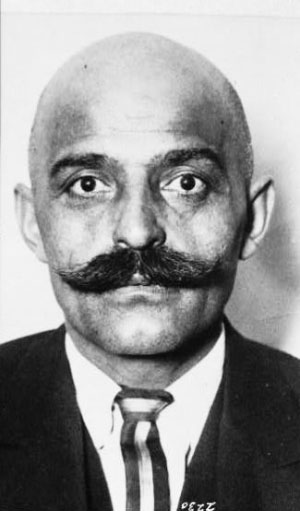
George Gurdjieff
De Ropp worked every weekend at Lyne Place in England and then, after the end of the war, at Franklin Farms in New Jersey for over a decade. He was not alone in feeling that Ouspensky had lost his way and succumbed to a form of the guru trap, with a drinking problem and surrounded by followers who had become dogmatic and authoritarian. He was also not alone in feeling that in his last months Ouspensky had shrugged off this role and lived like a spiritual warrior at the end.
After Ouspensky died de Ropp finally met Gurdjieff in New York in 1948. With some exceptions, the strict firewalls that Ouspensky erected against what he thought was the increasingly erratic influence of Gurdjieff had broken down. Long term students of Ouspensky encountered Gurdjieff in a series of vivid and pungent encounters. Gurdjieff struck de Ropp as a king in exile, perhaps the last Magus. He was the most impressive man de Ropp met in his entire life – a view to which he held 30 years later. Gurdjieff combined the Tarot archetypes of Magician, Hierophant, Emperor and Hanged Man. Yet, when Robert and his wife walked back with Gurdjieff after a movements class in New York, he wracked his brains trying to remember the question he should have asked Gurdjieff, but it just would not come and they continued in silence. Soon afterwards Gurdjieff would be in such demand that there was no chance for direct contact; De Ropp would have a long illness, and the master died the next year in 1949. In retrospect, de Ropp decided that although Gurdjieff represented unparalleled spiritual possibilities, he just wasn’t up to the challenge. “For the intelligent and the strong he [Gurdjieff] could provide the inspiration of a lifetime. But for the stupid and the weak he could be dangerous, even deadly. You have to be a pretty strong player to be able to play games with such a master.”1
The Domestic Oaf won out, eager for a job, a mate and a family, but life was not to be easy. Now on his second marriage and second family, de Ropp built himself a house from scratch for $3,500, and held down a good scientific post.
Both de Ropp’s wives suffered from mental illness, his first wife to such an extent that she was institutionalised for decades. His scientific professional life would now intersect with his inner mental life to understand the influence of drugs on the mind.
Drugs & the Mind
De Ropp had a common sense attitude to drug use. He didn’t believe that psychoactive substances, whether modern pharmaceuticals or traditional plants, could lead one to anything like true awakening. Yet neither did he agree with the increasingly vociferous prohibition in response to the 1960s drug scene. Anyone who wished to experiment with drugs should be able to do so, preferably in a safe situation. Even though de Ropp had experimented with drug use and concluded that it was a “blind alley, a cul de sac, a dead end,”2 he still recommended that others should not take him for his word but try their own experiments – preferably in safe conditions. Legislation against psychedelics and other mind-altering drugs, he believed, “strikes at one of the most fundamental of all liberties, the liberty of the individual to explore his own inner world by means of his own choosing.”3
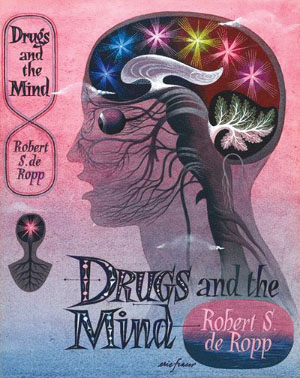
His book Drugs and the Mind not only addressed issues such as the nature of addiction and the use of drugs to treat mental illness. Already in 1957 de Ropp had written: “The greatest public health problem at the present time is mental illness.”4 The book had entire chapters devoted to peyote and marijuana. Of the many mind-altering substances de Ropp personally experimented with, it was not the more dramatic and powerful hallucinogens like LSD or peyote that impressed him, but cannabis when taken as an extract in a sizeable dose.
Among the love and peace generation, de Ropp became, if not quite a household name, then certainly the author of one of the significant books of the period. Drugs and the Mind kept company on hippy bookshelves with Huxley’s The Doors of Perception and works by Timothy Leary and Alan Watts. The disciplined and scientific Englishman, now in his fifties, found himself fêted by young Americans who were tuning in, turning on, and dropping out. De Ropp was one of a small number of older people who could see the potential of the new movement. Leary’s message was turn on, tune in and drop out. But could these explorers of inner space turn up (on time), tune up their bodies, and drop unnecessary attachments?
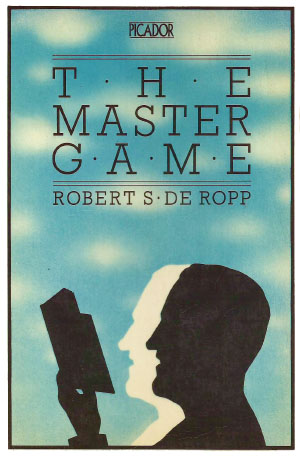
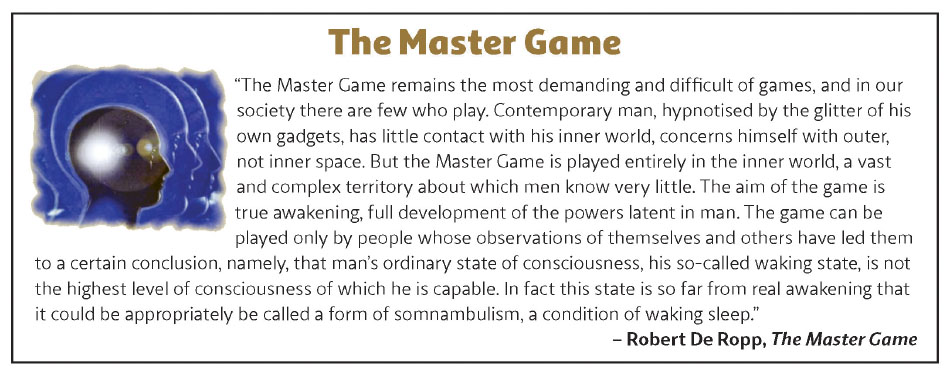
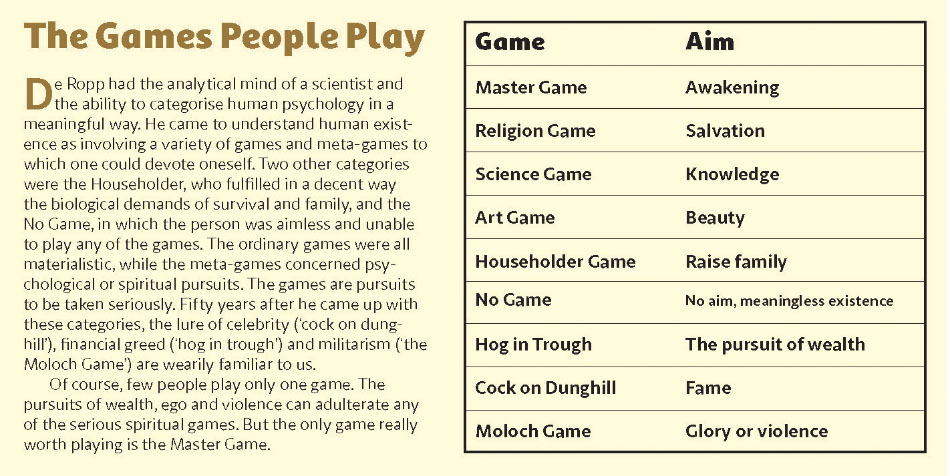
Unlike Leary or Watts, each of whom de Ropp felt had succumbed to the temptations inherent in being a guru, de Ropp managed to navigate the rapids of the psychedelic tide. Although he could see that young people were in desperate need of self-discipline and grounding, he also felt that the Fourth Way of the Gurdjieff-Ouspensky teachings was somewhat authoritarian in its approach, and neither entirely successful in its methods or transmission. This line of thinking led to his next major book, released in 1968, The Master Game: Beyond the Drug Experience, which sold in the hundreds of thousands.
Spiritual Explorers & Teachers
Throughout his life de Ropp encountered many spiritual explorers and teachers. By the time he moved to California in 1962 he had developed a knack of testing would-be teachers. It was not an infallible touchstone of soundness yet it worked well enough. He simply challenged them in his forthright manner. When he did this to Timothy Leary in 1962, after a long and inspiring talk from Leary on his plans to establish a utopian psychedelic community on the Pacific coast of Mexico, Leary simply turned off his hearing aid. It was a quirky response from Leary but didn’t bode well for the future of a co-operative enterprise. As is so often the case with spiritual teachers, the message was – my way or the highway. De Ropp saw Leary’s hallucinatory tropical utopia as impractical, and he was right – it was closed down by the police after just a few weeks.
Of the flower power generation, de Ropp admired Ken Kesey but felt he hadn’t followed through successfully. Only Steve Gaskin, founder of the Farm community, met with his approval.
De Ropp may be accounted a teacher himself. How did he fare? He describes his hesitancy and self-questioning, but many teachers feel thus inwardly. Rather than displaying these to the pupil, spiritual teachers often overcompensate for their internal doubts.
Despite his love for describing life as a game, de Ropp certainly had something of the puritan about him. He detested alcohol and tobacco. City life was not for him and only country living seemed authentic. But most of us live in cities and towns, and they aren’t without their advantages.
De Ropp could see that the situation of humanity in the West was changing rapidly and he was able to negotiate the rapids produced by the flood of change. He began his own experimental community, the Church of the Earth, in Sonoma County, California. It was never intended to be a large group. A good portion of the group, with de Ropp’s blessing, started going to J.G. Bennett’s more ambitious International Academy for Continuous Education at Sherborne, England. De Ropp had reservations about those who came back from the accelerated ‘evolution’ of Sherborne House, dubbed by one wag the ‘Bennetron’. “I had expected well-trained, obedient, ready-for-service disciples,” de Ropp wrote, “I received rebellious, starry-eyed, self-opinionated ‘adepts’.”
When they returned they were in no mood for serious teachers, or so de Ropp concluded, and the whole enterprise collapsed. The Church of the Earth was intended to have been built around the three pillars of garden, temple, and university, feeding the body, spirit and mind respectively. In a 1974 book of the same name, de Ropp describes their attempts at working together and setting up a rural community. The garden seems to have fared the best. The temple or dojo never seems to have got far beyond a wonky physical structure, and of the university there was little mention at all apart from a vague notion of seminars. Perhaps the project’s collapse was to de Ropp’s advantage after all. As a result he never was seduced by the guru trap.
De Ropp seems to have been most stimulated by his attempts to harvest the garden of the sea. He designed and built his own kayaks and became a skilled fisherman. He found the sea a demanding teacher, unforgiving of lapses of attention, requiring the fisherman to successfully adapt to the rhythms of nature. At the end of his penultimate book, Warrior’s Way, de Ropp contemplates existence from his tiny boat in the Pacific Ocean on the northern Californian coast. He has somehow made contact with a Taoist spirit teacher named Fong, who has given him the gift of balance between yin and yang, receptiveness and relaxation balancing the austere demands of the Gurdjieff work; he was a Taoist hermit going with the flow. De Ropp seeks no ultimate answers, feels no need for any metaphysical belief, has no desire or faith in a survival of the personal ego. “My spirit will dance there as the shadow of that rock, among seagulls and pelicans, sea lions and starfish. I would like to give my flesh back to the ocean to feed the fish whose bodies have so often fed me.”5
Forty years ago de Ropp’s concern for the state of humanity and the planet was part of the emerging green movement. His view of modern westerners as “a spoiled, careless, pampered, town-bred manswarm” might seem harsh but we are already several stages down the road, oblivious of the warning signs. We do not even notice them as we wander towards oblivion, our sight focused on smartphones as we stagger towards the cliff. (This is metaphor but it seems that every week someone walks into a lamppost or off a cliff because they’re absorbed by their smartphones. There should be a word for the phenomenon.)
In his final book, Self-Completion, in which he introduces himself as an elderly hermit, he included insights into Gnosticism and the latest developments in science. The Gurdjieff-Ouspensky work still provided the spine of his teaching but his pragmatic approach combined the work with aspects of Taoism, psychology, Sufism, Arthur Koestler’s holons, and his own bluff, no-nonsense assessment of western culture.
In 1987, at the age of 74, he died while kayaking in his beloved Pacific. Having pitted himself against the ocean for years, one suspects he knew that he could not win every time, and would have been content to have died in that manner, honourably, alone with nature, in the Warrior’s Way.
“…if a man can be properly said to love something, it must be clear that he feels affection for it as a whole, and does not love part of it to the exclusion of the rest.”
Sahar Delijani is an Iranian American writer in New York City.
The clock in Evin Prison stopped just before noon on June 23. That was the hour Israeli bombs tore through the compound, heavily damaging the health clinic, visitation center, administrative buildings and multiple wards — including the infamous Ward 209, where Evin’s many political prisoners were held. The attack took place amid 12 days of Israeli airstrikes, an unlawful war targeting Iran’s military and nuclear facilities. But Evin is no military site: It is known for holding the regime’s dissenters and critics.
Israeli authorities called the strike on Evin “symbolic”— an attack on a prison that represented “oppression for the Iranian people.” In a social media post, Israel’s foreign minister Gideon Saar suggested it was a strike aimed at liberation. That symbolism did not ring true for the many Iranians killed in the blasts: visiting family members, social workers, medical staffers, teenage conscripts tasked with escorting prisoners and inmates, among them transgender prisoners whose ward was reduced to rubble. Anguished families were left scrambling for news of their loved ones. Prisoners who were already at risk were pushed into deeper peril — relocated to distant prisons, cut off from support and left to endure even harsher conditions under the unrelenting grip of a regime that punishes survival itself.
If there’s anything symbolic in Israel’s bombing of Evin Prison, it is the false and dangerous narrative that wars help those fighting to bring democracy to Iran. Far from weakening the Islamic Republic’s apparatus of repression, Israel’s war has emboldened it, rolling back the fragile gains won through years of homegrown civil defiance. It has sabotaged decades of grass-roots organizing and collective labor by Iran’s civil society, tearing through the very scaffolding of democratic resistance and undermining the only force capable of changing Iran from within: the Iranian people.
I come from a long lineage of resistance to repression and tyranny. I was born in Evin Prison in 1983. My parents were secular leftist activists who fought to overthrow the Shah, and after the 1979 revolution continued their activism against the newly established Islamic Republic. In 1983, when my mother was pregnant with me, she and my father were arrested along with thousands of other political activists. After I was born, I stayed with her for a month before I was taken from her arms and given to my grandparents, who raised me while my parents remained behind bars. They were eventually released after serving yearslong sentences.
My parents’ arrest came during a wave of mass detentions and intimidation targeting the regime’s political opponents. By 1983, as the Iran-Iraq war raged on, the regime used the conflict to justify a sweeping crackdown, framing dissent as treason in times of national crisis. My mother and father’s imprisonment took place amid a ruthless campaign of repression that would culminate in 1988 in the bloodiest political purge in Iran’s post-revolutionary history.
Few things are more dangerous than a dictatorship in panic. The deeper the fear, the more ruthlessly it strikes back. That summer, weakened by eight years of war with Iraq and determined to consolidate power, the Iranian regime launched a campaign of executions against political prisoners it deemed unrepentant. Thousands were killed, their bodies dumped into unmarked mass graves. My uncle Mohsen was among them. The 1988 massacre remains seared into the collective memory of Iranians, an open wound in the nation’s conscience.
Today a similar cycle of violence is at risk of repeating. The once abstract threat of foreign invasion, long invoked to justify crackdowns, became real, giving the regime cover to escalate repression in the name of security. Now a familiar purge is underway in Iran. Dissidents, activists, journalists, writers, minority leaders, community organizers and protesters of the 2022-23 Woman, Life, Freedom uprising are facing a renewed crackdown by authorities. Many face execution, accused of “espionage” for Israel. Hundreds of thousands of Afghan residents were deported in days. Ordinary people live in fear of an ever-deepening oppression.
The Woman, Life, Freedom movement in particular — born out of outrage at the death in police custody of a young Kurdish woman, Jina Mahsa Amini, arrested for allegedly wearing her mandatory hijab improperly — was one of the largest pro-democracy revolts in Iran’s post-revolutionary history. The uprising struck at the very core of the regime’s patriarchal, authoritarian and theocratic foundations, initiating a profound shift in society. Now it is precisely these brave women and men who face persecution as the Islamic Republic moves to reclaim control.
The harrowing aftermath of the Evin Prison bombing mirrors what has unfolded across Iran since Israel’s attacks. According to testimonies from political prisoners inside Evin, Iranian security forces stormed the prison just hours after the airstrikes — not to offer aid or protection to prisoners fearing further strikes but to turn their guns on them, aiming at terrified inmates’ heads and chests as they forced them back into blown-out cells. The prisoners were then chained together, shackled at hand and foot and marched at gunpoint through the wreckage and, darkness, past corpses in body bags, before they finally reached buses bound for other prisons.
The injustice of these cruel acts is twofold for Iranians: It’s not just that the oppressive regime is carrying them out, it’s also that the bombs of “liberation” were dropped by Israel, a country that has committed unspeakable violence for the last 22 months in Gaza, killing and starving Palestinians.
Israel’s assault has shattered something deep within the Iranian people, sparking a realization that decades of fragile gains in the civil rights struggle could be set back in a few days, that outside forces could bomb their way into their lives and homes with no accountability. With chilling clarity, we witnessed how swiftly our generational fight for democracy could be cast aside as futile and insignificant, too slow for warmongering powers that trade in conquest, not change and justice. In this moment, we see how alone we truly are in our fight for a better life.
Two prominent political prisoners, Mehdi Mahmoudian and Abolfazl Ghadyani, captured the stark reality of the aftermath of the war in a letter they wrote from Evin Prison: “On one side, Iran was under attack by Netanyahu’s government, which has been accused of ‘war crimes’ by the International Criminal Court. On the other, the Islamic Republic — also accused of ‘crimes against humanity’ by U.N. legal experts for its suppression of the Woman, Life, Freedom movement — kept prisoners behind bars under wartime conditions.”
As the dust from the Israeli airstrikes settles and the ruins of Evin are laid bare, the picture is now clear: Iranians are still caught between a ruthless regime that extinguishes life under the hollow claim of protecting a revolution and foreign powers that drop missiles on innocent people under the treacherous guise of liberation.
Sahar Delijani is an Iranian American writer in New York City. She is the author of the novel “Children of the Jacaranda Tree” and several essays and short stories.
The Times is committed to publishing a diversity of letters to the editor. We’d like to hear what you think about this or any of our articles. Here are some tips. And here’s our email: letters@nytimes.com.
New Thinking Allowed with Jeffrey Mishlove Jul 25, 2025 Kevin Cann is a contributor to Jeffrey Kripal’s book, How to Think Impossibly. He is a high-functioning, autistic individual. He is the originator of a unique worldview he calls Platonic Surrealism. His website is https://platonicsurrealism.com/ Here is a link to his 140 page document on Platonic Surrealism: http://platonicsurrealism.com/wp-cont… NOTE: Kevin is scheduled to offer a program at the Esalen Institute in Big Sur, California, in conjunction with Jeffrey Kripal that will include the topic of this interview. For more information, see https://www.esalen.org/workshops/the-… Here he shares both his personal experiences and his philosophy regarding the conditions appropriate for summoning UFOs, and also understanding what they are. 00:00 Introduction 04:23 What is real and not real 11:38 Plasma in the human body 15:00 How life formed on Earth 18:26 How to summon a UFO 24:58 Government psionic assets 27:11 How Kevin Cann summoned an alien 30:59 The greatest illusion of all 38:06 Contending with UFO reality 39:23 Conclusion New Thinking Allowed host, Jeffrey Mishlove, PhD, is author of The Roots of Consciousness, Psi Development Systems, and The PK Man. Between 1986 and 2002 he hosted and co-produced the original Thinking Allowed public television series. He is the recipient of the only doctoral diploma in “parapsychology” ever awarded by an accredited university (University of California, Berkeley, 1980). He is also the Grand Prize winner of the 2021 Bigelow Institute essay competition regarding the best evidence for survival of human consciousness after permanent bodily death. He is Co-Director of Parapsychology Education at the California Institute for Human Science. (Recorded on March 7, 2025)
“Physics isn’t the most important thing. Love is.” ― Richard P. Feynman
“I’m smart enough to know that I’m dumb.” ― Richard P. Feynman
Richard Feynman’s Love Letter to His Wife, Sixteen Months After Her Death
Richard Feynman was an amazing character mastering physics, thinking, life, and as we shall soon see, love. Richard and Arline Greenbaum were soul mates. They were a perfect symbiotic pair, each completing the other. They shared the love we all seek.
None is more beautiful than the one Richard wrote to Arline sixteen months after her death.
October 17, 1946
D’Arline,
I adore you, sweetheart.
I know how much you like to hear that — but I don’t only write it because you like it — I write it because it makes me warm all over inside to write it to you.
It is such a terribly long time since I last wrote to you — almost two years but I know you’ll excuse me because you understand how I am, stubborn and realistic; and I thought there was no sense to writing.
But now I know my darling wife that it is right to do what I have delayed in doing, and that I have done so much in the past. I want to tell you I love you. I want to love you. I always will love you.
I find it hard to understand in my mind what it means to love you after you are dead — but I still want to comfort and take care of you — and I want you to love me and care for me. I want to have problems to discuss with you — I want to do little projects with you. I never thought until just now that we can do that. What should we do. We started to learn to make clothes together — or learn Chinese — or getting a movie projector. Can’t I do something now? No. I am alone without you and you were the “idea-woman” and general instigator of all our wild adventures.
When you were sick you worried because you could not give me something that you wanted to and thought I needed. You needn’t have worried. Just as I told you then there was no real need because I loved you in so many ways so much. And now it is clearly even more true — you can give me nothing now yet I love you so that you stand in my way of loving anyone else — but I want you to stand there. You, dead, are so much better than anyone else alive.
I know you will assure me that I am foolish and that you want me to have full happiness and don’t want to be in my way. I’ll bet you are surprised that I don’t even have a girlfriend (except you, sweetheart) after two years. But you can’t help it, darling, nor can I — I don’t understand it, for I have met many girls and very nice ones and I don’t want to remain alone — but in two or three meetings they all seem ashes. You only are left to me. You are real.
My darling wife, I do adore you.
I love my wife. My wife is dead.
Rich.
PS Please excuse my not mailing this — but I don’t know your new address.
)fs.blog)
Richard Phillips Feynman (May 11, 1918 – February 15, 1988 ) was a Nobel laureate, physicist, and legendary teacher. He made significant contributions to quantum physics, quantum electrodynamics, and superfluidity. During World War II, he was a leader in the Manhattan Project’s theoretical division, helping develop a formula to predict the atomic bomb’s energy yield. He also played a key role in uncovering the cause of the Challenger space disaster in 1986. (Wikipedia.org)
New Thinking Jul 25, 2025 This video is a special release from the original Thinking Allowed series that ran on public television from 1986 until 2002. It was recorded in about 1987. It will remain public for only one week. Philosopher Arthur M. Young was the inventor of the Bell Helicopter and founder of the Institute for the Study of Consciousness, Young’s books include The Reflexive Universe, the Geometry of Meaning, Which Way Out, and The Bell Notes. Additionally, there is a posthumously published astrological autobiography titled Nested Time. Here he addresses the popular notion that we live in an era of paradigm shift. Now you can watch all of the programs from the original Thinking Allowed Video Collection, hosted by Jeffrey Mishlove. Subscribe to the new Streaming Channel (https://thinkingallowed.vhx.tv/) and watch more than 350 programs now, with more, previously unreleased titles added weekly. Free month of the classic Thinking Allowed streaming channel for New Thinking Allowed subscribers only. Use code THINKFREELY.
Yes Thank You Universe is a chant of unlimited miracles. Whether you are looking for love, joy, health, wealth, peace, success, harmony or anything else, Yes Thank You Universe is happily going to give it to you. There is abolutely nothing that is out of its gamut. It is the key to anything anyone desires and imagines on this planet. It will help you fulfill all your dreams as well as overcome all your challenges in life. Inside, this book you will discover how. The biggest strength of Yes Thank You Universe is that it will show you scientifically that you are the Universe is human form and that all its energy resides in you. It will remind you that in the pure possibilities of life, you are born to be as infinite as the in fact, any less and you are undermining yourself. Read this book with a willing heart and an open mind, and your life will never be limited again.
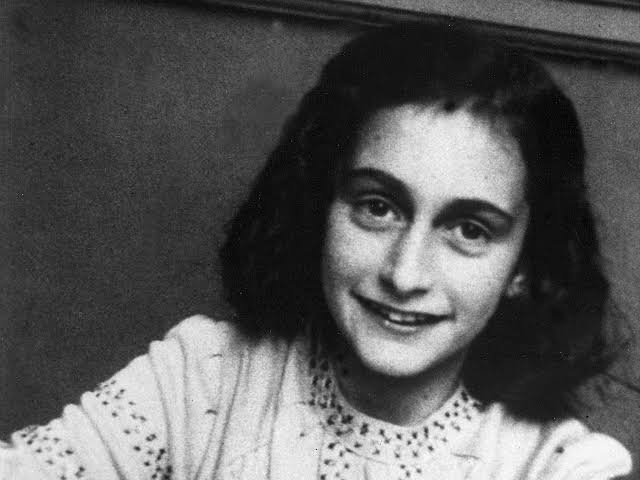
“Think of all the beauty still left around you and be happy.”
~ Anne Frank
Annelies Marie Frank (June 12, 1929 – February 1945) was a German-born Jewish girl and diarist. She gained worldwide fame posthumously for keeping a diary documenting her life in hiding during the German occupation of the Netherlands. Wikipedia
Consciousness, spirituality, biography, sexuality, androgyny, futurism, space, the arts, science, astrology, democracy, humor, books, movies and more