WASHINGTON—Lambasting the current program as wasteful, bloated, and entirely unnecessary, Defense Secretary Pete Hegseth called for steep cuts Monday to the number of steps in the Alcoholics Anonymous recovery model. “We must cut through the red tape bogging down what could be a far more efficient AA,” said Hegseth, who slammed the 12-step program as an undue burden on alcoholics, not only in the Defense Department, but across all levels of federal government. “We’re going to start by slashing the parts about admitting you have a problem and making amends to everyone you’ve supposedly ‘hurt.’ Ideally, we’ll cut it down to one step—praying or whatever it is. That’s a 92% savings in steps. Eventually, we hope to get rid of the program entirely.” Hegseth added that the time saved by the reduction in steps would also allow Americans to get to happy hour far more quickly.
John Eastburn “Jeb” Boswell was born on March 20, 1947, in Boston to a military family. He converted from the Episcopal Church of his upbringing to Roman Catholicism at age 16. Boswell graduated from William and Mary in 1969 and earned a Ph.D. in history from Harvard in 1975. He attended mass daily until his death, even though as an openly gay Christian he disagreed with church teachings on homosexuality. He also helped found Yale’s Lesbian and Gay Studies Center in the late 1980s.
Boswell entered academia at an important time for LGBTQ rights, during the AIDS crisis and the rise of the Christian right in politics. He joined the Yale faculty as assistant professor, was appointed a full professor in 1982 and served as chair of the history department from 1990-92.
Using some of his last strength as he battled AIDS, Boswell translated many rites of adelphopoiesis (Greek for making brothers) in his 1994 book Same-Sex Unions in Premodern Europe. The book presents evidence that throughout much of medieval Europe both the Catholic and Eastern Orthodox churches blessed same-sex unions in ceremonies that were similar to heterosexual weddings.
Again Boswell struck a nerve and sparked national controversy. His new book was even featured in the nationally syndicated Doonesbury comic strip, causing many newspapers to stop running the cartoon.
Doonesbury by Gary Trudeau, June 1994
Boswell’s sister Patricia confirmed to Q Spirit that he loved to tell the story of how an anonymous monk sent him a letter to tip him off about the same-sex union ceremonies. She added that it is also possible that he discovered some of the ceremonies by accident while doing research at the Vatican and other European archives.
Boswell can be seen in a 1986 video lecturing on “Jews, Gay People, and Bicycle Riders” at the University of Wisconsin-Madison for the series “Out & About: Celebrating Gay and Lesbian Culture.”
A 25th-anniversary collection analyzing Boswell’s work was published as “The Boswell Thesis: Essays on Christianity, Social Tolerance, and Homosexuality,” edited by Mathew Kuefler. Scholars take many different approaches, looking at Boswell’s career and influence, a Roman emperor’s love letters to another man; suspected sodomy among medieval monks; and genderbending visions of mystics and saints.
Boswell’s life and impact on LGBTQ acceptance are explored in the 2022 documentary film “Not a Tame Lion.” First-hand accounts from his closest friends, family, students and colleagues shed light on his life, including how he worked feverishly to finish “Same-Sex Unions in Medieval Europe” in the final days before his death from AIDS at age 47 in 1994. It is written and directed by Craig Bettendorf, an openly gay film maker and LGBTQ activist who ministered the Anglican tradition. Bettendorf is the author of the book “A Biblical Defense Guide for Gays, Lesbians and Those Who Love Them.” After winning awards at film festivals in 2022, “Not a Tame Lion” had a rolling release on other streaming platforms.
John Boswell painted his family in medieval style
Boswell was age 27 when he painted a medieval-style illumination as a 1974 Christmas present for his mother, Catharine Eastburn Boswell. It was generously provided to Q Spirit in 2020 by his sister, Patricia Boswell, who keeps it hanging in her bedroom. The previously unpublished artwork by John Boswell was released by Qspirit.net for his birthday on March 20, 2020.
“Serve the Lord with Gladness” by John Boswell, 1974 (Courtesy of Patricia Boswell)
The watercolor looks like a page from an illuminated manuscript of the Middle Ages. It depicts each member of his family, including a self-portrait of Boswell as a medieval scribe on the right. A line from his mother’s favorite psalm is inscribed in calligraphy: “Serve the Lord with gladness” (Psalm 100:20).
Boswell painted his parents in the corners on the bottom. His mother is shown reading to her children on the right, while his father, Army colonel Henry Boswell Jr., slays a dragon on the left. Patricia told Q Spirit about how well the image depicts her family:
“Jeb brilliantly captured the essence of each. Dad, the career military officer and man of honor. Mom, who never went to college but educated us as children with her intellect and reading. Henry, who wanted to be a vet but ended up a Navy pilot. Wray, the court jester, who always lightened a tense situation. My portrayal is slightly more mysterious, but fortunately, I can tell you what Jeb himself answered. That Christmas morning, Wray asked if I was some sort of cheerleader. Jeb responded, ‘Pat is searching for truth among the stars.’”
The woman under the angel remains a mystery. “My best guess is that she is Joan of Arc. Jeb had a passion for her when young,” Patricia said.
Visual art was one of many interests for the multi-talented John Boswell. “To my knowledge, which is pretty complete, Jeb did not have a strong interest in displaying art in his home. He tended to hang framed things people gave him. He loved the Prado, but his artistic interest was mostly musical. Jeb did enjoy painting himself when he was younger and painted some quite lovely illuminations…. He was fascinated by angels and often painted them, but I don’t think any survived other than in the illumination I have,” Patricia explained. She added that her brother was also a gifted poet and had begun but not finished many stories before he died.
Icon of John Boswell by Faithful Heretic
Boswell appears with tongues of flame above his head in an icon by the artist known as Faithful Heretic. Rich in symbolism, the image appears at the top of this post. Fire is associated with the Holy Spirit and the gift of “speaking in tongues,” a reference to Boswell’s extraordinary linguistic ability. He carries a book that says, “The crown of glory for me is with you.” The quote is an expression of same-sex love between paired male saints in “The Passion of Saints Sergius and Bacchus,” a fourth-century hagiography that Boswell translated into English for the first time. “The Venerable John Boswell” wears academic robes and carries a palm branch, a symbol of martyrdom in Christian art.
Faithful Heretic’s website includes a “hagiography” of Boswell, urging churches to commemorate him because he laid the foundation for LGBTQ-affirming ministry. “He must be respected in all of his twinky, flamboyant, brilliant, and life-giving glory. He declared that queer people could know God without shame or self-censorship, and that the Church could be made to repent and welcome us as it once did,” Faithful Heretic wrote.
A temporary home altar honors John Boswell with a rosary adorning his books, photo and a sticker of his icon by Faithful Heretic. The Faithful Heretic Icons Sticker Shop offers waterproof vinyl stickers of various LGBTQ historical figures and saints. Photo by Faithful Heretic.
Raised Mormon, Faithful Heretic is an Episcopalian lay minister and a lifelong student of history, especially medieval history and LGBTQ history.
John Boswell’s memory lives on
Boswell’s untimely death came at age 47 from AIDS-related illness on Christmas Eve 1994. He is buried beside his longtime partner Jerone Hart (1946-2010) at Grove Street Cemetery in New Haven, Connecticut.
Shared gravestone of John Boswell and his life partner Jerone Hart (photo by Kickstand)
They are pictured together in photos on Boswell’s Findagrave.com page with the caption, “partners in life, for life.” Their shared headstone is shaped to look like a book. Hart’s inscription reads, “To live in one’s memory is never to die.” Boswell’s epitaph says, “He was not a tame lion.” His sister Patricia told Q Spirit that the phrase is a reference to the character Aslan in “The Chronicles of Narnia” by C. S. Lewis, which was one of Boswell’s favorite books.
William and Mary, a university in Williamsburg, Virginia, named a large academic building after Boswell in 2021. The official campus map shows that the many amenities at John E. Boswell Hall include “two all-gender restrooms,” a feature promoted by LGBTQ activists. Jeff Trammell, former rector there and the first openly gay chair of the governing board of a major public university, is quoted in the official announcement: “It brings honor to our 328-year-old institution that we name an academic building for an alumnus who used his William & Mary education to improve the lives of millions of Americans. John Boswell’s scholarship inspired the recognition of same-sex relationships here and around the world. And, personally, it helped make it possible for William & Mary Chancellor Sandra Day O’Connor to marry my husband and me in the U.S. Supreme Court.”
Boswell remains an unofficial saint to the many LGBTQ Christians who find life-giving spiritual value in his historical research that affirms queer people in Christian history.
___ Top image credit: “The Venerable John Boswell” by Faithful Heretic ____ This post is part of the LGBTQ Saints series by Kittredge Cherry. Traditional and alternative saints, people in the Bible, LGBTQ martyrs, authors, theologians, religious leaders, artists, deities and other figures of special interest to lesbian, gay, bisexual and transgender and queer (LGBTQ) people and our allies are covered.
This article was originally published in March 2017, expanded with new material over time, and most recently updated on March 19, 2025.
Kittredge Cherry is a lesbian Christian author who writes regularly about LGBTQ spirituality.She holds degrees in religion, journalism and art history.She was ordained by Metropolitan Community Churches and served as its national ecumenical officer, advocating for LGBTQ rights at the National Council of Churches and World Council of Churches.
A rendering of what San Quentin State Prison could look like after a major $239 million renovation intended to turn the prison into a Scandinavian-style rehabilitation center. California Department of Corrections and Rehabilitation
California officials have envisioned a host of sweeping changes for San Quentin State Prison as they attempt to remake the facility into a Scandinavian-style rehabilitation center complete with a farmers market, a podcast production studio and a self-service grocery store.
The renovations are expected to cost California taxpayers $239 million, according to state officials. Construction was on track to finish in January 2026, officials said, with the first incarcerated people set to begin using the revamped facility within months of completion early next year.
The overhaul of what Gov. Gavin Newsom’s office has called California’s “most notorious prison” was set in motion shortly after Newsom was elected in 2018. He declared a moratorium on executions, began dismantling Death Row and ordered officials to begin the slow process of transferring San Quentin prisoners to other state facilities. In 2023, he announced plans to turn the entire prison into a Nordic-style center for preparing incarcerated people to reenter life outside prison.
The Newsom administration hired the Danish architecture firm Schmidt Hammer Lassen to help reimagine the maximum-security prison with influences from the Scandinavian incarceration system, where many prisoners live in detention centers designed to approximate life outside prison. Over the past several decades Nordic countries including Denmark, Finland, Iceland, Norway and Sweden have successfully reduced prison populations and recidivism by focusing jail time on preparing incarcerated people for their release back into society.
Architects envisioned a campus where prisoners will have access to so-called normalizing spaces like the self-service grocery store, a café and food trucks staffed by other incarcerated people.
An advisory council that included criminal justice experts and prison reform advocates made dozens of recommendations for the overhaul. Among the suggestions was the idea to “make good nutrition foundational to the San Quentin experience,” through gardening and access to a farmers market with external vendors.
Newsom declined to comment and referred questions to the California Department of Corrections and Rehabilitation.
Pioneered in Norway in the 1990s, the Nordic incarceration model rejected punishment in favor of rehabilitation through work and education. Under this model, San Quentin’s population will shrink by about a third from 3,400 to about 2,400 as prisoners are transferred elsewhere. Those who remain will receive their own rooms with no bunk beds.
“The holistic initiative leverages international, data-backed best practices to improve the well-being of those who live and work at state prisons,” Todd Javernick, a spokesperson for the California Department of Corrections and Rehabilitation, said in an email.
But some victims’ advocates and family members of people affected by crime sharply criticized Newsom’s plan, saying any funding spent to transform San Quentin would be better spent on helping victims heal. Criticism has also flowed in from family members of people incarcerated there, who said they fear their loved ones will be moved to facilities in other parts of the state that are far away from spouses and children.
The Newsom administration is hoping the renovated San Quentin will serve as a model for other correctional facilities in the state and country. They’ve dubbed the effort the California Model, with the aim of making prison life less punitive and more humane.
“The initiative’s goal is creating safer communities and a better life for all Californians, by breaking cycles of crime for the incarcerated population, while improving workplace conditions for institution staff,” Javernick said.
In preparation for the overhaul, San Quentin’s security level was reduced from maximum to medium, meaning it will host prisoners deemed to have fewer behavioral issues and who pose a lower escape risk. California prisons have four security levels.
According to the administration, emptying Death Row will also save taxpayers money. The average prisoner in San Quentin costs the state around $60,000 a year, and those on Death Row cost twice that in additional security costs.
Construction on the new facilities is underway and includes three new buildings that will house podcast and television production studios, classrooms for learning to code, a large multipurpose gathering space, a cafe and a store.
Nora Mishanec is a San Francisco Chronicle breaking news and enterprise reporter. She joined the paper in 2020 as a Hearst fellow and returned in 2022 after a stint at The Houston Chronicle.
The Daily Show • Mar 31, 2025 • Oren Cass, chief economist at American Compass, who writes the “Understanding America” newsletter, sits down with Jon Stewart to discuss conservative economic policies of the New Right, which will be outlined in his forthcoming book, “The New Conservatives.” Cass describes a conservative shift from faith in markets, using tariffs as incentives to pursue profit that supports society, how livable wages are the key to a strong economy, and the U.S.’s ideal economic and security alliance that includes balanced trade, owning defense burdens, and keeping China out. #DailyShow#Economics#Tariffs#China
Everyone, today’s card of the day comes from an exiting new deck that we’re trialling – the Cockataki deck! The bright bold designs and interesting structure are very appealing, although the instruction booklet was quite confusing. Anyway, today’s card is the Green Cow! Symbolic of all things Earthy and Nature, and also delicious dairy products (as long as you’re not vegan or lactose intolerant). Please let us know what you think!
John Allyn Smith, Jr. was eleven when, early one morning in the interlude between two world wars, not long after his parents had filed for divorce, he was awakened by a loud bang beneath his bedroom window. He looked to see his father dead by his own gun. Within months, his mother had remarried, changing her last name and that of her son, who became John Berryman (October 25, 1914–January 7, 1972). He would spend the rest of his life trying to comprehend the incomprehensible. Art being the best instrument we have invented for our suffering, he would become a poet. “I cannot read that wretched mind, so strong & so undone,” he would write about his father in a poem, not realizing he was writing about himself.
Berryman tried to medicate his deepening depression with alcohol and religion, but writing remained his most effective salve. He wrote like the rest of us draw breath — lungfuls of language and feeling to keep himself alive: ten poetry collections, numerous essays, thousands of letters, and a long biography of his favorite writer.
John Berryman
Early one morning in the pit of his fifty-eighth winter — having won a Pulitzer Prize, a National Book Award, and a $10,000 grant from the newly founded National Endowment for the Arts, having dined with the President at the White House, having nurtured the dreams of a generation of poets as a teacher and mentor and unabashed lavisher with praise, and having finally quit drinking — John Berryman jumped from the Washington Avenue Bridge in Minneapolis to his death, slain by the meaning confluence of biochemistry and trauma that can leave even the strongest of minds “so undone.”
Several months earlier, Berryman had written a long letter to his former teacher Mark Van Doren, who had emboldened him to make a life in poetry and who would lovingly remember him as “an overflowing man, a man who was never self-contained, a man who would have been multitudes had there been time and world enough for such a miracle.” Despite reporting a routine of astonishing vitality — studying theology before breakfast, keeping up “a fancy exercise-programme” in the afternoon, reading a canon of medical lectures as research for a novel he was writing, responding to a dozen letters a day, and “and supporting with vivacity & plus-strokes & money various people, various causes” — Berryman placed at the center of the letter a self-flagellating lament about his “lifelong failure to finish anything,” which he attributed to his twenty four years of alcoholism. (This may be the grimmest symptom of depression — a punitive hyperfocus on one’s perceived deficiencies, to the total erasure of one’s talents and triumphs.)
Art by Staffan Gnosspelius from Bear — a wordless picture-book for grownups about life with and liberation from depression.
1. some bone-laziness but mostly DOLDRUMS, proto-despair, great-poets-die-young or at least unfulfilled like Coleridge & Co., all that crap.
2. the opposite, fantastic hysterical labor, accumulation, proliferation…
3. over-ambitiousness. Part of this is temperamental grandiosity but more of it — unless of course I am wrong — is legitimate self-demand on the largest conceivable scale.
Elizabeth Barrett Browning, who went on to become one of the most celebrated and influential poets of the nineteenth century not because of but despite the uncommon share of suffering she was dealt, had an antidote to the first.
As we often give others the advice we most need ourselves, Berryman himself offered an antidote to the third — which he considered his “greatest problem” — in his answer to a student’s question. That student would go on to become a great poet himself, immortalizing his mentor’s advice in a poem that remains the finest blueprint I know to staying sane as an artist:
BERRYMAN by W.S. Merwin
I will tell you what he told me in the years just after the war as we then called the second world war
don’t lose your arrogance yet he said you can do that when you’re older lose it too soon and you may merely replace it with vanity
just one time he suggested changing the usual order of the same words in a line of verse why point out a thing twice
he suggested I pray to the Muse get down on my knees and pray right there in the corner and he said he meant it literally
it was in the days before the beard and the drink but he was deep in tides of his own through which he sailed chin sideways and head tilted like a tacking sloop
he was far older than the dates allowed for much older than I was he was in his thirties he snapped down his nose with an accent I think he had affected in England
as for publishing he advised me to paper my wall with rejection slips his lips and the bones of his long fingers trembled with the vehemence of his views about poetry
he said the great presence that permitted everything and transmuted it in poetry was passion passion was genius and he praised movement and invention
I had hardly begun to read I asked how can you ever be sure that what you write is really any good at all and he said you can’t
you can’t you can never be sure you die without knowing whether anything you wrote was any good if you have to be sure don’t write
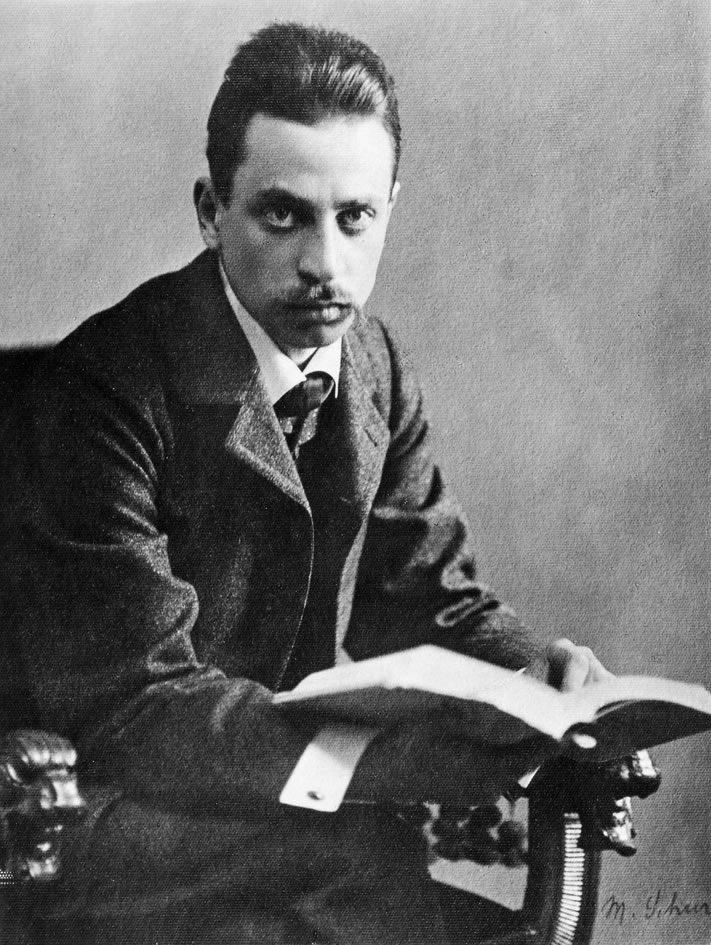
“Let everything happen to you,” wrote Rilke, “Beauty and terror.”
It is not easy, this simple surrender. The courage and vulnerability it takes make it nothing less than an act of heroism. Most of our cowardices and cruelties, most of the suffering we endure and inflict, stem from what we are unwilling to feel, and there is nothing we cower from and rage against more than our own incoherence — that intolerable tension between the poles of our capacities, which Maya Angelou so poignantly addressed in one of the greatest poems ever written, urging us to “learn that we are neither devils nor divines.”
We have been great inventors but poor students of ourselves: The religions we invented, helpful though they have been to our moral development, split us further into angels and demons destined for heaven or hell; the psychotherapy we invented, helpful though it has been to allaying our inner turmoil, secularized original sin in its pathology model of the psyche, treating us as problems to be solved rather than parts to be harmonized. Both have sold us the alluring illusion that a state of permanent happiness can be attained — in Eden, or across the finish line of our self-improvement project — ultimately denying our fulness of being, denying the oscillation of “beauty and terror” that makes life alive.
When a man he encounters wonders why “nobody can stay in the garden of Eden,” the narrator is stopped up short. With an eye to the banality of the question as a fractal of the banality of life — like the banality of evil, like the banality of survival — Baldwin writes:
The question is banal but one of the real troubles with living is that living is so banal. Everyone, after all, goes the same dark road — and the road has a trick of being most dark, most treacherous, when it seems most bright — and it’s true that nobody stays in the garden of Eden.
Considering the difficulty of reconciling our own darkness with our light, our innocence with our pain, he adds:
Perhaps everybody has a garden of Eden, I don’t know; but they have scarcely seen their garden before they see the flaming sword. Then, perhaps, life only offers the choice of remembering the garden or forgetting it. Either, or: it takes strength to remember, it takes another kind of strength to forget, it takes a hero to do both. People who remember court madness through pain, the pain of the perpetually recurring death of their innocence; people who forget court another kind of madness, the madness of the denial of pain and the hatred of innocence; and the world is mostly divided between madmen who remember and madmen who forget. Heroes are rare.
“The only important elements in any society are the artistic and the criminal, because they alone, by questioning the society’s values, can force it to change.”
–SAMUEL R. DELANY
Samuel R. “Chip” Delany (born 1942) is an American writer and literary critic. His work includes fiction, memoir, criticism, and essays on science fiction, literature, sexuality, and society. Wikipedia
A celebration of 2025 as the International Year of Quantum Mechanics and Science would be remiss without a look at how the carrier of electricity finally yielded its secrets — paving the way to the quantum era
Support sound science and smart stories Help us make scientific knowledge accessible to all Donate today
It’s pretty hard to imagine a world without electrons. With no electrons, there would be no TV, no radio, no internet. No smartphones, no computers, no electricity. Not to mention no chemicals, no food, no life. No atoms.
Of course, electrons have in fact always been around, in abundance. They have permeated the universe since the earliest instants after the Big Bang. But despite their ubiquity, no human knew very much about them until nearly the 20th century. Before then, only the foggiest clues existed about what caused the curiosities of static electricity and electric currents.
Pursuing those clues proceeded slowly for centuries. But once the quarry was captured, and its identity established, the electron enabled the magic of modern technology and fathered new fields of science. It was the electron that led scientists into the wild and weird world of quantum mechanics, which is marking its centennial this year. Knowledge of the electron’s behavior and its quantum powers transformed civilization in ways that defied anything the ancients could have imagined.
Ancient Greek philosophers did have an inkling that something mysterious was afoot in matter’s interactions. It was well known that amber rubbed with silk or fur acquired the ability to attract small, light objects — an example of what now is known as static electricity. Thales of Miletus, active around 600 B.C.E., even speculated that amber’s power and the attraction of iron to the mineral magnetite had something in common.
In ancient times, humans discovered that amber rubbed with a cloth would gain the power to attract small, lightweight objects like the bits of paper shown here, but the reason for this power — static electricity — remained mysterious for millennia.CREDIT: NTV / SHUTTERSTOCK
Progress during antiquity and through the Middle Ages was limited. But around the end of the 16th century in England, Queen Elizabeth’s physician, William Gilbert, noted that many substances, including glass rods, acquired attractive powers similar to amber’s when rubbed with silk. Gilbert referred to such rods as “electric bodies” or “electrics” from elektron, the Greek word for amber.
A deeper pursuit of electricity’s mysteries came in the mid-18th century from Benjamin Franklin. Famous for proving that lightning is a form of electricity, Franklin also adduced the basic concepts and provided much of the terminology for future electrical science research.
“He introduced into the language of scientific discourse relating to electricity such technical words as plus and minus, positive and negative, charge, and battery,” wrote the science historian I.B. Cohen.
Franklin believed in a single electrical fluid — or “electrical fire” — that existed independently of other material substances. Glass rubbed with human hands, for example, did not create electrical fire; rather, bits of preexisting electrical fire were transferred from the hands to the glass during the rubbing. The glass, in other words, acquired what Franklin called a positive electric charge; silk’s deficit of electrical fire left it with a negative charge.
The electrical fire acquired by glass turned out to be nothing other than electrons. (Alas, later terminological conventions required assigning electrons a negative charge. But that wasn’t Franklin’s fault.)
Franklin surmised that his electrical fire, or fluid, “consists of particles extremely subtile” that “can permeate common matter” with ease. If anyone doubted electrical fire’s ability to pass through bodies, Franklin remarked that “a shock from an electrified large glass jar … will probably convince him.”
In the 18th century, Benjamin Franklin performed a suite of electrical experiments leading to his deduction that some sort of “electrical fluid” could be transferred from one object to another. That fluid turned out to be composed of what scientists now know to be electrons.CREDIT: SCIENCE HISTORY IMAGES / ALAMY STOCK PHOTO
Electrical research flourished in the 19th century, leading to the eventual understanding of a mutual relationship between electricity and magnetism, manifested in the electromagnetic waves that would later make radio, TV and Wi-Fi possible. But the nature of Franklin’s electrical fire remained obscure.
A key development came with the discovery that a glass tube containing a low-pressure gas could conduct an electric current. When wires from a battery were connected to electrodes sealed inside each end of the tube, a green glow appeared to emanate from the negative electrode. Since the negative electrode was called the cathode, the green glow became known as cathode rays.
Experiments by the British physicist William Crookes showed that cathode rays traveled in a straight line, suggesting they were a form of light. But Crookes then showed that a magnet bent the rays’ path, ruling light out. A debate then swirled among Europe’s leading physicists over whether the rays consisted of waves or tiny particles.
As the end of the 19th century neared, the cathode ray debate merged with two other electrical issues: whether a fundamental unit of electric charge existed, and if so, was there a particle that carried that charge — a fundamental particle smaller than an atom.
At the forefront of investigating those questions was the British physicist J.J. Thomson. Thomson was trained as a mathematician but took up physics at the famous Cavendish Laboratory in Cambridge, working under the esteemed Lord Rayleigh. In 1884 Thomson succeeded Rayleigh as head professor at the Cavendish.
In 1897 Thomson showed that the electric charge in the cathode rays was associated with a definite mass, establishing the electron as a particle. The ratio of this mass to the electric charge indicated that the unit of charge — the atom of electricity — was carried by a mass less than a thousandth the mass of the hydrogen atom.
“The assumption of a state of matter more finely subdivided than the atom of an element is a somewhat startling one,” Thomson admitted in announcing his findings in a lecture at the Royal Institution. Yet that was exactly what his experiment had demonstrated.
What’s more, Thomson showed that this particle was the same mass no matter what gas was used in the tube and no matter what element the cathode was made of.
“After that no reasonable person could really refuse belief that there were particles smaller than atoms, or lighter than atoms at least, and that these particles played a fundamental part in the constitution of matter,” wrote J.J.’s son, George.
In 1897, J.J. Thomson subjected cathode rays (produced in a cathode ray tube) to electric and magnetic fields. By analyzing the response to those fields, Thomson showed that whatever carried the charge had a specific mass, no matter the element used in the tube. He deduced that cathode rays consisted of small electrically charged particles that he called corpuscles, now known as electrons.
Hence Thomson (the father) earned credit for the discovery of the electron, the first subatomic particle to be identified. He called his discovery “corpuscles.”
But oddly enough, the particle had previously been christened the electron in 1891, years before its discovery, by the Irish physicist George Johnstone Stoney. Stoney coined the term (from the Greek word for amber, remember) to refer to the fundamental unit of electricity, even though nobody yet knew what it was. Soon after Thomson identified the particle, electron became the popular term.
Inside the atom
Coming shortly after the discovery of X-rays and radioactivity, the electron’s arrival further accelerated the frenzied efforts to figure out what was going on inside atoms.
A particular problem was how atoms, known to be electrically neutral in ordinary circumstances, could contain charged particles. To offset the electron’s negative charge, positive electric charge of some sort must also reside within the atom. But nobody knew the proper architecture that permitted such cohabitation.
Thomson proposed that the negatively charged electrons embedded themselves in a pudding of positive charge, electrons playing the role of plums. No evidence for such an arrangement existed, though, and the whole idea was shattered in 1911, when Ernest Rutherford announced the discovery of the atomic nucleus. Each atom contained a tiny core, like a positively charged stage of a theater in the round, with the negatively charged electrons relegated to the cheap seats.
Rutherford’s discovery of the nucleus was a surprise that seemed impossible. Even Ben Franklin would have been befuddled. Everything physicists had discovered about electric charge required the negatively charged electron to spiral into a positively charged nucleus in a fraction of a second, releasing electromagnetic energy in the process.
But soon the Danish physicist Niels Bohr rescued the electron from its death spiral, invoking the novel rules of quantum physics.
Bohr’s atom pictured electrons circling the nucleus in certain allowed orbits, preventing them from releasing energy by traveling into the nucleus. (Energy was released or absorbed only when an electron jumped from one allowed orbit to another.)
The Danish physicist Niels Bohr attempted to explain the electron’s role in atomic structure as a set of orbiting trajectories around a central nucleus, as with the element radium shown here in this vintage drawing. After the introduction of quantum mechanics a century ago, precise orbits were replaced by electron energy levels without specific trajectories.CREDIT: H. HOLST ET AL / THE ATOM AND THE BOHR THEORY OF ITS STRUCTURE 1923
Bohr’s idea (as he well knew) was preliminary. His math didn’t work for atoms more complicated than hydrogen. But a more complex approach, initiated by the German physicist Werner Heisenberg in 1925, established quantum mechanics as the rule book for electron behavior. Soon thereafter chemists began to apply quantum math to explain how electrons mediated the bonding between atoms to make chemical compounds.
But the electron was not done with surprises. Even before Heisenberg constructed his picture of the atom with electrons as particles, French physicist Louis de Broglie suggested that electrons might actually travel through space as waves. Soon after Heisenberg’s work appeared, Austrian physicist Erwin Schrödinger devised an electron wave model of the atom. Schrödinger’s wave math gave precisely the same results as Heisenberg’s particle picture.
Experimental verification of the wave picture soon came from Clinton Davisson and colleagues at Bell Labs and independently from George Thomson at the University of Aberdeen in Scotland. Both showed that electron beams sent through a crystal deviated from their path to form a diffraction pattern, something only waves could produce.
Davisson and Thomson were awarded the Nobel Prize in physics in 1937. It was one of the great ironies in physics history: J.J. Thomson won the 1906 Nobel for proving electrons are particles; his son George won the 1937 Nobel for proving electrons are waves.
A way out of the conundrum was proposed in 1927 by Bohr. He argued that both the wave and particle pictures were correct, but they applied only to mutually exclusive experimental arrangements. You could devise an experiment showing the electron to be a wave, or you could design one showing it to be a particle, but you could not construct an experiment that would reveal both wave and particle at the same time.
Bohr’s solution, called complementarity, solved the problem for the moment, but it birthed a century’s worth of debate about how the math of quantum mechanics should be interpreted.
Stay in the Know Sign up for the Knowable Magazine newsletter today
Despite continuing interpretational controversy, quantum physics eventually matured into a driver of exotic technology relying on the electron. As electronic circuitry miniaturized, from its origins in bulky vacuum tubes to tidy transistors and tiny integrated circuits, society witnessed a flood of technological revolutions, along with a deeper understanding of the natural world.
Electron behavior permeates all realms of nature, from the chemical properties of individual atoms to the complexities of biological molecules. Understanding the electron enabled the era of designer materials, consumer electronics and prodigious computational power. From email to electron microscopes, solar-electric cells to lasers, electrons have been the key ingredient in making the modern world modern.
As Benjamin Franklin foresaw, his “electrical fluid” would someday offer humankind ample reward for pursuing its properties. “The beneficial uses of this Electrical Fluid we are not yet well acquainted with,” he wrote, “tho’ doubtless such there are and great ones.”
Tom Siegfried is a science journalist in Avon, Ohio. His book The Number of the Heavens, about the history of the multiverse, was published in 2019 by Harvard University Press.
Consciousness, sexuality, androgyny, futurism, space, the arts, science, astrology, democracy, humor, books, movies and more