Why aren’t great Black thinkers called philosophers?

American writer James Baldwin in Paris, circa 1970. Baldwin has been called a novelist, an essayist, a social critic but, until now says author Justin Ray, never a philosopher. Sophie Bassouls/Getty Images

OPINION//OPEN FORUM

Philosophy has a race problem. Less than 2% of members of the American Philosophical Association are Black. This exclusion is harming us all.

By Justin Ray

June 19, 2025 (SFChronicle.com)

James Baldwin dissected the human condition with surgical precision. His essays on race, identity and American democracy didn’t just document injustice — he philosophically dismantled it, revealing profound truths about freedom and what it means to be human. “I would like us,” he once wrote, “to do something unprecedented: to create ourselves without finding it necessary to create an enemy.” That is not just social critique — it is metaphysics. It is ethics. It is philosophy.

Yet we call Baldwin a novelist, an essayist, a social critic. Anything but what he clearly was: a philosopher.

This isn’t a coincidence. It’s intellectual gatekeeping, and it robs all of us of a fuller understanding of wisdom itself.

There’s even a data point: The American Philosophical Association — the primary society for philosophers in America — has 6,985 members, according to its 2024 data. Of them, 116 are Black — a little less than 2%. If we find it alarming that Black people represent less than 6% of doctors and lawyers, why isn’t their near-total absence from philosophy — the field that shapes our understanding of justice, truth and human meaning — treated as equally troubling?

Philosophy has long positioned itself as the domain of pure reason, supposedly above the fray of politics and identity. But scratch the surface, and the bias becomes clear: The very definition of who counts as a philosopher has always been political.

Walk into almost any introductory philosophy classroom in the United States, and you’ll encounter a carefully curated lineage — from ancient Greece to medieval Europe, to Enlightenment Germany and France, and finally to a narrow slice of American white men. That’s not intellectual history. It’s intellectual mythology, one that treats whiteness and maleness as the natural vessels for deep thought.

This is not due to a lack of philosophical insight from Black thinkers. Long before Baldwin or bell hooks, philosophical traditions flourished across the African continent — from the concept of Ubuntu, which emphasizes the interdependence of humanity, to Ethiopian rationalism. Imagine if students learned Ubuntu alongside Descartes’ “I think, therefore I am.” What kind of society might that produce?

Even in the 20th century, the exclusion persisted. Audre Lorde, who wrote extensively about anger as a vehicle for truth, warned: “We cannot allow our fear of anger to deflect us nor seduce us into settling for anything less than the hard work of excavating honesty.” But Lorde is most often referred to as a poet. bell hooks wrote powerfully about connection and ontology, saying, “When we drop fear, we can draw nearer to people, we can draw nearer to the earth, we can draw nearer to all the heavenly creatures that surround us.” Yet she’s typically described as a feminist theorist or cultural critic. Angela Davis is often introduced as an activist — rarely as a philosopher.

This isn’t just mislabeling. It’s intellectual apartheid.

As George Yancy, the Samuel Candler Dobbs Professor of Philosophy at Emory University, told me, “For the most part, there still exists the racist assumption that Black people are not philosophers — and cannot be philosophers. There is still the idea that being Black and a philosopher is an oxymoron.”

This isn’t just academic hair-splitting. The people we label as philosophers are given the efficacy to shape ethical frameworks in society. America’s founding fathers were heavily influenced by Enlightenment philosophy. Socrates helped shape modern medical education. Immanuel Kant’s thoughts helped construct the idea of the United Nations. 

So what might have changed if thinkers like Baldwin had been recognized as philosophers, not just commentators? If philosophy departments taught Baldwin’s meditations on identity and freedom alongside Locke and Rousseau, how might American civic life — or our national conception of liberty — look different today?

When we deny Black thinkers the title of philosopher, we don’t just rob them of recognition — we impoverish ourselves.

Philosophy is supposed to grapple with the biggest questions about human existence. Black thinkers have been wrestling with these questions for centuries, often with more urgency, clarity and moral courage than their white counterparts.

They’ve had to. When your humanity is constantly questioned, you develop profound insights into what humanity actually means. When your freedom is perpetually threatened, you understand liberty in ways that others never could.

James Baldwin was a philosopher. bell hooks was a philosopher. Angela Davis is a philosopher. So are the dozens of Black scholars quietly reshaping the field today, asking the hard questions about justice, identity and human flourishing that our moment desperately needs. One example is Amanda Gorman, who suggested in the poem she recited during Joe Biden’s 2021 inauguration that democracy isn’t something to protect, but rather something we must finally accomplish. 

“We will rebuild, reconcile and recover / and every known nook of our nation / and every corner called our country, / our people diverse and beautiful will emerge, / battered and beautiful,” Gorman said

The philosopher isn’t just in the canon. She’s here. She’s speaking. The question is whether we’ll recognize her before it’s too late.

As Lorde wisely observed: “Everything can be used / except what is wasteful.” Let’s stop wasting the brilliance we’ve already been given.

Justin Ray is a Los Angeles-based journalist who has written for the Los Angeles Times and the Guardian. He works for the independent, environmental news outlet Grist.

June 19, 2025

Justin Ray
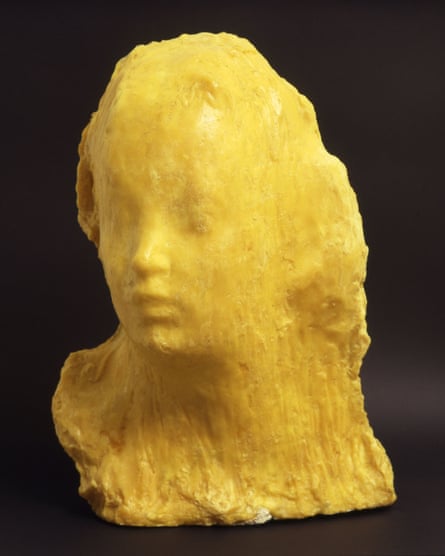
Rodin’s rowdy rival: Medardo Rosso, the anarchist who brought sculpture into the modern era

A new retrospective shines a light on the turn-of-the-century Italian artist, one of the art world’s most obscure yet revered figures, whose legacy was eclipsed by his contemporaries

Christian House Thu 19 Jun 2025 (TheGuardian.com)

If you ask art dealers and auctioneers about the legacy of the turn-of-the-century sculptor Medardo Rosso, you are likely to be met with a uniform reply: “Medardo who?” There’s no judgment here. I’ve worked in and around the art world for 20 years, and until recently I hadn’t heard of Rosso either.

In artists’ ateliers, however, Rosso has long been a familiar and revered name. Auguste Rodin, the father of modern sculpture, was his champion and friend until the pair’s fallout. Émile Zola was a fan. The playwright Edward Albee owned a version of his sculpture Enfant Juif; French poet Guillaume Apollinaire described him as “without a doubt the greatest living sculptor”.

Rosso, a new retrospective at Kunstmuseum Basel, contends, brought sculpture into the modern era with busts and figures that seemed to materialise organically out of his materials – wax, plaster, bronze – like spectres in motion. The Swiss art institution has had no trouble finding 60 contemporary artists who feel a kinship with his sculptures, photographs and drawings, his fleeting impressions of street scenes, cafes and clouds – from Louise Bourgeois’s textile sculptures that look like entrails to Francesca Woodman’s wraithlike photographs.

“If you sit 10 gallerists and collectors around a table, nine out of the 10 will not know who Medardo Rosso is,” says Elena Filipovic, the director of Kunstmuseum Basel, which is holding a retrospective on this shadowy figure. “If you sit 10 artists around the table, nine out of the 10 will fall to the floor with excitement.”

A sculpture of a human head that looks as if it’s melting, in a browny-yellow colour.
Sickly yellow lumps: Rosso’s Ecce Puer, made of wax on plaster. Photograph: Courtesy Galleria Russo, Rome

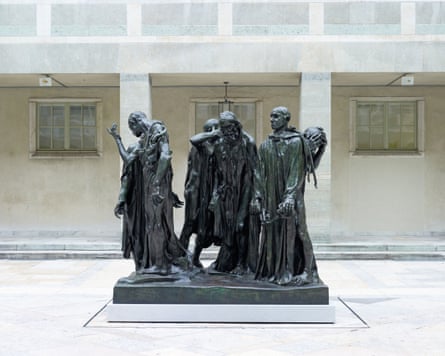
There are good reasons why Rosso has fallen into relative obscurity. Some, albeit unintentionally, are Rosso’s fault. For instance, his practice was neurotically self-contained. While Rodin followed the template for becoming famous, Rosso followed his own instincts. Rodin knew to create monumental works – “size matters,” says Filipovic – and that professional marketing was key. Rosso created small-scale works, works seen in the studio, home and exhibitions but not out on the boulevards, and he liked to promote them himself.

Rodin created monumental works and knew professional marketing was key – Rosso worked small scale and promoted himself

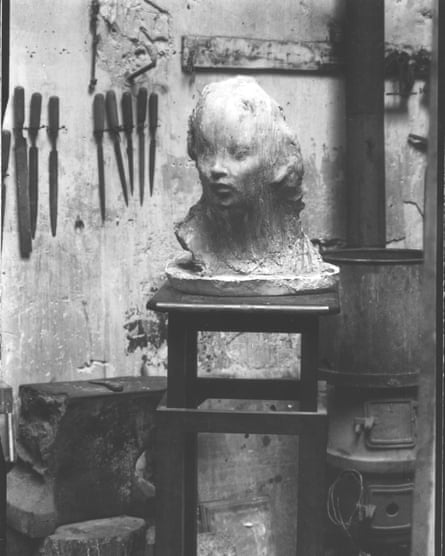
He worked, repeatedly, on a relatively small number of motifs. One of his most famous works, Ecce Puer (1906), is of a boy’s head shrouded in a sheet; he’s there but not there. Another, Enfant Malade (1893-95), features the inclined head of a sick child, tipping possibly towards death.

We often use the term “in the flesh” when standing in front of a sculpture, but with Rosso the phrase has a particular resonance: his faces, just that little bit smaller than in real life, with dimensions that add to a sense of unease, look as if they might blink their waxy eyelids. His sickly yellow lumps are not pretty. They’re not Degas’s dancers.

Perhaps the most disturbing of all though is Aetas Aurea (1886), a study of his wife, Giuditta, and their son, Francesco, in which the pair look conjoined at their cheeks. They melt into the background. It’s a horror movie prop rather than a loving family portrait. Other figures are drunk, leaning, screaming. His wax sculptures are the colour of nicotine stains.

A large sculpture of multiple people set on a plinth standing in a courtyard
Size matters: Auguste Rodin’s Les Bourgeois de Calais, 1884-1889. Photograph: Martin P Bühler/Kunstmuseum Basel

Born in Turin in 1858, the second son of a railway worker, Rosso opened his first atelier in Milan in 1882 and circulated with members of the artistic group Scapigliatura – translated as “dishevelment” – a Bohemian set of a socialists and anarchists. Living up to the name, Rosso’s studies in the city’s esteemed Accademia di Belle Arti di Brera were cut short when he was expelled for assaulting another student. Three years later, however, he had a wife and son, and was successfully forging a career in Paris, wooing patrons and winning commissions.

Rosso was definitely a “very idiosyncratic personality, very persuasive, powerful, winning, someone with a big heart, especially for children, but also suspicious, controlling, obsessively pursuing his cause,” says Heike Eipeldauer, a curator and Rosso expert at the Mumok museum in Vienna, Austria. There were a lot of disagreements: his wife left him and one of his closest friends cut him off after an argument about debts. And then there was Rodin, who he got into a public spat with over who had influenced whom. “They were friends, until they weren’t,” says Filipovic.

A black-and-white photo of a sculpture of a human head resting on a stool in a workshop
Spirit photography: Ecce Puer, pictured inside Rosso’s studio on Boulevard des Batignolles, Paris. Photograph: Mumok/Markus Wörgötter

His intractable nature could work against him. He cast his own works – eating into his time and reducing the number of works created – while Rodin used foundries. And Rodin hired Edward Steichen and other well-known photographers to capture his works and produce portraits of him as the great master in the studio (often with a hammer and chisel, even though he never carved marble himself). Rosso’s sculptures were only ever photographed by the artist himself.

“He wanted to control the image,” says Filipovic. “He understood that photography and how you saw the work was also the work.” The exhibition features about 200 of Rosso’s photographs: frail prints of sculptures, some as small as stamps, otherworldly portraits rather than iconic marketing shots. He lit and staged them, with an ethereal aesthetic that echoed the Victorian craze for spirit photography.

While Rosso’s photographic studies reanimate objects, his studio-set self-portraits conjure up a phantom, his scruffy features bleached by the sun through his studio’s skylight, his figure blurred in movement: studies as faint and mercurial as his artistic footprint.

Having spent his last two decades constantly reworking a few subjects, the artist died in 1928, aged 69. He had dropped glass negatives on his foot, resulting first in the amputation of several toes, then part of his leg and finally a fatal case of blood poisoning. A gradual erosion.

Today, Rosso’s complicated nature hampers research, explains his great-granddaughter, Danila Marsure Rosso, who manages the artist’s estate. “He destroyed all the letters he received because he said that nobody should enter in his private life,” she says.

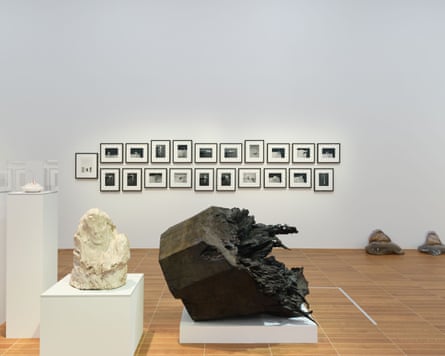
Sculptures and photos displayed in Kunstmuseum Basel.
An artist’s artist: Rosso’s Portinaia next to modern works by Isa Genzken and Yayoi Kusama at Kunstmuseum Basel. Photograph: Max Ehrengruber

There are no biographies of Rosso. There are dozens of Rodin. Rosso’s auction record stands at £341,000 (for a version of Enfant Juif, sold in London in 2015); Rodin’s record was set in 2016, when the master’s marble Eternal Springtime sold in New York for $20m (£14m). Legacies can pay dividends.

But Rosso’s quirks had their own creative rewards. He invited groups into his studio to watch him sculpt and cast his works, as if he were a performer. “It was about understanding that there is magic in this making,” says Filipovic. “Rodin couldn’t do that because he used a foundry.”

Another idiosyncrasy was Rosso’s fondness for installing sculptures in collectors’ homes in strange, jarring configurations. Context was everything, but not always logical. I can imagine him sitting uncomfortably close to guests at dinner parties just to observe their reaction. Was he a control freak? “Certainly,” says Filipovic. “But don’t you want that in an artist?”

(Contributed by Gwyllm Llwydd)

How to speak up — even when you don’t want to

Sarah Crawford-Bohl | TEDxRRU

• May 2024

What stops you from speaking up when it matters most? Healthcare leader Sarah Crawford-Bohl offers a practical, compassionate framework to have difficult conversations with clarity and heart — and shows how it can lead to stronger teams and real impact.

Want to use TED Talks in your organization?

Start here

About the speaker

Sarah Crawford-Bohl

Healthcare leader and innovation catalystSee speaker profile

The Twin Root of Our Confusion and Our Power in Times of Turmoil: Muriel Rukeyser on the Wellspring of Aliveness

By Maria Popova (themarginalian.org)

It is such delicate work, such devoted work, the work of contouring the personhoods of persons who have imprinted the world with nothing less than revolutions of the mind, yet have left only faint traces of themselves as persons, unselved first by the nature of their revolutionary ideas — vast, abstract, lightyears beyond the solipsisms of the self — and then unselved again by the selective collective memory we mistake for history and its perennial failure at a foothold in the abstract beyond personhoods, beyond identities, beyond the narrow and unimaginative bounds of so-called human interest. There is quiet heroism to this work of rescuing from obscurity and erasure lives understanding which helps understand the entire eras in which they were lived and the fundaments of sensemaking the following epochs have taken as givens.

Such is the work Muriel Rukeyser (December 15, 1913–February 12, 1980) did with Willard Gibbs (public library).

Muriel Rukeyser

Rukeyser’s own genius came abloom in the dawn of her twenties, when her debut poetry collection, Theory of Flight, earned her the Yale Younger Poets Award — America’s longest-running literary accolade. She was not yet thirty when she composed her staggering more-than-biography of the father of physical chemistry, Willard Gibbs (February 11, 1839–April 28, 1903) — this odd and world-shifting bridge figure between classical mechanics and quantum physics, celebrated as the greatest mind of the nineteenth century, lauded by Einstein as one of the most original and important thinkers America ever produced, prophesied to outlive in remembrance all of his contemporaries except perhaps Lincoln, yet almost entirely forgotten by Rukeyser’s time.

Like Eddington, Gibbs was a quiet, reserved genius — “silent, inhibited, remote,” Rukeyser tells us — queer by all reasonable deduction; he never married and lived out his life in his sister’s home. Like Newton, who accomplished the greatest leap in science within the solitude of his plague quarantine, Gibbs imagined his revolution within the chamber of the mind, within a dense solitude — “in silence, in isolation, in the years of rejection directly after the Civil War, when abstract work was wanted least of all, when the cry was for application and invention and the tools that would expand the great growing fortunes of the diamond boys.” And yet there he was, living “closer than any inventor, any poet, any scientific worker in pure imagination to the life of the inventive and organizing spirit of America.”

Willard Gibbs, 1855. (Beinecke Rare Book & Manuscript Library, Yale University.)

Rukeyser’s enchantment with Gibbs became the crucible for her lifelong stewardship of the parallels between poetry and science, her astute and abiding insight into how they help hold “the giant clusters of event and meaning that every day appear” and in doing so “equip our imaginations to deal with our lives.”

Published in 1942, Rukeyser’s majestic 446-page masterwork of antierasure grew from the seed of a fascination first germinated with her poem “Gibbs,” written as WWII was beginning to cast its umbra of terror over all that is bright and beautiful in the human spirit, unpeeling from the hallways of time the image of every genius who ever lived as an irrelevance to this apotheosis of dumb destruction. It is always the poet’s task to defend the relevance of radiance, whatever its shape and subject, and so she did. From the life of Willard Gibbs, Muriel Rukeyser drew something larger, vaster, more radiant than his life, than any life — a celebration of life itself, of the living mind and its deathless imagination and the power of that imagination to irradiate the world with the wonder of possibility. It is the connective tissue of her thought, the poetic musculature of context and concept propping up the skeleton of the dead scientist’s life, that renders Rukeyser’s book a revelation from the opening page:

Whatever has happened, whatever is going to happen in the world, it is the living moment that contains the sum of the excitement, this moment in which we touch life and all the energy of the past and future. Here is all the developing greatness of the dream of the world, the pure flash of momentary imagination, the vision of life lived outside of triumph or defeat, in continual triumph and defeat, in the present, alive. All the crafts of subtlety, all the effort, all the loneliness and death, the thin and blazing threads of reason, the spill of blessing, the passion behind these silences — all the invention turns to one end: the fertilizing of the moment, so that there may be more life.
The Triumph of Life by Maria Popova. (Available as a print.)

Writing from within the savage wastefulness of a particular moment in a world unworlded by its most destructive war yet, Rukeyser insists on the irrepressible aliveness that consecrates the present, any present, and that springs from the indivisibility of the life of the body and the life of the mind:

Spring, and the years, the wars, and the ideas rejected, the swarming and anonymous people rejected, and the slow climb of thought to be more whole, the few accepted flames of truth in a darkness of battle and further rejection and further battle. We know the darkness of the past, we have a conscious body of knowledge — and under it, the black country of a lost and wasted and anonymous world… jungle-land, wasteful as nature, prodigal.

Our living moment rides this confusion; it is torn by the dead wars; seizes the old knowledge; speeds on the imagination of the living and the dead, and passes, fertilized. But the hidden life today continues among all the silence, and in the midst of war. The hidden life of the senses, the vivid, speculative life of the mind. The man over his table, glass shine of the test-tubes reflected in the eyes; the woman staring into her thought of the child not yet born… We see, in this moment of the world, the lives of many people brought to a time of stress. The streams are challenged, all the meanings are again in question.

In a sentiment which Octavio Paz (whom Rukeyser translated) would come to echo several years later in his observation that “there is something revealing in the insistence with which a people will question itself during certain periods of its growth,” she adds:

It is at this moment that we turn… In the imaginations which tapped that energy, in the energy itself and its release, we see our power. Man, the mystery; man, the pure force; man, the taproot of naked vision, the source himself, will look in such a moment for deeper sources, for the sources of power that can bring a fuller life to a desperate time. We cut away the old life, cutting down to the root. And the root of such power, of such invention, is in the imaginative lives of certain men and women, responding in their way and with their proper kinds of love to the wishes of history — that is, to the wishes of the people at that moment, however disguised, however premature and dark.

For Rukeyser, Willard Gibbs was one of those people; for me, the people whose lives and loves I contoured in Figuring were, and the people in whose lives and loves I have dwelt in the years since: Mary ShelleyWalt Whitman, Rukeyser herself.

Rukeyser notes that however rigorous our scholarship, it is always at bottom a presumption to attempt to “solve the personality” and reanimate the lives and worlds of the long-gone people whose work has shaped our own lives and our understanding of the world. In a passage to which I relate in the marrow of my being, she adds:

It is by a long road of presumption that I come to Willard Gibbs. When one is a woman, when one is writing poems, when one is drawn through a passion to know people today and the web in which they, suffering, find themselves, to learn the people, to dissect the web, one deals with the processes themselves. To know the processes and the machines of process: plane and dynamo, gun and dam. To see and declare the full disaster that the people have brought on themselves by letting these processes slip out of control of the people. To look for the sources of energy, sources that will enable us to find the strength for the leaps that must be made. To find sources, in our own people, in the living people. And to be able to trace the gifts made to us to two roots: the infinite anonymous bodies of the dead, and the unique few who, out of great wealth of spirit, were able to make their own gifts.

In consonance with my longtime conviction that history is not what happened, but what survives the shipwrecks of judgment and chance, Rukeyser mourns the erasure of so many such titans of spirit from our collective selective memory, mourns their loss “through waste and carelessness,” and offers the single most poignant and precise diagnosis I have ever encountered of what ails our systems of remembrance and sensemaking, which are ultimately our systems of future-making:

This carelessness is complicated and specialized. It is a main symptom of the disease of our schools, which let the kinds of knowledge fall away from each other, and waste knowledge, and time, and people. All our training plays into this; our arts do; and our government. It is a disease of organization, it makes more waste and war.

Both in her choice of subject (a man of such singular, specialized, abstract genius) and in her treatment of it (so rigorous in scholarship, so rapturous in breadth of sentiment), Rukeyser’s Willard Gibbs stands as a bold antidote to this cultural carelessness — and falls as one, having perished out of print by these very forces, these abiding emblems of the ahistorical and segregationist impulses arising in the puerile bosom of our species, which might, just might, one day mature to outgrow. Until then, we have the poets — in the largest Baldwinian sense — to salve our collective amnesia with their bold benedictions of immortal truth.

Physicists Discover Never-Before-Seen Particle In Back Of Old Cupboard

Published: June 18, 2025 (TheOnion.com)

BOSTON—Blowing dust off a scientific breakthrough that could fundamentally alter human perception of the universe, physicists at Boston University reportedly discovered a never-before-seen elementary particle in the back of an old cupboard Wednesday. “In what constitutes a giant leap forward in the field of quantum mechanics, one of our researchers was rooting around in a cabinet and came across this thing, just lying there behind a long-forgotten bag of dried lentils,” said physics professor Garrett Percy, confirming the hitherto unknown boson particle must have been there for decades and might have even belonged to the previous tenant. “It makes you feel a little silly, going out and about, spending hours trying to discover new particles, when all along there was a perfectly good one back home. And sure, it’s a little dried out, but if we pop it in the accelerator for a few minutes it’ll be good as new.” At press time, a panicked Percy was asking the assembled reporters to help him find the subatomic particle after he accidentally dropped it on the ground.

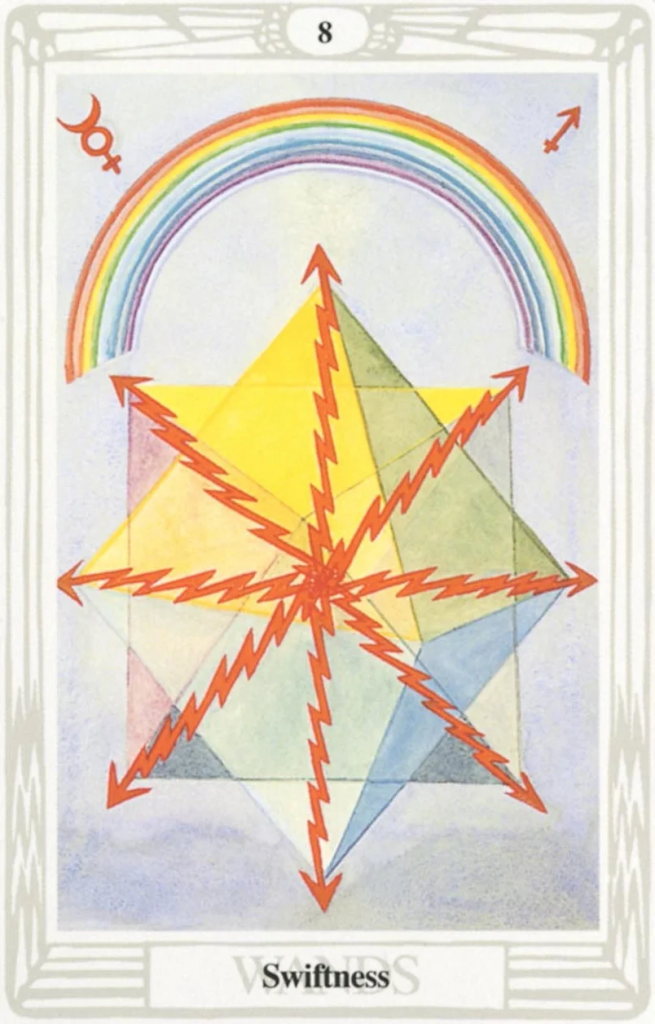
Tarot Card for June 19: Swiftness

The Eight of Wands

When the Lord of Swiftness comes up in a reading, it shows that there is an energy available which will break down obstacles, move restrictions and allow the free flow of power in any situation you direct it toward.Often there will have been problems which refuse to yield to any reasonable solution previously attempted. However on a day ruled by the Eight of Wands even the most intractable and stubborn difficulties will simply fall away when the downrush of power is felt from this card.Accordingly, on an Eight of Wands day, go looking for problems! Try to locate those things – whether major or minor, that have refused resolution till now. When you find something that seems applicable, sit down for a few minutes and mentally walk around the obstacle, trying to get a new perspective on it.This thinking period is important, because when this card rules, there is rapid and swift communication – either intuitively or in real terms, which allows you to see a way through the maze of complications that can build up around the most mundane of tasks.Expect, during your period of contemplation, to see new possibilities for solving the problem. Wait for the out-of-the-blue thought that strikes you as though from nowhere. When you discover it, try it out, no matter how outlandish it may at first appear.Be open to what life tells you – not as a result of seeking advice, but as a spontaneous offering from the people around you. When we leave ourselves open for the Universe to convey its thoughts to us, they can arrive from the most unexpected sources! Be prepared to consider any options offered to you obliquely – don’t take them at face value; try to turn them into applications for the matter you are attempting to resolve.And allow your sense of humour full rein – you need a light-hearted attitude to get the best out of this card. You’ll be amazed at the things you will get done on a day ruled by the Lord of Swiftness.

Affirmation: “Challenges and obstacles are achievements waiting to happen.”

(Angelpaths.com)

Free Will Astrology: Week of June 19, 2025

BY ROB BREZSNY | JUNE 17, 2025 (NewCity.com)

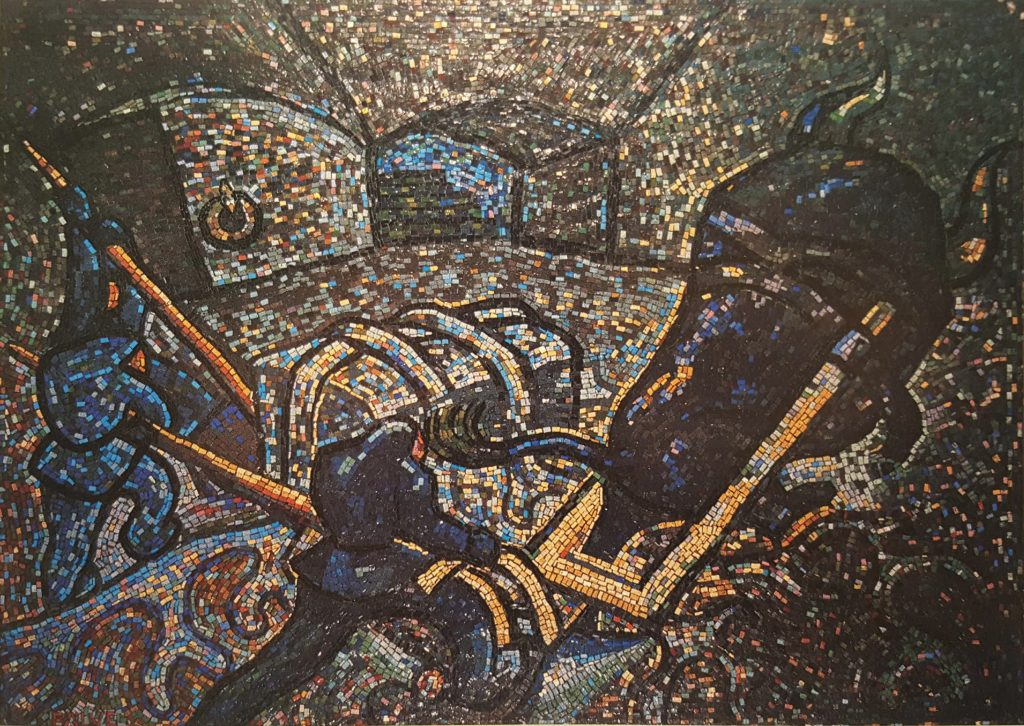
“The Retrieval of the Sampo,” showing Lemminkäinen ploughing up its roots with a bull. Mosaic by Veikko Aaltona

ARIES (March 21-April 19): Aries writer Joseph Campbell was a world-renowned mythologist. His theories about the classic hero archetype have inspired many writers and filmmakers, including “Star Wars” creator George Lucas. As a young man, Campbell crafted the blueprint for his influential work during a five-year period when he lived in a rustic shack and read books for nine hours a day. He was supremely dedicated and focused. I recommend that you consider a similar foundation-building project, Aries. The coming months will be an excellent time for you to establish the groundwork for whatever it is you want to do for the rest of your long life.

TAURUS (April 20-May 20): In Japan, komorebi refers to the dappled sunlight that streams through tree leaves. It names a subtle, ephemeral beauty that busy people might be oblivious to. Not you, I hope, Taurus! In the coming weeks, I invite you to draw on komorebi as an inspirational metaphor. Tune in to the soft illumination glimmering in the background. Be alert for flickers and flashes that reveal useful clues. Trust in the indirect path, the sideways glance, the half-remembered dream, and the overheard conversation. Anything blatant and loud is probably not relevant to your interests. PS: Be keen to notice what’s not being said.

GEMINI (May 21-June 20): In Finnish folklore, the Sampo is a magic artifact that generates unending wealth and good fortune. Here’s the catch: It can’t be hoarded. Its power only works when shared, passed around, or made communal. I believe you are close to acquiring a less potent but still wonderful equivalent of a Sampo, Gemini. It may be an idea, a project, or a way of living that radiates generosity and sustainable joy. But remember that it doesn’t thrive in isolation. It’s not a treasure to be stored up and saved for later. Share the wealth.

CANCER (June 21-July 22): Tides don’t ask for permission. They ebb and flow in accordance with an ancient gravitational intelligence that obeys its own elegant laws. Entire ecosystems rely on their steady cyclical rhythms. You, too, harbor tidal forces, Cancerian. They are partially synced up with the earth’s rivers, lakes and seas, and are partially under the sway of your deep emotional power. It’s always crucial for you to be intimately aware of your tides’ flows and patterns, but even more than usual right now. I hope you will trust their timing and harness their tremendous energy.

LEO (July 23-Aug. 22): Some jewelers practice an ancient Korean art called keum-boo, in which they fuse pure gold to silver by heat and pressure. The result is gold that seems to bloom from within silver’s body, not just be juxtaposed on top of it. Let’s make this your metaphor for the coming weeks, Leo. I believe you will have the skill to blend two beautiful and valuable things into an asset that has the beauty and value of both—plus an extra added synergy of valuable beauty. The only problem that could possibly derail your unprecedented accomplishment might be your worry that you don’t have the power to do that. Expunge that worry, please.

VIRGO (Aug. 23-Sept. 22): Some Indigenous cultures keep track of time not by clocks but by natural events: “the moon when the salmon return,” “the season when shadows shorten,” “the return of the rain birds.” I encourage you to try that approach, Virgo. Your customary rigor will benefit from blending with an influx of more intuitive choices. You will be wise to explore the joys of organic timing. So just for now, I invite you to tune out the relentless tick-tock. Listen instead for the hush before a threshold cracks open. Meditate on the ancient Greek concept of kairos: the prime moment to act or a potential turning point that’s ripe for activation.

LIBRA (Sept. 23-Oct. 22): Botanists speak of “serotiny,” a plant’s ability to delay seed release until the environment is just right. Some pinecones, for instance, only open after a fire. What part of you has been patiently waiting, Libra? What latent brilliance has not been ready to emerge until now? The coming weeks will offer catalytic conditions—perhaps heat, perhaps disruption, perhaps joy—that will be exactly what’s needed to unleash the fertile potency. Have faith that your seeds will draw on their own wild intelligence.

SCORPIO (Oct. 23-Nov. 21): One of your superpowers is your skill at detecting what’s unfolding beneath the surfaces. It’s almost like you have X-ray vision. Your ability to detect hidden agendas, buried secrets, and underground growth is profound. But in the coming weeks, I urge you to redirect your attention. You will generate good fortune for yourself if you turn your gaze to what lies at the horizon and just beyond. Can you sense the possibilities percolating at the edges of your known world? Can you sync up your intuitions with the future’s promises? Educated guesses will be indistinguishable from true prophecies.

SAGITTARIUS (Nov. 22-Dec. 21): Sagittarius-born Wassily Kandinsky (1866–1944) got a degree in law and economics and began a career teaching those subjects at the university level. But at age thirty, he had a conversion experience. It was triggered when he saw a thrilling exhibit of French Impressionist painters and heard an enthralling opera by Richard Wagner. Soon he flung himself into a study of art, embarking on an influential career that spanned decades. I am predicting that you will encounter inspirations of that caliber, Sagittarius. They may not motivate you as drastically as Kandinsky’s provocations, but they could revitalize your life forever.

CAPRICORN (Dec. 22-Jan. 19): The ancient Egyptians revered the River Nile’s annual flooding, which brought both disruption and renewal. It washed away old plant matter and debris and deposited fertile silt that nourished new growth. In the coming weeks, Capricorn, I suspect you will experience a metaphorical flood: a surge of new ideas, opportunities and feelings that temporarily unsettle your routines. Rather than focusing on the inconvenience, I suggest you celebrate the richness this influx will bring. The flow will ultimately uplift you, even if it seems messy at first.

AQUARIUS (Jan. 20-Feb. 18): Medieval stonemasons worked not just in service to the immediate structures they made. They imagined eternity, laying foundation blocks in cathedrals they knew they would never live to see completed. I think you are being invited to do similar work: soulful construction whose fruits may not ripen for a while. A provocative conversation you have soon may echo for years. A good habit you instill could become a key inheritance for your older self. So think long, wide and slow, dear Aquarius. Not everything must produce visible worth this season. Your prime offerings may be seeds for the future. Attend to them with reverence.

PISCES (Feb. 19-March 20): In the frigid parts of planet Earth, some glaciers sing. As they shift and crack and melt, they emit tones: groans, pulses, crackles and whooshes. I believe your soul will have a similar inclination in the coming weeks, Pisces: to express mysterious music as it shifts and thaws. Some old logjam or stuck place is breaking open within you, and that’s a very good thing. Don’t ignore or neglect this momentous offering. And don’t try to translate it into logical words too quickly. What story does your trembling tell? Let the deep, restless movements of your psyche resound.

Homework: You know exactly what you need to do next, but are refraining. Why? Do it! Newsletter.FreeWillAstrology.com

Word-Built World: brandish

A.Word.A.Daywith Anu Garg

brandish

PRONUNCIATION:

(BRAN-dish) 

MEANING:

verb tr.: To hold or wave something (especially a weapon), in a threatening or triumphant manner.
noun: The act of waving or displaying something in an ostentatious or boastful manner.

ETYMOLOGY:

From Anglo-French brandir (to flourish or wave), from brant/brand (sword). Earliest documented use: verb: 1350, noun: 1601.

Salami Brandished

(TheOnion.com)

Morning Meditation

In the spiritual universe, only love is real, and nothing else exists

JUN 18, 2025

Saskia Pasman / EyeEm

In the spiritual universe, only love is real, and nothing else exists

While the appearances of the three-dimensional world would deceive me into the false belief that there are powers more powerful than God, In fact, only love is the kingdom, the power and the glory. My physical senses are useful tools, but they are not the arbiters of ultimate truth. Only the love in my heart is the knower of all things.

The world has trained me to believe in the illusions of fear and separation and to disbelieve in the truth that lies beyond them. Today, I take a stand for truth as I extend my perceptions beyond what my physical senses reveal to me to what I know to be true in my heart. I commit to the realization that only love is real and I recognize the illusory nature of anything else. This way, I gain the power of the miracle, the power of conviction, as my mind becomes a conduit for the power by which only love prevails.

No matter what situation I am in today, I will remember that only love is real. I will not be waylaid by false appearances. When I cannot find my way to true vision, I pray to be reminded that false appearances are powerless before the will of God. I pray that my inner eye be opened to the love within all things.

In the spiritual universe, only love is real and nothing else exists

*To receive a morning meditation each day, please upgrade to a paid subscription

Consciousness, spirituality, biography, sexuality, androgyny, futurism, space, the arts, science, astrology, democracy, humor, books, movies and more