“Nothing less than a full-scale assault on conventional economic wisdom.” —Newsweek
One the 100 most influential books published since World War II —The Times Literary Supplement
Hailed as an “eco-bible” by Time magazine, E.F. Schumacher’s riveting, richly researched statement on sustainability has become more relevant and vital with each year since its initial groundbreaking publication during the 1973 energy crisis. A landmark statement against “bigger is better” industrialism, Schumacher’s Small Is Beautiful paved the way for twenty-first century books on environmentalism and economics, like Jeffrey Sachs’s The End of Poverty, Paul Hawken’s Natural Capitalism, Mohammad Yunis’s Banker to the Poor, and Bill McKibben’s Deep Economy. This timely reissue offers a crucial message for the modern world struggling to balance economic growth with the human costs of globalization.
Ernst Friedrich “Fritz” Schumacher was an internationally influential economic thinker, statistician and economist in Britain, serving as Chief Economic Advisor to the UK National Coal Board for two decades.
Buddhist Insights @ Empty Cloud Oct 1, 2022 Ronald Eyre’s 1977 BBC documentary focused on the Japanese experience of Buddhism and the complexities of Zen
Two male elephants affectionately embracing in a Sri Lanka national park. | Video screenshot
No, you’re not hallucinating. There really are gay elephants.
While they may not be pink, they are engaging in homosexual behavior, according to park rangers in Sri Lanka, who say they frequently observe wild male elephants mounting and bonding with one another.
The elephant experts say fraternal interactions are a natural part of elephant social behavior, and are most easily seen during the dry season when herds gather en masse around water sources, The Daily Mirror reports.
In Sri Lanka, the small South Asian island nation at the southern tip of India, those destinations include large reservoirs in two national parks, Minneriya and Kaudull, well-known for their large elephant populations.
Male elephants can be seen ‘holding hands’ by intertwining their trunks, and grooming each other to show affection. They even put their trunks in one another’s mouths. Relationships between elephants of both sexes often last a lifetime.
Across the Palk Strait in the Indian state of Tamil, two male elephants recently displayed these behaviors near the city of Gudalur.
Two male elephants are showing affection near Gudalur in the Nilgiris dt of Tamil Nadu. ????. Elephants have good memory, can remember their friends & family for life. pic.twitter.com/SjJ9kFyFvr
Observers witness this behavior less often in the rainy season, when elephant populations disperse into the surrounding forests. That migration often coincides with mating season, when male elephants engage in intense fights to attract females, demonstrating physical strength and social dominance — the losing bulls will often console themselves with one another.
Similar same-sex interactions are seen across the animal kingdom, but for elephants, one of the most emotionally evolved species on the planet, the behaviors are a reflection of the animals’ terrifically complex social structures.
Same-sex behaviors in animals of all kinds have been documented for millennia
Aristotle (384–322 BC) observed it in pigeons and quail; the Egyptian writer Horapollo (circa 4 AD) found it in partridges.
Same-sex behaviors have been observed in over 1,500 species — in every major animal group, and in every region of the planet — including birds, insects, primates, reptiles, fish, invertebrates, and ocean mammals, according to a 2009 University of California study. Those behaviors can include sexual contact, courtship, affection, pair-bonding behaviors (like hugging, nuzzling, licking, and grooming), and even joining forces to raise offspring — their own or another parent’s.
However, scientists don’t call animals “gay,” “lesbian,” “bisexual,” or “queer” because the word connotes a human sexual orientation with strong cultural and political implications that are irrelevant to non-human species. Instead, most scientists will say that animals exhibit “same-sex behaviors” or “homosexual behaviors.” Scientists use these phrases to avoid “anthropomorphizing” animals and seeing them as “imperfect copies of humans,” biologist Marlene Zuk explained.
Nevertheless, one Daily Mirror reader summed up reaction to the same-sex behavior, calling it a “favourite Lanka pastime and activity. Even the animals living in our paradise engage in it.”
Subscribe to the LGBTQ Nation newsletter and be the first to know about the latest headlines shaping LGBTQ+ communities worldwide.
Greg Owen writes about politics and culture for LGBTQ Nation. An award-winning writer, producer and journalist, he was recently recognized for Excellence in Online Journalism by NLGJA: the Association of LGBTQ Journalists for his coverage of the 2024 election. He’s written for Q Digital since 2015 and for LGBTQ Nation since 2022.
This article includes links that may result in a small affiliate share for purchased products, which helps support independent LGBTQ+ media.
Shutterstock Composite
At 35, Lieutenant Rae Timberlake has spent just over half their life in the United States Navy. Now they’re wrapping up their career due to the president’s second transgender military ban. When Secretary of Defense Pete Hegseth gleefully cheerleaded the ejection of trans servicemembers, he characterized it as “no more dudes in dresses.”
After giving 18 years of their life and defining a part of their identity through service to their country, Timberlake is now being forced out by an administration that doesn’t even acknowledge their identity in its hateful speeches.
Timberlake, who is the Communications Director for the non-profit SPARTA Pride, is obviously angry about the ban’s effect on all trans people who serve. But the effect on the rarely-mentioned trans masc servicemembers is a particular point of frustration.
“I honestly think it’s weird because the military is one of the safest places for women that are masc or want to present more masc because it’s a very masculine environment. So I think if you are masc-presenting or trans-masculine, people are generally more accepting of that.”
While trans people have become a hot political topic, not every identity is discussed in equal measure. We hear concerns about trans women in bathrooms and uproar over trans girls playing sports, but the presence of trans men in the conversation is often only notable by its absence.
Harper Seldin, a Staff Attorney at the ACLU LGBTQ & HIV Project, explained how the discussion of trans rights often carefully attacks trans femme identities while ignoring trans men and boys.
“With the way that the anti-trans coalition frames the issue of medical care for transgender minors, even that framing truly erases trans men.”
This absence is clear on both sides of the aisle. While we’re eager to talk about how a trans woman threw the first brick at Stonewall and expound on the forgotten history of trans women in the early 1900s, trans men tend to be less discussed.
Jamison Green has been living openly as a trans man since the 1980s. Along with his extensive activism over the last forty years, Green wroteBecoming a Visible Man in 2004, which explores masculinity and overlooked stories of trans men. This year, he co-editedA History of Transgender Medicine in the United States.
Green recalls that when he was doing public speaking and trainings in the 90s, people had a very set idea of what a trans person might be, and it wasn’t a trans man. “They’d be disappointed because they were expecting a transsexual, who they think is a man in a dress,” he said.
Green has seen the effects of this way of thinking over and over, whether it comes in the form of people being “blown away” that someone who was assigned female at birth could look like him, or by the way that some people see all trans men as interchangeable and regularly mistake him for his contemporaries, such as Stephen Whittle or Loren Cameron.
Why anti-trans groups ignore trans men
Trans people have become a political punching bag for much the same reason that immigrants have: We’re easy targets. As Timberlake points out, “It’s still more socially acceptable to paint [trans people] as other or bad, whereas conventional racism and colorism is less palatable in the mainstream. It’s clearly a winning issue.”
While that’s proven to be a winning strategy overall, it relies on a focus on trans women. Green, Seldin, and Timberlake all agree that there’s a root cause behind both the attacks and the erasure: misogyny.
“If there’s nothing particularly biologically innate about being a man, there’s nothing particularly supreme about being a man… Trans men reveal sort of the artifice behind this idea of male supremacy.”Harper Seldin, Staff Attorney at the ACLU LGBTQ & HIV Project
However, in each of their theories, that misogyny takes a different form. For Timberlake, it’s about how fragile masculinity makes trans women a simpler target. “The worst insult to a man is that he’s not a man,” muses Timberlake. “So it’s really easy to identify trans women as a bad thing, or a boogeyman. I think it’s all rooted in misogyny, and trans men, trans masculine people don’t fit that narrative.”
For Green, misogyny fuels dismissal: “Of course women want to be men. Because who cares what women do? They’ll never be ‘real’ men anyway, so there’s no threat.”
Seldin goes a step further, seeing the anti-trans movement’s response to trans women vs trans men as representative of trying to uphold the patriarchy. Trans women can be seen as challenging the patriarchy because they’re perceived as “giving up” manhood, which doesn’t make sense in a framework of male supremacy. To avoid acknowledging that idea, trans women are demonized as predators, deviants, and a threat to women.
But for trans men, the idea of “becoming” men would be desirable under a patriarchal model, but Seldin points out the ability to do so would weaken that very framework: “If there’s nothing particularly biologically innate about being a man, there’s nothing particularly supreme about being a man… Trans men reveal sort of the artifice behind this idea of male supremacy.”
The only way to combat that issue is to either lean into Green’s point that the patriarchy doesn’t see trans men as “real men,” or to try to ignore their existence. The anti-trans lobby is very keen to keep the conversation on trans women, where they can stoke outrage rather than acknowledging trans men and face difficult questions about a societal system built on the idea of male supremacy.
Seldin points out that we know this is, at least in part, a deliberate choice. There’s documentation in Project 2025 promoting a focus specifically on trans women in bathrooms and sports to push fear and anger, and we’ve seen that procedural shift from politicians after marriage equality was passed.
Why trans advocates ignore trans men
Part of what makes the erasure of trans men from these political conversations possible is how plainly some of the arguments made against trans women would fall apart if applied to trans men. This is particularly true with the trans military ban. The administration suggested that trans people affect military readiness by not being fit for duty, taking excessive medical leave, forcing people to think about pronouns, and costing taxpayers a significantly larger amount than other service members because of their medical bills.
None of these arguments withstands any real scrutiny. The cost is relatively low for gender-affirming care compared to other medical needs service members might have. Medical leave for gender-affirming surgeries can be planned and is comparable to many other surgeries. All service members are required to pass regular fitness tests to remain in service. And pronouns are just part of the English language.
But the idea that someone would become a worse soldier because they were trans masc and taking hormones is bizarre, and if that was brought up more often, the public would probably see through it.
Timberlake explains: “As somebody who’s been on T for like four years now, my run times are better. My physical performance is better… I just don’t think that there’s a valid argument that being on testosterone makes me less capable.”
But despite that, there are arguments for why politicians who are generally trans allies might not raise the topic of trans men.
For Seldin, it comes down to the fact that the issue with anti-trans hate isn’t its lack of comprehensive attacks across the board. Rather, it is the fact that it comes from an uninformed or bigoted place to begin with.
“The existence of trans men is not a rejoinder to any particular anti-trans narrative. The true rejoinder to the anti-trans narrative is that gender is complicated and life is a rich tapestry and that gender expression doesn’t take anything away from anybody else. And that in seeking to make trans people’s lives smaller and shackled to sex assigned to birth, it actually makes everyone’s life smaller because of what it means about reifying gender roles in a way that’s tied specifically to biology.”
Green, on the other hand, suggests that it comes down to a lack of visibility and understanding for who trans men are.
“I think there are lots of trans men who are trying to be visible, and I think people don’t give a sh*t… I think probably part of it is that the politicians don’t really understand trans people… They don’t know how to make an argument about the medical necessity of our healthcare. I just don’t think they have a grasp on what kinds of discrimination we actually face and what kinds of institutionalized systematic oppression we have endured for forever.”
Why it is critical to talk about trans men more
Both Seldin and Green noted that there are some benefits to the lack of attention, particularly for those who have passing privilege. One of the few times that trans men come up in more mainstream discourse is in memes of muscly bearded trans men in restrooms, highlighting the absurdity of them being told to use the women’s room.
Green recounted anecdotes of regularly going to public meetings in San Francisco and people questioning why no trans men were attending. All of that shows how trans men can fly under the radar at times, and, combined with anti-trans groups painting a smaller target on them, it is a small plus.
“I just don’t think they have a grasp on what kinds of discrimination we actually face and what kinds of institutionalized systematic oppression we have endured for forever.”Jamison Green, writer and activist
But Green is quick to point out that it’s not as simple as that: “We are often very invisible. And that’s a double-edged sword. It’s a blessing and a curse. Our needs go unaddressed. Trans men are often particularly lonely. There are advantages to being able to just move through society, but to be invisible [means] that no one knows how to meet our needs.”
Seldin pointed to evidence that while there’s the benefit of not being directly attacked as often, trans men are still affected by legislation and sentiments built by anti-trans rhetoric. Rules driven by those demonizing trans women prevent all trans people from accessing services. Trans boys and men are still losing access to healthcare, school sports, and more.
Beyond that, Seldin worries about the lack of attention given to healthcare for trans men: Less visibility means less pressure to provide better resources.
“Healthcare for trans men is under-researched and under-invested in. As trans men, it can be difficult to access the kind of healthcare that we need because spaces that cater to people with uteruses may not be particularly welcoming. So that can also be difficult, to connect trans men with appropriate healthcare resources, not just in the context of reproductive healthcare, but any kind of healthcare.”
Worrying about healthcare access is part of what moved Green to be so vocal in his activism. He recounts the story of Billy Tipton, a trans man and jazz singer who kept his gender identity a secret from his family for his entire life. Tipton eventually became ill and avoided going to a doctor for fear that this secret would be revealed. He passed away from a treatable illness.
“If people don’t know who we are, we’re never going to be safe. They will never know how to take care of our needs when we are elderly, infirm, vulnerable in any way.”
These thoughts drove Green to work to make trans men more visible, but his peers feared the other edge of that sword. They asked him not to do that work, saying, “If they find out about us, they’ll take everything away from us.”
But Green has remained resolute: “I think if people understand our bodies and who we are, we’ll be safer in the world.”
Subscribe to the LGBTQ Nation newsletter and be the first to know about the latest headlines shaping LGBTQ+ communities worldwide.
Faefyx Collington is a British American author who writes about LGBTQ+ issues, politics, popular culture, and their intersection. You can find Faefyx Collington on socials and the wider internet by googling their unique name.
“A well-fed man keeps and calmly gives forth his infinitesimal portion of eternity.”
– Ray Bradbury
‘How long has it been since you wrote a story where your real love or your real hatred somehow got onto the paper?’ Finding the truth of our authentic passions is the key to forming the foundations of a writing practice, according to science fiction author Ray Bradbury. In his essay collection, Zen in the Art of Writing, he indulges in a series of pointers and incitements for writers in the process of forging their craft. In this extract from the essay, How to Keep and Feed a Muse, he talks about the importance of recognizing and then nurturing our deepest inspirations, in the understanding that it is the sheer energy of the Muse that drives the engine of labor required for a lifetime of writing. For more on the process of writing, read Norman Fischer’s Poetics Statement, and other thoughts from Natalie Goldberg and Patti Smith. For the text that inspired the title of Bradbury’s book, check out Eugene Herrigel.
The Feeding of the Muse seems to me to be the continual running after loves, the checking of these loves against one’s present and future needs, the moving on from simple textures to more complex ones, from naïve ones to more informed ones, from nonintellectual to intellectual ones. Nothing is ever lost. If you have moved over vast territories and dared to love silly things, you will have learned even from the most primitive items collected and put aside in your life. From an ever-roaming curiosity in all the arts, from bad radio to good theatre, from nursery rhyme to symphony, from jungle compound to Kafka’s Castle, there is basic excellence to be winnowed out, truths found, kept, savored, and used on some later day. To be a child of one’s time is to do all these things.
Do not, for money, turn away from all the stuff you have collected in a lifetime.
Do not, for the vanity of intellectual publications, turn away from what you are—the material within you which makes you individual, and therefore indispensable to others.
To feed your Muse, then, you should always have been hungry about life since you were a child. If not, it is a little late to start. Better late than never, of course. Do you feel up to it?
“By living well, by observing as you live, by reading well and observing as you read, you have fed Your Most Original Self.”
It means you must still take long walks at night around your city or town, or walks in the country by day. And long walks, at any time, through bookstores and libraries.
The Muse must have shape. You will write a thousand words a day for ten or twenty years in order to try to give it shape, to learn enough about grammar and story construction so that these become part of the Subconscious, without restraining or distorting the Muse.
By living well, by observing as you live, by reading well and observing as you read, you have fed Your Most Original Self. By training yourself in writing, by repetitious exercise, imitation, good example, you have made a clean, well-lighted place to keep the Muse. You have given her, him, it, or whatever, room to turn around in. And through training, you have relaxed yourself enough not to stare discourteously when inspiration comes into the room.
You have learned to go immediately to the typewriter and preserve the inspiration for all time by putting it on paper.
“At the exact moment when truth erupts, the subconscious changes from wastebasket file to angel writing in a book of gold.”
And you have learned the answer to the question asked earlier: Does creativity like loud or soft voices?
The loud, the passionate voice seems to please most. The voice upraised in conflict, the comparison of opposites. Sit at your typewriter, pick characters of various sorts, let them fly together in a great clang. In no time at all, your secret self is roused. We all like decision, declaration; anyone loudly for, anyone loudly against.
This is not to say the quiet story is excluded. One can be as excited and passionate about a quiet story as any. There is excitement in the calm still beauty of a Venus de Milo. The spectator, here, becomes as important as the thing viewed.
Be certain of this: When honest love speaks, when true admiration begins, when excitement rises, when hate curls like smoke, you need never doubt that creativity will stay with you for a lifetime. The core of your creativity should be the same as the core of your story and of the main character in your story. What does your character want, what is his dream, what shape has it, and how expressed? Given expression, this is the dynamo of his life, and your life, then, as Creator. At the exact moment when truth erupts, the subconscious changes from wastebasket file to angel writing in a book of gold.
Look at yourself then. Consider everything you have fed yourself over the years. Was it a banquet or a starvation diet?
“To feed well is to grow. To work well and constantly is to keep what you have learned and know in prime condition.”
Who are your friends? Do they believe in you? Or do they stunt your growth with ridicule and disbelief? If the latter, you haven’t friends. Go find some.
And finally, have you trained well enough so you can say what you want to say without getting hamstrung? Have you written enough so that you are relaxed and can allow the truth to get out without being ruined by self-conscious posturings or changed by a desire to become rich?
To feed well is to grow. To work well and constantly is to keep what you have learned and know in prime condition. Experience. Labor. These are the twin sides of the coin which when spun is neither experience nor labor, but the moment of revelation. The coin, by optical illusion, becomes a round, bright, whirling globe of life. It is the moment when the porch swing creaks gentle and a voice speaks. All hold their breath. The voice rises and falls. Dad tells of other years. A ghost rises off his lips. The subconscious stirs and rubs its eyes. The Muse ventures in the ferns below the porch, where the summer boys, strewn on the lawn, listen. The words become poetry that no one minds, because no one has thought to call it that. Time is there. Love is there. Story is there. A well-fed man keeps and calmly gives forth his infinitesimal portion of eternity. It sounds big in the summer night. And it is, as it always was down the ages, when there was a man with something to tell, and ones, quiet and wise, to listen.
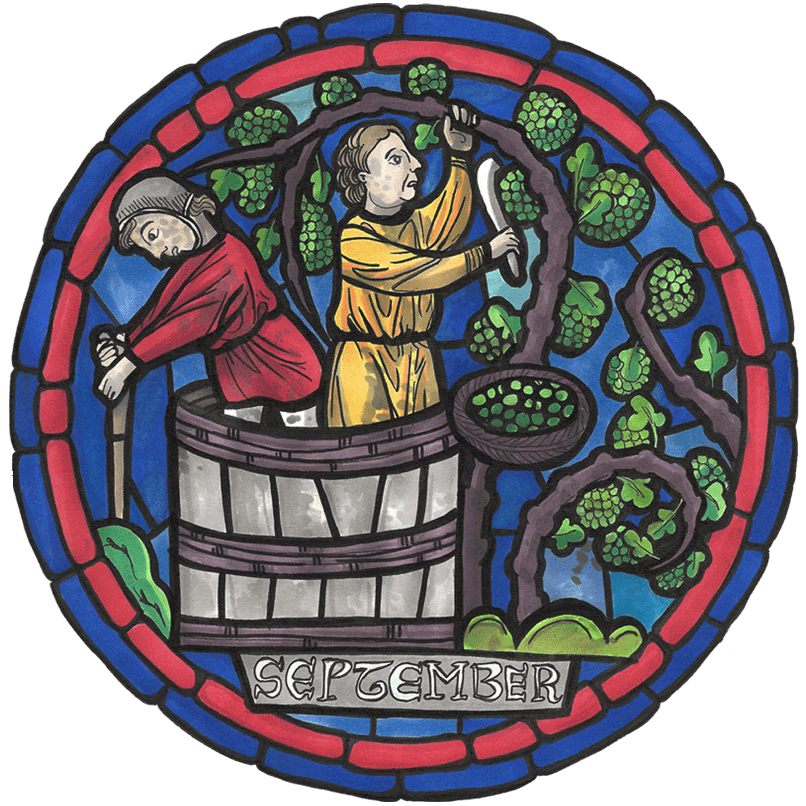
September brings our third and last harvest, the harvest of grapes. Grapes symbolize the emotional function by which we experience emotions towards people, places, objects or events. This function empowers us with the ability to feel people’s moods, perceive the motive behind their actions, and in general blend into social situations. The complete spectrum of our emotions extends even wider than this, reaching to potentially transformative emotions that alter the way we see ourselves and the world around us, such as empathy, compassion, and remorse of conscience. This broad spectrum is reflected in the journey a grape undergoes to become wine. It is a journey of many stages that ultimately transforms the grape’s nature into an altogether superior end product. As we shall see, the highest reach of our emotional function is likewise superhuman.
Since the development of our Essence is typically arrested early in life, the emotional function—the function of Essence—is usually atrophied. We only take advantage of its basic emotional output of comradery, humor, and gossip, and rarely benefit from its higher and transformative range. In effect, we have in our possession an instrument of great force yet spend our days fiddling only with its most basic parts. It is as if we used our smartphone only to check the time and our car only to store our belongings. This is a serious waste of potential as well as an objective limitation to inner farming, because the only power that can overrule the instinctive inertia discussed in May and the mechanical momentum discussed in June is emotion.
When we try to study the different qualities of our emotions we stumble upon an underlying attitude that makes their observation particularly difficult. Their very arising sweeps us away. They come with a deep conviction that glues us to them and blinds us to their manifestations. This abandonment of our sense of self in the face of our emotions is called identification and it is here that our labor of September must begin. To be clear, the tendency to identify with any of our functions—whether physical, mental, or emotional—makes self-observation challenging. We are accustomed to calling all our impulses ‘I’ and associate their manifestation with our entirety. Nevertheless, identification exacts its strongest force on our emotional world, particularly in our dealings with others.
As a rule, our undeveloped emotional function distorts our perception of the world by placing ourselves at its center. Everything is about us, everyone is ignoring or conspiring against us, everyone should be considering or acknowledging us. Misled by this bias, we take everything personally and experience difficult emotions about things that need not stimulate any emotions in us whatsoever. “Why did they not think about me? Why did they look at me that way? What will happen if I am proven wrong? If I make a fool of myself? What if I am considered irresponsible?” Our struggle with identification reveals that these habitual considerations are the default state of our emotional function. We cycle through them endlessly. When we do succeed in obtaining this supposedly important validation from our environment, our emotional function quickly works itself into new doubts and concerns. It proves to be a state in search of an object, which means that we can only break free from these emotional considerations by severing the state of identification.
Any action that goes against the need for social validation achieves this: making a public comment we know to be incorrect; restraining our smartness and letting others take credit for coming up with a helpful solution; staying put when a traffic light turns green until the driver behind us honks; dropping our cup at the cafe to make us seem clumsy or careless. Or in short, any deliberate action that paints us as fools and sabotages our need for social validation.
If executed correctly, the effect is instantaneous. A space between ‘I’ and ‘my emotions’ opens up all of a sudden, sparking a brief out-of-body experience. All of a sudden we can observe in real time what was previously invisible to us. But this successful execution depends on the attitude behind our effort. We are playing the fool to sever identification. We are aiming to wedge a crack between our emotions and our budding ability to observe. The moment we lose sight of this, our vanity takes credit for having gone against our habitual reactions, and distorts our original aim. We break free of identification only to rebuild it elsewhere. The practitioner will have to bear this in mind and understand that some of their experiments will succeed, and others will fail. Moreover, the somewhat dramatic examples given above will not always be necessary. We will not always have to employ these extreme measures to sever identification with our emotions. As we gain expertise in inner farming, we will gradually learn more subtle ways of harvesting the same yield.
Harvest involves discrimination. Not all crops are of equal value. Some grape clusters may make fine wine while others need to be discarded lest they detract from our final product. The same applies to our emotions. We must study their different qualities and flavors, and ultimately choose some over others. For this, we must learn to struggle with identification. The farmer who can observe their feelings as they arise in real time—who can see ‘joy,’ ‘expectation,’ ‘disappointment,’ or ‘apprehension’ and resist the urge to call them ‘I’—is positioned favorably before the September harvest. Now can they attempt to fulfill the transformative potential of their emotional function.
Burning Man attendee Kayla gave birth to a baby girl during this year’s festival in the Black Rock Desert of Nevada.Courtesy of Kayla’s family
On Wednesday morning at Burning Man, the raging dust storms and torrential rain had mostly come to a halt. But for one woman camped in a recreational vehicle in the middle of the playa, a different sort of cataclysm was imminent.
Kayla, who asked to be identified only by her first name to protect her family’s privacy, awakened to the feeling of needing to use the restroom, she told SFGATE. Soon after that came the cramps — really, really bad ones. “Within 10 to 15 minutes of me starting to cramp, I just felt like something weird was going on,” Kayla said. “It felt like something needed to come out.”
As it turned out, Kayla was eight months pregnant. She didn’t know that, though, and was unaware she was about to give birth in the middle of the wildest, weirdest, dustiest desert festival on the planet. “We legit 100 percent had no idea that we were expecting,” said Kayla’s husband Kasey, who also asked to be identified only by his first name.
“Cryptic pregnancies” are more common than one might think, accounting for 1 out of every 2,500 childbirths and amounting to 1,600 surprise births in the U.S. each year, according to the National Library of Medicine.
The Salt Lake City couple spoke with SFGATE over the phone from a hospital in Reno, recounting the harrowing and deeply emotional experience of unexpectedly becoming new parents while at Burning Man.
Their time in the desert began much like the rest of the estimated 70,000 Burners who showed up to the playa this year — dusty and wet. “It was a struggle from the moment we got there,” Kasey said.
On the first day, their camp — named Way Way Super Good — blew over, and all the poles for their shade structure broke. They woke up and rebuilt, but then the rain came and flooded everything. So then they had to tear it all down and rebuild again.
There was just one night when they got to bike around the playa, but there wasn’t a whole lot to see at that point, Kasey said. Then Wednesday morning came around, and he noticed something was wrong with Kayla.
“My wife went to the bathroom, came back, and I could tell she was in a little discomfort,” he said. “I could tell, just in her face. I was asking her, ‘What’s going on? What’s going on?’ She’s like, ‘I’m OK. I’m OK. I’m just starting to cramp a little bit.’”
Kasey left the RV for a few minutes, and when he returned, his brother gave him a heads-up that things were not OK. “You need to get in there right away,” Kasey remembers being told. “Kayla’s not in good shape.”
Luckily, a few medical professionals were camped near Way Way Super Good. Kasey rounded them up and brought them to the RV, where Kayla was back in the bathroom. She had been cramping for about 15 minutes, she estimates, when the professionals showed up and began assessing the situation.
After a few more short minutes of what turned out to be labor, she gave birth to a baby girl.
Kayla was in total shock.
Kasey was in “a straight panic,” knowing his baby had been born “in the middle of the most harsh desert on the planet.”
He ran out of the RV and started yelling for anyone and everyone to come help. And right away, more medical professionals began appearing. There was an obstetrician-gynecologist in his underwear who happened to be walking by. A neurologist showed up. A nurse with experience delivering babies ran over from a nearby camp.
“It was the most beautiful thing,” Kasey said. “In a matter of minutes, we had everyone we needed … It was the scariest moment of my life, also the most magical, like just seeing the people just come together, complete strangers, just coming to our rescue.”
Kasey distinctly remembers scrambling to find scissors in the camp to cut the umbilical cord. When they couldn’t find any, he remembers the OB-GYN saying, “We need a string right now.”
They used that to cut the cord, Kasey said, and around that time, a nurse who works for Stanford Medical Center was ripping plastic bags off her feet — which had been in place for mud-walking — and entering the RV.
Maureen O’Reilly had worked as a neonatal critical care transport nurse, and knowing everything she does about newborns, she immediately identified the situation as “gnarly.” As to the unexpected nature of the pregnancy, O’Reilly emphasized that sometimes pregnant women continue getting their periods, or they have other medical issues that make it harder to tell they are pregnant.
During a hospital delivery, there would be tools like suction, and a way to give a baby breaths, she told SFGATE. This baby, which O’Reilly immediately noticed was on the small side and not full-term, would have none of those resources. It was terrifying. She rinsed her hands and put gloves on.
“Give me that baby,” she said.
Upon receiving the newborn, O’Reilly pulled her shirt up and placed the baby on her belly for skin-to-skin contact. The baby started crying, and that was a good sign. O’Reilly studied the baby’s color, tone and breathing, assessing and stimulating her.
ADVERTISEMENT
Article continues below this ad
She wrapped the baby in a dry towel that “appeared actually pretty clean, considering how bad things are out here with the weather and the, you know, mud everywhere,” she said.
To keep the baby warm, someone fetched a hot water bottle and wrapped it in a towel, and O’Reilly kept the baby on her stomach until Burning Man’s medical staff arrived.
In her 13 years of attendance at Burning Man, it was the wildest thing she’s ever experienced on the playa, O’Reilly said.
From there, the couple and their baby were transported to Rampart, Burning Man’s emergency health care facility, where a plan came together for getting everyone to a hospital in Reno. Another of Rampart’s patients had had a stroke, Kasey said, and needed to be airlifted to Reno as well. It meant the couple had to send their baby on the helicopter by herself.
“Kayla and I had to ride in the ambulance, which was probably one of the hardest decisions I’ve ever made in my life,” he said. “It took like an hour, hour and a half just to get off the playa, and then another two hours from the main road to get to Reno.”
Eventually, they all arrived safely at the hospital. The baby weighed in at 3 pounds, 9.6 ounces and measured 16.5 inches long. She went straight to the neonatal intensive care unit and will likely be there for a couple of weeks, Kayla said. The couple expressed regret that they had to write Reno on the birth certificate instead of Black Rock City.
Kasey’s parents showed up with clean clothes, and Kasey’s sister launched a GoFundMe to help the couple with the impending medical bills and other costs associated with having a child.
Burning Man Project, the organization that puts on the festival, extended congratulations and well-wishes to the family in an emailed statement. “In the midst of wind, heat, and storms, they brought new life into the world in Black Rock City,” the statement reads. “Of all the things we celebrate at Burning Man, bringing life, connection, transformation, and joy are dearest to our hearts.”
Because the Burning Man birth has already been the subject of several news stories that are thin on information, judgmental comments are mounting on social media, and baseless rumors about drug use during the birth have been circulating around the festival. The couple denied that any drugs were involved.
Another rumor the couple would like to put to rest is that their baby’s name might be “Puddles.” They never considered that one, they said, but did think about Stormy, Sandy and Rainy.
Ultimately, they settled on Aurora.
“She was born at dawn, and she lights up the sky, and she’s going to be a special little girl,” Kasey said. “So I feel like the name Aurora is very fitting for her.”
Asked if they’ll ever go back to Burning Man, Kasey didn’t hesitate.
“One hundred percent,” he said. “I have the most special gift, a little daughter, and she has to go back to her birthplace.”
Ashley Harrell is the national parks bureau chief at SFGATE, where she’s worked since 2020. She recently co-authored the National Geographic book “100 Beaches of a Lifetime: The World’s Ultimate Shorelines,” and has reported from 17 countries, working on more than 50 travel guidebooks. Her story about human-turtle conflict on Hawaii’s Poipu Beach won gold in the environmental and sustainable tourism category of the Lowell Thomas Awards in 2024. Send story tips or comments to ashley.harrell@sfgate.com.
For a long time, what is, and what is not, Paris was defined by the 21-mile beltway that encircles it. Inside the Périphérique, as the road is known, was the romantic city of gilded bridges and ageless beauty that inspired the most famous line in the movies, Humphrey Bogart’s epitaph for love: “We’ll always have Paris.”
Beyond it, in the banlieue, or suburbs, home to many immigrants, stood dilapidated public housing. From time to time, as in 2005, riots erupted. The postal code 93, denoting the vast department of Seine-Saint-Denis north of the city, was synonymous to some with troubled dereliction, however reductive that stereotype became over time.
Forget all that. Greater Paris is born, reconfiguring the city. The Périph, a moat no longer, has steadily become porous. The east, long snubbed by the bourgeoisie of western Paris, has risen, turning the banlieue from Pantin to Romainville into cool, desirable areas. Tourists troop to the Louvre, but the action is no longer on the Seine River — it is on a 200-year-old canal, the Ourcq.
“In Pantin, I always feel I’m in the future, and in central Paris, I’m stuck in the past,” said Rémi Babinet, the founding chairman of the BETC advertising agency, which moved its headquarters from the city to Pantin in 2016. “Tourists pay a lot to see a Paris that never moves, but they are going to have to discover a different one that does.”
Mr. Babinet’s offices look out over the gently flowing waters of the Ourcq (pronounced “Ork”), which began life bringing drinking water to Paris and, not so long ago, flowed past a squalid industrial zone of factories for cigarettes, steel boiler tubes, toilets and mopeds.
“Stolen cars got dumped in the water,” said Laurence Lavillière, recalling her childhood. She was born in 1972 and has lived her entire life in Pantin. “The canal was a no man’s land of drugs and garbage.”
Cut to today’s leafy waterfront of biking trails, workout equipment, footpaths, hip bars and restaurants. The canal is broad and flows unfenced almost at the level of its banks, creating a liberating sense of liquid space. People fish for pike and perch.
Brunch in Pantin. Once a marginal area, it has steadily grown chic.A park in Pantin. Even as the area has gentrified, subsidized apartments make up about 41 percent of housing in this suburb of 61,000 people.
This is another Seine-Saint-Denis, by no means born overnight, but now screaming that the time has come to retire, or least adjust, tired images and stereotypes of the banlieue, with their baggage of prejudice.
That was part of the idea behind the Greater Paris Metropolis, founded almost a decade ago by an act of Parliament. It groups the city with 130 surrounding districts, more than tripling the Paris population to over seven million. One of the aims was to break barriers, both ethnic and economic. Paris had to be more than a manicured museum preserved for the affluent beneath the Eiffel Tower and the Panthéon’s dome.
The project stalled. The Grand Paris Express, its heart, a $46.7 billion rail network connecting areas of the banlieue and the city, advanced fitfully. Only with the opening last year, in time for the Olympics, of its hub at the St.-Denis-Pleyel station was there a movement in people’s minds. The Olympics themselves, heavily concentrated in Seine-Saint-Denis, brought development, vitality, new housing and an enlarged view of Paris.
Suddenly the banlieue is buzzing. A show called “Banlieues Chéries,” or “Dearest Banlieues,” at the Museum of the History Immigration was the hit of the summer. Through installations, videos and paintings, it traced the cultural richness of the banlieue with the aim of shattering “reductive prisms.” A website called Enlarge Your Paris is thriving; its Greater Paris Guide is in its third edition.
Thaddaeus Ropac, a pioneer in Pantin, saw it coming. He opened his vast art gallery in a redbrick former boiler factory 13 years ago. He wanted to show the likes of Anselm Kiefer and Georg Baselitz; there was no space in his Paris gallery in the Marais.
The Paris Philharmonic, which opened a decade ago. “Even architecturally, it is a hand extended across the ring road,” said Olivier Mantei, its director.Thaddaeus Ropac’s gallery in Pantin, showing the work of Georg Baselitz. “The French were initially horrified,” when he opened in the area, he recalled.
“The French were initially horrified,” he recalled. “My God! To come here at night was unthinkable. But I was sure that if we did it, we would get our audience.”
To stroll the banks of the Ourcq for 20 minutes from Pantin toward Paris is to grasp how seamlessly connected the city has become and how its center of gravity has shifted. The Périphérique feels like a noisy relic. Mr. Babinet predicts it will be gone within 25 years as the green economy transforms the city further.
The waterway ushers you into the Parc de la Villette in the 19th district of Paris. Abutting the large park is the Paris Philharmonic, opened a decade ago and designed by the architect Jean Nouvel, a 2,400-seat concert hall housed in a many-faceted silvery shell.
Traditional Paris groused at having to drag itself from the moneyed 16th district near the Bois de Boulogne to hear great classical music, but it slowly came around. Today, 1.5 million people attend the Philharmonic annually.
There are added perks. Climbing the Eiffel Tower is a little passé. The rooftop of the Philharmonic, known as the Belvédère, offers a panoramic view over the new Paris to the north of the Sacré-Coeur, the old Paris beside the tower itself and Pantin. It is a stirring change of perspective.
The view from the top of the Paris Philharmonic offers a unifying perspective of the city’s many faces. Here to the west.Pantin. Central Paris has been combined with 130 surrounding districts in an effort to break down ethnic and economic barriers.
“What is the Philharmonic if not a way to create bridges and passageways toward new publics?” Olivier Mantei, its director, said in an interview. “Even architecturally, it is a hand extended across the ring road.”
For Mr. Mantei, central Paris is inert. It is suffocated. Its creativity is stilled. The city, he believes, is “moving its center toward Greater Paris, where there is space, diversity, innovation and air.”
In Pantin, I ran into Ayoud Houzali, whose family comes from the Comoros, and Aymane Laraqui, of Moroccan descent. Both live in subsidized housing daubed in graffiti and are in their final year of high school, studying science and technology.
The housing reflects the fact that social problems have not been eliminated. With more than 40 homicides last year, Seine-Saint-Denis still had the highest number in the Paris region.
But a different, more hopeful atmosphere now prevails. “I’m 17 and I’ve never experienced any racism,” Mr. Houzali said. “The image of Seine-Saint-Denis is totally out of date.”
Alongside the Ourcq. “I believe in diversity,” said Pantin’s Socialist mayor, Bertrand Kern. “We do not want a ghetto of the wealthy in Pantin.”Les Grandes Serres, or Great Greenhouses, project will transform a disused factory into a glass emporium.
And what of the future? “In tech, which we study, there are many opportunities,” Mr. Laraqui said.
Mixité, or social diversity, has been an obsession of Bertrand Kern, a Socialist who has been the mayor of Pantin for almost a quarter-century. Subsidized apartments make up about 41 percent of housing in this suburb of 61,000 inhabitants; 33 percent of apartments in any new construction must be low-cost social housing accessible to poorer families.
“I am a man of the left, I believe in diversity,” Mr. Kern said in an interview. “We do not want a ghetto of the wealthy in Pantin. You have to mix, the poor beside the rich, and every man and woman has to find a place. We have problems, of course, but it’s rare.”
Ms. Lavillière, the longtime Pantin resident, has seen a working-class suburb become a magnet for poor immigrants as industry collapsed. She now sees a whirlwind of gentrification, which has its downsides because it pushes out people who cannot afford rising prices, whatever the best efforts of local authorities. “We laugh at the chic Parisians who insist on organic vegetables and matcha teas, but everyone has to adapt,” she said.
Shopping in Pantin. “We laugh at the chic Parisians who insist on organic vegetables,” said Laurence Lavillière, a longtime resident. “But everyone has to adapt.”The Hermès workshop building. Chanel and other iconic French brands also have offices in Pantin.
Pantin is home to major offices of Hermès, Chanel and other iconic French brands more readily associated with the Rive Gauche. An immense project, called Les Grandes-Serres, or Great Greenhouses, will transform a disused factory on the banks of the Ourcq into a glass emporium of food, culture and artists’ studios, flanked by several acres of greenery.
“Our designers here feel they have their finger on the pulse of our times,” said Bernhardt Eichner, the director general of the Hermès Services Groupe. “That’s important.”
The pulse moves at various speeds. Frantz Leconte, a graphic artist, had walked for 40 minutes from his home in the 19th district of Paris to cast his line into the Ourcq. He explained that fishing was his passion, a form of meditation.
“When you fish you think of nothing and you find answers,” he said. “If you want to fish, be patient and persevere. It won’t come at once but when you catch the first one you’ll find it’s you who’ve been caught by the fish.”
In the same way, the affluent of western Paris who initially made their way with reluctance to the Philharmonic now find themselves hooked, “and they’re looking for apartments to buy in Pantin,” Mr. Mantei said.
Frantz Leconte, a graphic artist, fishing on the canal. “When you fish you think of nothing and you find answers,” he said.
Roger Cohen is the Paris Bureau chief for The Times, covering France and beyond. He has reported on wars in Lebanon, Bosnia and Ukraine, and between Israel and Gaza, in more than four decades as a journalist. At The Times, he has been a correspondent, foreign editor and columnist.
What happens when you reach middle age and the very things that sustained you, that gave you structure and identity — that made you you — are gone?
Jen Hatmaker went through a drastic middle-age crisis like that. Twice. Hatmaker, who is 51, had built a career as a Christian women’s influencer, best-selling author and TV personality — all along modeling a lighthearted, relatable yet enviable family lifestyle for evangelical women. Then, about a decade ago, she went through a public shift away from some of her most conservative stances on things like gay marriage. That shift alienated a big part of her fan base and turned her from popular to pariah in the evangelical community. It also forced her to find a new audience and a new relationship with her faith — and develop some seriously thick skin.
Then, in 2020, Hatmaker discovered that her husband of 26 years was cheating on her. They divorced soon after that, and for a second time, she had to pick up the broken pieces of her past life and start over in a myriad of ways: as a professional, as a public figure and as an independent person. Her upcoming book, “Awake: A Memoir,” which will be published on Sept. 23, marks the first time she has gone into detail publicly about that painful, heartbreaking, but ultimately hopeful, process.
On your website, you say, “I used to be a darling of the evangelical women’s subculture, but now I am a bit of a problem child.” How did you become a darling? I grew up in a really traditional, regimented Christian environment, the Southern Baptist world. I had always been good at being good, so that was a great environment for me to succeed in because it’s rules based: This is what we do, this is what we don’t do, this is what we believe, this what we don’t believe. I went to a Baptist college, and I married a ministry major. We immediately went into full-time ministry. But the way that it works in church is a two-for-one approach: His job was my second job. I was a teacher, but I was at every single church thing that existed. Then when I was 29, I wrote my first book. Miraculously it got published, it became a five-book contract, and thus began my ascent into evangelical lady subculture.
How do you understand the influence that you had within that subculture? It dovetailed with the rise of social media. So I had twin paths: a traditional publishing path in that I was writing books, and they were going on shelves, and then this larger world that existed on the internet. I hit a moment in that space where it was growing as fast as I could keep up with it. I think what people were drawn to is that I held to most, if not all, of the traditional doctrines, the theology, the talking points, the party lines. At the same time, I was funny and had a shiny personality. I was entertaining and just spicy enough, but without threatening the story. That was the magic formula.
Jen Hatmaker during the Moxie Matters Tour with the Christian singer-songwriter Nichole Nordeman at Southern Methodist University in Dallas in 2017.Credit…Amy Paulson
And why are you now a problem child? When I started picking up the mantle of antiracism — that did not go well. Then we hit 2016. There were two huge things that year. The first was being anti-Trump. I did not feel like I was abandoning my faith to be anti-Trump; it was my faith that compelled me. So that was absolutely going terribly. I was losing a thousand followers a day. Then there was the slower burn that had been going on for a couple of years: I was internally going through a doctrinal reversal on what I had always been taught about the L.G.B.T.Q.I.A. community. Maybe 10 days before the 2016 election, I gave an interview to the Religious News Service in which I said, I’ve changed my mind on this, and I’m in full affirmation of the L.G.B.T.Q.I.A. community. That was it. My books were pulled off shelves the next day. My most successful book was put out of print. All my speaking engagements were canceled. My publisher put out a press release the next day against me. I thought my career was over, but then to my surprise, my community began backfilling with hundreds of thousands of primarily women who were in a similar seat as me going, This is what we were raised in, this is what we were taught, but this is no longer holding. That began a whole new period of my life.
“Awake” is centered on the dissolution of your marriage. You start the book with this dramatic scene of realizing that your husband is being unfaithful. Can you tell me about the initial feelings of realizing that your husband was cheating on you? That was the singular most shocking thing that has ever happened to me. We were pastors. We had started a church in Austin. We had been married for 26 years. We’d followed the rules. So there was this initial period of just grief and trauma as the story unfolded. But as I started to work through that, I had to finally begin admitting this marriage was in trouble. For a while my preferred story was everything was great, he’s a terrible person, he ruined our family, he broke us apart, he betrayed me. That is to some degree true, but what is untrue is that everything was going great until it wasn’t.
The way you found out about your ex-husband’s infidelity was you two were in bed in the middle of the night, and you overheard him sending a voice text to his girlfriend. Do you think he wanted to get caught on some level? That seems bonkers. It’s bonkers.
I don’t mean to be glib. No, no. It’s bonkers. There was a lot of alcohol involved. That was another contributing factor to the complete disintegration, not just of our marriage but of him at the time. There was my life before that moment at 2:30 a.m., and then there’s my life after.
Your divorce became news in the evangelical world, but only after someone started digging around into public records and then wrote an article revealing that it had happened. What was that experience like of being made to publicly acknowledge this thing that you probably weren’t ready to publicly acknowledge? We had filed, and we tried to keep that file private with initials instead of our full names. My attorney had done the best she could do, but a journalist — and I’m using that term loosely; her whole deal is raising the alarm on Christian leaders in Christian spaces — she said, I’ve got ahold of this public filing. These people are getting divorced. It was so interesting because the response to her exposé was to come for me, that this was my fault, that my walking away from the evangelical community four years earlier was a signal.
That the divorce was almost a divine punishment? That’s right. I had obviously done something wrong, and this was my fault. My husband was completely omitted from the reckoning.
Credit…Devin Oktar Yalkin for The New York Times
In the book, you write about the purity culture that you were raised in. You were married at 19. So what did you understand about marriage at that time? What were you taught about what marriage meant? We were taught there’s zero sex before marriage. Our dads would give us what were called purity rings. They went on our left hands and that was the placeholder for our purity until some man put a wedding ring on it. We all went through this curriculum called True Love Waits. It was abstinence-only, and that instruction was baked in with fear and shame. It was scary to imagine getting on not just the wrong side of our parents, of our faith communities, but on the wrong side of God. Holy [expletive], we were scared to death. A whole generation of us came into marriage absolutely freaked out around sex. We had no idea what the hell we were doing, or what we were supposed to be doing once we could finally have it. There was this narrative, particularly for women, which was, Don’t be slutty and have sex before marriage, but the day you get married, girl, you better turn into a vixen in that bedroom and give it up any old time. You’re supposed to be amazing, and it’s up to you to keep that bedroom spicy and keep that husband happy and coming home to you and you only. What could go wrong?
The image you were portraying in your earlier books — I wouldn’t say it was feminist, but it was feminist adjacent: You wrote about empowerment and encouraging women to adopt some nontraditional roles and duties within the family. That feels opposed to ideas that seem ascendant in the Christian women’s influencer world now: tradwives who give this image of a perfect traditional family. What might explain the shift toward more rigid gender hierarchies? Why has that become more popular? I don’t know how pervasive it actually is. There’s the internet world, and there is the real world. In my real world, I don’t know anybody like that.
I’ve seen people argue that tradwife content is actually consumed more by men than by women. You don’t say. It’s interesting to me to notice that if we come up to the political sphere and take a peek at what the far right is banging the drum for in terms of gender roles, maybe it’s not such a surprise that this tradwife narrative is really having a moment.
One other hypothesis for explaining the appeal of tradition broadly is that the world has been so defined by upheaval and change and instability that people find tradition and hierarchy comforting. And I can understand that as somebody who was raised in a traditional space and for a long time found a great deal of comfort in it. I get the appeal. It worked for me, too, until it didn’t.
How do you reconcile the fact that people you love and care about and think are good people are still part of the community that you’ve so aggressively rejected? Some of that is just a complete [expletive] show. I am working that out on a daily basis and deciding: Where is my line? Is there a line where I just go, the chasm is too big? Like, we are now debating people’s dignity or their humanity or their right to get married or their autonomy over their body? These are consequential, enormous ideas. I have two Black kids. I have a gay kid. I have a Black boyfriend. I am a woman with a body. I have two daughters. So we are tiptoeing through this in factions of our family, like a lot of American families are.
Is there ever any part of you that wonders if in embracing more progressive ideas, or what your critics would call wokeism, you’ve just swapped one set of beliefs for another? There is that possibility. When I think back to Jen Hatmaker of 2016, 2017, 2018, I was still an evangelist. I was just an evangelist for different ideas. I fought with everybody. I fought on Twitter. I could not let anything lie. So, yeah, you can take your extreme ideology and just locate it in a different ZIP code. I don’t know. Again, David, this goes back to my childhood because we were taught in my church culture that we were responsible for people’s eternity. If we did not evangelize, if we didn’t tell people about God in the right way and if they went to hell, that’s on us. That is a heavy responsibility to put on the head of an 8-year-old. That took a long time to purge: I am not responsible for everybody’s worldview, for their choices, for their actions, for what they think.
Hatmaker speaking at the Dallas Women of Faith event in 2015.Credit…Edmonson Photography
You no longer go to church, right? For now. I’m a complicated person because I’m still a big fan of Jesus, but I guess I don’t like many of his folks. I lost my marriage in July of 2020, so at the beginning of the pandemic, which meant there was no church to go to for a while. I didn’t have to make that hard choice back then because I had nowhere to go. By the time church started meeting again, and I went back to my own church that I had helped found, I could not shoulder everybody’s shock and pain and pity. I couldn’t handle it. So I stayed home, and I haven’t gone back. That’s not to say that I won’t ever. I don’t really know. But the organized-religion part of faith is not serving me right now.
It’s interesting for me to hear you say that in the context of criticism that has been leveled at you from the evangelical influencer Allie Beth Stuckey. Her argument is that you have a salad-bar approach to faith: You pick and choose what you like and discard what you don’t, and also you let your positions be defined by feelings rather than Scripture. Is there something that that line of criticism is missing about you and Christianity? I don’t listen to that, I don’t care about that, and that doesn’t bother me.
Why do you think it’s wrong? My faith is still what anchors me, what leads me, what compels me, what sustains me. I had always deeply succeeded in the two institutions that kept me credible: church and marriage. Having lost one and disconnected myself from the other, I’ve discovered a faith that exists beautifully outside of all of that.
I don’t mean this insensitively or skeptically, but the story you tell in your book fits very cleanly within the common tropes of divorce memoirs. There’s the initial conflict, then grief and then self-actualization. I suspect that things aren’t always so clean. Are there any aspects of your divorce that didn’t fit in with the story you were trying to tell in the book? Well, I hope what readers will see pretty immediately is that I included every scrap of sorrow in this story. I hope that they’ll also see that there is a high degree of self-awareness. I really examine my own complicity. I examine my patterns. I talk about my failures. So it’s not a shiny story. But maybe it fits into the arc because that’s how that arc works, which is that women are truly, genuinely capable of recovery and rebuilding.
You describe yourself in “Awake” as being codependent. How did codependency show up in your marriage? First of all, I didn’t even know what that word meant until I got divorced. I thought it meant needy or fragile or something. But I learned that codependency is essentially feeling and trying to become responsible for other people’s choices, feelings and life, and then allowing however they’re living their life to affect you. I came to understand that I had spent my entire marriage as a codependent, trying to manage my husband’s behavior. How he was, how he acted, how he talked. Purging myself of codependency has been one of the biggest and the heaviest lifts of the last five years. Anyway, I’m doing terrible at it.
Have there been moments since you were divorced that made you feel like, yes, I am on my way to being a functional independent adult? As mentioned, I was a teenage child bride and had never spent one minute of adulthood in independence. Not one. I’d never been to a movie by myself. I had handed over all financial labor to my ex-husband. I didn’t know what our bank accounts were. I did not know how much money I made. I had never filed taxes. So some of it was just by necessity; I had to build my own independent life because there was no one else to do it for me. Then I discovered I’m good at this. It’s like I woke up halfway through my life.
I’ve been reading your books, and I was struck by how in “Fierce, Free, and Full of Fire,” which was published in 2020 and which is a lot about honoring truthfulness and being the most truthful version of yourself, you have a bit in there about the importance of realness with you and your husband. This was being written at the same time that your marriage was falling apart. Did you feel as if it was too risky from a business perspective to talk about what your real troubles were back then? Help me through my skepticism. I wrote that book in 2018. In 2018, we were not at the apex of our crisis. A keen eye would have noticed in “Fierce,” where I did talk about my marriage, one of the long sections was about our communication struggles. We were circling the drain around the same repeated patterns neither one of us could ever seem to break. But I have always said, David, that there is a difference between secrecy, which is generally marked by shame, and privacy, which is marked by discretion. Even the most public person deserves some privacy inside her marriage. So I understand your skepticism, and I will say I certainly did not know in 2018 what I knew two years later.
Credit…Devin Oktar Yalkin for The New York Times
An underdiscussed subject related to divorce is the way that people in a marriage can take on a sexual identity, and then when that relationship ends, it can be necessary — but also hard — for people to forge a new sexual identity. Have your own ideas about sex and sexuality changed since your marriage ended? The short answer is yes. Until 2020, I hadn’t had sex with a different person since 1992, and that was a young kid with some weird, malformed ideas about sexual health and possibility and connection and my own body, my own preferences. I’m grown now, and I’m in much better control of my own self-awareness in every possible way, including a sexual ethic. There’s a trope that women around my age get divorced and just go absolutely bananas. I’m not judgmental of it, but that was never going to be my way. I spent exactly 12 hours on a dating app before bursting into tears, pulling my sweatshirt over my face and deleting the app. So that’s how well that went. But it is interesting to have grown up, to have become mature, to develop the capacity for critical thinking and to examine the systems, the rules, the limitations that I was handed as an 18-year-old and go, All right, where are we at now? It’s an interesting time to have a sexual renaissance, if I am allowed to say that. This is a better version of me in every way.
We talked about a common divorce narrative: They start in a rough place and end in an unambiguously better place. My parents divorced when I was very young, and it was 100 percent the right decision. But the experience affected my parents and my brother and I in ways that still have ripples all these years later. Some things got broken and were put together, but they weren’t brand new again. So are there things with your divorce that you haven’t been able to integrate? Or that don’t fit into the “everything is better now” story? Of course, and I don’t think I ever said everything is better now. I didn’t write that story because I’ve not lived that story. My oldest son, Gavin, and his sweet young wife are about to have their first baby. We always dreamed about those kids bringing home that baby to our house, and we would rock them on the porch for all their days. Nobody dreams about bringing their new baby to two different houses, to two different families. There are cracks and missing pieces, and some of that will just always be true. When it comes to my kids’ story, that is certainly true. There’s a before and an after for them, and to some degree, the after will always be a little sad, and it will be for me too. But I do stand by this: I see that there is a common experience where women have lost a marriage, in often devastating, soul-crushing ways, and they don’t just recover, they rebuild, and they ultimately flourish.
David Marchese is a writer and co-host of The Interview, a regular series featuring influential people across culture, politics, business, sports and beyond.
(Contributed by Michael Kelly, H.W.)
Consciousness, spirituality, biography, sexuality, androgyny, futurism, space, the arts, science, astrology, democracy, humor, books, movies and more



 Two male elephants affectionately embracing in a Sri Lanka national park. | Video screenshot

 Shutterstock Composite