The Prosperos class “Translation” refers to the creative process of transforming or “re-engineering” outdated mental software to achieve identification with the One Consciousness, as taught by the Prosperos School of Ontology. This process involves removing the distortions of the senses and memory to experience reality from the perspective of the One Mind.
Here’s a breakdown of the concept:
Re-engineering the Mind:Translation is described as a way to creatively reconstruct the mind’s “outdated software” by using the five processes taught by the Prosperos.
Removing Distortions:The goal is to strip away the false claims of the senses and the influence of memory, which can hide the true self.
Identifying with the One Consciousness:Through this process, individuals aim to experience reality as the One Mind or Pure Consciousness, achieving identification with the Absolute.
Part of a Larger System:Translation is one of several concepts discussed in the Prosperos’ teachings and classes, alongside others like “Releasing the Hidden Splendor” and the use of the five processes (Statement of Being, Uncovering the Lie, Argument, Summing up the Results, and Establishing the Absolute).
The Prosperos | Encyclopedia.comThe Prosperos believed in One Mind and claimed that reality can be experienced only from its perspective by removing the distortio…Encyclopedia.com
Where to find online info about Translation class? – FacebookTRANSLATION is the creative process of re-engineering the outdated software of your mind. Check out The Prosperos School of Ontolo…Facebook
New Thinking Aug 29, 2025 Huston Cummings Smith PhD (1919–2016) was an American scholar of religious studies. He authored at least thirteen books on world’s religions and philosophy. He was the author of The Religions of Man which sold over three million copies as of 2017. In this video he recounts how India transformed his understanding of spiritual life—from early Advaita/Jñāna practice in the U.S. to immersive encounters with India’s sacred culture. He reflects on reports of siddhis (yogic powers) while affirming the “greater miracle” of moral transformation, visits Gandhi’s ashram and Vinoba Bhave’s village movement, observes laboratory studies of yogis’ psychophysiological control, and traces a Buddhist detour into Vipassana that leads to a discussion of Southern and Northern traditions. In conversation with Jeffrey Mishlove, Smith explores symbolism, pluralism, and the living presence of the divine in everyday life. [00:00:00] Opening: Siddhis vs the “greater miracle” of goodness [00:02:03] From U.S. Advaita/Jñāna practice to “3-D” India [00:04:49] Arrival in Delhi: sensory shock, poverty, and buoyant spirit [00:07:08] India’s religiosity and a critique of Western materialism [00:10:02] Seeking gurus and siddhis: disciple accounts and Nityananda stories [00:18:02] Lonavla lab: yogi biocontrol (pulse, temperature, perspiration) with scientists [00:22:03] Gandhi’s ashram: truth, simplicity—and Vinoba Bhave’s Bhoodan cooperatives [00:27:27] Many gods as visual poetry: symbolism, pluralism, and “33 million deities” [00:43:10] Burma detour: Vipassana intensive, “divine eye,” Goenka lineage, IMS & Rains Retreat [00:52:30] Southern vs Northern Buddhism: Bodhisattva ideal, civilization vs religion, society tripod New Thinking Allowed host, Jeffrey Mishlove, PhD, is author of The Roots of Consciousness, Psi Development Systems, and The PK Man. Between 1986 and 2002 he hosted and co-produced the original Thinking Allowed public television series. He is the recipient of the only doctoral diploma in “parapsychology” ever awarded by an accredited university (University of California, Berkeley, 1980). He is also the Grand Prize winner of the 2021 Bigelow Institute essay competition regarding the best evidence for survival of human consciousness after permanent bodily death. He currently serves as Co-Director of Parapsychology Education at the California Institute for Human Science. (Recorded/Created on XXXX 00, 20XX)
“If you can convince the lowest white man he’s better than the best colored man, he won’t notice you’re picking his pocket. Hell, give him somebody to look down on, and he’ll empty his pockets for you.”
― Lyndon B. Johnson
Lyndon Baines Johnson, also known as LBJ (August 27, 1908 – January 22, 1973), was the 36th president of the United States, serving from 1963 to 1969. He became president after the assassination of John F. Kennedy, under whom he had served as the 37th vice president from 1961 to 1963. Wikipedia
“Wake me up when September ends” … or more likely “Don’t let me sleep through this one,” because Eclipse season is ON!
September 2025 is marked by 2 powerful eclipses: a Total Lunar Eclipse in Pisces, and a Solar Eclipse in Virgo.
Eclipse season is when things ‘happen’ – so get ready for a month full of twists, turns, and interesting developments.
This month, the astrological landscape is in flux: most planets are either in the final degrees or the very first degrees of their signs.
Times are changing, and September feels like that threshold moment – with one foot in the old world and one in the new, we’re invited to take stock of what’s worth carrying forward and what’s better left behind.
But let’s take a look at the most important astrological events of the month:
September 1st, 2025 – Saturn (re)Enters Pisces
Saturn left Pisces to enter Aries back in May 2025.
You thought that the Saturn-in-Pisces story was done and dusted? Not so fast. On September 1st, 2025, Saturn retrograde reenters Pisces for one last stroll through the sign.
Slow-moving planets always have some loose ends to tie up. It ain’t over till it’s over.
So yes, there’s a bit more to the Saturn-in-Pisces story. Most of us don’t like to go back and revisit old territory – we just want to move on with our lives. But there’s gold in the integration process – when we pause to reflect, we gain a new perspective, and only then can the cycle truly complete.
The good news? Later this month, Saturn begins to form a trine to Jupiter in Cancer. Even better, in October and November we’ll see a beautiful Grand Water Trine between Saturn in Pisces, Jupiter in Cancer, and the planets moving through Scorpio.
And this brings a rare opportunity for closure and emotional healing – a wave of support from the universe to help us close one chapter and welcome the next.
September 2nd, 2025 – Mercury Enters Virgo
On September 2nd, 2025, Mercury enters its favorite sign: Virgo. Mercury moves quickly here, spending just 17 days in the sign.
Mercury (Hermes) was the messenger of the gods, the only deity who could travel from the Underworld to Olympus and back, delivering important news wherever it was needed. We have the same spirit of movement and communication whenever Mercury is activated.
Think of it like newspaper delivery kids zipping through the neighborhood on their bikes, tossing the latest updates onto doorsteps – or, in today’s world, like Instagram or TikTok Reels, with fresh content appearing in mobile feeds every second.
That’s Mercury. Mercury is all about swift movement, rapid delivery, and connecting information to where it needs to go.
In Virgo – the sign of both itsdomicile and exaltation – Mercury’s function is at its absolute peak. Here, Mercury can do what it does best, unhindered: the weather is perfect, there’s no traffic jams, so the messenger can reach every neighborhood on the route.
Mercury will be clearing the Virgo eclipse path, delivering all the information you need – including those last-minute details or missing puzzle pieces – at lightning speed.
The downside? When everything happens fast, there’s barely time to absorb the lessons. On the bright side, whatever has felt stagnant or sluggish in your life will suddenly get a huge burst of momentum.
September 6th, 2025 – Uranus Turns Retrograde
On September 6th, 2025, Uranus – freshly ingressed into Gemini – turns retrograde at 1° of the sign.
This station is a light bulb moment about where we are right now in this new Gemini reality, and where we might have rushed ahead or skipped steps in our eagerness to embrace change.
At the time of the station, Uranus is tightly trining Pluto in Aquarius. There’s a sense of fatedness in the air, a feeling that the forces at work are bigger than us. And it’s the right kind of fatedness – we feel we’re in the right place at the right time.
And even if the path forward isn’t entirely clear, there’s a quiet confidence that the universe is on our side, and that things will eventually work out.
September 7th, 2025 – Total Lunar Eclipse In Pisces
On September 7th, 2025, we have a Full Moon and Total Lunar Eclipse at 15° Pisces. The eclipse is total – which means it’s intense – VERY intense.
If you have planets or angles in the middle of the mutable signs (Gemini, Virgo, Sagittarius, Pisces), you’re going to feel this one big time.
It’s also a North Node Eclipse. Both North and South Node eclipses are connected with our life purpose, but there’s a subtle difference: while South Node eclipses are more about releasing old patterns or karma, North Node eclipses are about creating new possibilities.
This Full Moon Eclipse forms an auspicious trine aspect to Jupiter (at 19° Cancer) – a reminder that we have what it takes – that all the resources we need are within reach. In fact, with Pisces’ magic in the mix, what shows up now might seem a little bit too easy, or too good to be true.
And this is where Mercury (at 10° Virgo), opposing the eclipse, steps in to ask the anticlimactic but necessary question: Are you sure? Have you looked into the details?
This questioning energy is not meant to raise doubt or stop us from moving forward. It’s meant to make sure we do look at the fine print, so we’re fully aware of what this North Node opportunity truly entails.
Because if we don’t read the fine print now, those overlooked details could come back to haunt us later – probably at the next round of Virgo/Pisces axis eclipses.
With eclipses – more than any other transits – what goes around truly comes around. So it’s important that we plant the kind of seeds we actually want to see blooming in our future.
September 13th, 2025 – Mercury Cazimi In Virgo
On September 13th, 2025, Mercury conjuncts the Sun at 20° Virgo. This transit is like the Full Moon – or better said, the “Full Mercury” of the current Mercury cycle – a culmination point, bringing deep insight and clarity.
Remember, Mercury is the messenger of the gods – the “deliverer” of important messages.
The Sun is our life purpose.
So whenever the Sun conjuncts Mercury, we receive a message about who we are and what our purpose is. This message may or may not feel like a dramatic breakthrough (that’s more Uranus).
Yet, that doesn’t make it less important. Mercury conjunct Sun messages are always meaningful.
And if a message keeps repeating – as often happens during Mercury transits – that’s not a reason to dismiss it. On the contrary, its persistence is a sign it matters. It will keep coming back until we finally tune in and listen.
September 18th, 2025 – Mercury Enters Libra
On September 18th, 2025, Mercury enters Libra. After a 17-day sprint through Virgo, Mercury lands in the uncharted territory of the Other.
Here, ideas echo. Opinions are challenged. And in the back-and-forth dance of dialogue and debate, something shifts: we allow the Other in, and in doing so, create something greater than the sum of our individual perspectives.
The result? A broader, more nuanced understanding of ourselves and the world around us.
September 19th, 2025 – Venus Enters Virgo
On September 19th, 2025, Venus leaves Leo and enters Virgo.
The difference between look-at-me Venus in Leo to practical and humble Venus in Virgo is like Barbie vs. Cinderella.
Unlike Barbie, Cinderella was not born in a shiny outfit… she had to scrub the whole house to go to the ball.
But for Cinderella – and for Venus in Virgo – the reward means now more because she actually earned it.
With Venus in Virgo, the slogan changes from “Because I’m worth it” to “Because I’ve earned it.”
September 21st, 2025 – Solar Eclipse In Virgo
On September 21st, 2025, just before the equinox, we have a “Forget me not” Solar Eclipse at 29° Virgo, the very last degree of the sign.
This is a spectacular eclipse that bridges the gap between the “world before” and the “world after” the ‘Genesis’ Saturn-Neptune conjunction at 0° Aries (in February 2026).
The eclipse is opposite Saturn (at 28° Pisces) and Neptune (at 0° Aries), and is trine Uranus (at 1° Gemini) and trine Pluto (at 1° Aquarius).
The Eclipse (the Sun and the Moon) forms the propeller of a kite – the engine, the push, the fuel for the new reality that’s just around the corner.
The geometry of this Eclipse is fascinating: most planets are either at the first or last degrees of their signs (even Mars is at 29° Libra), further highlighting the “a door closes, a new door opens” energy that is the signature of this lunation.
Change can feel unsettling, but the supportive aspects – the grand trine – surrounding this eclipse suggest there’s a higher plan orchestrated by the universe – something that’s guiding us toward something better, and even more aligned with our true purpose.
This is a South Node Eclipse (about releasing the old). It’s at 29 degrees (about closing a chapter). The message couldn’t be clearer. It’s time to integrate the lessons, and just like a Phoenix, allow ourselves to be born again from our own ashes.
This is not about erasing the past, but about using what we’ve built so far as the foundation to step into a better, more fully realized version of our lives.
29° Virgo is not just the last degree of Virgo; it’s also the final degree of the first hemisphere of the zodiac – the part that’s all about “Me” and “My world.” From Aries to Virgo, we’ve grown, developed, and maybe even found mastery in our field.
But focusing on our own growth, living from a “Me” island, can only take us so far. Sometimes we can’t make it on our own. The way forward now asks us to welcome new perspectives, and to step into the hallmark of the second half of the zodiac: life beyond the Self.
September 22nd, 2025 – Sun Enters Libra
On September 22nd, 2025, the Sun enters Libra. Happy bday to all Libras out there and happy equinox to everyone!
The Equinox is that powerful time of the year when the day is equal to the night.
This point of equilibrium is also a turning point → the balance between day and night now shifts. There’s a new season bringing new developments, new opportunities, and new beginnings.
And while Libra is almost synonymous with the word “balance” – and balance sounds a bit like inaction -, let’s not forget that Libra is a cardinal sign. The Libra season is actually a great time to take action – get yourself out there, make connections, and initiate new projects.
On the same day Sun leaves Virgo to enter Libra, Mars leaves Libra to enter the sign of its domicile, Scorpio.
Mars feels great in Scorpio because in this fixed, powerful sign, it can channel its intense energy and passion with surgical precision. ‘Surgical’ quite literally: both Scorpio’s glyph and Mars’ glyph feature an arrow – a symbol of assertive, directed energy that needs an outlet for expression.
Mars in Scorpio is the most resilient, strong-willed, and passionate Mars placement.
Nothing will stop Mars in Scorpio from getting what he wants. Setbacks? Challenges to overcome, not reasons to quit.
So if there’s been something in your life you didn’t feel ready – emotionally or energetically – to face or pursue, Mars’ transit through Scorpio is your invitation to go all in.
This is the time to commit fully, confront your fears, and draw on your inner reserves of courage and determination to do what you know you need to do.
Jean-Paul Charles Aymard Sartre (June 21, 1905 – April 15, 1980) was a French philosopher, writer, and key figure in 20th century existentialism. He was a leading exponent of existentialism, a philosophy of existence. His notable works include Nausea (1938), Being and Nothingness (1943), and Existentialism and Humanism (1946). Sartre became a philosophy professor in Le Havre in 1931 and also taught in Paris and Laon. More References: Wikipedia, +3
As a teenager, social entrepreneur Anshul Tewari didn’t see young voices represented in the conversations that mattered. His solution? A simple blog that has since transformed into Youth Ki Awaaz (Voice of the Youth): India’s largest citizen media platform, where more than 200,000 young people write about underrepresented issues every month. From stories of bringing electricity to forgotten villages to launching national climate campaigns, Tewari reveals how authentic storytelling can build individual and collective agency for change.
In Charles Richet: A Nobel Prize Winning Scientist’s Explorations of Psychic Phenomena, author, Carlos Alvarado, PhD, presents a collection of previously published scholarly papers about Richet.
Recent research has repeatedly confirmed that it is not the technique nor the theory, but the interaction between therapists and clients that creates change in clients. Paul J. Leslie presents this practical guide which outlines the ways in which psychotherapists can find new methods of moving their therapy sessions toward dynamic, healing interactions by shifting away from an overreliance on techniques and theories.
Parapsychologist Dr. Barry E. Taff describes a bold new world where the paranormal becomes “normal”! In his exciting new book, Aliens Above, Ghost Below, he goes into depth on how parapsychology will lead the way into mankind’s future. From ghost and poltergeists to aliens and spacecraft, Dr. Taff covers it all!
We have long regarded humans as the most rational of animals. But as polymath Bertrand Russell noted, we spend our lives looking for evidence of that claim and find little. On the contrary, we find far more convincing evidence of our tendency toward self-deception. We blame others for our mistakes, rationalize after the fact, and make impulsive choices even when patience would yield better rewards.
Some behavioral imperfections appear uniquely human. One is what the evolutionist Bill Hamilton referred to as the nonadaptive strategy of malevolence: harming others with no form of benefit for oneself. Or, in other words, a version of economic historian Carlo M. Cipolla’s third fundamental law of human stupidity, which goes like this: A stupid person is someone who causes losses to others while he receives no advantage and may even experience losses. After all, only humans insult strangers online or back incompetent leaders out of blind loyalty. Much of the damage we do isn’t criminal, but born of sloppiness, ignorance, and sloth.
Though we behave like know-it-alls, we are easily manipulated and taken in by charlatans of all kinds. We prefer a product that is 80 percent lean to one that is 20 percent fat, and an unnecessary item that costs $9.99 seems cheaper than one that costs $10. We are willing to get into our cars, stand in lines for hours, and squish into horrendous shopping centers to save a pittance on a special offer for snacks dripping with sugar and fat.
We are descended from animals that had to make fast decisions — about food, threats, and reproduction.
All of these behaviors illustrate our evolutionary inertia. We are descended from animals that had to make fast decisions — about food, threats, and reproduction. There was no time for deliberation; quick but flawed judgment meant survival. Thus, irrationality, or at least a limited and pragmatic rationality, has made it possible for us to survive (which does not implicitly mean that it is justified today). This compromise between speed and accuracy generates a cascade of imperfections and snap judgments.
As psychologist Gerd Gigerenzer argues, from our evolutionary past, we have inherited an adaptive, contextual form of reasoning that is neither logical nor probabilistic, but good enough to keep us alive. We’re wired to scan for threats, anticipate others’ behavior, and infer meaning, even when none exists. This explains why we tend to attribute cause-and-effect relationships between totally unrelated phenomena, such as stepping under a ladder and failing an exam, and draw broad conclusions from anecdotes. A great deal of the data from developmental psychology, anthropology, and neuroscience confirms that, for adaptive reasons that no longer exist, our minds have evolved a strong tendency to distinguish between inert entities, such as physical objects, and entities of a psychological nature, like animate agents. We thus are dualists and animists by nature. As a result, we attribute purposes and intentions to things, even when none exist, and imagine hidden motives and conspiracies where there are none. For us, stories always have a purpose, which can be evident or hidden.
We are, in short, belief machines, and we manufacture a lot of those beliefs. And when belief comforts us or helps us make sense of a chaotic world, we cling to it, no matter how irrational. We’re even willing to endure ridicule, as in the case of flat-earthers who set out on a cruise to reach the ends of the earth. They never reached it, but afterward, many found ways to explain why.
We are not equipped with foresight
A clear sign of our brain’s flaws is that we often make mistakes even when we know we’re making them. We know perfectly well that we are wrong — or at least, we have all the intellectual and factual tools to understand — but we do it anyway, because admitting it would force us to change. This isn’t just about emotions overruling reason, as they have since the dawn of time. That’s only part of the story.
There is a deeper evolutionary logic that explains the countless manifestations of human irrationality. Insincerity, the narcissism of gurus, and obscurantism may aggravate it, but they don’t explain it. At the core is a paradoxical defect — an imperfection that helped us survive. Research shows that our brains process thoughts and decisions using two distinct, though interconnected, systems.
Put simply, the first system is old in evolutionary terms and governs quick, automatic responses — whether in routine or emergency situations — and is primarily connected to the amygdala, cerebellum, and basal ganglia. The second system, primarily connected to the prefrontal cortex, is a relatively recent evolutionary development. It governs our most deliberate actions, those that result from careful and slow evaluation of contextual information. We could call it the logical reasoning system, as it handles the careful analysis of concepts, generalizations, principles, and abstractions.
Neither system is necessarily more rational or emotional than the other. Both have played a fundamental role in our evolution: first, by providing us with instantaneous evaluations based on experience, which is preferable when the decision has to be taken immediately or is based on a large number of different variables; and second, by offering us the wonders of science and any choice based on reasoned arguments, especially when we are faced with a new problem. We should not consider one to be irrational and the other rational, because reacting instinctively in certain situations is often the most rational choice. At the same time, however, both can cause us to make enormous mistakes because our actions are frequently generated from an improvised middle ground between the two systems.
In fact, neither has definitive control over the other, and the mutual interferences between intuitions and reflections are about as imperfect as it is possible to imagine for a self-proclaimed “sapiens” mammal. One tries to control the other, while the other tries to condition it. The deliberative system is, in any case, based on data provided by the reflex system, which is not always reliable. When we are greatly fatigued or overloaded with work and stress, we need to count on its reliability, but instead, it gets bogged down in thousands of cumbersome procedures and misfires, and we can be easily manipulated by those who can cleverly exploit the weaknesses of the reflex system. In other words, when we should use our head, we often react instinctively, and vice versa.
When we should use our head, we often react instinctively, and vice versa.
So we must look for perfection elsewhere, perhaps in our “superior” human faculties. What about our memory? Unfortunately, it too is good at spotting patterns, but short, selective, and unreliable. We reinterpret, misplace, and forget details, especially online, where repeated exposure to a claim makes it feel true. This makes us vulnerable to misinformation and ensures we repeat both personal and collective mistakes.
This is why the decisions we are making today, whose consequences will affect future generations, are unfortunately not a gift left to us by nature. We have to learn to make decisions through education and culture. Evolution favors the present moment, as survival once depended on seizing immediate opportunities. As a result, we lack true foresight — something many recognize when, for example, they delay starting a diet despite knowing they should.
Homo sapiens is brilliant in calculation, curiosity, and technological innovation, yet profoundly limited in foresight, reasoning, and social judgment. At our core remains that imperfection that Holocaust survivor and writer Primo Levi saw nesting in human nature. People are not beasts, wrote Levi in “The Drowned and the Saved”; they become so in certain conditions and contexts that reduce them to following their basic instincts. We inherit a dual nature, where culture and experience guide us toward better or worse outcomes, underscoring the need for constant ethical vigilance.
Levi saw technical and narrative invention as forms of tinkering, building on existing materials and constraints, just like evolution itself. For Levi, humanity is capable of both sublime achievement and unimaginable horror. In his appendix to “If This Is a Man,” he writes that the extermination camps are nonhuman, even counter-human inventions. But there can be no return to Arcadia; we must forge ahead as our own blacksmiths. The only true antidote to falling back into “inhumanism,” according to Levi, is critical and self-critical rationalism. Not a perfect logic, but a skeptical and methodical approach, whose first lesson is simple: Distrust all the prophets that manipulate the imperfections of the human mind.
Telmo Pievani is Full Professor in the Department of Biology at the University of Padua, where he covers the first Italian chair of Philosophy of Biological Sciences. A leading evolutionist, science communicator, and columnist for Corriere della Sera, he is the author of, among other books, “Serendipity” and “Imperfection,” from which this article is adapted.
POSTED ON AUG 12
The MIT Press is a mission-driven, not-for-profit scholarly publisher. Your support helps make it possible for us to create open publishing models and produce books of superior design quality.
An excerpt from the Slovenian philosopher and cultural theorist’s 1991 book “Looking Awry: An Introduction to Jacques Lacan through Popular Culture.”
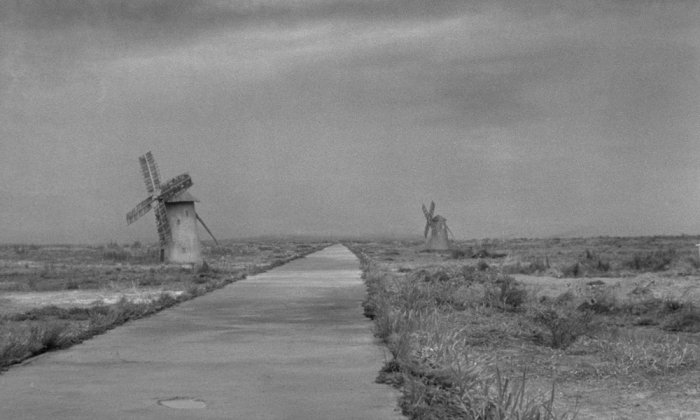
Still from Hitchcock’s “Foreign Correspondent” (1940)
By: Slavoj Žižek
In the film “Foreign Correspondent,”there is a short scene that exemplifies what might be called the elementary cell, the basic matrix of the Hitchcockian procedure. In pursuit of the kidnappers of a diplomat, the hero finds himself in an idyllic Dutch countryside with fields of tulips and windmills. All of a sudden, he notices that one of the mills rotates against the direction of the wind.
Here we have the effect of what Jacques Lacan calls the point de capiton (the quilting point) in its purest: a perfectly natural and familiar situation is denatured, becomes “uncanny,” loaded with horror and threatening possibilities as soon as we add to it a small supplementary feature, a detail that does not belong, that sticks out, is out of place, and does not make any sense within the frame of the idyllic scene. This “pure” signifier without signified stirs the germination of a supplementary, metaphorical meaning for all other elements: the same situations, the same events that, till then, have been perceived as perfectly ordinary acquire an air of strangeness. Suddenly we enter the realm of double meaning, where everything seems to contain some hidden meaning that is to be interpreted by the Hitchcockian hero, “the man who knows too much.” The horror is thus internalized; it reposes on the gaze of him who “knows too much.”1
Hitchcock is often reproached for his “phallocentrism”; although meant as a criticism, this designation is quite adequate, on condition that we locate the phallic dimension precisely in this supplementary feature that “sticks out.” To explain, let us articulate three successive ways of presenting an event onscreen, three ways that correspond to the succession of “oral,” “anal,” and “phallic” stages in the subject’s libidinal economy.
The “oral” stage is, so to speak, the zero degree of filmmaking: We simply shoot an event, and as spectators we “devour it with our eyes”; the montage has no function in organizing narrative tensions. Its prototype is the silent, slapstick film. The effect of “naturalness,” of direct rendering of reality, is, of course, false: Even at this stage, a certain choice is at work, part of reality is enframed and extracted from the spacetime continuum. What we see is the result of a certain manipulation; the succession of shots partakes of a metonymical movement. We see only parts, fragments of a never-shown whole, which is why we are already caught in a dialectic of seen and unseen, of the field (enframed by the camera) and its outside, giving rise to the desire to see what is not shown. For all that, we remain captive of the illusion that we witness a homogeneous continuity of action registered by the “neutral” camera.
In the “anal” stage, montage enters. It cuts up, fragments, and multiplies the action; the illusion of homogeneous continuity is forever lost. Montage can combine elements of a wholly heterogeneous nature and thus create new metaphorical meaning having nothing whatsoever to do with the “literal” value of its component parts (compare Eisenstein’s concept of “intellectual montage”). The exemplary display of what montage can achieve at the level of traditional narration is, of course, the case of “parallel montage”: We show in alternation two interconnected courses of action, transforming the linear deployment of events into the horizontal coexistence of two lines of action, thus creating an additional tension between the two.
Let us take, for example, a scene depicting the isolated home of a rich family encircled by a gang of robbers preparing to attack it; the scene gains enormously in effectiveness if we contrast the idyllic everyday life within the house with the threatening preparations of the criminals outside: if we show in alternation the happy family at dinner, the boisterousness of the children, father’s benevolent reprimands, etc., and the sadistic smile of a robber, another checking his knife or gun, a third already grasping the house’s balustrade.
In what would the passage to the “phallic” stage consist? In other words, how would Hitchcock shoot the same scene? The first thing to remark is that the content of this scene does not lend itself to Hitchcockian suspense insofar as it rests upon a simple counterpoint of idyllic interior and threatening exterior. We should therefore transpose this “flat,” horizontal doubling of the action onto a vertical level: the menacing horror should not be placed outside, next to the idyllic interior, but well within it, more precisely: under it, as its repressed underside.
Let us imagine, for example, the same happy family dinner shown from the point of view of a rich uncle, their invited guest. In the midst of dinner, the guest (and together with him, we, thepublic) suddenly “sees too much,” observes what he was not supposed to notice, some incongruous detail arousing in him the suspicion that the hosts plan to poison him in order to inherit his fortune. Such a “surplus knowledge” has, so to speak, an abyssal effect on the perspective of the host (and ours with it): The action is in a way redoubled in itself, endlessly reflected in itself as in a double mirror play. The most common, everyday events are suddenly loaded with terrifying undertones, everything becomes suspicious: The kind mistress of the house asking if we feel well after dinner wants perhaps to learn if the poison has already taken effect; the children who run around in innocent joy are perhaps excited because the parents have hinted that they would soon be able to afford a luxurious voyage… Things appear in a totally different light, although they stay the same.
Incomparably more threatening than the savage cries of the enemy is his calm and cold gaze.
Such a “vertical” doubling entails a radical change in the libidinal economy: The “true” action is repressed, internalized, subjectivized, i.e., presented in the form of the subject’s desires, hallucinations, suspicions, obsessions, feelings of guilt. What we actually see becomes nothing but a deceptive surface beneath which swarms an undergrowth of perverse and obscene implications, the domain of what is prohibited. The more we find ourselves in total ambiguity, not knowing where “reality” ends and “hallucination” (i.e., desire) begins, the more menacing this domain appears. Incomparably more threatening than the savage cries of the enemy is his calm and cold gaze, or — to transpose the same inversion into the field of sexuality — incomparably more exciting than the openly provocative brunette is the cold blonde who, as Hitchcock reminds us, knows how to do many things once we find ourselves alone with her in the back seat of a taxi. What is crucial here is this inversion by means of which silence begins to function as the most horrifying menace, where the appearance of a cold indifference promises the most passionate pleasures — in short, where the prohibition against passing over into action opens up the space of a hallucinatory desire that, once set off, cannot be satisfied by any “reality” whatsoever.
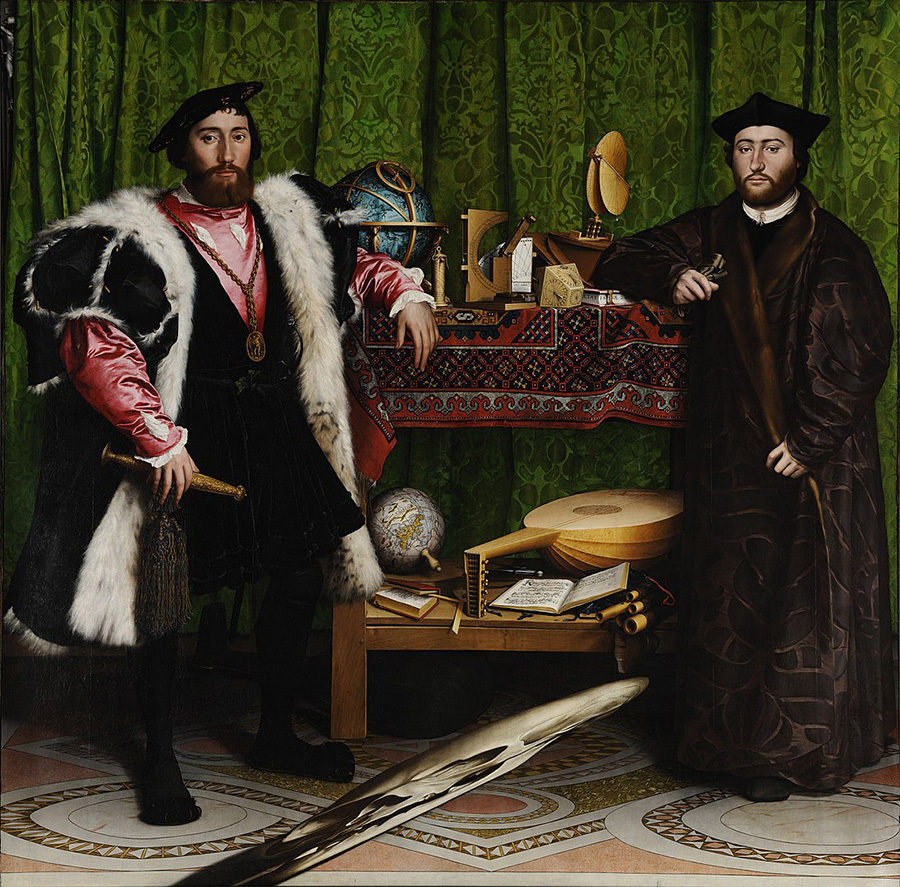
Hans Holbein the Younger, “The Ambassadors,” 1533.
But what has this inversion to do with the “phallic” stage? “Phallic” is precisely the detail that “does not fit,” that “sticks out” from the idyllic surface scene and denatures it, rendering it uncanny. It is the point of anamorphosis in a picture: the element that, when viewed straightforwardly, remains a meaningless stain, but which, as soon as we look at the picture from a precisely determined lateral perspective, suddenly acquires well-known contours.
Lacan’s constant point of reference is Holbein’s “Ambassadors”:At the bottom of the picture, under the figures of the two ambassadors, a viewer catches sight of an amorphous, extended, “erected” spot. It is only when, on the very threshold of the room in which the picture is exposed, the visitor casts a final lateral glance at it that this spot acquires the contours of a skull,disclosing thus the true meaning of the picture — the nullity of all terrestrial goods, objects of art and knowledge that fill out the rest of the picture.
This is the way Lacan defines the phallic signifier, as a “signifier without signified” which, as such, renders possible the effects of the signified: The “phallic” element of a picture is a meaningless stain that denatures it, rendering all its constituents suspicious, and thus opens up the abyss of the search for a meaning — nothing is what it seems to be, everything is to be interpreted, everything is supposed to possess some supplementary meaning. The ground of the established, familiar signification opens up; we find ourselves in a realm of total ambiguity, but this very lack propels us to produce ever-new “hidden meanings”: It is a driving force of endless compulsion. The oscillation between lack and surplus meaning constitutes the proper dimension of subjectivity.
In other words, it is by means of the “phallic” spot that the observed picture is subjectivized: This paradoxical point undermines our position as “neutral,” “objective” observer, pinning us to the observed object itself. This is the point at which the observer is already included, inscribed in the observed scene-in a way, it is the point from which the picture itself looks back at us.2
From this perspective, the denouement of “Dial M for Murder” is extremely interesting insofar as it reverses the usual situation of Hitchcock’s films: “The man who knew too much” is not the hero foreboding some terrifying secret behind the idyllic surface, but the murderer himself. That is to say, the inspector traps the murderous husband of Grace Kelly through a certain surplus knowledge — the murderer is caught knowing something that it would not be possible for him to know if he were innocent (the hiding place of the other key to his apartment).The irony of the denouement is that what provokes the downfall of the murderer is precisely his quick and clever reasoning. If he had been just a little bit more slow-witted, i.e., if, after the key in his jacket had failed to open the door to his apartment, he had been unable to deduce quickly what must have happened, he would have been forever safe from the hand of justice. In the way he sets the trap for the murder, the inspector acts like a real Lacanian analyst: The crucial ingredient of his success is not his ability to “penetrate the other,” to understand him, to adapt to his reasoning, but rather his capacity to take into account the structuring role of a certain object that circulates among the subjects and entangles them in a network that they cannot dominate — the key in “Dial M for Murder” (and in “Notorious”), the letter in Edgar Allen Poe’s “The Purloined Letter,” etc.
We must be attentive to the diversity of the ways this motif of the “uncanny” detail is at work in Hitchcock’s films. Note just five of its variations:
•“Rope”: Here, we have the spot first (the traumatic act of murder) and then the idyllic everyday situation (the party) constructed to conceal it.
•”The Man Who Knew Too Much”: In a short scene in which the hero (James Stewart) makes his way to the taxidermist Ambrose Chappell, the street the hero traverses is depicted as charged with a sinister atmosphere; but in fact things are precisely what they seem to be (the street is just an ordinary suburban London street, etc.), so that the only “stain” in the picture is the hero himself, his suspicious gaze that sees threats everywhere
•”The Trouble with Harry”: A “stain” (a body) smears the idyllic Vermont countryside, but instead of provoking traumatic reactions, people who stumble upon it merely treat it as a minor inconvenience and pursue their daily affairs.•“Shadow of a Doubt”: The “stain” here is uncle Charlie, the film’s central character, a pathological murderer who rejoins his sister’s family in a small American town. In the eyes of the townsfolk, he is a friendly, rich benefactor; it is only his niece Charlie who “knows too much” and sees him as he is — why? The answer is found in the identity of their names: the two of them constitute two parts of the same personality (like Marion and Norman in “Psycho,” where the identity is indicated by the fact that the two names reflect each other in an inverted form).
•And finally “The Birds,” where — in what is surely Hitchcock’s final irony — the “unnatural” element that disturbs everyday life is the birds, i.e., nature itself.
POSTED ON AUG 15
The MIT Press is a mission-driven, not-for-profit scholarly publisher. Your support helps make it possible for us to create open publishing models and produce books of superior design quality.
MINNEAPOLIS—In its detailed analysis of how your corpse will appear when lying on a brightly lit postmortem examination table, a report published Friday by researchers in the University of Minnesota’s mortuary science program concluded that your naked body will make the entire morgue laugh. “According to our projections, the mortician, an assistant, and anyone else who happens to walk in and catch sight of your unclothed remains will immediately burst into uncontrollable laughter at both the size and shape of your various body parts,” said lead researcher Rachel Stein, adding that your abdomen, genitals, and buttocks, along with any tattoos you may have, will become inside jokes at the funeral home, hospital, or medical examiner’s office where your dead body will lie exposed for several hours. “Someone will look at your toe tag, chuckle as they read your name aloud, and then tell all their coworkers to ‘come over here and take a look at this one.’ A gathering of people will soon be pointing out unsightly aspects of your body and saying things like ‘That’s just goofy’ and ‘I’ve never seen one like that before.’ They will remember your name for many years, as it will become shorthand for any repellent anatomical feature they encounter from that day on.” The report went on to state that this situation will not be helped by the fact that your name is Dick B. Short.
Consciousness, spirituality, biography, sexuality, androgyny, futurism, space, the arts, science, astrology, democracy, humor, books, movies and more


Facebook