

Americans have 400 days to save their democracy

I never thought I’d see fear spread so far and fast. Next year’s midterm elections are now crucial for the Democratic party – and for democrats everywhere
Tue 16 Sep 2025 (TheGuardian.com)
Illustration: Rob Dobi/Getty
I return to Europe from the US with a clear conclusion: American democrats (lowercase d) have 400 days to start saving US democracy. If next autumn’s midterm elections produce a Congress that begins to constrain Donald Trump there will then be a further 700 days to prepare the peaceful transfer of executive power that alone will secure the future of this republic. Operation Save US Democracy, stages 1 and 2.
Hysterical hyperbole? I would love to think so. But during seven weeks in the US this summer, I was shaken every day by the speed and executive brutality of President Trump’s assault on what had seemed settled norms of US democracy and by the desperate weakness of resistance to that assault. There’s a growing body of international evidence to suggest that once a liberal democracy has been eroded, it’s very difficult to restore it. Destruction is so much easier than construction.
That’s why all democrats, irrespective of party or ideology, must hope the Democrats regain control of the House of Representatives in midterm elections on 3 November 2026. Not because of the Democrats’ policies, which are a muddle, or their current leadership, which is a mess, but simply because US democracy needs Congress, the principal check on presidential power envisaged in the US constitution, to start doing its job again. That will not happen so long as the Republicans, dominated and intimidated by Trump, control both houses.
Much has been made of comparisons to other authoritarian power grabs, from Europe in the 1930s to Viktor Orbán’s Hungary, but I’m most struck by the distinctive features of the US case. To name just four: excessive executive power; chronic gerrymandering; endemic violence; and the way a would-be authoritarian can exploit the intense capitalist competition that permeates every area of US life.
The danger of executive overreach has been there from the very beginning. Revolutionary war hero Patrick Henry (“give me liberty or give me death”) voted against the constitution at the Virginia ratifying convention in 1788 precisely because he thought it would give a criminal president the chance “to make one bold push for the American throne.” Throughout the 20th century, presidents of both parties extended the “executive power” that is so ill-defined in article 2 of that constitution. More recently, a conservative-dominated supreme court has given succour to the unitary executive theory developed by rightwing legal theorists, which gives the most expansive reading of presidential power. And now the Trump administration – well prepared, unlike in 2017 – has exploited every inch and wrinkle of existing executive power, as well as simply breaking the law and defying the courts to stop it.
Tom Ginsburg, a leading US comparative constitutionalist, argues that the biggest single flaw of the unreformed US constitution is that it gives state legislatures the power to draw electoral boundaries. The word gerrymandering was coined as early as 1812. In recent times, partisan redistricting has become more extreme as US politics has become more polarised. And then, in 2019, the supreme court declared that it could not correct even the most blatant party-political gerrymandering (only that done on racial lines). So now, at Trump’s direct request, Texas sets out to change constituency boundaries explicitly to win five more seats for the Republicans in the midterms, whereupon California says it will counter-gerrymander to win five more for the Democrats. There’s no longer even a bare pretence of impartiality about the most basic procedure of democracy.
No European society can compare to the US for the ubiquity of violence. Hardly a day passed this summer without the evening news reporting at least one violent crime, including yet another horrific school shooting. The US has more guns than people. France loves its pseudo-revolutionary political theatre, but the US had the 6 January 2021 mob assault on the Capitol. Now the rightwing activist Charlie Kirk has been shot. Before the identity of the killer was known, Elon Musk said “the left is the party of murder” and Trump blamed the hate speech of the “radical left”. It will be a miracle if the US avoids a downward spiral of political violence, as last seen in the 1960s. That in turn could be the pretext for Trump to invoke the 1807 Insurrection Act, bring more military on to US streets and further exploit an alleged state of emergency.
Meanwhile, universities, business leaders, law firms, media platforms and tech supremos have utterly failed to engage in collective action in response. They have either kept their heads down, settled humiliatingly like Columbia University and the law firm Paul, Weiss, or fawned on the president, like Mark Zuckerberg. Why? Because they all follow the logic of fierce free-market competition and fear targeted reprisals. I never imagined I would see fear spread so far and fast in the US.
Add in attempts to disqualify or intimidate voters, plus Trump’s threat to ban mail-in ballots, and there’s a real doubt how far next November’s midterm elections will be fully free and fair. The task for democrats of all parties is to ensure they are, so far as possible. The task for the Democrats (capital D) is to win them in spite of any such obstacles.
The key to that will probably still be bread-and-butter issues. Here, in the economy, lies paradoxical hope. We’re already beginning to see Trump’s tariffs feed through into higher prices. The job numbers are weakening. Trump’s “big beautiful bill” will further increase an already gobsmacking national debt of $37tn (£27tn). Already in the 2024 fiscal year, servicing that debt cost more than the entire $850bn defence budget. But until a debt crisis actually hits, such macro-risks remain remote and abstract to most voters, rather as predictions of diminished GDP growth made little impact in the Brexit referendum debate.
So the big question is whether the negative economic consequences of Trump will be palpable to ordinary voters before the midterms. One astute political observer suggested to me that Trump, flush with revenue from the new tariffs, could do a pre-election cash handout to voters, perhaps presented as compensation for the “temporary difficulties” of the transition to a Maga economy. That would be a classic populist move.
Human: Origins | NOVA | PBS
NOVA PBS Official Premiered 19 hours ago Trace the remarkable origin story of Homo sapiens and the crucial moments that shaped our species. Official website: https://to.pbs.org/46djrws | #novapbs Where do we come from? To find out, journey back to a time when multiple human species walked the earth. Discover how radical fossil finds in Morocco rewrote the history of our origins – suggesting we did not have a single birthplace, but that modern Homo sapiens emerged from a mosaic of prehistoric, early human communities. Explore the tools, language, and rituals that bound us together, and the setbacks that nearly destroyed us. (A 5-part series premiering September 17, 2025 at 9 pm ET on #pbs ) Chapters 00:00 Introduction 06:37 Discovery of Early Human Remains in Africa 16:37 Adaptability and Evolution of Human Species 34:36 Early Human Behavior, Innovation and Culture 50:07 Conclusion © 2025 WGBH Educational Foundation All rights reserved
Free Will Astrology: Week of September 18, 2025
BY ROB BREZSNY | SEPTEMBER 16, 2025 (NewCity.com)

ARIES (March 21-April 19): Hindu goddess Durga rides a tiger and carries weapons in her ten hands, including a sword, axe and thunderbolt. Yet she wears a pleasant smile. Her mandate to aid the triumph of good over evil is not fueled by hate but by luminous clarity and loving ferocity. I suggest you adopt her attitude, Aries. Can you imagine yourself as a storm of joy and benevolence? Will you work to bring more justice and fairness into the situations you engage with? I imagine you speaking complex and rugged truths with warmth and charm. I see you summoning a generous flair as you help people climb up out of their sadness and suffering. If all goes well, you will magnetize others to participate in shared visions of delight and dignity.
TAURUS (April 20-May 20): Born under the sign of Taurus, Maya Deren first expressed her extravagant creative urges as a writer, poet, photographer, clothes designer and dancer. But then she made a radical change, embarking on a new path as experimental filmmaker. She said she had “finally found a glove that fits.” Her movies were highly influential among the avant-garde in the 1940s and 1950s. I bring Deren to your attention, Taurus, because I suspect that in the coming months, you, too, will find a glove that fits. And it all starts soon.
GEMINI (May 21-June 20): In medieval times, alchemists believed mercury was a sacred substance and divine intermediary. They knew that it’s the only metal that’s liquid at room temperature. This quality, along with its silvery sheen (why it’s called “quicksilver”), made it seem like a bridge between solid and liquid, earth and water, heaven and earth, life and death. I nominate mercury as your power object, Gemini. You’re extra well-suited to navigate liminal zones and transitional states. You may be the only person in your circle who can navigate paradox and speak in riddles and still make sense. It’s not just cleverness. It’s wisdom wrapped in whimsy. So please offer your in-between insights freely. PS: You have another superpower, too: You can activate dormant understandings in both other people’s hearts and your own.
CANCER (June 21-July 22): In the western Pacific Ocean, there’s a species of octopus that builds its lair from coconut shells. The creature gathers together husks, dragging them across the seafloor, and fits them together. According to scientists, this use of tools by an invertebrate is unique. Let’s make the coconut octopus your power creature for now, Cancerian. You will have extra power to forge a new sanctuary or renovate an existing one, either metaphorically or literally. You will be wise to draw on what’s nearby and readily available, maybe even using unusual or unexpected building materials.
LEO (July 23-Aug. 22): I invite you to contemplate the meaning of the phrase “invisible architecture.” My dream told me it will be a theme for you in the coming weeks. What does it mean? What does it entail? Here are my thoughts: Structures are taking shape within you that may not yet be visible from the outside. Bridges are forming between once-disconnected parts of your psyche and life. You may not need to do much except consent to the slow emergence of these new semi-amazing expressions of integrity. Be patient and take notes. Intuitions arriving soon may be blueprints for future greatness. Here’s the kicker: You’re not just building for yourself. You’re working on behalf of your soul-kin, too.
VIRGO (Aug. 23-Sept. 22): A supple clarity is crystallizing within you. Congratulations! It’s not a brittle or rigid certainty, but a knack for limber discernment. I predict you will have an extra potent gift for knowing what truly matters, even amidst chaos or complication. As this superpower reaches full ripeness, you can aid the process by clearing out clutter and refining your foundational values. Make these words your magic spells: quintessence, core, crux, gist, lifeblood, root. PS: Be alert for divine messages in seemingly mundane circumstances.
LIBRA (Sept. 23-Oct. 22): The ancient Mesopotamian goddess Inanna was called “the Queen of Heaven.” Her domains were politics, divine law, love and fertility. She was a powerhouse. One chapter of her mythic story tells of her descent into the underworld. She was stripped of everything—clothes, titles, weapons—before she could be reborn. Why did she do it? Scholars say she was on a quest for greater knowledge and an expansion of her authority. And she was successful! I propose we make her your guide and companion in the coming weeks, Libra. You are at the tail-end of your own descent. The stripping is almost complete. Soon you will feel the first tremors of return—not loud, not triumphant, but sure. I have faith that your adventures will make you stronger and wiser, as Inanna’s did for her.
SCORPIO (Oct. 23-Nov. 21): In ancient Rome, the dye called Tyrian purple was used exclusively for garments worn by royalty and top officials. It had a humble origin: murex snails. Their glands yielded a pale liquid that darkened into an aristocratic violet only after sun, air and time worked upon it. I’m predicting you will be the beneficiary of comparable alchemical transformations in the coming weeks. A modest curiosity could lead to a major breakthrough. A passing fancy might ripen into a rich blessing. Seemingly nondescript encounters may evolve into precious connections.
SAGITTARIUS (Nov. 22-Dec. 21): Bees can see ultraviolet patterns in flowers that are invisible to humans. These “nectar guides” direct bees to the flower’s nectar and pollen, functioning like landing strips. Let’s apply these fun facts as metaphors for your life, Sagittarius. I suspect that life is offering you subtle yet radiant cues leading you to sources you will be glad to connect with. To be fully alert for them, you may need to shift and expand the ways you use your five senses. The universe is in a sense flirting with you, sending you clues through dream-logic and nonrational phenomena. Follow the shimmering glimmers.
CAPRICORN (Dec. 22-Jan. 19): At the height of her powers, Egyptian pharaoh Hatshepsut declared, “I have restored what had been ruined. I have raised up what had dissolved.” You now have a similar gift at your disposal, Capricorn. If you harness it, you will gain an enhanced capacity to unify what has been scattered, to reforge what was broken, and to resurrect neglected dreams. To fulfill this potential, you must believe in your own sovereignty—not as a form of domination, but of devotion. Start with your own world. Make beauty where there was noise. Evoke dignity where there was confusion.
AQUARIUS (Jan. 20-Feb. 18): In the high Himalayas, there’s a flower called Saussurea obvallata—the Brahma Kamal. It blooms only at night and for a short time, releasing a scent that legend says can heal grief. This will be your flower of power for the coming weeks, Aquarius. It signifies that a rare and time-sensitive gift will be available, and that you must be alert to gather it in. My advice: Don’t schedule every waking hour. Leave space for mystery to arrive unannounced. You could receive a visitation, an inspiration, or a fleeting insight that can change everything. It may assuage and even heal sadness, confusion, aimlessness or demoralization.
PISCES (Feb. 19-March 20): The human heart beats 100,000 times per day, thirty-five million times per year, and 2.5 billion times in an average lifetime. It’s the most reliable “machine” ever created, working continuously and mostly without special maintenance for decades. Although you Pisceans aren’t renowned for your stability and steadiness, I predict that in the coming weeks, you will be as staunch, constant and secure as a human heart. What do you plan to do with this grace period? What marvels can you accomplish?
Homework: I dare you to plan a wild and smart adventure. Newsletter.FreeWillAstrology.com
Treasury Department Badly Needs Ones And Fives

Published: February 27, 2002 (TheOnion.com)
WASHINGTON, DC—Critically low on small denominations, the Treasury Department put out an urgent call for ones and fives Monday.
“If we don’t get some soon, we’re going to run out,” Deputy Treasury Secretary Kenneth Dam said. “And right now, we have no one we can send to the Bureau of Engraving and Printing to grab more. [Executive Secretary] Jeffrey [Kupfer] is in Federal Trade Commission meetings all day, and [Under Secretary] Peter [Fisher] is too new to handle cash.”
Though Dam said he suspects there may be a fully stocked tray of cash in the department’s safe, the only one who knows the combination is Secretary Paul O’Neill, who is at an economic summit in Stockholm until Saturday.
The shortfall, Dam said, is the result of the unusually busy day the department is having.
“For some reason, all the banks want ones and fives today,” Dam said. “Usually, it’s twenties we run low on first, because everybody needs them for their cash machines, but today it’s the small stuff.”
In addition to a sign on the Alexander Hamilton statue in front of the Treasury Building, Dam posted a handwritten sign on the front door reading, “We need ones and fives!!! Any that you have would be hugley [sic] appreciated!!!” Thus far, no one has come forward.
The appeal was directed at any U.S. citizens in the vicinity of the department, as well as members of Congress, whose annual budget allocation to the Treasury Department is forthcoming.
“We have, like, less than 10 ones left right now,” Dam said. “We have a few rolls of quarters we could give out four at a time, but those won’t last very long.”
Early Tuesday morning, Dam put in a call to the Internal Revenue Service to lend the Treasury any singles it may have on hand from early tax returns.
“So far, I haven’t heard back from [IRS commissioner] Charles [Rossotti],” Dam said. “I left a message, but he must be real busy this time of year. Hopefully soon.”
Dam, who was left in charge of the Treasury in O’Neill’s absence, was explicitly told by the secretary to make sure the department kept plenty of small bills on hand.
“This is really getting bad,” Dam said. “All we need is for one more lending institution to come in here and ask us to break a twenty and that’s it.”
Hermann Hesse on owning up to ourselves


To Know Them, We Must Love them
Truth Emerges from Deep Communion
| ROB BREZSNY SEP 16, 2025 |

TO KNOW THEM, WE MUST LOVE THEM
In order to understand anyone or anything, we have to love it. Every act of true knowing begins not with intellect, not with data, not with clever analysis—but with love.
I don’t mean romantic passion or self-centered yearning tinged with expectation or sentimentality. The love I mean is the radiant force of compassion, empathy, and lovingkindness.
When we open up our perceptions and sensibilities with love to a marsh frog, black oak tree, or red fox, we declare: “You are a source of truth we aren’t familiar with. You are a portal of blessing worthy of communion. You have teachings and influences we are interested in. We are receptive to your specific intelligence speaking through your special language.”
We are not being metaphorical or poetic here. We are not using fairy tale logic. Our meaning is literal. This is the law of the Divine Hologram: Every living entity is a fractal cell in the Divine Consciousness; is a special case of the One Intelligence expressing itself; is a facet of the Infinite Soul offering a unique gift.
+
I’ll tell you an ultimate and primal fact that goes largely unacknowledged: Every living thing LONGS to express its unprecedented genius so that we can take it in. (It’s the same ache we all carry: to be witnessed, to be loved, to be known.)
In giving our loving attention to the marsh frog or black oak or red fox, we are expressing our wish to understand it. This allows it, in turn, to give us the tremendous and mysterious gift of its special intelligence, expressed through its unique language.
The gift we receive is double.
The first initiation: We are jolted awake out of our narrow perspective. We slip free from the flatland of habitual consciousness. We see with frog-eyes, think with oak-roots, roam with fox-senses. We become amphibious, arboreal, feral. Our human awareness sprouts new limbs of perception.
The second initiation: We receive the harvest. The marsh frog’s croak may disclose the savvy of living in two worlds; the oak may murmur a gospel of endurance; the fox may smuggle into our dreams a joke that doubles as a revelation. Each offering awakens a corresponding chamber of the Universal Goddess
Yes, each of us is a holographic shard of the Universal Projector, the One and Only Hologram. But sometimes, in order to “turn on” parts of the All-In-One within us, we have to open to those specific parts in the physical world. They remain remain dormant until the outer frog, oak, or fox sings us into remembering.
And this is a crucial part of our strategy to enter into a variety of altered states in our quest to viscerally commune with a myriad aspects of the Divine Consciousness.
If we can learn to speak the language of the marsh frog, black oak, and red fox, and awaken in ourselves the parts of our intelligence that are like a marsh frog’s, black oak’s, and red fox’s, then we have glided into an altered state.
Let’s say we can do this regularly, in little or big ways. Once every day, and more on our freer days, we can open our heart-soul-brain with love in the quest to understand the essence of a marsh frog, black oak, or red fox. And can, thereby, allow the marsh frog, black oak, or red fox to do what comes naturally for it, to do what it was made to do, which is to unveil itself to us in glorious extravagant fullness, with its own love nature bursting.
And so the marsh frog, black oak, or red fox can initiate us into the enigmas of its intelligence, teach us how to experience the world as it does, and bestow on us the power to alter our state of awareness—giving us yet one more tool for knowing the Divine Soul not just conceptually but with gnosis, with visceral understanding.

TO KNOW A PERSON, WE MUST LOVE THEM
The same law that opens us to frog, fox, and oak—or cat, dragonfly, rose, horse, goldfinch, and all the rest—applies to the human beings who cross our path. A person, too, is a fractal shard of the Infinite Soul, aching to reveal their genius if only they are met with love.
To know a person is not to catalogue their traits or analyze their patterns. It’s to open our heart-soul-brain with the same luminous receptivity we offer to the wild intelligences. The gaze of love says: “You are not a puzzle to be solved but a song I long to hear. I will sit close enough to feel your rhythm, patient enough to let your hidden roots speak.”
When we approach a person this way, two initiations awaken:
First Initiation: We are jolted out of the flat caricatures we make of others. We slip free of projections and prejudices. We begin to glimpse their many-sided paradox, their amphibious capacity to be more than one thing.
Second Initiation: We receive their gifts—their sly humor that rescues us from despair, their rooted endurance that steadies our own trembling, their capacity for metamorphosis that awakens hope. Each offering is a spark of the Universal Goddess refracted through their singular life.
To know a person, we must love them. Love is the solvent that dissolves the barriers of fear. Love is the riddle that rouses our dormant chambers of recognition. With love, we breathe their air, taste their dreams, and let them alter our state of awareness.
And the gift is doubled: They are witnessed into fuller being, and we are rewilded into fuller knowing.
Herman Hesse on losing oneself

“He had loved and he had found himself. Most people love to lose themselves.”
~ Hesse
Hermann Karl Hesse (July 2, 1877 – August 9, 1962) was a German-Swiss poet and novelist, and the 1946 Nobel Prize in Literature laureate. His interest in Eastern religious, spiritual, and philosophical traditions, combined with his involvement with Jungian analysis, helped to shape his literary work. Wikipedia
How Oakland teachers are using — or avoiding — AI in the classroom
With only a bare bones policy from Oakland Unified School District, educators are on their own figuring out how to incorporate artificial intelligence platforms and keep students from misusing them.
by Ashley McBride Sept. 16, 2025, 4:55 p.m. (Oaklandside.org)

Help us tell the Oakland stories that matter to you and your fellow Oaklanders.
Yes, I want to chip in to support Oaklandside’s work!
When Calupe Kaufusi was a freshman at McClymonds High School in West Oakland, he’d use platforms like ChatGPT or Google Gemini for written assignments in his history class. But he quickly learned they weren’t infallible.
“It became kind of inconvenient,” Kaufusi said. “As I learned more about AI, I learned it wouldn’t give you correct information and we’d have to fact check it.”
Like many students, Kaufusi used generative AI platforms — where users can input a prompt and receive answers in various formats, be it an email text, an essay, or the answers to a test — to get his work done quickly and without much effort. Now a junior, Kaufusi said he’s dialed down his AI use.
Already rampant in college and university settings, artificial intelligence software is also reshaping the K-12 education landscape. Absent a detailed policy in the Oakland Unified School District, individual teachers and schools have been left to navigate how to integrate the technology in their classrooms — or how to try to keep it out.

Some teachers told The Oaklandside they are choosing to embrace AI by incorporating it into student projects or using it to assist with their own lesson planning, while others have said they’ve rejected it for its environmental impacts and how it enables students to cut corners. Some teachers are returning to old forms of assessment, such as essays handwritten during class that can’t be outsmarted by the platforms.
What’s clear to many is that AI platforms are already ubiquitous on the internet and many students are going to use them whether their teachers advise them to or not.
Never miss a story. Sign up for The Oaklandside’s free daily newsletter.Email
Kaufusi, who is in McClymonds’ engineering pathway, is interested in studying machine learning or software engineering, so he wants to see more of his teachers discuss responsible uses for AI. “They know there’s no way to stop us” from using it, he said, “so they can try to teach us how to use it properly.”
A new policy in the works
Under current OUSD guidance, published in March, teachers and principals are left to determine whether students are allowed to use AI in their work; if they do, students are required to cite it. The guidance also outlines procedures for teachers to follow if they suspect a student is misusing AI, for example, by representing AI-generated work as their own, starting with a private conversation with the student, then the collection of evidence, and finally a consultation with colleagues about proper discipline.
Work is underway in Oakland Unified to develop a more comprehensive AI policy for the district, said Kelleth Chinn, the district’s instructional technology coordinator. In his role, he’s been thinking about how to address student use of AI. A former classroom teacher, Chinn can imagine beneficial uses for both students and teachers in the classroom, but he knows teaching students responsible uses for AI doesn’t preclude them from using it in dishonest ways.
“The reason that we need to talk about AI to students is because a lot of students are already using it,” Chinn told The Oaklandside. “In the absence of having any kind of conversations, you’re just leaving this vacuum without guidance for students.”
Any new draft policy would first be evaluated by the school board’s teaching and learning committee before being considered by the full board of directors. VanCedric Williams, chair of that committee, has met with Chinn and his team to discuss potential approaches. Williams, a veteran teacher, said he is hesitant to recommend a policy that would encourage educators to use AI.
“I do not want to put any expectations for teachers or students to use it or not,” Williams told The Oaklandside. “We’re looking at best practices around the state, what other districts are doing and what pitfalls they’ve incurred.”
Chinn added that he’s been looking at how colleges and universities are addressing AI. What he’s found is that some professors are turning away from papers and written homework assignments and toward methods like blue book exams and oral presentations that preclude the use of AI.
‘We just want our kids to be able to critically think’
Some teachers are hesitant to fully embrace the technology, concerned that it could hamper student learning and critical thinking. At Oakland Technical High School, a group of history and English teachers have formed a professional learning community to study AI in education and come up with potential guidance.
Amanda Laberge and Shannon Carey, who both teach juniors at Oakland Tech, joined the group as AI skeptics. Carey, who has been teaching in OUSD since 1992, sees AI differently than she does other advances in technology that have taken place over the course of her career.
“A computer is a tool: You can draft your essay and I can put comments on it,” Carey, a history teacher, told The Oaklandside. “Whereas AI, the way many students are using it, is to do their thinking for them.”
Carey noted that after years of a drive to incorporate more tech in the classroom, the tide is turning on cell phones — many schools now have “no smartphone” policies and last year Governor Gavin Newsom signed a law, which goes into effect in 2026, requiring all school districts to prohibit cell phone use during the school day.
Neither Carey nor Laberge plan to use AI themselves, the way some educators use it for grading or lesson planning.

Laberge, who teaches English in Oakland Tech’s race, policy, and law pathway, assigned her students a project encouraging them to think critically about AI. They’ll survey other students on how they use AI, research the cognitive impacts of relying on AI, gain an understanding of how exactly the algorithms and platforms operate, and examine wider societal implications.
“Our job is to help them develop skills and thinking so as adults they can do whatever they want,” Laberge said.
Laberge and Carey said they want to see OUSD put together an evidence-based policy around AI use. They mentioned a 2025 MIT study that monitored brain function for groups writing an essay. The authors found that those using a large language model to assist in writing the essay had lower brain activity than those who didn’t, and they had more trouble quoting their own work.
“We just want our kids to be able to critically think and read and write fluently and with grace,” Carey said. “We do not see a way in which AI is going to make that happen.”
Using AI strategically
At Latitude High School in Fruitvale, educators are taking a different approach. Computer science students at the charter school, which emphasizes project-based learning, are incorporating AI into math video games they’re creating for local fourth graders. This is the first year that classes have introduced AI as part of the curriculum, according to Regina Kruglyak, the school’s dean of instruction.
Students first write out code on their own, then run it through ChatGPT to test their ideas and find errors. The school uses GoGuardian, a software that can block websites, to restrict access to ChatGPT when students aren’t actively using it for an assignment, Kruglyak said.
“We were nervous about the possibility that students will forget how to do certain things, or they’ll never learn how to do it in the first place because they’ll just fall back on having ChatGPT do it for them,” Kruglyak said. “That’s where we use GoGuardian. Making sure that students are using their own brains and learning the skills in the first place feels very crucial.”
Kruglyak coaches Latitude’s science teachers and has held professional development sessions on new AI platforms. She recently introduced Notebook LM, a Google platform that can summarize documents and organize notes into various media. Kruglyak tested it by uploading a grant application and having the software turn it into a podcast. Her goal, she said, is to “change teachers’ minds about what AI can do, and how to help students learn from it rather than be scared of it as a teacher.”
It’s not only high school educators who are confronting students using AI. Joel Hamburger, a fifth grade teacher at Redwood Heights Elementary School, said with students using Google on their Chromebooks, AI results come up every time they type in a Google search. Hamburger, who has been teaching for four years, said this calendar year is when he first started noticing how unavoidable AI is in the classroom.
“Google AI culls the information from the internet and immediately gives you a response,” Hamburger told The Oaklandside. “Whereas a year or two ago, it gave you websites to go to.”
For now, he allows his students to use Google’s AI for filling out simple worksheets in class. At this time of year, Hamburger’s focus is teaching his students how to craft the right inputs to get the answers they’re looking for. During a spring unit on research projects, he’ll lay out the foundations for evaluating information and factchecking what Google serves up.
Any kind of AI policy should include tiered guidance for various grade levels, Hamburger said. While fifth graders may not be using ChatGPT, he said, they’re surrounded by AI on their devices and guidance for them may not look the same as instructions for a high schooler.
“The genie’s just about to be brought out of the bottle for these 10-year-olds,” he said. “They need to know appropriate uses.”
ASHLEY MCBRIDE
Ashley McBride writes about education equity for The Oaklandside. Her work covers Oakland’s public district and charter schools. Before joining The Oaklandside in 2020, Ashley was a reporter for the San Antonio Express-News and the San Francisco Chronicle as a Hearst Journalism Fellow. In 2024, Ashley received the California School Board Association’s Golden Quill Award, which recognizes fair, accurate, and insightful reporting on public schools. Ashley earned her master’s degree in journalism from Syracuse University and holds a certificate in education finance from Georgetown University.More by Ashley McBride
Trump Executive Order Quietly Declared That NASA Is Now a Spy Agency
PUTTING THE NSA INTO NASA
SEP 16, 12:10 PM EDT (Futurism.com)
So long, space science.
/ Off World/ Donald Trump/ NASA/ National Security
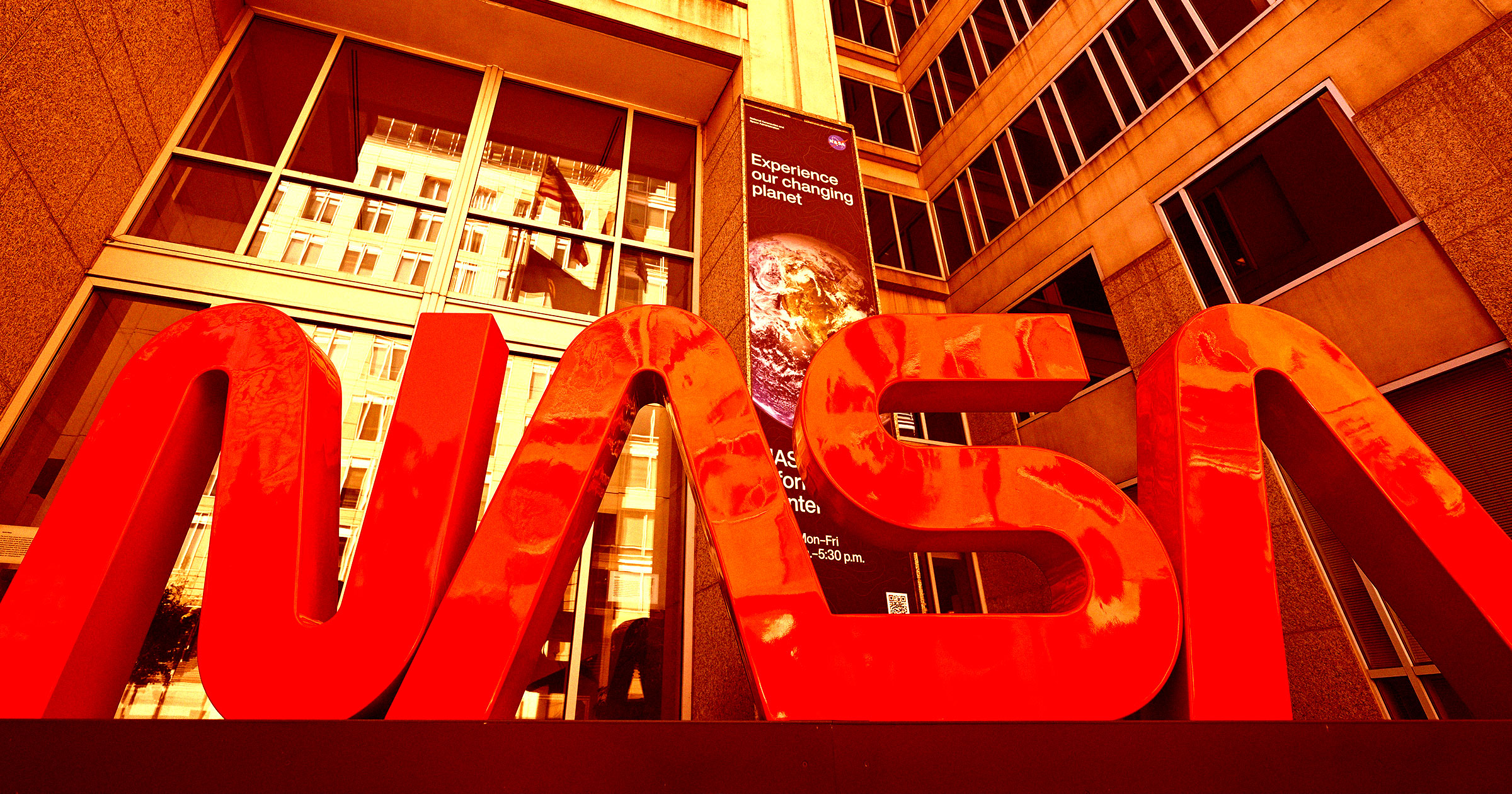
Image by Celal Gunes/Anadolu Agency via Getty Images
The Trump administration issued an executive order late last month, quietly declaring that NASA will operate as a national intelligence and security agency going forward.
The order stipulates that the agency will now “have as a primary function intelligence, counterintelligence, investigative, or national security work.”
It’s a major departure for the agency, which has historically focused on space exploration, as well as space and Earth sciences over its 67-year lifespan.
“No mention of that science and exploration stuff,” NASA Watch founder Keith Cowing, a former scientist at the agency who now closely follows its internal and external politics, wrote in a blog post.
There are signs that Trump’s intentions behind the order were at least partially related to labor concerns, rather than spycraft. The order also added NASA to the Federal Service Labor-Management Relations Statute (FSLMRS), excluding it from collective bargaining representation.
The news that NASA will now be a spy agency was seemingly overshadowed in the media by the president’s elimination of union rights for thousands of federal employees — mere days before Labor Day — despite multiple lawsuits challenging the change.
The change of status outlined in the order will also affect other agencies and subdivisions of the government, including the International Trade Administration and the National Weather Service.
The move sparked a protest outside of NASA’s Washington, DC, headquarters earlier this week.
“A huge part of the reason that I have that independence, and that my colleagues do, is that as a union-represented worker I know that I am protected from unfair retaliation,” Goddard Engineers, Scientists and Technicians Association area vice president Monica Gorman told the crowd, as quoted by Government Executive.
Trump’s latest declaration comes at a turbulent time for NASA. The White House has already threatened to cut the agency’s science budget in half for the next fiscal year, potentially putting dozens of major space missions on ice.
While lawmakers have come up with a far more lenient revision to the proposed budget, NASA is quickly running out of time.
Trump’s most recent reimagining of NASA also underlines the president’s desire to militarize space and commitment and send “boots” to the Moon and Mars, as interim NASA administrator Sean Duffy recently put it.
The president has also proposed sending weapons into space for the first time as part of his proposed “Golden Dome” missile defense program, raising concerns over a space arms race with the United States’ adversaries.
Meanwhile, space science has taken a back seat, with Duffy vowing last month that NASA will give up on “all of these Earth sciences,” highlighting the White House’s dismissal of climate change and anti-science stance.
Despite its doubling down on crewed space exploration, experts warn that the United States could fall behind China in the race to return to the Moon.
Put it all together, and it feels as though the government is increasingly NASA’s primary adversary, with the agency is expected to lose thousands of senior-ranking employees as Trump remakes the United States in his image.
More on NASA: Now That NASA Found Signs of Life on Mars, It’s Clear Trump Made a Massive Error
(Contributed by Michael Kelly, H.W.)