adjective: Having the appearance of truth or reality.
ETYMOLOGY:
From Latin verum (truth) + similis (like). Earliest documented use: 1681. The noun form is verisimilitude. See alsp Potemkin village.
USAGE:
“And will we, in the age of the image, become too easily accustomed to verisimilar rather than true things, preferring appearance to reality?” Christine Rosen; The Dangers of Visual Culture; The Futurist (Washington, DC); Mar/Apr 2007.
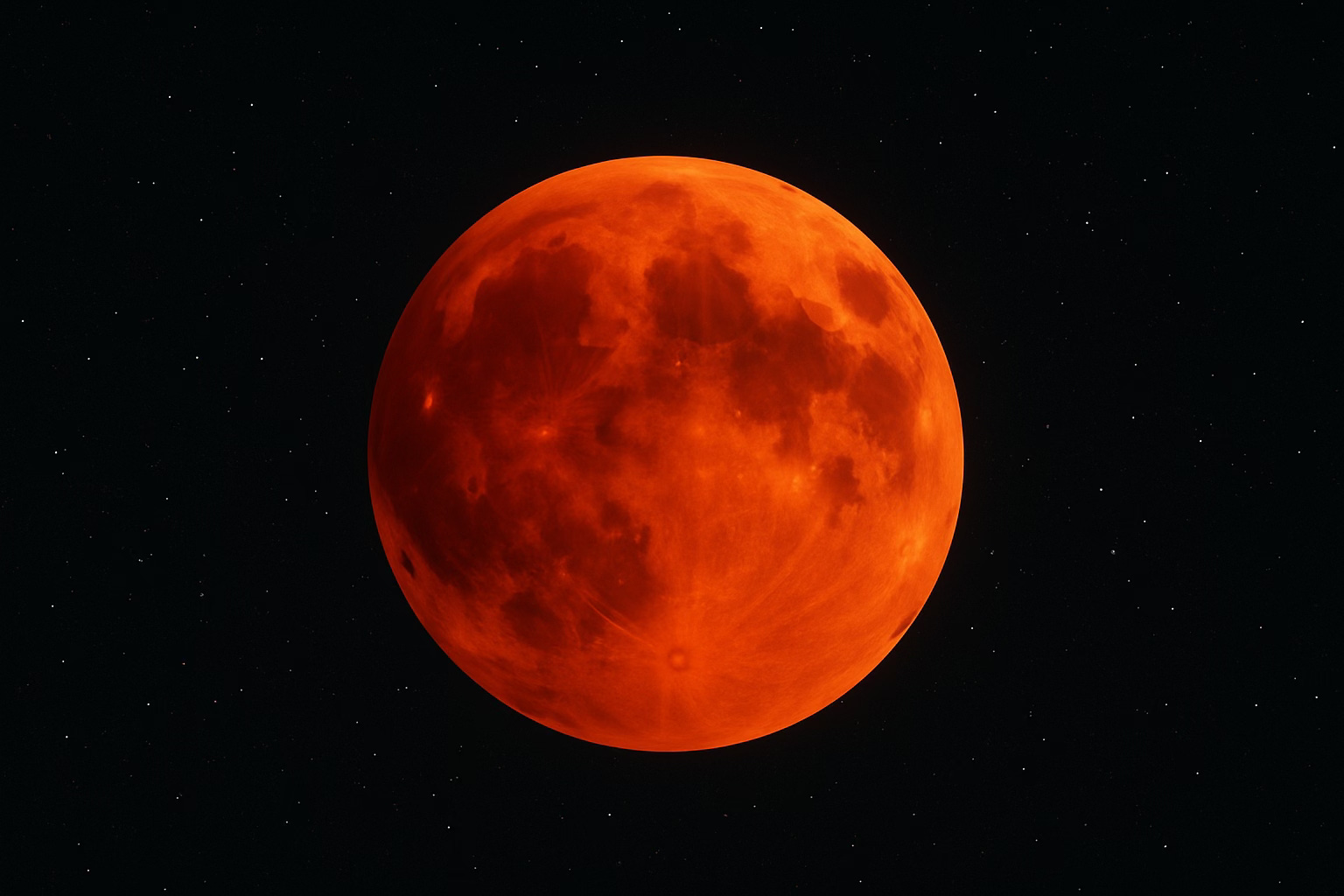
There are moments when the universe insists we pause. September 7th was one of them. The so-called Blood Moon, a total lunar eclipse, spread a deep red glow across the night sky. You didn’t need a telescope or a degree in astrophysics to appreciate it. You just needed to step outside, tilt your head upward, and let awe do the work it always has for our species.
Human beings have been gazing at eclipses since long before we had words to describe them. In Mesopotamia, priests believed lunar eclipses were omens for kings; in China, they told stories of dragons devouring the moon; in ancient Greece, Aristotle used eclipses to deduce that the Earth must be round.
The same event that sent shivers of fear through some cultures provoked wonder and scientific curiosity in others. The moon turning crimson has always been a mirror for human imagination, reflecting back our deepest fears and our most expansive dreams.
Science explains this blood-red moon easily enough. The Earth passes between the sun and the moon, casting a shadow that temporarily hides the familiar bright disk. Some light still bends through our atmosphere, and that light is redder because shorter wavelengths scatter away.
It’s the same principle that makes sunsets fiery. The physics are simple, elegant, and indisputable. But knowing the mechanics doesn’t make the event less magical, it makes it more so. To imagine photons of light traveling 93 million miles from the sun, slipping through the thin skin of our atmosphere, and then painting the moon a glowing red before those photons reach our eyes is a chain of connection almost too beautiful to comprehend.
Yet comprehension isn’t the point. What matters is the pause. What matters is that somewhere that night children tugged on their parents’ sleeves to ask what was happening, couples held hands beneath a darkening sky, and solitary wanderers felt less alone under the silent witness of a reddened moon.
The eclipse is democratic in the truest sense; it requires no ticket, no password, no status. The richest billionaire and the poorest farmworker look up at the same glowing disk and for one brief moment share exactly the same view.
It is rare in our fractured world to find such common ground. The eclipse doesn’t care about our politics, our borders, or our hierarchies. It comes when orbital mechanics dictate, indifferent to whether humans are at peace or war, whether we are gentle stewards of the Earth or reckless despoilers of it. Yet by its indifference it calls us to a kind of humility.
We can destroy the forests, poison the oceans, and heat the climate until it turns against us, but we can’t move the moon or alter its eternal dance with Earth and Sun. The eclipse is a reminder of forces larger than ourselves, of a cosmos that neither needs nor notices our dramas, and yet somehow makes space for our consciousness within it.
In an age when attention is our most scarce commodity, a lunar eclipse is a forced meditation. It slows us down. The shadow creeps gradually, so slowly it almost defies our impatient, digital minds. We’re used to instant results, to click and scroll, to dopamine hits delivered at the speed of a refresh. But an eclipse won’t be rushed. You must wait for it, watch for it, stay with it as it deepens and recedes. In doing so, you rediscover what patience feels like. You may even rediscover that patience itself is a kind of sacred practice.
Wisdom traditions across the world have spoken of the need to align ourselves with cycles larger than our own desires. Buddhists remind us of impermanence, Christians speak of humility before creation, Indigenous traditions honor the interconnected rhythms of Earth and sky.
A lunar eclipse gives all of us, whatever our tradition, an experiential taste of those teachings. It’s impermanence written across the heavens. It’s humility painted in red light. It’s interconnection embodied in the fact that the shadow we see on the moon is our own planet’s silhouette. We are participants, not just spectators.
There is also something deeply human in how we name these events. “Blood Moon” is not a scientific term. It’s poetry. And poetry is exactly what moments like this demand.
The science tells us what’s happening, but the poetry tells us how to feel about it. And feeling is what anchors wisdom. Without feeling, knowledge is sterile; with it, knowledge becomes transformative. A child who learns that the moon is being painted red by the breath of Earth’s atmosphere will remember the fact, but a child who whispers “the moon is bleeding” under a sky of wonder will carry the experience for life.
Perhaps the truest teaching of eclipses is connection. We live in a time when people feel more isolated than ever, their gaze pulled downward into screens instead of upward into sky. Loneliness has been called an epidemic. On eclipse nights, for those willing to look up, the moon offers connection freely.
Connection to the cosmos, connection to our ancestors who stood under other red moons and made their own stories, connection to strangers across the world doing the same thing at the same time. Connection, finally, to ourselves, the self that remembers awe is not a luxury but a necessity.
When the shadow passed and the moon returned to silver, the world looked the same as before. But those who paid attention will not be the same. For a moment they participated in the vast dance of Earth and sky. For a moment they remembered that the universe is not a backdrop but a living presence in which we are embedded. For a moment they knew that wisdom begins not in classrooms or scriptures but in the simple act of paying attention to what is.
The Blood Moon faded, but the invitation it offered will remain. Look up. Slow down. Remember that the same forces that can turn the moon red also beat in your blood and bones. You are not separate from this dance. You are the eclipse, and the eclipse is you.
Henri Cartier-Bresson’s “Decisive Moment” is the exact fraction of a second when the significance of an event and the precise organization of forms in a scene perfectly align to create a powerful and meaningful photograph. It requires a photographer to have patience, sharp observation, and quick reflexes to capture the moment where elements of chaos come together in spontaneous harmony, resulting in a powerful and unified composition.
Key aspects of the Decisive Moment:
Simultaneous recognition: The photographer recognizes both the importance of the event and the visual harmony of its elements all at once.
Precise organization of forms: This refers to the composition, framing, and the interplay of lines, shapes, and movement that give the event its proper expression.
Timing and spontaneity: It’s about capturing a fleeting instant, not about arranging the scene, which requires the photographer to be constantly ready to seize the opportune moment.
Anticipation and reflexes: The ability to anticipate an important event and react quickly with the camera is crucial.
In-camera composition: Cartier-Bresson believed in composing the shot carefully in the viewfinder, arguing that cropping in the darkroom can damage the image’s integrity and balance.
How it works in practice:
A photographer observes the continuous flow of life, looking for moments of potential visual harmony.
When moving objects and elements in the scene align naturally and create a balanced composition, the photographer presses the shutter to freeze that perfect, fleeting moment.
The resulting photograph is seen as a powerful testament to the photographer’s vision and their ability to see the extraordinary within the ordinary.
Henri Cartier-Bresson (August 22, 1908 – August 3, 2004) was a French humanist photographer, and also an artist. He was considered a master of candid photography, and was an early user of 35mm film. He pioneered the genre of street photography and viewed capturing what he named the decisive moment as the essence of the very best pictures. Wikipedia
“Hate speech does not exist legally in America. There’s ugly speech. There’s gross speech. There’s evil speech. And ALL of it is protected by the First Amendment. Keep America free.”
–Charlie Kirk on X
Charles James Kirk (October 15, 1993 – September 10, 2025) was an American right-wing political activist, author, and media personality. He co-founded the conservative organization Turning Point USA in 2012 and was its executive director. He published a range of books and hosted The Charlie Kirk Show, a talk radio program. Wikipedia
If a monomachy is a fight between two people, what’s a duomachy? Also a fight between two people. Best not to spar with the English language. Don’t duel with a language, any language. Here’s how it works: mono here refers to the number of contests, not the number of contestants. In some battles, one champion from each army engaged in a duel and the outcome is taken as if the whole army fought. Saves a lot of casualties, though not much confusion for the etymologist.
“The call of death is a call of love. Death can be sweet if we answer it in the affirmative, if we accept it as one of the great eternal forms of life and transformation.”
~ Hesse
Hermann Karl Hesse (July 2, 1877 – August 9, 1962) was a German-Swiss poet and novelist, and the 1946 Nobel Prize in Literature laureate. His interest in Eastern religious, spiritual, and philosophical traditions, combined with his involvement with Jungian analysis, helped to shape his literary work. Wikipedia
“The modern Tribesman…is the most relevant type in contemporary society. Nationalism, warfare, heavy industry and consumership, are already outdated and useless. The next great step of mankind is to step into the nature of his own mind—the real question is “just what is consciousness?”—and we must make the most intelligent and creative use of science in exploring these questions. The man of wide international experience, much learning and leisure—luxurious product of our long and sophisticated history—may with good reason wish to live simply, with few tools and minimal clothes, close to nature.The Revolution has ceased to be an ideological concern. Instead, people are trying it out right now. How do they recognize each other? Not always by beards, long hair, bare feet or beads. The signal is a bright and tender look; calmness and gentleness, freshness and ease of manner. Men, women and children—all of whom together hope to follow the timeless path of love and wisdom, in affectionate company with the sky, winds, clouds, trees, waters, animals and grasses—this is the tribe.”
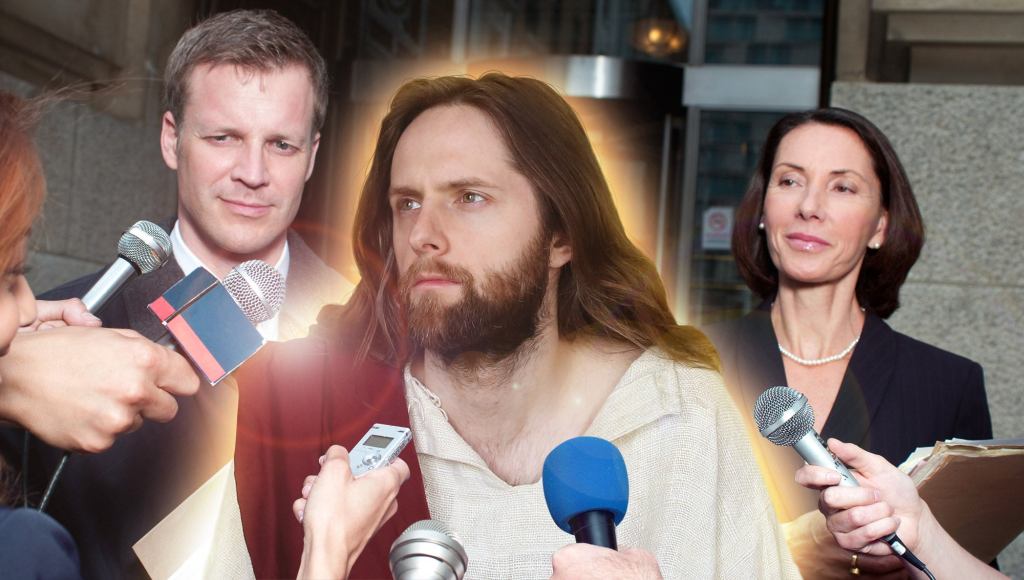
VATICAN CITY—Claiming the religion was infringing upon His personality rights, Jesus Christ, the Light of the World, sued the Catholic Church Friday for alleged unlicensed use of His image. “Today, I have filed a lawsuit against the Roman Catholic Church for its unlawful appropriation of my likeness in their branding and promotional material,” said Christ, who in the case of King of Kings and Lord of Lords v. Vatican will argue that He hasn’t seen a cent since the Church started profiting off His image approximately 2,000 years ago. “I never signed off on, nor do I endorse, the sentiments behind any of these candles, plates, statues, paintings—none of it. I don’t want to have my brand devalued by a bunch of people just trying to turn a quick buck by slapping a reproduction of my wounded body on a cross.” At press time, sources confirmed the Church was attempting to reduce its legal exposure by altering its depictions of Jesus so they would instead feature short hair and a neatly trimmed mustache.
Consciousness, spirituality, biography, sexuality, androgyny, futurism, space, the arts, science, astrology, democracy, humor, books, movies and more