Supreme Court Justice Sonia Sotomayor speaks at the New York Law School’s Constitution and Citizen Day Summit, in New York, Tuesday, Sept. 16, 2025. (AP Photo/Richard Drew)
2 of 5 |
Supreme Court Justice Sonia Sotomayor greets audience members after she spoke at the New York Law School’s Constitution and Citizen Day Summit, in New York, Tuesday, Sept. 16, 2025. (AP Photo/Richard Drew)
3 of 5 |
Supreme Court Justice Sonia Sotomayor speaks at the New York Law School’s Constitution and Citizen Day Summit, in New York, Tuesday, Sept. 16, 2025. (AP Photo/Richard Drew)
4 of 5 |
Supreme Court Justice Sonia Sotomayor speaks at the New York Law School’s Constitution and Citizen Day Summit, flanked by Judge Joseph Blanco, left center, and Judge Anthony Cannataro, right center, in New York, Tuesday, Sept. 16, 2025. (AP Photo/Richard Drew)
5 of 5 |
Supreme Court Justice Sonia Sotomayor speaks at the New York Law School’s Constitution and Citizen Day Summit, flanked by Judge Joseph Blanco, left, and Judge Anthony Cannataro, right, in New York, Tuesday, Sept. 16, 2025. (AP Photo/Richard Drew)
NEW YORK (AP) — Supreme Court Justice Sonia Sotomayor, questioning whether Americans understand the difference between a king and a president, told a New York Law School crowd Tuesday that improved civic education across the country would help people make better decisions.
Sotomayor, speaking at a panel discussion during a “Constitution and Citizenship Day Summit,” did not make comments that were overtly political and did not directly address any controversies of the moment. President Donald Trump was not mentioned.
At one point, though, she raised doubts about how much Americans are being taught about civics in schools.
“Do we understand what the difference is between a king and a president? And I think if people understood these things from the beginning, they would be more informed as to what would be important in a democracy in terms of what people can or shouldn’t do,” she said.
She decried the lack of education about civics and how democracy works, even giving her version of Ben Franklin’s famous anecdote at the end of the constitutional Convention in Philadelphia when he was asked whether the nation would have a republic or a monarchy.
Sotomayor called social media “one of the largest causes of misinformation on the internet.”
“If you are only hearing one side of the story, you are not making an informed decision,” Sotomayor said. “The world is a complex place and issues are always difficult.”
Sotomayor also called for civic education to be required in law schools along with some public service, though she was quick to add that she would suggest a broad definition of it.
“I don’t think it’s working for the government or anything like that,” she said, suggesting that it might mean doing something outside the classroom to make a difference and affect a community in a positive way.
Without alluding to any current events, the justice also criticized those who emerge from law school to announce edicts against the free speech of others.
“The thing that gets to me is every time I listen to a lawyer-trained representative saying we should criminalize free speech in some way. I think to myself: ‘That law school failed,’” Sotomayor said. “If any student, who becomes a lawyer hasn’t been taught civics, then the law school has failed.”
The Bronx-born justice said she became interested in civics in grammar school, where she began debating issues, and improved those skills when she learned to debate both sides of a single issue.
At the end of her remarks, she urged students who watched in a large auditorium or saw her on video screens in overflow rooms to think about everything in the world that is wrong and “everything that’s happening in the United States” and realize ”we adults have really messed this up.”
She said she’s counting on today’s students to find solutions.
Deep dives and investigations you won’t find anywhere else
Living a Life of Color with Psychedelic OG Gwyllm Llwydd
From ferrying mescaline in the ’60s to layering mandalas today, Gwyllm Llwydd has spent a lifetime channeling altered states into art, music, and myth.
By Gregory Daurer Images Courtesy of Gwyllm Llwydd
Call Gwyllm Llwydd — as he’s known in the art world — a longstanding member of what he playfully considers the “entheogensia.” He’s a painter, a psychedelic collage maker, and the publisher of the Invisible College, a publication brimming with visionary art and poetry that launched in 2006. (The journal’s 13th edition will be arriving soon.) His work spans to blotter art, as well — one of his pieces appears in Erik Davis’ book Blotter: The Untold Story of an Acid Medium. Llwydd also writes and curates a streaming radio broadcast called Radio EarthRites. Some music buffs might know his early-’80s band Grey Pavilion, which he formed with his wife Mary and which featured future Wilco guitarist Nels Cline. For a deeper dive into his sprawling creative universe, see his book Alcove of Dreams: Art & Writings.
Llwydd’s journey arcs from precocious ’60s teenager exploring altered states of consciousness — as a youthful courier, he recalls ferrying Southwestern mescaline to California and introducing friends in Colorado to Owsley acid — to more recent experiments with Salvia divinorum, which he recounted in his presentation to the Portland Psychedelic Society in his home state of Oregon, which we get into, along with so much more, in the interview below.
*This interview has been edited for length and clarity
DoubleBlind: What was your first psychedelic experience?
Gwyllm Llwydd: It was either on August 30 or August 31 in 1966 in Berkeley, California. I hitchhiked from Denver, Colorado, up to Wyoming, and caught freight [trains] out to Marysville in California, and then hitchhiked into Berkeley to meet up with friends. I was 14. I was offered LSD at the commune that I was staying at. And we went out to a cafe called the Jabberwock. And, as it was coming on, Country Joe and the Fish were the band playing that night. I went up and sat underneath the organ for a while!
It was an absolute revelation. I realized that most of my life I had lived as a lie, and that I’d been telling myself a story that wasn’t true, which was pretty heady stuff for a 14-year-old. LSD has the ability to reveal what’s going on internally / psychologically / spiritually. And yeah, there’s always the bangs and whistles and all the colors and sensations and stuff, but it really is about the inner work. It will reveal things to you, and if you’re smart, you’ll work on what was presented to you. So that’s pretty much been the experience I’ve had with psychedelics: It’s a tool. It’s a really great tool.
Were you a visual artist from a young age?
My first piece of art was a finger painting when I was five years old, and it was a storm cloud with lightning. And I think it was probably my mental state at that point. But my father was a frustrated artist, and he introduced me to different artists, different music. He introduced me to the Beat writer Jack Kerouac on TV when I was eight years old. He saw that I had talent, and he made sure that, when we were living in Colorado Springs when I was 12, I was admitted to the Colorado College for art classes. Of course, you’re not allowed at that age to do nude life drawing. [Laughs.] So I never got to that part of art. I did music for many years, but the visual arts have always been my first and foremost love.
Mandalas have been an important part of your artwork. Can you explain how they first came into your awareness?
There was a bookstore in Boulder, Colorado, in the ’60s, and there was a young man working there: John Chick, from the Bardo Matrix art and lightshow collective. And John had several of his illustrations there. You could buy his mandalas for 50 cents apiece. And I was absolutely fascinated with them. And I started experimenting with mandalas at [a young] age. And by the time I’d reached 16, 17 years old, I was working with pointillism and mandalas. Mandalas have always been my main focus, art-wise.
It seems in terms of your computer collage work, you often layer mandalas underneath what’s taking place on the surface.
It’s part of it. I mean, some of my pieces that I’ve worked on with the computer have up to 180, 190 layers. I have a piece that I’ve been working on now for, like, 15 years, that still isn’t complete. But the idea of the mandala is to try to bring things into focus.
Do you consider yourself a Visionary Artist?
Not like, say, Martina Hoffman or Mati Klarwein or Ernst Fuchs. I do consider myself more of a Surrealist in the school of Max Ernst, Wilfried Sätty, and my good friend Jim Harter, who has now passed. And I try to make this bridge between Eastern and Western art and ideas, all the time. A lot of my artwork is Islamic-influenced, because of my background with Sufism. My art is, on the whole, Surrealism, because I’m trying to evoke a dream state.
But you’ve also worked to capture the altered states you’ve experienced in some of your pieces.
Oh, absolutely. And I did a lot of paintings and collages of the different states with tryptamines and Salvia divinorum. And the Salvia paintings are some of my favorites because the inspiration is incredibly strong when you come out of that state. I can’t do art whilst I am under the influence of something, but I can evoke it afterwards.
There’s a Salvia painting that I did. It’s a mandala: The leafing out of different Salvia plants. And each of those plants that are illustrated in that artwork resulted from a separate Salvia experience. When I came back each time, a different plant was what I was supposed to depict. Salvia probably wouldn’t be considered a psychedelic in the classical sense, but it is a visionary plant, and it talks just like mushrooms will talk. I was doing lots of work with the plant at that point, and I have a very healthy garden of Salvia now. I haven’t gone into that Salvia-induced space for several years, but that doesn’t mean that it’s still not an ally: She talks, she shows, and she tells stories.
I’d like to touch on a couple of your DMT pieces. During one experience, you said you encountered a divinity, shall we say, with tentacle-like arms flowing. And you saw that as a representation of the Hindu deity Vishnu. Is that correct?
First, before encountering Vishnu, I noticed some very interesting things with the machine elves whose presence in the DMT space are often talked about. Those entities are meant to keep you on “this side” of “that space.” They are a diversion. But with that Vishnu experience, I broke through: I went down what was like a giant tunnel, and I broke into this vaulted space, and there was the entity sitting there. And it recognized me. I recognized it as Vishnu: that was the way it was presented. We sat there in meditation and stared at each other until I started drifting back and came out through the tunnel. And it was a very special experience.
But one of the amazing things about it was that on the way out, the machine elves were dancing around again. And I took a look at them, and I understood that they were stuck in this state. And I felt my heart open up, and I felt this burst of light go out from my heart to them. And they were dancing in ecstasy that they were recognized for their role. And that stayed with me for a very, very long time. You can’t replicate those guys with art.
DMT is an amazing substance. You know, I don’t understand how you could do anything like DMT casually, but I know people do. I’ve actually been in rooms where people are passing a pipe back and forth and just laughing. And that was kind of interesting to witness. But I take this stuff kind of seriously. Maybe I’m too serious about it, but I’ve never been a trip-for-trip’s-sake [kind of person], if you know what I mean.
How did you first get involved in the medium of blotter art?
There was a gentleman called Adam Stanhope, who passed away a few years back, whom I met when I was managing the floor for the Mind States conference down in Berkeley in 2001. Adam saw my art and he really liked it. And I had done a mantis head piece, because I was very interested in mantises at that point. And he loved it, and he had the blotters printed up for me. He distributed, like, four pieces of mine before he passed away. I got into doing blotter art in 2001-2002, and I still continue. I just released another piece that’s coming out next week, which is called Peyote Visions. And my favorite piece that I ever did was the one for Alexander “Sasha” Shulgin called The Chemist.
Sasha was a sweet person. I got to meet him and his wife, Ann, several times.
We used to sit and talk. And after he went into decline, I was working on this piece. And I was trying to get it to him before he passed, but he died beforehand. It shows Sasha working in his laboratory — or my impression of Sasha. And so, emotionally, it evokes fond memories for me of him. That’s one of my favorite pieces. It’s very simple: it’s basically black-and-white. I’ve redone it and put some color into it, but it’s not needed.
Did you ever get to sample any of his research chemicals and write up a report for him?
I did. 5-MeO-DiPT, which was a very interesting experience. I’ve written that one up. That was an experience. I mean, it wasn’t my favorite. It was the last time I did any research chemicals.
I did “STP,” which Shulgin had originally formulated, back in the ’60s. It’s technically called DOM.
Please explain the setting where you tried that.
I was staying with friends up in Boulder, Colorado, because I was going back and forth to California quite a bit. And these were [Students for a Democratic Society]friends. And we had some of this stuff. And we decided to go down to the concert venue, the Family Dog in Denver, Colorado. And the Buffalo Springfield was playing. And by the time that I got to the door, I didn’t know if I was still alive or not, because I couldn’t tell if I was breathing. So I laid on the floor, and I kind of had my head propped up, and I was watching the bands play. And you could see the music coming out of the amplifier like molten color. The synesthesia experience was extremely powerful with DOM. And everything was kind of delightful. It was overpowering.
I used to fly out to California to pick up acid and to bring it back — acid being legal, at that point, except in California. And I would take mescaline out from a group of people in Austin, Texas, exchange it for Owsley acid, and bring it back to Denver. And I didn’t get paid money for it, I just got paid lots and lots of mescaline that I passed around and gave away all over the place. I was 15 years old. And then I turned 16, and I stopped making those round trips around October of ’67.
How do you look back on those days now? Do you ever look at your younger self and say, “You crazy fucking kid!”? Or: “You were a brave son of a bitch!”
It’s probably a combination of the two. I had a couple of occasions where very crazy people, including police, did stupid things to me. I was in and out of jail quite a bit. I had policemen shoot at me. Nearly died on freight trains because you don’t go across the Utah and Nevada desert without water. [Laughs.] The fact that I survived is amazing. I never expected to be the age that I am now. And I’m happy I am. I have a great family and wonderful friends around the world. But yeah, my teens and my early 20s were incredibly wild periods of my life. I prefer now. It’s a little safer!
I basically walked out the door when I was 14 years old and didn’t come back until I was in my late teens to my family. You know, I lived everywhere; I did all kinds of things. I survived everything that I got myself into. And I have a story that I like telling people…to a degree, you know. I always thought what I was doing was normal. I’ve had people tell me since then that [what I was up to] was not normal. I’ve come to realize that while watching my own kid grow up and being protective of him.
How long did your New Wave-era electronic band Grey Pavilion last?
That band lasted for 11 years. I had been doing music from the late ’60s on, and I worked with Phil Lithman , the musician known as Snakefinger. So he and I used to play in L.A. together, and we’d do these casual shows at different locations. Anyway, I was interested in synthesizers, and my wife Mary and I brought a keyboardist friend Ley Thompson over from the U.K. The band was originally my wife Mary (who’s from Scotland), Ley, and myself. And then Ley had to go back to the U.K. So, then we got involved with guitarist Nels Cline , who’s now in [the band] Wilco.
I met Nels at Rhino Records through DD Faye. They got married later on. And I started hanging out at Westwood Music, and we got our synthesizers there. And Rhino Records was across the street. And the band just went from there. I picked up an 8-track recording device. Mary had been a sound engineer in the U.K., so she taught me how to use it. I was tired of singing, so she got that responsibility. And we have an album that’s still sitting in a box that never was released. But we worked with Nels and his drummer brother Alex, and we did shows off and on for years.
For this next question, let’s set the stage for folks: You’re about 23 years old, you’re in Venice, California, and you enter a bookstore wearing roller skates. And it’s here that this young man in 1975 sees a book that was originally released in 1857. It’s a work from a whole different world and time frame — although the book has an otherworldly yet contemporary Surrealist image on the cover. Can you describe what that book was and the impact it’s had on you?
Well, the book was The Hasheesh Eater. And it was written by Fritz Hugh Ludlow. And he was the son of a minister in upper New York. And he was introduced to hashish through the local chemist, because you could buy a tincture of hashish or cannabis at that point over the counter. And this book describes his — what I would call — trips. And if you use hashish correctly, you have these experiences that can feel very psychedelic. And the world that he describes is very florid. I mean, he’s a writer in the 1850s. He’s only 21-years-old when he wrote this. And he explores heaven and hell through his hashish use.
The book that I picked up had been put out by Level Press. And Michael Horowitz was the editor of it. Michael Horowitz was Tim Leary’s archivist. And the illustrations were done by Wilfried Sätty. I was so impressed by this book — by the combination of the art and the writing. And, at that point, hash was my main go-to.
Sätty passed in 1982, so I never got to meet him. But I did get to meet Michael Horowitz, and we have had a wonderful conversation on and off for over 20-plus years. I decided that I was going to put out a copy of the book myself, and I was going to put my spin on it as a homage to both Sätty and Michael. And I have expanded the book out. It’s had two editions, and there are now, I think, 40 or 50 illustrations in it.
What did you hope to bring to the illustrations for the book? And what do you hope your psychedelic artwork does overall for people?
A lot of the illustrations that are in the book are from my own hash experiences. There are also pieces in there to evoke the different sections. Sätty hardly ever used color, and I like to use color as an emotional texture.
I’m an advocate for psychedelics, yes,but what I’m really an advocate for is what psychedelics can evoke and what they can bring forward. And that’s part of the magic for me. What can we bring forth from all of this that will help change the world? If I can evoke the transcendental in my artwork, then what I’m doing is correct for this lifetime. Even though I may never have great recognition, the art’s out there. Thousands of people see it. I like that. You know, they don’t have to buy it, but if it sets something off in them that might change something in their life or that may evoke a recognition of the inner self, then it’s all worth it.
Gregory Daurer’s work has been published by High Times, Westword, CrimeReads, and Please Kill Me. He also records songs as Gregory Ego. Bluesky: @gregoryego.bsky.social
???? If you loved this email, forward it to a psychonaut in your life.
Editorial Process
DoubleBlind is a trusted resource for news, evidence-based education, and reporting on psychedelics. We work with leading medical professionals, scientific researchers, journalists, mycologists, indigenous stewards, and cultural pioneers. Read about our editorial policy and fact-checking process here.
Laurence W. Britt outlined 14 characteristics of fascism in his 2003 essay, “Fascism, Anyone?” for
Free Inquiry magazine. Britt, described as a retired international businessperson, analyzed the fascist regimes of Adolf Hitler, Benito Mussolini, Francisco Franco, Suharto, and Augusto Pinochet to identify what he called the “identifying characteristics of fascism”.
The 14 points, as outlined by Britt, are:
Powerful and continuing nationalism: Fascist regimes often use patriotic mottos, slogans, and symbols to foster a fervent and unwavering sense of national identity.
Disdain for the recognition of human rights: The fear of enemies and the need for security often override human rights, with people being conditioned to look the other way or even approve of abuses.
Identification of enemies/scapegoats as a unifying cause: Fascist regimes use a unifying patriotic cause against perceived threats, such as minorities, liberals, or communists, to distract the public from other problems.
Supremacy of the military: A disproportionate amount of national resources is allocated to the military, which is often glamorized and seen as an expression of national strength.
Rampant sexism: Fascist regimes often use sexist ideas to promote traditional gender roles and limit the rights and roles of women.
Controlled mass media: The media is either directly or indirectly controlled by the government, which suppresses dissent and manufactures consent through censorship and propaganda.
Obsession with national security: Fear is used as a motivational tool to rally the public behind the government, often leading to unchecked security measures.
Religion and government are intertwined: Religious rhetoric and terminology are commonly used by government leaders to manipulate public opinion, regardless of whether the government’s actions align with religious principles.
Corporate power is protected: Fascist governments often have mutually beneficial relationships with the business and industrial elite, who put the leaders in power and in turn receive government favoritism.
Labor power is suppressed: Labor unions are often eliminated or severely suppressed to prevent their potential as a threat to the regime.
Disdain for intellectuals and the arts: Fascist nations promote and tolerate open hostility toward higher education, academia, and free expression in the arts.
Obsession with crime and punishment: The regime maintains control through the fear of crime and the promotion of harsh punishments for even minor offenses.
Rampant cronyism and corruption: Those with close ties to the regime use their position to enrich themselves, with corruption largely unchecked due to controlled oversight.
Fraudulent elections: Elections are often manipulated to achieve desired results through control of voting machinery, intimidation, and voter disenfranchisement.
Context and reception
It is important to note that Britt’s list was not intended as a strict definition of fascism, but rather as a set of “early warning signs” based on his observations of historical regimes. The list is not universally accepted by scholars as a comprehensive or definitive framework for defining fascism.
In 2020, USA Today reported that a poster based on Britt’s article was once sold at the U.S. Holocaust Memorial Museum, though it was not an official museum text. His work continues to be discussed in political and academic contexts today.
At the Greater Good Science Center, we cover the science of a meaningful life. That means learning and writing about gratitude, relationships, joy, and awe—and reading other media and new research about those topics and more. As a result, I thought I had a comprehensive view of the other journalists, researchers, change agents, and media makers working in these areas.
But our new initiative on the science of love opened my eyes. We received a whopping 1,334 applications for grants about love, connection, and relationships, representing a huge diversity of media, formats, geographies, and communities. As director of the project, I personally read each application—quickly—and spent additional time on the projects that moved forward in the review process. In the end, it took 12 internal and 25 external reviewers working from March through June to evaluate the applications and select 23 winning applications.
Those individuals and media organizations will receive grants of between $5,000 and $50,000 each for projects on love. GGSC will also support them from September 2025 through March 2027 with guidance from scientific advisors and quarterly Zoom calls to facilitate shared learning among grantees and researchers. We’re planning two in-person convenings for the grantees, their advisors, and other scientists and journalists.
The process of reviewing and assessing these grant applications had a profound impact on me. I felt surprised and engaged by the hundreds of creative projects across the globe, led by dynamic nonfiction storytellers, all passionately dedicated to building a more loving society and shedding light on humanity’s capacity for love. I hope that by giving Greater Good readers a glimpse into how the process moved me, you might also benefit from inspiration and reassurance, at a time of great uncertainty with regard to technology, the political climate, economy, and more.
It pays to expand your media diet
As a journalist, I’m a voracious consumer of books, articles, podcasts, social videos, documentary film, and other nonfiction media. Yet many of the platforms and outlets that showed up in applications—either as applicants or as work samples—were new to me. I discovered new shows, series, and entire worlds of content that now comprise part of my routine media diet.
For example, I learned about 99.media, a platform for short-form documentary films that capture and evoke emotions in just a few minutes. I now regularly listen to the Pulse on WHYY and Proxy, to learn and reconsider the science of emotions (among other topics.) Who knew there were podcasts about Asian American pop culture history (Saturday School) and the intersections of music and science (Sing For Science).
I also discovered a slew of long-form journalists working in the same space that I do, whose newsletters and LinkedIn feeds help me stay abreast of new developments and engage me in their narratives. One of the best ways to grow as a writer is to read widely, and cast a wide net for inspiration—not only by topic but also narrative style and structure.
Love stories come in many forms and places
I felt surprised by the different communities, media, and angles that all saw themselves as fitting in the request for grant proposals we distributed. In some cases, this was wishful thinking—the program isn’t designed to fund the creation of a curriculum or board game—but other proposals merely reflected the diversity of love itself.
Spreading Love Through the MediaThis piece is part of a three-year GGSC project to explore love’s role in promoting social well-being, bridging divides, and contributing to a good, meaningful life.Learn More
The applicants included advocates for marginalized communities and recovery from a specific disease or natural disaster. Journalists covering immigration told poignant stories of separation, loss, and resilience. Visual storytellers shared moving projects about long-time lesbian partnerships and marriages affected by incarceration. Some applicants brought their most personal relationships into the grant proposal, describing emotional journeys and transformation over years or even decades. And many are independent media makers who already have attracted large and engaged audiences who are eager to learn about love and contribute to the conversation in the platforms—both public and private—on which grant applicants publish.
Romantic love was well-represented among the applications, as it is in research and popular media about love. However, I was impressed that the entire batch of applications included every one of the types of love we identified in our research summary, including love for humanity and across differences. Certainly, proposals on romantic and parental love featured heavily, but we also reviewed projects about loving strangers, love across distance, self-love, family relationships, friendships, and love across differences of identity.
More funding for storytelling will be well-spent
Awarding the grants felt bittersweet, in that the review team easily could have found another 23 or 46 grantees, or more, whose projects would enlighten, provoke, and move audiences. Assembling the grant cohort felt like putting together a college class, as we tried to select a diversity of media, experience levels, type of love, and narrative approach. As I wrote to those applicants who didn’t receive an award, I am rooting for them to find alternate funding and continue to pursue their projects. What the world needs now is love!
We didn’t want to part ways with the hundreds of creative, committed individuals who submitted exciting proposals. So, to capture that excitement, we’re hosting a Slack community for connection and collaboration among people who are working on media projects about love. As the grant cohort officially kicks off this month, we invite other interested media makers and journalists to join us in conversation and community. Email ggsclove@berkeley.edu to learn more.
About the Author
Katherine Reynolds LewisKatherine Reynolds Lewis is the special projects editor at the Greater Good Science Center and author of the Good News About Bad Behavior. She is an award-winning science journalist with bylines in the Atlantic, Fortune, New York Times, Undark, and Washington Post.
West Side Story On Broadway May 11, 2020 “It is always hard to see the light at the end of a tunnel and even more so, that of a tunnel we’ve never been in before. ‘Something’s coming, something good!’ would be good to keep in mind looking to a much brighter time when all this is over.” Lead Trumpeter Dominic Derasse organized a very special digital rendition of “Something’s Coming” featuring Isaac Powell and the WEST SIDE STORY orchestra. “I saw this video as a special opportunity to credit all the orchestra members whose hard work you always hear, but whose faces you don’t often see” (Isaac Powell). www.westsidestorybway.com
Translation is a 5-step process of “straight thinking in the abstract” comparing and contrasting what seems to be truth with what you can syllogistically, axiomatically and mathematically (using word equations) prove is the truth. It is not an effort to change, alter or heal anything.
The claims in a Translation may seem outrageous, but they are always (or should always be) based on self-evident syllogistic reasoning. Here is one Translation from this week.
1) Truth is that which is so. That which is not truth is not so. Therefore truth is all that is. Truth being all is therefore total, therefore whole, therefore sound, therefore perfect. I think therefore I am. Since I am and since Truth is all that is, therefore I, being, am Truth. Since I, being, am Truth, therefore I, being, have all the attributes of Truth. Therefore I, being, am total, whole, sound, perfect. Since I am mind (self-evident) and since I (being) am Truth, therefore Truth is Mind. (Two things (mind and Truth) being equal to a third thing (I) are equal to each other. Since Truth is Mind, therefore Mind has all the attributes of Truth. Therefore Mind is total, whole, sound, perfect.
2) Consumption of sugar can lead to inflammation and pain.
Word-tracking: pain: opposition inflammation: flame, flagrant, a flaming torch, to catch fire, to be consumed in flame, to shine, brilliant, fulminate, to explode. explode: plaudit, to applaud, to clap to chase away sugar: saccharine, excessively sweet, sentimental. endearing, loved consumption: to consume, to take in completely, devour, to swallow, to believe something, to suppress feeling love: affection, influence, force, power power: potent, the ability to be
3) Truth being all that is, therefore Truth is all that can be swallowed, all that can swallow. Therefore Truth swallows Itself. Since power is the ability to be and since Truth is all that is, therefore Truth is the only power. Love being affection, meaning influence or being influenced, and Truth being the only power (or influence), therefore Truth is love. (Truth being love, there is nothing sentimental or saccharine or cloying about it.) Truth being all that is, there is nothing not native (or unnatural) in Truth therefore Truth loves all as its own. Truth being total, whole, sound, perfect, there is nothing to explode (to clap away), therefore Truth is not explosive. Truth being mind and Truth being without limit or infinite, therefore Truth is Infinite Mind. Truth being Infinite Mind can never be anything less than brilliant. Truth being one and there being no opposite to one, therefore there is no pain in Truth. Therefore Truth is painless.
4) Truth swallows Itself. Truth is the only power. Truth is love. (Truth being love, there is nothing sentimental or saccharine or cloying about it.) Truth loves all as its own. Truth is not explosive. Truth being Infinite Mind can never be anything less than brilliant. Truth is painless.
5) Truth loves all as its own, brilliantly.
Weekly Invitational Translation Group invites your participation. If you would like to submit a Translation on any subject, feel free to send your weekly Translation to zonta1111@aol.com and we will anonymously post it on the Bathtub Bulletin on Friday.
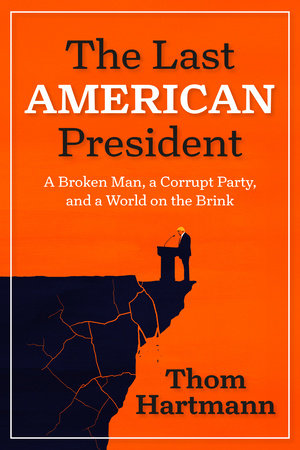
From bestselling progressive talk show host Thom Hartmann comes an urgent autopsy of American democracy, showing how plutocrats, political cowardice, and systemic rot built the perfect runway for Trump’s authoritarian ascent.
The Last American President rips open America’s wounded democracy to expose a terrifying truth: Donald Trump isn’t an anomaly—he’s the inevitable product of a system engineered to fail. This searing investigation reveals how a man forged by childhood trauma, pathological narcissism, and calculated cruelty didn’t hijack democracy—he was handed the keys by those who should have been its guardians.
Hartmann uncovers the unholy alliance between Trump’s damaged psyche and America’s rotted institutions. From Fred Trump’s brutal parenting to Roy Cohn’s lessons in shamelessness, from a Republican Party that traded principles for power to billionaire donors who treated democracy as a profit center, this book exposes the assembly line that manufactured an authoritarian.
But this is about more than Trump’s past—it’s about America’s future. As climate catastrophe accelerates and fascism spreads globally, Hartmann reveals the nightmare scenario: a second Trump term that doesn’t just end American democracy but also triggers irreversible planetary damage. Through meticulous research and unflinching analysis, he shows how political cowardice and corporate greed created the perfect storm that could extinguish humanity’s last chance at survival.
This isn’t just political commentary—it’s a last-minute alarm sounding before the point of no return.
“Now is the time of monsters” is a phrase from the Italian Marxist philosopher Antonio Gramsci, meaning the period of upheaval and uncertainty when old orders are failing and new ones haven’t yet emerged, creating space for chaos and extreme ideologies. The phrase has become popular in discussions of political and societal transitions, and it is also the title of a 2024 psychological thriller novel by A.G. Mock.
From Antonio Gramsci
Context: The phrase comes from Gramsci’s writings while he was imprisoned by Mussolini’s fascist regime in the 1920s.
Meaning: It refers to an “interregnum,” a transitional period where the established structures of power (hegemony) have collapsed, and a new, stable system has not yet formed.
The “Monsters”: These are the forces—such as extremism, conflict, and chaos—that fill the void left by the weakening of old systems.
Symbolism: The “monsters” can also be seen as things that “demonstrate,” “warn,” or “make evident” the failings of the old system.
The phrase “Now is the time of monsters” reflects a period of great uncertainty when an old political or social order is dying and a new one has not yet been born. During this “interregnum,” or in-between time, “morbid symptoms” or monstrous forces can emerge. The statement is widely attributed to the Italian Marxist philosopher Antonio Gramsci, who wrote on the topic in his Prison Notebooks in the 1930s while imprisoned by Italy’s Fascist regime.
While the exact wording (“time of monsters”) may have been a later, more evocative rendering by philosopher Slavoj Žižek, it accurately captures the meaning of Gramsci’s original observation.
Meaning and context
Interregnum: Gramsci borrowed the term “interregnum” from ancient Roman law, where it described a period of suspended legality between the death of one ruler and the accession of the next. Gramsci extended this idea to a broader historical context, referring to any transitional phase where one system of power is crumbling and another has not yet established itself.
Morbid symptoms: In his original text, Gramsci described a “great variety of morbid symptoms” that appear in this uncertain period. These “symptoms” are the social, economic, and political crises that emerge in the vacuum of legitimate authority.
Political “monsters”: The “monsters” are the reactionary forces that flourish in this chaotic environment. Gramsci and other thinkers have used the term to describe various forms of extremism, authoritarianism, populism, and demagoguery that offer simplistic and dangerous solutions to a population disoriented by change.
Modern applications of the quote
The quote has been applied to various modern situations where society is experiencing profound change and instability. Observers use Gramsci’s framework to analyze events where established institutions and norms are breaking down, but a coherent, positive alternative has yet to materialize.
Examples include:
Political instability: The rise of populist and authoritarian movements around the world in recent decades is often described through this lens. Commentators suggest that the decline of the post-Cold War liberal international order has created a vacuum that has allowed new, more extreme political forces to emerge.
Economic disruption: Major economic shifts, such as the crises of capitalism or the decline of U.S. economic hegemony, are also viewed as creating the kind of instability where “monsters” can thrive.
Cultural fragmentation: Ideological conflicts and cultural clashes—including those related to race, gender, and nationalism—can be seen as symptoms of a transitional period, as older cultural narratives lose their power and are challenged by new ones.




 Look Inside