

“Chinese like water. Take long time to boil, but once hot, lifetime to cool down. White man like sand. Fast hot. Fast cold. Do not last.”
—William Yuekun Wu as Ning’s father in the movie Front Cover
Servant leadership is a leadership philosophy. Traditional leadership generally involves the exercise of power by one at the “top of the pyramid.” By comparison, the servant-leader shares power, puts the needs of others first and helps people develop and perform as highly as possible. Servant leadership turns the power pyramid upside down; instead of the people working to serve the leader, the leader exists to serve the people. When leaders shift their mindset and serve first, they unlock purpose and ingenuity in those around them, resulting in higher performance and engaged, fulfilled employees.
Servant leadership is an ancient philosophy. There are passages that relate to servant leadership in the Tao Te Ching, attributed to Lao-Tzu, who is believed to have lived in China sometime between 570 BCE and 490 BCE:
The highest type of ruler is one of whose existence the people are barely aware.
Next comes one whom they love and praise.
Next comes one whom they fear.
Next comes one whom they despise and defy.When you are lacking in faith,
Others will be unfaithful to you.The Sage is self-effacing and scanty of words.
When his task is accomplished and things have been completed, All the people say, ‘We ourselves have achieved it!’
Chanakya wrote, in the 4th century BCE, in his book Arthashastra:
the king [leader] shall consider as good, not what pleases himself but what pleases his subjects [followers]
the king [leader] is a paid servant and enjoys the resources of the state together with the people.
Servant leadership can be found in many religious texts, though the philosophy itself transcends any particular religious tradition. In the Christian tradition, this passage from the Gospel of Mark is often quoted in discussions of servant leadership:
42 Jesus called them together and said, “You know that those who are regarded as rulers of the Gentiles lord it over them, and their high officials exercise authority over them.
43 Not so with you. Instead, whoever wants to become great among you must be your servant,
44 and whoever wants to be first must be servant of all.
45 For even the Son of Man did not come to be served, but to serve, and to give his life as a ransom for many.” (Mark 10:42-45.)
While servant leadership is a timeless concept, the phrase “servant leadership” was coined by Robert K. Greenleaf in “The Servant as Leader”, an essay that he first published in 1970. In that essay, Greenleaf said:
“The servant-leader is servant first… It begins with the natural feeling that one wants to serve, to serve first. Then conscious choice brings one to aspire to lead. That person is sharply different from one who is leader first, perhaps because of the need to assuage an unusual power drive or to acquire material possessions…The leader-first and the servant-first are two extreme types. Between them there are shadings and blends that are part of the infinite variety of human nature.”
“The difference manifests itself in the care taken by the servant-first to make sure that other people’s highest priority needs are being served. The best test, and difficult to administer, is: Do those served grow as persons? Do they, while being served, become healthier, wiser, freer, more autonomous, more likely themselves to become servants? And, what is the effect on the least privileged in society? Will they benefit or at least not be further deprived?“
Robert Greenleaf recognized that organizations as well as individuals could be servant-leaders. Indeed, he had great faith that servant-leader organizations could change the world. In his second major essay, “The Institution as Servant” (1972), Greenleaf articulated what is often called the “credo.” There he said:
“This is my thesis: caring for persons, the more able and the less able serving each other, is the rock upon which a good society is built. Whereas, until recently, caring was largely person to person, now most of it is mediated through institutions – often large, complex, powerful, impersonal; not always competent; sometimes corrupt. If a better society is to be built, one that is more just and more loving, one that provides greater creative opportunity for its people, then the most open course is to raise both the capacity to serve and the very performance as servant of existing major institutions by new regenerative forces operating within them.”
You know, there is one reason why I think the United States is an exceptional country, as the Republicans always insist.
America is a very practical country, a do-it-yourself country. In the 19th century, the United States gave birth to Christian Science, because if Jesus can heal people, why can’t everybody?
And, then, several decades later, the United States gave birth to Translation and Releasing the Hidden Splendour. Yes, we can access our divinity, but it should be accessible to everybody.
It takes work, but we can do it ourselves, using logic, reasoning, and self-evident truths. And it takes self-observation and honesty but there’s no reason everybody can’t be that honest and that self-aware and that unrelenting.
The only aristocracy in America is the aristocracy of the aware.
And I don’t think there is another country on Earth that could have come up with Translation and RHS.
quit booze anyway. Recovery for our 3rd Year. I went back out after 20 years thought I could control it. It took me to my knees. I am sober now…over a year…and glad. Anyway, It is good to be alive. I quit starting fires. I do like candles though. Lots!!! I fill a room with 25 candles and light them. Put on my favorite 1971 Led Zep and dance. I like to do that.”
Robby
October 11, 2017 (Futurism.com)
Ray Kurzweil is a formidable figure in futuristic thinking, as he is estimated to have an 86 percent accuracy rate for his predictions about the future. The future he envisions is one marked by decentralization of both the physical and mental.
Motherboard has called Ray Kurzweil “a prophet of both techno-doom and techno-salvation.” With a little wiggle room given to the timelines the author, inventor, computer scientist, futurist, and director of engineering at Google provides, a full 86 percent of his predictions — including the fall of the Soviet Union, the growth of the internet, and the ability of computers to beat humans at chess — have come to fruition.
Kurzweil continues to share his visions for the future, and his latest prediction was made at the most recent SXSW Conference, where he claimed that the Singularity — the moment when technology becomes smarter than humans — will happen by 2045. Sixteen years prior to that, it will be just as smart as us. As he told Futurism, “2029 is the consistent date I have predicted for when an AI will pass a valid Turing test and therefore achieve human levels of intelligence.”
Kurzweil’s vision of the future doesn’t stop at the Singularity. He has also predicted how technologies, such as nanobots and brain-to-computer interfaces like Elon Musk’s Neuralink or Bryan Johnson’s Kernel, will affect our bodies, leading to a possible future in which both our brains and our entire beings are mechanized.
This process could start with science fiction-level leaps in virtual reality (VR)technology. He predicts VR will advance so much that physical workplaces will become a thing of the past. Within a few decades, our commutes could just become a matter of strapping on a headset.
As Inverse points out, this paradigm shift could have some interesting consequences. Without the need for people to live close to work, we could see unprecedented levels of deurbanization. People will no longer need to flock to large cities for work or be tethered to a specific location. Inverse suggests that this decentralization may decrease the opportunity for terrorist attacks. Blockchain technology will continue to bolster decentralization as well.
According to Kurzweil, technology will not only enable us to rethink the modern workplace, it will also give us the ability to replace our biology with more substantial hardware. He predicts that by the early 2030s, we will be able to copy human consciousness onto an electronic medium.

Click to View Full Infographic
As Inverse puts it, “That means no more flesh, blood, or bones — just a scan of your brain on a machine — and [it] will enable humans to take any form, from a box to a bird.” The even bigger implication of this ability is that humans will no longer die. As our brains will no longer be reliant on fragile biology, we could (theoretically) live forever.
Not all of Kurzweil’s predictions are so drastic, and some seem even more likely to come to fruition. For example, his prediction of truly ubiquitous WiFi is well on its way to becoming reality, especially with Elon Musk’s announcement that he hopes to beam the internet across the globe from space, and his belief that many of the diseases currently plaguing humanity will be eradicated by the 2020s also seems remarkably possible given ever more frequent medical breakthroughs.
Kurzweil envisions a future that is exciting, daunting, and a little bit terrifying all at once. Time will tell if his impressive batting average will improve or if the future has other plans for humanity.
Best ever from Soderling.
From: Ron
As I was driving home and worrying about getting a handle on my life, I was flooded with concerns over my family’s lives, my friends, the fires eating up California, our loose cannon in the White House, the fake news, the real news, what’s happening in London, Paris, the Middle East, the refugee crises, illegals, terrorists and how our country is rapidly loosing its religion and moral base …I saw a sign on a nearby neighborhood lawn:NEED HELP ?CALL JESUS
1-800-555-3787
Out of curiosity, and a bit of desperation, I called the number.
A Mexican showed up with a lawnmower.
October 8, 2017
Americans are inherently a little crazy. But now the crazy is being enabled by politicians in the White House and by the internet. How exactly did it get so bad?
Read more at BigThink.com: http://bigthink.com/videos/kurt-ander…
Follow Big Think here:
YouTube: http://goo.gl/CPTsV5
Facebook: https://www.facebook.com/BigThinkdotcom
Twitter: https://twitter.com/bigthink
Americans have always been magical thinkers and passionate believers in the untrue. We were started by the Puritans in New England who wanted to create and did create a Christian utopia and theocracy as they waited for the eminent second coming of Christ and the end of days. And in the south by a bunch of people who were convinced, absolutely convinced that this place they’d never been was full of gold just to be plucked from the dirt in Virginia and they stayed there looking and hoping for gold for 20 years before they finally faced the facts and the evidence and decided that they weren’t going to get rich overnight there. So that was the beginning. And then we’ve had centuries of buyer-beware charlatanism to an extreme degree and medical quackery to an extreme degree and increasingly exotic extravagant implausible religions over and over again from Mormonism to Christian Science to Scientology in the last century.
And we’ve had this antiestablishment “I’m not going to trust the experts, I’m not going to trust the elite” from our character from the beginning. Now all those things came together and were super-charged in the 1960s when you were entitled to your own truth and your own reality. Then a generation later when the Internet came along, giving each of those realities, no matter how false or magical or nutty they are, their own kind of media infrastructure. We had entertainment, again for the last couple hundred years, but especially in the last 50 years permeating all the rest of life, including Presidential politics from John F. Kennedy through Ronald Ragan to Bill Clinton. So the thing was set up for Donald Trump to exploit all these various American threads and astonishingly become president, but then you look at this history and it’s like no we should have seen this coming.
The idea of America from the beginning was that you could come here, reinvent yourself, be anybody you want, live any way you wanted, believe any thing you wanted. For the first few hundred years, like everywhere else in the world, celebrity and fame were a result of some kind of accomplishment or achievement, sometimes not a great accomplishment or achievement, but you did something in the world to earn renown. America really was the key place that invented the modern celebrity culture, which was, beginning a century ago, more and more not necessarily about having won a war or led a people or written a great book or painted a great painting, but about being famous, fame for its own sake. We created that, we created Hollywood, we created the whole culture industry and that then became what I call the fantasy industrial complex where, certainly in the last few decades more than ever more than anybody thought possible before, fame itself, however you’ve got it, was a primary goal for people. And again, as so many of the things I talk about in Fantasyland, not uniquely to America but more here than anywhere. And then you get reality television, which was this unholy hybrid of the fictional and the real for the last now generation where that blur between what’s real and what’s not is pumped into our media stream willy-nilly. There are now more reality shows on television than there were shows on television 20 years ago. And that’s another way for nobodies to become famous overnight. YouTube, another way for nobodies to become a famous overnight for doing almost nothing or nothing.

If you’re tired of hearing about all that’s wrong with the world and would rather get up and do something about it, then you’re in the right place. Doom and gloom can only go so far before we’re depressed and stunned into inaction…all while the world continues to slide.
What can we do to help offset our impact on the planet and make this place safer and friendlier for our children?

My name is Pedram Shojai. I’m a NYT Best Selling Author (The Urban Monk) and this is my third movie. My first one, “Vitality” was an exploration of why the healthcare system doesn’t work and it was about helping us understand our personal role in getting healthy. I followed that with one called “Origins” which looked at all of the environmental toxins that may be smothering our health. That movie ended on a very positive note and, in looking for actual solutions to the world’s problems, I had to follow the money. That’s how we ended up here.
Let’s take a closer look at our definition of “Prosperity”.
Progress at any cost has cost us plenty.
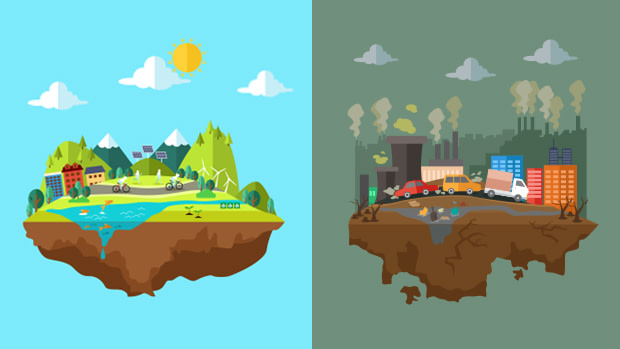
There’s a concept in economics where things that don’t fall onto your balance sheet are called “externalities”. For instance, a coal company makes a ton of money but the environmental impact: cleanup costs, mercury in the oceans, smog, deforestation, and all the illness that comes from this somehow “isn’t their problem”. Society is left to deal with these externalities. Taxpayers, non-profits, fish, and wildlife all pay for their profits. Uncool.

Prosperity is following a new generation of companies that are doing the right thing and deserve our attention (and money). There’s an emerging movement of “For Benefit” companies that are building into their bylaws the new ethics of conscious companies. In the old days, a CEO could be sued by the board if he/she didn’t maximize profits at any cost. Now, companies can elect to be “For Benefit” and factor in doing the right thing over just profits alone.
This is revolutionary and is changing the game.
Our feature length movie is following the key players in this movement and showing a real positive way out of the mess we’ve inherited and helped co-create. The more we support this blossoming movement, the more money goes to people who care…people who will take a stand for our values and our environment.

We have our cameras on these heroes and are going to break some amazing news in the release of this movie. From CEOs of major public companies, to urban farmers, and remote tribes, we’re covering the whole story in a powerful narrative.
