(Courtesy of Ben Gilberti, H.W., M.)

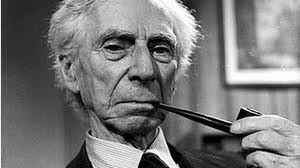
The writings of towering 20th-century philosopher Bertrand Russell have drawn many great thinkers to the subject. This article discusses his famous rallying cry for philosophy’s value.

By Jack Maden | October 2019 (philosophybreak.com)
Bertrand Russell was a giant of the twentieth century. Recognized as one of the founders of modern analytical philosophy, his work has significantly influenced mathematics, logic, artificial intelligence, cognitive science, and computer science.
The life Russell led was almost as interesting and inspiring as his work. From being dismissed by both Cambridge Trinity College and New York City College, living through two World Wars, and being arrested twice for political activism; to being awarded the Order of Merit, winning the Nobel Prize for Literature, becoming an early TV personality, and playing a role in halting the Cuban Missile Crisis — Russell was not a philosopher confined to the dusty halls of academia.
Russell’s character is perhaps best typified by an event that occurred towards the end of his life. At the age of 89, he was jailed for seven days in Brixton Prison for ‘breach of peace’ after taking part in an anti-nuclear demonstration in London. The magistrate offered to exempt him from jail if he pledged himself to ‘good behavior’, to which Russell replied: ‘No, I will not.’

Throughout his academic life, Russell wrote a number of classics, from Principia Mathematica to Human Knowledge: Its Scope and Limits. But it is in his short but powerful introductory book on philosophy for the general reader, The Problems of Philosophy, in which Russell’s love for the subject is laid bare. Having presented a number of core philosophical topics, Russell then composes a beautiful exposition on why philosophy matters — and explains the value in practicing it at all.
To start, Russell outlines why there is typically a rather dismissive attitude towards philosophy. As he puts it:
“Many men, under the influence of science or of practical affairs, are inclined to doubt whether philosophy is anything better than innocent but useless trifling, hair-splitting distinctions, and controversies on matters concerning which knowledge is impossible.”
This dismissive attitude towards philosophy is caused by two main things, Russell argues. Firstly, it is due to the fact that philosophy doesn’t produce obvious material benefits like science does. Secondly, it is because philosophy is unable to provide answers to most of the questions it asks. Why, then, is philosophy valuable?
Regardless of whether we find answers to satisfy our curiosity, Russell argues, it is vital to keep alive our speculative interest in the universe which is apt to be killed if we limit ourselves to what can be known. Why? Because it is precisely in philosophy’s uncertainty that we find its value. As Russell puts it:
“The man who has no tincture of philosophy goes through life imprisoned in the prejudices derived from common sense, from the habitual beliefs of his age or his nation, and from convictions which have grown up in his mind without the co-operation or consent of his deliberate reason. To such a man the world tends to become definite, finite, obvious; common objects rouse no questions, and unfamiliar possibilities are contemptuously rejected.”
As soon as we begin to philosophize, however, we find that “even the most everyday things lead to problems which only very incomplete answers can be given.”
“Thus, while diminishing our feeling of certainty as to what things are, philosophy greatly increases our knowledge as to what they may be; it removes the somewhat arrogant dogmatism of those who have never travelled into the region of liberating doubt, and it keeps alive our sense of wonder by showing familiar things in an unfamiliar aspect.”
Humbling our certainty leads to another important value, Russell continues. By contemplating deep, abstract, mysterious subjects, our concern with the world is expanded beyond our own private sphere of interests. Without such contemplation, we may neglect attention to anyone or anything that doesn’t directly impact us — or, worse, mark such things as contrary to our interests, dividing the world into friend or foe. As Russell expounds:
“Unless we can so enlarge our interests as to include the whole outer world, we remain like a garrison in a beleaguered fortress… In such a life there is no peace, but a constant strife between the insistence of desire and the powerlessness of will. In one way or another, if our life is to be great and free, we must escape this prison and this strife. One way of escape is by philosophic contemplation.”
By thoughtfully dwelling on subjects bigger than ourselves, we attain a humble tranquility. As Russell puts it, “through the infinity of the universe the mind which contemplates it achieves some share in infinity”.
This contemplative spirit filters through to our actions, too — as we accordingly view our thoughts and desires in the context of the whole:
“Thus contemplation enlarges not only the objects of our thoughts, but also the objects of our actions and our affections: it makes us citizens of the universe, not only of one walled city at war with all the rest. In this citizenship of the universe consists man’s true freedom, and his liberation from the thraldom of narrow hopes and fears.”
The study and practice of philosophy therefore opens up whole new worlds for us, making us think beyond ourselves to care about the bigger, more fulfilling picture in life. As Russell concludes:
“Philosophy is to be studied, not for the sake of any definite answers to its questions since no definite answers can, as a rule, be known to be true, but rather for the sake of the questions themselves; because these questions enlarge our conception of what is possible, enrich our intellectual imagination and diminish the dogmatic assurance which closes the mind against speculation; but above all because, through the greatness of the universe which philosophy contemplates, the mind also is rendered great, and becomes capable of that union with the universe which constitutes its highest good.”

“It has often been said that power corrupts. But it is perhaps equally important to realize that weakness, too, corrupts. Power corrupts the few, while weakness corrupts the many. Hatred, malice, rudeness, intolerance, and suspicion are the faults of weakness… When it is their power to do so, the weak destroy weakness wherever they see it.”
– Eric Hoffer
Eric Hoffer (July 25, 1898 – May 21, 1983) was an American moral and social philosopher. He was the author of ten books and was awarded the Presidential Medal of Freedom in February 1983. Wikipedia
Zat Rana Oct 20 · (medium.com)
Good and evil: order and entropy. The first is a story about God and morality and the devil and sin. It is a story that tells us what is right and what is wrong; how to act and how to be. The second, too, is a story about right and wrong and acting and being, but instead of metaphysical speculation, it grounds itself in science and progress and the unforgiving Universe and decay.
We see a version of this story — however innocent — play out anytime we set ourselves up to compete, to engage in a Me vs. Him or a Us vs. Them battle. For something to exist clearly in one form, it has to contrast itself with something that it is clearly not. It doesn’t focus on what is similar, but rather, it goes out of its way to conjure up differences. This kind of competition is what has driven our species to become what it is. Without competition, without something to fight against as a way to fight for something else, it’s hard to find a solid ground to stand on, and it’s hard to incentivize behavior, and it’s hard to make sense of the daily demands of reality.
When we use this aspect of our programming to fight some objective force of nature, say, like a deadly hurricane, or indeed entropy itself on the scale of the physical Universe, we mobilize the best of our capabilities. We work together. We build things. We connect. Not only that but when the enemy is a real, tangible thing, our certainty of the fact that it is indeed the villain of the story, without any reasonable doubt, is a source of both individual and collective strength. We are doing the right thing, and that is a good thing, and knowing that clarifies our course of action.
The problem, however, arises when this part of our mentality is applied in the social or the political arena, when the competition isn’t some objective process or thing but groups of other people banded together. Worse yet, in most of these instances, what is good and what is evil isn’t objectively clear because it stems from subjectivity itself. We are all very charitable when we think of our own beliefs, convincing ourselves that what we stand for is good and right and honest and that the other side is filled with people who are bad and wrong and dishonest. But when was the last time you actually met someone you disagreed with who claimed that they were fighting for evil or for entropy? Even the people we think of as the worst of the worst think they are doing the right thing, the noble thing, the important thing. Most of them, in fact, are people like you, with their own families, frustrations, and joys. We only forget all of this because we are so caught up in the self-centeredness of our own experiences.
The majority of the most insidious things that have been done in human history were done by people who thought they were fighting for good or for order as a part of a group against another group. Many of them even began banding together out of frustrations that most of us are familiar with. Many of them, in fact, claimed to represent causes whose premise most of us would broadly agree with, regardless of religious belief or political orientation. How is it, then, that groups of people fighting against other groups can start off from a place of genuine concern but end up causing destruction and disorder on a mass scale? How can we reasonably take subjective sides between good and evil in the social and the political realm when it is not always clear what is truly good and evil? The answers have something to do with the relationship between identity and hate.
Identity is the glue that binds groups of people together. It is who I am when I decide to attach myself with a collective of individuals formed due to similarity in belief systems. Feminism is an identity. Being a Googler is an identity. The label Buddhist is an identity. Identity is different from the self. The self is the emotional relationship you have with your physical body, as defined by the linguistic concepts you use to make sense of reality. It is purely individual, and it is a personal experience. Identity is the projection of some part of this self into a larger, collective story shared with other people. In order for an identity to exist, there is always a need for opposition, whether that opposition is evil or disorder or simply another person, and that creates Us vs. Them narratives.
Naturally, it’s worth noting that many groups engaged in Us vs. Them battles aim for constructive resolution through healthy debate and criticism, but generally when identity is involved at scale, rather than resolution, the goal of the group slowly morphs away from doing what is seemingly right into whatever it takes to destroy Them because this collective identity has become more important than the agency and the autonomy of the self. I could make a long list of examples gathered from history to see this in action, but realistically, we need to look no further than Twitter or the current news cycle to see how unfruitful and dangerous these kinds of battles end up becoming.
Now, the reason that the self gives up its agency and autonomy for an identity is simple: When there is unresolved pain that hasn’t been observed and reconciled internally to a satisfactory degree, the self looks for another outlet of expression, finding the perfect vehicle in an identity that can blame someone else for that pain — that can hate someone else for that pain. In this sense, groups of collectives that fight each other are really projections of internal, individual traumas on scale. Hate is a second-order effect of repressed pain, and identity is the second-order effect of an unhealed self.
People who are exceptionally tribal in their social views and in their politics project their pain into an identity, valuing the supremacy of their subjectivity and its experience. But in the process of doing so, they negate the pain and the subjectivity of people on the other side who are essentially doing the same thing. They want to be seen, but in the process of absorbing themselves in their own self-centeredness of what is good and what is bad, they deny that same possibility to those on the opposite end, because hating both yourself and other people is far easier than dealing with your own pain and compassionately acknowledging the pain of someone who is completely different from you.
Even if some of the intentions and actions at the core of an identity leads to positive change in the short-term, the long-term effects generally negate those benefits in different ways. Channeling pain into hate may provide the starting momentum needed for a socially invisible frustration to be voiced, but that hate eventually spirals out of control until you become a version of exactly the kind of person who you thought you were fighting against. Nobody who actually commits evil thinks they are doing so until it’s too late. Everyone has their reason for taking action in a particular direction, and when these reasons are marinated in self-centered intentions masked by a collective label, the boundary between right and wrong starts to quickly blur.
In December of 2018, I sat down for my first 10-day Vipassana meditation retreat. It’s a spiritual practice that seems to originate from the Theravada tradition of Buddhism prior to the 10th century, but its roots in the modern world can be traced to Burma some few hundred years ago. This particular organization was founded by S.N. Goenka. He also happens to be the teacher who instructs the practice via video recordings during the 10 days, where the aim of the students is to use their mind to refine their attention of the body until they can learn to see what is referred to as the true nature of reality.
There is nothing mystical or overly exotic about the retreat. You essentially sit still for two-thirds of the day to just experience your thoughts and the corresponding sensations that are present. There are no electronic devices to distract you. You can’t read. You can’t write. You can’t touch anyone. You can’t talk to anyone. It is an attempt to get as close to the veneer of the self as is possible in that time so that it is seen objectively for what it is rather than whatever ideas and attachment you have to it.
Every night during the retreat, after a full day of practice, all students gather in the meditation hall to listen to Goenka talk about the conceptual scaffolding that adds theoretical color to the raw experience of the Vipassana practice. He tells jokes. He explains experiences and sensations. He shares stories. And there is one story in particular that he told at some point in the middle of the retreat that I think about a lot when it comes to the relationship between self and identity, between curing our own ills and attempting to cure the ills of the world.
In the time of the Buddha, Goenka explained, there was apparently a King and a Queen who began to heed the Buddha’s teachings. They gave the Vipassana practice an honest go, digging deep into their narrative of self, their bodily sensations, and whatever pain and trauma they had accumulated over the course of life. One day, after years of shared practice, the Queen woke up next to the King and asked him a simple question: “Do you love me?” The King, taken back for a moment, thought about this, and to his surprise, answered that he didn’t. He only felt that he loved himself. The Queen, as it turned out, wasn’t too surprised by this and said that she felt the same way. At first, they were troubled by this development, but after further inquiry, they realized that their love of themselves was, in fact, the only thing that allowed them to share love with the world.
This story captures a cliche but illustrates something profound and important: We all live in separate bodies with distinct experiences of reality. And these experiences are filled with different kinds of pain and suffering that nobody can deal with but us. Before we learn to accept this simple fact and experience the love, compassion, and responsibility that comes with that, we can’t hope to positively impact the world. If inner pain isn’t dealt with, it subtly turns into hate and gets projected outward. You may think that you are doing something selfless by reducing the agency of the self in the name of some larger identity, but the truth is that you’re just scared to face your own pain because the spiral of hate is easier and more comforting than the alternative.
Groups of people gathered for a collective goal can accomplish incredible things, and using identity as a means to do that is an important strategical tool. But that identity should be no more than an association. As soon as the attachment to an identity is placed above the agency of a healed self, intentions get clouded and actions become needlessly competitive when they should instead be integrative. In our attempt to be seen, we begin to negate others. And so, it turns that another often repeated cliche is more true than it seems at first glance: Before you go out to change the world, do the work to change yourself.
WRITTEN BY
— Clark Strand, from Why We Need the Winter Solstice
(Contributed by Marty Owens)
From Wikipedia, the free encyclopedia

Crowd at New York’s American Union Bank during a bank run early in the Great Depression. Marx argued that the devaluation of wealth during capitalism’s periodic financial crises was an inevitable outcome of the processes of wealth creation.
Creative destruction (German: schöpferische Zerstörung), sometimes known as Schumpeter’s gale, is a concept in economics which since the 1950s has become most readily identified with the Austrian economist Joseph Schumpeter[1] who derived it from the work of Karl Marx and popularized it as a theory of economic innovation and the business cycle.
According to Schumpeter, the “gale of creative destruction” describes the “process of industrial mutation that incessantly revolutionizes the economic structure from within, incessantly destroying the old one, incessantly creating a new one”.[2] In Marxian economic theory the concept refers more broadly to the linked processes of the accumulation and annihilation of wealth under capitalism.[3][4][5]
The German Marxist sociologist Werner Sombart has been credited[1] with the first use of these terms in his work Krieg und Kapitalismus (War and Capitalism, 1913).[6] In the earlier work of Marx, however, the idea of creative destruction or annihilation (German: Vernichtung) implies not only that capitalism destroys and reconfigures previous economic orders, but also that it must ceaselessly devalue existing wealth (whether through war, dereliction, or regular and periodic economic crises) in order to clear the ground for the creation of new wealth.[3][4][5]
In Capitalism, Socialism and Democracy (1942), Joseph Schumpeter developed the concept out of a careful reading of Marx’s thought (to which the whole of Part I of the book is devoted), arguing (in Part II) that the creative-destructive forces unleashed by capitalism would eventually lead to its demise as a system (see below).[7] Despite this, the term subsequently gained popularity within mainstream economics as a description of processes such as downsizing in order to increase the efficiency and dynamism of a company. The Marxian usage has, however, been retained and further developed in the work of social scientists such as David Harvey,[8] Marshall Berman,[9] Manuel Castells[10] and Daniele Archibugi.[11]
Although the modern term “creative destruction” is not used explicitly by Marx, it is largely derived from his analyses, particularly in the work of Werner Sombart (whom Engels described as the only German professor who understood Marx’s Capital),[12] and of Joseph Schumpeter, who discussed at length the origin of the idea in Marx’s work (see below).
In The Communist Manifesto of 1848, Karl Marx and Friedrich Engels described the crisis tendencies of capitalism in terms of “the enforced destruction of a mass of productive forces”:
Modern bourgeois society, with its relations of production, of exchange and of property, a society that has conjured up such gigantic means of production and of exchange, is like the sorcerer who is no longer able to control the powers of the nether world whom he has called up by his spells. … It is enough to mention the commercial crises that by their periodical return put the existence of the whole of bourgeois society on trial, each time more threateningly. In these crises, a great part not only of existing production, but also of previously created productive forces, are periodically destroyed. In these crises, there breaks out an epidemic that, in all earlier epochs, would have seemed an absurdity – the epidemic of over-production. Society suddenly finds itself put back into a state of momentary barbarism; it appears as if a famine, a universal war of devastation, had cut off the supply of every means of subsistence; industry and commerce seem to be destroyed; and why? Because there is too much civilisation, too much means of subsistence, too much industry, too much commerce. The productive forces at the disposal of society no longer tend to further the development of the conditions of bourgeois property; on the contrary, they have become too powerful for these conditions. … And how does the bourgeoisie get over these crises? On the one hand by enforced destruction of a mass of productive forces; on the other, by the conquest of new markets, and by the more thorough exploitation of the old ones. That is to say, by paving the way for more extensive and more destructive crises, and by diminishing the means whereby crises are prevented.[3]
A few years later, in the Grundrisse, Marx was writing of “the violent destruction of capital not by relations external to it, but rather as a condition of its self-preservation”.[4] In other words, he establishes a necessary link between the generative or creative forces of production in capitalism and the destruction of capital value as one of the key ways in which capitalism attempts to overcome its internal contradictions:
These contradictions lead to explosions, cataclysms, crises, in which … momentaneous suspension of labour and annihilation of a great portion of capital … violently lead it back to the point where it is enabled [to go on] fully employing its productive powers without committing suicide.[4][13]
In the Theories of Surplus Value (“Volume IV” of Das Kapital, 1863), Marx refines this theory to distinguish between scenarios where the destruction of (commodity) values affects either use values or exchange values or both together.[8] The destruction of exchange value combined with the preservation of use value presents clear opportunities for new capital investment and hence for the repetition of the production-devaluation cycle:
the destruction of capital through crises means the depreciation of values which prevents them from later renewing their reproduction process as capital on the same scale. This is the ruinous effect of the fall in the prices of commodities. It does not cause the destruction of any use-values. What one loses, the other gains. Values used as capital are prevented from acting again as capital in the hands of the same person. The old capitalists go bankrupt. … A large part of the nominal capital of the society, i.e., of the exchange-value of the existing capital, is once for all destroyed, although this very destruction, since it does not affect the use-value, may very much expedite the new reproduction. This is also the period during which moneyed interest enriches itself at the cost of industrial interest.[14]
Social geographer David Harvey sums up the differences between Marx’s usage of these concepts and Schumpeter’s: “Both Karl Marx and Joseph Schumpeter wrote at length on the ‘creative-destructive’ tendencies inherent in capitalism. While Marx clearly admired capitalism’s creativity he … strongly emphasised its self-destructiveness. The Schumpeterians have all along gloried in capitalism’s endless creativity while treating the destructiveness as mostly a matter of the normal costs of doing business”.[15]
.jpg)
In Hinduism, the god Shiva is simultaneously destroyer and creator, portrayed as Shiva Nataraja (Lord of the Dance), which is proposed as the source of the Western notion of “creative destruction”.[1]
In the Origin of Species, which was published in 1859, Charles Darwin wrote that the “extinction of old forms is the almost inevitable consequence of the production of new forms.” One notable exception to this rule is how the extinction of the dinosaurs facilitated the adaptive radiation of mammals. In this case creation was the consequence, rather than the cause, of destruction.
In philosophical terms, the concept of “creative destruction” is close to Hegel‘s concept of sublation. In German economic discourse it was taken up from Marx’s writings by Werner Sombart, particularly in his 1913 text Krieg und Kapitalismus:[16]
Again, however, from destruction a new spirit of creation arises; the scarcity of wood and the needs of everyday life… forced the discovery or invention of substitutes for wood, forced the use of coal for heating, forced the invention of coke for the production of iron.
Hugo Reinert has argued that Sombart’s formulation of the concept was influenced by Eastern mysticism, specifically the image of the Hindu god Shiva, who is presented in the paradoxical aspect of simultaneous destroyer and creator.[1] Conceivably this influence passed from Johann Gottfried Herder, who brought Hindu thought to German philosophy in his Philosophy of Human History (Ideen zur Philosophie der Geschichte der Menschheit) (Herder 1790–92), specifically volume III, pp. 41–64.[1] via Arthur Schopenhauer and the Orientalist Friedrich Maier through Friedrich Nietzsche´s writings. Nietzsche represented the creative destruction of modernity through the mythical figure of Dionysus, a figure whom he saw as at one and the same time “destructively creative” and “creatively destructive”.[17] In the following passage from On the Genealogy of Morality (1887), Nietzsche argues for a universal principle of a cycle of creation and destruction, such that every creative act has its destructive consequence:
But have you ever asked yourselves sufficiently how much the erection of every ideal on earth has cost? How much reality has had to be misunderstood and slandered, how many lies have had to be sanctified, how many consciences disturbed, how much “God” sacrificed every time? If a temple is to be erected a temple must be destroyed: that is the law – let anyone who can show me a case in which it is not fulfilled! – Friedrich Nietzsche, On the Genealogy of Morality
Other nineteenth-century formulations of this idea include Russian anarchist Mikhail Bakunin, who wrote in 1842, “The passion for destruction is a creative passion, too!”[18] Note, however, that this earlier formulation might more accurately be termed “destructive creation”,[original research?] and differs sharply from Marx’s and Schumpeter’s formulations in its focus on the active destruction of the existing social and political order by human agents (as opposed to systemic forces or contradictions in the case of both Marx and Schumpeter).
Translators: Mike Zonta, Melissa Goodnight, Richard Branam
SENSE TESTIMONY: Fear of the unknown quashes excitement and prevents progress.
5th Step Conclusions:
1) Truth is harmless nature, the untamable wild, irrevocable, unannulable, endless excitement, always coming forward, always progressing. OR: Truth is at home with the wild. OR: We do not tame Truth. Truth tames us.
2) There is only ONE, infinitely wise and all-knowing Intelligence, of absolutely assured wholeness that is irrepressible and indomitable — always fulfilling and succeeding in every radiant expression of its own perfect Cosmic Intent.
3) Truth Being Resurging, Exciting resourcefulness, this Sudden Increase, the Terrific Knowingness, Wisdom of the cunning couthful Progressive Ethos, this Lawful Principle: Summoning Forth, the everpresent Goodness, Saying I Have Come, I Am the Adventurer: Provenience, I Am All that Constitutes Life ItSelf.
All Translators are welcome to join this group. See BB Upcoming Events.

― Mark Zuckerberg
Mark Elliot Zuckerberg (born May 14, 1984) is an American technology entrepreneur and philanthropist. Zuckerberg is known for co-founding and leading Facebook as its chairman and chief executive officer. He also co-founded and is a board member of the solar sail spacecraft development project Breakthrough Starshot. Wikipedia