Translators: Mike Zonta, Melissa Goodnight, Richard Branam, Hanz Bolen, Sarah Flynn
SENSE TESTIMONY: Power (of authorities or of victims) can be misused.
5th Step Conclusions:
1) Truth has the right to give orders, make decisions and enforce obedience because Truth is the law, the correct behavior or procedure and all events are harmless, life-sustaining and just because Truth cannot be wrongly used.
2) One Infinite Consciousness Beingness, is the all-powerful enabling force, that has absolute responsibility and jurisdiction, to utilize perfect righteousness (right-useness), for outpicturing only its limitless Oneness and Wholeness.
3) Truth is always and only absolute, effective, rightuseness expressing perfect, harmonious oneness.
4) Harmonious Abundant Universal Integrity is the Essence of Power and the Universal Expression of Power, the healthy Value use of all Individuation and Expression of Being. Power is abundant harmonious essence.
5) Truth Being the Real Soothing Omni-presence, through, and throughout this Universally Principled Essence, I AM Androgynous Consecrated Author of Inherent Increase, is Magical Empowerment, Actual Psychi sensibleness, kinetic energy to enforce obedience: defined, refined Identity.
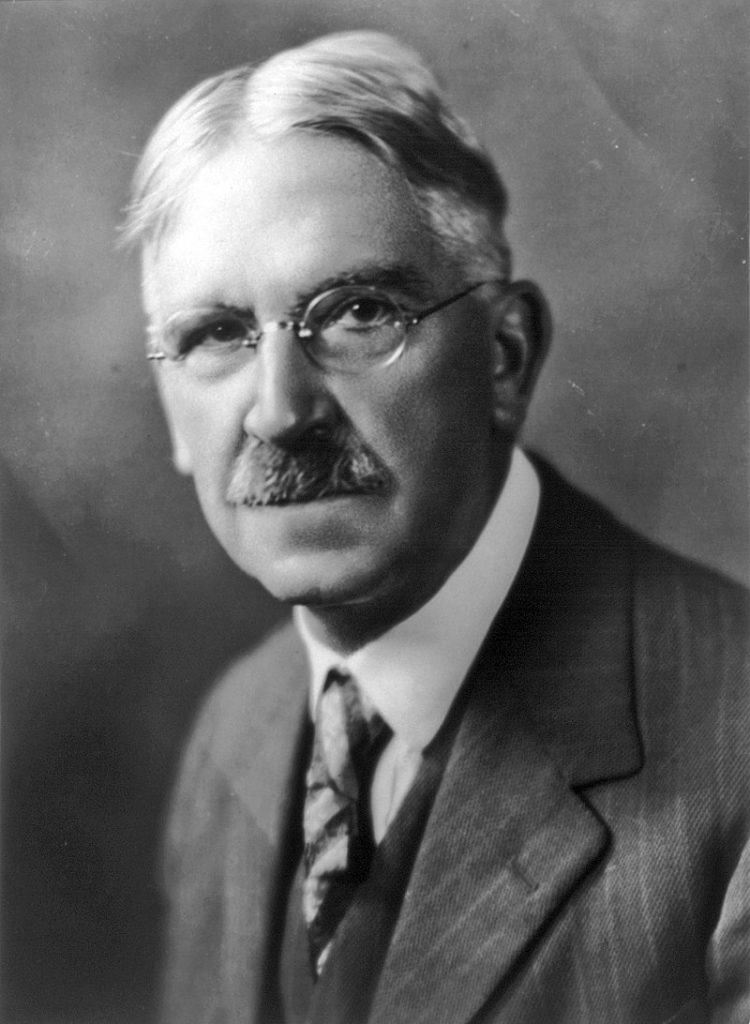
John Dewey (/ˈduːi/; October 20, 1859 – June 1, 1952) was an Americanphilosopher, psychologist, and educational reformer whose ideas have been influential in education and social reform. He is regarded as one of the most prominent American scholars in the first half of the twentieth century.[3][4]
The overriding theme of Dewey’s works was his profound belief in democracy, be it in politics, education, or communication and journalism.[5] As Dewey himself stated in 1888, while still at the University of Michigan, “Democracy and the one, ultimate, ethical ideal of humanity are to my mind synonymous.”[6] Known for his advocacy of democracy, Dewey considered two fundamental elements—schools and civil society—to be major topics needing attention and reconstruction to encourage experimental intelligence and plurality. Dewey asserted that complete democracy was to be obtained not just by extending voting rights but also by ensuring that there exists a fully formed public opinion, accomplished by communication among citizens, experts, and politicians, with the latter being accountable for the policies they adopt.
Dewey was one of the primary figures associated with the philosophy of pragmatism and is considered one of the fathers of functional psychology. His paper “The Reflex Arc Concept in Psychology,” published in 1896, is regarded as the first major work in the (Chicago) functionalist school.[7][8] A Review of General Psychology survey, published in 2002, ranked Dewey as the 93rd most cited psychologist of the 20th century.[9]
Winston Wolfe To launch the high quality TV channel TNT in Belgium we placed a big red push button on an average Flemish square of an average Flemish town. A sign with the text “Push to add drama” invited people to use the button. And then we waited… Discover here what happened or visit http://www.tnt-tv.be for more info. TNT. We know drama.
Music in this video
Song: Solar Flare
Artist: Nick Ingman, Terry Devine-King
Album: ANW1392 – Blockbuster Movie Trailers
Licensed to YouTube by: Audio Network (on behalf of Audio Network plc); LatinAutor, ASCAP, Warner Chappell, and 16 Music Rights Societies
“Love takes off the masks that we fear we cannot live without and know we cannot live within. I use the word “love” here not merely in the personal sense but as a state of being, or a state of grace – not in the infantile American sense of being made happy but in the tough and universal sense of quest and daring and growth.”
Whatever you feel about the big picture view of ‘George Soros “left-wing” financial backing and Trump “right-wing” military force, a remarkable change is happening.
We are as human beings bringing to the surface yet again the worldwide problem with racism. If we are to go forward together, I would like us to understand what I call Duality, which we have been brainwashed into for at least 15,000 years. Under this Duality, people have been separated and therefore enslaved. This is against the laws of nature and cannot continue.
Taoism is an experience of no opposites, only flow. I suggest we look at our own shadow to see the light and the joy that we could experience in the ups and downs of life in nature. Can we see through the duality of male / female (co-dependence), christian/muslim (religion), black/white (racism), educated/uneducated, gay/straight and sexuality/spirituality. We also need to try and step out of an old but very familiar triangle of Victim-Persecutor-Rescuer or the Karpman drama triangle.
Can we see through our own Cognitive Dissonance and embrace a different future? I think we can!
Illinois Attorney General Kwame Raoul, a first-term Democrat, says the state should license police officers the same way it does with other professions. Jason Marck / WBEZ
When Illinois Attorney General Kwame Raoul watched the video of George Floyd’s killing at the hands of Minneapolis police, he found himself wishing he could have done more years ago.
“I’m angry in all sorts of directions, including angry at myself,” Raoul said in an interview this week with WBEZ. “We’ve had several incidents over time that at each point we say, ‘Oh, this could serve as an impetus for change,’ and we only go so far, right? We only go so far.”
Raoul is a first-term Democrat who’s just the second black man to serve as the state’s top elected law enforcement officer. He’s continued the office’s legal effort to put a consent decree in place for the Chicago Police Department. His comments come a week after Floyd’s killing sparked daily demonstrations against police violence across the world, looting around Illinois and a threat from the president of the United States to order federal troops to stand guard against American protesters.
Now, Raoul is renewing his push for a controversial police reform measure, he told WBEZ, to require cops to be licensed by the state.
His self-directed anger stems from his time as an Illinois state senator. After the 2014 police shooting of Michael Brown in Ferguson, Mo., Raoul helped lead the passage of a sweeping criminal justice bill that was ultimately signed into law by then-Republican Gov. Bruce Rauner. The bill created a system for police officers to use body cameras, prohibited the use of police chokeholds and created a database of officers who were fired or resigned due to misconduct.
But Raoul tells WBEZ he had to drop one key element of the bill in order to get enough support for it to pass. And that’s the element he now says would have the most impact: Have the state license police officers the same way it licenses physicians, pharmacists and hairdressers.
“I think it’s the responsibility of the legislature to do what they’ve done for many other professions to have consequence for repeated misconduct or single acts of egregious misconduct,” Raoul said.
“If they have an egregious act of official misconduct or a pattern of such, they can have their license taken away such that they cannot participate in that profession anymore and that should be the same thing for a law enforcement officer who is capable of using deadly force in carrying out his or her duties.”
Raoul said a state licensing system would ensure that officers with repeated misconduct claims could have their licenses pulled — regardless of how discipline is handled in a police union contract — and they would then be forbidden from continuing to do police work in another city. He argues such a system could’ve disciplined so-called “bad apple” cops like former Chicago police officer Jason Van Dyke, who was convicted of murdering Laquan McDonald, or Derek Chauvin, the Minneapolis police officer charged with second-degree murder for killing Floyd.
The executive director of the Illinois Association of Chiefs of Police, Ed Wojcicki, did not take a clear stance on whether his organization supports or opposes licensing cops.
“Any response to George Floyd, you’re not going to get any disagreement from law enforcement about what happened there,” Wojcicki said. “We’re right with everybody to say that was a terrible thing that happened.”
Wojcicki said his association is open to discussing the topic with Raoul, but he also questioned whether the current certification process for officers could just be amended, rather than establishing an entirely new licensure process. State law does establish a process for the decertification of officers, but only if they are convicted of certain crimes, such as sexual abuse.
By contrast, revoking an officer’s license could come as a result of disciplinary action taken against them for misconduct, not only convictions.
Raoul defends Illinois’ current chokehold policy
Raoul said what stood out to him as he watched the video showing Floyd’s killing is a look of “numbness” on Chauvin’s face as he knelt on Floyd’s neck.
“There’s a sickness that has to be associated with that,” he said. “But the notion there were other officers there equally treating it as just a casual situation angers me.”
But as Raoul expressed his support for the peaceful demonstrations in response to Floyd’s death — which he says his own children have joined — he defended a portion of the 2015 law that forbids the use of police chokeholds but allows certain types of holds to the neck. That section allows holds that are not “intended to reduce the intake of air.”
Raoul defended that language, likening someone who’s resisting arrest to wrestling — in which there may be contact with the neck. He said it’s “unrealistic” to expect there will be no neck contact when police scuffle with someone resisting arrest.
“The next horrific death — God forbid — might be somebody kneeing somebody to the stomach,” he said. “There are all sorts of different forms of conduct they could do that can be fatal contact that I don’t know whether it’s in the province of the legislature to start calling balls and strikes on that.”
Patting down a prosecutor: Raoul reflects on his own police run-ins
Raoul said his own experiences with the police inform the policies he’s now promoting, such as the state licensure of officers.
During the interview with WBEZ, he recalled four run-ins with the police in his life, from after the Chicago Bears won the Super Bowl in 1986 to being put in handcuffs at age 17 and taken to the scene of a crime.
In another instance, while he was in college, Raoul recalled being handcuffed after he was cut off by an unmarked police car while driving his mother’s new car. And Raoul chuckled incredulously as he recounted being patted down at a time he was a prosecutor — wearing his suit and tie — because, he was told, he matched the description of someone who’d been stealing vehicles around Chicago’s South Loop neighborhood.
He says his anger grows when he thinks about how black people across the country must have “the conversation” with their children about how to interact with police so that their kids can return home alive.
“When I said earlier I’m angry at myself, I’ve been criticized much in my career about showing too much passion sometimes and I think that passion grows from my personal experiences,” he said.
Raoul thinks his campaign to have the state license police officers now has a better chance of passing the legislature than it did five years ago.
“I’m hopeful,” he said. “The nation watched as an officer casually caused asphyxiation by kneeling on a man’s neck for minutes. That has angered a lot of people. That has moved a lot of people. That has forced a lot of people to look in the mirror and say, ‘What have I done to contribute to this?’
“It is moving people to think, and that is perhaps a silver lining, but a man shouldn’t have to lose his life for that thought process amongst the masses to occur.”
Tony Arnold covers Illinois state politics and government for WBEZ. Follow him on Twitter @tonyjarnold.
OnMay 31, the news agency Reuters published an article with an optimistic but incendiary headline: “New coronavirus losing potency, top Italian doctor says.”
The story included comments from hospital leaders in Milan and Genoa, cities in two regions of northern Italy that have been hit hard by Covid-19. The doctors’ comments were pulled from published news reports in the Italian media, and both suggested that the virus is growing weaker. Matteo Bassetti, MD, PhD, is head of the Infectious Diseases Clinic at the San Martino-IST University Hospital and a professor of infectious diseases at the University of Genoa. He is quoted in the Reuters piece as saying that, “The strength the virus had two months ago is not the same strength it has today.”
Reached for comment on Tuesday, Bassetti elaborated on his prior statement for Elemental. “What is happening in our hospitals — at least in the northern part of Italy — the clinical impression is that the disease is now different compared to the disease of three months ago,” he says. “The majority of patients who presented in our emergency rooms or wards during March and April were very sick with acute respiratory distress syndrome, shock, multiple organ failure, and the majority died in the first days after admission. Now in May, we no longer see these types of patients.”
Bassetti completed a post-doctoral fellowship at Yale University. He’s quick to say that he is not basing his views on lab-confirmed findings; his statements are based on his own interactions with patients and his conversations with other doctors. “The clinical impression here is that the virus is different,” he says. “Is this because the virus lost some viral potency? Or because the viral load or total count of the virus is lower? I don’t know.”
Expert speculation that the virus could be weakening is unpopular — and maybe also dangerous. The Reuters piece was republished in the New YorkTimes and elsewhere, and it triggered an immediate wave of backlash. Health officials within Italy and at the World Health Organization refuted the Italian doctors’ comments, and a panel of U.K.-based experts said that any claims that the virus is weakening are dubious and not supported by evidence.
“I think it’s just not plausible at this point in time,” says Oscar MacLean, PhD, one of those panelists and a bioinformatician at the Institute for Infection, Immunity, and Inflammation at the University of Glasgow in the U.K. “We’ve seen no evidence of widespread attenuation.”
“Yes, the Golden Rule is that viruses tend to mutate and evolve over time to become less pathogenic while we become more resistant, but that doesn’t happen over a matter of a few months — it’s more like a matter of years.”
It’s also worth noting that the push to loosen business and quarantine restrictions in Italy is politicized, as it is in the U.S. Some government officials there have accused their colleagues in the north of manipulating patient data and testing protocols in order to expedite the reopening process in their regions.
But some say the Italian doctors’ claims are plausible — if not proven. “Every time a virus passes from one person to another, it goes through mutations,” says Lee Riley, MD, a professor and chair of the division of infectious disease and vaccinology at the University of California, Berkeley School of Public Health. “Over time these mutations can accumulate, and the virulence of the virus can ultimately lessen.”
He says it’s possible that these mitigating mutations are occurring in Italy — and maybe even in parts of the U.S. “I think this is happening in many places already, including in New York City,” he says. “It’s the nature of these viruses to get tired after a while.”
How some viruses evolve
While plenty of viruses kill, high lethality is not a trait that the most successful viruses possess — at least not in the long term. And no one doubts that Covid-19 could, theoretically, become weaker as time passes. “This is definitely something that can happen,” MacLean says. “Over time there can be a general selection for decreased virulence.”
How does that occur? In oversimplified terms, some different mutations or “strains” of Covid-19 (scientists around the world have already identified roughly 10,000 of them) could be milder than others. And if this mildness helps them spread more rapidly — for example, by helping them elude detection — then that could lead to a softening of the virus over time. But MacLean says that plenty of scientists are on the lookout for these types of changes — in large populations and in small communities — and so far they don’t see evidence that a mild strain or strains are taking hold and displacing more severe ones.
That doesn’t mean patient outcomes are not improving in some places — as Bassetti says he’s observed. MacLean highlights an Italian study published late in May that found that the virus’s lethality in April had “significantly decreased” compared to its lethality in March. But that study’s authors cite improved clinical management as the likeliest cause of the decrease. “This makes sense,” MacLean says. As doctors and health care systems gain experience treating the virus, they’re likely to get better at it. “Along with changes in hospital capacity, triage, and treatment methods, as testing efforts get amplified, more mild and asymptomatic cases will be detected,” he says. “On the ground, that will probably look like a change on the virus’s part, but you need to be far more systematic, and control for those confounders, to make the claim that it’s attenuating.”
Other experts echo his sentiments and say that Covid-19 is unlikely to weaken in the near term. “Yes, the Golden Rule is that viruses tend to mutate and evolve over time to become less pathogenic while we become more resistant,” says Mark Cameron, PhD, an infectious disease researcher and associate professor at Case Western Reserve University in Cleveland. “But that doesn’t happen over a matter of a few months — it’s more like a matter of years.”
Cameron says that coronaviruses, compared to other viruses such as influenza, are genetically very stable, which means they’re less likely to mutate in ways that could lessen the severity of the resulting illness. He says that, in some ways, this stability is a good thing; it means that if and when a Covid-19 vaccine is available, we won’t have to worry about the virus changing in ways that render the vaccine ineffective. “The virus has changed with small mutations since it emerged from Wuhan, however, the sum total of those mutations has not changed the pathogenesis or severity of the disease it causes in humans, or its ability to spread among us,” he explains. “I think it’s highly unlikely that this virus is going to help us out by evolving into a less pathogenic version.”
One of his colleagues at Case Western Reserve, Robert Salata, MD, is a professor of medicine and also physician in chief at the University Hospitals. “To make these statements without genetic evidence, in my opinion, was the wrong thing to do,” he says of the Italian doctors’ comments.
He says that these sorts of unsubstantiated claims are dangerous because they may encourage some people to lower their guard or take fewer precautions, which could lead to an elevated risk of infection. He also says that, in his hospital system in Cleveland, he’s seen no evidence that the virus is weakening or changing.
An uncertain outlook
UC-Berkeley’s Riley says that his belief that Covid-19 could be weakening is not one his colleagues share. “I don’t know of other experts who think the way I do, and I could be totally off the mark,” he allows. “But I look at real-world data instead of predictive models to come up with my ideas.”
He points out that the number of new cases and deaths has steadily declined in New York City and many other hard-hit areas, and that there are no places in Asia where, once the epidemic swept through a city or a community, another wave of similar magnitude returned. He says that there are, of course, multiple explanations for this, and that social-distancing guidelines partly explain the encouraging trends. “But a more likely reason is that the virus itself has evolved during the initial big wave of the epidemic and lost its high pathogenicity,” he says.
He offers a hopeful prediction, though one he readily admits is speculative: “We’ll continue to see low numbers of mild-to-moderate cases, but the severe cases and deaths are likely to gradually disappear over the six months following the initial big wave.” But, he adds, this prediction assumes that most people will continue to wear masks in public places, practice social distancing, and follow other safety measures.
Others say the data — both on Covid-19, and on related viruses — does not support such a sanguine take. “In Toronto in 2003, we thought we’d beaten back SARS, but then we got hit with a second wave that lasted as long as the first,” says Case Western Reserve’s Cameron. “That may be where we are now. We think the worst might be over, but a second wave may wash over us and reset the clock.”
If people underestimate Covid-19 or ignore their state’s public-health guidelines, he says a second wave is still the likeliest scenario. “That’s the risk we’re taking right now if we loosen our public-health response,” he says. “I hope it doesn’t take a new peak in infections to get people to adhere to some of the simple things that they can do to prevent new infections and potential suffering.”
Growing up in church, I don’t recall hearing that the Bible has an erotic poem to God. I’d surely have noticed? It’s not a secret, exactly. My pastor could’ve pulled out Patrick W. Skehan’s 1971 paper “The Acrostic Poem in Sirach 51:13–30” in The Harvard Theological Review, and read it to us aloud—with feeling?
I burned with desire for her, never turning back. I became preoccupied with her, never weary of extolling her. My hand opened her gate and I came to know her secrets. For her I purified my hands; in cleanness I attained to her. (v.19–20)
The ‘hand’ that opens her ‘gate’, as in Song of Songs 5:4, is a penis. The ‘secrets’ means, literally, ‘nakedness’.
A sex scene is happening. The ‘female’ . . . is God.
We Protestants didn’t talk about the book of Sirach, maybe because the Catholics liked it? It’s in the Septuagint (LXX), the Greek translation of the ‘scriptures’ as Jesus knew them.
Jesus seems to quote or works off Sirach, including in the Beatitudes and the Lord’s Prayer. Can it be dismissed?
To turn to the usual text of Sirach 51:13–30, admittedly, there isn’t anything too sexy. Here is the Greek version of v.19–20:
My soul has grappled with her, And in the performance of the law I was exacting. I spread my hands on high, And I thought about ignorance of her, I directed my soul to her, and in purification I found her. (NETS)
In the Dead Sea Scrolls, however, a version in Hebrew—the sexual version—was discovered. What to do?
T. Muraoka, the great scholar of Hebrew, notes his puzzlement in a 1979 paper, “Sir. 51, 13–30: An Erotic Hymn to Wisdom?”
“The Greek is totally innocuous and puritan in spirit, entirely free from any signs of offensive, obscene language,” he says.
Is the sexual version ‘offensive’ and ‘obscene’? A phrase like “my hand forced open her portals,” he notes, “could hardly be understood otherwise…”
I love the idea of a vagina as a portal—here to Wisdom, to mystic insight of God, and of fellow humans.
Muraoka adds even more sexual suggestion. The phase translated, in v.19d, “never weary of extolling her,” might be, he thinks: “in the moments of her exaltation [i.e. orgasm], I will not let up…”
Wisdom is orgasmic, but the spiritual seeker doesn’t stop. He wants God to remain in that heightened state, and he develops the skill to keep her there?
Spiritual insight and understanding continues to flow from their coitus.
I’d long suspected that ‘Wisdom’, the recurring aspect of God in the ‘Wisdom literature’ of the Old Testament—Proverbs, Ecclesiastes, etc.—was to be understood, in human terms, as a woman.
There were clues? In the Wisdom of Solomon, another LXX text, Solomon says: “I was charmed by her beauty and wanted her for my bride.”
Or Sirach 15:2: “She will meet him like a mother; like a young bride she will receive him . . .” (cf. 14:23–24).
‘She’ would seem to be a gendered being, a woman, even in texts that Protestants prefer to read. “Wisdom calls out in the street, she lifts her voice in the square,” goes Proverbs 8:1.
The Christian establishment, never that fond of women’s voices, or women, with typical penetrating insight realized she was just an effect of grammar, a mere happenstance that happens when men talk.
Michael Heiser, a go-to Hebrew scholar for Evangelical audiences, assures us that Wisdom is not “an actual woman or feminine entity,” as he says. “The language simply reflects the grammar.”
Strange to have overlooked Muraoka’s warning against this very position. Though a “linguistic minefield,” he says, “it should not facilely be taken for granted that Hebrew speakers of the second century B.C. in Palestine thought in these grammatical categories as we are wont to.”
Muraoka notes that Wisdom seems, in Jewish writings, to often be embodied as an unusually beautiful and sexual woman. It wouldn’t seem too strange that in Sirach 51:13–30 . . . they have sex.
Even if your pastor or priest has somehow overlooked it, many scholars discuss Sirach’s sex poem to God.
“Remarkably, an openness on sexual issues, including sexual intercourse, female nakedness, and orgasm, is found along with lines about praising God,” notes William Loader. “Eros and the sacred are not at odds.”
Muraoka had read Sirach 51:13–30 as a “secular, erotic love-song,” but Edmée Kingsmill, in The Song of Songs and the Eros of God, challenges that. In all its sexual detail, Sirach, she suggests, tells us how the Song, the great love poem of the Jewish scriptures, is to be read.
“The language of ardent love, the overwhelming sense of human eros responding to divine eros, was, it appears, an element in the teaching of the ascetics of the Judean desert,” she says.
There she, unfortunately, falls for the idea that the Jews who were the owners of the Dead Sea Scrolls were anti-sexual.
Paul Heger, in a 2013 paper, “Celibacy in Qumran: Hellenistic Fiction or Reality?” demolished that particular hoax. It had been repeated by many respected writers—Philo! Josephus! Pliny!—but the Scrolls had disproven it.
Those guys were just writing up, he suggests, how they “imagined their Greek readers would expect a venerated sect or group to behave.”
There is nothing in the Bible critical of sex in itself. He documents this fact in detail. Many said otherwise, but it was all a tissue of assumptions, and perhaps lies.
“The desire for legitimate sexual intercourse implanted by God in humans,” as Heger says, “cannot be perceived as something wrong, nor can we infer that one may not enjoy the satisfaction of its accomplishment.”
It was Annette Schellenberg’s 2018 paper “May Her Breasts Satisfy You at All Times” that really threw me for a loop.
She takes Sirach 51:13–30 as a cue to the possibility that many references—perhaps all references to Wisdom are sexual.
The “loving” of Wisdom (cf. Prov 4:6; 8:17, 21; 29:3), or “embracing” Wisdom (Prov 4:8), do seem, as she says, “erotically loaded.”
Then, elsewhere in Sirach, “loving” wisdom (4:14), dwelling in her “inmost chambers” (4:14–15), moving to “reveal/uncover” her (4:18) might be “understood sexually.”
I suddenly realized . . . the Bible is very sexual.
Spiritual currents are seen as embodied, sexual forms.
Christianity had certainly read Wisdom’s opposing figure, the malign female of Proverbs 6:20–35 & 7 (cf. Sirach 26:19, 22) out to deceive and destroy the hapless man, as a real sexual figure.
Do not lust in your heart after her beauty or let her captivate you with her eyes. (Prov 6:25)
This is how Christianity thought of women in general? But this was one image, and the Bible had two: the Dark Lady, and Wisdom.
The two versions, the standard, ‘non-sexual’ one in Greek, and the sexual Hebrew text, I realized, could be two versions of the same idea: one for a new spiritual seeker, orienting his senses to God.
Then the Hebrew text, sexual, sweaty, illuminated. A path into the cosmic and the beautiful.
It’s not like the writers of these texts are here explaining it to you.
But the idea that Christian clerics—or scholars—know all about them is clearly untenable.
The prompt is there? Get sexy with God. As man and woman, God (being both energies) draws humans into a personal embrace.
I thought of the grim, misogynist, asexual men who developed what we call ‘Christianity’. The ones for whom Sirach 51:13–30 is ‘obscene’.
Did they know the supple, sexual female spirit the Jews knew as God? She speaks in Sirach 24:24–27, as you realize she’s the most wonderful woman you’d ever want to know.
I am the mother of fair love, and of fear, and of knowledge, and of holy hope. In me is all grace of the way and of the truth, in me is all hope of life and of virtue. Come over to me, all ye that desire me, and be filled with my fruits. For my spirit is sweet above honey, and my inheritance above honey and the honeycomb.
This language is very familiar in the New Testament. But it’s all connected? A cosmic opera that brings us to a vast embrace with the divine, and each other?— even if the traditions have labored to conceal it.
Christianity has yet to have the honor of meeting Wisdom, or entering her portal, or learning her secrets.