September 4-7, 2020 (Labor Day Weekend) Mariott Westin Hotel 866-547-5334 10600 Westminister Boulevard Westminister, Colorado 80020
WHAT IS THE STANDARD OF A PERFECT LIFE
By Pam Rodolph, H.W.,M.
Would it surprise you to know there is no standard of a perfect life? But not for the reasons you may think. There can be no perfect life as long as there IS a standard. You know, that standard by which you measure everything – people, places, events, times? You are actually measuring, judging people against YOUR subjective idea of perfection. You believe this standard to be absolute, objective and set in stone. But the only standard of a perfect life is your own arbitrary stick that you’ve been forming all your life. You know, that stick that constantly shows you how dissatisfying life is compared to your standard’s idea of perfection – “Ugh, Shelia got a tattoe”, “that waitress is not very friendly”, “this is taking way too long”.
It might surprise you to find out that, objectively, there is no perfect measuring stick. But there can be a perfect life!! In measuring odd shaped areas, calculus was invented and uses something called “integration”. The idea of integration considers standard areas it CAN measure, then decreases the size and number to infinity to fill up the area being measured and get as close to an accurate measurement of the area as possible, but it will never fill up the whole area. It can get infinitely close, but will never reach it. This is the story of your standard, your measuring stick. People, places, times, things will be judged and measured but will never quite reach your idea of perfection, insuring you will always be dissatisfied.
“HOW?? How can I achieve a perfect life?” Simple – give up your standard.
Its not the failing of life compared to your measuring stick that is the cause of all your problems. It’s the measuring stick itself that is the cause of all your problems – that silent measuring stick whereby we compare every moment of our lives, indulging in continuous internal chatter, weighing, measuring, categorizing. And all this judging and measuring elicit emotional responses from us, sometimes so subtle we are clueless as to their existence. But no matter how subtle, these emotional responses constantly sap our energy. There is a refreshing kind of tiredness that comes from physical work, but most of us go to bed worn out from the constant conflict between our idea of “perfection” and the failure of life to measure up. Our standard of perfection steals our energy, leading us into illness of all kinds. In short, our judgments are just as harmful to us and self-destructive as any other addiction.
All spiritual evolution addresses this problem – including organized religion, who say, “Stop playing God (it is God’s job to judge, right?)”. But there’s a problem – nobody believes they ARE playing God and if they do, they have no idea how to stop. I know of two methods who’s goals are to do just that – “Translation” and “Releasing the Hidden Splendor” as taught by this organization — two methods designed to help you examine this subjective measuring stick of yours. Its not easy to hear that you are responsible for your life, that there is a way to change it’s direction and nobody’s going to do it but you, but we don’t offer easy. We offer REAL. The Prosperos is the mystery school I found all those years ago. It just might be the one you are looking for.
If you really want to get to know us – be brave, step out, come to the Assembly listed above. But don’t come if you want easy. Come because you are starving for “real”, because you are ready to lay down that most ruthless of taskmasters – your standard of perfection.
COVID-19
By William Fennie, H.W., M.
It’s time to look to our deepest spiritual roots
The emergence of this pathogen and its spread around the world is just the latest in a series of contractions that have shaken the planet and altered nations and international standards.
There will be those who see this as part of an “end-times” scenario, and we may as well accept that the postwar universe many of us have inhabited for most of our lives is passing away. Anyone who claims to know what will emerge in its place is selling moonshine. So – not end times in the evangelical sense but undeniably the ending of a well-known world.
Yesterday, the Governor of Maryland declared a state of emergency and closed all of the state schools. This is good public health policy, but from what I’ve seen it has produced a state of derangement even in people who are usually even-tempered and sober. The ham-handed and contradictory response from the federal government hasn’t helped.
I believe the most important preliminary step for all of us is to understand this crisis in a larger context – it’s only one piece of a process of fundamental change in governing institutions around the world that corresponds with the transit of Pluto through Capricorn and which has reached a kind of peak with the conjunction of Pluto, Saturn, Jupiter, and Mars in the latter degrees of that sign. More is coming: the period between now and the November elections promises to continue the “hardening of hearts” around the world. (I will write about this in detail in another post.)
How are we to respond ? Throw up our hands ? Say it’s karma ? Opine about archetypal patterns playing out ? These are unsatisfying responses. We are being called on to cash in old concepts and old identities, and the salvation of ourselves and our planet can only come from willingly moving into a new and as yet unknown relationship with our world. The key is to seek the future by releasing the past; as we do this individually we help everyone around us.
Translation provides a way to take on the challenges of this situation and see through to an underlying, ever-present spiritual wholeness that cannot be undone. This in a way that is distinctly different than praying to God for deliverance. Many years before the founding of The Prosperos Emma Curtis Hopkins put it this way:
“The free, wise, immortal center of man is the begotten of God. Only this uninjurable and shining principle is offspring of I AM THAT I AM. . . . The upward vision saves [both sinner and saint]. There is no respect of persons on the high watch.”
The Prosperos instruction teaches that change is inevitable and that underlying the shifting kaleidoscope of appearances can be found an unchanging source of illumination and wholeness. By tapping into this invisible source we can bring forth that same integrity in our world. In the Law of the Vacuum the founder of The Prosperos lays out a fundamental metaphysical principle : the size of any challenge is proportional to the bounty waiting to be called forth into manifestation.
*As of this date (March, 2020), Assembly 2020 is still on. If anything changes, you will be informed. Also, all Prosperos charges for Assembly are being hammered out and will be determined soon. At that time, we will start offering pre-enrollment.
Our sense of the universe as an orderly expanse where events happen in absolute locations is an illusion
By George Musser on November 1, 2015 (scientificamerican.com)
Credit: Edward Kinsella III
IN BRIEF
In everyday life, distance and location are mundane absolutes. Yet physics now suggests that at the most fundamental level, the universe is nonlocal—there is no such thing as place or distance.
Initially Isaac Newton’s conception of gravity seemed to imply the phenomenon of nonlocality because the attractive force between masses appeared to act magically across expanses.
Albert Einstein’s general relativity instead ascribed gravity to the curvature of spacetime. Yet it introduced a deeper sense of nonlocality by showing that spacetime positions have no intrinsic meaning.
When I first learned about the quantum phenomenon known as nonlocality in the early 1990s, I was a graduate student. But I didn’t hear about it from my quantum-mechanics professor: he didn’t see fit to so much as mention it. Browsing in a local bookshop, I picked up a newly published work, The Conscious Universe, which startled me with its claim that “no previous discovery has posed more challenges to our sense of everyday reality” than nonlocality. The phenomenon had the taste of forbidden fruit.
In everyday speech, “locality” is a slightly pretentious word for a neighborhood, town or other place. But its original meaning, dating to the 17th century, is about the very concept of “place.” It means that everything has a place. You can always point to an object and say, “Here it is.” If you can’t, that thing must not really exist. If your teacher asks where your homework is, and you say it isn’t anywhere, you have some explaining to do.
The world we experience possesses all the qualities of locality. We have a strong sense of place and of the relations among places. We feel the pain of separation from those we love and the impotence of being too far away from something we want to affect. And yet multiple branches of physics now suggest that, at a deeper level, there may be no such thing as place and no such thing as distance. Physics experiments can bind the fate of two particles together so that they behave like a pair of magic coins. If you flip them, each will land on heads or tails—but always on the same side as its partner. They act in a coordinated way even though no force passes through the space between them. Those particles might zip off to opposite sides of the universe, and still they act in unison. The particles violate locality—they transcend space.
Evidently nature has struck a peculiar and delicate balance: under most circumstances it obeys locality, and it must obey locality if we are to exist, yet it drops hints of being nonlocal at its foundations. For those who study it, nonlocality is the mother of all physics riddles, implicated in a broad cross section of the mysteries that physicists confront these days—not just the weirdness of quantum particles but also the fate of black holes, the origin of the cosmos and the essential unity of nature.
For most of the 20th century, quantum entanglement—the peculiar synchronicity of particles—was the only type of nonlocality that rated any mention. It was the phenomenon that Albert Einstein called “spooky action at a distance.” But physicists gradually realized that other phenomena are suspiciously spooky, too.
For instance, Einstein created his general theory of relativity—which provides our modern understanding of gravity—with the express purpose of expunging nonlocality from physics. Isaac Newton’s gravity acted at a distance, as if by magic, and general relativity snapped the wand in two by showing that the curvature of spacetime, and not an invisible force, gives rise to gravitational attraction. But whatever Einstein’s intention may have been, his theory began to reveal a different side as physicists put it to use. The workings of gravity turn out to be sparkling with nonlocal phenomena.
WHAT WE MEAN BY “HERE”
One day in autumn, Don Marolf, a physicist at the University of California, Santa Barbara, and I were talking about gravity while sitting in the student center of his campus, eating salads and looking out over the lagoon. But hang on. How did I really know I was sitting in the U.C.S.B. student center on a certain day in autumn? The principle of locality says that I had a position, the student center had a position, and when these two positions coincided, I was there. The GPS coordinates on my phone matched those of the center, and the date matched the calendar on the wall. But this seemingly straightforward procedure doesn’t stand up on examination. “To ask a question about here, we should know what we mean by ‘here,’ and that’s not so easy to do,” Marolf says.
One obvious complication is that California is tectonically active. The crustal plate on which Santa Barbara sits is moving northwest by a couple of inches per year relative to the rest of North America and to the national latitude and longitude grid. So the student center has no fixed position. If I come back some years from now and go to the same coordinates, I’ll find myself sitting in that lagoon. Mapping companies must periodically resurvey tectonic zones to account for this motion.
You might suppose that the student center still has a position defined in an absolute sense by space itself. Yet space and time are no more stable than a tectonic plate. They can slide, heave and buckle. When a massive body shifts, it sends tremors through the spacetime continuum, resculpting it. The position of the cafeteria might change as a result, even if the tectonic plate stays put. This process, rather than Newton’s mysterious action at a distance, is how gravity is communicated from one place to another, according to Einstein’s general theory of relativity. Like geologic tremors, gravitational ripples propagate at a certain finite speed—namely that of light.
To grasp the reshaping of spacetime, our minds have to overcome a hurdle of abstraction. Spacetime is not as tangible as a geologic landscape. We can’t see it, let alone discern its shape. Yet we catch indirect glimpses. Objects that are moving freely through space, unhindered by other objects, are like raindrops streaking across a car windshield, revealing the curve of the glass: they trace out the shape of space. For instance, astronomers routinely observe rays of starlight that begin as parallel, pass near a giant lump of mass such as the sun, then afterward intersect. Textbooks and articles describing this effect often say that the sun’s gravity has bent the light rays, but that’s not quite right. The rays are as straight as straight can be. What the sun has really done is to alter the rules of geometry—that is, to warp space—such that parallel lines can meet.
The morphing of space and time is not just the stuff of exotic physics. It governs the motion of any falling object. Baseballs, wineglasses, expensive smartphones: things that slip out of your hand accelerate toward the floor because Earth’s mass warps time. (The warping of space plays only a minor role in these cases.) “Down” is defined by the direction in which time passes more slowly. Clocks at sea level tick more slowly than clocks on the summit of Denali; a watch strapped to your ankle will fall behind one on your wrist. In human terms, the deviations are small—parts in a trillion at most—but enough to account for the rate at which falling objects pick up speed. When you see an apple fall from a tree, you are watching it roll across the contours of time.
RELATIVITY’S REVELATION
Although the shape shiftiness of spacetime explains away the kind of nonlocality that Newton talked about, it produces a new variety. It comes out of relativity theory’s core innovation: that there’s no such thing as a place outside spacetime, no external or absolute standard to judge it by. This seemingly self-evident proposition has remarkable consequences. It means that spacetime not only warps but also loses many of the qualities we associate with it, including the ability to define locations.
Disavowing a god’s-eye perspective, Marolf says, “is very subtle, and, honestly, Einstein didn’t understand it for a long time.” Previous conceptions of space, including Newton’s and even Einstein’s own earlier thinking, supposed that space had a fixed geometry, which would let you imagine rising above space and looking down on it. In fact, at one point, Einstein argued there had to be an absolute reference point or else the shape of space would become ambiguous.
For a sense of why the ambiguity arises, consider how we experience geography in everyday life. We might suppose there is a unique “real” shape to the landscape—what Google Earth shows—but in practice the shape is defined by the experience of being embedded within that landscape, and that experience can vary. A student running late to an exam, an athlete hobbling on a sprained ankle, a professor walking with a colleague while deep in conversation and a cyclist yelling at pedestrians to get out of the way will perceive very different campuses. A short distance for one may seem an interminable crossing to another. When we eschew the view from on high, we can no longer make definitive statements about what is where.
In an epiphany in 1915, Einstein realized that the ambiguity is not a bug but a feature. He noted that we never observe places to have absolute locations, anyway. Instead we assign positions based on how objects are arranged relative to one another, and—crucially—those relative locations are objective. Everyone wandering around the college campus will recognize the basic ordering of places. They will juxtapose the U.C. student center with the lagoon rather than putting them on opposite sides of campus. If the landscape buckled or flowed while preserving these relations, the denizens would never know. So it is for spacetime. Different observers may ascribe different locations to a place but will agree on the relations that places bear to one another. These relations are what determine the events that occur. “If George and Don met in a certain café at noon in the first spacetime,” Marolf tells me, “they would also do so in the reshuffled spacetime. It’s just that in the first case this would have occurred at point B, and in the reshuffled case it occurs at point A.”
The cafeteria, then, is situated at A or B or C or D or E—an infinity of possible positions. When we say it’s located at such and such a place, we’re really using a shorthand for its relations to other landmarks. Lacking definitive coordinates, the cafeteria must be situated by the things within and around it. To locate it, you’d need to search the world over for a place where the tables, chairs and salad bar are arranged just so and where a patio overlooks a lagoon bathed in the golden sunlight of southern California. The position of the student center is a property not of the center but of the entire system to which it belongs. “The question you asked in principle refers to the whole spacetime,” Marolf says.
The ambiguity of localized measurements is a form of nonlocality. To begin with, quantities such as energy can’t be situated in any specific place, for the simple reason that there is no such thing as a specific place. You can no sooner pin down a position than you can plant a flag on the sea. Points in space are indistinguishable and interchangeable. Because they lack any differentiating attributes, whatever the world consists of must not reside at points; space is unable to support any localized structure. Gravitational quantities must instead be holistic—properties of spacetime in its entirety.
Furthermore, the multiple equivalent shapes of space are described by different configurations of the gravitational field. In one configuration, the field might exert a stronger force in one place than it would in another configuration, with compensating changes elsewhere to maintain the relative arrangement of objects. Points in the gravitational field must be interlinked with one another so that they can flop around while collectively still producing the same internal arrangement of objects. These linkages violate the principle that individual locations in space have an autonomous existence. Marolf has put it this way: “Any theory of gravity is not a local field theory. Even classically there are important constraint equations. The field at this point in spacetime and the field at this point in spacetime are not independent.”
Under most circumstances, we can ignore this nonlocality. You can designate some available chunk of matter as a reference point and use it to anchor a coordinate grid. You can, to the chagrin of Santa Barbarans, take Los Angeles as the center of the universe and define every other place with respect to it. In this framework, you can go about your business in blissful ignorance of space’s fundamental inability to demarcate locations. “Once you’ve done that, the physics looks like it’s local,” Marolf says. “The dynamics of gravity is completely local. Things move in a continuous way, limited by the speed of light.” But the properties of gravity are still only “pseudo local.” The nonlocality is always there, lurking beneath the surface, emerging under extreme circumstances such as black holes.
In short, Einstein’s theory is nonlocal in a more subtle and insidious way than Newton’s theory of gravity was. Newtonian gravity acted at a distance, but at least it operated within a framework of absolute space. Einsteinian gravity has no such element of wizardry; its effects ripple through the universe at the speed of light. Yet it demolishes the framework, violating locality in what was, for Einstein, its most basic sense: the stipulation that all things have a location. General relativity confounds our intuitive picture of space as a kind of container in which material objects reside and forces us to search for an entirely new conception of place.
This article was originally published with the title “Where is Here?” in Scientific American 313, 5, 70-73 (November 2015)
Translators: Mike Zonta, Melissa Goodnight, Richard Branam, Hanz Bolen
SENSE TESTIMONY: Intentional terror may use viruses or fear as weapons for mass disruption.
5th Step Conclusions:
1) Truth, the Finished Kingdom, incorruptible, irreverent, unbreakably whole, having dominion over all, uses Itself in all ways, at all times with whatever tool is at hand.
2) Truth is All entirely One, Divine Design of perfectly benevolent Intelligence, always expressing completely and seamlessly, the transmission and transition of Itself — as Infinite Mind Unfolding.
3) Truth is ONE Universal World Mind Abstraction, this Harmony of the Divine Syllogism is the Determined Sphere of Humaneness, I Amness, the substantial Principle, Principal Being comprehensively Enlightened facilitator of the Garden of Love.
4) The Universal Integrity of Truth is all there is. Truth is the Only Face, Only Language and Only Holding of all there is, all I am, Possessing All, Expressing All, Clearly, Cleanly, Purely, in strong Healthy Harmonious Self Evident Well Being.
All Translators are welcome to join this group. See Weekly Groups page/tab.
The triadthesis, antithesis, synthesis (German: These, Antithese, Synthese; originally:[1]Thesis, Antithesis, Synthesis) is a progression of three ideas or propositions in which the first idea is followed by a second idea that negates the first, and the conflict between the first and second ideas is resolved by a third idea.[2] It is often used to explain the dialectical method of GermanphilosopherGeorg Wilhelm Friedrich Hegel,[3] but Hegel never used the terms himself; instead his triad was concrete, abstract, absolute. Thesis, antithesis, synthesis originated with Johann Fichte.[1]
Thesis: “The world has a beginning in time, and is limited with regard to space.”
Antithesis: “The world has no beginning and no limits in space, but is infinite, in respect to both time and space.”
Inasmuch as conjectures like these can be said to be resolvable, Fichte‘s Grundlage der gesamten Wissenschaftslehre (Foundations of the Science of Knowledge, 1794) resolved Kant’s dyad by synthesis, posing the question thus:[4]
Are synthetic judgments a priori possible?
No synthesis is possible without a preceding antithesis. As little as antithesis without synthesis, or synthesis without antithesis, is possible; just as little possible are both without thesis.
Fichte employed the triadic idea “thesis–antithesis–synthesis” as a formula for the explanation of change.[5] Fichte was the first to use the trilogy of words together,[6] in his Grundriss des Eigentümlichen der Wissenschaftslehre, in Rücksicht auf das theoretische Vermögen (1795, Outline of the Distinctive Character of the Wissenschaftslehre with respect to the Theoretical Faculty): “Die jetzt aufgezeigte Handlung ist thetisch, antithetisch und synthetisch zugleich.” [“The action here described is simultaneously thetic, antithetic, and synthetic.”[7]]
Still according to McFarland, Schelling then, in his Vom Ich als Prinzip der Philosophie (1795), arranged the terms schematically in pyramidal form.
According to Walter Kaufmann (1966), although the triad is often thought to form part of an analysis of historical and philosophical progress called the Hegelian dialectic, the assumption is erroneous:[8]
Whoever looks for the stereotype of the allegedly Hegelian dialectic in Hegel’s Phenomenology will not find it. What one does find on looking at the table of contents is a very decided preference for triadic arrangements. … But these many triads are not presented or deduced by Hegel as so many theses, antitheses, and syntheses. It is not by means of any dialectic of that sort that his thought moves up the ladder to absolute knowledge.
Gustav E. Mueller (1958) concurs that Hegel was not a proponent of thesis, antithesis, and synthesis, and clarifies what the concept of dialectic might have meant in Hegel’s thought.[9]
“Dialectic” does not for Hegel mean “thesis, antithesis, and synthesis.” Dialectic means that any “ism” – which has a polar opposite, or is a special viewpoint leaving “the rest” to itself – must be criticized by the logic of philosophical thought, whose problem is reality as such, the “World-itself”.
According to Mueller, the attribution of this tripartite dialectic to Hegel is the result of “inept reading” and simplistic translations which do not take into account the genesis of Hegel’s terms:
Hegel’s greatness is as indisputable as his obscurity. The matter is due to his peculiar terminology and style; they are undoubtedly involved and complicated, and seem excessively abstract. These linguistic troubles, in turn, have given rise to legends which are like perverse and magic spectacles – once you wear them, the text simply vanishes. Theodor Haering’s monumental and standard work has for the first time cleared up the linguistic problem. By carefully analyzing every sentence from his early writings, which were published only in this century, he has shown how Hegel’s terminology evolved – though it was complete when he began to publish. Hegel’s contemporaries were immediately baffled, because what was clear to him was not clear to his readers, who were not initiated into the genesis of his terms.
An example of how a legend can grow on inept reading is this: Translate “Begriff” by “concept,” “Vernunft” by “reason” and “Wissenschaft” by “science” – and they are all good dictionary translations – and you have transformed the great critic of rationalism and irrationalism into a ridiculous champion of an absurd pan-logistic rationalism and scientism.
The most vexing and devastating Hegel legend is that everything is thought in “thesis, antithesis, and synthesis.”[10]
In modern times, the dialectic of thesis, antithesis, and synthesis has been implemented across the world as a strategy for organizing expositional writing. For example, this technique is taught as a basic organizing principle in French schools:[13]
The French learn to value and practice eloquence from a young age. Almost from day one, students are taught to produce plans for their compositions, and are graded on them. The structures change with fashions. Youngsters were once taught to express a progression of ideas. Now they follow a dialectic model of thesis-antithesis-synthesis. If you listen carefully to the French arguing about any topic they all follow this model closely: they present an idea, explain possible objections to it, and then sum up their conclusions. … This analytical mode of reasoning is integrated into the entire school corpus.
Thesis, Antithesis, and Synthesis has also been used as a basic scheme to organize writing in the English language. For example, the website WikiPreMed.com advocates the use of this scheme in writing timed essays for the MCAT standardized test:[14]
For the purposes of writing MCAT essays, the dialectic describes the progression of ideas in a critical thought process that is the force driving your argument. A good dialectical progression propels your arguments in a way that is satisfying to the reader.The thesis is an intellectual proposition.The antithesis is a critical perspective on the thesis.The synthesis solves the conflict between the thesis and antithesis by reconciling their common truths, and forming a new proposition.
Imagine a man who could endure near-freezing water for 45 minutes at a stretch. Imagine if that same man could run a barefoot marathon in the Arctic or swim 50 meters under the ice of a frozen lake. Imagine that man said the secret to his abilities not only allows him to climb Himalayan mountains wearing shorts, but also eases everything from chronic pain to Crohn’s disease and even Parkinson’s. What would you call that man? A savant? Guru? Prophet of God, maybe?
That’s the character Scott Carney describes in his new book, What Doesn’t Kill Us, about legendary survivalist and icy-water swimmer Wim Hof. The 57-year-old Dutchman, often referred to as the Iceman, has devised a series of breathing techniques and conditioning exercises—mostly various types of hyperventilation and other ways to purge the body of CO2—that he credits as being the key to his extraordinary abilities. Hof, for his part, sees the whole thing in a much more spiritual light—getting back to a purer, more primitive version of ourselves.
The book is a fun read because, at first glance, Hof does seem superhuman. He claims that by slowly conditioning oneself to low-oxygen states (through breathing exercises) or extreme cold (through full-body muscle-clenching exercises), one can channel their spiritual energy and tap into all kinds of hidden powers. Carney is at his best when he tries to explain Hof’s abilities through science. For instance, he suggests that Hof has tapped into a specific type of fat cell called brown adipose tissue that is found in human babies but mostly disappears in adulthood; through his body training, it’s possible that Hof has encouraged this vestigial fat to play an increased role in trapping heat. But the tone of What Doesn’t Kill Us occasionally implies that we should worship the guy. And honestly, it’s hard not to.
Hof is one of those extraordinary characters who pops up occasionally throughout human history seeming to be nothing short of miraculous. For thousands of years, humanity has occasionally glimpsed man’s capacity to do the seemingly impossible or the miraculous using only force of will: walking on burning coals, healing the sick, enduring lethal temperatures for hours. And for all that time, we have been left to our own devices in guessing how such things are possible.
But today, modern science has revealed a number of fascinating mechanisms for how the brain influences the rest of the body, forming a string of enticing bread crumbs leading toward a more satisfying understanding of some of the limits of the human body—and how people like Hof cheat them.
Take one fascinating lead: the effect certain expectations have on bodily functions. The mind has a propensity to make predictions, and then ensure those predictions come to pass through internal “pharmacies” that, when lumped together, are also called placebo effects.
In my book, Suggestible You, I talked to scientists around the world who investigate placebos, internal pharmacies, hypnosis, and the power of belief on the body and mind. One of my favorite quotes came from Alia Crum, a psychologist at Stanford. “I don’t think the power of mind is limitless,” she said. “But I do think we don’t yet know where those limits are.”
In his book, Carney points to Wof’s ability to heal things like Parkinson’s, asthma, chronic pain, and digestive problems, giving us the impression that the mind can do anything it wants. As it happens, all of these diseases are also highly susceptible to the influence of placebo. Contrary to popular belief, not all placebo effects are the same, and not all conditions respond to them equally. That’s because a big part of placebo effects are chemical, employing things like dopamine, endogenous opioids, serotonin, and an untold number of other chemicals your brain idly keeps on hand in case it needs to adjust what’s happening in the body.
That’s what’s at the center of almost every “miracle” I’ve encountered: chemicals that have incredible effects but still follow the rules of biochemistry, even if we don’t yet fully understand what those rules and mechanisms are. Hof claims that one of the secrets to superhuman strength and healing is specialized breathing techniques. Fair enough. But I can introduce him to a healer in Beijing who says it’s about balancing spiritual heat with cold or a witch doctor in Mexico who says it’s about channeling spirits. What do they all share? The chemistry of expectation and belief—which, writ wide, is the world of placebo. A better definition for placebo might be to call it a measurement of the effect of one’s belief on their body.
Belief and placebos don’t just affect disease. They also boost athletic performance, as Hof demonstrates when he swam under 50 yards of ice. This is where scientists have begun asking some really interesting questions.
Placebo effects have long been studied in medicine, but Christopher Beedie, a sports psychologist at the Canterbury Christ Church University in England, is among the few scientists who study it in athletics. His work often examines how elite athletes perform under intense fatigue when they think they have some kind of performance enhancement. The interesting question for Beedie isn’t what can the human body do, but rather, what more can the human mind add to that?
“I don’t think there’s anything surprising about people who exist at the end of continua,” says Beedie. “[Hof] is an extension of the classic example of a unique athlete optimized on nearly all variables who’s also probably learned to capitalize on every component of placebo responding he can.”
One of the most studied mechanisms of placebo in medicine is that of pain relief. Scientists have documented an extensive network of self-medicating pathways in the brain involving internal opioid stores that kick into gear when our bodies expect a treatment—from aspirin to acupuncture—and don’t get one. And there’s a lot of overlap between pain and athletic performance. Because what is intense exercise but extended pain resistance? In fact, pain relievers like morphine are strictly regulated in athletics for their performance-enhancing powers.
In addition to painkillers, there may be a whole network of internal chemicals our bodies can dip into for increased performance. In one mind-boggling study from 2008, legendary Italian placebo scientist Fabricio Benedetti told weightlifters that they were getting performance-enhancing drugs when they were actually getting placebos and, secretly, lighter weights to lift. Once they believed the drugs were working, as perceived by the lighter weights, the loads were surreptitiously returned to their normal weight. The force the athletes were able to produce with their muscles increased while perceived fatigue stayed the same.
Beedie has done a lot of similar placebo performance experiments—consistently demonstrating their ability to give an impressive edge to cyclists, runners, and many other athletes—to the point where the athletes at his school don’t always believe what he says. He claims belief taps into “headroom” that every athlete has in their potential—or the idea that that athletes can push themselves to operate between their perceived maximum execution and the maximum that physics and their bodies will allow. By either removing energy-wasting anxiety or tapping into chemicals like opioids or as-yet-undiscovered internal performance drugs through one’s expectations, the brain can coax the body into that magical zone.
In fact, Beedie is convinced this headroom is the same space filled by performance-enhancing drugs. (Indeed it’s not even clear that some banned drugs, like erythropoietin, can outperform placebos.) He’s just finished the largest (not yet published) placebo study ever done in athletics—600 subjects in all—and found that the people most likely to respond to placebo were the ones experienced using supplements. Perhaps the previous supplements the athletes had taken primed them to have a placebo response. Perhaps people who naturally respond to a sports placebo are also likely to have taken performance enhancers. Either way, it suggests that artificial boosted performance and boosted performance from expectation produce similar effects.
“This [whole idea of expectation-based bodily responses] is an evolved mechanism that allows us to capitalize on untapped resources at critical points in our existence,” Beedie says. Belief is belief, so it’s possible that drugs—real or placebo—fill the same space that superstitious baseball pitchers fill by wearing mismatched socks or dirty underwear and the same space filled by Hof and his breathing methods. None of this is to say Hof isn’t incredible. His feats of endurance are astounding and perhaps even scientifically significant, like his ability to control his body temperature so well. But he’s not magic, and we should be careful about trusting important health decisions to any belief-based technique—even one that allows a person to swim under ice.
Perhaps the most interesting question is what can people like Hof really tell us about the effect of our mind on our bodies? Scientists already know that Parkinson’s disease, pain, and depression all respond very well to all kinds of beliefs, whether through special breathing, secret pills, or magic crystals. But could that same belief fuel unprecedented feats of athleticism? Beedie says that, especially for elite athletes, there’s a limit to the benefits of both psychological and pharmacological performance enhancers, so why not just use belief in place of drugs?
“We’re trying to educate athletes into the idea that the headroom is there to be filled, and drugs are not necessarily the only way of filling that headroom,” he says. “Confidence is the drug of champions.”
Erik Vance is the author of the new bookSuggestible You. Reporting for this project was supported in part by the Pulitzer Center.
This article was originally published on January 16, 2017, by Outside, and is republished here with permission.
A resident in the Trullo district of Rome, Italy wearing a face mask and gloves stands next to a mural featuring Swedish climate activist Greta Thunberg and her quote “You’re never too young to save the world” on March 30, 2020.PHOTO BY ANDREAS SOLAR / AFP / GETTY IMAGES
Amid the terrible news about the spreading coronavirus epidemic, a scintillating fact has emerged that can energize the environmental movement: The global slowdown in human activity has given Mother Nature a much-needed breath of fresh air. Between travel restrictions, reductions in public transport and overall economic activity that generates emissions—such as coal burning, refining oil and producing steel—the climate is getting the kind of rest from destructive human activity it hasn’t gotten since the dawn of the Industrial Revolution.
The lockdown in China (the world’s biggest emitter of greenhouse gases), for example, has cut the nation’s carbon dioxide emissions by 100 million metric tons in just two weeks, according to an analysis by Carbon Brief, a UK-based climate policy watchdog. That’s down a quarter from the same two-week period in 2019. Observations made by NASA and European Space Agency pollution monitoring satellites appear to confirm the analysis. They show a sudden and steep decrease in nitrogen dioxide—an air pollutant emitted by power plants, factories, and vehicles—over China during mid-February when the nation entered a quarantine.
“This is the first time I have seen such a dramatic drop-off over such a wide area for a specific event,” said Fei Liu, an air quality researcher at NASA’s Goddard Space Flight Center.
While these are significant and sudden reductions achieved over a remarkably brief period of time, they are temporary. The long-term effects on energy consumption and greenhouse gas emissions and other atmospheric pollutants are unclear. On one hand, Chinese authorities may try to boost production after the pandemic is over to try to make up for the lost time. On the other hand, the economic impact of the pandemic may suppress the global demand for Chinese goods for months or even years to come.
While a global pandemic can instigate a break in human activity, the climate crisis hasn’t been able to make a dent in it. Why is that?
“Any sustained impact on fossil-fuel use would come from reduced demand, which initial indicators suggest could have a major impact. For example, February car sales are forecast to fall by 30% below last year’s already depressed levels,” writes Lauri Myllyvirta, lead analyst at the Finland-based Centre for Research on Energy and Clean Air. “If consumer demand is reduced—for example, due to unpaid wages during the crisis cascading through the rest of the economy—then industrial output and fossil-fuel use might not recover, even though capacity is available to do so.”
Still, the findings offer climate activists a tantalizing fact: It is technically feasible to achieve big reductions in pollutants that are fueling the climate crisis. All that’s required is a break in economic production and human activity. But while a global pandemic can instigate a break in human activity, the climate crisis hasn’t been able to make a dent in it. Why is that?
For one thing, the coronavirus pandemic has a clear killer: a microorganism. And the global death toll is rising by the hour as the virus jumps from person to person. The climate crisis, on the other hand, doesn’t have a distinct killer. Countless deaths have been tied to all the human activity that is the cause of the climate crisis: heat waves, hurricanes, droughts, and yes, even diseases such as Lyme disease, the normal range of which has spread because of warming climates. And, of course, the invisible killer is not a microorganism: Air pollution is caused by a number of toxic chemicals, some of which are greenhouse gases that are heating up the planet. But the fatalities associated with climate impacts are many steps removed from the actual causes, which are simply a matter of degree: too many cars and trucks on the roads, too many planes in the sky, too many bulldozers clearing rainforests, too many factories, air conditioners, large-screen televisions, mansions. Ultimately, too many people consuming too many things.
Let’s say COVID-19, the disease caused by coronavirus, ends up killing 7 million people this year. That figure would probably shock most people. But that is the same number of people who die from air pollution—every single year. As Tedros Adhanom Ghebreyesus, director-general of the World Health Organization, writes, “Black carbon, methane, and nitrogen oxides are powerful drivers of global warming, and, along with other air pollutants such as carbon monoxide and ozone, they are responsible for over 7 million deaths each year, about one in eight worldwide.”
And that’s just air pollution. Heat exposure, coastal flooding and diseases such as malaria and dengue—all increased by climate change—could cause about 250,000 deaths annually between 2030 and 2050, according to the World Health Organization. A study led by Oxford University forecast that by 2050, climate-related reductions in food availability (primarily fruits and vegetables) will cause an additional 529,000 adult deaths worldwide.
Sadly, no one knows these statistics, because—tragically for all the people who might be saved, and for the planet—the mainstream news media barely covers the climate. The figures are shocking. Major network news programs devoted barely four hours to the climate crisis over the entirety of 2019, according to a recent study by Media Matters. That amounts to a paltry 0.7% of overall evening broadcasts and the Sunday morning news shows.
Clearly, we cannot rely on the media. And we can’t rely on world leaders, either. According to a recent report by a panel of world-class scientists, “The Truth Behind the Paris Agreement Climate Pledges,” the majority of the carbon emission reduction pledges for 2030 that 184 countries made under the international accord aren’t nearly enough to prevent global warming from exceeding 2° Celsius above pre-industrial levels, which is necessary to avoid the worst impacts of climate change. The authors further note that some nations won’t even meet their pledges, and some of the biggest polluters will even increase their emissions.
It’s up to you and me, and every single individual who wants a healthy planet for ourselves, our children and future generations. And environmental activists should use this moment in history to help people understand that we can, we should, and we must make changes to our behavior, our lifestyles, and our consumption habits.
Across the globe, the coronavirus pandemic has changed daily human life in ways small (like the length of time we wash our hands) and big (like how we work and play). It also demonstrates one salient fact: Our everyday activities affect so many things—not just our own personal health, but the health of our local communities and even the entire planet. Coronavirus is a killer, but it can also be a teacher. Let’s learn all of its lessons.
REYNARD LOKIis a senior writing fellow and the editor and chief correspondent for Earth | Food | Life, a project of the Independent Media Institute. His work has been published by Truthout, Salon, BillMoyers.com, EcoWatch and Truthdig, among others.
If Sweden, which has not locked down its economy and society, emerges with a death toll from COVID-19 that is somewhere in the middle of the pack of European countries, there is going to be a lot of recrimination, particularly against those who have tried to silence any discussion about the true extent of the threat that COVID-19 actually poses
In a word: Sweden. What happens if they pull this off? What happens if it turns out that we could have coped with COVID-19 without collapsing entire sectors of the economy putting millions on the dole, and imposing some of the most draconian restrictions on civil liberties in living memory?
Sweden has not closed the bars. Shopping malls are open. Schools and companies are open too. There are some restrictions such as on gatherings of over 50 people. But, in comparison with most European countries, life in Sweden is relatively normal.
In the United States the number of deaths per million of the population is 18, but many argue that the outbreak in America took off later, and European levels of fatality from the virus are on their way. We shall see.
But, in any case, which levels of European fatality? The figures are all over the place. Partly this must be due to different ways in which the death toll is being counted.
In some countries, COVID-19 is being listed as the cause of death merely if it appears somewhere on the death certificate. In other words, you may have been days away from dying from terminal lung cancer, but if you had contracted COVID-19 in the meantime, your death will be listed in the overall COVID-19 fatality numbers. In other countries, it has to have been the single most obvious cause of death to make it into the same statistics.
Sweden appears to be in the latter category, which may be making their numbers look a little lower than in countries which list things differently. But probably not enough to radically change the comparisons.
That will all be looked at closely when all this is over.
But if, when all such necessary adjustments have been made, Sweden emerges with a death toll from COVID-19 that is somewhere in the middle of the pack of European countries, there is going to be a lot of recrimination, particularly against those who have tried to silence any discussion about the extent of the threat that COVID-19 actually poses.
What is interesting though, is that precisely because it is Sweden, the usual suspects in our politics who benefit from disillusionment with the establishment may find it hard to profit from this. The Swedish government is led by Stefan Loeven, a Social Democrat.
Sweden is practically a role model for mainstream, left of centre politics. If you’re a European populist, it’s going to be more than a little incongruous to start singing the praises of Sweden, of all countries.
Similarly in America. Donald Trump has, albeit reluctantly, broadly followed the lockdown policies we see across most of Europe. Unless he very quickly does a 180 degree turn (and don’t rule that out) how can he profit from his usual disdain for the way things are done by the establishment?
That said, if this particular “Swedish model” wins the day, someone is going to get it in the neck. The question is, who?
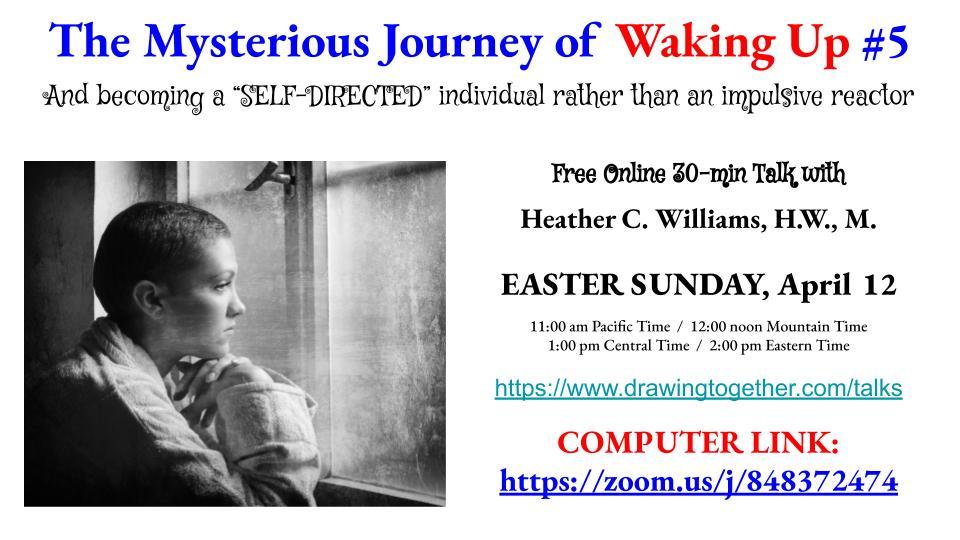
If there is a holiday about The Mysterious Journey of Waking Up – it is EASTER – when Jesus awakened! I invite you to come to The Prosperos Sunday Meeting on April 12 and begin your own journey of awakening!Save the link below to your calendar. See you on Easter Sunday!
With love and gratitude, Heather
WHAT: THE MYSTERIOUS JOURNEY OF WAKING UP #5DATE: Sunday April 12TIME: 11:00 am Pacific / Noon Mtn / 1:00 pm Central / 2:00 pm Eastern
CONNECT BY PHONE: One tap mobile+13126266799,,848372474# US(Chicago) +19292056099,,848372474# US(New York)Dial by your location +1 312 626 6799 US (Chicago) +1 929 205 6099 US (New York) +1 346 248 7799 US (Houston) +1 669 900 6833 US (San Jose) +1 253 215 8782 US +1 301 715 8592 US Meeting ID: 848 372 474 Find your local number: https://zoom.us/u/aoRqiholN
Democracy is struggling in America–by now this statement is almost cliche. But what if the country is no longer a democracy at all? In “Democracy Incorporated,” Sheldon Wolin considers the unthinkable: has America unwittingly morphed into a new and strange kind of political hybrid, one where economic and state powers are conjoined and virtually unbridled? Can the nation check its descent into what the author terms “inverted totalitarianism”?
Wolin portrays a country where citizens are politically uninterested and submissive–and where elites are eager to keep them that way. At best the nation has become a “managed democracy” where the public is shepherded, not sovereign. At worst it is a place where corporate power no longer answers to state controls. Wolin makes clear that today’s America is in no way morally or politically comparable to totalitarian states like Nazi Germany, yet he warns that unchecked economic power risks verging on total power and has its own unnerving pathologies. Wolin examines the myths and mythmaking that justify today’s politics, the quest for an ever-expanding economy, and the perverse attractions of an endless war on terror. He argues passionately that democracy’s best hope lies in citizens themselves learning anew to exercise power at the local level.
“Democracy Incorporated” is one of the most worrying diagnoses of America’s political ills to emerge in decades. It is sure to be a lightning rod for political debate for years to come.”
(Goodreads.com)
Consciousness, sexuality, androgyny, futurism, space, the arts, science, astrology, democracy, humor, books, movies and more