INSIDE THE WINNING FIGHT FOR REPARATIONS IN ATHENS, GEORGIA

Hattie Thomas Whitehead, 72, is one of at least 10 living former Linnentown residents. In this April 3, 2021, photograph, she stands outside of Creswell Hall at the University of Georgia, where Linnentown homes once stood, in Athens, Ga. Photo: Lynsey Weatherspoon for The Intercept

Fifty Black families were forcibly displaced from their homes in the 1960s. Now the descendants are seeking redress and a chance to testify before Congress.

Rachel M. Cohen
April 9 2021, 4:00 a.m. (TheIntercept.com)

WITHIN THE BOUNDS of a block in Athens, Georgia, three high-rise dorms stand where 50 Black families used to live. The dorms were built in the 1960s as part of the federal government’s urban renewal program, which empowered cities and colleges to seize property in the name of so-called slum clearance. As the University of Georgia and the Athens city government requisitioned lots and burned homes to the ground, they steered many residents into public housing. According to the University of Richmond’s “Renewing Inequality” project, 298 families in Athens were displaced during this period, 176 of them families of color.

In February, nearly six decades later, the county began its first attempt to offer redress. “The Unified Government of Athens-Clarke County extends to former residents of Athens’ Urban Renewal Districts, their descendants, and to all Athenians a deep and sincere expression of apology and regret for the pain and loss stemming from this time, and a sincere commitment to work toward better outcomes in all we do moving forward,” pledged Mayor Kelly Girtz in a signed proclamation. Two weeks after that, the county’s 10 commissioners voted unanimously to adopt a resolution that apologized specifically for the county’s role in destroying Linnentown, the Black, middle-class community that preexisted the UGA dorms. Join Our NewsletterOriginal reporting. Fearless journalism. Delivered to you.I’m in

The resolution acknowledges the seizure of residents’ homes and the perpetration of “an act of institutionalized white racism and terrorism resulting in intergenerational Black poverty, dissolution of family units, and trauma.” It pledges, among other things, to erect an on-site memorial honoring the legacy of Linnentown and create a new center on slavery, Jim Crow laws, and the future of Athens’s Black communities. Perhaps most importantly, it promises to calculate the total amount of intergenerational wealth lost through urban renewal and use that number to inform annual participatory budgeting on projects for redress — in other words, public funding for reparations.

A view of the Linnentown neighborhood, left, in 1943 from the vantage of old Sanford Stadium. Photo: Courtesy of Hargrett Rare Book and Manuscript Library/The University of Georgia Special Collections Libraries

The resolution is the first official act of reparations in Georgia, but those involved in its creation hope it won’t be the last. They aim to model an example for communities throughout the state and across the country, even as they recognize their success in the progressive city of Athens will be difficult to replicate. Nationally, reparations remains controversial at best. Last summer, amid mass protests for racial justice, one poll found just 1 in 5 respondents agreed the United States should use “taxpayer money to pay damages to descendants of enslaved people in the United States.” At the time, the city council in Asheville, North Carolina, approved a reparations resolution, but leaders have since stalled in distributing funds, and the resolution’s lead sponsor lost his reelection. 

Still, Girtz told The Intercept, “I think it will spread to other places.” The mayor pointed to St. Paul, Minnesota, which earlier this year passed a resolution to study reparations, and his hometown of Norfolk, Virginia, which is also reckoning with its lasting segregation. Evanston, Illinois, a wealthy Chicago suburb, last month announced its own reparations program: a plan to distribute $10 million over the next decade to Black residents who can show that they or their direct relatives lived in the city and suffered from racial discrimination between 1919 and 1969.

In February, White House press secretary Jen Psaki confirmed that President Joe Biden is open to studying federal reparations, though Biden has not committed to signing H.R. 40, a bill to fund a study of slavery and recommend “appropriate remedies,” in the event that it passes. The former Linnentown residents say they hope to testify before Congress on reparations and the harms of urban renewal. They have also requested meetings with their new senators, Jon Ossoff and Raphael Warnock, and plan to push for a constitutional change at the state Legislature to make distributing direct payments easier.

Hattie Thomas Whitehead holds a photograph of a street in the Linnentown neighborhood where she lived as a child, on the grounds where they used to stand, in Athens, Ga., on April 3, 2021. Photo: Lynsey Weatherspoon for The Intercept

Hattie Thomas Whitehead, a 72-year-old Black woman and fourth-generation Athenian, is one of at least 10 living former Linnentown residents. She knows their organizing work is far from over and that the next few months will be critical for ensuring that her government meets its pledges. Still, she can hardly believe they’ve reached this point.

“They voted on it in Black History Month, which is just a tremendous time for it to get approved,” she told The Intercept. “The night I watched the vote, and it was 100 percent, I was brought to tears.”

Thomas Whitehead lived in Linnentown until she was 14, when urban renewal came to Athens. Leaders burned down her home and directed her family into public housing. While details of Linnentown’s destruction had been passed down orally for decades, Thomas Whitehead said that until recently, descendants just lacked the hard data needed to make their case for justice. “Being part of this project has given me a voice,” she said. “It’s bringing healing.”

FINDING DATA ON the destruction of Linnentown began as an accident. A philosophy doctorate and library employee at UGA named Joseph Carter was doing research in December 2018 for a living wage campaign with the United Campus Workers of Georgia — hoping, he said, “to make the case for how the university suppresses wages in the county, and how that then has an effect on the local housing market.”

He called up an Athens-Clarke County commissioner, Melissa Link, who said she had heard rumors of an old community that used to be where three high-rise UGA dorms now stand. Carter began digging around in the UGA Special Collections Libraries, where he discovered many documents about urban renewal, including early 20th-century fire insurance maps that showed the Linnentown homes. The case file was called “Urban Renewal Project GA. R-50.”

Through a friend of Link’s, Carter connected with Geneva Johnson, a former Linnentown resident still living in Athens. When contractors demolished Johnson’s childhood home, her father was permitted to move another Linnentown house off-site to the neighborhood of East Athens, where she still lives today. Her home is one of just three surviving structures from the neighborhood.

Hattie Thomas Whitehead and Joseph Carter look at pictures of the former Linnentown neighborhood in Athens, Ga., on April 3, 2021. Photo: Lynsey Weatherspoon for The Intercept

Johnson, Carter, and Thomas Whitehead connected with three more Linnentown descendants, and together they launched a campaign called the Linnentown Project in September 2019.

That month, Thomas Whitehead spoke publicly about her displacement for the first time, in a speech she gave to a full house at a local arts center. In the autumn months that followed, the Linnentown Project began drafting its proposed resolution and started its outreach to UGA and city leaders. 

Word spread through the community, and by February 2020, dozens of residents and students poured into Athens’s City Hall to demand recognition and reparations for Linnentown descendants. Protesters stood with hand-painted signs bearing messages like “UGA Took Our Homes Away” and “Redress for Linnentown.”

EVEN IN A left-leaning city like Athens, unanimous support for reparations was in no way guaranteed. Some lawmakers initially shied away from using terms like “white racism and terrorism” to describe the displacement of Black families and the burning of their homes. According to Mariah Parker, a county commissioner who helped draft the proposal, some leaders found the language too harsh and feared alienation from the university, which has refused to acknowledge any harms related to Athens’s urban renewal. Commissioners Patrick Davenport and Russell Edwards were originally against the resolution, but by the night of the vote in February, Edwards apologized for his initial opposition.

“It was an act of terrorism. It was an act of white supremacy,” he said. Davenport voted in favor as well. 

Last June, Jerry NeSmith, another commissioner who opposed the resolution, died in an accident; his successor, Jesse Houle, made support for the Linnentown Project part of their campaign platform. Carol Myers, another commissioner newly elected last year, also ran in support of the Linnentown Project. 

As the year went on, some Linnentown Project activists protested for racial justice following the death of George Floyd. One local demonstration ended with Athens-Clarke police and National Guardsmen spraying tear gas on peaceful protesters, and soon after, Girtz approached Thomas Whitehead about moving forward with the Linnentown reparations effort.

“My hunch is he realized how much he screwed up with the protests, with the tear gassing and the arrests, and so then made the decision to move ahead with the Linnentown committee,” said Carter.

Russell Hall sits on the land of the former Linnentown community. Lynsey Weatherspoon for The InterceptLynsey Weatherspoon for The Intercept

Top/Left: Linnentown teenagers Geneva Johnson, left, Katy Mae Thomas, middle, and Christine Davis, right, are dressed ready for church in April 1960, at Davis’s house in Linnentown. Bottom/Right: University of Georgia’s Russell Hall dormitory, which sits on the land of the former Linnentown community, seen on April 3, 2021, in Athens, Ga.Credit: Top/Left: Courtesy Christine Davis Johnson/The Linnentown Project. Bottom/Right: Lynsey Weatherspoon for The Intercept

While a year of pressure, one-on-one meetings, and racial justice organizing helped bring the mayor and all 10 county commissioners on board, the university still spurns any suggestion of its culpability.

UGA sent a statement to Athens-Clarke County commissioners in January 2020, saying it “respectfully disagrees” with the “conclusions” of the Linnentown Project. As college enrollment surged during the 1960s, institutions nationwide began taking advantage of eminent domain to make room for new students. Historical documents reveal how UGA officials worked closely with city and federal leaders to leverage funds and move urban renewal forward.

Thomas Whitehead said she’s disappointed but not surprised UGA has given them the cold shoulder. “UGA has never acknowledged anything they’ve ever done that was not in the community’s favor,” she said. 

This year, the university is celebrating its 60th anniversary of desegregation, replete with signs and commemorative events throughout the spring. On its special website for the cause, the university is soliciting donations to “support diversity, equity and inclusion efforts across campus today.” 

Meanwhile, UGA continues to dismiss entreaties from Black Linnentown descendants. “They continue to ignore the residents and that in itself is just a continued slap in the face,” said Carter. “They’re just acting like it’s the 1960s all over again.”

UGA did not return The Intercept’s requests for comment.

While local leaders say they would prefer to partner with UGA to create their wall of recognition, Athens-Clarke County intends to build the memorial with or without the university’s collaboration.

“It’s best to acknowledge that there were some horrible things done in the not-so-distant past, because then we can move together more strongly,” said Girtz. “We’re going to be moving forward, and I would hope UGA joins us.”

Joseph Carter of the Linnentown Project, photographed on April 3, 2021, in Athens, Ga. Photo: Lynsey Weatherspoon for The Intercept

THE ATHENS BUDGET planning period runs from now through June. As part of that process, a committee chaired by Thomas Whitehead and fellow Linnentown descendant Bobby Crook will make recommendations for how to spend the reparations funding.

Girtz is looking to hire an economist to help community members calculate how much more money Linnentown descendants might have today, had they been permitted to stay in their homes. He plans first to approach Mehrsa Baradaran, a former UGA law professor and the author of “Color of Money,” a book on the racial wealth gap. Baradaran now works as a law professor at the University of California, Irvine, and progressives nationally have been pushing Biden to appoint her to lead the Office of the Comptroller of the Currency.

Parker, the commissioner, said she sees the work ahead as focused on both delivering material redress to descendants of Linnentown and launching additional efforts to help other lost and displaced communities in Athens. She and several local activists plan to ramp up pressure on their state legislature to change the so-called gratuities clause in Georgia’s constitution. The clause, which was initially passed as an anti-corruption measure, prevents local governments from providing direct cash payments to individuals and nonprofits. This hampers not only reparations efforts but also broader economic relief.

In January and February, Thomas Whitehead sent letters to Ossoff and Warnock’s offices to request assistance tackling Georgia’s gratuities clause. The senators have not yet answered, nor did they return The Intercept’s requests for comment.

Carter acknowledges that the success in Athens could be difficult to replicate elsewhere, particularly given the treasure trove of evidence they had available to make their case.

“There are communities in Atlanta that were affected by Georgia Tech and Georgia State that we want to take a look at, but the thing I’m concerned about is the availability of historical documents and who from those communities is still around,” he said. “To do this organizing you have to come with evidence, and with residents who see this as something that they want. Are the residents alive? Are they willing? Interested?”

According to Carter, an essential part of the process in Athens is that the decisions about how to achieve reparations have been on the Linnentown descendants’ own terms, and that they’ve been given power by their local government to make those calls. 

“We believe part of reparations should be to reallocate not just money but political power,” he said. “It’s not just you write a check and you’re done.”

CONTACT THE AUTHOR:

Rachel M. Cohenrachel.cohen@​theintercept.com@rmc031

© FIRST LOOK MEDIA. ALL RIGHTS RESERVED
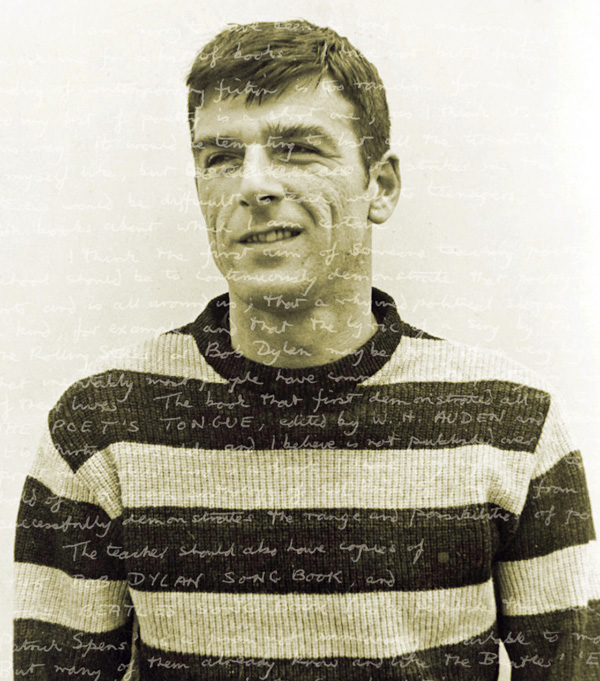
Thom Gunn on the sincerity of erections

“And there’s no such thing
as an insincere
erection is there?”

–Thom Gunn from the poem “Tenderloin” in his book The Man with Night Sweats

Thomson William “Thom” Gunn (August 29, 1929 – April 25, 2004) was an English poet who was praised for his early verses in England, where he was associated with The Movement, and his later poetry in America, even after moving towards a looser, free-verse style. Wikipedia

Twilight sleep

“A Peasant Mother and her Twilight Sleep Boy” from Painless childbirth in twilight sleep : a complete history of twilight sleep from its beginning in 1903 to its present development in 1915, including its successful use in Great Britain to-day by Hanna Rion

From Wikipedia, the free encyclopedia

Twilight sleep (English translation of the German word Dämmerschlaf)[1][2] is an amnesic condition characterized by insensitivity to pain without loss of consciousness, induced by an injection of morphine and scopolamine, especially to relieve the pain of childbirth.[3]

In 1899, a Dr. Schneiderlin recommended the use of hyoscine and morphine for surgical anaesthesia and it started to be used for purpose, sporadically.[3][4] The use of this combination to ease birth was first proposed by Richard von Steinbuchel in 1902 then was picked up and further developed by Carl Gauss in FreiburgGermany starting in 1903.[5] The method came to be known as “Dämmerschlaf” (“twilight sleep”) or the “Freiburg method”.[3][5] It spread rather slowly, and different clinics experimented with different dosages and ingredients; in 1915 The Canadian Medical Association Journal reported that “the method [was] really still in a state of development”.[3]

In 1915, the New York Times published an article on twilight sleep and the work of Hanna Rion, or Mrs. Frank Ver Beck, who had recently written a book entitled The Truth About Twilight Sleep. In that article, Rion said that the consensus of 69 medical reports she had looked at said that “scopolamin-morphin is without danger to the child”.[5]

It was initially heralded as the dawning of “a new era for woman and through her for the whole human race”,[5] and early feminists in the US formed the National Twilight Sleep Association, which advocated for wider use; articles appeared in the New York TimesThe Ladies’ Home Journal, and Reader’s Digest praising it.[6] The campaign dwindled after one of its leaders, Frances X. Carmody,[7] died of hemorrhage giving birth.[6]

The drug combination relieved the pain partially; and created amnesia such that the woman giving birth sometimes didn’t remember the pain, although results were variable.[6][8] Women were sometimes blind-folded, or had their ears plugged, in order to “promote sleep.”[8]

It remained widely used in the US until the 1960s. Growing chemophobia and a desire for more natural childbirth[9] led to its abandonment.[6]

More at: https://en.wikipedia.org/wiki/Twilight_sleep#:~:text=Twilight%20sleep%20(English%20translation%20of,relieve%20the%20pain%20of%20childbirth.

Making Safe Nuclear Power from Thorium | Thomas Jam Pedersen | TEDxCopenhagen


TEDx Talks
30.6M subscribersSUBSCRIBEDThomas Jam Pedersen, engineer and co-founder of Copenhagen Atomics, was skeptical at first upon discovering and reading about thorium energy, which is present everywhere in the world and could technically provide an inexpensive energy supply for everyone for thousand years. While the world is still heavily relying on fossil fuels, thorium energy and nuclear reactors, which reuse nuclear waste, are now part of the energy debate, proposing a pollution-free solution that could provide an unlimited supply of fuel for the next millennium. Thomas Jam Pedersen aims to build a thorium molten salt reactor in Copenhagen, and introduce thorium energy to the public eye. Thomas Jam Pedersen is an engineer, who has extensive experience in software and simulations. With a group of chemical engineers and physicists, he co-founded the startup Copenhagen Atomics. He also writes a blog about thorium energy on the website Ingeniøren. This talk was given at a TEDx event using the TED conference format but independently organized by a local community. Learn more at http://ted.com/tedx

(Inspired by Clint Lambert)

New Measurements of Muons Might Rewrite Particle Physics

The gap between theoretical predictions and the experimental measurements isn’t a full-blown discovery yet

A 50-foot-wide blue ring used at Fermilab to study particle physics
The 50-foot-wide racetrack used to study muons traveled by barge around Florida and up the Mississippi, and then by truck across Illinois. (Reidar Hahn, Fermilab)

By Theresa Machemer

SMITHSONIANMAG.COM APRIL 9, 2021

About 50 years ago, physicists came up with a rulebook to describe the ways fundamental particles interact to create the world as we know it. Since then, researchers have pushed that theoretical framework, called the Standard Model, to its limits in order to study its imperfections.

Now, results from two particle physics experiments have come tantalizingly close to discovering a gap in the Standard Model.

The experiments focused on muons, which are similar to electrons. Both have an electric charge and spin, which makes them wobble in a magnetic field. But muons are over 200 times larger than electrons, and they split apart into electrons and another particle, neutrinos, in 2.2 millionths of a second. Luckily, that’s just enough time to gather precise measurements, given the right equipment, like a 50-foot-wide magnet racetrack.

Physicist Chris Polly of the Fermi National Accelerator Laboratory presented a graph during a seminar and news conference last week that showed a gap between theoretical calculation and the actual measurements of muons moving in the racetrack.

“We can say with fairly high confidence, there must be something contributing to this white space,” said Polly during the news conference, per Dennis Overbye at the New York Times. “What monsters might be lurking there?”

The Standard Model aims to describe everything in the universe based on its fundamental particles, like electrons and muons, and its fundamental forces. The model predicted the existence of the Higgs boson particle, which was discovered in 2012. But physicists know that the model is incomplete—it takes into account three fundamental forces, but not gravity, for example.

A mismatch between theory and experimental results could help researchers uncover the hidden physics and expand the Standard Model so that it explains the universe more fully.

“New particles, new physics might be just beyond our research,” says Wayne State University particle physicist Alexey Petrov to the Associated Press’ Seth Borenstein. “It’s tantalizing.”

Theresa Machemer is a freelance writer based in Washington DC. Her work has also appeared in National Geographic and SciShow. Website: tkmach.com

(Submitted by Suzanne Deakins, H.W., M.)

A Gender Non-Binary Overview from “Openly” on Twitter

Openly @Openly (via Twitter)

The gender binaries of “male” and “female” aren’t as universal as you think. From Samoa to Albania, here are eight cultures throughout history showing that the concept of non-binary gender is far from new.

Image

Two-spirit (North America)

Identifying with masculinity and femininity, indigenous North American two-spirit people are often said to contain both male and female ‘spirits’. They’re often revered in their communities, seen as a channel between the physical and spiritual.

Image

Fa’afafine (Samoa)

Identifying as a separate gender, fa’afafines’ roles in society move fluidly between the traditional male and female. While they’re assigned male at birth, Samoa also recognises fa’afatama – an equally fluid gender for those assigned female at birth.

Image

Hijras (South Asia)

The centuries-old third gender, associated with sacred powers, usually refers to those assigned male at birth but don’t identify as such. In 2014, India legally recognised hijras as a third gender after they were criminalised by the British in 1871.

Image

Sworn Virgins (Albania)

In this dying practice, women take on the social identity of a man for life, while taking a vow of chastity. By taking on this identity, they’re elevated to the status of a man, entitled to the rights and privileges of the patriarchy.

Image

Metis (Nepal)

Officially recognised as a third gender in Nepal in 2007, metis have a long history in the Himalayan region. Assigned male at birth, they assume a traditional feminine appearance. Nepal set a global precedent with a third gender category on official documents.

Image

Bugis (Indonesia)

The ethnic group has for centuries seen gender as a spectrum, with three additional genders in addition to male and female. Bugis genders include ‘calabai’ (feminine men), ‘calalai’ (masculine women) and intersex ‘bissu’ priests.

Image

Brotherboys and sistergirls (Indigenous Australians)

Used by Aboriginals and Torres Strait Islanders, brotherboys describes people with a gender experience inconsistent with their assigned sex, with a male spirit and male roles in the community – sistergirls are the opposite.

Image

Toms (Thailand)

One of the dozen or more common gender identities in Thailand, ‘toms’ are women who adopt masculine mannerisms and style, while using male speech terms. Toms are often attracted to ‘dees’ – women who follow traditional Thai gender norms.

971K5.9K Openly @Openly·

While far from being all-inclusive, this list goes to show that non-binary concepts of gender are not a recent phenomenon.

New Moon In Aries – Let’s do it!

by Astro Butterfly (astrobutterfly.com)

We have a New Moon in Aries on Sunday, April 11th, 2021 (Americas) or April 12th (Europe, Asia and Oceania).

The New Moon in Aries is the 1st New Moon of the astrological year. This is when things finally start to move forward.

If you’ve been feeling a bit lethargic or stuck during the Pisces season, this will change. The New Moon in Aries is a cosmic reset – the Universe is giving you a green light to start all over again. 

We have a record of 5 planets in Aries: the Sun, the Moon, Mercury, Venus and Chiron are all in the first sign on the zodiac. This New Moon is as “Aries” as you can get. 

Aries energy is synonymous with new beginnings.

When you start a fire, Aries is that initial spark that turns solid matter into flames.

When you turn your car keys, Aries is that initial ignition that gets your car going.

Aries is the spark of life, the big bang, the beginning of everything. 

Aries – The Spiritual Instinct

Aries people are known for their uninhibited courage and instinct. Aries will not wait around for life to come to them. They will get out there and take action.

If Libra, the opposite sign, takes their time to reflect and rationalize, Aries doesn’t need to reflect – their actions are a result of an impulse, of an internal combustion they feel called to act upon as soon as possible.

To everyone else, this approach seems crazy and risky, but nothing that Aries does is random; it is ignited by the divine spark of consciousness it initially emerged from.  

It’s important to mention that while Aries is very instinctual, we are NOT talking about the earthy, Taurean instinct. Aries is a fire sign.

Here we are talking about the ‘spiritual’ instinct, that inner knowing of what’s right, of what makes us feel alive, of what we’ve been called to do in this lifetime. 

At the New Moon in Aries, we feel an urge to ACT and affirm ourselves.

We are infused with this raw instinct of affirmation, with this primal desire to BE and participate.

We are all in, in total flow, pulsing to the same heartbeat as the Universe. 

Psychologists have recognized the creative potential when people are in a flow state, or “in the zone”. When we are in the zone, we are fully focused, energized, and immersed in what we are doing.

Psychologists have identified several factors that describe the “state of flow”

  • Intense and focused concentration in the present moment
  • Merging of action and awareness
  • A loss of reflective self-consciousness
  • A sense of personal control over the situation or activity
  • A distortion of temporal experience 
  • Experience of the activity as intrinsically rewarding

The state of flow is not just a random experience, it is the result of being aware, of understanding something very fundamental about the role we are called to play in this lifetime.  

New Moon in Aries – Let’s Do It

The New Moon is at 22° Aries and it is sextile Mars in Gemini, sextile Jupiter in Aquarius, and square Pluto in Capricorn.

Mars, Jupiter and Pluto are the powerhouses of the solar system.

Basically all planets that make aspects with the New Moon in Aries have this “let’s do it”, “let’s do it now” vibe. 

Mars is the ruler of this New Moon, and a harmonious aspect between the New Moon and its ruler is very auspicious.

The mutual reception between Mars and Mercury suggests that this New Moon is about aligning our thoughts with our actions.

“Whatever the mind can conceive, the mind can achieve”.  – Napoleon Hill

The sextile with Jupiter infuses us with faith, optimism, and big-picture perspective. Jupiter is not about having faith for the sake of having faith. With Jupiter, the reason we’re confident is that we understand the bigger context, the bigger vision of what we are trying to achieve. 

The square to Pluto in Capricorn will ensure we keep our integrity in check. Whatever goal or project that is in focus, you want it to be about YOU, not about anyone else. 

This is a visionary New Moon that will ask us to explore, take a stand and get involved in projects that reflect the truth of who we are. 

And while you have all the reasons to get excited about the New Moon in Aries, keep in mind that this New Moon is just the 1st New Moon of the astrological year.

You’ll have 11 other lunations to bring your vision to reality. You don’t have to change the world just yet – so don’t be disappointed if nothing spectacular happens on April 11th. 

Don’t worry too much at this point about “how” you are going to make it happen.

Your role right now is to plant the seed.

At the same time, don’t forget that this is the Aries season, so just thinking about your project (and doing nothing concrete about it) will probably not cut it. 

Even if you’re not an Aries, and normally you don’t resonate with the Aries approach, at the New Moon try to experiment with this fresh, bold, daring energy.

And if you don’t have any project in mind, put yourself out there anyway, and trust that the Universe will guide you in the right direction.

Aries New Moon, April 11th, 2021

Wendy Cicchetti

Aries New Moon

The Aries New Moon bursts onto the scene in a blaze of glory, with the restless, impetuous energy of spring’s emergence. Yet this Moon is somewhat tempered by close proximity to Venus, adding a softer edge. As the Moon and Venus are traditionally the major symbols of feminine energy in astrology, this is a double, female alliance. We may notice more sisterly energy around us — or realize this needs to come from within, since tolerance has worn thin for the harder edges and demanding impatience often associated with a more masculine approach. This New Moon nudges us to focus on the more patient, giving, gentle sides of our nature, as opposed to the more aggressive, pushy ways we may go about getting what we want. The Moon–Venus combination in Aries calls forth a finely tuned balance — an engaged receptivity.

It won’t go unnoticed that, overall, this lunation chart contains a chain of asteroids and planets in Aries — six planetary bodies in all, both major and minor, from Chiron through Mercury, Ceres, Sun and Moon, to Venus. Despite any established ideas of which bodies “count” within a stellium, I have found in practice that people who have a lot of cosmic content in a particular sign, in their charts, tend to have a strong resonance with that sign — and may seem to embody it in some obvious way. In particular, Mercury in Aries stands out in this stellium, as it reminds me of someone I know with that placement, who needs to move around physically a great deal, in order to “think straight.” The New Moon’s close proximity to Ceres is also reflective of thinking about what nourishes us — or even, quite literally, urging us to get our dietary plan or grocery list in order!

The Moon sextiles Mars, in Gemini, underlining the theme of collaboration already hinted at in its conjunction with Venus. Mars in the double-bodied sign of the Twins gives us the benefit of greater manpower; if we get others involved, the job becomes easier! The Moon also sextiles Jupiter in Aquarius, emphasizing opportunities for growth. With the humanitarian streak that runs through Aquarius, along with its ability to function well in groups, this brings to mind the lyrics of the song “Love Train,” with “people all over the world” joining in! The sextile’s doorway into fostering co-operation should not be ignored — although sometimes we have to be the ones to create the opportunity, rather than wait for it to show itself. So, embrace the courage of Mars and generosity of Jupiter, and extend options, invitations, and encouragement to others. A gentle nudge may be in order. Then we will see how to take matters forward, or that we need to hold back a while, depending on the responses we receive (and not forgetting that we might need to be patient, and not just judge on what happens in the first few hours, or days!) The Jupiter sextile also reminds us to focus on a journey — a longer path of progress and learning.

If there is one blot on the sky, it is perhaps the cardinal square of the Moon to Pluto in Capricorn. Where there are Pluto issues, I am often reminded of the late Donna Cunningham’s work in her book, Healing Pluto Problems. Hard Moon–Pluto aspects (the square, opposition, and sometimes the conjunction) symbolize an intense sensitivity, especially to feeling suffocated, controlled, disempowered, and shamed. This lunation allows us a chance to become aware of these states, perceptions, or feelings, whether they are triggered in us or someone around us. If we notice them arising, aim to bring compassion to help heal the situation, rather than brash, Aries energy that might add fuel to the fire!

Equally, given our heightened sensitivity, we may experience events in a deeper way than usual, and if so, we may benefit from handling ourselves with kid gloves — especially our inner child, whose delicate nervous system registers pain more easily. Cunningham speaks about chakra healing and use of flower remedies in her book, both of which I have felt to be helpful in supporting sensitive moments, when life sends a sparky event that feels like a cannon ball landing!

This article is from the Mountain Astrologer, written by Diana Collis.

Ernest Hemingway: The Old Man and the Androgyny

Ken Burns’ new film explores the man beneath the myth, reopening questions about the macho writer’s sexuality

By Mary Katharine Tramontana 05/04/2021 (Esquire.com)

ernest hemingway

Ernest Hemingway and his three sons with blue marlin on the docks of Bimini, in The Bahamas. 20 July 20, 1935ERNEST HEMINGWAY COLLECTION. JOHN F KENNEDY PRESIDENTIAL LIBRARY AND MUSEUM, BOSTON

Bullfight-lover. Big game hunter. Deep sea fisher. Brawler. Boxer. Drinker. War hero. Ladies’ man. Even for his time, Ernest Hemingway was masculinity in hyperbole. The outsized writer of stripped-back prose was also, a new documentary argues, an explorer of gender fluidity in the bedroom – both in his literature and his life. At a cultural moment which favours simplistic interpretations of iconic figures as villains or heroes, American filmmakers Ken Burns and Lynn Novick muddy the waters of the fallen literary celebrity in Hemingway, their non-hagiographic, six-hour examination of the contradiction between the myth and the man.

“For us it’s about making things more complex,” Burns tells me, on a call from his home in Walpole, New Hampshire. “Hemingway is monstrous at times and there’s never a moment in the film where we let him off the hook.” The writer’s epic and, ultimately, tragic life allowed him to create literature – considered to be among the most influential in the English language – that Burns says belies the imprisoning masculinity that he’s known for. “He shows how incredibly difficult it is to have an on-off switch. That black-white, good-bad labelling may be the de rigueur activity, but there’s nothing binary about the world.”

This quest for nuance is key in understanding Hemingway’s marital bed. In the film, biographer Mary Dearborn calls him “brave” for his “sexual preferences” and admission to an “intense desire” for role play. “He really had a thing about androgyny and he liked to switch sex roles in bed, and he tells Mary [Walsh Hemingway, his fourth wife], ‘Let’s play around, I’m gonna call you Pete, you call me Catherine.’”

Was Hemingway gay or straight? He was a fetishist

In her journal, Mary wrote that he was the best man she’d been with in bed. He “wanted his wife to be both completely obedient and sexually loose.” She “enjoyed the sexual part, cut her hair short and bleached it platinum, because it excited him, and sometimes pretended that she was a boy and he was a girl,” the narrator (longtime Burns collaborator Peter Coyote) tells us. “He dyed his hair too.”

The film voices a condensed excerpt from Hemingway’s entry in Mary’s diary while the two were on safari in East Africa in 1953:

She has always wanted to be a boy and thinks as a boy without losing any of her femininity. If you should become confused on this, you should retire. She loves me to be her girls, which I love to be, not being absolutely stupid… In return she makes me awards, and at night we do every sort of thing which pleases her and which pleases me. […] I loved feeling the embrace of Mary, which came to me as something quite new and outside all tribal law.

Was the gender swapping simply code for Hemingway’s enjoyment of every sort of thing outside all tribal law – like anal penetration? Does “being the girl” just mean being the one penetrated? Was Hemingway an early, literary proponent of pegging?

“I don’t know,” Burns told me. “This is a really important question, something’s clearly happening in that diary entry and in Garden of Eden. It certainly opens a door to that consideration.”

The Garden of Eden is a posthumously published novel that overlaps, in many ways, with Hemingway’s life – including the matching hair and sex play. In the film, the writer Michael Katakis says the novel exposes things that “some people would find shocking” about Hemingway. “He’s not hiding himself.”

“He lay there and felt something and then her hand holding him and searching lower and he helped with his hands and then lay back in the dark and did not think at all and only felt the weight and the strangeness inside and she said, “Now you can’t tell who is who can you?”

“No.”

“You are changing,” she said. “Oh you are. You are. Yes you are and you’re my girl Catherine. Will you change and be my girl and let me take you?”

“You’re Catherine.”

“No. I’m Peter. You’re my wonderful Catherine. You’re my beautiful lovely Catherine. You were so good to change. Oh thank you, Catherine, so much. Please understand. Please know and understand. I’m going to make love to you forever.”

― Ernest Hemingway, The Garden of Eden

The book focuses on a couple honeymooning in the French Riviera in 1927 (the spot of Hemingway’s honeymoon with his second wife, Vogue editor Pauline Pfeiffer). David, an author and war veteran, and Catherine spend their days eating, tanning, drinking, and having sex. One day Catherine returns to the hotel with a surprise for David. She cut her hair “cropped as short as a boy’s.” Later in bed, when David calls her “girl” Catherine tells him, “Don’t call me girl.” Then she asks, “Will you change and be my girl and let me take you? [….] I’m Peter. You’re my wonderful Catherine.” The two meet and fall in love with Marita, who becomes a proto-polyamorous lover to both.This content is imported from YouTube. You may be able to find the same content in another format, or you may be able to find more information, at their web site.

Hemingway said the book was “too sexually adventurous” to be published in his lifetime, and he was right. It wasn’t released until 1986, 25 years after he shot himself in his home in Ketchum, Idaho. Rounds of electroshock therapy prescribed for depression had caused a loss in Hemingway’s short-term memory, rendering him unable to write. Numerous concussions, self-medication with prescription drugs, and decades of alcoholism didn’t help, but depression and suicide ran in the family. His father, sister, brother, and granddaughter also killed themselves. There’s a painful scene in the film where Hemingway gives a rare interview, after winning his Nobel Prize in 1954, with his speech impaired.

After the book came out, Joan Didion – who, like Ralph Ellison, would retype Hemingway’s stories to learn his style – lamented its publication in The New Yorker. How ethical is it to publish an unfinished book against an author’s wishes – an author who cared about every period, comma, and article?

And yet, he didn’t destroy it either.

Pegging Papa

Ethics aside, the book does offer essential insight. For one, the anal penetration in The Garden of Eden is “pretty well accepted” by critics familiar with the original manuscript, according to Debra Moddelmog, dean of the College of Liberal Arts at the University of Nevada, Reno. In Reading Desire, Moddelmog points out a revealing phrase Hemingway had crossed out, which contains more explicit detail: David felt “something that yielded and entered.” In the published novel,

[David] lay there and felt something and then her hand holding him and searching lower and he helped with his hands and then laid back in the dark and did not think at all and only felt the weight and the strangeness inside and she said, “Now you can’t tell who is who can you?”

What entered?

“I think this is digital anal penetration,” Moddelmog tells me (a 2010 film adaptation agrees), “but there’s room for interpretation.” Of course, the “something” and the “weight” could easily be an implement heavier than fingers. The game is repeated many times. And absinthe helped to cure David’s “remorse” when, one day, while visiting Spain, the penetration occurred when he and Catherine were both “boys.”

The late Richard Fantina’s “Pegging Ernest Hemingway”, from his book Straight Writ Queer, offers another take. “In Hemingway’s work the male heroes seldom penetrate women but rather are sometimes penetrated themselves,” he writes. Male submission is part of the back door sex for Fantina: “The ideal Hemingway woman”, like sexually liberated Brett Ashley in The Sun Also Rises (1926), “demonstrates power and a will to dominate.” In The Garden of Eden, Hemingway “celebrates a woman who controls the sexual relationship with her husband and who initiates female-on-male sodomy.” Sodomy, Fantina argues, is a “polymorphous practise that transcends categories of gender and sexual preference.”

In her diary, during that previously mentioned 1953 African sex safari, Mary Hemingway wrote: “Papa’s definition of buggery: ‘Sodomy when practised by those who are not gentlemen.’” A few lines away from that is an account of their afternoon nap: a “love-feast, love-fest, love fiesta,” and another entry later that night noted “a bigger, happier, lovelier, love-fest-feast.” There’s also her account of Hemingway’s mock interview:

REPORTER: ‘Mr. Hemingway, is it true that your wife is a lesbian?’
PAPA: ‘Of course not. Mrs Hemingway is a boy.’
REPORTER: ‘What are your favorite sports, sir?’
PAPA: ‘Shooting, fishing, reading and sodomy.’
REPORTER: ‘Does Mrs Hemingway participate in these sports?’
PAPA: ‘She participates in all of them.’
REPORTER: ‘Sir, can you compare fishing, shooting and cricket, perhaps, with the other sports you practise?’
PAPA: ‘Young man, you must distinguish between the diurnal and the nocturnal sports. In this later category sodomy is definitely superior to fishing.’

Icebergs and Enemas

In 1918, Hemingway was in hospital in Milan after being wounded while volunteering as an ambulance driver on the Italian front during World War I. In preparation for an operation, he was likely given an enema by nurse Agnes von Kurowsky – his first great love. This enema was replicated in A Farewell to Arms, when Catherine administers one to Frederic, a lieutenant of the ambulance core, before his operation.

The word ‘enema’ is never used. The reader must infer from his lover-nurse making him “clean inside and out.”

In Hemingway’s pared-down ‘iceberg’ technique of layered writing, it’s what’s unsaid, left beneath the surface, that matters. That omission entailed excising chunks of text and giving the reader the generous credit to intuit the absence. In his 1927 short story, “Hills Like White Elephants,” a man pressures a woman to get an abortion, and the word abortion is never mentioned. “The Sea Change” (1931) features a woman talking to a man in a bar about how she’s going to leave him for another woman, yet her bisexuality is never stated directly. Elision and subtext are Hemingway’s signature style. And this certainly applied to sex.

The quiet enema in A Farewell to Arms is sexualised, subtly, as is the moment directly after:

‘What would you like me to do now that you’re all ready?’
‘Come to the bed again.’
‘All right. I’ll come.’
‘Oh, darling, darling, darling,’ I said.
‘You see,’ she said. ‘I do anything you want.’
‘You’re so lovely.’
‘I’m afraid I’m not very good at it yet,’
‘You’re lovely.’
‘I want what you want. There isn’t any me any more. Just what you want.’

Hemingway’s enema intimacy was possibly his foray into adulthood anal pleasures.

A Moveable Fetish

Years earlier, a young Ernest wore a flouncy summer dress. His mother, Grace, captioned a snapshot of him: “summer girl.” He and his sister Marcelline, who was a year-and-a-half older, were always dressed alike – with identical haircuts. In that time, it was common for young boys to wear dresses. However, at the Hemingway’s, his mother also referred to him as a girl, and this went on long enough for Ernest to worry aloud that Santa Claus would not know he was a boy.

Being raised as the pseudo-twin of his sister is what many critics attribute to his fascination with matching haircuts, which is repeated in his adult eroticism, letters, and fiction, and the gender swapping – which often alludes to brother/sisters.

“You’ll almost never see an erotic scene in Hemingway without a good deal of attention to hair,” Carl Eby, the president of The Hemingway Foundation and author of Hemingway’s Fetishism tells me by phone from Boone, North Carolina. “People always ask me, ‘Was Hemingway gay or straight?’

“He was a fetishist.”

ernest hemingway

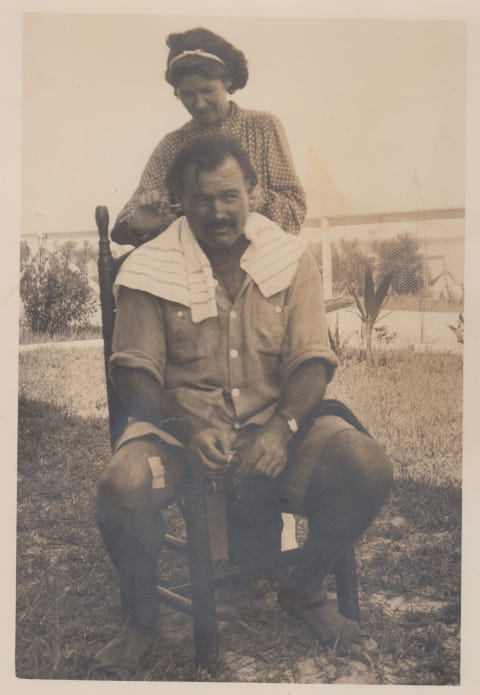
Ernest Hemingway’s second wife, Pauline Pfeiffer, cutting his hairERNEST HEMINGWAY COLLECTION. JOHN F KENNEDY PRESIDENTIAL LIBRARY AND MUSEUM, BOSTON

Fetishes, which are typically linked to experiences in childhood, are “an obligatory prop – for instance, shoes, underwear, or in Hemingway’s case, hair—that makes sexual gratification possible,” said Eby. “The fetishist will use it as a tool to disavow sexual difference in a partner, so the person wearing the fetish can become a girl-boy. As Robert Stoller beautifully puts it, ‘a fetish is a story masquerading as an object.’”

In Hemingway’s fiction, the “heterosexual sodomising” of men is connected to a set of patterns, according to Eby, like fetishised haircuts, gender transformation, and the male protagonist entering a state of “not thinking.”

(Though, isn’t a state of not thinking an aim of all sex?)

“For Hemingway, sodomy carried a homosexual undertone,” Eby said. “Like David in The Garden of Eden, he’d imagine himself in a female role while getting penetrated by a female partner playing a male role. A sort of gender-swapping heterosexuality. But he could never free himself from a sneaking suspicion that there was something ‘homosexual’ about it.” His characters often seem to be trying to fend that off.

Secret Pleasures

Was the macho posturing a front to cover Papa’s secret pleasures?

That’s the pop psychology take. But Hemingway was likely aware of his kinks. He was an avid fan of the pioneering sexologist Havelock Ellis, who wrote extensively on all things sexually deviant – including hair fetishes – and even recommended his books to his first wife, Hadley, and friends. Alfred Kinsey, another non-judgmental taxonomer of sexual behaviour, was also on his bookshelves. After Hemingway found his trans son in his mother’s nylons he said, “Gigi [a nickname for Gregory, who transitioned to Gloria after Hemingway’s death], we come from a strange tribe, you and I.”

Papa, who helped launch this magazine, really did love those “manly” hobbies. The manliness was definitely hyperbolic, thanks to the press and Hemingway’s mastery of branding (back when self-promotion was still a social embarrassment). He knew the public wanted the he-man, and it was the taboo of its opposite that excited him.

Like a feminist who gets off on being subservient to men in bed, the erotic lies in the verboten. For Hemingway, born in 1899, being bad meant “being the girl” and getting penetrated.

The complexity of human nature and desire is, ultimately, unknowable, even in ourselves

The hair stuff was a cheeky public prelude to all of that. Transgressing cultural taboos is often an element of fetishism. Like his writing, you could see the haircuts on the surface, and the “devil things” they got up to privately (as they call it in Garden) were the bottom part of that hair iceberg.

In the safari entry Hemingway calls Mary “prince of devils.” In “Secret Pleasures,” a chapter cut from A Moveable Feast – his glossed-up autobiographical account of living in Paris in the Twenties with Hadley – he gushes over their matching hair (his grown out, hers cut) and “how much fun it was to be damned… [We] kept our own tribal rules and had our own customs and our own standards, secrets, taboos and delights.”

None of this is new. That sodomy interview was printed in The New York Times in 1977, in a feature called “A Farewell to Machismo.” What’s baffling is that after Garden was published in 1986, reviewers focused on the hair stuff and ignored the sodomy. With the mystery of his understatement and truncation, surely many critics just missed it. After all, the pleasures of prostate stimulation aren’t part of the standard hetero sex script (vaginal penetration + phallus) – Hemingway’s depiction is remarkable for its rareness in literature. Bottoming doesn’t exactly fit the (homophobic) archetypal epitome of masculinity either. Then, too, there’s no doubt that some critics who were clued-in about the anality were too self-conscious to write about it. What might that awareness suggest about their own lives?

The Garden of Eden

I’m still not convinced that too much fuss isn’t being made about Papa’s gender trouble. After all the posturing and the bravado, knowing more about Hemingway’s private life and writing reminds us that “we have very little understanding of the intimate lives of other people,” co-filmmaker Lynn Novick tells me, on a call from her apartment in New York City. “With a famous person who’s left a lot of breadcrumbs, we’re so curious and we want to explain everything, but maybe that’s oversimplifying the complexity of human nature and desire, which is, ultimately, unknowable – even in ourselves.”

It’s worthwhile to keep in mind how much overblown analysing we do with the art and lives of legendary figures. We project our desires as part of our existential craving for meaning in our own lives, and in doing so, we often place meaning where none may be. Hemingway was a pleasure-seeker, and his writing is undeniably sensual, that much is clear in his erotic descriptions of food and drink alone (tasting “the cold bottle of white wine wrapped in a newspaper” at the beach; the “flow of the butter” melting on eggs at breakfast).

An appreciation of blonde hair and prostate sensation are not exactly unique pleasures either. Before researching this story, I told a male friend, who sleeps exclusively with women, that after mulling over the film’s vagueness about his sexual ambiguity, I wondered if the big androgyny mystery of “being the girl” wasn’t much of a mystery at all. “I think Hemingway just liked stuff in his ass,” I said. His response: “Who doesn’t?”

Hemingway’ airs on PBS from 5-7 April, and on the BBC later this year

Mary Katharine Tramontana is a writer covering sexual politics and culture for The New York Times, Playboy, and other outlets. You can follow her on Twitter at @MKTramontana or on Instagram at @marykatharinetramontana. She lives in Berlin.

Red herring

From Wikipedia, the free encyclopedia

red herring is something that misleads or distracts from a relevant or important question.[1] It may be either a logical fallacy or a literary device that leads readers or audiences toward a false conclusion. A red herring may be used intentionally, as in mystery fiction or as part of rhetorical strategies (e.g., in politics), or may be used in argumentation inadvertently.

The term was popularized in 1807 by English polemicist William Cobbett, who told a story of having used a strong-smelling smoked fish to divert and distract hounds from chasing a rabbit.

In the mystery story “A Study in Scarlet“, detective Sherlock Holmes examines a clue which is later revealed to be intentionally misleading (i.e., a red herring).

More at: https://en.wikipedia.org/wiki/Red_herring#:~:text=The%20term%20was%20popularized%20in,hounds%20from%20chasing%20a%20rabbit.

Consciousness, spirituality, biography, sexuality, androgyny, futurism, space, the arts, science, astrology, democracy, humor, books, movies and more