ARIES (March 21-April 19): Created by Leonardo da Vinci in the 16th century, the “Mona Lisa” is one of the world’s most famous paintings. It’s hanging in the Louvre museum in Paris. In that same museum is a less renowned version of the “Mona Lisa.” It depicts the same woman, but she’s unclothed. Made by da Vinci’s student, it was probably inspired by a now-lost nude Mona Lisa” painted by the master himself. Renaissance artists commonly created “heavenly” and “vulgar” versions of the same subject. I suggest that in the coming weeks you opt for the “vulgar” “Mona Lisa,” not the “heavenly” one, as your metaphor of power. Favor what’s earthy, raw and unadorned over what’s spectacular, idealized and polished.
TAURUS (April 20-May 20): Taurus poet Vera Pavlova writes, “Why is the word yes so brief? It should be the longest, the hardest, so that you could not decide in an instant to say it, so that upon reflection you could stop in the middle of saying it.” I suppose it makes sense for her to express such an attitude, given the fact that she never had a happy experience until she was 20 years old, and that furthermore, this happiness was “unbearable.” (She confessed these sad truths in an interview.) But I hope you won’t adopt her hard-edged skepticism toward YES anytime soon, Taurus. In my view, it’s time for you to become a connoisseur of YES, a brave explorer of the bright mysteries of YES, an exuberant perpetrator of YES.
GEMINI (May 21-June 20): In indigenous cultures from West Africa to Finland to China, folklore describes foxes as crafty tricksters with magical powers. Sometimes they’re thought of as perpetrators of pranks, but more often they are considered helpful messengers or intelligent allies. I propose that you regard the fox as your spirit creature for the foreseeable future. I think you will benefit from the influence of your inner fox — the wild part of you that is ingenious, cunning, and resourceful.
CANCER (June 21-July 22): “The universe conspires in your favor,” writes author Neale Donald Walsch. “It consistently places before you the right and perfect people, circumstances, and situations with which to answer life’s only question: ‘Who are you?’” In my book “Pronoia Is the Antidote for Paranoia: How the Whole World Is Conspiring to Shower You with Blessings.” I say much the same thing, although I mention two further questions that life regularly asks, which are: 1. What can you do next to liberate yourself from some of your suffering? 2. What can you do next to reduce the suffering of others, even by a little? As you enter a phase when you’ll get ample cosmic help in diminishing suffering and defining who you are, I hope you meditate on these questions every day.
LEO (July 23-Aug. 22): The poet Anne Sexton wrote a letter to a Benedictine monk whose real identity she kept secret from the rest of us. She told him, “There are a few great souls in my life. They are not many. They are few. You are one.” In this spirit, Leo, and in accordance with astrological omens, I invite you to take an inventory of the great souls in your life: the people you admire and respect and learn from and feel grateful for; people with high integrity and noble intentions; people who are generous with their precious gifts. When you’ve compiled your list, I encourage you to do as Sexton did: Express your appreciation; perhaps even send no-strings-attached gifts. Doing these things will have a profoundly healing effect on you.
VIRGO (Aug. 23-Sept. 22): “It’s a temptation for any intelligent person to try to murder the primitive, emotive, appetitive self,” writes author Donna Tartt. “But that is a mistake. Because it is dangerous to ignore the existence of the irrational.” I’m sending this message out to you, Virgo, because in the coming weeks it will be crucial for you to honor the parts of your life that can’t be managed through rational thought alone. I suggest you have sacred fun as you exult in the mysterious, welcome the numinous, explore the wildness within you, un-repress big feelings you’ve buried, and marvel adoringly about your deepest yearnings.
LIBRA (Sept. 23-Oct. 22): Science writer Sharman Apt Russell provides counsel that I think you should consider adopting in the coming days. The psychospiritual healing you require probably won’t be available through the normal means, so some version of her proposal may be useful: “We may need to be cured by flowers. We may need to strip naked and let the petals fall on our shoulders, down our bellies, against our thighs. We may need to lie naked in fields of wildflowers. We may need to walk naked through beauty. We may need to walk naked through color. We may need to walk naked through scent.”
SCORPIO (Oct. 23-Nov. 21): As Scorpio author Margaret Atwood reminds us, “Water is not a solid wall; it will not stop you. But water always goes where it wants to go, and nothing in the end can stand against it.” According to my reading of the astrological omens, being like water will be an excellent strategy for you to embrace during the coming weeks. “Water is patient,” Atwood continues. “Dripping water wears away a stone. Remember you are half water. If you can’t go through an obstacle, go around it. Water does.”
SAGITTARIUS (Nov. 22-Dec. 21): In a letter to a friend in 1856, Sagittarian poet Emily Dickinson confessed she was feeling discombobulated because of a recent move to a new home. She hoped she would soon regain her bearings. “I am out with lanterns, looking for myself,” she quipped, adding that she couldn’t help laughing at her disorientation. She signed the letter “From your mad Emilie,” intentionally misspelling her own name. I’d love it if you approached your current doubt and uncertainty with a similar light-heartedness and poise. (P.S.: Soon after writing this letter, Dickinson began her career as a poet in earnest, reading extensively and finishing an average of one poem every day for many years.)
CAPRICORN (Dec. 22-Jan. 19): Now is a favorable time to celebrate both life’s changeableness and your own. The way we are all constantly called on to adjust to unceasing transformations can sometimes be a wearying chore, but I suspect it could be at least interesting and possibly even exhilarating for you in the coming weeks. For inspiration, study this message from the “Welcome to Night Vale” podcast: “You are never the same twice, and much of your unhappiness comes from trying to pretend that you are. Accept that you are different each day, and do so joyfully, recognizing it for the gift it is. Work within the desires and goals of the person you are currently, until you aren’t that person anymore.”
AQUARIUS (Jan. 20-Feb. 18): Aquarian author Toni Morrison described two varieties of loneliness. The first “is a loneliness that can be rocked. Arms crossed, knees drawn up; holding, holding on, this motion smooths and contains the rocker.” The second “is a loneliness that roams. No rocking can hold it down. It is alive, on its own.” Neither kind is better or worse, of course, and both are sometimes necessary as a strategy for self-renewal — as a means for deepening and fine-tuning one’s relationship with oneself. I recommend either or both for you in the coming weeks.
PISCES (Feb. 19-March 20): England’s Prince Charles requires his valet to iron his shoelaces and put toothpaste on his toothbrush and wash all of his clothes by hand. I could conceivably interpret the current astrological omens to mean that you should pursue similar behavior in the coming weeks. I could, but I won’t. Instead, I will suggest that you solicit help about truly important matters, not meaningless trivia like shoelace ironing. For example, I urge you to ask for the support you need as you build bridges, seek harmony and make interesting connections.
Homework: The Dream of the Month Club wants to hear about your best nightly dreams. Truthrooster@gmail.com.
Traveling out of body is what many people hope to experience when they attend the Monroe Institute. The out-of-body experience (or OBE) is a concept that’s been around for centuries, though the term, “out of body,” was coined in the book “Apparitions,” by G.N.M. Tyrrell, published in 1953. Luckily for us, Robert A. Monroe had one in 1958. He learned to use his OBEs to discover, explore and map deep levels of awareness. Thanks to his efforts, the Monroe Institute was born.
OBEs have been thought to be induced by traumatic brain injuries, near-death experiences, sleep disorders, and/or electrical stimulation to the brain. My own personal journey with OBEs began when I was a teenager. I experienced sleep paralysis literally every single morning, and it was a real struggle that I had to work through. I first found myself fighting to move and filled with terror. As time went by, I began learning to calm down and project myself out of my body. I’ll admit that I never mastered this process, but it was something that shaped me and pushed my interests in the direction of the metaphysical world very quickly.
As I grew into adulthood, my adventures in sleep paralysis became less frequent, and when I did have them, I taught my husband to wake me up. I found I could make a very specific sound that he could recognize so he was able to wake me quickly. My OBEs became less and less common. Throughout my experiences in different Monroe Institute programs, I’m not sure I’ve ever really had an experience that could compare to the ones from my teenage years, though I’ve definitely had some incredibly life-changing moments.
To get yourself on track to having an OBE for yourself, here are a few things I’ve found that have helped me that could potentially help you.
As you allow your body to drift to sleep while keeping your mind awake and alert, you can experience a whole new world of Focus levels to explore, and can potentially experience an OBE.
Stay calm and go with the flow.
There can be a small amount of fear associated with letting go and going within yourself before expanding your state of awareness. While this is normal, it’s important to learn to relax each part of yourself and truly stay calm to experience an OBE. “Mind Awake, Body Asleep” is a state heavily associated with OBEs, and it’s for a good reason. As you allow your body to drift to sleep while keeping your mind awake and alert, you can experience a whole new world of Focus levels to explore, and can potentially experience an OBE. If you get nervous or fight yourself as your body goes to sleep, it’s incredibly counterproductive and may inhibit your ability to have an OBE. So, going with the flow and being willing to commit to any experience that comes your way are especially important.
Be open to using your imagination.
When you’re over-analytical like I am, it’s possible you’ll decide one of your experiences “doesn’t count,” or you’ll quickly invalidate something you’ve gone through. This is immensely counterproductive. You have to be willing and open to work with your intuition, and through it, your imagination. You have to believe that your mind could be taking you on a journey through your imagination to lead you to something important, and that this is the way your intuition can show it to you. Just as our subconscious can show us our inner thoughts and turmoil while we sleep, our imagination can open up insights into our inner thoughts, desires and worries while we are awake. So, if your meditative experience has you on a journey within your imagination, go with the flow and see where it takes you. It might just surprise you, and it could easily lead you to an OBE.
Don’t compare yourself to others, and definitely don’t try too hard. Part of the meditative experience is truly just letting go and experiencing it, as I said.
Trust that you will have the experience you want when you are ready for it.
Trying too hard or pushing yourself will most likely not end the way you want it to. Everyone’s journey is unique and will, therefore, take different amounts of time to accomplish. Don’t compare yourself to others, and definitely don’t try too hard. Part of the meditative experience is truly just letting go and experiencing it, as I said. If you spend your meditation asking yourself, “Why can’t I see anything?” or “Why isn’t this happening for me?,” then you’re living in your head and are too focused on that to experience anything deeper. You have to trust that you are on the right path for yourself and that everything will reveal itself to you in time. Being impatient isn’t going to help.
All in all, our journeys are different. However, if you are open to staying calm, going with the flow, listening to your intuition and trusting yourself, you can be assured that you will go down the right meditative path for you. Hopefully, with time and practice, this can result in an OBE.
Learn core techniques to induce an Out-of-Body Experience in OBE Spectrum and let the adventure begin!
Malorie Mackey
Actress, author and adventurer Malorie Mackey is an actress, host, and writer living in Los Angeles, CA. Malorie’s first book was published in 2017 and her short story “What Love Has Taught Me” has been published in the anthology “Choices.” You can find Malorie’s travel content on dozens of digital media platforms. Check out www.maloriesadventures.com for more. Malorie’s adventures don’t just encompass physical adventures. She has been a student of intuition since she was a teenager, studying at Edgar Cayce’s A.R.E. In 2019, Malorie discovered the Monroe Institute while filming her travel show. Since then, she has been studying the art and science of consciousness through many different programs and life experiences.
In a chapter of the altogether indispensable 1843 treatise Either/Or: A Fragment of Life (public library), Søren Kierkegaard (May 5, 1813–November 11, 1855), considered the first true existentialist philosopher, explores precisely that — how our constant escapism from our own lives is our greatest source of unhappiness.
Kierkegaard, who was only thirty at the time, begins with an observation all the timelier today, amidst our culture of busy-as-a-badge-of-honor:
Of all ridiculous things the most ridiculous seems to me, to be busy — to be a man who is brisk about his food and his work.
(It’s worth remembering, here, that “busy is a decision” — one we constantly make, and often to our own detriment.)
In a latter chapter, titled “The Unhappiest Man,” he returns to the subject and its deeper dimension:
The unhappy person is one who has his ideal, the content of his life, the fullness of his consciousness, the essence of his being, in some manner outside of himself. The unhappy man is always absent from himself, never present to himself. But one can be absent, obviously, either in the past or in the future. This adequately circumscribes the entire territory of the unhappy consciousness.
He considers how the very architecture of our language perpetuates our proclivity for absence:
The unhappy one is absent. But one is absent when living in the past or living in the future. The form of expression is important, for it is evident, as philology also teaches us, that there is a tense that expresses present in the past, and a tense that expresses presence in the future; but the same science also teaches us that there is a pluperfect tense in which there is no present, as well as a future perfect tense with the same characteristics. These are the hoping and remembering individuals. Inasmuch as they are only hoping or only remembering, these are indeed in a sense unhappy individuals, if otherwise it is only the person who is present to himself that is happy. However, one cannot strictly call an individual unhappy who is present in hope or in memory. For what one must note here is that he is still present to himself in one of these. From which we also see that a single blow, be it ever so heavy, cannot make a person the unhappiest. For one blow can either deprive him of hope, still leaving him present in memory, or of memory, leaving him present in hope.
Kierkegaard goes on to explore these two key forms of escapism from presence, via hope and via memory:
Consider first the hoping individual. When, as a hoping individual (and of course to that extent unhappy), he is not present to himself, he becomes unhappy in a stricter sense. An individual who hopes for an eternal life is, indeed, in a certain sense an unhappy individual to the extent that he renounces the present, but nevertheless is strictly not unhappy, because he is present to himself in the hope and does not come in conflict with the particular moments of finitude. But if he cannot become present to himself in hope, but loses his hope, hopes again, and so on, then he is absent from himself not just in the present but also in the future, and we have a type of the unhappy. Though the hoping individual does not hope for something that has no reality for him, he hopes for something he himself knows cannot be realized. For when an individual loses hope, and instead of becoming a remembering individual, wants to remain a hoping one, then we get this form.
Similarly if we consider the remembering individual. If he finds himself present in the past, strictly he is not unhappy; but if he cannot do that but remains constantly absent from himself in a past, then we have a form of the unhappy.
Memory is pre-eminently the real element of the unhappy, as is natural seeing the past has the remarkable characteristic that it is gone, the future that it is yet to come; and one can therefore say in a sense that the future is nearer the present than is the past. That future, for the hoping individual to be present in it must be real, or rather must acquire reality for him. The past, for the remembering individual to be present in it, must have had reality for him. But when the hoping individual would have a future which can have no reality for him, or the remembering individual remember a past which had had no reality for him, then we have the genuinely unhappy individuals. Unhappy individuals who hope never have the same pain as those who remember. Hoping individuals always have a more gratifying disappointment. The unhappiest one will always, therefore, be found among the unhappy rememberers.
Oct. 27, 2020 Updated: May 5, 2021 10:01 a.m. (SFGate.com)
651 Duncan, the former home of two LGBTQ pioneers, has received landmark status.Aerial Canvas
The former San Francisco home of two lesbian pioneers has been officially granted landmark status, approved unanimously by the San Francisco Board of Supervisors.
Phyllis Lyon and Del Martin [both long-time members of The Prosperos] were the first couple to be married by San Francisco officials in defiance of California’s ban on same-sex marriage. The duo were also co-founders of the Daughters of Bilitis, the first political and social organization for lesbians in the United States.
Lyon and Martin lived in the small Noe Valley house at 651 Duncan during most of their 54 years together and oversaw the garden spanning one side of the double lot. The city’s lesbian community often used the space for meetings and events.Read More
Martin died in 2008 and Lyon died at the age of 95 in April 2019.
District 8 Supervisor Rafael Mandelman, who is gay, submitted the resolution to begin the Historic Preservation Commission’s approval process in October 2020.
“This particular home was a place where a lot of history got made over many decades by two extraordinary women,” Mandelman said. “Del and Phyllis envisioned queer rights before anyone could have imagined that would be a thing. … They changed the course of history for millions of queer people and did it all from this little cottage in Noe Valley.”
While landmarking will not require any public recognition on the property, it would limit the development of the land should the new owners of the home want to demolish the 756-square-foot property in favor of a larger structure.
The property was listed for $3 million in August 2020 and sold for $2.25 million in September.
This is the first LGBTQ historic site in a solely residential neighborhood. Four other LGBTQ locations currently hold landmark status, but they all are in commercial corridors.
Editor’s note: This story was updated May 5, 2021, when the home’s landmark status was approved.
Tessa is a Local Editor for SFGATE. Before joining the team in 2019, she specialized in food, drink and lifestyle content for numerous publications including Liquor.com, The Bold Italic, 7×7 and more. Contact her at tessa.mclean@sfgate.com.
In December 1968, the ecologist and biologist Garrett Hardin had an essay published in the journal Sciencecalled ‘The Tragedy of the Commons’. His proposition was simple and unsparing: humans, when left to their own devices, compete with one another for resources until the resources run out. ‘Ruin is the destination toward which all men rush, each pursuing his own best interest,’ he wrote. ‘Freedom in a commons brings ruin to all.’ Hardin’s argument made intuitive sense, and provided a temptingly simple explanation for catastrophes of all kinds – traffic jams, dirty public toilets, species extinction. His essay, widely read and accepted, would become one of the most-cited scientific papers of all time.
Elinor Ostrom, Nobel Laureate in Economics photographed in 2011. Photo by Raveendran/AFP/Getty.
Even before Hardin’s ‘The Tragedy of the Commons’ was published, however, the young political scientist Elinor Ostrom had proven him wrong. While Hardin speculated that the tragedy of the commons could be avoided only through total privatisation or total government control, Ostrom had witnessed groundwater users near her native Los Angeles hammer out a system for sharing their coveted resource. Over the next several decades, as a professor at Indiana University Bloomington, she studied collaborative management systems developed by cattle herders in Switzerland, forest dwellers in Japan, and irrigators in the Philippines. These communities had found ways of both preserving a shared resource – pasture, trees, water – and providing their members with a living. Some had been deftly avoiding the tragedy of the commons for centuries; Ostrom was simply one of the first scientists to pay close attention to their traditions, and analyse how and why they worked.
The features of successful systems, Ostrom and her colleagues found, include clear boundaries (the ‘community’ doing the managing must be well-defined); reliable monitoring of the shared resource; a reasonable balance of costs and benefits for participants; a predictable process for the fast and fair resolution of conflicts; an escalating series of punishments for cheaters; and good relationships between the community and other layers of authority, from household heads to international institutions.
A parliamentary study tour of the conservancies in 2005. Photo courtesy NACSO/WWF Namibia
When it came to humans and their appetites, Hardin assumed that all was predestined. Ostrom showed that all was possible, but nothing was guaranteed. ‘We are neither trapped in inexorable tragedies nor free of moral responsibility,’ she told an audience of fellow political scientists in 1997.
What Hardin had portrayed as a tragedy was, in fact, more like a comedy. While its human participants might be foolish or mistaken, they are rarely evil, and while some choices lead to disaster, others lead to happier outcomes. The story is far less predictable than Hardin thought, and its twists and turns can lead to uncomfortable places. But in those surprises lie the possibilities that Hardin never saw.
You might think that scientists, and the public, would eagerly trade Hardin’s dark speculations about human nature for Ostrom’s sunnier findings about our capabilities. But as I learned while researching and writing my bookBeloved Beasts (2021), a history of the modern conservation movement, Ostrom’s conclusions have faced stubborn resistance. During the early years of her career, colleagues criticised her for spending too much time studying the differences among systems and too little time looking for a unifying theory. ‘When someone told you that your work was “too complex”, that was meant as an insult,’ she recalled.
Ostrom insisted that complexity was as important to social science as it was to ecology, and that institutional diversity needed to be protected along with biological diversity. ‘I still get asked, “What is the way of doing something?” There are many, many ways of doing things that work in different environments,’ she told an audience in Nepal in 2010. ‘We have got to get to the point that we can understand complexity, and harness it, and not reject it.’
Her research gained global prominence in 2009, when, aged 76, Ostrom became the first woman to be awarded the Nobel Prize in Economic Sciences. But for a variety of reasons – perhaps because she was a woman in a male-dominated field, or perhaps because her sophisticated work didn’t lend itself to a catchy name – her carefully collected data hasn’t dislodged Hardin’s metaphor from the public imagination.
When Ostrom died in 2012, she was celebrated by her colleagues for her pioneering work, her plainspoken humility, and her steady resistance to what she called ‘panaceas’. She knew from experience how corrosive simple stories could be. Hardin, for his part, seemed bent on making his own ideas as repugnant as possible. Among his proposed solutions to the tragedy of the commons was coercive population control: ‘Freedom to breed is intolerable,’ he wrote in his 1968 essay, and should be countered with ‘mutual coercion, mutually agreed upon’. He feared not only runaway human population growth but the runaway growth of certain populations. What if, he asked in his essay, a religion, race or class ‘adopts overbreeding as a policy to secure its own aggrandisement’? Several years after the publication of ‘The Tragedy of the Commons’, he discouraged the provision of food aid to poorer countries: ‘The less provident and less able will multiply at the expense of the abler and more provident, bringing eventual ruin upon all who share in the commons,’ he predicted. He compared wealthy nations to lifeboats that couldn’t accept more passengers without sinking.
Hardin compared wealthy nations to lifeboats that couldn’t accept more passengers without sinking.
In his later years, Hardin’s racism became more explicit. ‘My position is that this idea of a multiethnic society is a disaster,’ he told an interviewer in 1997. ‘A multiethnic society is insanity. I think we should restrict immigration for that reason.’ Hardin died in 2003, but the nonprofit Southern Poverty Law Center, alert to the longevity of his ideas, maintains his profile in its ‘extremist files’ and classifies him as a white nationalist.
Still, many of those who abhor Hardin’s racist ideas – or would if they were aware of them – are seduced by the simplicity of his tragedy. If academic citation indexes are any guide, the tragedy of the commons remains far better known to scholars than any of Ostrom’s findings. It continues to be taught, uncritically, to high-school students in environmental science courses. It’s used as a justification by those who support severe restrictions on human immigration and reproduction. Even more frequently, it’s casually invoked as an explanation for human failures: even the eminent biologist E O Wilson, in his bookHalf-Earth (2016), describes the weakness of international climate-change agreements and the ongoing depletion of ocean resources as tragedies of the commons, without making clear that such tragedies can be averted.
Despite the evidence gathered by Ostrom and her colleagues, it seems, many are still all too willing to believe the worst of their fellow humans – to the detriment of conservation efforts worldwide. Like Hardin, many conservationists assume that humans can only be destructive, not constructive, and that meaningful conservation can be achieved only through total privatisation or total government control. Those assumptions, whether conscious or unconscious, close off an entire universe of alternatives.
While Ostrom’s ideas are not yet familiar maxims, they haven’t been ignored. In southern Africa in the 1980s, some conservationists recognised that parks and reserves, many created by colonial governments, had divided subsistence hunters and farmers from much of the wildlife that had long sustained them – and which, in some cases, they’d managed as a commons for generations. The resulting lack of local support meant that even the best-patrolled park boundaries were vulnerable to incursions by human neighbours, people unlikely to tolerate – much less protect – the large, sometimes troublesome species that ranged beyond even the largest reserves.
A local warden at the Wuparo Conservancy in Namibia. Photo courtesy NACSO/WWF Namibia
In response, new initiatives attempted to redistribute the burdens and benefits of conservation: the Communal Areas Management Programme for Indigenous Resources (CAMPFIRE) project in Zimbabwe directed revenue from hunting and tourism on communal lands to district councils, incentivising those councils and their communities to control illegal hunting. In neighbouring Zambia, the Administrative Management Design (ADMADE) programme trained local people as wildlife rangers, then transferred some wildlife management responsibilities, and benefits, from the national government to community boards. These and similar efforts became known as community-based conservation.
In 1987, when the South African conservationist Garth Owen-Smith attended a conference on community-based conservation in Zimbabwe, a comment by Harry Chabwela, the director of Zambia’s national parks, left a lasting impression. ‘At this conference we have talked a lot about giving local people this and giving them that, but what has been forgotten is that they also want power,’ Chabwela said. ‘They want a say over the resources that affect their lives. That is more important than money.’
Owen-Smith had already spent years living in Namibia, which was controlled by South Africa and known as South West Africa. When severe drought and an epidemic of illegal hunting threatened livelihoods and wildlife in the territory’s northwestern desert in the early 1980s, Owen-Smith had supported the creation of a system of community game guards. The unarmed guards – many of whom were hunters themselves – were so effective at tracking illegal hunters that, after a few years, the killing of elephants and rhinos in the region stopped completely. Antelope numbers improved so much that Owen-Smith was able to persuade the national conservation department to reopen limited game hunting in the area – a development much appreciated by locals.
Local wardens conduct a game count in Caprivi, Northeastern Namibia. Photo courtesy NACSO/WWF Namibia
Chabwela’s comment about power motivated Owen-Smith to think bigger. When he returned home, he and his partner Margaret Jacobsohn began to talk with community leaders and members about ways of restoring some local authority over wildlife. After Namibia won independence from South Africa in 1990, the new government recruited Jacobsohn and Owen-Smith to survey rural attitudes toward conservation, and the survey confirmed what the two had by then been hearing for years: most people didn’t want the occasionally dangerous species they lived with to be killed or removed – but they did, as Chabwela had suggested, want a say in their management. In 1996, the Namibian National Assembly passed a law that allowed groups of people living on communal land to establish institutions called conservancies. Conservancies would be governed by elected committees, and all members would share the benefits of any tourism or commercial hunting within conservancy boundaries.
Trophy hunters are sometimes directed toward lions and elephants who have become aggressive toward people.
The first conservancies on communal land were formalised in 1998, and there are now more than 80 of them in Namibia. They cover more than 40 million acres of land, and stretch from the northwestern desert to the humid, densely populated Zambezi Region in the northeast. They earn revenue from lodges, campgrounds and guide services, both as partners in joint ventures and as solo operators. They participate in annual surveys of game and wildlife populations and, in cooperation with the national conservation ministry, set quotas for both subsistence and commercial hunting within their boundaries. They employ their own game guards, who are currently fending off a continent-wide wave of rhino poaching driven by Asian demand for powdered rhino horn (a discredited traditional medicine). And, every year, the members of each conservancy assemble to call their governing committees to account.
Detailed recods are made of local wildlife. Photo courtesy NACSO/WWF NamibiaLocal hunting quotas are agreed upon. Photo courtesy NACSO/WWF Namibia
In August 2019, I attended the general meeting of Orupembe Conservancy, held in an open-air pavilion on the outskirts of Onjuva, a tiny town hundreds of miles from the nearest gas station, and even further from a paved road. Most of the people at the meeting were semi-nomadic herders, many of whom had travelled long distances from even more isolated corners of the conservancy. (I was present thanks to the expert off-road driving skills of the guide Edison Kasupi, who grew up in nearby Purros Conservancy.) When the Onjuva committee called the meeting to order, there were 95 people seated inside the pavilion, about half of the conservancy members and just enough for a quorum. The chairman Henry Tjambiru commented that the current drought had forced many people to take their herds further afield, preventing them from attending.
Orupembe Conservancy has several sources of income, all relatively modest: a campsite, a small lodge that it co-owns with two other conservancies, and contracts with a handful of hunting guides. (Some conservancies have very little income, and fund their operations with donations from international conservation groups; others, such as the neighbouring Marienfluss Conservancy, have joint venture agreements with upscale lodges that can net more than $100,000 a year in salaries and fees.)
After a review of the year’s earnings, the committee distributed a list of local species and the current hunting quotas for each. Because the drought had worsened since the quotas were set, conservancy members had voluntarily left most of them unfilled. While wildlife surveys earlier in the year had suggested that 75 oryx could be killed without harming the population, for example, only three had been shot so far. The meat from two of those was currently boiling in a nearby row of pots, about to be served for lunch.
The meeting, which lasted several hours, was disrupted by procedural inefficiencies, lively sideline arguments and, at one point, an accusation of petty corruption. But as the sun sank and the meeting came to a ragged end, I realised with surprise that I was exhilarated. During an exceptionally difficult year, these conservancy members had taken the trouble to travel to the meeting, consider the long-term future of other species, and recommit themselves to ensuring it.
In reviving the commons, the Namibian conservancies have revived the relationships between people and wildlife – and the results, as Ostrom would be unsurprised to learn, are complex. Where parks and reserves separate land into clearly defined categories, community-based conservation proposes that land can be simultaneously protected and utilised – through the cooperative efforts of the people who live on it. It’s a profound challenge to Hardin’s assumptions, and while some of its outcomes are easy to applaud – the recovery of elephants and rhinos, the arrival of new jobs – others make outsiders squirm.
A vulnerable rhino is relocated. Photo courtesy NACSO/WWF Namibia
John Kasaona, who grew up in northwestern Namibia and, as a boy, watched Owen-Smith and his father set out on game-guard patrols, is now the executive director of Integrated Rural Development and Nature Conservation, a nonprofit organisation that provides technical support to the conservancies. When he travels overseas to talk about the accomplishments of the Namibian conservancy system, he mentions only briefly, if at all, that its success depends in part on income from trophy hunters – tourists who pay for the privilege of shooting an animal for sport, and who in some cases keep hides or horns for display. For many conservancies, trophy hunting is not only a source of income but a tool for preserving the peace between humans and other species, since trophy hunters are sometimes directed toward individual lions or elephants who have become aggressive toward people.
Kasaona is well aware of the images that trophy hunting conjures in his listeners’ minds: Theodore Roosevelt standing next to a fallen elephant, dwarfed by the carcass and its upturned tusks; Eric Trump grinning as he hefts the limp body of a leopard, his brother Don Jr beside him; the Zimbabwean lion named Cecil, whose illegal killing by a dentist from Minnesota during a guided hunt in 2015 caused a global outcry. For some in North America and Europe, trophy hunting in Africa has come to symbolise human sins against other species.
In 2017, after Kasaona spoke at a Smithsonian Institution conference in Washington, DC, a young woman stood to speak at the audience microphone. ‘I think that some pieces were missing from the presentation,’ she began. Kasaona had not shown images of the animals slain by trophy hunters, she said. He had neglected to mention that the lion or elephant spotted by a visiting family on safari might be killed the next day. Kasaona, at the podium, acknowledged the international controversy over trophy hunting, but said that regulated commercial hunts remained an important source of revenue for the Namibian conservancies. There was more to say, but the session was over, and any further discussion was washed away by chatter.
Even in the darkest times, Ostrom’s work reminds us that the future is unpredictable and full of opportunity.
More than two years later, I met up with Kasaona in the town of Swakopmund, about halfway down the Namibian coast. We talked over generous plates of springbok curry at the colonial-era Hansa Hotel, where German is spoken more frequently than English, and both are far more common than any of Namibia’s 20-plus Indigenous languages and dialects.
I asked Kasaona to finish answering his questioner at the Smithsonian conference. ‘People say: “I don’t like what they’re doing to animals,” but most of them wouldn’t want to live next to a lion that could harm their family,’ he said. The majority of tourists who hunt for sport in Namibia pursue more common species such as springbok, whose hunting is permitted through the conservancy quota system. In the case of globally threatened species, the number of animals (if any) that can be shot each year is set by the Convention on International Trade in Endangered Species (CITES). In 2004, the parties to the convention approved applications by Namibia and South Africa to allow limited hunting of black rhinos, determining that the population had recovered to the point that five male rhinos could be shot in each country each year. In Namibia, the national conservation ministry chooses which rhinos will be hunted – usually older animals that have become aggressive or territorial – and issues permits for the hunts. The permit fee is deposited in a national conservation trust fund, and in one recent case a hunter paid $400,000 to shoot a single male rhino, far more than most conservancies earn in a year.
The trophy-hunting system in Namibia isn’t perfect, Kasaona acknowledges – there are cases where hunters have killed the wrong animal – but over the long term, he said, it benefits both the conservancies and the species in question by reducing conflicts between people and wildlife. When international conservation groups promise to regulate and censure trophy hunting out of existence, Kasaona hears what he calls ‘another kind of colonisation’ – a violation of the local authority that he and others have spent decades building up, and a threat to the revenue it depends on. ‘What do they say to the people whose livelihood depends on what they are trying to ban?’ he says.
Global restrictions on trophy hunting, Kasaona argues, are a simplistic response to a complex situation – what Ostrom might call a panacea. Not all countries are alike; not all conservancies are alike; not all conservancy members are alike; not even all trophy hunters are alike. And a few individual lions and elephants are far more dangerous than others, as those who have lost loved ones and livelihoods to rogue animals can attest.
While those viral images of trophy hunters with carcasses might all seem to say the same thing, they don’t. Some, surely, are symbols of corruption or needless violence. But, in the best cases, they’re examples of sustainable utilisation: colonial nostalgia, harnessed by the formerly colonised to further multispecies survival.
Ostrom’s principles of commons management now underlie not only the Namibian conservancy system but hundreds of similar efforts throughout the world. Many have revived and adapted conservation practices developed centuries ago, developing new rules suited to current circumstances. Their creators cooperate in the management of coral reefs in Fiji, highland forests in Cameroon, fisheries in Bangladesh, oyster farms in Brazil, community gardens in Germany, elephants in Cambodia, and wetlands in Madagascar. They operate in thinly populated deserts, crowded river valleys, and abandoned urban spaces.
While conservation almost always carries at least some short-term costs, researchers have found that many community-based conservation projects reduce those costs and, over time, deliver significant benefits to their human participants, tangible and intangible alike. And while community-based conservation began as a reaction to top-down conservation strategies, it can operate in parallel with large parks and reserves – and even foster their creation. In northwestern Namibia, two neighbouring conservancies have proposed to establish a ‘people’s park’ where livestock would be excluded and tourist numbers would be limited by a permit system, allowing lions and other large predators to more easily avoid conflicts with humans. Should the national legislature approve the conservancies’ proposal, the region could serve as a core habitat from which large carnivores can range in relative safety – since the region’s biological diversity is now protected not only by law, but by supportive human neighbours.
Community-based conservation can’t solve everything, and it doesn’t always succeed in protecting the commons. In many cases, national governments don’t recognise the longstanding land claims of Indigenous and other rural communities, creating uncertainty that interferes with community efforts to manage for the long term. Even well-established systems are vulnerable to internal conflict, and to external pressures ranging from drought to war to global market forces. As Ostrom often reminded her audiences, any strategy can succeed or fail. Community-based conservation is distinctive because many societies have only begun to understand – or remember – its potential. ‘What we have ignored is what citizens can do,’ she said.
At Indiana, Ostrom and her husband Vincent, also a political scientist, founded the Workshop in Political Theory and Policy Analysis, affectionately known as ‘The Workshop’ to the researchers who continue to gather there. Current students of commons management struggle, as Ostrom did, with the difficulty of managing large-scale resource problems such as air pollution at the community level. They wrestle with the implications of her findings for the digital landscape, where the veneration of open access often collides with Ostrom’s definition of the commons as a boundaried, regulated space. And despite what one researcher in 2011 dubbed ‘Ostrom’s Law’ – that whatever works in practice can work in theory – even Ostrom’s admirers sometimes echo her earliest critics, lamenting that the field lacks an overarching theory.
The challenge of understanding the complexity of all species continues, as does the challenge of seeing possibility in what so often looks like a collective tragedy. But even in the darkest times, Ostrom’s work can remind us that the future is deliciously unpredictable, and full of opportunities for us to stumble away from the edge.
This original essay draws on the book ‘Beloved Beasts: Fighting for Life in an Age of Extinction’ (2021) by Michelle Nijhuis, published by W W Norton & Co.
In April, I joined in a debate with Ben Bradlee, Jr., the estimable onetime senior editor at my hometown Boston Globe and former overseer of the prestigious Spotlight team. For movie buffs who are wondering, Ben was played by John Slattery in the Best Picture-winning film.
The Munk Debates are a project of the Aurea Foundation, a Canadian charity. Their aim is “to help the world rediscover the art of civil and substantive public debate by convening the brightest thinkers of our time to weigh in on the big issues of the day.”
The issue Mr. Bradlee and I respectfully debated came in the form of a resolution:
Be it resolved: the mainstream media is dying, and that’s OK.
I was asked to argue the proside of this debate. I could have argued either way, honestly. But there is something to the idea that the mainstream media is dying for a reason, and innovation is now badly needed, so I tried to explore that angle.
It turned out to be a lively discussion.
Mainstream Media | Munk DebatesMunk Debates Podcast, Season Two, Episode #22 – Mainstream Mediamunkdebates.com
April 22nd 20218 Retweets14 Likes
Below, some of the excerpts from the debate have been transcribed. I should note that I have great respect for Ben, so what might have been a nastier exchange with a different media opponent turned into more of a productive, thoughtful discussion. But, still interesting! Some of the key exchanges of the discussion, moderated by Rudyard Griffiths:
Rudyard Griffiths: One of the key public goods that the media provides is investigative reporting, public accountability journalism. It’s expensive. It takes time. It takes training. It takes a methodology. And it’s arguably critical to the role of The Estate to hold power to account.
Matt, in your universe, with the death of mainstream media and the rise of platforms like the ones you’re on, Substack — how is that critical public good function going to be fulfilled and why would we have any faith that it would be fulfilled with the same quality and attention to detail and concern for the facts that traditional mainstream outlets like Ben’s former employer The Boston Globe bring to that critical public service of investigative reporting?
Matt Taibbi: For nearly 15 years, I was one of the few people in the country that had a traditional full-time investigative reporting job. I would get an assignment from Rolling Stone and be told to go off and work for two or three months on a story about an arcane topic like credit default swaps, or the ratings agencies on Wall Street. I would have to come back with a 6,000- or 7,000-word story that would have to be fact-checked from beginning to end, every line. These are expensive endeavors. They cost a lot for the companies, and there’s also a lot of logistical work that goes into them.
In the Internet age, when everybody’s revenue is tied to content, and people are surfing constantly, it’s very difficult to financially justify that kind of work. You can get the same financial return from a 200-word article or a tweet or especially a viral video. Companies are very tempted to forgo that kind of investment. They’ve figured out that audiences, for the most part, don’t require it in the same way that they used to. And so, people are no longer really investing in that kind of work with the same passion. It’s a serious problem. Where are we going to find people to do those massive exposes anymore?
You might remember, a couple of years ago, the New York Times did a gazillion-word expose on Donald Trump’s finances. It was well done, the kind of thing that once upon a time would’ve galvanized the entire country for a while, maybe a week, two weeks. But though that piece lit up the internet for about a day and a half, it petered out and was replaced by other stories. That newspapers can’t afford that anymore. They can’t afford to put that much work in and not get that big of a return.
Griffiths: Ben, in your career, which is a storied one, you were the editor at The Boston Globe, responsible for the paper’s really important reporting on the Roman Archdiocese of Boston and its serial cover-ups of children being abused by priests.
How, in this new kind of world that Matt is part of, is any of that public accountability journalism going to happen? Or, do we just accept that it goes away, and we leave this all to law enforcement and the FBI to figure out?
Ben Bradlee Jr.: No, no, we shouldn’t abandon it. This stuff is near and dear to my heart. I think this is mainly tied to the lack of resources that newspapers have anymore. I mentioned earlier the loss of half of the nation’s newsrooms in the last 10 or 15 years. So increasingly, especially the local and regional papers are viewing investigative reporting as a luxury they can no longer afford, as Matt alluded to.
This takes time. The Spotlight team that I used to oversee at The Globe has four reporters. They’re sequestered in another part of the newsroom, and they can often take up to a year on a project. But these days, with fewer and fewer resources and fewer reporters able to put out the paper anymore, I think many editors are viewing investigative reporting as a luxury they can’t afford.
Griffiths: Probably the seminal media event of the Trump era was the ongoing investigation of the president and his campaign regarding the possibility of illegal dealings with the Russian government, vis-a-vis, assistance in the 2016 election. There was a lot of controversy around that investigation. What did it actually reveal?
Ben Bradlee Jr.: Well, it wasn’t a witch-hunt. I don’t think we should lose sight of the fact that the Mueller report came up with the overarching finding of systematic Russian interference in the 2016 election and cited about 10 specific examples of obstruction of justice.
The Mueller report documented dozens and dozens of interactions between the Trump campaign and Russian operatives. So just because Mueller didn’t sign off on a formal conspiracy blessed by Putin doesn’t mean that there wasn’t… And Matt has lived and worked in Russia, I know. That’s not how it’s done. It’s outsourced to operatives in troll farms.
Griffiths: Thanks. Matt, your take?
Taibbi: I would disagree with Ben a little on this. I think it was a very damaging episode for the media, even just at the level of the constant predictions that this investigation would result in the end of the Trump presidency.
We heard, over and over again, newscasts leading off with segments saying things like, “Is this the beginning of the end of the Trump presidency?” We had anchors saying things like, “Trump is done. It’s over.” There was a widespread expectation that was raised in audiences across the aisle that when Mueller delivered his report that it was going to result in Trump leaving office. When that didn’t happen, I think it was a shock to a lot of people.
We also saw the spectacle of people in the news business openly rooting for that outcome, which I think was unseemly, especially since we got it wrong. For a lot of people who aren’t confirmed Democrats, that situation looked really bad, and I think media people underestimate the reputational damage it caused.
Rudyard Griffiths: One of the features we’ve seen recently in a lot of mainstream media is intramural warfare breaking out within papers and between journalists around what is permitted debate, what is permitted reporting?
Matt, you’re doing a lot of writing on this through Substack and your newsletter. I think it would be interesting for our audience to hear a bit more from you about why you think this is a really pernicious feature of mainstream media today and something that you think heralds its demise.
Taibbi: Some of the best investigative reporters that we had when I was growing up were basically impossible people, but that’s how they became the reporters that they were. They were relentless, dogged, distrustful, suspicious, and were not team players. That was part of the character make-up of a good investigative reporter — lone-wolf types who were more devoted to seeking the truth than they were to getting social rewards or acclaim from within the organization.
In modern newsrooms, especially in the last four or five years, the intellectual diversity that I think was normal in a newsroom once upon a time is vanishing, and there is an expectation, especially among younger reporters, that everybody is going to be a team player, that they’re going to be devoted to pursuing the same ideological framework.
We’ve had a lot of controversies within news organizations where one or two reporters will try to report something, and the rest of the newsroom will revolt. We’ve had episodes in organizations like The Nation where somebody has done a story and the rest of the newsroom will write a letter to the editor. There have been similar episodes at The Intercept and other places.
Reporters feel: if I don’t write something that the rest of the newsroom agrees with, I’m going to end up with a problem. That’s resulted in a lot of conformity, and an unwillingness to go anywhere near where the perceived line of debate might be. It’s also made people unwilling to go near an unpopular opinion.
Take the Bountygate story. There were a lot of people who worked in the news business who thought, “Where’s the proof?” If you look at Fairness & Accuracy in Reporting, they did a story about that right away last year, saying, “We don’t see the evidence for this.” But within news organizations, the commercial ones, there weren’t those voices, because people were probably afraid to be perceived as making a pro-Trump comment. In fact, that isn’t what it would have been. You’re actually just trying to be accurate.
It was always been that way on Fox News and in right-wing media, but it’s increasingly also a feature of news on the other side now, and that has created a problem.
Griffiths: Ben, let’s hear from you on that.
Bradlee Jr.: I think in many cases, political correctness has run amok at some of the bigger papers. Notably, there was the Tom Cotton affair, when the senator from Arkansas wrote an op-ed at The New York Times, which caused an internal uprising and got the op-ed editor fired. That’s too much. We can’t have the thought police intervening to that extent.
Griffiths: Let’s go to closing statements. So Ben, your opportunity, two minutes on the clock just to sum up the key points you want to leave our audience with. Our resolution that we’ve been debating today is, Be it resolved: The mainstream media is dying and that’s OK. You’ve been speaking against the motion. Let’s have your concluding remarks.
Bradlee Jr.: I think eliminating any media or wishing any media dies is wrong. I think the more voices we can get at this point, the better. The business models of the mainstream newspapers will change, and have. I think that the key thing is how do we come together on defining facts, so that there is less of a chasm between left and right on this? And that despite mistakes that are always made, that means trying to make those more and more rare, so that one side can’t more easily scoff at the other, and more diligent fact-checking. This is part of the partisan divide that we now live in, and I hope that there can be more of a coming together around what constitutes a fact.
Griffiths: Thanks, Ben. Now, Matt, we’re going to give you the last word. Be it resolved: The mainstream media is dying and that’s OK. You’ve been arguing in favor of the motion.
Taibbi: In the best-case scenario, I would hope that the mainstream media didn’t die or lose its authority. But I think we’re heading into a situation where something has to change dramatically.
We’ve talked about news deserts in this country. We’ve lost thousands of local newspapers since the early 2000s. The situation has resulted in a major class schism in journalism, because so many of those local news reporters in those smaller papers — these aren’t rich people. They’re not children of privilege. They don’t have a lot of money, but they served a very valuable role in small communities and they reported on things that were important to ordinary people. And also, they were in touch with the people in their own community because they live there.
What’s happened with the disappearance of those types of organizations is that the only thing left is the national news media, which increasingly — and I watched this process happen because I’ve been in the business — it’s increasingly made up of people like me who are upper-class white folks from big cities of the coast, of the East Coast and California.
If you go on the plane on the campaign trail, most of the people on the plane now are graduates of Ivy League universities. They live in rarefied areas of expensive, cosmopolitan neighborhoods. Socially, they see themselves as being the same people as the politicians they’re reporting on. That’s a terrible situation. I think that it’s an underrated problem within modern news media. It’s lost some touch with mass audiences — in part because they’re no longer the people who are covering the affairs of ordinary people.
On Jan. 19, as President-elect Joe Biden and Vice President-elect Kamala Harris memorialized the 400,000 Americans who had died from COVID-19, I found tears streaming down my face. I hadn’t realized how many emotions I’d been holding in, or how badly I needed a sign that it was okay to let go for a moment.
“To heal, we must remember,” Biden said, standing beside the waters at the Lincoln Memorial. “And it’s hard, sometimes, to remember.”
Like many around the world, I’ve experienced the pandemic as a pervasive, slow-moving trauma that has left me separated from my full range of emotions. We live in fear of getting sick and dying, or of loved ones meeting a similar fate. Worldwide, 2.2 million people have died from COVID-19, leaving loss and grief in their wake. Many more have experienced frightening COVID-19 symptoms, or have lost jobs, homes and businesses because of the pandemic’s economic effects. Our sense of safety has been shaken, or even shattered.
“The whole country is in a state of numbness and denial because it is all too much to take in. It is too much to process,” Dr. Diane E. Meier, longtime director of the Center to Advance Palliative Care, part of New York City’s Mount Sinai Hospital, told the New York Times in March.
But in the coming months, as more of us become fully vaccinated and are able to reconnect with others and return to school and work, all of those pent-up emotions are likely to come flooding out. We should get ready for that, and make space to let it happen.
Trauma expert Peter Levine writes about how, in response to trauma, our bodies (like animals’ bodies) undergo a series of unconscious changes that make us more able to weather a threat. We may fight, flee, or freeze; think of an opossum or mouse “playing dead.” When we’re in danger, our emotions get turned off, because they would only slow us down. Only when the threat has passed do we have the opportunity to return to baseline and become able to feel and process what happened.
I’ve spent much of the past year vacillating between survival states. I’ve been grumpy and defensive; that’s the fight response. I’ve buried myself in sewing and writing projects, keeping myself too busy to soften into my emotions; that’s the flight response. And I’ve spent countless hours distracting myself with books, or bingeing TV and movies; that’s the freeze response. It has often felt like there’s a thick wall of glass between myself and my feelings. And I know I’m not alone.
For the first several months of the pandemic, my friend Daphne (not her real name) juggled full-time work at a major tech company, plus full-time parenting, while her husband started a new full-time job. She tried to cope by putting one foot in front of the other, not allowing herself to feel anything.
In August, during an online appointment, her doctor asked how she was doing. “I started crying and I couldn’t stop,” she says. Her doctor prescribed antidepressants, anti-anxiety meds and a medical leave from work. Although Daphne felt much better, she still didn’t feel very much.
Particularly in the United States, we were rarely given a moment to rest, take stock, and grieve what we may have lost. Stimulus funds from the U.S. government came nowhere close to covering the cost of lost paychecks or missed rent and mortgage payments. The hustle didn’t stop; it intensified.
The Trump administration didn’t offer any moments of silence or ceremonies honoring those who’d died of COVID-19. We didn’t get any public memorials until the one Biden and Harris held the day before their inauguration. Biden led another one a month later, when U.S. deaths crossed the 500,000 threshold.
For many who’ve lost loved ones during the pandemic, either because of COVID-19 or something else, their grief has felt muffled by isolation and by funeral services carried out on the screen, instead of in person. When my friend Zachary Graham’s father lost his best friend — who was like a father figure to Graham — not being able to be with his dad in person was painful, he said.
“His pastor did a good job honoring him, but sitting there, crying in my kitchen, gave me very little closure,” Graham said. “I’m still trying to figure out a way to celebrate his love and grieve properly.”
Right now, millions of people in the U.S. are being vaccinated daily, which brings us closer and closer to feeling safe again. In the coming weeks and months, our bodies, our emotions, are likely to soften. A trickle or a flood of feelings — grief, terror, sadness — may come.
When Daphne got her first dose of COVID-19 vaccine in mid-March, a wave of emotion — and relief — flooded through her body. The 48-year-old Californian has multiple health conditions that put her at higher risk of severe or fatal COVID, and she has spent the pandemic isolated at home with her husband and 4-year-old son.
“I feel like crying. I feel like cartwheeling,” Daphne said after the vaccination. “For a year, I couldn’t stop thinking about my son growing up without me. I’ve written him the letter every parent thinks about — the ‘here’s all the things I want you to know about life and I’m sorry I’m not there to tell you in person’ letter.”
After trauma, whether it’s a brief event or a year-long pandemic, one of the best ways for us to feel safe again is to be among other people. Humans are, by nature, a social species. Isolation, even without a pandemic at its back, is traumatic, according to Stephen Porges, director of the Trauma Research Center within the Kinsey Institute. Being with others, particularly others who are also feeling safe, and being able to look into each other’s eyes, hear each other’s friendly voices, and touch each other, is powerful medicine, Porges writes in his “Pocket Guide to Polyvagal Theory.”
“As we build a new sense of safety, it’s almost certain that we’ll fall apart more times than we can imagine,” mental-health coach Sam Dylan Finch wrote on Instagram in February. He was talking about trauma recovery in general, but it applies here, too. “If you’re breaking down, that doesn’t mean you’re doing recovery ‘wrong.’ In fact, we often break down only when we finally feel safe enough to do so.”
I got my first COVID-19 shot in mid-March. I was hoping for some sense of relief, but it didn’t come. Friends of mine have contracted the coronavirus after their first shot, and a family member was hospitalized with it following his initial vaccination. It still doesn’t feel safe, and probably won’t until my second vaccine takes effect — until I’m able to see my family and friends again, wrap my arms around them, and see their faces, no longer obscured by masks.
I’m grateful that this year has made trauma and mental health a mainstream conversation, but a year is a long, long time to feel numb and alone. I wouldn’t say I’m looking forward to the emotional deluge that’s on the horizon, but I’m making space, getting ready. To remember, and to heal.
Beth Winegarner is a freelance writer living in San Francisco. She is a guest
The U.S. Can Learn From Sweden’s Policies That Spread Growth, Development, and Opportunity Into Smaller Cities and Rural Regions
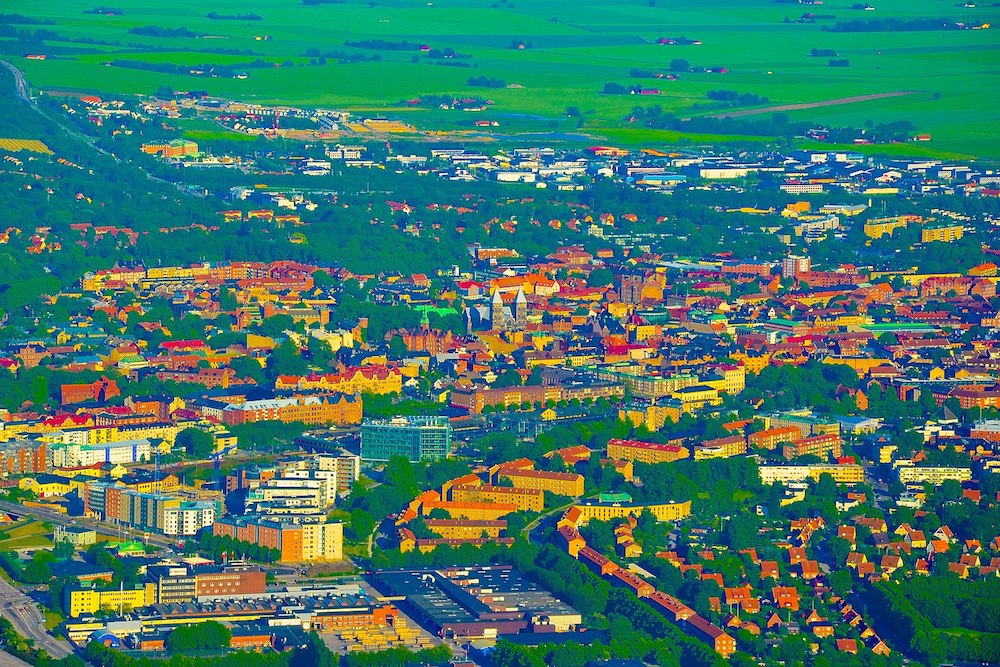
Aerial view of Scania, Sweden. Edited for maximum color saturation. Courtesy of Bob Collowan/Commons/CC-BY-SA-4.0.
by JOHN MIRISCH | MAY 3, 2021 (zocalopublicsquare.org)
Lagom—pronounced “LAW-goohm”—is a Swedish word for which there is no direct English translation. Some dictionaries translate it as “moderate” or “modest” or “suitable” or “sufficient.” The “just right” of Goldilocks gives a sense of the Swedish lagom, but in all its nuance and in the full scope of its meaning, lagom can’t really be boiled down to a single English word or expression.
I’m both a Swedish and an American citizen, and I know there is much America can learn from Sweden. It’s not a socialist country, but it does offer its residents universal healthcare, free university, paid parental leave, subsidized childcare, and more. In many ways, Sweden is a model of sustainability, egalitarianism, and environmentalism. Much of this has to do with its conception of lagom.
Lagom represents a way of life for many Swedes, a deep sense that there is something inherently wrong with excess; an ingrained worldview that balance and equilibrium are not only desirable, but that they are the keys to sustainability and living in harmony with nature.
It’s hard for Americans to understand—Americans who are so focused on constant motion, continual growth, and extreme consumerism. We always seem to want “more” of everything.
I’m a local elected official in Beverly Hills, and I see the American lack of lagom in the urban supremacism in the United States—an axis of developers, corporations, speculators, and politicians, which demands constant growth and metastasis in megalopolises like Los Angeles. Invoking purported solutions to deal with everything from homelessness, reduced productivity, climate change, housing unaffordability, and stagnant economic growth to racial equity, urban supremacists call for forced density, the elimination of single-family neighborhoods, centralized Sacramento-driven urban planning, gutting CEQA and the further commodification of housing. In the process, they pursue a new Manifest Destiny, in which a limited number of “winner” megalopolises are destined to redeem the U.S. by concentrating and controlling its economy, its social, educational, and cultural institutions, and its spectrum of lifestyle choices. These urbanists say they are progressive, or environmentalists—but they are so in a very American, and very different, way than the Swedish climate activist Greta Thunberg, who admonishes us, “We are in the beginning of mass extinction, and all you can talk about is money and fairy tales of eternal economic growth.”
“Inga träd växer till himlen” is a Swedish proverb; its literal translation is “No trees grow to the sky.” The proverb suggests that there are natural and obvious limits to growth. It also communicates the sense that arrogance, too, has limits. Americans should take note.
Among the consequences of Sweden’s embrace of lagom are urban planning policies which promote economic balance and geographic equity. Policies like glesbygdspolitik (“rural area policy”) and regionalutvecklingspolitik (“regional development policy”) consciously aim to create livable, viable, and thriving communities throughout the country—rather than depopulating rural areas and smaller towns and cities. Not everyone in Sweden should live in Stockholm, Gothenburg, or Malmö. Not everyone in Sweden wants to. Not everyone in Sweden has to.
“Hela landet ska leva!” is another great phrase. It means, “The whole country should live!” as well as “The whole country should thrive!” and is so uncontroversial in Sweden that it has the broad support of all the major political parties, from the hard left to the hard right to the Green Party as well. Governmental policies in Sweden supporting decentralization, including locating governmental agencies in smaller cities, are all part of ensuring that there are opportunities throughout the country, not just in the larger cities.
Recognizing the individuality and strength of diverse communities, rather than boiling everything down to economics or looking for ways to maximize productivity and profits, is the hallmark and essence of urban humanism. While the term itself is not Swedish, I use it to describe an idealized version of Swedish urban philosophy, which also encompasses the Swedish notion of folkhemmet, or “the people’s home,” in which communities are like a version of a large family. Urban humanism respects the individual, while at the same time embracing collective responsibility, particularly towards the most vulnerable. Urban humanism is community-based; urban humanism is inclusive; urban humanism is lagom.Lagom represents a way of life for many Swedes, a deep sense that there is something inherently wrong with excess; an ingrained worldview that balance and equilibrium are not only desirable, but that they are the keys to sustainability and living in harmony with nature.
And while Sweden itself seems to enjoy a fairly good reputation in the U.S., an antilagom, anti-community, anti-communitarian bent seems to infuse our mainstream media. Take the New York Times, which allows a host of op-ed writers and its housing reporter to extol growing megalopolises, and specifically the Bay Area, as beacons of opportunity—decrying the “rising cost of being near it” as if there were no alternative. Or listen to those in the YIMBY, or Yes in My Backyard movement, who dream of eternal growth that might take the Bay Area from seven million to more than 40 million residents, or four times the population of Sweden. One proponent writes:
The goal is to live in one of the most job rich, opportunity rich, high productivity areas in the world. We don’t care if it’s called ‘San Francisco’ or if it’s filled with 2 story bungalows built in the 1950s. In fact, we’d prefer it not be filled with 2 story bungalows, because if instead it was filled with 5 story apartment buildings, more of us could live here and have jobs here, and have opportunities here that we don’t have access to in the towns we were born in.
If [S]ilicon [V]alley moved to Detroit, we would happily move there. It’s not the name, it’s the jobs.
Understanding, as Thunberg has suggested, that models of eternal economic growth are not sustainable, even San Francisco, the second-densest urban area in the U.S., recognized that there should be limits to commercial growth. And so, in 2019, its voters passed Proposition E, which in theory limited the development of further office space until the city’s affordable housing goals had been met. California state senator Scott Wiener, who advocates for anti-lagom growth policies, was none too pleased by this. On Feb. 10, 2019, months before the election, he tweeted:
There’s a new argument in Silicon Valley & San Francisco (eg Prop E) that the solution to our housing shortage isn’t to build more homes but rather to kill the economy by pushing away jobs & banning new office space.
By this logic, being willing to limit commercial growth is to “kill the economy.”
How very un-Swedish.
It would be better to step back and re-examine American logic. Many of the problems that America’s urbanists want to “solve” with exponential growth are a direct result of this phenomenon of “concentration of opportunity,” or overconcentration of people and businesses in certain areas. This account of urbanism entails a kind of feeding frenzy of development, in which regions try to address problems created by growth with even more growth.
However, when overconcentration leads to problems, it makes sense to start thinking about de-concentration. That’s the essence of lagom. In other words, we should seek economic balance and geographic equity through sharing opportunity with other cities and regions throughout the state and country. I have had the experience of suggesting to YIMBY urbanists and Sacramento politicians that we adopt policies to steer economic development and jobs to struggling small and mid-sized cities in California—“What about Bakersfield? What about Fresno, Stockton, Modesto, San Bernardino, and Visalia?”—and receiving a shrug in response: “Nobody wants to live there.”
But is that really so? The cities that American urbanists dismiss are in some cases larger than Malmö, one of Sweden’s key commercial centers. Why do Big City snobs have difficulty comprehending that many people might be perfectly happy living in them and that place-making is what much of urbanism is all about?
Far from giving these cities and regions up for dead, depopulating them and rural America so that everyone is forced to move to metropolises, we should be looking to strengthen smaller cities’ abilities to provide vibrant, diverse, welcoming, and inclusive communities for their existing residents and for those who might seek a home there if opportunities were available.
Many Americans, I believe, would not only support Swedish-style policies to deconcentrate opportunity but also would welcome the added lifestyle choices that such policies would provide them: from villages, to small towns, to village- and small town-atmospheres within larger cities and regions. The COVID-19 pandemic might change the dynamic of where and how people want to live, as well as some people’s tolerance levels for the rat race.
Sweden, of course, opted for an open and less restrictive approach to COVID-19 which probably could not have been effective in many other countries with any degree of success. And because of the Swedish sense of balance and its pre-COVID philosophy of urban lagom, the post-COVID world in Sweden might not change so significantly. People are likely to stay in the communities where they are, picking up where they left off.
It’s very different in America, where many people left big, dense cities this past year. Will they ever come back? Social, sociological, and psychological effects of the pandemic may change our urban planning goals. It should be noted that the demand for homes in single-family neighborhoods (which urban supremacists want to outlaw) has increased significantly in the aftermath of the pandemic. Escaping urban density may also be an addition incentive for people to experience the joys of a more human-scale, small-town America, if we would only let them.
And, as another silver-lining from the pandemic, we now have more tools and proof-of-concept to let them. Remote work is a potential paradigm-shifter, and not just for corporations. Much of the business of the City of Beverly Hills, for example, including council and commission meetings, all continue to take place remotely. And if significantly more people can work remotely, then the typical American urbanist arguments about carbon emissions and global warming no longer justify increased density. Remote work can level the playing field for cities, areas, and regions that, for whatever reasons, have not been graced by the feudal largesse of Big Tech and other corporate oligarchies.
Of course, to take advantage of being able to work remotely, connectivity is extremely important. This is something Sweden already recognized, pre-COVID. The country is implementing a plan to provide one gigabit broadband to 98 percent of the country’s population by 2025. Similarly, the U.S. should focus its infrastructure spending on connecting the entire country through high-speed internet, and not just on building out urban public transportation networks with diminishing return. (Ridership sometimes decreases despite greater investments.)
This may seem like common sense, but in the U.S., it’s not. Harvard economist Edward Glaeser, a champion of the megalopolis, writes: Joblessness has become endemic in parts of the American heartland, but how many jobless people can afford to leave Youngstown, Ohio, where the median home price in 2019 was about $103,000 to go to San Jose, Calif., where the median price was $1.265 million?
When you dismiss Youngstown, Yakima, and York, you are mocking the notion of a lagom and more egalitarian society, and questioning the enduring idea of the civic cohesion and virtues of folkhemmet. Youngstown’s current population is around 65,000, down from a peak of some 167,000 in the ’60s. But the solution to Youngstown’s challenges is not to encourage the city’s population to move to the Bay Area. Instead of devising schemes about how to grow the Bay Area, we should focus on investing in economic opportunity for people in Youngstown, now rebranded as the “City of You” as part of its revitalization efforts.
True urbanism—vibrant, inclusive and humanitarian urbanism—understands that cities—of all sizes, stripes, colors and density levels—are places where we come together to form communities. They offer us a shared sense of place, a shared sense of belonging, and, perhaps most importantly, a shared sense of home.
Because of the speed of communication, cities today have the ability to be more dynamic than at any point in history. Cities that grew for purely commercial reasons based on geography—they were on a river, or near oil fields or coal mines, or near fertile farmlands or stone quarries or whatever—are now free to develop identities unfettered by physical (and often, consequently, economic) necessity. They can reclaim their rightful places within the fabric of a diverse nation in the real and virtual world, and they can take advantage of their physical surroundings without necessarily having to exploit them. Some people prefer the mountains, some the coast, some the prairie, and some the desert. Some people love the bustle of ultra-dense cityscapes like Manhattan, and others prefer more human-scale settings all the way down to isolated villages. All should be able to thrive in the kind of hometown they love.
As a Swede, I’m partial to Sweden. Yes, it is far from perfect: It faces challenges to its ideals, its welcoming policies towards migrants, and its robust support for its citizens, in part from the onslaught of globalization and American consumerist culture. But even in somewhat weakened form, the ideals of folkhemmet and lagom live. In many ways, Sweden still represents the contrast between corporatism and communitarianism, between spite and solidarity, between urban supremacism and urban humanism.
We would do well to learn from Sweden. We would do well to create our own folkhem in America and to learn to live the values of lagom. We would do well to help the entire country become a community of vibrant, dynamic, diverse, inclusive, and thriving communities.
Hela landet ska leva!
JOHN MIRISCH has been a member of the Beverly Hills City Council since 2009 and has served three terms as mayor. He is currently a garden-variety councilmember.
Burying a person who died of Covid-19 in Gauhati, India this week. Photograph: Anupam Nath/AP
It’s hard to convey the full depth and range of the trauma, the chaos and the indignity that people are being subjected to. Meanwhile, Modi and his allies are telling us not to complain
During a particularly polarising election campaign in the state of Uttar Pradesh in 2017, India’s prime minister, Narendra Modi, waded into the fray to stir things up even further. From a public podium, he accused the state government – which was led by an opposition party – of pandering to the Muslim community by spending more on Muslim graveyards (kabristans) than on Hindu cremation grounds (shamshans). With his customary braying sneer, in which every taunt and barb rises to a high note mid-sentence before it falls away in a menacing echo, he stirred up the crowd. “If a kabristan is built in a village, a shamshan should also be constructed there,” he said.
“Shamshan! Shamshan!” the mesmerised, adoring crowd echoed back.
Perhaps he is happy now that the haunting image of the flames rising from the mass funerals in India’s cremation grounds is making the front page of international newspapers. And that all the kabristans and shamshans in his country are working properly, in direct proportion to the populations they cater for, and far beyond their capacities.
“Can India, population 1.3 billion, be isolated?” the Washington Post asked rhetorically in a recent editorial about India’s unfolding catastrophe and the difficulty of containing new, fast-spreading Covid variants within national borders. “Not easily,” it replied. It’s unlikely this question was posed in quite the same way when the coronavirus was raging through the UK and Europe just a few months ago. But we in India have little right to take offence, given our prime minister’s words at the World Economic Forum in January this year.
Modi spoke at a time when people in Europe and the US were suffering through the peak of the second wave of the pandemic. He had not one word of sympathy to offer, only a long, gloating boast about India’s infrastructure and Covid-preparedness. I downloaded the speech because I fear that when history is rewritten by the Modi regime, as it soon will be, it might disappear, or become hard to find. Here are some priceless snippets:
“Friends, I have brought the message of confidence, positivity and hope from 1.3 billion Indians amid these times of apprehension … It was predicted that India would be the most affected country from corona all over the world. It was said that there would be a tsunami of corona infections in India, somebody said 700-800 million Indians would get infected while others said 2 million Indians would die.”
“Friends, it would not be advisable to judge India’s success with that of another country. In a country which is home to 18% of the world population, that country has saved humanity from a big disaster by containing corona effectively.”
Modi the magician takes a bow for saving humanity by containing the coronavirus effectively. Now that it turns out that he has not contained it, can we complain about being viewed as though we are radioactive? That other countries’ borders are being closed to us and flights are being cancelled? That we’re being sealed in with our virus and our prime minister, along with all the sickness, the anti-science, the hatred and the idiocy that he, his party and its brand of politics represent?
When the first wave of Covid came to India and then subsided last year, the government and its supportive commentariat were triumphant. “India isn’t having a picnic,” tweeted Shekhar Gupta, the editor-in-chief of the online news site the Print. “But our drains aren’t choked with bodies, hospitals aren’t out of beds, nor crematoriums & graveyards out of wood or space. Too good to be true? Bring data if you disagree. Unless you think you’re god.” Leave aside the callous, disrespectful imagery – did we need a god to tell us that most pandemics have a second wave?
This one was predicted, although its virulence has taken even scientists and virologists by surprise. So where is the Covid-specific infrastructure and the “people’s movement” against the virus that Modi boasted about in his speech? Hospital beds are unavailable. Doctors and medical staff are at breaking point. Friends call with stories about wards with no staff and more dead patients than live ones. People are dying in hospital corridors, on roads and in their homes. Crematoriums in Delhi have run out of firewood. The forest department has had to give special permission for the felling of city trees. Desperate people are using whatever kindling they can find. Parks and car parks are being turned into cremation grounds. It’s as if there’s an invisible UFO parked in our skies, sucking the air out of our lungs. An air raid of a kind we’ve never known.
Oxygen is the new currency on India’s morbid new stock exchange. Senior politicians, journalists, lawyers – India’s elite – are on Twitter pleading for hospital beds and oxygen cylinders. The hidden market for cylinders is booming. Oxygen saturation machines and drugs are hard to come by.
There are markets for other things, too. At the bottom end of the free market, a bribe to sneak a last look at your loved one, bagged and stacked in a hospital mortuary. A surcharge for a priest who agrees to say the final prayers. Online medical consultancies in which desperate families are fleeced by ruthless doctors. At the top end, you might need to sell your land and home and use up every last rupee for treatment at a private hospital. Just the deposit alone, before they even agree to admit you, could set your family back a couple of generations.
None of this conveys the full depth and range of the trauma, the chaos and, above all, the indignity that people are being subjected to. What happened to my young friend T is just one of hundreds, perhaps thousands of similar stories in Delhi alone. T, who is in his 20s, lives in his parents’ tiny flat in Ghaziabad on the outskirts of Delhi. All three of them tested positive for Covid. His mother was critically ill. Since it was in the early days, he was lucky enough to find a hospital bed for her. His father, diagnosed with severe bipolar depression, turned violent and began to harm himself. He stopped sleeping. He soiled himself. His psychiatrist was online trying to help, although she also broke down from time to time because her husband had just died from Covid. She said T’s father needed hospitalisation, but since he was Covid positive there was no chance of that. So T stayed awake, night after night, holding his father down, sponging him, cleaning him up. Each time I spoke to him I felt my own breath falter. Finally, the message came: “Father’s dead.” He did not die of Covid, but of a massive spike in blood pressure induced by a psychiatric meltdown induced by utter helplessness.
What to do with the body? I desperately called everybody I knew. Among those who responded was Anirban Bhattacharya, who works with the well-known social activist Harsh Mander. Bhattacharya is about to stand trial on a charge of sedition for a protest he helped organise on his university campus in 2016. Mander, who has not fully recovered from a savage case of Covid last year, is being threatened with arrest and the closure of the orphanages he runs after he mobilised people against the National Register of Citizens (NRC) and the Citizenship Amendment Act (CAA) passed in December 2019, both of which blatantly discriminate against Muslims. Mander and Bhattacharya are among the many citizens who, in the absence of all forms of governance, have set up helplines and emergency responses, and are running themselves ragged organising ambulances and coordinating funerals and the transport of dead bodies. It’s not safe for these volunteers to do what they’re doing. In this wave of the pandemic, it’s the young who are falling, who are filling the intensive care units. When young people die, the older among us lose a little of our will to live.
T’s father was cremated. T and his mother are recovering.
Things will settle down eventually. Of course, they will. But we don’t know who among us will survive to see that day. The rich will breathe easier. The poor will not. For now, among the sick and dying, there is a vestige of democracy. The rich have been felled, too. Hospitals are begging for oxygen. Some have started bring-your-own-oxygen schemes. The oxygen crisis has led to intense, unseemly battles between states, with political parties trying to deflect blame from themselves.
On the night of 22 April, 25 critically ill coronavirus patients on high-flow oxygen died in one of Delhi’s biggest private hospitals, Sir Ganga Ram. The hospital issued several desperate SOS messages for the replenishment of its oxygen supply. A day later, the chair of the hospital board rushed to clarify matters: “We cannot say that they have died due to lack of oxygen support.” On 24 April, 20 more patients died when oxygen supplies were depleted in another big Delhi hospital, Jaipur Golden. That same day, in the Delhi high court, Tushar Mehta, India’s solicitor general, speaking for the government of India, said: “Let’s try and not be a cry baby … so far we have ensured that no one in the country was left without oxygen.”
Ajay Mohan Bisht, the saffron-robed chief minister of Uttar Pradesh, who goes by the name Yogi Adityanath, has declared that there is no shortage of oxygen in any hospital in his state and that rumourmongers will be arrested without bail under the National Security Act and have their property seized.
Yogi Adityanath doesn’t play around. Siddique Kappan, a Muslim journalist from Kerala, jailed for months in Uttar Pradesh when he and two others travelled there to report on the gang-rape and murder of a Dalit girl in Hathras district, is critically ill and has tested positive for Covid. His wife, in a desperate petition to the chief justice of the supreme court of India, says her husband is lying chained “like an animal” to a hospital bed in the Medical College hospital in Mathura. (The supreme court has now ordered the Uttar Pradesh government to move him to a hospital in Delhi.) So, if you live in Uttar Pradesh, the message seems to be, please do yourself a favour and die without complaining.
Funeral pyres in Delhi last week. Photograph: Anindito Mukherjee/Getty Images
The threat to those who complain is not restricted to Uttar Pradesh. A spokesperson for the fascist Hindu nationalist organisation the Rashtriya Swayamsevak Sangh (RSS) – of which Modi and several of his ministers are members, and which runs its own armed militia – has warned that “anti-India forces” would use the crisis to fuel “negativity” and “mistrust” and asked the media to help foster a “positive atmosphere”. Twitter has helped them out by deactivating accounts critical of the government.
Where shall we look for solace? For science? Shall we cling to numbers? How many dead? How many recovered? How many infected? When will the peak come? On 27 April, the report was 323,144 new cases, 2,771 deaths. The precision is somewhat reassuring. Except – how do we know? Tests are hard to come by, even in Delhi. The number of Covid-protocol funerals from graveyards and crematoriums in small towns and cities suggest a death toll up to 30 times higher than the official count. Doctors who are working outside the metropolitan areas can tell you how it is.
If Delhi is breaking down, what should we imagine is happening in villages in Bihar, in Uttar Pradesh, in Madhya Pradesh? Where tens of millions of workers from the cities, carrying the virus with them, are fleeing home to their families, traumatised by their memory of Modi’s national lockdown in 2020. It was the strictest lockdown in the world, announced with only four hours’ notice. It left migrant workers stranded in cities with no work, no money to pay their rent, no food and no transport. Many had to walk hundreds of miles to their homes in far-flung villages. Hundreds died on the way.
This time around, although there is no national lockdown, the workers have left while transport is still available, while trains and buses are still running. They’ve left because they know that even though they make up the engine of the economy in this huge country, when a crisis comes, in the eyes of this administration, they simply don’t exist. This year’s exodus has resulted in a different kind of chaos: there are no quarantine centres for them to stay in before they enter their village homes. There’s not even the meagre pretence of trying to protect the countryside from the city virus.
These are villages where people die of easily treatable diseases like diarrhoea and tuberculosis. How are they to cope with Covid? Are Covid tests available to them? Are there hospitals? Is there oxygen? More than that, is there love? Forget love, is there even concern? There isn’t. Because there is only a heart-shaped hole filled with cold indifference where India’s public heart should be.
Early this morning, on 28 April, news came that our friend Prabhubhai has died. Before he died, he showed classic Covid symptoms. But his death will not register in the official Covid count because he died at home without a test or treatment. Prabhubhai was a stalwart of the anti-dam movement in the Narmada valley. I stayed several times at his home in Kevadia, where decades ago the first group of indigenous tribespeople were thrown off their lands to make room for the dam-builders and officers’ colony. Displaced families like Prabhubhai’s still remain on the edges of that colony, impoverished and unsettled, transgressors on land that was once theirs.
There is no hospital in Kevadia. There’s only the Statue of Unity, built in the likeness of the freedom fighter and first deputy prime minister of India, Sardar Vallabhbhai Patel, who the dam is named after. At 182 metres high, it’s the tallest statue in the world and cost US$422m. High-speed elevators inside take tourists up to view the Narmada dam from the level of Sardar Patel’s chest. Of course, you cannot see the river valley civilisation that lies destroyed, submerged in the depths of the vast reservoir, or hear the stories of the people who waged one of the most beautiful, profound struggles the world has ever known – not just against that one dam, but against the accepted ideas of what constitutes civilisation, happiness and progress. The statue was Modi’s pet project. He inaugurated it in October 2018.
Narendra Modi at the inauguration of the Statue of Unity, the world’s tallest statue, in India’s western Gujarat state in 2018. Photograph: HANDOUT/AFP/Getty Images
The friend who messaged about Prabhubhai had spent years as an anti-dam activist in the Narmada valley. She wrote: “My hands shiver as I write this. Covid situation in and around Kevadia Colony grim.”
The precise numbers that make up India’s Covid graph are like the wall that was built in Ahmedabad to hide the slums Donald Trump would drive past on his way to the “Namaste Trump” event that Modi hosted for him in February 2020. Grim as those numbers are, they give you a picture of the India-that-matters, but certainly not the India that is. In the India that is, people are expected to vote as Hindus, but die as disposables.
“Let’s try and not be a cry baby.”
Try not to pay attention to the fact that the possibility of a dire shortage of oxygen had been flagged as far back as April 2020, and then again in November by a committee set up by the government itself. Try not to wonder why even Delhi’s biggest hospitals don’t have their own oxygen-generating plants. Try not to wonder why the PM Cares Fund – the opaque organisation that has recently replaced the more public Prime Minister’s National Relief Fund, and which uses public money and government infrastructure but functions like a private trust with zero public accountability – has suddenly moved in to address the oxygen crisis. Will Modi own shares in our air-supply now?
“Let’s try and not be a cry baby.”
Understand that there were and are so many far more pressing issues for the Modi government to attend to. Destroying the last vestiges of democracy, persecuting non-Hindu minorities and consolidating the foundations of the Hindu Nation makes for a relentless schedule. There are massive prison complexes, for example, that must be urgently constructed in Assam for the 2 million people who have lived there for generations and have suddenly been stripped of their citizenship. (On this matter, our independent supreme court came down hard on the side of the government.)
There are hundreds of students and activists and young Muslim citizens to be tried and imprisoned as the primary accused in the anti-Muslim pogrom that took place against their own community in north-east Delhi last March. If you are Muslim in India, it’s a crime to be murdered. Your folks will pay for it. There was the inauguration of the new Ram Temple in Ayodhya, which is being built in place of the mosque that was hammered to dust by Hindu vandals watched over by senior BJP politicians. (On this matter, our independent supreme court came down hard on the side of the government and leniently on the side of the vandals.) There were the controversial new Farm Bills to be passed, corporatising agriculture. There were hundreds of thousands of farmers to be beaten and teargassed when they came out on to the streets to protest.
Then there’s the multi-multi-multimillion-dollar plan for a grand new replacement for the fading grandeur of New Delhi’s imperial centre to be urgently attended to. After all, how can the government of the new Hindu India be housed in old buildings? While Delhi is locked down, ravaged by the pandemic, construction work on the “Central Vista” project, declared as an essential service, has begun. Workers are being transported in. Maybe they can alter the plans to add a crematorium.
Crowds at the Kumbh Mela festival in Haridwar earlier this month. Photograph: Anushree Fadnavis/Reuters
There was also the Kumbh Mela to be organised, so that millions of Hindu pilgrims could crowd together in a small town to bathe in the Ganges and spread the virus even-handedly as they returned to their homes across the country, blessed and purified. This Kumbh rocks on, although Modi has gently suggested that it might be an idea for the holy dip to become “symbolic” – whatever that means. (Unlike what happened with those who attended a conference for the Islamic organisation Tablighi Jamaat last year, the media has not run a campaign against them calling them “corona jihadis” or accusing them of committing crimes against humanity.) There were also those few thousand Rohingya refugees who had to be urgently deported back to the genocidal regime in Myanmar from where they had fled – in the middle of a coup. (Once again, when our independent supreme court was petitioned on this matter, it concurred with the government’s view.)
So, as you can tell, it’s been busy, busy, busy.
Over and above all this urgent activity, there is an election to be won in the state of West Bengal. This required our home minister, Modi’s man Amit Shah, to more or less abandon his cabinet duties and focus all his attention on Bengal for months, to disseminate his party’s murderous propaganda, to pit human against human in every little town and village. Geographically, West Bengal is a small state. The election could have taken place in a single day, and has done so in the past. But since it is new territory for the BJP, the party needed time to move its cadres, many of who are not from Bengal, from constituency to constituency to oversee the voting. The election schedule was divided into eight phases, spread out over a month, the last on 29 April. As the count of corona infections ticked up, the other political parties pleaded with the election commission to rethink the election schedule. The commission refused and came down hard on the side of the BJP, and the campaign continued. Who hasn’t seen the videos of the BJP’s star campaigner, the prime minister himself, triumphant and maskless, speaking to the maskless crowds, thanking people for coming out in unprecedented numbers? That was on 17 April, when the official number of daily infections was already rocketing upward of 200,000.
Now, as voting closes, Bengal is poised to become the new corona cauldron, with a new triple mutant strain known as – guess what – the “Bengal strain”. Newspapers report that every second person tested in the state capital, Kolkata, is Covid positive. The BJP has declared that if it wins Bengal, it will ensure people get free vaccines. And if it doesn’t?
“Let’s try and not be a cry baby.”
Anyway, what about the vaccines? Surely they’ll save us? Isn’t India a vaccine powerhouse? In fact, the Indian government is entirely dependent on two manufacturers, the Serum Institute of India (SII) and Bharat Biotech. Both are being allowed to roll out two of the most expensive vaccines in the world, to the poorest people in the world. This week they announced that they will sell to private hospitals at a slightly elevated price, and to state governments at a somewhat lower price. Back-of-the-envelope calculations show the vaccine companies are likely to make obscene profits.
Under Modi, India’s economy has been hollowed out, and hundreds of millions of people who were already living precarious lives have been pushed into abject poverty. A huge number now depend for survival on paltry earnings from the National Rural Employment Guarantee Act (NREGA), which was instituted in 2005 when the Congress party was in power. It is impossible to expect that families on the verge of starvation will pay most of a month’s income to have themselves vaccinated. In the UK, vaccines are free and a fundamental right. Those trying to get vaccinated out of turn can be prosecuted. In India, the main underlying impetus of the vaccination campaign seems to be corporate profit.
People with breathing problems caused by Covid-19 wait to receive oxygen in Ghaziabad. Photograph: Adnan Abidi/Reuters
As this epic catastrophe plays out on our Modi-aligned Indian television channels, you’ll notice how they all speak in one tutored voice. The “system” has collapsed, they say, again and again. The virus has overwhelmed India’s health care “system”.
The system has not collapsed. The “system” barely existed. The government – this one, as well as the Congress government that preceded it – deliberately dismantled what little medical infrastructure there was. This is what happens when a pandemic hits a country with an almost nonexistent public healthcare system. India spends about 1.25% of its gross domestic product on health, far lower than most countries in the world, even the poorest ones. Even that figure is thought to be inflated, because things that are important but do not strictly qualify as healthcare have been slipped into it. So the real figure is estimated to be more like 0.34%. The tragedy is that in this devastatingly poor country, as a 2016 Lancet study shows, 78% of the healthcare in urban areas and 71% in rural areas is now handled by the private sector. The resources that remain in the public sector are systematically siphoned into the private sector by a nexus of corrupt administrators and medical practitioners, corrupt referrals and insurance rackets.
Healthcare is a fundamental right. The private sector will not cater to starving, sick, dying people who don’t have money. This massive privatisation of India’s healthcare is a crime.
The system hasn’t collapsed. The government has failed. Perhaps “failed” is an inaccurate word, because what we are witnessing is not criminal negligence, but an outright crime against humanity. Virologists predict that the number of cases in India will grow exponentially to more than 500,000 a day. They predict the death of many hundreds of thousands in the coming months, perhaps more. My friends and I have agreed to call each other every day just to mark ourselves present, like roll call in our school classrooms. We speak to those we love in tears, and with trepidation, not knowing if we will ever see each other again. We write, we work, not knowing if we will live to finish what we started. Not knowing what horror and humiliation awaits us. The indignity of it all. That is what breaks us.
The hashtag #ModiMustResign is trending on social media. Some of the memes and illustrations show Modi with a heap of skulls peeping out from behind the curtain of his beard. Modi the Messiah speaking at a public rally of corpses. Modi and Amit Shah as vultures, scanning the horizon for corpses to harvest votes from. But that is only one part of the story. The other part is that the man with no feelings, the man with empty eyes and a mirthless smile, can, like so many tyrants in the past, arouse passionate feelings in others. His pathology is infectious. And that is what sets him apart. In north India, which is home to his largest voting base, and which, by dint of sheer numbers, tends to decide the political fate of the country, the pain he inflicts seems to turn into a peculiar pleasure.
Fredrick Douglass said it right: “The limits of tyrants are prescribed by the endurance of those whom they oppress.” How we in India pride ourselves on our capacity to endure. How beautifully we have trained ourselves to meditate, to turn inward, to exorcise our fury as well as justify our inability to be egalitarian. How meekly we embrace our humiliation.
When he made his political debut as Gujarat’s new chief minister in 2001, Modi ensured his place in posterity after what has come to be known as the 2002 Gujarat pogrom. Over a period of a few days, Hindu vigilante mobs, watched over and sometimes actively assisted by the Gujarat police, murdered, raped and burned alive thousands of Muslims as “revenge” for a gruesome arson attack on a train in which more than 50 Hindu pilgrims had been burned alive. Once the violence subsided, Modi, who had until then only been appointed as chief minister by his party, called for early elections. The campaign in which he was portrayed as Hindu Hriday Samrat (“The Emperor of Hindu Hearts”) won him a landslide victory. Modi hasn’t lost an election since.
Several of the killers in the Gujarat pogrom were subsequently captured on camera by the journalist Ashish Khetan, boasting of how they hacked people to death, slashed pregnant women’s stomachs open and smashed infants’ heads against rocks. They said they could only have done what they did because Modi was their chief minister. Those tapes were broadcast on national TV. While Modi remained in the seat of power, Khetan, whose tapes were submitted to the courts and forensically examined, appeared as a witness on several occasions. Over time, some of the killers were arrested and imprisoned, but many were let off. In his recent book, Undercover: My Journey Into the Darkness of Hindutva, Khetan describes in detail how, during Modi’s tenure as chief minister, the Gujarat police, judges, lawyers, prosecutors and inquiry committees all colluded to tamper with evidence, intimidate witnesses and transfer judges.
Despite knowing all this, many of India’s so-called public intellectuals, the CEOs of its major corporations and the media houses they own, worked hard to pave the way for Modi to become the prime minister. They humiliated and shouted down those of us who persisted in our criticism. “Move on”, was their mantra. Even today, they mitigate their harsh words for Modi with praise for his oratory skills and his “hard work”. Their denunciation and bullying contempt for politicians in opposition parties is far more strident. They reserve their special scorn for Rahul Gandhi of the Congress party, the only politician who has consistently warned of the coming Covid crisis and repeatedly asked the government to prepare itself as best it could. To assist the ruling party in its campaign to destroy all opposition parties amounts to colluding with the destruction of democracy.
So here we are now, in the hell of their collective making, with every independent institution essential to the functioning of a democracy compromised and hollowed out, and a virus that is out of control.
The crisis-generating machine that we call our government is incapable of leading us out of this disaster. Not least because one man makes all the decisions in this government, and that man is dangerous – and not very bright. This virus is an international problem. To deal with it, decision-making, at least on the control and administration of the pandemic, will need to pass into the hands of some sort of non-partisan body consisting of members of the ruling party, members of the opposition, and health and public policy experts.
As for Modi, is resigning from your crimes a feasible proposition? Perhaps he could just take a break from them – a break from all his hard work. There’s that $564m Boeing 777, Air India One, customised for VVIP travel – for him, actually – that’s been sitting idle on the runway for a while now. He and his men could just leave. The rest of us will do all we can to clean up their mess.
No, India cannot be isolated. We need help.
This article was amended on 29 April 2021 to correct the year in which theCitizenship Amendment Act was passed. It was 2019, not 2020.
Follow the Long Read on Twitter at @gdnlongread, listen to our podcasts here and sign up to the long read weekly email here.


 Of all ridiculous things the most ridiculous seems to me, to be busy — to be a man who is brisk about his food and his work.




 COMMUNITY CONTRIBUTOR