Rilke on the Relationship Between Solitude, Love, Sex, and Creativity

By Maria Popova (brainpickings.org)

letterstoayoungpoet_rilke_macy_barrows.jpg?fit=320%2C512

“You are born alone. You die alone. The value of the space in between is trust and love,” artist Louise Bourgeois wrote in her diary in her seventy-seventh year as she looked back on a long and lush life to consider the central role of solitude in creativity.

A generation before her, recognizing that “works of art arise from an infinite aloneness,” Rainer Maria Rilke (December 4, 1875–December 29, 1926) explored the relationship between solitude, love, and creativity in his stunning correspondence with the nineteen-year-old Franz Xaver Kappus — an aspiring poet and cadet at the same military academy that had nearly broken Rilke’s own adolescent soul.

Posthumously published in German, these letters of uncommonly penetrating insight into the essence of art and love — that is, the essence of life — now come alive afresh as Letters to a Young Poet: A New Translation and Commentary (public library) by ecological philosopher, Buddhist scholar, and environmental activist Joanna Macy, and poet and clinical psychologist Anita Barrows: two women who have lived into the far reaches of life — Macy was ninety-one at the time of the translation and Barrows seventy-three — and who have spent a quarter century thinking deeply about what makes life worth living in translating together the works of a long-ago man who barely survived to fifty and who was still in his twenties when he composed these letters of tender and timeless lucidity.rilke4.jpg?w=680

1902 portrait of Rilke by his brother-in-law, Helmuth Westhoff

Anticipating the illuminations of twentieth-century psychology about why a childhood capacity for “fertile solitude” is essential for creativity, self-esteem, and healthy relationships later in life, Rilke writes to his young correspondent in the short, dark, lonesome days just before the winter holidays:

2e292385-dc1c-4cfe-b95e-845f6f98c2ec.pngWhat (you might ask yourself) would a solitude be that didn’t have some greatness to it? For there is only one solitude, and it is large and not easy to bear. It comes almost all the time when you’d gladly exchange it for any togetherness, however banal and cheap; exchange it for the appearance of however strong a conformity with the ordinary, with the least worthy. But perhaps that is precisely the time when solitude ripens; its ripening can be painful as the growth of a boy and sad like the beginning of spring… What is needed is only this: solitude, great inner solitude. Going within and meeting no one else for hours — that is what one must learn to attain. To be solitary as one was as a child. As the grown-ups were moving about, preoccupied with things that seemed big and important because the grown-ups appeared so busy and because you couldn’t understand what they were doing.

openhouseforbutterflies18.jpg?w=680

Illustration by Maurice Sendak from Open House for Butterflies by Ruth Krauss.

Echoing Kierkegaard’s ever-timely insistence that “of all ridiculous things the most ridiculous seems… to be busy” and Emerson’s observation that “our hurry & embarrassment look ridiculous” the moment we pause the headlong rush of sociality through which we try to escape from ourselves, Rilke adds:

2e292385-dc1c-4cfe-b95e-845f6f98c2ec.pngIf one day one grasps that their busyness is pathetic, their occupations frozen and disconnected from life, why then not continue to see like a child, see it as strange, see it out of the depth of one’s own world, the vastness of one’s own solitude, which is, in itself, work and status and vocation?

Solitude-by-Maria-Popova.jpg?resize=680%2C907

“Solitude” by Maria Popova. Available as a print.

And yet the crucial, exquisite creative tension that Rilke so singularly harmonizes is the essential interplay between solitude and love — each enriching the other, each magnifying the totality of the spirit from which all art springs. In another letter penned the following spring, he writes:

2e292385-dc1c-4cfe-b95e-845f6f98c2ec.pngDon’t let your solitude obscure the presence of something within it that wants to emerge. Precisely this presence will help your solitude expand. People are drawn to the easy and to the easiest side of the easy. But it is clear that we must hold ourselves to the difficult, as is true for everything alive. Everything in nature grows and defends itself in its own way and against all opposition, straining from within and at any price to become distinctively itself. It is good to be solitary, because solitude is difficult, and that a thing is difficult must be even more of a reason for us to undertake it.

To love is good too, for love is difficult. For one person to care for another, that is perhaps the most difficult thing required of us, the utmost and final test, the work for which all other work is but a preparation. With our whole being, with all the strength we have gathered, we must learn to love. This learning is ever a committed and enduring process.

margaretcook_leavesofgrass10.jpg?resize=680%2C899

Art by Margaret C. Cook from a rare 1913 edition of Walt Whitman’s Leaves of Grass. Available as a print.

Two decades before Kahlil Gibran offered his abiding poetic wisdom on the difficult balance of intimacy and independence in true love, Rilke calls for shedding the ideological shackles of our culture’s conception of love as a melding of entities. “No human experience is so rife with conventions as this,” he observes with an eye to those who have not yet befriended their sovereign solitude and instead “act from mutual helplessness” to “simply surrender to love as an escape from loneliness.” He offers the liberating alternative that still requires as much countercultural courage in our day as it did in his:

2e292385-dc1c-4cfe-b95e-845f6f98c2ec.pngTo love is not about merging. It is a noble calling for the individual to ripen, to differentiate, to become a world in oneself in response to another. It is a great, immodest call that singles out a person and summons them beyond all boundaries. Only in this sense may we use the love that has been given us. This is humanity’s task, for which we are still barely ready.

[…]

This more human love (endlessly considerate and light and good and clear, consummated by holding close and letting go) will resemble that love that we so arduously prepare — the love that consists of two solitudes that protect, border, and greet each other.

margaretcook_leavesofgrass17.jpg

Art by Margaret C. Cook for Leaves of Grass. (Available as a print.)

In another letter, Rilke adds the complexity of physical intimacy to this realm of transcendent difficulty, formulating his advice on how to best harness eros as a creative force:

2e292385-dc1c-4cfe-b95e-845f6f98c2ec.pngYes, sex is hard. But anything expected of us is hard. Almost everything that matters is hard, and everything matters… Come to your own relationship to sex, free of custom and convention. Then you need not fear to lose yourself and become unworthy of your better nature.

Sexual pleasure is a sensory experience, no different from pure seeing or pure touch, like the taste of a fruit. It is a great, endless experience given to us, a natural part of knowing our world, of the fullness and brilliance of every knowing. And nothing we receive is wrong. What’s wrong is to misuse and spoil this experience and to use it to excite the exhausted aspects of our lives, to dissipate rather than connect.

Long before scientists shed light on how the sexuality of early flora and fauna gave our planet its beauty, Rilke adds:

2e292385-dc1c-4cfe-b95e-845f6f98c2ec.pngSeeing the beauty in animals and plants is a form of love and longing; and we can see the animal, as we see the plant, patient and willing to come together and increase — not out of physical lust, not out of suffering, but bowing to necessities that are greater than lust and suffering and more powerful than will and resistance.

Oh that humans might humbly receive and earnestly bear this mystery that fills the earth down to the smallest thing, and feel it as part of life’s travail, instead of taking it lightly. If they could only be respectful of this fertility, which is undivided, whether in spiritual or physical form. For this spiritual creativity stems from the physical, derives from that erotic essence, and is but an airier, more delightful, more eternal iteration of its lush sensuality.

elizabethblackwell_curiousherbal_poppy.jpg?resize=680%2C986

Red poppy from A Curious Herbal by Elizabeth Blackwell, 1737. (Available as a print and as a face mask, benefitting The Nature Conservancy.)

So too with the role of the erotic in creative work:

2e292385-dc1c-4cfe-b95e-845f6f98c2ec.pngThe art of creating is nothing without the vast ongoing participation and collaboration of the real world, nothing without the thousandfold harmonizing of things and beings; and the creator’s pleasure is thereby inexpressibly rich because it contains memories of the begetting and bearing of millions. In a single creative thought dwell a thousand forgotten nights of love, which infuse it with immensity. And those who come together in the night, locked in thrusting desire, are gathering nectar, generating power and sweetness for some future poetic utterance that will sing the rapture.

For more of and about this ravishing new translation of Letters to a Young Poet — one which embodies the Nobel-winning Polish poet Wisława Szymborska’s notion of “that rare miracle when a translation stops being a translation and becomes… a second original,” and the finest such miracle performed on a classic since Ursula K. Le Guin’s feminist translation of the Tao Te Ching — savor this On Being conversation with Macy and Barrows about the wider resonances of Rilke’s work in our world, then revisit Rilke’s contemporary Hermann Hesse on solitude and the courage to find yourself, physicist Brian Greene’s Rilkean reflection on how to live with our human vulnerabilities, and Rilke himself on what it takes to be an artist.

How Independent Are We Really? Why We Need Each Other to Evolve on the Spiritual Path

BY CRAIG HAMILTON | JUL 2, 2020 | craighamiltonglobal.com

As a spiritual guide and teacher, I’ve worked with thousands of people aspiring to realize their spiritual potential. And if I’ve learned anything in the process, it’s that to evolve on the spiritual path, we need each other.

To truly realize our highest potentials, we need to engage in transformative interactions with other people who share our aspiration to evolve.

It’s a simple idea. But its implications run deep.

Notice how this idea strikes you, and perhaps you’ll see what I mean.

For instance, this notion that we can’t walk the spiritual path alone may resonate with the part of you that longs for connection and support on your journey.

But you might also notice that another part of you finds it difficult to swallow.

In our modern world, in which independence has become almost a religion, the notion that we need other people for anything seems like heresy. Indeed, if we were to embrace such an idea, wouldn’t we be giving away our power, and our freedom?

When we think about traditional depictions of the spiritual path, the picture that often comes to mind is also of a solitary, independent journey. The lone sage on the mountaintop. The yogi alone in the cave. The hermit in a hut. The wandering pilgrim.

Even if we attend church services or classes or meditation groups, most of us still tend to think of our spiritual path as a private, internal, solo quest in which we are the sole determining factor of our own spiritual destiny.

But how independent are we really?

If you’ve ever attended a personal growth workshop or spiritual retreat, you’ve probably noticed that in an environment where everyone is focused on our higher evolutionary potentials, it’s relatively easy to experience a spiritual “high” or to break through to new ground within ourselves.

But what happens when you come home from such an event, and find yourself again surrounded by people who don’t share your higher values and aspirations?

For most of us, in the absence of a supportive social container for our awakening, we find ourselves quickly losing touch with the new potentials that had seemed so accessible in the retreat or workshop environment.

Although we like to think of ourselves as independent, the reality is that we are social creatures. Our ability to co-exist with one another depends on our willingness to abide within a matrix of shared values, assumptions and agreements about what is real, what is important, and what is acceptable behavior.

So unless we surround ourselves with others who share our highest spiritual values and aspirations, we will almost inevitably find ourselves fighting against a kind of invisible but powerful “social gravity” pulling us back into the unenlightened, unevolved “world mind” we’re trying to break free from.

It’s not impossible to generate “escape velocity” on one’s own. But, for most of us, a sustained context of “evolutionary partnership” with kindred spirits becomes essential.

Where and how do we begin to create such an environment?

Begin by asking yourself some important questions:

  • Of everyone I know, with whom can I truly be my highest self? Among my friends, family and colleagues, who truly shares my deepest values and highest spiritual aspirations?
  • Do I have any social structures in my life in which I feel free to stretch myself—and my relationships—beyond my and our comfort zones? To reach into new territory without being concerned that I’ll “rock the boat” or scare others off in my efforts to awaken and evolve?

If a number of people come to mind, count yourself among the fortunate, and then arrange a meeting with your newly identified “evolutionary partners” to begin to create a conscious container for ongoing evolutionary partnership.

In that meeting, make your shared agreements and values explicit. As a starting point, I invite you to discuss with them one of the Principles of Evolutionary Relationship I teach in my Integral Enlightenment 9-week course:

Evolutionary Relationship Principle #5: We agree that the context for our relationship will be leaning into our evolutionary edges. Rather than meeting in our limitations and problems, fears and doubts, we take a stand for meeting in the expression of our highest potential. We take up the challenge of showing up and engaging from that place, stretching to manifest that potential now, and explore that potential with each other.

This is just one of seven Principles of Evolutionary Relationship I explore in the Integral Enlightenment course. But even on its own, if engaged with sincerity, it can serve as a powerful foundation for deepening into evolutionary partnership.

If your relationship inventory does not immediately reveal a core group of potential evolutionary partners, you may need to begin searching for a new group of kindred spirits with whom you resonate at the deepest level.

You can do that in your local area, and thanks to the ever-expanding power of the Internet, you can also now find community online. More and more opportunities are emerging all the time for us to not only find loosely knit spiritual community, but true kindred souls whose aspiration and focus is deeply aligned with our own.

Wherever your spiritual journey takes you, remember: you’re not in this alone. You never will be.

So, seek a supportive context for your higher development. If you do, you may find your solitary spiritual journey being replaced by a rich and joyous relational spirituality, in which the fruits of the path begin to show up immediately as love, trust and shared inspiration with your newfound partners in evolution.

–Craig Hamilton

“Love is the absence of relationship.”

“Lovers don’t finally meet somewhere. They’re in each other all along.”

–Rumi

scienceandnonduality You can watch all our videos at https://scienceandnonduality.com Rupert Spira has a conversation with the audience at SAND19 US. Science and Nonduality is a community inspired by timeless wisdom, informed by cutting-edge science, and grounded in direct experience. We come together in an open-hearted exploration while celebrating our humanity.

At 245, America Is Old Enough to Be Honest About Its Founding

The Declaration of Independence’s clause about “merciless Indian Savages” and its deleted passage on slavery say a lot about us.

Jon Schwarz July 4 2021 (theintercept.com)

An illustration by Udo Keppler, “The Triumph of the American Battle-ship,” depicts the celebration of the Fourth of July in 1898.

Illustration: Universal Images Group via Getty

Happy Birthday, America! Today, July 4, 2021, we turn 245 years old. You might think we’d have trouble blowing out all the candles on the cake, but fortunately we can use the downdraft from the Sikorsky S-97 Raider, a new prototype attack helicopter with two rotors that spin in opposite directions.

And now that we’re 245, it seems as though we should be old enough to take an honest look at various dumb and awful things about our birth, and stop believing in preposterous myths.

While the American Revolution officially began at Lexington and Concord in Massachusetts in April 1775, for some time afterward complete separation from Great Britain was only supported by a fervent minority. However, nothing works as well as killing and being killed to make everyone believe the other side are irredeemable monsters. By June 1776, public sentiment favored a total break.Join Our NewsletterOriginal reporting. Fearless journalism. Delivered to you.I’m in

The Declaration of Independence was drafted by Thomas Jefferson, with edits by several others, including John Adams and Benjamin Franklin. It is Filled with The kind Of unpredictable Capitalization that was Common before English Was Standardized, and accuses King George III of attempting to impose both “absolute Despotism” and “absolute Tyranny” on the 13 Colonies. With the benefit of hindsight, many of the complaints make this seem like the kind of excitable language you employ to justify a decision you’ve already made. For instance, King George “called together legislative bodies at places unusual” for “the sole purpose of fatiguing them into compliance.” Bad, maybe, but not the worst crime in human history. This style of wild rhetorical exaggeration survives today among Americans who proclaim that the phaseout of incandescent lightbulbs is exactly like what Hitler did.

The most interesting parts of the declaration are two complaints, one that made it into the final version and one that did not. The one that did make it in is the final entry on the list of indictments of King George: “He has excited domestic insurrections amongst us, and has endeavoured to bring on the inhabitants of our frontiers, the merciless Indian Savages, whose known rule of warfare, is an undistinguished destruction of all ages, sexes and conditions.” This is the kind of thing that makes you wonder whether Sen. Josh Hawley, R-Mo., who just condemned the idea that the U.S. was “founded in racism,” has ever read the Declaration of Independence. He may also never have heard of George Washington, who once told a friend that Indigenous people in the Americas and wolves were both “beasts of prey tho’ they differ in shape.”

Then there is the clause about slavery in Jefferson’s original rough draft of the declaration. King George, said Jefferson, had “waged cruel war against human nature itself, violating it’s most sacred rights of life & liberty in the persons of a distant people who never offended him, captivating and carrying them into slavery in another hemisphere, or to incur miserable death in their transportation hither.” This seems like conclusive evidence that white Americans were capable at the time of grasping the concept that slavery was evil. Thus judging those who engaged in it is not “presentism,” in which we impose today’s moral standards on the past.

Of course, Jefferson himself owned at least 600 slaves during his life. Presumably he understood they were not working his plantation by choice, just because they wanted him to have more free time for philosophizing. Jefferson squared this circle by also condemning King George for “now exciting those very people to rise in arms among us, and to purchase that liberty of which he had deprived them, by murdering the people upon whom he also obtruded them.” First, King George forced people like Jefferson to enslave human beings, which they never would have done otherwise! And now King George was making these enslaved humans believe it was terrible to be enslaved, something they never would have figured out on their own! This was Tyranny in its purest form.

Decades later in 1821, Jefferson wrote that the slavery clause had been removed by the full Continental Congress “in complaisance to South Carolina and Georgia. … Our Northern brethren also, I believe, felt a little tender under these censures, for though their people had very few slaves themselves, yet they had been pretty considerable carriers of them to others.” GOP-controlled state governments that today are cracking down on the teaching of history might want to bar Jefferson’s first point but emphasize his second to own the libs. New York City, the capital of liberalism, had one of America’s largest slave markets on Wall Street for much of the 18th century and continues to have many streets named after prominent families of the era that enriched themselves in the trade.

None of this means that the U.S. is uniquely dreadful; the foundings of other countries were similarly bloody and hypocritical. But it does mean that when we’re tempted to bloviate about our unique goodness that we should probably cool it.

And obviously there are some good parts in the Declaration of Independence, ones so universally inspiring that Ho Chi Minh copied them directly when he wrote a Proclamation of Independence for Vietnam in 1945. America was so touched by this that a few years later we considered giving France a few nuclear weapons to drop on Vietnam.

The declaration today resides at the National Archives in Washington, D.C. It’s barely legible but is still worth a visit as an opportunity to be honest with ourselves about what our history’s truly about. It wasn’t created by a race of perfect angels, but by people who were just as sweaty, confused, and occasionally drunk as we are. Just like us, they had grievous faults and intermittent noble aspirations. And if they could change the world, and they definitely did, we can too.

CONTACT THE AUTHOR:

Jon Schwarzjon.schwarz@​theintercept.com@Schwarz

Homosexuality of Jesus explored by 18th-century philosopher Jeremy Bentham

by Kittredge Cherry | Jun 5, 2021 (qspirit.net)

Last Updated on June 5, 2021 by Kittredge Cherry

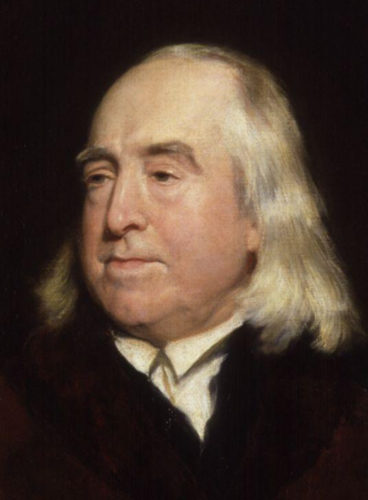
Jeremy Bentham portrait by Henry William Pickersgill

Biblical arguments for LGBTQ rights and a queer Jesus may seem like new ideas, but they were pioneered about 200 years ago by an influential British philosopher — in writings that were published only in recent years.

Philosopher Jeremy Bentham (1748 – 1832) presented Biblical evidence for Jesus’ homosexuality as part of his theological defense for same-sex love in “Not Paul, but Jesus Vol. III.” It was published for the first time in 2013 and is freely available to download or view online. He died on June 6, 1832.

Bentham didn’t dare publish it during his lifetime because he feared being labeled a “sodomite” himself. At the time “buggery” was punished with death by hanging in England.

This champion of sexual freedom was far, far ahead of his time. “Not Paul, but Jesus” lays out many of the same arguments that are still used today by LGBTQ Christians and our allies: debunking the scriptures typically used to condemn LGBTQ people and pointing out that Jesus never said anything about homosexuality. Bentham goes on to present an idea that many still consider blasphemous. He suggests that Jesus had male-male sexual relationships.

Bentham wrote the book so long ago that the word “homosexuality” had not been invented yet. Instead he has a chapter titled “The eccentric pleasures of the bed, whether partaken of by Jesus?” His language may sound quaint, but his ideas are right on target for today. Bentham himself struggled with words for what we call homosexuality, deliberately creating new vocabulary so he could avoid the negative connotations associated with the terminology of his day (sodomy, buggery, perversion, etc.).

Bentham is best known as the founder of Utilitarianism, a philosophy that advocates “the greatest happiness of the greatest number of people” A respected thinker during his lifetime, Bentham was also far advanced on a wide range of other legal, economic and political issues. He coined the word “international.” He was one of the first proponents of animal rights. He supported women’s equality and opposed slavery and capital punishment. He corresponded with various world leaders, including US presidents Jefferson and Madison. Several South and Central American nations sought his advice in creating their constitutions and legal codes. Born and raised in a devout Anglican family in London, he became an agnostic who believed that religion was an instrument of oppression. His solution was separation of church and state.

Bentham sheds light on “clobber passages”

In the third volume of “Not Paul, but Jesus Vol. III,” Bentham corrects false interpretations of what would later come to be called the “clobber passages.” He identifies the sin of Sodom as gang-rape. He puts the sexual prohibitions of the Hebrew scriptures into historical context, pointing out that many of the other taboos are no longer enforced.

Bentham dismisses Paul’s condemnations of homosexuality as an asceticism not shared by Jesus himself. He sees romantic love between Old Testament heroes Jonathan and David — and possibly between Jesus and his beloved disciple John, noting that the Bible reports their loving touch without condemnation.

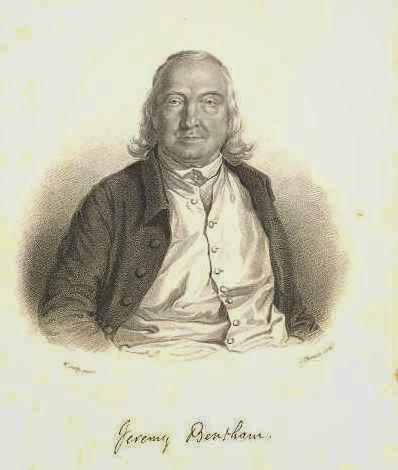
Jeremy Bentham engraving by J. Thomson, from a painting by W. Derby (courtesy of the Bentham Project)

Bentham goes on to analyze the account in Mark’s gospel of “the stripling in the loose attire” (now usually known as “the naked young man”) at the arrest of Jesus — a passage that continues to fuel 21st-century speculations in the LGBTQ community. He urges readers to consider the most “probable interpretation” for the nakedness. (In a different manuscript he made it clear that the youth was probably a male prostitute loyal to Jesus.) Bentham even hints that Jesus was killed for homosexuality, asking readers to consider what interaction with a naked man could be “so awful” that it leads to cruel execution.

Pro-LGBTQ Christians today often note that Jesus never said anything against homosexuality. Bentham makes the same point in his own elaborate way, with sentences such as: “In the acts or discourses of Jesus, had any such marks of reprobation towards the mode of sexuality in question been to be found as may be seen in such abundance in the epistles of Paul—in a word, had any one decided mark of reprobation been so to be found as pronounced upon it by Jesus, in the eyes [of] no believer in Jesus could any such body of evidence as hath here been seen [to] present itself be considered as worth regarding.”

Indeed Bentham’s main purpose in all three volumes of “Not Paul, but Jesus” is to show the error in following the ascetic Paul instead of the true Christianity of the more tolerant Jesus, who accepted the human pursuit of pleasure. This concept is introduced in the first volume of “Not Paul, but Jesus” was published in 1823. Fearing hostile reactions, Bentham used the pseudonym Gamaliel Smith. The second volume, which deals with the early church, and the third volume, which focuses on sexual morality, remained unpublished.

Bentham wrote a lot about homosexuality

Bentham wrote more than 500 pages explaining his liberal views on homosexuality during the last 50 years of his life.  Some of these documents may have circulated among his followers, but none of it was published during his lifetime.

The first Bentham writings on homosexuality to be published were primarily secular. His 1785 essay “Offences Against One’s Self: Paederasty” is considered the first document arguing for decriminalization of homosexuality in England. He reasoned that consensual sex between same-sex partners should not be punished because it does not harm anyone. The essay was not published until 1931, when a fragment first appeared in print. The full essay was finally published in 1978.

Only now are Bentham’s writings on Jesus and homosexuality coming to light. The third volume of “Not Paul, but Jesus” was not published in any form until 2013. It was released last year by the Bentham Project at University College London, which counts him as its spiritual father.

In January 2014 Bentham’s own overview of the “Not Paul, but Jesus, Volume 3” appeared as a chapter in a book published by Oxford University Press: “Of Sexual Irregularities, and Other Writings on Sexual Morality” by Jeremy Bentham. (More info at: http://ukcatalogue.oup.com/product/9780199685189.do)

A section on “Jesus’s Sexuality” is also included in the 2012 article “Jeremy Bentham: Prophet of Secularism” by Philip Schofield, director of the Bentham Project. He draws on the “Not Paul” book and another set of manuscripts to draw powerful conclusions such as this:

Bentham claimed that, unlike Paul, Jesus did not, according to any account that appeared in the four Gospels, condemn either the pleasures of the table or the pleasures of the bed. On the contrary, Jesus’s opposition to asceticism was shown in his condemnation of the Mosaic law in Matthew 9: 9–17…. Bentham pointed out that Paul’s most forceful condemnation was directed towards homosexuality. Bentham responded that not only had Jesus never condemned homosexuality, but that he had probably engaged in it. There were, moreover, many females in Jesus’s immediate circle, and again Bentham saw no reason why Jesus might not have engaged in heterosexual activity as well.

Bentham’s mysterious life and lasting impact

Although Bentham doggedly defended consensual sexual activity between same-sex couples for half a century, his own love life remains a mystery. The son of a wealthy lawyer, he was a child prodigy who grew up to be a brilliant and eccentric recluse, living alone in London in what he called “a state of perpetual and unruffled gaiety.” He referred to his home as his “hermitage.” He lived there with a “sacred teapot” called Dicky, a favorite walking stick named Dapple, and a beloved tom cat addressed as the Reverend Doctor John Langborn. He declared, “I love everything that has four legs,” and allowed a colony of mice to share his office. One study concludes he had Asperger Syndrome, a high-functioning form of autism. Check this link for an 1827 description of Bentham’s eccentricities.

The philosopher’s influence continued to grow after his death as his supporters spread his ideas. Most of what is now known as liberalism is rooted in Bentham’s philosophy. His diverse followers included economist John Stuart Mill and feminist firebrand Frances “Fanny” Wright, who once exclaimed in a poem, “Oh had I but the Lesbyan’s lyre, / Blue-eyed Sappho’s fervid strain, / Then might I hope thy blood to fire…”.

Contemporary queer theologians such as Robert Shore-Goss have recognized him too. Shore-Goss writes a section about Bentham in the chapter on “Christian Homodevotion to Jesus” in his book “Queering Christ: Beyond Jesus Acted Up.”

During his 84 years Bentham wrote manuscripts totaling more than 5 million words, and many remain unstudied and unpublished. The Bentham Project is busy recruiting volunteers worldwide to transcribe them. More words of wisdom are likely to emerge from this prophet of LGBTQ rights who once summed up his approach to life by saying: “Create all the happiness you are able to create: remove all the misery you are able to remove.”

Not Paul, but Jesus Vol. III by Jeremy Bentham, edited by Philip Schofield, Michael Quinn and Catherine Pease-Watkin, is now freely available to download or view online at:
http://blogs.ucl.ac.uk/bentham-project/2013/04/30/not-paul-but-jesus-vol-iii/

___
Top image credit:
Jeremy Bentham portrait by Henry William Pickersgill (Wikimedia Commons)

___
Related links:

To read this article in Russian, go to:
Гомосексуальность Иисуса в трудах философа XVIII века (nuntiare.org)

To read this article in Italian, go to:
Il Gesù omosessuale del filosofo Jeremy Bentham (gionata.org)

____
This post is part of the LGBTQ Saints series by Kittredge Cherry. Traditional and alternative saints, people in the Bible, LGBTQ martyrs, authors, theologians, religious leaders, artists, deities and other figures of special interest to lesbian, gay, bisexual and transgender and queer (LGBTQ) people and our allies are covered. It is also part of the Queer Christ series by Kittredge Cherry at the Jesus in Love Blog. The series gathers together visions of the queer Christ as presented by artists, writers, theologians and others.

This article was first published on Q Spirit in June 2017 and was updated for accuracy on June 5, 2021.

Copyright © Kittredge Cherry. All rights reserved.
http://www.jesusinlove.blogspot.com/
Jesus in Love Blog on LGBT spirituality and the arts

Kittredge Cherry

Kittredge Cherry Founder at Q Spirit Kittredge Cherry is a lesbian Christian author who writes regularly about LGBTQ spirituality.She holds degrees in religion, journalism and art history.She was ordained by Metropolitan Community Churches and served as its national ecumenical officer, advocating for LGBTQ rights at the National Council of Churches and World Council of Churches.

The Sacred Band of Thebes – The Elite Military Unit of Same Sex Lovers

Image Credit : Pinkpasty – Artist Credit : artist Malcolm – CC BY 4.0

The Sacred Band of Thebes was an elite force of shock troops in the Theban army, consisting of 150 paired male lovers that were famed in the classical world during the 4th century BC for their legendary courage and military strength in battle.

(heritagedaily.com)

The view of homosexuality or same sex relations in Ancient Greece was distinguished not by sexual desire, but instead was perceived by the role that each participant played by either being the penetrator, or passively penetrated.

The role of the penetrator corresponded with attributes of being dominant, masculine, and of high social status, whilst the passive role was associated with femininity, lower social status, and youth, with the latter often being the subject of social stigma in Greek society.

According to the philosopher and historian Plutarch (AD 46 – 119), the Sacred Band consisted of 300 hand-picked men, that were identified as either an older erastês or a younger passive erômenos, who would exchange sacred vows and worship at the shrine of Iolaus (claimed to be one of the lovers of Heracles) at Thebes.

The earliest record of the Sacred Band was in the oration “Against Demosthenes” by the Athenian logographer Dinarchus in 324 BC, but accounts of their full story is given by Plutarch, who likely drew on earlier text from contemporary chroniclers whose works are now lost.

Plutarch describes how the Sacred Band was formed by the boeotarch Gorgidas, shortly after the expulsion of the Spartan garrison occupying the Theban citadel of Cadmea.

Plutarch’s “Parallel Lives” from the second century AD records: “The sacred band, we are told, was first formed by Gorgidas, of three hundred chosen men, to whom the city furnished exercise and maintenance, and who encamped in the Cadmeia; for which reason, too, they were called the city band; for citadels in those days were properly called cities. But some say that this band was composed of lovers and beloved.”

The Sacred Band were first deployed during the Boeotian War in 378 BC, but gained a legendary reputation for their participation in the Battle of Leuctra in 371 BC, in which the Sacred Band fought at the head of the Theban column against the Spartans.

They remained undefeated until the battle of Chaeronea in 338 BC, in which a Macedonian army under the command of Phillip II and his son Alexander, crushed an alliance of Greek city-states led by Athens and Thebes.

In Plutarch’s accounts of the battle: “It is said, moreover, that the band was never beaten, until the battle of Chaeroneia; and when, after the battle, Philip was surveying the dead, and stopped at the place where the three hundred were lying, all where they had faced the long spears of his phalanx, with their armour, and mingled one with another, he was amazed, and on learning that this was the band of lovers and beloved, burst into tears and said: Perish miserably they who think that these men did or suffered aught disgraceful.”

The Greek geographer Pausanias (AD 110-180) in his “Description of Greece”, mentions that the Thebans had erected a lion statue near Chaeronea to commemorate the Thebans killed in the battle.

During the 19th century, pieces of a large stone lion were rediscovered, along with a quadrangular enclosure containing the remains of 254 men, that many historians argue is the final resting place of the fallen soldiers from the Sacred Band of Thebes.

(Contributed by Gwyllm Llwydd)

Wittgenstein’s ladder

From Wikipedia, the free encyclopedia

In philosophyWittgenstein’s ladder is a metaphor set out by Ludwig Wittgenstein about learning. In what may be a deliberate reference to Søren Kierkegaard‘s Concluding Unscientific Postscript to Philosophical Fragments,[1][2] the penultimate proposition of the Tractatus Logico-Philosophicus (translated from the original German) reads:[3]

6.54

   My propositions serve as elucidations in the following way: anyone who understands me eventually recognizes them as nonsensical, when he has used them—as steps—to climb beyond them. (He must, so to speak, throw away the ladder after he has climbed up it.)

   He must transcend these propositions, and then he will see the world aright.

Given the preceding problematic at work in his Tractatus, this passage suggests that, if a reader understands Wittgenstein’s aims in the text, then those propositions the reader would have just read would be recognized as nonsense. From Propositions 6.4–6.54, the Tractatus shifts its focus from primarily logical considerations to what may be considered more traditionally philosophical topics (God, ethics, meta-ethics, death, the will) and, less traditionally along with these, the mystical. The philosophy presented in the Tractatus attempts to demonstrate just what the limits of language are—and what it is to run up against them. Among what can be said for Wittgenstein are the propositions of natural science, and to the nonsensical, or unsayable, those subjects associated with philosophy traditionally—ethics and metaphysics, for instance.[4]

Curiously, the penultimate proposition of the Tractatus, proposition 6.54, states that once one understands the propositions of the Tractatus, one will recognize that they are nonsensical (unsinnig), and that they must be thrown away.[5] Proposition 6.54, then, presents a difficult interpretative problem. If the so-called picture theory of language is correct, and it is impossible to represent logical form, then the theory, by trying to say something about how language and the world must be for there to be meaning, is self-undermining. This is to say that the picture theory of language itself requires that something be said about the logical form sentences must share with reality for meaning to be possible. This requires doing precisely what the picture theory of language precludes. It would appear, then, that the metaphysics and the philosophy of language endorsed by the Tractatus give rise to a paradox: for the Tractatus to be true, it will necessarily have to be nonsense by self-application; but for this self-application to render the propositions of the Tractatus nonsense (in the Tractarian sense), then the Tractatus must be true.

Other philosophers before Wittgenstein, including Zhuang ZhouSchopenhauer and Fritz Mauthner, had used a similar metaphor.

In his notes of 1930 Wittgenstein returns to the image of a ladder[6] with a different perspective:

I might say: if the place I want to get could only be reached by way of a ladder, I would give up trying to get there. For the place I really have to get to is a place I must already be at now.
Anything that I might reach by climbing a ladder does not interest me.[7]

More at: https://en.wikipedia.org/wiki/Wittgenstein%27s_ladder

Rupert Spira on Non-Dualism, Consciousness, God, and Death

Theories of Everything with Curt Jaimungal Rupert Spira is a teacher of the “direct path”-method of spiritual self-enquiry, and a world renowned expert on non-dualism. Sponsors: https://brilliant.org/TOE for 20% off. http://algo.com for supply chain AI. Patreon for conversations on Theories of Everything, Consciousness, Free Will, and God: https://patreon.com/curtjaimungal Crypto (anonymous): https://tinyurl.com/cryptoTOE PayPal: https://tinyurl.com/paypalTOE Twitter: https://twitter.com/TOEwithCurt Discord Invite: https://discord.com/invite/kBcnfNVwqs iTunes: https://podcasts.apple.com/ca/podcast… Pandora: https://pdora.co/33b9lfP Spotify: https://open.spotify.com/show/4gL14b9… Subreddit r/TheoriesOfEverything: https://reddit.com/r/theoriesofeveryt… LINKS MENTIONED: Rupert’s Website: https://rupertspira.com/ Rupert’s Twitter: https://twitter.com/RupertSpira Interview with Bernardo Kastrup: https://www.youtube.com/watch?v=lAB21… Interview with Donald Hoffman: https://www.youtube.com/watch?v=CmieN… Interview with Iain McGilchrist: https://www.youtube.com/watch?v=M-SgO… THANK YOU: Cooper Sheehan and Henry Hoffman-Bakoussis for formatting the audience questions. TIMESTAMPS: 00:00:00 Introduction 00:06:07 Overview of non-dualism 00:09:09 Experience vs consciousness vs awareness 00:10:31 “In ignorance, I am something. In understanding, I am nothing. I love, I am everything.” 00:14:29 Discovering “you” by taking off your thoughts and perceptions 00:17:09 Meditative exercise to see union between the self and the world 00:33:14 Can you be aware of not being aware? 00:48:34 Why can there only be “one” consciousness? 00:51:54 Consciousness as fundamental. Not matter 01:04:55 Why does infinite consciousness need to become finite? 01:09:17 There no real “things” 01:11:40 Definition of enlightenment 01:14:47 Are atheists / materialists lying when they say they have peace? 01:21:30 It’s okay for your body’s pain to not have caught up to your mind’s peace 01:28:19 The nature of consciousness is happiness 01:34:55 Logos 01:40:35 Donald Hoffman and Bernardo Kastrup 01:48:03 Psychedelics 01:58:01 Consciousness as “love” requires subtlety to understand 02:00:19 Love, truth, and beauty are the same, but depend on the path one takes 02:04:12 Psychological suffering is veiled happiness 02:07:31 Some truths will break you at your core 02:17:40 New age is missing the malicious element of humanity 02:24:26 Rupert’s distinctive manner of speech 02:27:07 Does infinite consciousness “speak” to us? 02:29:15 Why does suffering exist? Why does it have to be so drastic? 02:43:04 “Overlapping consciousness” and the objective world 02:49:40 Materialists don’t disagree with non-dualism 02:51:22 Curt’s “fractal” theory of reality and the extremization of a parameter unifying with its opposite 02:56:55 Iain McGilchrist, the bihemispheric model, and fractals 03:00:17 On death, and continuing on 03:06:11 Science 2.0 (“abhijgnosis” as Curt calls it) 03:18:48 [Hubur Galula] Does Rupert still get overwhelmed with emotions / attached to objects or people? 03:23:44 Functional vs dysfunctional attachments (co-dependence) 03:25:37 [Inannawhimsey] Rupert, is there any emotion that isn’t valid? 03:35:22 [Rebecca Briggs] Ego and shadow work in the non-dual recognition tradition? 03:42:10 Why are we separate at all? Why are these truths something we have realize? 03:47:59 Descartes was wrong, or right? 03:52:27 The East vs The West (the East was first to non-dualism) 03:57:59 Rupert Spira interprets the Prodigal son with non-dualism 04:02:59 Prayer in the West vs meditation in the East 04:20:27 Does infinite consciousness suffer? Does it lack? 04:25:07 No background necessary to realize the insights of non-dualism 04:32:52 [DIYCraftq] What happens when you die in your model vs. Rupert Sheldrake’s model? 04:41:01 Where to find out more about Rupert Spira * * * Just wrapped (April 2021) a documentary called Better Left Unsaid http://betterleftunsaidfilm.com on the topic of “when does the left go too far?” Visit that site if you’d like to watch it.

“Are People Doing The Best They Can?” | Brené Brown & Russell Brand

Russell Brand A clip from the upcoming Under The Skin podcast with the incredible Brené Brown! You can listen to the entire conversation this Sat 22nd June on Luminary, sign up here to listen for free: http://luminary.link/russell Have you seen Brené’s TEDtalk on YouTube or her new Netflix special? If not…go watch it, it’s fantastic and very moving. You might cry a little. Subscribe to my channel here: http://tinyurl.com/opragcg (make sure to hit the BELL icon to be notified of new videos!) You can get my new book Mentors here (and as an audiobook!): https://amzn.to/2t0Zu9U Get my book “Recovery” here: https://amzn.to/2R7c810 Instagram: http://instagram.com/trewrussellbrand/ Twitter: http://twitter.com/rustyrockets Produced by Jenny May Finn (Instagram: @jennymayfinn)

Britain is the World’s Newest Failed State

How Britain Imploded Into a Frenzy of Sleaze, Greed, Corruption, and Lies

umair haque · Jun 26 · Medium.com

Image Credit: The Sun

Allow me to introduce you to the ruinous, tragicomic state of Britain circa 2021. This week, the Health Secretary was caught…on video…breaking his own lockdown rules…to have an affair…with his key aide…who was married, by the way…and whose brother had won a lucrative Covid contract from the NHS…which said Health Secretary is also busy selling off to American hedge funds…so soon, Brits will pay American prices for healthcare…while there’s a third wave of Covid’s Delta variant breaking loose.

Did you get all that?

Now, put aside for a moment that the Health Secretary, Matt Hancock, is a man that nobody should have an affair with. He gives off creepy vibes like a stalker at midnight, only he wears a suit. You don’t even need to consider how weirdly creepy like a Stepford Man or a Manchurian Plutocrat Matt Hancock is…you don’t need to consider how astoundingly ass-grabbingly sleazy the video is…no, just the raw facts are mind-boggling enough. After all, Hancock appears to have been quite possibly breaking the law, which is what his own lockdown rules were about, but I guess they don’t matter if you’re the Health Secretary, and you need to grab your aide’s ass. Not only that, but he apparently knew the video was coming out, and used that time to tell his wife, who he had given Covid to, that he was leaving herHe woke his kids in the night to tell them he was moving out. What the?

Ah, but we’re barely just beginning.

The next day, the Metropolitan Police (aka “the Met”) announced that they were going to arrest. Who? Matt Hancock? The aide’s brother? Nope. Environmental activists. They were going to raid…wait for it…art centres.

That’s because these environmental activists, Extinction Rebellion, stage elaborate, dramatic, artistic protests. Here, check out a few pictures. Tell me that’s not aesthetically impressive — whatever your particular politics might be. Now, Londoners, some of them, anyways, find Extinction Rebellion annoying. Oh no, how annoying. To have to care about the planet. At any rate, it’s hardly the stuff of serious crime.

At this point, you might be asking: wait, what? Why were the Police wasting their time raiding art centres? Instead of the Health Secretary who broke his own lockdown rules?

After all, the rest of the nation had to follow those rules. People didn’t see their loved ones for months. Parents died without children ever saying goodbye. And the doctors who witnessed all this, handled it, treated it? They’re quitting in droves, because, well, who wants to work for an assh*le like that?

But I digress. Why are the police raiding art centres…while the Health Secretary was getting off scot-free? Sorry — did I forget to mention that part? That’s right. While Matt Hancock has now resigned, Boris defended him, instead of saying, “That’s a serious offense.”

What on earth is going here?

Wait, let me give you one final example. While all is going on, right under Brit’s noses, the NHS is being sold off to American hedge funds. Has anyone told Brits that Americans get medical bills like this one — for three million dollars? Channel 4, too — one of the world’s finest broadcasters — is being privatised. It was something unique and beautiful and cool — a public indie broadcaster which took big, bold risks, tasked with making the highest quality, most original stuff around. You probably don’t know it if you’re American, but Channel 4 has made some of your favourite shows and actors and directors. Meanwhile, a new channel — “GB News” — has been set up, with a little help from pals and billionaires — and it’s more rancid and conservative than Fox News.

These are seismic, irreversible shifts in Britain’s cultural and institutional landscape. No more NHS — a once indispensable part of modern British life. Sure, it might still be there — as a paid phone line or app or something. But not as a social system. No more Channel 4 — liberal, open, uncompromising, critical, artistic — instead, the dun, mindless propaganda of florid, angry, red-faced old conservative men, ranting about how much they hate the people they hate on “GB News.”

All these are examples as clear as day.That, dear reader, modern-day Britain is the world’s newest failing state. You can’t see it more clearly than the examples above. Let me sum up more formally what happened here. One of the nation’s senior politicians broke his own rules — while the police are wasting their time, and everyone’s money, going after artsy, harmless environmental protestors…who are now classed as “terrorists.”

Let’s count how many levels and features of failed states are present in this one tiny example alone — and then we’ll zoom out to the others. The rule of law has ceased to function. Elites operate according to one set of rules, and everyone else, another. The public good has stopped mattering, and private interests — like making out with your aide during a lockdown everyone else is supposed to follow — is all that counts. The little people don’t matter anymore — maybe they never did. Most of them don’t seem to care at all, in fact. Hence, basic public institutions are being subverted and perverted for nakedly, openly authoritarian ends.

Yes, authoritarian ones. What else do you call it when environmental protesters in art centres are being “raided”…by heavily armed police…because they’re classed as “terrorists”? That’s happening because the ultra-conservative government doesn’t want any dissent. It doesn’t want any unrest. It doesn’t much like the idea of caring about anything that isn’t money, power, sex, or fame. Like, say, the planet, democracy, the future, each other. It doesn’t want people to be intelligent, thoughtful, sane, optimistic, forward-looking.

It doesn’t want the rule of law to function at all — it’s abusing public institutions for not just openly political ends, but ones corrosive and inimical to democracy, like free expression and association.

So environmental protesters can’t hang out at art centres to try and save the planet. But if you’re the Health Secretary, apparently, you’re free to…freely associate…with anyone you like…even during lockdown. Because you have power. To abuse the system. While everyone else just has to submit to your abusive, absolute power.

Get all that? You should. You should think about it carefully. Nothing shows failed states more clearly than the juxtapositions of elites and ordinary people — especially ones who dissent, care, try to change the system.

In this case, we have an alarming, bizarre, juxtaposition so extreme, it takes on comical proportions. Art centres being raided, because freedom of expression is now so severely curtailed caring about the environment is “terrorism” — for ordinary people — while for elites, no rules apply at all, and you can cheat on your wife at the office during lockdown. Laugh or cry? You tell me, I guess.

In failing states — truly failing ones — elites do something strange and perverse. They rub it in. They flaunt it. The absoluteness of their power. That they don’t have to follow the rules, because the rules are for the little people, marks, rubes, suckers. They openly break the very rules they’ve made.

Why do they do that? For three reasons. One, to demonstrate their power really is absolute. Two, to build authoritarian cults of personality. And three, because they can.

Remember how the aide’s brother has a lucrative NHS Covid contract? He’s just one of a long string of examples. The same Health Secretary awarded another lucrative Covid contract to…who, a company run by doctors?…a non-profit?…no, the guy that ran his pub.

The corruption isn’t even hidden in plain sight anymore. No, it’s not hidden at all. Like, for example, “GB News,” more conservative than Fox, magically arising, while Channel 4, which made people think critically, is sold off to the lowest bidder. Or like selling off the NHS to American hedge funds, who are quite happy watching Americans die because they can’t get basic medicine like insulin, which costs ten times or as much in America as it does in Canada, life openly sacrificed — or should I say taken? — for the sake of even more money for a tiny malicious, ultra rich few.

When elites reach that point — not even bothering to hide the corruption, but doing the very opposite, which is flaunting it — a society is crossing a dark, grim, and dangerous threshold. Everything is changing. Elites only flaunt how badly they can break the rules when they know they can get away with it, and that means that a) social norms are corroding b) the rule of law has no teeth b) politics doesn’t work anymore c) you’re not living in much of a democracy and d) people have been demoralised and dispirited so much that nothing seems to matter anymore, and today’s latest depredation is met with shrugs of “what else did you expect?”

That, my friends, is a failed state.

How did Britain get here?

Let me give you another story of what happened this week. Kids are literally going to be made to sing a song at school that goes: “Strong Britain, Great Nation!”

Go ahead and giggle. That’s pretty…North Korean. Kim Jong Un would be proud. Shall we put them in stadiums and have them do synchronised billboard-holding next? But you know who else would be proud? Donald Trump.

Because Britain’s kids are going to be made to sing about Making Britain Great Again. LOL.

That’s another example of subverting and perverting many things. Institutions — schools. Social norms — what kids should say and think. These things shouldn’t be part of the British government’s insane nationalistic crusade to Make Britain Great Again. But they are — and that’s how Britain became a failing state.

You know part of the story by now. 2008, financial crisis. 2010, austerity begins. 2015, people have plunged into poverty, and, desperate, bewildered, they buy the stupid, stupid nationalistic myth — “Those Europeans are responsible for our woes! Get them!!” Gentle, wise, friendly Europeans became scapegoats for the catastrophic mistakes a string of conservative governments made — the worst in modern history, reducing Britain to something like a neo Weimar Republic, dysfunctional, bereft, sinking into poverty and despair and ruin, florid with the rage and vitriol which usually accompanies such implosions.

Bang. Cue Brexit. And since then, well, Britain has simply fallen apart. No, that’s too kind. It’s been put through the shredderBrexit’s caused some of Britain’s key exports to collapse in ways totally unseen — ever — in a modern, rich society. As in, simply stop dead. Fish, farming, dairy, cars — all these are industries which are simply now dying. And yet the fishermen and farmer and assembly line worker — these are the people who voted for Brexit, and still do, because they still back the conservatives so heavily, by a two to one ratio, that Britain’s future looks even more ultra-conservative, authoritarian, regressive — read, backwards, foolish, hateful, corrupt, malign, and broken — than it is now.

Think about it for a second. You’re some farmer or fisherman. Along come a bunch of malign elites, and tell you Europeans are to blame for your sinking income — not the incredibly dumb mistakes, like austerity, those very elites have made. Confused, afraid, you buy the myth. You’d think you’d come to your senses when you were literally losing the farm. But that’s not happened, nor happening, in Britain. Instead, the average Brit is more committed to backing the very agents of his own ruin — conservative elites — than ever.

So of course Britain’s conservative elites think they can flout the rules, flaunt it, and get away with it. They can. They have a pretty good measure of how deluded and broken in the mind and spirit the average Brit is now. They don’t even care about the fact that they scapegoated the wrong people — they still back conservatives, who led them off Brexit’s cliff edge. So why would they hold those very same elites accountable for much, much smaller things — mere seeming peccadilloes, like affairs, or garden-variety corruption, or the abuse of everyday power?

Britain’s elites have the measure of the average Brit, and it’s about the height of a slug. They know that the average person is still fervid with nationalism, that the fever of hate and venom and spite which began to poison Britain around 2015 or so hasn’t broken. And so, with a bit of clever misdirection — or just time — they can get away with anything.

And they do.

Why would people who won’t hold you accountable for wrecking their lives, jobs, livelihoods, communities, towns, politics, democracy, futures…hold you accountable for raiding art centres, for selling their healthcare system, for brainwashing their children with North Korean chants?

Of course they won’t.

Britain’s conservative elites understand this all perfectly. Sadly, it’s Britain’s liberals and social democrats who don’t. Britain is a nation gripped by a terrible fever. No, not (just) Covid. Nationalism. And nationalism is proceeding in Britain just the way it always does. The fever doesn’t break. It develops. Into the organ failures of authoritarianism and fascism. Those happen when public institutions are abused for repressive, regressive political ends. Like, say, the police raiding art centres because the government doesn’t like environmental protestors and calls them “terrorists” now — that’s the real crime now, not corruption, cronyism, incompetence, letting your country have one of the highest Covid death rates in the world, breaking your society, shredding your economy. All that stuff? Not just perfectly OK in Britain today — that’s what the people want.

So, naturally, conservative elites are giving it to them. Of course, they’re the ones who fed Brits the lies that they should want all this in the first place. But really — who’s foolish enough, apart from Americans, to believe that liberation lies in their own self-destruction? Remember how the NHS and Channel 4 are being privatised. For what? For purely political ends, for money and power’s sake.

Nationalism, authoritarianism, fascism. It’s a sequence as old as time — Athens fell victim to it, and so did Rome, in the end. Why should modern-day Britain be any different, or better, than those far older and enduring societies?

Umair
June 2021Eudaimonia and Co

WRITTEN BY

umair haque

Eudaimonia and Co

Eudaimonia and Co

Eudaimonia & Co

Consciousness, spirituality, biography, sexuality, androgyny, futurism, space, the arts, science, astrology, democracy, humor, books, movies and more