

This news from NASA may cause you to question everything.
The government space agency recently reported that there are actually 13 constellations in the Zodiac, rather than 12. So this means that if you’ve been reading your horoscope under a certain sign, you’ve been reading it all wrong. This new constellation is called Ophiuchus, and if your birthday is between November 29 and December 17, you would technically fall under this sign. Naturally, this news has caused the Internet to completely freak out and some of the reactions have been absolutely hysterical. Apparently this information isn’t new, however, it’s actually been around for millions of years and for some reason people have just seemed to ignore it. Maybe it’s because Ophiuchus doesn’t have the same ring to it as Capricorn or Aries. According to Elite Daily, its sign is a man named Serpentarius holding a snake and people born under it seek peace and harmony, are poetic and inventive and have thirsts for knowledge but also secret enemies in their close circles. Woah, calm down Ophiuchus. Check out the amended list of horoscopes and some of our favorite Twitter reactions below.
•Aquarius: Feb 16 – March 11
•Pisces: March 11 – April 18
•Aries: April 18 – May 13
•Taurus: May 13 – June 21
•Gemini: June 21 – July 20
•Cancer: July 20 – August 10
•Leo: August 10 – September 16
•Virgo: September 16 – October 14
•Libra: October 14 – November 23
•Scorpio: November 23 – November 29
•Ophiuchus: November 29 – December 17
•Sagittarius: December 17 – January 20
Ophiuchus: Facts about the Snake Bearer
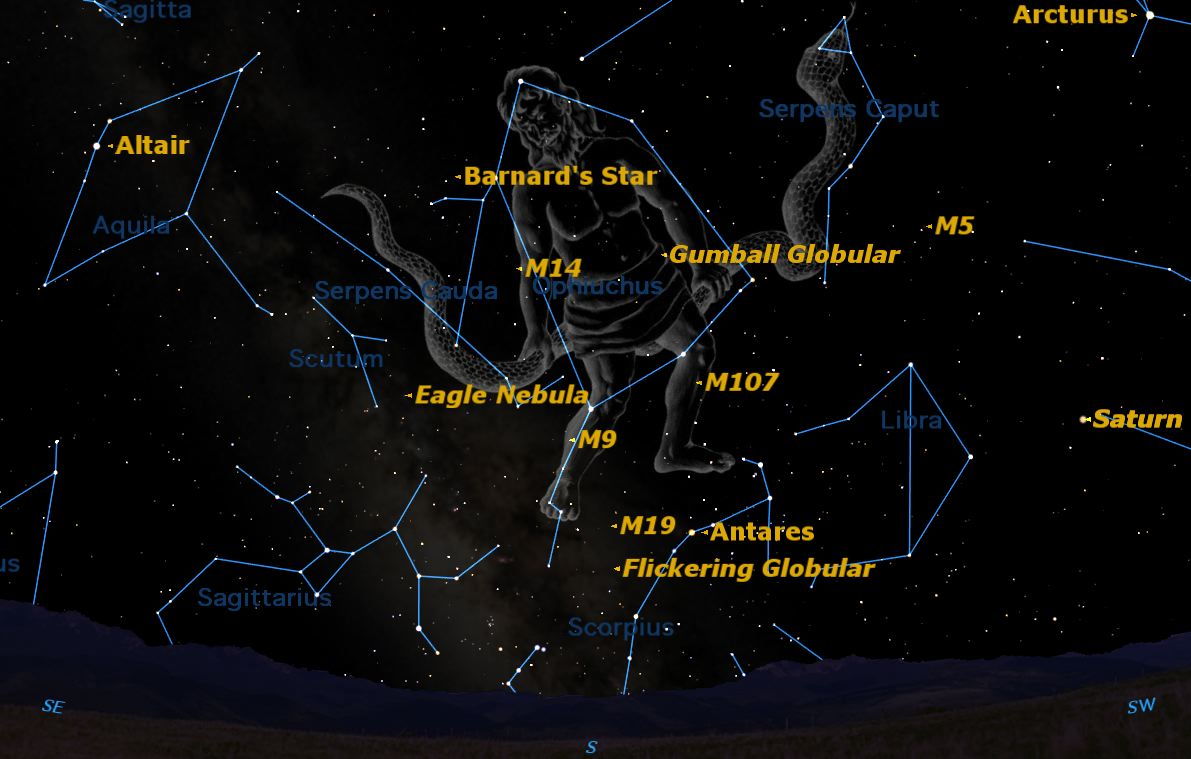
Credit: Starry Night Software
Ophiuchus is a fairly large and rambling constellation, but it is one of the least well-known. Although Ophiuchus does touch the elliptic — the path that the sun appears to take through the sky — astrologers for centuries ignored it as part of the Zodiac. The constellation finally got some respect in 2011 when they added Ophiuchus as an astrological sign and realigned the Zodiac calendar.
Locating Ophiuchus
Ophiuchus [Oaf-ih-YOU-kus] spans 948 square degrees in area. It can be found northwest of the center of the Milky Way. It is situated near the constellations Aquila, Serpens and Hercules and opposite Orion. The southern part lies between Scorpius to the west and Sagittarius to the east. The position of Ophiuchus is:
- Right Ascension: 17.18 hours
- Declination: -4.24 degrees
- Visible: between 80 degrees and -80 degrees
- Best viewed: In July around 9 p.m.
Notable stars and objects
Ophiuchus contains the second closest star to Earth — Barnard’s Star — about 6 light-years away. The red dwarf star is a magnitude 9.5, making it a challenge to find with the naked eye.
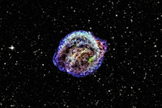
Credit: X-ray: NASA/CXC/NCSU/M.Burkey et al; Optical: DSS
Delineating the head of Ophiuchus, alpha Ophiuchi is an A-type giant. The star is also known by the name Rasalhague, meaning “Head of the Snake Charmer” in Arabic.
Two stars — eta Ophiuchi and zeta Ophiuchi, a hot blue giant that has a reddish appearance because of interstellar dust — mark the knees of Ophiuchus.
A red giant about 170 light-years distant, delta Ophiuchi (Yed Prior), a red giant 170 light-years distant, and epsilon Ophiuchi, a class G giant 108 light-years distant, form the snake charmer’s left arm.
Ophiuchus is home to a number of star clusters, including M10, which is only 20,000 light-years from Earth. It has a magnitude of 6.6 and is a Shapley class VII cluster.
Ophiuchus also houses Kepler’s Supernova, also known as Kepler’s Star or Supernova 1604, as it was discovered by German astronomer Johannes Kepler in 1604. He tracked the supernova for a year and its remnants are still studied today as it was the most recent supernova to be observed with the naked eye.
Mythology
As is the case with all of the Zodiac constellations, Ophiuchuswas recorded in the 2nd century by the Greek astronomer Ptolemy, and the name is Latin for “serpent bearer.”
The snake is often associated with doctors, so Ophiuchus is often associated with healing images. The Romans associated the constellation with Asclepius, who learned the secret to immortality by watching one serpent treat another serpent with healing herbs. Zeus killed Asclepius with a lightning bolt because he didn’t want everyone to be immortal, but later honored his good deeds by giving him a spot in the heavens.
The Babylonians associated the constellation with Nirah, a god who was sometimes depicted with a human upper body and legs that were serpents.
Ophiuchus is the 13th sign of the Zodiac (which is not a science) and represents those born between Nov. 30 and Dec. 17.
— Kim Ann Zimmermann, SPACE.com contributor
(from collegecandy.com, space.com and Hugh John Malanaphy, H.W., m.)