
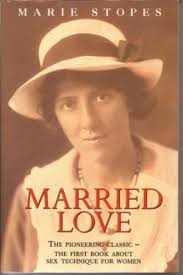
Married Love or Love in Marriage is a book by British academic Marie Stopes, first published in March 1918 by a small publisher, after many other larger publishers turned her down because of its controversial content. It rapidly sold out, and was in its sixth printing within a fortnight.
The US Customs Service banned the book as obscene until April 6, 1931, when Judge John M. Woolsey overturned that decision. Woolsey was the same judge who in 1933 would lift the ban on James Joyce‘s Ulysses, allowing for its publication and circulation in the United States of America.
It was the first book to note that women’s sexual desire coincides with ovulation and the period right before menstruation. The book argued that marriage should be an equal relationship between partners. Although officially scorned in the UK, the book went through 19 editions and sales of almost 750,000 copies by 1931.
In 1935 a survey of American academics said Married Love was one of the 25 most influential books of the previous 50 years, ahead of Relativity by Albert Einstein, Interpretation of Dreams by Sigmund Freud, Mein Kampf by Adolf Hitler and The Economic Consequences of the Peace by John Maynard Keynes.
The book was the basis for a 1923 British silent film adaptation Married Love directed by Alexander Butler.
A quote from the book:
“One of the most famous instances of the married ascetic is Tolstoy, whose later opinion was that the highest human being completely inhibits his sex-desires and lives a celibate life.
“Ascetics, however, seldom have much knowledge of human physiology, and it seems to me that, with all their fine and religious fervor, they often lack the mysticism necessary for the full realization of the meaning and potentialities of the new creation resulting from man’s and woman’s highest union.
“Doubtless if for an hour we were to take the place of the individual chemical atoms of Oxygen or of Hydrogen, we could have no inkling of the physical properties of the water-drop they together form.
“Christianity, like most religions, had a strong wave of asceticism early in its history. While there was, as there still is, a harsh asceticism which is hostile to the other sex, it is of much interest to see that there was also a romantic asceticism which, while revolting from the sensuality of the pagan contemporaries, did not entirely prohibit the charms and pleasures of mutual companionship. Thus, in a mutilated form, it seems these early Christian ascetics gained some of the immaterial benefits of marriage.
“The harsh ascetic, however, is the one the word ascetic most generally conjures up. Even if he accomplishes miracles of self-restraint, and subdues desire, he is often weakened rather than strengthened by his determination to flout nature. Save only in the truly great, there is a warping and narrowing which results from coercing beyond the limits of reason the desires which were implanted in Adam and Eve when they were told to be fruitful and multiply.
“Approaching the subject in a more modern and scientific attitude of impartial inquiry, the medical man can produce an imposing list of diseases more or less directly caused by abstinence both in men and in women. These diseases range from neuralgia and “nerves” to (in women) fibroid growths. And it is well worthy of remark that these diseases may be present when the patient (as have many unmarried women) has no idea that the sex-impulse exists unmastered.
“Thus the ascetic and the profligate (whether or not in legal marriage) have both to run the gauntlet of disease. There is, however, no disease I know of which is caused by the normal and mutually happy marriage relation a relation which, certainly to most, has positive healing and vitalizing power.
“The profound truth which is perceived by the ascetics is that the creative energy of sex can be transformed into other activities. This truth should never be lost sight of in marriage; where between the times of natural, happy, and also stimulating exercise of the sex-functions, the periods of complete abstinence should be opportunities for transmuting the healthy sex-power into work of every sort.”