
From Wikipedia, the free encyclopedia
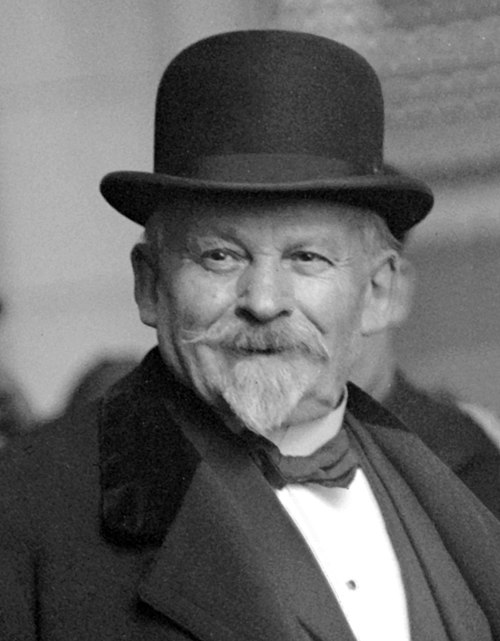
| Émile Coué | |
|---|---|
| Born | 26 February 1857 Troyes, Second French Empire |
| Died | 2 July 1926 (aged 69) Nancy, France |
| Occupation(s) | Pharmacist; psychologist |
| Spouse | Lucie Lemoine (1858–1954) |

Émile Coué de la Châtaigneraie (French: [emil kue də la ʃɑtɛɲʁɛ]; 26 February 1857 – 2 July 1926) was a French psychologist, pharmacist, and hypnotist who introduced a popular method of psychotherapy and self-improvement based on optimistic autosuggestion.[1][2]
It was in no small measure [Coué’s] wholehearted devotion to a self-imposed task that enabled him, in less than a quarter of a century, to rise from obscurity to the position of the world’s most famous psychological exponent. Indeed, one might truly say that Coué sidetracked inefficient hypnotism [mistakenly based upon supposed operator dominance over a subject], and paved the way for the efficient, and truly scientific.
— Orton (1935).[3]
Coué’s method was disarmingly non-complex—needing few instructions for on-going competence, based on rational principles, easily understood, demanding no intellectual sophistication, simply explained, simply taught, performed in private, using a subject’s own resources, requiring no elaborate preparation, and no expenditure.
— Yeates (2016).[4]
Most of us are so accustomed … to an elaborate medical ritual … in the treatment of our ills … [that] anything so simple as Coué’s autosuggestion is inclined to arouse misgivings, antagonism and a feeling of scepticism.
— Duckworth (1922).[5]
Coué’s method was based upon the view that, operating deep below our conscious awareness, a complex arrangement of ‘ideas’, especially when those ideas are dominant,[6] continuously and spontaneously suggest things to us; and, from this, significantly influence one’s overall health and wellbeing.[7]
We possess within us a force of incalculable power, which, when we handle it unconsciously is often prejudicial to us. If on the contrary we direct it in a conscious and wise manner, it gives us the mastery of ourselves and allows us not only to escape … from physical and mental ills, but also to live in relative happiness, whatever the conditions in which we may find ourselves.
— Coué, 1922b, p. 35.[8]
As long as we look on autosuggestion as a remedy we miss its true significance. Primarily it is a means of self-culture, and one far more potent than any we have hitherto possessed. It enables us to develop the mental qualities we lack: efficiency, judgment, creative imagination, all that will help us to bring our life’s enterprise to a successful end. Most of us are aware of thwarted abilities, powers undeveloped, impulses checked in their growth. These are present in our Unconscious like trees in a forest, which, overshadowed by their neighbours, are stunted for lack of air and sunshine. By means of autosuggestion we can supply them with the power needed for growth and bring them to fruition in our conscious lives. However old, however infirm, however selfish, weak or vicious we may be, autosuggestion will do something for us. It gives us a new means of culture and discipline by which the “accents immature”, the “purposes unsure” can be nursed into strength, and the evil impulses attacked at the root. It is essentially an individual practice, an individual attitude of mind.
— Brooks, 1922[9]
Life and career
Coué’s family, from the Brittany region of France and with origins in French nobility, had only modest means. A brilliant pupil in school, he initially intended to become an analytical chemist; however, because his father, who worked for the Eastern Railway Company, was in a precarious financial state, he eventually abandoned these studies. Coué then decided to become a pharmacist and graduated with a degree in pharmacology in 1876.
Working as an apothecary at Troyes from 1882 to 1910, Coué quickly discovered what later came to be known as the placebo effect. He became known for reassuring his clients by praising each remedy’s efficiency and leaving a small positive notice with each given medication. In 1886 and 1887, he studied with Ambroise-Auguste Liébeault and Hippolyte Bernheim, two leading exponents of hypnotism, in Nancy.
In 1910, Coué sold his business and retired to Nancy, where he opened a clinic that continuously delivered some 40,000 treatment-units per annum (Baudouin, 1920, p. 14) to local, regional, and overseas patients over the next sixteen years.[10] In 1913, Coué and his wife founded The Lorraine Society of Applied Psychology (French: La Société Lorraine de Psychologie appliquée). His book Self-Mastery Through Conscious Autosuggestion was published in England (1920), and in the United States (1922). Although Coué’s teachings were, during his lifetime, more popular in Europe than in the United States, many Americans who adopted his ideas and methods, such as Elsie Lincoln Benedict, Maxwell Maltz, Napoleon Hill, Norman Vincent Peale, Robert H. Schuller, and W. Clement Stone, became famous in their own right by spreading his words.
Considered by Charles Baudouin to represent a second Nancy School,[11][12] Coué treated many patients in groups and free of charge.[13][14]
The Coué Method: General
The Coué Method
Continuously, unjustly, and mistakenly trivialised as just a hand-clasp, some unwarranted optimism, and a ‘mantra’, Coué’s method evolved over several decades of meticulous observation, theoretical speculation, in-the-field testing, incremental adjustment, and step-by-step transformation.
It tentatively began (c.1901) with very directive one-to-one hypnotic interventions, based upon the approaches and techniques that Coué had acquired from an American correspondence course.
As his theoretical knowledge, clinical experience, understanding of suggestion and autosuggestion, and hypnotic skills expanded, it gradually developed into its final subject-centred version—an intricate complex of (group) education, (group) hypnotherapy, (group) ego-strengthening, and (group) training in self-suggested pain control; and, following instruction in performing the prescribed self-administration ritual, the twice daily intentional and deliberate (individual) application of its unique formula, “Every day, in every way, I’m getting better and better.”— Yeates (2016c), p.55.
The application of his mantra-like conscious autosuggestion, “Every day, in every way, I’m getting better and better” (French: Tous les jours à tous points de vue je vais de mieux en mieux) is called Couéism or the Coué method.[15] Some American newspapers quoted it differently, “Day by day, in every way, I’m getting better and better.” The Coué method centered on a routine repetition of this particular expression according to a specified ritual—preferably as many as twenty times a day, and especially at the beginning and at the end of each day.[16] When asked whether or not he thought of himself as a healer, Coué often stated that “I have never cured anyone in my life. All I do is show people how they can cure themselves.”[17] Unlike a commonly held belief that a strong conscious will constitutes the best path to success, Coué maintained that curing some of our troubles requires a change in our unconscious thought, which can be achieved only by using our imagination.
Although stressing that he was not primarily a healer but one who taught others to heal themselves, Coué claimed to have effected organic changes through autosuggestion.[15]
Self-suggestion
Coué identified two types of self-suggestion: (i) the intentional, “reflective suggestion” made by deliberate and conscious effort, and (ii) the involuntary “spontaneous suggestion“, that is a “natural phenomenon of our mental life … which takes place without conscious effort [and has its effect] with an intensity proportional to the keenness of [our] attention”.[18] Baudouin identified three different sources of spontaneous suggestion:A. Instances belonging to the representative domain (sensations, mental images, dreams, visions, memories, opinions, and all intellectual phenomena);B. Instances belonging to the affective domain (joy or sorrow, emotions, sentiments, tendencies, passions);C. Instances belonging to the active or motor domain (actions, volitions, desires, gestures, movements at the periphery or in the interior of the body, functional or organic modifications).[19]
Two minds
According to Yeates, Coué shared the theoretical position that Thomson Jay Hudson had expressed in his Law of Psychic Phenomena (1893): namely, that our “mental organization” was such that it seemed as if we had “two minds, each endowed with separate and distinct attributes and powers; [with] each capable, under certain conditions, of independent action”.[20]
Further, argued Hudson, it was entirely irrelevant, for explanatory purposes, whether we actually had “two distinct minds”, whether we only seemed to be “endowed with a dual mental organization”, or whether we actually had “one mind [possessed of] certain attributes and powers under some conditions, and certain other attributes and powers under other conditions”.[21]
Dr. Couê audio and more at: https://en.wikipedia.org/wiki/%C3%89mile_Cou%C3%A9