JUNE 6, 2023 AT 7:00 AM BY ROB BREZSNY (NewCity.com)
Photo: Alexis Fauvet
ARIES (March 21-April 19): “Everything that irritates us about others can lead us to an understanding of ourselves,” said psychologist Carl Jung. What was he implying? That we may sometimes engage in the same behavior that bothers us about others? And we should examine whether we are similarly annoying? That’s one possible explanation, and I encourage you to meditate on it. Here’s a second theory: When people irritate us, it may signify that we are at risk of being hurt or violated by them—and we should take measures to protect ourselves. Maybe there are other theories you could come up with, as well, Aries. Now here’s your assignment: Identify two people who irritate you. What lessons or blessings could you garner from your relationships with them?
TAURUS (April 20-May 20): In 1886, a wealthy woman named Sarah Winchester moved into a two-story, eight-room farmhouse in San Jose, California. She was an amateur architect. During the next twenty years, she oversaw continuous reconstruction of her property, adding new elements and revising existing structures. At one point, the house had 500 rooms. Her workers built and then tore down a seven-story tower on sixteen occasions. When she died at age eighty-three, her beloved domicile had 2,000 doors, 10,000 windows, forty-seven stairways, and six kitchens. While Sarah Winchester was extreme in her devotion to endless transformation, I do recommend a more measured version of her strategy for you—especially in the coming months. Continual creative growth and rearrangement will be healthy and fun!
GEMINI (May 21-June 20): “All the things I wanted to do and didn’t do took so long. It was years of not doing.” So writes Gemini poet Lee Upton in her book “Undid in the Land of Undone.” Most of us could make a similar statement. But I have good news for you, Gemini. I suspect that during the rest of 2023, you will find the willpower and the means to finally accomplish intentions that have been long postponed or unfeasible. I’m excited for you! To prepare the way, decide which two undone things you would most love to dive into and complete.
CANCER (June 21-July 22): Cancerian author Denis Johnson had a rough life in his twenties. He was addicted to drugs and alcohol. Years later, he wrote a poem expressing gratitude to the people who didn’t abandon him. “You saw me when I was invisible,” he wrote, “you spoke to me when I was deaf, you thanked me when I was a secret.” Now would be an excellent time for you to deliver similar appreciation to those who have steadfastly beheld and supported your beauty when you were going through hard times.
LEO (July 23-Aug. 22): Don’t make a wish upon a star. Instead, make a wish upon a scar. By that I mean, visualize in vivid detail how you might summon dormant reserves of ingenuity to heal one of your wounds. Come up with a brilliant plan to at least partially heal the wound. And then use that same creative energy to launch a new dream or relaunch a stalled old dream. In other words, Leo, figure out how to turn a liability into an asset. Capitalize on a loss to engender a gain. Convert sadness into power and disappointment into joy.
VIRGO (Aug. 23-Sept. 22): At age nine, I was distraught when my parents told me we were moving away from the small town in Michigan where I had grown up. I felt devastated to lose the wonderful friends I had made and leave the land I loved. But in retrospect, I am glad I got uprooted. It was the beginning of a new destiny that taught me how to thrive on change. It was my introduction to the pleasures of knowing a wide variety of people from many different backgrounds. I bring this to your attention, Virgo, because I think the next twelve months will be full of comparable opportunities for you. You don’t have to relocate to take advantage, of course. There are numerous ways to expand and diversify your world. Your homework right now is to identify three.
LIBRA (Sept. 23-Oct. 22): Most of us continuously absorb information that is of little or questionable value. We are awash in an endless tsunami of trivia and babble. But in accordance with current astrological omens, I invite you to remove yourself from this blather as much as possible during the next three weeks. Focus on exposing yourself to fine thinkers, deep feelers and exquisite art and music. Nurture yourself with the wit and wisdom of compassionate geniuses and brilliant servants of the greater good. Treat yourself to a break from the blah-blah-blah and immerse yourself in the smartest joie de vivre you can find.
SCORPIO (Oct. 23-Nov. 21): Over twenty-five countries have created coats of arms that feature an eagle. Why is that? Maybe it’s because the Roman Empire, the foundation of so much culture in the Western world, regarded the eagle as the ruler of the skies. It’s a symbol of courage, strength and alertness. When associated with people, it also denotes high spirits, ingenuity and sharp wits. In astrology, the eagle is the emblem of the ripe Scorpio: someone who bravely transmutes suffering and strives to develop a sublimely soulful perspective. With these thoughts in mind, and in accordance with current astrological omens, I invite you Scorpios to draw extra intense influence from your eagle-like aspects in the coming weeks.
SAGITTARIUS (Nov. 22-Dec. 21): “When I paint, my goal is to show what I found, not what I was looking for.” So said artist Pablo Picasso. I recommend you adopt some version of that as your motto in the coming weeks. Yours could be, “When I make love, my goal is to rejoice in what I find, not what I am looking for.” Or perhaps, “When I do the work I care about, my goal is to celebrate what I find, not what I am looking for.” Or maybe, “When I decide to transform myself, my goal is to be alert for what I find, not what I am looking for.”
CAPRICORN (Dec. 22-Jan. 19): Vincent van Gogh painted “Wheatfield with a Reaper,” showing a man harvesting lush yellow grain under a glowing sun. Van Gogh said the figure was “fighting like the devil in the midst of the heat to get to the end of his task.” And yet, this was also true: “The sun was flooding everything with a light of pure gold.” I see your life in the coming weeks as resonating with this scene, Capricorn. Though you may grapple with challenging tasks, you will be surrounded by beauty and vitality.
AQUARIUS (Jan. 20-Feb. 18): I suspect that your homing signals will be extra strong and clear during the next twelve months. Everywhere you go, in everything you do, you will receive clues about where you truly belong and how to fully inhabit the situations where you truly belong. From all directions, life will offer you revelations about how to love yourself for who you are and be at peace with your destiny. Start tuning in immediately, dear Aquarius. The hints are already trickling in.
PISCES (Feb. 19-March 20): The renowned Mexican painter Diego Rivera (1886–1957) told this story about himself: When he was born, he was so frail and ill that the midwife gave up on him, casting him into a bucket of dung. Rivera’s grandmother would not accept the situation so easily, however. She caught and killed some pigeons and wrapped her newborn grandson in the birds’ guts. The seemingly crazy fix worked. Rivera survived and lived for many decades, creating an epic body of artistic work. I bring this wild tale to your attention, Pisces, with the hope that it will inspire you to keep going and be persistent in the face of a problematic beginning or challenging birth pang. Don’t give up!
“The poor have sometimes objected to being governed badly. The rich have always objected to being governed at all.” – G. K. Chesterton
Gilbert Keith Chesterton (May 29, 1874 – June 14, 1936) was an English writer, philosopher, Christian apologist, a literary and art critic. Chesterton created the fictional priest-detective Father Brown, and wrote on apologetics. Wikipedia
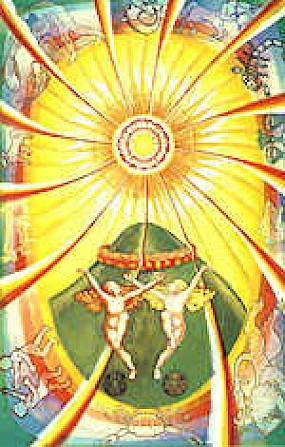
The Sun is numbered nineteen and usually shows a representation of the Sun with rays streaming from it. The Thoth deck version you see here is exceptional in that it is the rose of the Rose-Cross design which forms the Sun itself. The rays of light give the impression of spiralling out into the Universe. Within these rays are the signs of the Zodiac. There are usually a male and female – the same individuals we saw with the Lovers. They are the holy innocent children of God, bathed in the Sun’s rays.
The Sun conveys a sense of fertility and bounty. It is concerned with the turn of the years, cycles of birth, life, death and rebirth. This is a very warm and happy card. After the Moon opened up new doors, the Sun comes up to light the way forward. We have new hope and belief.
This is a card of healing, especially on an emotional level. It promises hope and happiness, along with a new sense of safeness, protection and recovery. We are at the place where miracles happen.
NATIONAL BESTSELLER • Discover the game-changing theory of the cycles of history and what past generations can teach us about living through times of upheaval—with deep insights into the roles that Boomers, Generation X, and Millennials have to play.
First comes a High, a period of confident expansion. Next comes an Awakening, a time of spiritual exploration and rebellion. Then comes an Unraveling, in which individualism triumphs over crumbling institutions. Last comes a Crisis—the Fourth Turning—when society passes through a great and perilous gate in history.
William Strauss and Neil Howe will change the way you see the world—and your place in it. With blazing originality, The Fourth Turning illuminates the past, explains the present, and reimagines the future. Most remarkably, it offers an utterly persuasive prophecy about how America’s past will predict what comes next.
Strauss and Howe base this vision on a provocative theory of American history. The authors look back five hundred years and uncover a distinct Modern history moves in cycles, each one lasting about the length of a long human life, each composed of four twenty-year eras—or “turnings”—that comprise history’s seasonal rhythm of growth, maturation, entropy, and rebirth. Illustrating this cycle through a brilliant analysis of the post–World War II period, The Fourth Turning offers bold predictions about how all of us can prepare, individually and collectively, for this rendezvous with destiny.
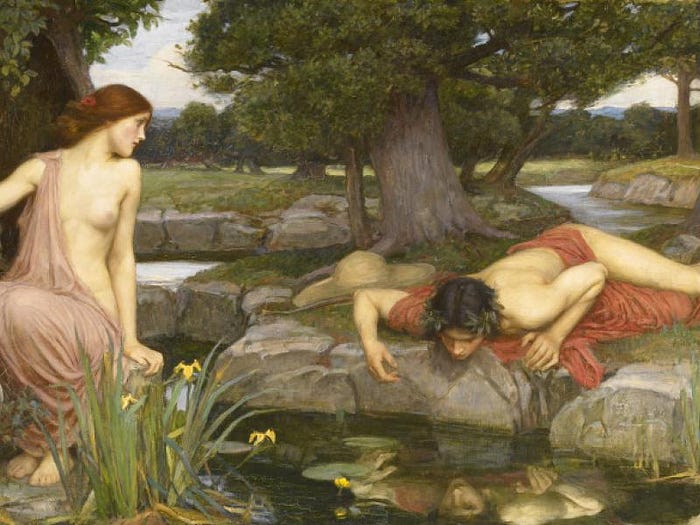
Echo and Narcissus by John Williams Waterhouse (Photo credit: Walker Art Gallery)
Narcissism — a personality disorder where confidence fills the air, and false praise is expected from everyone who crosses your path.
These narcissists live in a world of supremacy, expecting compliments and admiration from those around them.
From the modest to the ostentatious, they seek attention and power at any cost — all in the name of vanity. But such a lifestyle of arrogance can have disastrous repercussions; from declining mental health to physical harm, it doesn’t take long for their audaciousness to become a hindrance.
Narcissists demand special treatment and favorable outcomes for themselves, despite lacking compassion or consideration for others. Now that’s an attitude worth calling out.
Narcissism Is A Personality Disorder Characterized By Exaggerated Self-importance And An Expectation That Others Should Be Envious Of You.
Narcissism is a multifaceted condition, and it’s important to distinguish between its various aspects.
“Half of the people lie with their lips; the other half with their tears” ― Nassim Nicholas Taleb
Individuals afflicted with a narcissistic personality disorder may give the impression that they don’t merit admiration or appreciation from others; yet, their actions imply that they believe they are worthy of it.
Additionally, they may fail to comprehend how their behavior harms those in their proximity with whom they have an unequal power dynamic — for example, persistently rejecting assistance.
Narcissists Often Have A Family History Of Narcissism.
It’s common for narcissists to have an inherited family history of narcissistic tendencies. Unfortunately, their toxic parenting brings unimaginable damage to their children, possibly even causing them to take on the same behavior patterns in the future.
“Hate is the complement of fear and narcissists like being feared. It imbues them with an intoxicating sensation of omnipotence.” ― Sam Vaknin
That’s because these parents continually prioritize their own needs while disregarding the emotional and psychological needs of their children.
As a result, these kids fail to learn the ropes of healthy relationships. Consequently, they might be stuck in a vicious cycle of negative reinforcement unless they gain insight into their mistakes and create pathways for self-growth.
“When you have sexual relations with someone, for example, there is a soul tie (emotional bonding) that generates because two fleshes become one (Genesis 2:24). Sexual relations in marriage generate a healthy soul tie while sexual relations outside of marriage create unhealthy soul ties.” ― Jonas Clark
If you are struggling with your self-worth due to emotionally absent parents who only turn up when things are sailing smoothly, this very likely may continue into adulthood without turning a corner.
The Destructiveness Of A Narcissistic Lifestyle.
The ravaging repercussions of a narcissist’s tendencies are hard for many to comprehend. While it may seem appealing to praise their achievements and amplify their personal successes, this mindset can mask self-centeredness and the disregard for the feelings of those closest to them.
“Narcissists are consumed with maintaining a shallow false self to others. They’re emotionally crippled souls that are addicted to attention. Because of this they use a multitude of games, in order to receive adoration. Sadly, they are the most ungodly of God’s creations because they don’t show remorse for their actions, take steps to make amends or have empathy for others. They are morally bankrupt.” ― Shannon L. Alder
Such behaviors can delineate destruction in relationships and cause deep-seeded suffering and distress that prevents personal growth within such bonds.
When a person allows themselves to be consumed by vanity and pride, they break away from understanding others compassionately thereby diminishing all chances of connection.
How Can Narcissism Be Harmful To One’s Mental And Physical Health?
If you have been diagnosed with Narcissistic Personality Disorder, there are various ways your well-being may be impaired. You may find yourself feeling detached from other people, incapable of entrusting them with anything.
“Narcissists will never tell you the truth. They live with the fear of abandonment and can’t deal with facing their own shame. Therefore, they will twist the truth, downplay their behavior, blame others and say what ever it takes to remain the victim. They are master manipulators and conartists that don’t believe you are smart enough to figure out the depth of their disloyalty. Their needs will always be more important than telling you any truth that isn’t in their favor..” ― Shannon L. Alder
It could lead to paranoia and make it hard to communicate with anyone who doesn’t share the same values as you.
People suffering from NPD sometimes lack empathy for those who don’t agree with their thoughts or ideals, which can in turn make cooperation and collaboration a challenge at work and in other areas of life where different opinions are bound to arise.
Even the smallest issues, such as dietary preferences, can become sources of heated debates.
Their Demeanor Can Range From Being Modest To Ostentatious When It Comes To Their Physical Appearance.
Narcissists exemplify self-importance and haughtiness. They possess little empathy for others, viewing themselves as of higher status than the rest of the world.
“Often the narcissist believes that other people are “faking it”, leveraging emotional displays to achieve a goal. He is convinced that their ostensible “feelings” are grounded in ulterior, non-emotional motives. Faced with other people’s genuine emotions, the narcissist becomes suspicious and embarrassed. He feels compelled to avoid emotion-tinged situations, or worse, experiences surges of almost uncontrollable aggression in the presence of expressed sentiments. They remind him how imperfect he is and how poorly equipped.” ― Sam Vaknin
Through a mix of charisma, intellect, and clout, they manipulate their circumstances to acquire whatever it is that they desire.
Despite his oft-times destructive traits, narcissists can deliver quite the package when it comes to outward appearance.
They may be tall, handsome, and effortlessly alluring, casting a spell over women who are yet to discover their notorious reputation.
Narcissists Are Usually Untrustworthy.
Though they may appear to have your best interests at heart, it is important to be cautious of their underlying intentions.
These individuals will capitalize on your vulnerability for their own selfish gain and when it’s no longer convenient for them, you are likely to be thrown away without a second thought.
“You will never get the truth out of a Narcissist. The closest you will ever come is a story that either makes them the victim or the hero, but never the villain.” ― shannon l. alder
In the present moment, this strategy can seem effective, however, its eventual consequences can be incredibly damaging to both your self-worth and overall well-being.
Narcissists Are Self-obsessed And Don’t Consider Others Feelings.
Narcissists are all wrapped up in themselves and don’t take the needs of others into consideration. If you question one on their state of contentment, they’ll nonchalantly claim to be fine.
“pathological narcissists can lose touch with reality in subtle ways that become extremely dangerous over time. When they can’t let go of their need to be admired or recognized, they have to bend or invent a reality in which they remain special despite all messages to the contrary.” ― Bandy X Lee
Even when faced with critique, the narcissist is swift to defend themself with an airy “I’m not like that.” But don’t be fooled — they’re full of vanity and their armor of assurance may just mask their inner fragility.
Although most of us cannot fathom what it is like to be someone else, due to our limited scope of vision, this doesn’t stop us from attempting to come to terms with our own feelings by seeing them through someone else’s eyes.
When around a narcissist, we are forced to understand their perspectives and notions, erasing our chance to make any mutual headway in seeing matters for what they truly are.
Everything About Their Lives Revolves Around Them.
One striking thing about them is their unswerving individualism, with absolutely everything all about them. They never take the time to consider other people’s issues or needs — but only if it can serve their own purposes. Clearly, this attitude is rooted in self-interest.
“No other being is lesser human than the one who thinks of others as such.” ― Abhijit Naskar
Hoping to gather facts they can later weaponize, they bombard you with queries such as “What aspirations do you have?” or “Have any problems arisen in the workplace?” But if your reply doesn’t meet their expectations, it’s not worth their time to learn the details!
Utilizing their charm and charisma, narcissists are masters at the art of manipulation; they make it appear as though everything revolves around them. In reality, nothing truly profound takes place in their lives, except for their own adulation.
“Being a control freak is a weakness, not a strength. If you can’t allow others to shine, you’re exhibiting signs of narcissism and showing a lack of self-confidence. It is isolation through ego.” ― Stewart Stafford
Yet by keeping up this façade of grandiosity, they maintain a sense of being elevated beyond all others.
You’ll Be Second Best In Their Hearts If You’re Not A Clone Of Them.
Being around Narcissists can prove to be a toxic experience. Despite their promises of praise and admiration, they will always prioritize their own interests over yours.
“Some people, in an attempt to mask their shortcomings dig lies so deep, they end up drowning in a sea of their own delusions!” ― Carlos Wallace
You’ll find yourself being relegated to second-best if you don’t reflect their attitudes and values exactly. Unless you have the self-same interests in mind, you’ll never be able to achieve a genuine connection.
They Tend To Be More Self-centered Than Other People, And Don’t Think In Terms Of How Their Actions Impact Others.
Do you find yourself scratching your head with the question of why narcissists behave the way they do?
It’s not complicated; they’re focused intently on themselves, rarely considering the outcomes of their decisions and how they affect those around them.
“So many abusers survivors feel they were loved so little, as if the abuser was the most important person to receive love from. They forget that God loves them deeply and that is the only person’s love they need to validate their worth.” ― Shannon L. Alder
Quite often, they indulge in the false sense that they are better than others, totally disregarding any need for sympathy or empathy, not even for their own.
Do you have suspicions that someone close to you is a narcissist? Gauge their behavior — do they brag incessantly about themselves, while simultaneously condescendingly disregarding the thoughts of others?
“Someone asked me, “Who hurt you so badly?” I replied, “my own expectations.” ― Shannon L. Alder
If so, then it’s time to be wary! Even if compliments appear to come from a place of well-meaningness, like “I’m really smart,” be wary of any follow-up statements meant to belittle or discount other people — such as “you don’t know what I’m talking about!” — which points to a larger pattern of ego-centricity.
Narcissists Are Often Described As Having Empty, Unresponsive Eyes Or Having Deadpan Expressions On Their Faces.
The self-involved nature of narcissists means they are ignorant to the feelings that others have toward them.
Oftentimes, we express our emotions with the expressions on our faces; if we feel pleased at something occurring in our lives, a smile may wash over our features — contentment and joy lucidly laid bare.
“so often victims end up unnecessarily prolonging their abuse because they buy into the notion that their abuser must be coming from a wounded place and that only patient love and tolerance (and lots of misguided therapy) will help them heal.” ― George K. Simon
If a similar event happens again later, only to be followed by something undesirable (say, job loss), your face may not beam the same jubilation as before.
Instead, it might display a more subdued emotion arising from the current predicament; even a slight frown could replace a smile due to the frustration of being unemployed yet again!
“When we meet and fall into the gravitational pull of a narcissist, we are entering a significant life lesson that involves learning how to create boundaries, self-respect, and resilience. Through trial and error (and a lot of pain), our connection with narcissists teaches us the necessary lessons we need to become mature empaths.” ― Mateo Sol
Similarly, when we hear words like ‘thankful’ or ‘grateful’, we instantly decipher the body language cues that are conveying these astonishingly powerful emotions of gratitude towards someone who has assisted them in some form.
They Believe That Other People Should Look Up To Them, Admire Them, Or Envy Them.
Successful and powerful narcissists are constantly attempting to flaunt their wealth and influence to those around them. When they’re denied the admiration they seek, they quickly become fury-filled and resentful.
They may feel as though they’re owed something due to their considerable financial means or career success — but this is simply untrue. No one has the right to be handed anything on a silver platter; hard work and dedication is the only path to true reward!
Narcissists Perceive Themselves As Perfect, Often Exaggerating Their Achievements Or Accomplishments.
They express their lives through grandiose claims: “I’m a genius!”, “I’m the most successful person you’ll ever encounter!”, “My decisions are always just!” Gushing words paint an idealistic portrait of how they choose to see themselves.
“Playing the victim role: Manipulator portrays him- or herself as a victim of circumstance or of someone else’s behavior in order to gain pity, sympathy or evoke compassion and thereby get something from another. Caring and conscientious people cannot stand to see anyone suffering and the manipulator often finds it easy to play on sympathy to get cooperation.” ― George K. Simon
A Person With A Narcissistic Personality Disorder Can Be Destructive To Those Around Them Because They Feel Entitled To Use People As Tools.
When it comes to love, Narcissists yearn for total control of their companion and environment. This urge is only accentuated by the intimacy cultivated in a romantic connection.
“A narcissist, on the other hand, is the exact opposite of an empath. Emotionally, narcissists are like brick walls who see and hear others but fail to understand or relate to them. As a result of their emotional shallowness, narcissists are essentially devoid of all empathy or compassion for other people. Lacking empathy, a narcissist is a very destructive and dangerous person to be around.” ― Mateo Sol
With their craving for control so notably strong, Narcissists can take relationships to an extreme, demanding every facet of their partner’s life.
Believing that you’re more important than others may give you a false sense of grandeur and inflated self-worth. Yet, everyone will feel wary of forging a connection with somebody who boasts such little respect for the thoughts, feelings, and desires of others.
Whether you be a man or a woman; it doesn’t matter — regardless of the special qualities and powers that you claim to possess, we all come from the same place and the same humanity. Don’t let these shallow perceptions impede your potential for real growth.
Narcissists Can Be Physically Abusive Towards Family Members And Spouses.
A recent exploration revealed a troubling truth: narcissists are more apt to demonstrate physical aggression than other individuals suffering from personality disorders.
“The deal with dating conceited men like him was that she’d hoped some of his excess self-esteem would rub off. Women always secretly hoped this: that dating a narcissist would give them confidence by osmosis. It never worked.” ― Chuck Palahniuk
Arrogant in their perception of self-worth and expecting preferential treatment, these narcissistic people create an environment of strain and tension that can often lead to the victimization of those closest to them. Consequently, the ones dearest to their hearts become exposed to the potential of physical harm.
The Narcissist May Even Exhibit Signs Of Being An Attention-seeking Exhibitionist.
The narcissist craves adoration, evidenced through the posting of carefully curated images on social media.
For instance, a photo of him or her looking directly into the camera, trophy glinting in hand, right after receiving recognition for their school or work performance — hinting at their ambition and drive.
“Kindness from a narcissist is called an illusion.” Alice Little” ― Alice Little
In another setup, the narcissist may put on a show to draw the eyes of their romantic partner: possibly like placing signs around town promoting them as “the fresh couple.”
This kind of conduct is all right, but if your significant other is displaying it, it could signify that they have a fragile self-confidence that requires ongoing approval from outside sources to feel good and truly worth it (and therefore think primarily).
Many Narcissistic People Have A Tendency To Be High Achievers Who Believe They Deserve The Best Treatment And The Best Results.
Narcissists tend to believe they are entitled to the highest level of respect, accomplishments, and rewards — no matter what better alternatives may exist.
“Speaking to narcissists and imagining having a normal human interaction is called delusion.” Alice Little
These individuals might find trouble in close relationships as any sort of closeness or reliance can be seen as a challenge to their privy of strength and control.
To make sure that nothing disrupts their sense of authority, narcissists work hard to remain independent and self-sufficient.
The Destructive Consequences Of Narcissism On Relationships.
Manipulative Narcissists are experts of emotional manipulation and are more than happy to take advantage of any weaknesses or insecurities you have, pushing you into doing things that no longer serve your highest purpose. Their sly tactics are designed to control you — don’t let them be successful.
“Concerning the narcissist- after having been so seemingly incredibly loving and gentle, compassionate and caring- it would be like a light switch had suddenly been turned off and “all of a sudden” they simply did not care. They turned into a cold person, someone without love, compassion, empathy or regard for the subject’s feelings what so ever. It’s like they suddenly and literally stopped being human.” ― Jacqueline Servantess
Victims of narcissistic abuse have learned to tread carefully in the relationship, for even the most miniscule disagreements can cause friction.
This dynamic is frequently one-sided, with a single partner dominating the discourse. If this sounds recognizable, then putting a pause on the relationship and investing time in yourselves away from one another may be the best solution before you decide how to move forward.
The Impact Of Narcissism On Work Performance.
Personalities wielding narcissism as a weapon wreak havoc on those caught in their crossfire.
There’s nothing quite like the charm of a narcissist — but that sparkle is beguiling and can quickly be used to gain an upper hand.
“Maybe, the lesson we can all learn from the inner sadness of a Narcissist is to see through our own fabrications, our own illusions so that we can be set free to be real once more.” ― Shannon L. Alder
When you encounter someone who is unapologetically sure of themselves, it isn’t necessarily because they have self-confidence; more likely than not, there are deeper issues at play.
The Interpersonal Costs Of Living With Narcissism.
If you’re yoked to a partner grappling with Narcissistic Personality Disorder, it can be taxing to cohabitate.
“Narcissists often feign oppression because narcissists always feel entitled.” ― Criss Jami
However, rejoicing news: there are effective methods to tackle the obstacle and make it possible for both of you, though those remedies do not manifest at once.
If your beloved has a serious mental condition such as NPD, the troubles would be more stringent than if they had inadvertently become embroiled in reliance or debt — not even requiring direct intercourse with their behavior!
The Problem Of Entitlement Characteristic Of Narcissism
The sinister side of entitlement is how it can undermine our sense of self and turn into pernicious behavior.
“Most of the narcissists are geniuses and masters of Psychology. But they are using their knowledge to eradicate, rather than to help humanity.” ― Mwanandeke Kindembo
When this happens, any perceived slight is met with defensive rage, as we perceive ourselves deserving of more than others — even if that means forcing ourselves onto those around us in pursuit of what we feel entitled to.
This thirst for inequity often leads to anger when we fail to receive the privileges we believed should be ours, or scorn toward those who are fortunate enough to possess them.
“It is no accident that narcissists and altruists often have a magnetic attraction to one another. Can you see how perfect the fit is? The altruistic feels the need to selflessly serve others and this is just what the narcissist wants. Narcissists want to be worshipped and gratified in every way possible, and this is just what altruists offer, thinking it demonstrates their moral virtue.” ― Ellen Kenner
When one has a sense of entitlement, they often become intensely self-focused and fail to take into account the needs and struggles of those around them. With compassion waning, empathy quickly dissipates, leaving those with an inflated sense of entitlement in their own bubble of selfishness.
The Consequences Of Unchecked Narcissism.
The pernicious repercussions of unrestrained narcissism are starkly visible in several aspects of life.
For instance, in the corporate world, it can lead to disastrous choices and a conspicuous absence of compassion for other people.
“I raised the mystics up to the ladder of knowledge, in order to illustrate that one cannot be a narcissist when you are being praised by others.” ― Mwanandeke Kindembo
Empathy deficiency is typically one of the clearest indicators that someone has tipped the scales and ventured too far into the realm of narcissism.
Managers with narcissistic tendencies are less likely to request aid from others when they are in need, and more likely to let their frustration fester internally instead of openly addressing any issues with their staff or organization, even if they aren’t doing it in awareness.
Effects Of Living With Narcissism On Self-esteem And Mental Health
Living with a narcissist can be a damaging experience for your sense of self-worth. This individual holds little respect for you and routinely makes it evident through their words and actions.
“True and real friends don’t feel the need to be praised and worshipped.” ― Michael Bassey Johnson
Constant conflict only further illustrates the lack of interest in your well-being. Trapped in a relationship where the other party only values themselves and disregards your emotions, it’s easy to feel hopeless and helpless.
How Do Narcissists Struggle With Intimate Relationships And Friendships?
A menacing mental condition, narcissism can have a ruinous impact on the ones inflicted by it.
“You know that unforgivable lie they tell about you. You may struggle with this one because you know, they know the truth. You are a good parent, but the lie must be implanted for them to win. It’s a strategy and they don’t care what it does to you or the kids because they have no empathy. It comes down to, they simply do not care about anyone but themselves. They must win.” ― Tracy A. Malone
Unguarded emotion and an intense focus on their own needs render it nearly impossible for narcissists to comprehend the perspectives of their partners, leading to doomed friendships and tumultuous romantic relationships.
Even in more practical approaches such as business transactions, they typically find themselves in untenable situations, unable to connect with those around them.
“Narcissists have a tough job because perfection is viewed as either all or nothing: If you are not perfect, you are imperfect, and if you are imperfect, you are nothing.” ― Theodore Millon
Narcissists often harbor a deep-rooted inclination towards being harshly judgemental and critical of the behavior and characteristics of others.
This persistent, unforgiving outlook frequently results in them experiencing tension when interacting with others, as they are firmly convinced that their views are essentially infallible — no matter what any other person may think or say.
“Gaslighting qualifies as a form of emotional abuse that involves denying a person’s experience and making statements, such as “that never happened,” “you’re too sensitive,” or “this isn’t that big a deal.” ― Ramani Durvasula
When someone disagrees with you on an issue so vital that you won’t even consider making alterations, it implies there must have been some kind of mistake somewhere along the line, yes? Creative Tone or Style:
The craving for superiority that drives narcissists leads to a perpetual habit of casting judgment upon the traits and actions of those around them — this habitual condemnation sparks friction and discontent when they come into contact with others because they feel that their proclaimed truths reign supreme.
“She was struggling to make ends meet, and he — the narcissist — had been at best marginally available to her. To an outsider it looked like a relationship of convenience. You only exist when you are useful.” ― Ramani Durvasula
When someone opposes your belief on something deemed significant enough that you refuse to find accord, it stands to reason that a miscommunication has transpired somewhere along the way.
The Dark Side Of Narcissism Is Not Always Obvious But Can Have Negative Consequences.
Narcissists, just like anyone else, experience a broad array of sentiments and emotions. They can feel distressed, mirth, and sorrow akin to you or me.
Nonetheless, their inner experiences usually manifest with greater vigor than average, so they encounter these feelings in a more extreme fashion.
“Entitlement manifests across so many situations and scenarios, but it is often most visible when a person is dealing with service professionals (wait staff, flight attendants, hotel clerks, sales clerks, attendants in any situation where there are lines or waiting periods). Narcissistic people measure themselves on the basis of how they are treated by the outside world and expect special treatment.” ― Ramani Durvasula
Thus it can be difficult to comprehend their precise feelings for they oftentimes obscure them beneath an indifferent façade (the “mask”). That’s why it is imperative to consider all facets of a person when attempting to deduce how they may behave in particular circumstances — even if your instincts caution you not to place faith in them!
Conclusion
Narcissism is a damaging condition that succeeds in distorting one’s self-worth, to the point of superiors believing they deserve to be envied by all.
“When someone never takes responsibility for anything — words, actions, feelings — it is a challenging if not impossible way to maintain a relationship. They make up complex excuses and can rationalize anything. Be mindful as he shares the story of his life. Does he take ownership of past mistakes or missteps? Or does he share his history as though it were blameless and free of any errors on his part? Does he always seem to blame others for any negative situations in his life?” ― Ramani Durvasula
It has been shown to run in families, with its far-reaching implications leading to intense stress, depression, and a weakened sense of identity. Without taking steps to manage it, this affliction can have devastating consequences on both the mental and physical state of an individual.
The danger of narcissism lies in its capacity to wreak havoc on both physical and mental well-being.
While it can manifest as a humble attitude regarding one’s appearance, narcissists are often dishonest and manipulative when it comes to securing the people and resources they want for themselves.
They hold themselves as the most important thing in any equation, disregarding the thoughts and feelings of others; it’s an ego-centric world where you only get attention if you conform to their high standards. Don’t expect to be anything more than an afterthought if you don’t meet their exact expectations!
A ‘hasnamuss’ is a certain type of very dangerous person that Gurdjieff wrote about in Beelzebub’sTales and Ouspensky spoke about in his lectures published in The Fourth Way and A Further Record. In order to understand what it is and what it means to us and to the world at large, we must understand three other terms used by Gurdjieff and Ouspensky. They are ‘householder,’ ‘tramp,’ and ‘lunatic.’ As it happens none of the words can be defined in relation to their ordinary meaning. A ‘householder’ does not necessarily own a house, a ‘tramp’ may be wealthy and admired, and a ‘lunatic’ may be the head of a corporation or an important politician.
These terms all refer not to the role that the person plays but to the values that motivate his actions, or, as it often is in the case of tramp, the lack of action. Put simply a householder has correct values, a tramp has no values, and a lunatic has wrong values. Unfortunately the word ‘values’ in the last forty years has been used so much by certain hypocritical conservative politicians in the United States that it has lost its meaning and has become an unfashionable topic, especially among intellectuals. The word ‘priorities’ has become a replacement word in many circles.
But what I mean here by values is not difficult to understand. A value is what is important to you. But again this has to be understood in relation to what motivates you to act. If you say that you value helping those that are less fortunate than you, but the efforts you make to help the poor are motivated by a desire to give the impression to others that you are a good person, then what you actually value is the opinion of others. A value is also a relative term in that a person can value one thing over another, and a third thing can be valued above the other two. A person may, for instance, value honesty but find that in some situations honesty may not be the most practical or compassionate action.
Two qualities that are characteristic of a householder are the ability to think in a practical way and having a certain amount of discipline. Thinking practically means being able to observe a situation and to formulate an action that secures the aim you have set for yourself, and being disciplined means being able to carry out that action, even if it difficult or unpleasant. In conscious evolution these two qualities are not only important but essential. Without a certain level of householder, the student of the way will find no meaning in his work, or he will turn his work into something wrong or destructive.
Tramp is easy to understand. Tramp is an attitude that nothing matters, that everything is relative to everything else and therefore nothing can be of more value than anything else. There are people who romanticize tramp; they believe that having no values is a kind of objectivity and that an attitude of tramp makes them superior to others; nothing could be further from the truth. Dostoevsky seemed interested in characters who were ruled by tramp (he thought of it as nihilism, a philosophy that states that all values are baseless and that there are no universal moral truths). If nothing matters, then a man may murder his landlady, as Raskolnikov did in CrimeandPunishment, and believe that he will not be haunted by the consequences. You can see how such an attitude can lead to bad choices, but, in most people, tramp is less dramatic; it often means despondency in relation to the world or an inability to act. Why should I do anything if nothing matters? But things matter. The universe is constructed of lower and higher worlds, of which are, to some extent, reflected in our inner experience. To believe that higher and lower worlds are of the same value is a misunderstanding of the human experience.
A lunatic has values, but they are the wrong values. A politician, who values winning over everything else, will make choices that are morally wrong or even criminal because his peace of mind and conscience are less important to him than winning. Lunatic as a feature is also prevalent in the corporate world where greed is often seen as a virtue. Making money is valued even if the way the money is made exploits other people or destroys the planet where we all live. You can see that these values are wrong or in an incorrect order. There is nothing wrong with making money, but when it becomes more important than the wholesale suffering of a workforce or the health of the planet, then something is out of joint. Lunatics are also devoted to formatory thinking; that is, either-or thinking or absolute thinking. Much of the justification of a lunatic’s extreme behavior is based on formatory thinking. If you believe that you are absolutely right and that your opponents are wrong and that there is no gray area or middle ground, then it becomes possible for you to justify questionable actions. This is seen in many issues that are presently being debated in the United States. The firearm debate is a good example. People block a clear need for gun laws by believing that the second amendment of the U. S. Constitution is an absolute right, that no matter what the consequences, this amendment gives Americans the right to buy and use any gun that they like, even military-style weapons. There is no consideration of the reality of the situation, and no compromise is possible, no matter how many people die. The second amendment makes them right and their opponents wrong, and there is no higher right in their defense.
By definition, a hasnamuss is a lunatic and a tramp at the same time, which at first glance seems impossible. How can you have no values and wrong values at the same time? But when you begin to look at the examples you will see that it is possible. Another way to view a hasnamuss is that he is a lunatic given to extreme and unpredictable behavior who also has no values.
[A hasnamuss] never hesitates to sacrifice people or to create an enormous amount of suffering, just for his own personal ambitions. ~ P. D. Ouspensky
In order to understand how this works, we need to understand that we all have lunatic and tramp. For most people tramp and lunatic are just ‘I’s, or groups of ‘I’s, that are not believed or fought against, but in some people these same groups of ‘I’s grow strong and can, eventually, become crystallized. Both the lunatic and the tramp are unable to distinguish between higher and lower worlds, and as a result of his wrong crystallization, the hasnamuss is unable to manifest from higher worlds. He manifests from the lowest worlds experienced by man. Here we can add another characteristic of the hasnamuss: he does not experience positive emotions. Positive emotions require the burning of higher hydrogens (hydrogen 12), but the hasnamuss has lost his capacity to create hydrogen 12, he is, in Ouspensky’s words, crystallized in the wrong hydrogen.
The emotional function, when it works with its own energy, is an organ of perception, and the hasnamuss, who has only negative emotions, loses his ability to perceive from the emotional function. Part of what this means is that he has no conscience, no empathy, and no shame. In many important ways, it is exactly this that gives him his power over other people and his apparent strength. Since he has no conscience, he is not troubled by his lies or by his actions when they create suffering for other people. It is also his lack of shame that makes him attractive to a certain type of person. Many ordinary people are frustrated by the burden of conscience; shame and guilt keep these people from acting on their most base impulses, and the hasnamuss, when he achieves a position of power, gives them permission to manifest their prejudice, their hatred, and their violent desires. Here we come to another characteristic of the hasnamuss: he appeals to the lowest in his followers, and in doing so destroys whatever higher possibilities they have.
In ordinary conditions, in ordinary life, in ordinary times, theyare just criminals or actual lunatics—nothing more. But in certain periods of history—in times like these, for example—such people very often play a leading part; they may become very important people. ~ Ouspensky
It’s not clear from the source that I have, but this statement by Ouspensky seems to have been made in 1935; that is, just after the rise of Hitler and Mussolini.
Gurdjieff believed that darker times were cyclical and that they were the result of planetary influences.
Somewhere up there two or three planets have approached too near to each other; tension results. Have you noticed how, if a man passes quite close to you on a narrow pavement, you become all tense? The same tension takes place between planets. For them it lasts, perhaps, a second or two. But here, on the earth, people begin to slaughter one another, and they go on slaughtering maybe for several years. ~ G. I. Gurdjieff
Clearly we are now in another such time. The instability in the United States caused by the rise of Trump certainly has the most potential for a large-scale disaster, but the figures of hasnamuss have appeared in other countries as well, as would be expected if Gurdjieff is right and this movement is the result of planetary influences that affect the earth as a whole.
In the United States we find politicians and business people who think that they can use Trump to get what they want while he is in power without falling prey to his sordidness; they are mistaken. History has shown us that people who support the hasnamuss are either betrayed by him or, if they hold out, are shunned by coming generations. It also has to be observed that when powerful people protect the hasnamuss, it only emboldens him to commit greater crimes. It is predictable that his crimes will eventually become so horrific that they will go beyond what the majority of his supporters can stomach. The hasnamuss lives his life in a downward spiral and is happy to pull others into his inevitable downfall.
Others in the United States believe they can change Trump; they too are mistaken. The hasnamuss is crystallized in the meanest human desires and the most degenerate behavior. By definition he cannot change. More than anything he fears higher emotions, like love and compassion and sympathy, because he cannot understand them. They are no longer within his range of experience, and so, like Trump, the first impulse of the hasnamuss, on encountering anyone manifesting from higher emotions, is to bring them down to his level, and, if he can’t do this, to do his best to destroy them.
The next natural question is: what can we do? But in this case, the most revealing question is: what would a householder do? A householder is more than anything practical. A householder knows what is possible for him to affect and what is not. He doesn’t enter into fights that he cannot win, yet at the same time he does what he can to support the institutions that are trying to counter the trends the hasnamuss has created, and he doesn’t expect those institutions to be perfect or run by perfect individuals. A householder acts when he sees any possibility of positive change, and doesn’t allow himself to be drawn into domains where he has no influence. He is disciplined when he needs to be and aloof when the situation is out of his control.
On a human level, a householder does what he can when he can do it and then withdraws. He understands his possibilities as well as his limitations.
A householder is a normal man, and a normal man, given favorable conditions, has the possibility of development. ~ Ouspensky
A householder has the possibility of development, but it is not a certainty. In many ways it comes down to luck. He must be in the right place at the right time when conditions allow for the teachings of esoteric ideas. Ouspensky believed that the development of a teaching needs a time of relative calm, despite Gurdjieff’s claim to the contrary.
I think they were both right in their own way. Ouspensky observed that in difficult times it becomes next to impossible to organize a teaching and attract new people, and Gurdjieff believed that hard times were beneficial to people who have already adopted the fourth way as a way of life. So if we take both of these as correct, we can say that what hurts the organization of esotericism as a whole may benefit the individual.
The system is designed in a way that we can profit, on a spiritual level, from difficulties by using the tools that are given. We can transform suffering, if we know how to do it and have the discipline to bring the appropriate tools to the situation in the moment. Non-identification, external considering, and self-remembering are powerful tools in ordinary situations and become more powerful in difficult or extraordinary situations.
The moment you suffer, try to remember yourself. ~ Ouspensky
Of course, a comparison to the 1930s and ‘40s to our time is not exactly correct. On a human level the stakes are much higher now in our time. The hasnamuss, the lunatic, and the tramp are not only in a position to slaughter many, many people, and make many more suffer, but are in a position to destroy the entire human experiment on earth. The fact of global warming, unchecked pollution, extreme weather, and massive amounts of stockpiled weapons in countries that are now unstable does make a happy ending, or even a sustainable path forward, less likely. The question for us is this: do we allow the reality of what is happening force us into a state of fear and instinctive desperation, or do we use the situation to better understand that we are in essence spiritual beings.
For a long time we have taken self-remembering too narrowly. We have thought of our self as this body in this life, and have used self-remembering to further our worldly aims. But self-remembering can be more. If we can reach higher centers even for short periods of time, we will uncover a different being, one based on the experience of many lifetimes, whose understanding is rooted in spiritual worlds. And this is the self we ultimately want to remember.
Apple CEO Tim Cook on Monday hailed the arrival of the sleek goggles, dubbed “Vision Pro,” at the company’s annual developers conference.
CUPERTINO, Calif. — Apple on Monday unveiled a long-rumored headset that will place its users between the virtual and real world, while also testing the technology trendsetter’s ability to popularize new-fangled devices after others failed to capture the public’s imagination.
After years of speculation, Apple CEO Tim Cook hailed the arrival of the sleek goggles – dubbed “Vision Pro” – at the company’s annual developers conference held on a park-like campus in Cupertino, California, that Apple’s late co-founder Steve Jobs helped design.
“This marks the beginning of a journey that will bring a new dimension to powerful personal technology,” Cook told the crowd.
Although Apple executives provided an extensive preview of the headset’s capabilities during the final half hour of Monday’s event, consumers will have to wait before they can get their hands on the device and prepare to pay a hefty price to boot. Vision Pro will sell for $3,500 once it’s released in stores early next year.
The Apple Vision Pro headset is displayed in a showroom on the Apple campus in Cupertino, Calif., at the company’s annual developers conference, Monday, June 5, 2023.AP Photo/Jeff Chiu
The headset could become another milestone in Apple’s lore of releasing game-changing technology, even though the company hasn’t always been the first to try its hand at making a particular device.
Apple’s lineage of breakthroughs date back to a bow-tied Jobs peddling the first Mac in 1984 -a tradition that continued with the iPod in 2001, the iPhone in 2007, the iPad in 2010, the Apple Watch in 2014 and its AirPods in 2016.
The company emphasized that it drew upon its past decades of product design during the years it spent working on the Vision Pro, which Apple said involved more than 5,000 different patents. The goggles will be equipped with 12 cameras, six microphones and variety of sensors that will allow users to control it and various apps with just their eyes and hands. Apple also developed a technology to create three-dimensional digital version of each user to display during video conferencing.
If the new device turns out to be a niche product, it would leave Apple in the same bind as other major tech companies and startups that have tried selling headsets or glasses equipped with technology that either thrusts people into artificial worlds or projects digital images with scenery and things that are actually in front of them – a format known as “augmented reality.”
Facebook founder Mark Zuckerberg has been describing these alternate three-dimensional realities as the “metaverse.” It’s a geeky concept that he tried to push into the mainstream by changing the name of his social networking company to Meta Platforms in 2021 and then pouring billions of dollars into improving the virtual technology.
But the metaverse largely remains a digital ghost town, although Meta’s virtual reality headset, the Quest, remains the top-selling device in a category that so far has mostly appealed to video game players looking for even more immersive experiences. Cook and other Apple executives avoided referring to the metaverse in their presentations, describing the Vision Pro as the company’s first leap into “spatial computing” instead.
The response to virtual, augmented and mixed reality has been decidedly ho-hum so far. Some of the gadgets deploying the technology have even been derisively mocked, with the most notable example being Google’s internet-connected glasses released more than a decade ago.
After Google co-founder Sergey Brin initially drummed up excitement about the device by demonstrating an early model’s potential “wow factor” with a skydiving stunt staged during a San Francisco tech conference, consumers quickly became turned off to a product that allowed its users to surreptitiously take pictures and video. The backlash became so intense that people who wore the gear became known as “Glassholes,” leading Google to withdraw the product a few years after its debut.
Microsoft also has had limited success with HoloLens, a mixed-reality headset released in 2016, although the software maker earlier this year insisted it remains committed to the technology.
Magic Leap, a startup that stirred excitement with previews of a mixed-reality technology that could conjure the spectacle of a whale breaching through a gymnasium floor, had so much trouble marketing its first headset to consumers in 2018 that it has since shifted its focus to industrial, health care and emergency uses.
Daniel Diez, Magic Leap’s chief transformation officer, said there are four major questions Apple’s goggles will have to answer: “What can people do with it? What does this thing look and feel like? Is it comfortable to wear? And how much is it going to cost?”
The anticipation that Apple’s goggles are going to sell for several thousand dollars already has dampened expectations for the product. Although he expects Apple’s goggles to boast “jaw dropping” technology, Wedbush Securities analyst Dan Ives said he expects the company to sell just 150,000 units during the device’s first year on the market – a mere speck in the company’s portfolio. By comparison, Apple sells more than 200 million of its marquee iPhones a year. But the iPhone wasn’t an immediate sensation, with sales of fewer than 12 million units in its first full year on the market.
Since 2016, the average annual shipments of virtual- and augmented-reality devices have averaged 8.6 million units, according to the research firm CCS Insight. The firm expects sales to remain sluggish this year, with a sales projection of about 11 million of the devices before gradually climbing to 67 million in 2026.
Before taking the wraps of its new goggles, Apple kicked off the event by announcing that the latest models of two high-end computer lines, the Mac Studio and Mac Pro, will be powered by a company-designed chip that has already been available in less expensive Macs.
The Mac Studio will sell for $2,000 and the Mac Pro will be priced at $7,000. As it typically does at this conference, Apple provided a peek at the next iPhone operating system, iOS 17. That software, which will include more personalization and location-sharing tools for phone calls and texting, is expected to be released as a free update in September.
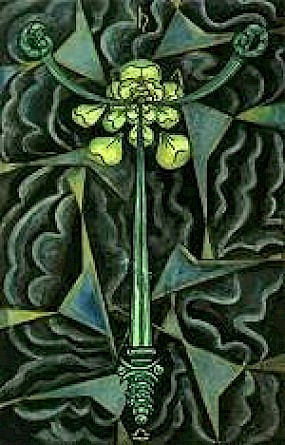
I doubt that anybody feels comfortable when they pull this card in a reading. The Lord of Sorrow almost always indicates some sort of disruption which will cause pain and uncertainty. Such disruption leads to loss of balance and disharmony.
At worst, the Three of Swords will indicate loss or separation. In order to determine how serious this is liable to be, you need to consider the cards surrounding this one. With Death, or the Tower, the loss is liable to be of a serious and deeply distressing nature.
With cards like the Seven of Disks, you’d expect to find unexpected changes in the working situation – redundancy for instance. With Cups, the impact will probably be felt in the emotional area. Wands could indicate loss or damage to your inner nature – a big blow to the self-esteem, as one example.
However, sometimes, particularly when the Lord of Sorrow is not badly aspected by the cards around it, there’s another more complex reason for its appearance. This card will always come up during a period of unhappiness, confusion or disturbance. There will be doubt (especially of the self), inability to make decisions, sometimes ill-health which wears you down and makes you feel that you cannot cope.
And often during times like this, there are choices and decisions to be made, which you feel too uncertain to tackle. Yet the fact that you are unable to make your decisions perhaps prolongs a difficult or unsatisfactory situation, adding to your anxiety and worry.
To identify this as a meaning for the card, look for cards indicating weariness and apathy – Seven of Swords,Five of Disks,the Moon etc – and the absence of other ‘bad’ cards. If you feel that the Three of Swords is indicating that you are too untrusting and insecure to make important decisions, first and foremost, agree to give yourself a break!
Let things develop on their own for a while. Rest and allow yourself time to build up your energies. Then you will stop feeling quite so inadequate, and will be able to make the choices which will shape the next phase of your life.
And if the Lord of Sorrow brings grief and sadness into your life, try hard to look forward in the reading to the start of the recovery period, in order to give yourself something positive to hold onto. Sometimes this card will appear to mark a shocking unexpected event which, whilst painful, is not as awful as it might first appear. It helps a little to know when the tide is going to begin to turn in your favour.
(via angelpaths.com and Alan Blackman)
Consciousness, spirituality, biography, sexuality, androgyny, futurism, space, the arts, science, astrology, democracy, humor, books, movies and more