(Courtesy of Commune at hello@onecommune.com)

This is the Lord of Waves and Water, often defined as the fiery aspect of water. As such, in many ways this card represents a contradiction. Most often when it appears, it will indicate an actual person who has influence. However sometimes it can also indicate a moodshift or a change of mode.
Since the Suit of Cups is all about love and loving relationships, it’s easy to see how the Knight can be regarded as the lover of the cards. When representing a moodshift, the card can indicate the period where a man falls in love.
When it represents a person he will be a complex and highly emotional being – creative and visionary, sensitive (and sometimes over-sensitive), romantic and intense. He will give the impression of being open and caring, though this is often misleading; the Knight of Cups is often subject to intense insecurity, needing constant re-assurance and attention.
He is attracted and attractive to women, and enjoys basking in their company. He will often be very charming, with a silver tongue and a powerful personal agenda. He will rarely manage practical matters well, tending to place rather more importance on buying two dozen red roses, than paying the bills. At his worst, he can be inconstant, unfaithful and selfish.
At his best, he is loving, generous with his emotions, supportive and tender. He can be capable of high levels of spiritual development, strong in intuition and warmly responsive. When he’s on form he is terrific company, having a good sense of humour and a keen interest in other people. He’s often an exciting and stimulating life partner and lover – but only at his best!
You see – I said he was contradictory!

(via angelpaths.com and Alan Blackman)
From Wikipedia, the free encyclopedia
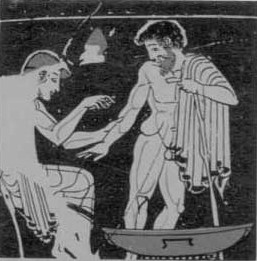
Ancient Greek painting in a vase, showing a physician (iatros) bleeding a patient
Iatrogenesis is the causation of a disease, a harmful complication, or other ill effect by any medical activity, including diagnosis, intervention, error, or negligence.[1][2][3] First used in this sense in 1924,[1] the term was introduced to sociology in 1976 by Ivan Illich, alleging that industrialized societies impair quality of life by overmedicalizing life.[4] Iatrogenesis may thus include mental suffering via medical beliefs or a practitioner’s statements.[4][5][6] Some iatrogenic events are obvious, like amputation of the wrong limb, whereas others, like drug interactions, can evade recognition. In a 2013 estimate, about 20 million negative effects from treatment had occurred globally.[7] In 2013, an estimated 142,000 persons died from adverse effects of medical treatment, up from an estimated 94,000 in 1990.[8]

We feel our way through life, then rationalize our actions, as if emotion were a shameful scar on the countenance of reason. And yet the more we learn about how the mind constructs the world, the more we see that our experience of reality is a function of our emotionally directed attention and “has something of the structure of love.” Philosopher Martha Nussbaum recognized this in her superb inquiry into the intelligence of emotion, observing that “emotions are not just the fuel that powers the psychological mechanism of a reasoning creature, they are parts, highly complex and messy parts, of this creature’s reasoning itself.”
A century before Nussbaum, the far-seeing Scottish philosopher John Macmurray (February 16, 1891–June 21, 1976) took up these questions in a series of BBC broadcasts and other lectures, gathered in his 1935 collection Reason and Emotion (public library).
John Macmurray by Howard Coster, 1933. (National Portrait Gallery, London.)
Macmurray writes:
We ourselves are events in history. Things do not merely happen to us, they happen through us.
They happen primarily through our emotional lives — the root of our motives beneath the topsoil of reason and rationalization. We suffer primarily because we are so insentient to our own emotions, so illiterate in reading ourselves.
Three decades before James Baldwin marveled at how “you think your pain and your heartbreak are unprecedented in the history of the world, but then you read,” Macmurray considers the universal resonance of our emotional confusion, which binds us to each other and makes our responsibility for our own lives a responsibility to our collective flourishing:

Art by the 16th-century Portuguese artist Francisco de Holanda. (Available as a print and as stationery cards.)
At the heart of this recognition, this reorientation to our own inner lives, lies what Macmurray calls “emotional reason” — a capacity through which we “develop an emotional life that is reasonable in itself, so that it moves us to forms of behaviour which are appropriate to reality.” The absence of this capacity contributes both to our alienation from life and to our susceptibility to dangerous delusion. Its development requires both a willingness to feel life deeply and what Bertrand Russell called “the will to doubt.” Macmurray writes:
In consonance with Romanian philosopher Emil Cioran’s insightful insistence on the courage to disillusion yourself, Macmurray adds:
And yet reason, Macmurray argues, is “primarily an affair of emotion” — a paradoxical notion he unpacks with exquisite logical elegance:
[…]
It is extremely difficult to become aware of this great hinterland of our minds, and to bring our emotional life, and with it the motives which govern our behaviour, fully into consciousness.
This difficulty is precisely what makes us so maddeningly opaque to ourselves, and what makes emotional reason so urgent a necessity in understanding ourselves — something only possible, in a further paradox, when we step outside ourselves:

Art by Jean-Pierre Weill from The Well of Being
In a sentiment evocative of E.E. Cummings’s wonderful meditation on the courage to feel for yourself, Macmurray adds:
An epoch before neuroscience uncovered how the life of the body gives rise to emotion and consciousness, Macmurray echoes Willa Cather’s insistence on the life of the senses as the key to creativity and vitality, and writes:
[…]
Living through the senses is living in love. When you love anything, you want to fill your consciousness with it. You want to affirm its existence. You feel that it is good and that it should be in the world and be what it is. You want other people to look at it and enjoy it too. You want to look at it again and again. You want to know it, to know it better and better, and you want other people to do the same. In fact, you are appreciating and enjoying it for itself, and that is all that you want. This kind of knowledge is primarily of the senses. It is not of the intellect. You don’t want merely to know about the object; often you don’t want to know about it at all. What you do want is to know it. Intellectual knowledge tells us about the world. it gives us knowledge about things, not knowledge of them. It does not reveal the world as it is. Only emotional knowledge can do that.
Emotional reason thus becomes the pathway to wholeness, to integration of the total personality — a radical achievement in a culture that continually fragments and fractures us:

One of English artist Margaret C. Cook’s illustrations for a stunning 1913 edition of Walt Whitman’s Leaves of Grass. (Available as a print.)
A generation after William James made the then-radical assertion that “a purely disembodied human emotion is a nonentity,” and an epoch before science began illuminating how our bodies and our minds conspire in emotional experience, Macmurray considers what the achievement of emotional reason requires:
This wakefulness to the sensorium of life, he argues, is not only the root of emotional reason but the root of creativity:
And yet we can’t be selectively receptive to beauty and wonder — those rudiments of inspiration — without being receptive to the full spectrum of reality, with all its terrors and tribulations. Our existential predicament is that, governed by the reflex to spare ourselves pain, we blunt our sensitivity to life, thus impoverishing our creative vitality and our store of aliveness. Macmurray writes:

Art by Olivier Tallec from Big Wolf & Little Wolf
The development of emotional reason, Macmurray argues, is the development of our highest human nature and requires “keeping as fully alive to things as they are, whether they are pleasant or unpleasant, as we possibly can.” It requires, above all, being unafraid to feel, for that is the fundament of aliveness. He writes:
[…]
The education of the intellect to the exclusion of the education of the emotional life… will inevitably create an instrumental conception of life, in which all human activity will be valued as a means to an end, never for itself. When it is the persistent and universal tendency in any society to concentrate upon the intellect and its training, the result will be a society which amasses power, and with power the means to the good life, but which has no correspondingly developed capacity for living the good life for which it has amassed the means… We have immense power, and immense resources; we worship efficiency and success; and we do not know how to live finely. I should trace the condition of affairs almost wholly to our failure to educate our emotional life.
In the remainder of the thoroughly revelatory Reason and Emotion, Macmurray goes on to explore the role of art and religion in human life as “the expressions of reason working in the emotional life in search of reality,” the benedictions of friendship, and the fundaments of an emotional education that allows us to discover the true values in life for ourselves. Complement it with Dostoyevsky on the heart, the mind, and how we come to know truth and Bruce Lee’s unpublished writings on reason and emotion, then revisit Anaïs Nin on why emotional excess is essential for creativity.
American Exp Premiered Jun 27, 2023 Official site: https://www.pbs.org/wgbh/americanexpe… In the 1950s and ’60s, an underground network of transgender women and cross-dressing men found refuge at a modest house in the Catskills region of New York. Known as Casa Susanna, the house provided a safe place to express their true selves and live for a few days as they had always dreamed—dressed as and living as women without fear of being incarcerated or institutionalized for their self-expression. Told through the memories of those who visited the house, the film provides a moving look back at a secret world where the persecuted and frightened found freedom, acceptance and, often, the courage to live out of the shadows. — This program is made possible by viewers like you. Support your local PBS station: https://www.pbs.org/donate
(Contributed by Michael Kelly, H.W.)
The Majority Report w/ Sam Seder Streamed live 10 hours ago MR Live Podcast Episodes The MR Crew are off today so we’re coming to you with a special mid-year best of! In an episode from February 2018, Sam spoke with the late, great Daniel Ellsberg about his book The Doomsday Machine: Confessions of a Nuclear War Planner. 7/3/23 Check out Daniel’s book here: https://www.bloomsbury.com/us/doomsda…
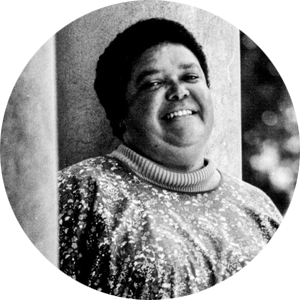
“I am building a stairway to the stars. I have the authority to take the whole of mankind up there with me. That is why I write.”
–BESSIE HEAD
Bessie Amelia Emery Head (July 6, 1937 – April 17, 1986) was a South African writer who, though born in South Africa, is usually considered Botswana’s most influential writer. She wrote novels, short fiction and autobiographical works that are infused with spiritual questioning and reflection. Wikipedia

CREDIT: THE JON B. LOVELACE COLLECTION OF CALIFORNIA PHOTOGRAPHS IN CAROL M. HIGHSMITH’S AMERICA PROJECT, LIBRARY OF CONGRESS, PRINTS AND PHOTOGRAPHS DIVISION
Our national and social identity is deeply rooted in values like freedom, equality and order. A political scientist explores how these ideas affected the US response to the pandemic.
By Anil Ananthaswamy 12.01.2020 (KnowableMagazine.org)
The spread of the coronavirus in the US is out of control: As of December 1, more than 13.5 million people have been infected nationwide and some 269,000 people have died. Yet many in the US still resist wearing masks in public and even deem mask orders and social distancing guidelines as affronts to their personal freedoms.
For political scientists like Deborah Schildkraut of Tufts University in Medford, Massachusetts, the US response to the pandemic can be seen through the lens of American identity. For more than two decades, Schildkraut has been studying what it means to be American, a topic she explored in an article in the Annual Review of Political Science. In it, she wrote that scholars increasingly regard American identity as a social identity, “which refers to the part of a person’s sense of self that derives from his or her membership in a particular group and the value or meaning that he or she attaches to such membership.”

CREDIT: JAMES PROVOST (CC BY-ND)
Tufts University
According to Schildkraut, at a minimum American identity consists of two sets of norms. One involves an evolving set of beliefs that anyone can follow. These beliefs harken back to Thomas Jefferson and the ideals set forth in the Declaration of Independence (“We hold these truths to be self-evident, that all men are created equal, that they are endowed by their Creator with certain unalienable rights, that among these are Life, Liberty and the pursuit of Happiness.”) The other set of norms depends on attributes such as one’s race and religion.
Knowable Magazine spoke with Schildkraut about the sometimes contradictory attributes Americans consider to be at the core of their national identity, the evolution of these ideas and the impact they have on the country’s ability to confront the pandemic. This conversation has been edited for length and clarity.
Why is one’s identity so important?
Social psychologists have written about the need to have positive distinctiveness. We like to feel good about the things that we think are unique about us. That drives a lot of in-group and out-group thinking. We like to think good things about the groups that we belong to. It doesn’t always lead to thinking bad things about the groups that we don’t belong to, but it easily can.
What’s an American identity, and has it evolved over time?
Some parts of it haven’t evolved all that much. A lot of the things people think of as being uniquely American are appropriately called aspirational: the idea of individualism, equality of opportunity, self-governance and engaged citizenship. For as long as we’ve been asking people how important certain things are in being American, there’s not been much variation over time in those kinds of things.
You see more change over time on issues that are more explicitly about race and ethnicity. There’s this idea of being a nation of immigrants. It’s the American creed: the idea that anybody can become American if they do and believe certain things, and that your country of origin, the language you speak, your religion, all of that is separate from becoming American. It’s crucially tied to the notion of the work ethic and that the opportunities are here for the taking. Of course, we know in practice that hasn’t been true.
The aspiration is that race and religion don’t matter. And that anybody can be a true American. We know that in reality, certainly at an unstated level, when people think of what an American is many have an ideal in mind: It’s white, Christian and, honestly, male.
The US is an extremely diverse country. How do different groups of people react to these aspirational ideals of individualism, equality of opportunity, self-governance and engaged citizenship?
We have done surveys in which we ask people what they think are the important things in making someone a true American. One of the big stories across all the years that we’ve been asking this is that a lot of the variation we see comes down more to party and ideology than it does really to race. There’s actually a lot of agreement on the things that are considered to be most essential such as respecting America’s political institutions and laws and believing in individualism. There’s also considerable agreement on things that are considered less essential, such as the language one speaks, or whether someone was born in the US or has European ancestry.
What does individualism mean in this context?
Individualism is tied to the notion of minimal government intervention. So that people are free to pursue what they want, with rare exceptions where it may be necessary for the government to intervene so that they don’t inflict harm on others.
Does American individualism conflict with other values?
Most Americans believe in and want certain values to be prevalent in their lives and they want the government to support them. Some of these key values are freedom, equality and order. Those don’t always go together. And when they conflict — and politics can be thought of as a conflict between these values — the government has to pick one.
What’s the effect of these conflicts on the US response to the pandemic?
You see the conflicts between freedom and order and freedom and equality playing out now, in how we’re responding to the coronavirus pandemic. People want freedom to be able to go where they want, to not wear a mask if they don’t want to, and that conflicts with the government imposing some kind of order to address the pandemic. We also know that this pandemic has exposed great inequalities and that in places where they are choosing freedom they are not addressing those inequalities, and maybe making them even worse. Other democracies might be more likely to pick equality over freedom when those two conflict; in the US, we tend to pick freedom, although there are certainly exceptions.
In any society, there’s always going to be some degree of autonomy that people have to give up in order for society to function, for us to live as a collective. What type of autonomy are you willing to give up? When are you willing to give it up? In the US, nobody bats an eye at the idea that we all have to stop at red lights on the road, even though that’s an infringement on our freedoms. But any time it’s something new that we’re not already used to, there will be resistance to it.
There’s also a deep distrust among Americans towards government, and they often do not believe that government will execute programs efficiently or use its resources responsibly. Compared with other countries, we also have the complexity of federalism where we value devolving power to the states in some areas, but not others. And people like to celebrate their state identities. Part of our national character is the immense variation across the states, and all that feeds into our response to the pandemic.
Have other countries demonstrated a tendency to put equality before freedom and does that influence the policies they pursue?
Countries that have multiparty systems, where there might be a stronger Labor Party, or a Democratic Socialist Party, where you have a stronger history of a welfare state, places that have national health care systems, for example — those are all evidences of greater government intervention and less reliance on people going it alone and figuring it out for themselves. In those countries, there’s an acceptance that government intervention is something of value so that there’s some equity and equality, and that the government is going to play a bigger role to ensure some minimum quality of life.
How else can one understand the US response to the pandemic, seen from the perspective of American identity?
I don’t pretend to have the answers. There’s one thing that has long been puzzling to me: President Trump’s insistence that this is not a big deal. At least initially, where there were lockdowns, there was this real sense of national purpose and community. People were applauding health care workers in the streets and putting up teddy bears in their windows for kids to go on scavenger hunts in their neighborhoods. There was this sense of solidarity that didn’t really last very long.
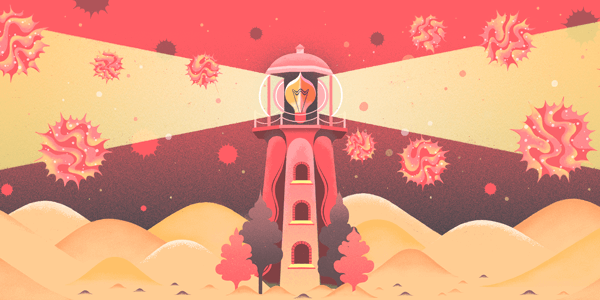
More from Reset — An ongoing series exploring how the world is navigating the coronavirus pandemic, its consequences and the way forward.
We know from a lot of political science research that elite rhetoric (meaning messages coming from prominent elected officials) can be really powerful. Once a politician decides to take a certain line — that this is not a big deal, places should be able to do what they want, we should prioritize freedom and so on — it’s not that surprising that many Americans would follow suit and prioritize that interpretation of American identity as well.
Can that messaging be changed?
There’s a lot of potential for leadership here to frame this in terms of national sacrifice: that this is who we are as Americans and we can find ways to come together to solve this.
Joe Biden is now President-elect. Do you foresee a sea change in how the US will respond to this pandemic, because of the messaging that might come from his administration?
I would hope so. But I’m not particularly optimistic, because while Trump has clearly been the leader of his party and the leader of the country during this time, he could really only have been successful with the support of the Republican Party. And all of those other politicians who either repeated what he said or didn’t contradict it are still going to be there.
One thing Trump certainly demonstrated is that you can do a lot with the executive powers of the presidency. And so even if Biden doesn’t get a lot of cooperation from Congress, there are lots of things he can do on his own with the executive branch. In terms of this idea that we are facing this national crisis, wouldn’t it be great if there was a sense of common purpose and common identity? We know that elite messaging can matter. And hopefully, there are enough people who are either already predisposed to support Biden’s messaging or just fed up with politics and conflict, that it would make them receptive to that kind of messaging.
A cynic would say that politicians are manufacturing identities and then manipulating them. Is that possible?
Oh, it’s definitely possible. It may be a strategy that’s helpful for winning in the short term, but isn’t necessarily in a political party’s long-term interest. We think of this a lot with the contemporary Republican Party. They may be trying to increase the salience of a white identity, for example. In the short term, this may be a winning strategy in enough places for the Republican Party, but it’s not going to be a long-term strategy as the population continues to change.
Is that because the notion of what it means to be American is somehow changing because of increasing diversity and immigration?
That’s right. The younger generation today, which will be the dominant makeup of voters in the not too distant future, is much more diverse. Whether they are going to find a campaign that capitalizes on white racial anxiety attractive or not remains to be seen, but it’s going to be harder than it is now.
What have the last nine months been like for you, personally and professionally?
A group of us political scientists joke — a kind of gallows humor — that some of these really bad things that are happening are great for political science. People who study anxiety and people who study anger and its political effects are getting great data. The problem is, none of us have time to actually do the research, because we’re all home with our kids. And that’s a concern, because political scientists can contribute to our understanding of a lot of big problems.
This article is part of Reset: The Science of Crisis & Recovery, an ongoing series exploring how the world is navigating the coronavirus pandemic, its consequences and the way forward. Reset is supported by a grant from the Alfred P. Sloan Foundation.
10.1146/knowable-120120-2
Anil Ananthaswamy is a science journalist who enjoys writing about cosmology, consciousness and climate change. He’s a 2019-20 MIT Knight Science Journalism fellow. His latest book is Through Two Doors at Once. www.anilananthaswamy.com