All posts by Mike Zonta

How the Bicycle Was Born: Mount Tambora, the Year Without a Summer, and the Stubborn Courage to Reimagine the Possible

By Maria Popova (themarginalian.org)

This essay is adapted from Traversal.

On April 5, 1815, as Napoleon is assembling his troops for the Battle of Waterloo, where he would meet his final defeat, the lieutenant-governor of Java leaps to his feet upon hearing the unmistakable roar of cannons in the distance while the setting sun is honeying the marble of his colonial mansion. Having taken advantage of the Napoleonic Wars to claim the island for the British crown from the Dutch and the French, he is all too aware that enemies might return for what we now call Indonesia — Earth’s largest archipelago, a geological treasure lush with ecosystems and betempled with human reverence, turned into a political trophy.

On Sumatra, chieftains hear the explosions and attribute them to a combat between spirits — the local version of the Devil endeavoring to keep their dead ancestors from reaching the local version of Paradise.

A thousand miles away, off the coast of another Indonesian island, a cruiser belonging to the British East India Company — the mercantile mutation of colonialism that metastasized into capitalism — hears the cannons from the south and assumes pirates are after its wares. For days, the ship patrols the horizon and neighboring islands. The sailors keep hearing the cannons, which seem to be drawing nearer and firing in quicker succession, but they find no enemies. Instead, they are plunged deeper and deeper into a sensescape that grows more and more surreal.

Morning comes, bringing not daybreak but nightfall. At eight o’clock, the ship’s captain anxiously observes that “some extraordinary occurrence” is clearly taking place.

The face of the heavens to the southward and westward had assumed the most dismal and lowering aspect, and it was much darker than when the sun rose.

What has at first appeared as a curtain of thunderclouds hanging low and heavy over the horizon now begins radiating an eerie dark-crimson glow, slowly charring the whole sky. By ten, the ship is hardly visible across the mere mile from the shore; by noon, the dark hemorrhage has spilled across the entire firmament. “I never saw any thing equal to it in the darkest night,” the captain recounted; “it was impossible to see your hand when held up close to the eye.” Being sufficiently versed in astronomy, as all ship commanders had to be, and in possession of reliable lunar tables, he knows that the next predicted solar eclipse is months and hemispheres away. No — this is something entirely unpredicted and entirely strange, constricting comprehension in the narrow neck of an hourglass of unreality, suddenly inverted to make every known and trusted thing — time, space, light, color — drip into its opposite.

And then, black rain begins showering the deck. Dry rain. The sailors, awestruck, dip their fingers into the strange substance and lick. (We are always children in the most cataclysmic moments.) It has no taste at all, only a faint burnt odor. It comes down so fast, and in such vast quantities, that within hours it has piled a foot in many places; the crew set about tossing it overboard with buckets — several tons, in one officer’s estimate, by the time the first sunbeams finally puncture the blackness a week later, revealing the colossal floating pumice stone that was once a ship.

An Erupting Volcano by Night by David Humbert de Superville. (Available as a print, a blanket, and more.)

Eons before humans began slicing Earth’s surface along artificial lines, trading and translating across them, warring over their subtlest curve, staking personal identities and nationalist ideologies relative to them, Earth itself divided the lithosphere below into enormous, drifting jigsaw pieces — the product of processes that began in the planet’s adolescence, long before we descended from the trees to invent the consensual reality of countries and currency and the writing systems in which to encode those ever-contested consensuses. Friction along the boundaries of these restless plates would cause the roiling open mouth of an Indonesian mountain to exhale one million tons of ash eighteen miles skyward in an era when the geological reality of tectonic plates was less real to the human imagination than the religious mythology of a punitive underworld for imperfect souls.

Climaxing on April 10, 1815, the eruption of Mount Tambora was the deadliest in recorded history, a hundred times more violent than the eruption of Mount St. Helens in 1980. Two billion years after colossal volcanic eruptions melted Earth’s ice-entombed earliest life-forms from out of the planet’s first global winter, nine thousand years after a cave artist drew the first surviving map of spatial relations to depict her location relative to a nearby volcano, the people who had built their lives and mapped their loves at Tambora’s foot had no chance to escape. An artillery of magma fired in every direction as the volcano heated the air above to thousands of degrees and filled the sky with twice as much pumice and ash as there is water in Lake Geneva — enough to bury all of Great Britain to the knee. Lava poured from the lip of the mountain toward the sea, leveling every mortared illusion of security, every spell cast against uncertainty in stone and wood, until no houses were left. It decimated every tree, flower, and animal on all sides of the peninsula, scorching the ocean itself as the rivers of molten rock vanquished all marine life in their path. The ocean lashed back fifteen-foot tsunamis loaded with the trunks of trees, destroying everything that had escaped the lava’s path ashore. The explosive collision of hot lava and cool salt water blasted even more ash into the air and blackened the white sand beaches with endless fields of pumice stones, fields soon drawn adrift onto the ocean to remain there as surreal antimatter icebergs, menacing ships for years to come.

Two centuries after Johannes Kepler was ridiculed for conceiving of Earth as a living organism with a circulation, a metabolism, and a breath, Tambora exhaled so forcefully that its 55 million tons of sulfur dioxide shot up twenty miles, filling the troposphere — the moist lowest layer of the atmosphere, curled with clouds. It then punctured the dry, stable stratosphere — a region of the sky that would be discovered some seventy years later, nesting the planet’s natural thermostat: the ozone layer, its discovery a century away from Tambora, fundamental to the understanding of what makes our planet a habitable world.

The sulfur dioxide clung immediately to the hydrogen gas permeating the stratosphere, bonding into more than 100 million tons of sulfuric acid — a herd of 25 million deadly elephants suspended in the sky, made of droplets each a fraction of a flea in size, turning Earth into a temporary Venus, whose thick cloudscape is composed primarily of sulfuric acid droplets. Powerful jet streams accelerated this aerosol cloud to sixty miles per hour and hurled it toward the other side of the globe. Injected into the bloodstream of the stratosphere, Tambora’s aerosol cloud circumnavigated the globe eighty times faster than Captain Cook, shape-shifting as it traversed the skies, pulled apart by varying wind speeds and gravity acting on differently sized particles.

By the time winter came, a thin film of ash had enveloped the entire planet, returning sunlight to its sender. Temperatures began dropping, weather patterns grew wild, and the seasons — those handrails of stability in a war-torn and uncertain world — came unbolted.’

Painting by 19th-century Norwegian artist Knud Baade. (Available as a print and as stationery cards.)

By the spring of 1816, entire chunks of landmass seemed to have been torn off from their time and place and hurled back into some otherworldly winter by a strange seasonal time machine. Across Europe and America, across farmsteads and newspaper pages, people inveighed disbelievingly against the “backward” season that rendered the young Mary Shelley so bored in her indoor captivity amid the downpours that she wrote Frankenstein. Summer sleet came down on English towns. Hail pummeled Scotland. Snow blanketed Pennsylvania and New York in the last week of June. An inch of ice crusted ponds and rivulets from Ithaca to Maine, blocks of it drifting down the St. Lawrence River. Heavy black frost sank its teeth half an inch into the Trenton soil. Enormous snowflakes covered the ground in Bangor. The hopeful embryonic life budding on New England branches was frozen dead, leaving entire hillsides of trees looking scorched. June blanketed Boston in snow, never recorded before or since, and covered the hills that Emily Dickinson’s father was then wandering as an adolescent. The icy apocalypse drove flocks of wild birds out of the forest and into barns and cities, seeking warmth. Many froze, their small lifeless bodies dropping from the sky onto the streets. Farmers picked up handfuls of dead hummingbirds from their fields. Unsweatered for human backs, shorn sheep perished. In town after town, elders could remember nothing like this.

No one connected this uncanny weather to the Tambora eruption. News of it didn’t even reach Europe and America for months. In Ireland, the first mention of Tambora appeared nine months after the eruption, which had savaged the island’s harvest and unleashed a famine-fomented typhoid epidemic that killed sixty thousand people. Meteorology was an unborn science. These were calamities without causal link. An enormous hand seemed to have shaken the snow globe of spacetime until the parts came loose and fell in all the wrong places across the miniature of life.

Pattern-seeking animals that we are, often blind to causality, often seduced by correlation, the surreal weather following Tambora’s draconic exhale was blamed on everything from the devil that always hovered on the shoulders of the pious to the sudden appearance of sunspots that so transfixed the era’s astronomers before it was understood that these temporary flecks of darkness are a function of our star’s magnetic field. No event in recorded history, save perhaps a total solar eclipse, would stir superstition and science with equal vigor. As the Seine rose to alarming heights, Parisian priests instructed parishioners to pray for better weather, and a candlelit procession of young women unspooled onto the streets, praying to the city’s patron saint for clear skies. In England, churches began offering public prayers for sunshine. In France, a physician claimed to have diagnosed the Sun as diseased and the Moon as terminally ill. Throughout the continent, cathedrals began filling with the terrified. From the elevated lookout of his scientific orientation and his opium delirium, Coleridge smirked that his chief complaint about the apocalyptic weather was that it kept him from exercise.

Art by Ryōji Arai from Every Color of Light by Hiroshi Osada

As the downpours continued in Europe through what would have been summer — 1816 would come to be known as the Year Without a Summer — the shoreside vineyards from which harvest songs had risen the previous summer were now swallowed by the river, silent under the leaden skies, the flooded fields afloat with the fetuses of grapes that had failed to ripen. Entire villages were submerged, entire crops devastated. Eight continuous weeks of rain. Storms, hail, and torrential downpours never before seen in the land. Threefold the seasonal rainfall in many regions of England, Ireland, France, Belgium, Holland, and Germany. Ice stilling the Thames in September — an anomaly never recorded before or since.

Famine was rising over this uncanny horizon stretching between continents and warring nations. The price of hay doubled. The invisible hand of exploitation began wringing the wrist of need as merchants started buying up all the high-quality grain they could get their hands on in anticipation of the poor harvest, then bidding up the price. Crops in the rice-growing region of China were devastated, sweeping mass deaths across the land as the Chinese Empire bent under its own scale in the face of towering subsistence needs; when the weather finally improved, the surviving peasants replanted the rice fields not with rice but with a far more valuable cash crop, one with a growing global market in an increasingly ailing, increasingly interconnected world: opium. Southwestern China thus became the dominant opium-growing region of the nineteenth century, fueling the visions of the Romantics and the living nightmare of the opioid crisis that would savage the world two hundred years later.

While Great Britain, with its developed maritime trade and ample ports, was less impacted by the famine, landlocked central European countries struggled for survival. In the frozen ground of central Italy, farmers had been unable to sow their wheat at all. Governments began bribing key geopolitical fulcrums with food — the city of Mainz, on the banks of the Rhine, a vital defense point against French invasion, received 300,000 pounds of flour from Austria; Prussia promised the same weight of wheat come harvest time.

Storm Cloud by Georgia O’Keeffe. (Available as a print, benefitting The Nature Conservancy.)

Karl von Drais watched menacing clouds steel the sky on his thirty-first birthday in Germany; he watched the specter of famine rise over his homeland as spring refused to bloom into summer, withering into winter instead. The young man — a radical nobleman and forester who would later recant his inherited title of Baron and drop the von from his name in solidarity with the revolutions that swept Europe in the middle of the century in defense of liberal principles and working-class rights — was moved to allay the suffering in some way. Observing the vicious cycle — failing crops causing shortages of fodder causing horses to die of starvation causing humans to starve, unable to travel in search of food and carry their paltry provisions back home — he set about devising a mechanical substitute for the horse, one that would require no feed or fuel, only human will and light exertion. Having lived through the French Revolution, he understood how widespread famine on the heels of a bitterly cold winter could rouse people to bloodshed.

By his thirty-second birthday, Karl had perfected his Laufmaschine — the “running machine,” first progenitor of the modern bicycle, christened vélocipède in France and derided as “dandy horse” in England. No gears, no chain, no tires or pedals even — just a seat atop two in-line metal wheels, to be straddled and propelled with strides pushing off the ground — a precarious high-speed waltz between footfall and wheelroll.

Karl Drais with his vélocipède

On June 12, 1817, Karl tested his creation up and down Baden’s best road, traversing the round trip of seven miles in a little more than an hour.

His proto-bicycle was soon banned in Germany, England, and America as a public hazard when riders struggling to balance the contraption migrated from the carriage-rutted streets to the smoother sidewalks, bolting past startled pedestrians. But once a culture developed around the novelty, once reason and regulation enveloped that culture, the bicycle did for the human foot what the telescope had done for the eye. A new era of traversal began. More than five thousand years after a forgotten sapiens invented the wheel, another ignited the Promethean fire of mechanized personal transport by inventing self-propulsion on two wheels. For the first time in the history of our species, human beings could traverse land faster than on foot, beholden to no other creature and relying only on the internal combustion of their own metabolism, propelled only by where they wanted to go and how hard they were willing to push to get there — in this glorious prosthetic stride, an allegory for life itself.

Art from Bicycling for Ladies, 1896. (Available as a print and as stationery cards.)

Had Tambora erupted in a world less vulnerable, less riven by conflict and less razed of resilience by the Napoleonic Wars, the global impact might have been different; the biological, ecological, social, and cultural costs — as well as the gains — might have been different; so many lives, millions, might have been spared; among them might have been another Mary Shelley, another Albert Einstein; the bicycle might not exist, Frankenstein might not exist, the opioid crisis might not exist. Over and over chance reaches into the loom of the possible to unspool the events of our lives, lives livable only if we never think about how unrecognizable the tapestry would be had any one thread been different. To be a thinking creature is to slip the tendrils of thought into every if that fissures the monolith of is; to be a feeling creature is to pulsate with the thrill and terror of every might bridging the two.

Conversion therapy since 1886: A dark history of the discredited practice

Even though conversion therapy is psychologically damaging, the Supreme Court appears poised to overturn Colorado’s ban on the practice.

Rebecca, Uncloseted Media March 9, 2026 (lgbtqnation.com)


Richard v. Krafft-EbingRichard v. Krafft-Ebing | via Wikipedia

This story was originally published in Uncloseted Media, an LGBTQ focused investigative news outlet.

This story was produced in partnership with @hankycodemagazine, an LGBTQ+ history publication.

Throughout history, the belief that homosexuality is a disease that needs treatment has been pervasive. During the Cold War, the moral panic from the “lavender scare” caused many folks to view homosexuals as national security risks. And many still believe that homosexuality is a threat to the nuclear family.

Since at least the 1800s, doctors and religious organizations have created various types of conversion therapy in an effort to cure LGBTQ people. But over time, the practice has become widely condemned by major medical organizations, 24 states have banned it for minors, and a United Nations expert has said it “may amount to torture.”

Despite this, the Supreme Court appears set to overturn Colorado’s ban on conversion therapy in a case that was brought forth by Southern Poverty Law Center-designated anti-LGBTQ hate group Alliance Defending Freedom (ADF).

The history and development of conversion therapy is long and complex. To make sense of it, here’s a timeline of key events over the last 140 years.


Related

“An absolute travesty”: GOP bill seeks to legalize so-called conversion therapy for trans minors


1886

German psychiatrist Richard von Krafft-Ebing publishes “Psychopathia Sexualis,” a foundational sexology text that describes homosexuality as a psycho-neuropathic degenerative illness. Krafft-Ebing attempts to convert patients to heterosexuality through hypnosis. The practice marks an early foundation of what later becomes known as conversion therapy and reflects the medical community’s early efforts to find a cure for homosexuality.

According to the “Encyclopedia of Gender and Society,” Krafft-Ebing’s stance drastically changed by the end of his life:

“The experience of getting to personally know and work with such a great number of homosexual individuals made him change his initial views that same-sex desire was caused by hereditary degeneracy and accompanied by mental affliction and moral corruption. He came to the conclusion that most of his subjects were physically, mentally, and morally healthy, and that homosexuality was not the result of mental illness.”

1897

Magnus Hirschfeld, who was dubbed the “Einstein of Sex,” was unique in an era when people tried to cure LGBTQ people because he used science to argue against homophobia. In his 1902 “psychobiological questionnaire,” for example, he sought to provide data to show that homosexuals weren’t mentally ill.

In 1897, he founded the Scientific Humanitarian Committee, the first LGBTQ rights organization, which had the motto: “Through science to justice.”

Rather than trying to cure a patient’s homosexuality, he provided consultations to patients, often free of charge. Notably, Hirschfeld—who founded the Institute for Sexual Research in 1919—was the first documented physician in the world to provide hormone treatments and modern gender-affirming surgery to transgender folks.

His work, however, would be tragically short lived when the Nazi’s destroyed the institute in 1933.

1899

German psychiatrist, physician, and paranormal researcher Albert von Schrenck-Notzing claims he turned gay men straight through 45 sessions of hypnosis and trips to the brothel. Schrenck-Notzing’s theory stems from the now debunked idea that behavioral modification—such as forcing patients to engage in heterosexual activity with sex workers—could cure homosexuality.

1913

American psychiatrist Abraham Brill publishes “The Conception of Homosexuality” in the Journal of the American Medical Association. He writes:

“Of the abnormal sexual manifestations that one encounters none, perhaps, is so enigmatical and … so abhorrent as homosexuality. … I can well recall my first scientific encounter with the problem, ten years ago, when I met a homosexual who was a patient in the Central Islip State Hospital. Since then I have devoted a great deal of time to the study of this complicated phenomenon.”

Brill claims that “curing” homosexuality is possible, worth pursuing and that he’s achieved it multiple times. He distinguishes himself by practicing psychoanalysis and by criticizing physical “treatments” his peers experiment with, such as bladder washing, rectal massage and castration.

1918

Physiologist Eugen Steinach and surgeon Robert Lichtenstern—who both believe that homosexuality is caused by the testicles—begin work on the connections between hormones and homosexuality and publish “Conversion of Homosexuality through Exchange of Puberty Glands.” The article describes an experiment in which Lichtenstern replaces the testes of homosexual men with those of heterosexual men. After the transplant, they study the men’s sexual tendencies and conclude that heterosexual inclinations replace homosexual ones following surgery. However, the surgeon’s varying results lead medical professionals to doubt the validity of their findings.

1920

In “THE PSYCHOGENESIS OF A CASE OF FEMALE HOMOSEXUALITY,” Sigmund Freud, the founder of psychoanalysis, argues that homosexuality develops under specific conditions and describes conversion as unlikely. Unlike many of his predecessors, Freud does not see homosexuality as an illness or neurosis. He writes that “to convert a fully developed homosexual into a heterosexual does not offer much more prospect of success than the reverse.”

1930

Austrian physician and psychologist Wilhelm Stekel views homosexuality as a disease and publishes “Is Homosexuality Curable?” in The Psychoanalytic Review. Like Freud, he focuses on psychoanalysis and says that treatment works best when the patient wants it, writing:

“My experience during the past few years absolutely confirms my belief that homosexuality is a psychic disease and is curable by-psychic treatment. Tersely expressed: This disease in question is not a congenital condition but a psychic state which can be handled by treatment correctly applied.”

1952

The American Psychiatric Association (APA) defines homosexuality as a mental disorder in the first edition of the Diagnostic and Statistical Manual of Mental Disorders (DSM), a book that outlines recognized mental disorders and provides symptoms and evaluation criteria. The DSM classifies it as a “sociopathic personality disturbance.” This fuels a new era of psychiatrists and psychoanalysts who offer theories and cures, including talk therapy; aversion therapy, such as electric shocks or nausea-inducing drugs; hypnosis; and—in some cases—lobotomies.

1956

Psychoanalyst Edmund Bergler claims that if gay people want to change and receive the right therapeutic approach, they can be cured in 90% of cases. He uses confrontational therapy and frames punishment and shame as part of treatment, saying homosexuals suffer from “psychic masochism.” He publishes books with titles such as “Homosexuality: Disease or Way of Life” and “Counterfeit-Sex: Homosexuality, Impotence, Frigidity.”

In a 2025 paper in The Yale Journal of Biology and Medicine, the authors criticize Bergler’s findings, writing that:

“[He] pathologized homosexuality as a psychological illness and a moral failing, reinforcing the stigmatizing narratives about same-sex desire in mid-20th-century psychiatry. By sensationalizing his work through inflammatory language, Bergler positioned himself as a moral crusader, blurring the line between scientific inquiry and ideological condemnation.”

1973

After years of pressure from gay activists, the APA finally removes homosexuality from the DSM. The removal prompts many medical professionals to distance themselves from conversion therapy techniques. However, the DSM still contains “sexual orientation disturbance”—which would later be renamed “ego-dystonic homosexuality”—referencing individuals who are conflicted about their sexuality. For the next 14 years, this would serve as a backdoor to legitimizing conversion therapy as a valid practice.

A so-called “ex-gay” Christian ministry, Love in Action—also known as Restoration Path—is co-founded by Frank Worthen, who describes himself as a former homosexual.

One of their programs, Refuge, was a two-to-six week conversion therapy camp. Participants—mostly teenage boys—would spend their days engaging in acts such as “healing touch,” where the organization’s leaders would cradle and rock the boys in an effort to cure them.

In 2005, 16-year-old Zach Stark, who was a participant, wrote on his MySpace blog: “Even if I do come out straight, I’ll be so mentally unstable and depressed it won’t matter.”

1987

The APA removes “ego-dystonic homosexuality” from the DSM-III-R, with experts arguing:

“If there are no categories of mental disorders for short people who are unhappy with their height, eye color or complexion, then why should there be one for distress related to sexual orientation?”

1991

American clinical psychologist Joseph Nicolosi publishes “Reparative Therapy of Male Homosexuality: A New Clinical Approach.” In the book, Nicolosi advocates for conversion therapy for “non-gay homosexuals,” or people who face conflict due to the societal stigmatization of their sexuality and—as a result—do not want to be gay.

1992

Alongside psychiatrists Charles Socarides and Benjamin Kaufman, Nicolosi launches the National Association for Research & Therapy of Homosexuality. The organization positions itself against mainstream medical views of sexuality and aims to “make effective psychological therapy available to all homosexual men and women who seek change.”

1998

Family Research Council, the American Family Association and 13 other far-right Christian groups spend $600,000 to promote the effectiveness of conversion therapy through full-page newspaper ads, including in The Washington Post and the Los Angeles Times. Family Research Council Director of Cultural Studies Robert Knight describes the ads as the “Normandy landing in the culture war.”

A few months later, the APA releases a position statement formally rebuking any “reparative” or “conversion” therapy designed to change a person’s sexuality. The position states that reparative therapy runs the risk of harming patients by causing depression, anxiety and self-destructive behavior. The APA joins the American Psychological Association, the American Association of Social Workers and the American Academy of Pediatrics in making a policy against reparative therapy.

2001

U.S. Surgeon General David Satcher issues a report stating that “there is no valid scientific evidence that sexual orientation can be changed.” That same year, American psychiatrist Robert Spitzer publishes a study that claims highly motivated homosexual people can become primarily heterosexual with the help of reparative therapy.

2009

The American Psychological Association adopts a resolution stating that patients should not be advised they can change their sexuality and that treatments predicated on homosexuality being an illness promote harm. Judith M. Glassgold, the chair of the task force, says:

“There is insufficient evidence to support the use of psychological interventions to change sexual orientation.”

2012

Exodus International, a major “ex-gay” faith-based ministry network that expanded into hundreds of local ministries since it was founded in 1976, publicly renounces conversion therapy. Their president, Alan Chambers, says, “We do not subscribe to therapies that make changing sexual orientation a main focus or goal.” Shortly after, Chambers would close the organization and apologize to participants for the “hurt” its programs caused.

That same year, Spitzer recants his study: “I owe the gay community an apology for my study making unproven claims of the efficacy of reparative therapy.”

2013

New Jersey becomes the first state to ban conversion therapy for minors by licensed psychologists, with the law receiving no pushback and immediately going into effect. This contrasts with California, which passed a ban in 2012 but received legal pushback and a preliminary injunction that delayed its enactment into law.

2018

Researchers at San Francisco State University find that attempted suicide rates among LGBTQ youth more than double when parents attempt to change their sexual orientation, and those rates increase further when therapists and religious authorities attempt conversion therapy.

2021

ADF, the Christian legal group that helped overturn Roe v. Wadefiles a lawsuit on behalf of Brian Tingley, a licensed marriage and family counselor in Washington State. In the suit, ADF argues that the ban on conversion therapy practices hinders Tingley’s ability to treat patients despite the abundance of evidence showing how harmful said practices are.

The case is dismissed, appealed, dismissed again, denied to be reheard and finally declined to be heard by the Supreme Court in 2023. One judge states that health care providers should not be able to treat gay children by telling them that they are “the abomination [they] had heard about in Sunday school.”

2023

A letter titled “United States Joint Statement Against Conversion Efforts” is signed by 28 medical and psychological associations. It reads: “The purpose of the United States Joint Statement (USJS) is to protect the public by committing to end the practice of so-called conversion therapy in the US, which could have a spillover effect in other countries as well.”

2025

Twenty-seven states, D.C. and Puerto Rico have some form of protection for youth against conversion therapy. However, none of these protections apply to religious leaders.

The Supreme Court hears oral arguments in a case brought forward by Colorado mental health counselor Kaley Chiles, who argues that her state’s conversion therapy ban infringes on her freedom of speech. Chiles is represented by ADF. After hearing oral arguments in October 2025, the Supreme Court appears set to side with Chiles and the Christian legal group.

The court will rule on the case later this year. If they side with ADF, their decision could have implications for other states with conversion therapy bans and undermine care and rights for LGBTQ youth across the country—more than 40% of whom seriously considered suicide in 2023.

Additional reporting by Nico DiAlesandro.

Subscribe to the LGBTQ Nation newsletter and be the first to know about the latest headlines shaping LGBTQ+ communities worldwide.


This story was originally published in Uncloseted Media. For all their LGBTQ-focused journalism, consider becoming a free or paid subscriber at UnclosetedMedia.com.

See more: The Monthly Issue, March 2026: Let us just be – How conversion therapy affects us allLifeFeatureConversion TherapyRichard v. Krafft-EbingUncloseted Media

Tom Lehrer – The Vatican Rag – From Copenhagen in 1967

The Tom Lehrer Wisdom Channel Oct 16, 2012 The recording is from Copenhagen, Denmark, in September 1967. This must be the best version of The Vatican Rag with Lehrer live on film! Good fun to watch him looking at the keyboard more than he usually does. Well, here are some other links: Tom Lehrer on DVD: https://www.amazon.com/Tom-Lehrer-Col… Tom Lehrer on public domain (2020): https://tomlehrersongs.com/

Recording date: September 5th 1967 Location: Falkonercenteret, Copenhagen, Denmark Format: Most probably Ampex Quadruplex PAL 4:3 Status: A rare recording indeed Storage: Most probably Sony Digital Betacam and in a digital format Production and preservation: Danmarks Radio (DR) in Denmark More HERE: http://www.dr.dk/Salg/DRsales/Contact…

Pope Delivers Holy Warning to Trump in Blistering Address

ARE YOU THERE GOD?

The pontiff said that prayers for war will go unanswered.

Daysia Tolentino 

Weekend Reporter

Published Mar. 29 2026 (thedailybeast.com) 

Pope Leo XIV condemned Donald Trump’s military operation in Iran and warned that God does not listen to the prayers of those who wage war.

The Chicago-born pontiff advocated for peace in his Palm Sunday address to worshipers. As Easter approaches, he reminded people that Jesus Christ spurns the prayers of those whose “hands are full of blood,” citing the prophet Isaiah.

Pope Leo leaves after a visit to the parish complex of Sacro Cuore di Gesu in Ponte Mammolo , where he stressed that conflicts cannot be resolved through war and called for continuous dialogue for peace, on the outskirts of Rome, Italy, March 15, 2026 REUTERS/Matteo Minnella
Pope Leo has been outspoken about his opposition to fighting around the globe.Matteo Minnella/REUTERS

“Jesus is the King of Peace, who rejects war, whom no one can use to justify war,” the pope said. “He does not listen to the prayers of those who wage war, but rejects them.”

The pontiff expressed concern for a “crucified humanity,” adding that the church can “hear the painful groans of all those who are oppressed by violence and are victims of war.” He asked warmongers to “have mercy” for the people impacted by the conflict.

“Christ, King of Peace, cries out again from his cross: God is love! Have mercy! Lay down your weapons! Remember that you are brothers and sisters!” he said.

President Donald Trump speaks next to Defense Secretary Pete Hegseth during a cabinet meeting at the White House in Washington, D.C., U.S., March 26, 2026.
President Donald Trump speaks next to Defense Secretary Pete Hegseth during a cabinet meeting at the White House in Washington, D.C., U.S., March 26, 2026.Evelyn Hockstein/REUTERS

This is a pointed homily from Pope Leo, as U.S. officials have weaponized Christianity in order to justify the war in Iran. After the military began its offensive in Iran alongside Israeli forces on Feb. 28, numerous commanders reportedly told troops that the operation was “God’s divine plan.”

The Military Religious Freedom Foundation, which advocates for service members’ constitutional right to religious freedom, claimed to receive over 200 calls from active-duty personnel across 50 military installations in the aftermath of the initial attack. Some of these commanders invoked Armageddon and the return of Jesus Christ to convince service members to fight.

Defense Secretary Pete Hegseth also prayed that the military would use “overwhelming violence” in Iran during his first Pentagon Christian worship service since the war began.

Pope Leo has been a loud critic of the continued attacks, which have since expanded to Lebanon, and has called for a ceasefire in the Middle East. He has also called the war “atrocious” and called on world leaders who start these conflicts to examine their conscience.

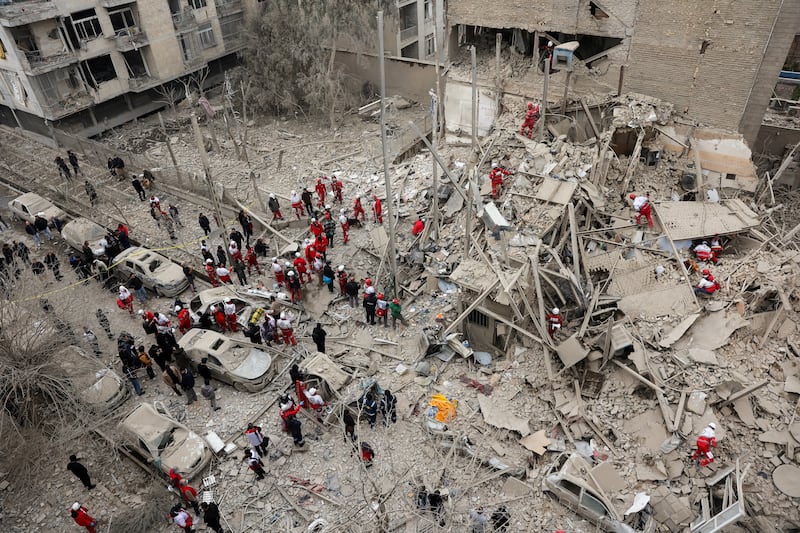
Emergency personnel work at the site of a strike on a residential building, amid the U.S.-Israeli conflict with Iran, in Tehran, Iran, March 16, 2026.
More than 2,000 people have been killed since the Iran war broke out, including 13 U.S. ​service members.Majid Asgaripour/WANA (West Asia News Agency) via Reuters

“Do those Christians who bear grave responsibility in armed conflicts have the humility and courage ​to make a serious examination of conscience and to ​go to confession?” he asked.

Over 2,500 people across Iran and Lebanon have been killed since the U.S. and Israel launched their offensive in the Middle East. The Israeli military targeted and killed three Lebanese journalists on Saturday, according to the Associated Press. Meanwhile, at least 13 U.S. service members have died since the war began.

Daysia Tolentino

Weekend Reporter

Rebecca Solnit Discusses “The Beginning Comes After the End” With Anand Giridharadas

BPLvideos Streamed live on Mar 24, 2026 BPL Presents welcomes Rebecca Solnit back to our stage, whose The Beginning Comes After the End offers a thrilling account of the sheer breadth and scale of social, political, scientific, and cultural change over the past three quarters of a century. In this sequel to her enduring bestseller Hope in the Dark, Solnit surveys a world that has changed dramatically since the year 1960. Despite the forces seeking to turn back the clock on history, change is not a possibility; it is an inevitability. The changes amount to nothing less than dismantling an old civilization and building a new one, whose newness is often the return of the old ways and wisdoms. While the white nationalist and authoritarian backlash drives individualism and isolation, this new world embraces antiracism, feminism, a more expansive understanding of gender, environmental thinking, scientific breakthroughs, and Indigenous and non-Western ideas, pointing toward a more interconnected, relational world. Rebecca Solnit is the author of more than 25 books, including Orwell’s Roses, Hope in the Dark, Men Explain Things to Me, A Paradise Built in Hell: The Extraordinary Communities that Arise in Disaster, and A Field Guide to Getting Lost. A longtime climate and human rights activist, she serves on the boards of Oil Change International and Third Act. Her newsletter of essays and analyses can be found at meditationsinanemergency.com. Anand Giridharadas is a writer. He is the author of The Persuaders: At the Front Lines of the Fight for Hearts, Minds, and Democracy (2022), Winners Take All: The Elite Charade of Changing the World (2018), The True American: Murder and Mercy in Texas (2014), and India Calling: An Intimate Portrait of a Nation’s Remaking (2011). A former foreign correspondent and columnist for The New York Times for more than a decade, he has also written for The New Yorker, The Atlantic, and Time, and he is the publisher of the newsletter The Ink.

The Ten Commandments Translated

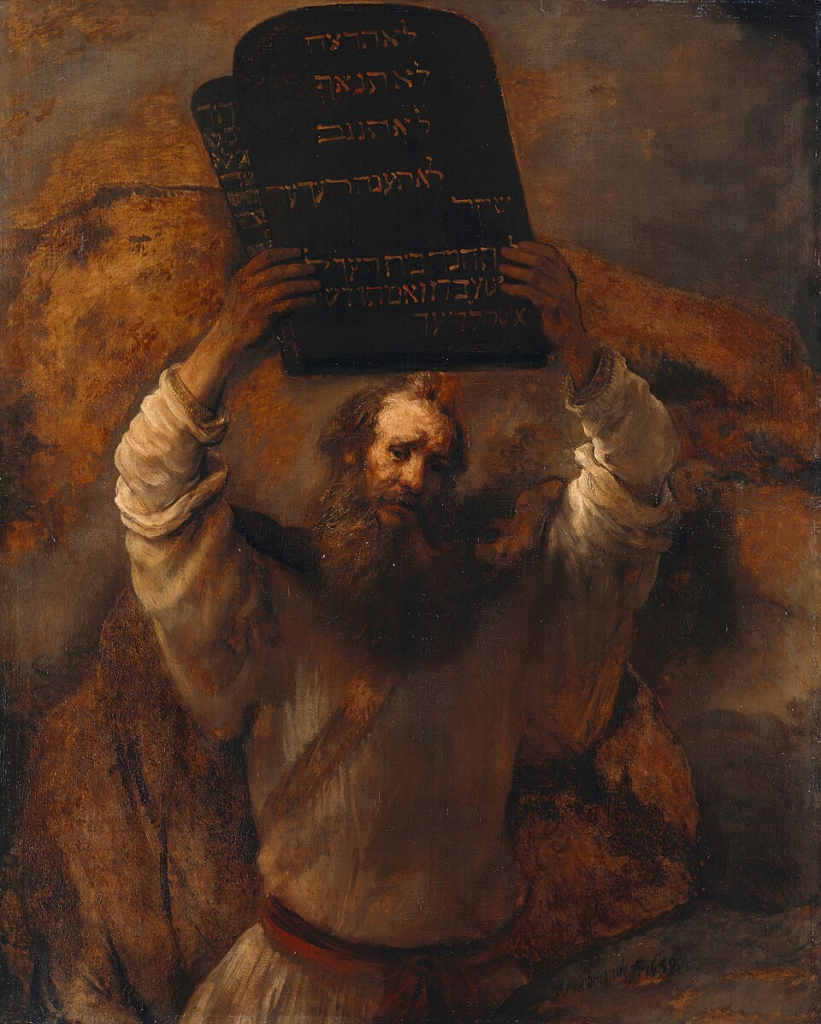
Moses Breaking the Tablets of the Law (1659) by Rembrandt, public domain

Exodus 20: 1-17

Translation by Mike Zonta, BB editor

1. Thou shalt have no other gods before me.

Truth is the only deity.

2. Thou shalt not make unto thee any graven image.

Truth is consciousness, a formless force.

3. Thou shalt not take the name of the Lord thy God in vain.

Disrespecting Truth is disrespecting Yourself.

4. Remember the sabbath day, to keep it holy.

Every day is a day to rest in Truth.

5. Honour thy father and thy mother.

Truth brings forth Itself.

6. Thou shalt not kill.

Truth cannot kill or be killed.

7. Thou shalt not commit adultery.

Truth is married to Itself.

8. Thou shalt not steal.

Truth is the only real estate.

9. Thou shalt not bear false witness against thy neighbour.

Truth does not lie and Truth has no neighbor.

10. Thou shalt not covet thy neighbour’s house/goods.

Truth, being all, possesses all.

© 2026 Michael Zonta. All rights reserved.

Trump administration places Christopher Columbus statue on White House grounds

MARCH 23, 2026 (npr.org)

HEARD ON ALL THINGS CONSIDERED

By Hosts, Ava Berger

A statue of the explorer Christopher Columbus stands on White House grounds at the Eisenhower Executive Office Building (EEOB) in Washington, D.C., on March 23, 2026.

A statue of the explorer Christopher Columbus stands on White House grounds at the Eisenhower Executive Office Building (EEOB) in Washington, D.C., on March 23, 2026.

Jim Watson/AFP/Getty Images

The Trump administration placed a statue of Christopher Columbus on White House grounds over the weekend, doubling down on its efforts to commemorate the 15th-century explorer.

“As we celebrate our Nation’s 250th anniversary of independence, the White House is proud to honor Christopher Columbus’s legendary life and legacy with a well-deserved statue on the White House grounds,” Davis Ingle, a White House spokesperson, said in a statement. “In this White House, Christopher Columbus is a hero, and President Trump will ensure he’s honored as such for generations to come.”

NATIONAL

Why Trump is talking about bringing Columbus Day ‘back from the ashes’

The statue is a replica of the one that used to sit in Baltimore’s Little Italy, according to John Pica, a Maryland lobbyist and president of the Italian American Organizations United. In 2020, after the killing of George Floyd by a white police officer and a reckoning on racial justice issues in the U.S., protesters pulled the statue down and hurled it into the city’s Inner Harbor.

The marble statue depicted Columbus facing east towards the sun, and was dedicated by former Baltimore Mayor William Donald Schaefer and President Ronald Reagan in October 1984.

Soon after, Pica, who also has served as a Maryland state senator, said his group hired divers to fish pieces of the statue out of the harbor. They raised money through grants and private contributions to hire a Maryland sculptor to rebuild it, Pica said.

The replica had been finished for a few years and sat in storage until Pica got a call last week that the White House wanted the statue. The statue was installed around 2 a.m. Sunday morning, he said, and it is on loan to the White House until the end of Trump’s term.

“It’s a place where it can peacefully shine and be protected,” he added.

“It’s a source of pride for Italian Americans,” Pica said. “Christopher Columbus, notwithstanding the controversy around him, is a symbol of pride and adventure for Italian Americans.”

Pica said he understands the hesitancy around Columbus’ legacy. In a way, he said, Italian Americans are “stuck” with Columbus.

“We don’t raise a glass of wine to Christopher Columbus on Columbus Day,” Pica said. “We celebrate our heritage. We don’t have Columbus celebrations. We have Italian American celebrations and Italian heritage celebrations. It’s just Columbus happens to be the symbol.”

The statue is not the administration’s first attempt to shine a favorable light on the controversial figure.

NATIONAL

Trump issues a Columbus Day proclamation to ‘reclaim’ the explorer’s legacy

Last year, the Trump administration issued a proclamation commemorating Columbus Day, and took a jab at people who have criticized the explorer.

“Outrageously, in recent years, Christopher Columbus has been a prime target of a vicious and merciless campaign to erase our history, slander our heroes, and attack our heritage,” the proclamation read. “Before our very eyes, left-wing radicals toppled his statues, vandalized his monuments, tarnished his character, and sought to exile him from our public spaces.”

Indigenous Peoples’ Day, which is not an official federal holiday but is celebrated by cities and states across the country, previously had been recognized by the Biden administration.

Members of the public offer mixed reactions to the statue

On Monday morning, groups of schoolchildren, tourists and locals passed by the White House and offered differing opinions of the statue.

The statue wasn’t visible to the public because of construction and fences walling off the area. But when Ivone Sagastume, a first-generation Guatemalan American, heard about the new statue, she was brought to tears. To her, she said, the statue is another way the Trump administration is dividing the country.

“We as a nation have fought for unity and for respect of other cultures,” Sagastume, 35, said. “That symbol is just going to destroy that even more, it’s just destroying what this country was built on.”

Gerald Horne, a professor of history and African American studies at the University of Houston, said that reaction to the statue makes sense.

“Statues are political statements and those who have objected to the statue of Christopher Columbus are objecting to his role in helping to ignite genocide against the Indigenous population, of being an enslaver himself,” Horne said.

Middle school history teacher Scott Silk, 57, looked out at the White House with a group of students from San Diego behind him.

“For so many people in the United States, Christopher Columbus is a symbol of racism and the oppression of native peoples,” he said.

He said if he and his students could see the statue, he would ask them to reflect on what it means.

CODE SWITCH

How Columbus Sailed Into U.S. History, Thanks To Italians

But others, like Martha Castillo, a tourist from San Diego, Calif., said it’s important to remember American history.

“I think it’s a good idea to have it here,” Castillo, 55, said. “This is a historic place and I think it should be here in the White House.”

Peter Diaz, 47, traveled from Miami, Fla. to explore the city’s capital. Diaz said the country has “bigger problems” than a statue.

“How many statues do we have in every city? In every state?” he said. “Are those really the issues that we care about? Don’t you think we have to think about our kids?”

Frank Lloyd Wright: “To define it is to confine it”

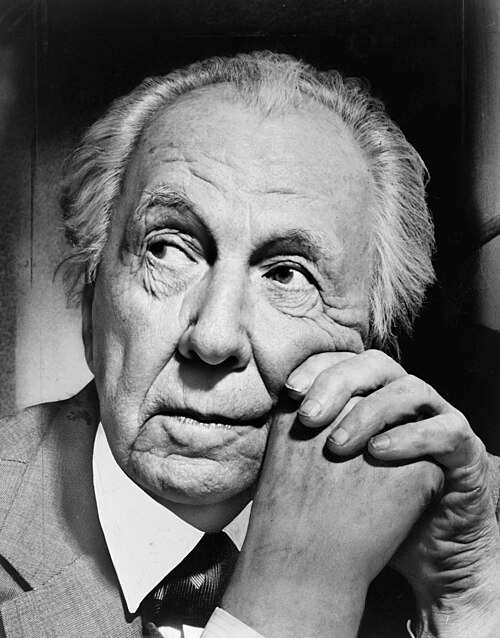
Wright in 1954

  • Google AI Overview

The phrase “To define it is to confine it” is widely attributed to Frank Lloyd Wright in various architecture and design contexts, often appearing in discussions of his organic architecture philosophy on sites like Goodreads, although it is not highlighted in the top search results of his quotes.

It encapsulates Wright’s approach to space, creativity, and nature. Here is the meaning and context behind this philosophy:

  • Organic Architecture: Wright believed that space should be fluid, continuous, and alive rather than segmented into rigid, box-like rooms.
  • Limitation of Definition: By strictly defining a space’s purpose (e.g., this is only a dining room) or boxing it in with solid walls, you lose the potential for flexibility, light, and connection to the environment.
  • “Space Within”: He famously believed that the “space within” was the reality of a building, not the walls. A defined (confined) space lacks that essential, expansive, and natural feeling.
  • Freedom of Design: By utilizing open floor plans and cantilevers, Wright sought to eliminate the “confinement” of traditional, restrictive, box-like architecture. Facebook +3

In essence, Wright felt that when you rigidly define a space, you limit its capacity to evolve and serve the human spirit.

Frank Lloyd Wright Sr. was an American architect, writer, educator, and designer who created over 1,000 structures in a 70-year career. He’s known for his philosophy of “organic architecture,” which aimed to integrate buildings with nature and their inhabitants. Wright’s work was inspired by technology and nature, and he used innovative materials and structural forms to reflect the US’s diverse geography.  (Wikipedia.org)

Born June 8, 1867, Richland Center, WI

Died April 9, 1959 (age 91 years), St Joseph Hospital, Phoenix, AZ

Book: “A Terrible Love of War”

A Terrible Love of War

James Hillman

War is a timeless force in the human imagination—and, indeed, in daily life. Engaged in the activity of destruction, its soldiers and its victims discover a paradoxical yet profound sense of existing, of being human. In A Terrible Love of War , James Hillman, one of today’s most respected psychologists, undertakes a groundbreaking examination of the essence of war, its psychological origins and inhuman behaviors. Utilizing reports from many fronts and times, letters from combatants, analyses by military authorities, classic myths, and writings from great thinkers, including Twain, Tolstoy, Kant, Arendt, Foucault, and Levinas, Hillman’s broad sweep and detailed research bring a fundamentally new understanding to humanity’s simultaneous attraction and aversion to war. This is a compelling, necessary book in a violent world.

About the author

James Hillman

James Hillman (1926-2011) was an American psychologist. He served in the US Navy Hospital Corps from 1944 to 1946, after which he attended the Sorbonne in Paris, studying English Literature, and Trinity College, Dublin, graduating with a degree in mental and moral science in 1950.

In 1959, he received his PhD from the University of Zurich, as well as his analyst’s diploma from the C.G. Jung Institute and founded a movement toward archetypal psychology, was then appointed as Director of Studies at the institute, a position he held until 1969.

In 1970, Hillman became editor of Spring Publications, a publishing company devoted to advancing Archetypal Psychology as well as publishing books on mythology, philosophy and art. His magnum opus, Re-visioning Psychology, was written in 1975 and nominated for the Pulitzer Prize. Hillman then helped co-found the Dallas Institute for Humanities and Culture in 1978.

Retired into private practice, writing and traveling to lecture, until his death at his home in Connecticut on October 27, 2011 from bone cancer.

(Goodreads.com)

Dual aspect monism

  • Google AI Overview

Dual aspect monism is a philosophical theory stating that mind and matter are not two distinct substances, but rather two complementary, inseparable aspects of a single, underlying reality. This fundamental, “psychophysically neutral” reality is neither inherently mental nor physical, but acts as a foundation from which both emerge. Wikipedia +5

Key Aspects of Dual Aspect Monism:

  • Fundamental Unity: Unlike dualism, it posits only one “stuff” or substance, known as the unus mundus (united world) in the Jung-Pauli scheme or the implicate order in Bohmian mechanics.
  • Irreducibility: Neither mind nor matter can be reduced to the other, nor can the underlying reality be reduced to either aspect.
  • Complementarity: Mind and matter are seen as two ways of looking at the same thing, similar to how a coin has two sides, or how quantum objects behave as both waves and particles.
  • Historical and Modern Context: While rooted in Spinoza’s philosophy (where one substance has two modes: thought and extension), it is a modern approach in the philosophy of mind, adopted by thinkers like David Chalmers, Wolfgang Pauli, and Carl Jung to bridge consciousness and physics. Reddit +4

Differences from Other Views:

  • Vs. Physicalism: Rejects that everything is fundamentally material.
  • Vs. Idealism: Rejects that everything is fundamentally mental.
  • Vs. Dualism: Rejects that mind and body are two separate substances that somehow interact. Wikipedia +4

This view offers a way to avoid the “hard problem” of consciousness by suggesting that subjective, mental experience and objective, physical activity are equally fundamental aspects of one reality. YouTube +1