
All posts by Mike Zonta

Julian of Norwich: Celebrating Mother Jesus
by Kittredge Cherry |
Last Updated on April 30, 2026 (qspirit.net)
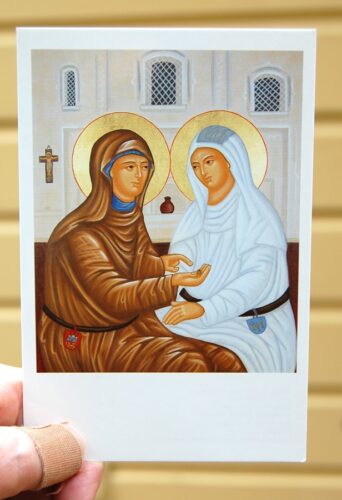
Julian of Norwich is a medieval English mystic who celebrated “Mother Jesus” and had important relationships with women. Her feast day, May 8, always falls near Mother’s Day in the United States.
She had some queer ideas about God, shared her hermit’s cell with a woman, and spent many days communing with another powerful woman mystic, Margery Kempe. Julian is the first woman to write a book in English: “Revelations of Divine Love,” where she wrote, “As truly as God is our Father, so truly is God our Mother.”
Julian’s discussions of Jesus as a mother sound radical even now, more than 600 years later. Her omnigendered vision of the Trinity fits with contemporary feminist and queer theology.
Mother’s Day is also a great time to honor mothers whose love for their LGBTQ children helped launch organizations such as Parents, Families, and Friends of Lesbians and Gays (PFLAG), founded by Jeanne Manford and Adele Starr.
Julian of Norwich (c.1342-1416) is the first woman to write a book in English. The book, “Revelations of Divine Love,” recounts a series of 16 visions or “showings” that she experienced from May 8-13, 1373, during a severe illness when she was 30 years old. The influential book reveals her intellectual capacity, clarity of thought, and deep spirituality. Just having mystical experiences is rather queer because it goes beyond standard ways of knowing.
The book includes Julian’s most famous saying, “All shall be well and all shall be well and all manner of things shall be well” — words spoken to her by God in one of Julian’s visions. This quote and the philosophy behind it influenced literary writers and church leaders far into the future. They include Mychal Judge, the gay chaplain who died in the line of duty during the 9/11 terrorist attack on the World Trade Center. Julian’s writings shaped his loving, inclusive approach to ministry and he reportedly often prayed a prayer based on her visions.
Little is known about Julian — not even her birth name. She was probably born in 1342 in Norwich and lived there for her whole life. Most likely she came from a wealthy family that provided financial support for her life at the anchorage. She described herself humbly as a “simple creature unlettered,” suggesting that she was not trained in Latin or academic theology.
After her recovery Julian went on to become an anchoress, a type of recluse who lives in a cell attached to a church and does contemplative prayer. Entering a life of permanent seclusion as an anchoress involved an impressive ceremony with a requiem mass before the doorway was literally sealed with bricks. Her hermit’s cell was at the Church of St. Julian in Norwich, and she took her name from this church. The cell had three windows, a church window for viewing worship and taking communion, a window for daily life, and a window to the street for communicating with the world. She became known throughout England for the spiritual counseling that she gave there.
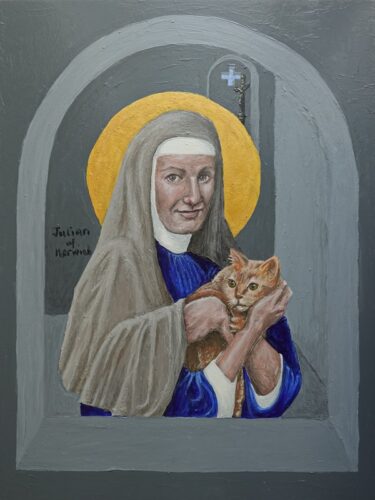
Julian of Norwich and her cat by Tobias Haller.
Julian was famously allowed to share her room was a cat — officially for the practical purpose of keeping it free from rats and mice. Many believe she developed a friendship with her cat companion. She has been depicted with her cat by many artists, including at least two whose work appears frequently at Q Spirit: Tobias Haller and Doug Blanchard.
Julian had important relationships with women
Julian lived as a recluse in a hermit’s cell, but she was not as isolated as is often supposed. A cat was not her only companion. A room for a servant was often attached to the cell, and in this space the anchoress and her servant form formed a long-term bond. Julian shared her cell at different times with women named Alice and Sarah. These companions are described as her “servant” or “maid.” But history suggests that sometimes a same-sex partner was called a servant to hide from social disapproval of homosexuality. Others whose same-sex “servants” were dearly beloved include the centurion and his “boy”, Boris and his servant George, and Good King Wenceslas and his “page” Podiven. Julian’s live-in companions Alice and Sarah are known because devout patrons gave bequests to them and Julian in their wills, documenting the significance of their relationships.
Julian also had an important relationship with another trailblazing woman writer and mystic, Margery Kempe. They appear together in the image at the top of this post. This queer side of Julian is explored in the chapter “Queer Touch Between Holy Women: Julian of Norwich, Margery Kempe, Birgitta of Sweden, and the Visitation” by scholar Laura Saetveit Miles of the University of Bergen, Norway, in the 2019 scholarly book “Touching, Devotional Practices, and Visionary Experience in the Late Middle Ages.” It “takes a new approach to the well-known meeting between two late-medieval English visionary women, Margery Kempe and the anchoress Julian of Norwich,” thereby revealing “the full transgressive effect of queer touch between women—or even its unspoken possibility,” according to the chapter summary.
When Margery Kempe wrote the first autobiography in English, she described her long and intimate visit in 1413 with Julian, the first woman to write a book in English. Their literary landmarks sound impressive now, but at the time English was the low-ranking local dialect of the common people. Scholars used Latin, and English was in the early stages of replacing French as prestige language of England’s government.
Kempe was in her 40s when she visited the elderly Julian. Kempe was seeking approval for the visions that she received from God. During their many days together, Julian assured Kempe that her visions were genuine and counseled her about spiritual life. They shared their visions and became chosen family, calling each other “sister.”
Here’s how Kempe described their connection in “The Book of Margery Kempe”: “Much was the dalliance that the anchoress [Julian] and this creature [Kempe] had by communing in the love of our Lord Jesus Christ the many days that they were together.” This text is updated from Middle English to modern English, but Miles points out that both “dalliance” and “communing” had a wide spectrum of meanings, from conversation to sexual union. Anchoresses were allowed to have overnight female guests, so it’s possible that Kempe stayed overnight in the cell with Julian.
Some say that Julian entrusted her handwritten book manuscript to Kempe, who preserved it and lent it to close friends to copy and circulate. The printing press was not yet invented. The unpublished manuscripts were carefully preserved by a long and mysterious chain of guardians that included an English convent of Benedictine nuns in France. Women were preserving women’s writing over the centuries, despite harrowing clashes with authorities during the Protestant Reformation and French Revolution. A Benedictine monk published a translation in 1670, but it got little attention. Finally in 1901 Grace Warrack, a Scots Presbyterian, discovered a copy made by French nuns at the British Library, painstakingly copied it by hand, translated it into modern English, and introduced it to an enthusiastic 20th-century audience. Based on gender stereotypes, many readers assumed that the author of such profound spiritual visions must be a man, especially since the name Julian is more common for men. Many of the most popular and best-remembered historical women in the Q Spirit’s LGBTQ Saints series were writers, including Julian, Perpetua, and Hildegard of Bingen.
Julian lived a long life. The date of her death is unknown, but records show that she was still alive at age 73 to receive an inheritance in 1416. She was never formally canonized, but Julian is considered a saint by popular devotion. The Episcopal and Lutheran Churches keep her feast day on May 8.
Julian wrote of God as mother
Jesus compared himself to a mother hen, but Julian is considered the first in Christian history to write at length about God as mother. Her profound ideas speak powerfully today to women and queer people of faith. A popular theory is that Julian drew on her own personal experience as a mother whose children and husband died in the Black Plague before she became an anchoress.
Here are a few short quotes from Julian’s extensive writings about “Mother Jesus”:
“So Jesus Christ who sets good against evil is our real Mother. We owe our being to him–and this is the essence of motherhood! –and all the delightful, loving protection which ever follows. God is as really our Mother as he is our Father.“ (Chapter 59)
“So Jesus is our true Mother by nature at our first creation, and he is our true Mother in grace by taking on our created nature.” (Chapter 59)
“A mother can give her child milk to suck, but our dear mother Jesus can feed us with himself, and he does so most courteously and most tenderly with the holy sacrament, which is the precious food of life itself… The mother can lay the child tenderly to her breast, but our tender mother Jesus, he can familiarly lead us to his blessed breast through his sweet open side….” (Chapter 60)
These quotes come from modern English translations of “Revelations of Divine Love” by Elizabeth Spearing and Clifton Wolters.
Other saints who wrote about God as mother include Aelred of Rievaulx, Bernard of Clairvaux and Anselm of Canterbury.
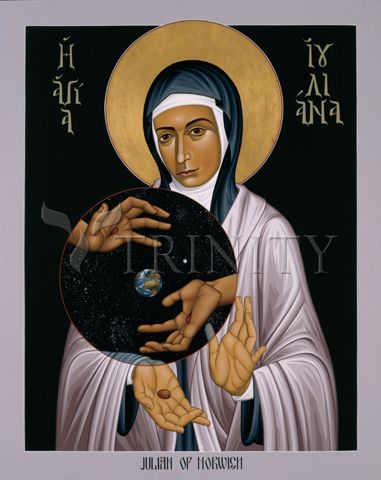
“Dame Julian’s Hazelnut” by Brother Robert Lentz, OFM, Prints available at Amazon or TrinityStores.com
Julian saw God’s love in ordinary life
The sacred feminine is just one of the many revelations that have endeared Julian to the public. She also uses objects from ordinary life to illustrate God’s loving, forgiving nature. For example, in one vision God shows Julian a small object like a hazel-nut in the palm of her hand. Julian writes:
“I looked at it and thought, ‘What can this be?’ And the answer came to me, ‘It is all that is made.’ I wondered how it could last, for it was so small I thought it might suddenly disappear. And the answer in my mind was, ‘It lasts and will last forever because God loves it; and in the same way everything exists through the love of God’.” (Chapter 5)
Julian of Norwich in art
Julian is a favorite subject for Tobias Haller, an iconographer, author, composer, and vicar of Saint James Episcopal Church in the Bronx. In addition to the icon at the top of this post, Haller sketched an elderly “Julian of Norwich” was sketched against a lavender background.
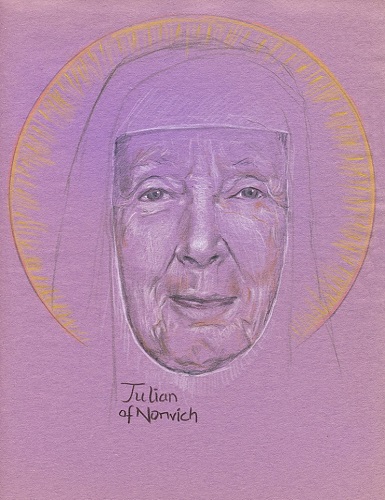
“Julian of Norwich” by Tobias Haller
Haller enjoys expanding the diversity of icons available by creating icons of LGBTQ people and other progressive holy figures as well as traditional saints. He and his spouse were united in a church wedding more than 30 years ago and a civil ceremony after same-sex marriage became legal in New York. He is the author of “Reasonable and Holy: Engaging Same-Sexuality.”
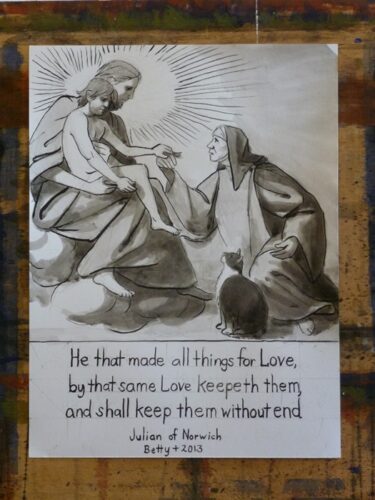
“Julian of Norwich,” a memorial drawing for his cat Betty, by Douglas Blanchard
New York painter Douglas Blanchard shows the saint with the artist’s own cat Betty in a drawing done as a memorial tribute to a beloved feline companion who died in 2013. He includes a favorite quote from Julian:
“He that made all things for love,
by that same love keepeth them,
and shall keep them without end.”
Blanchard is best known for his epic series “The Passion of Christ: A Gay Vision,” which is now available as a book. He teaches art and art history at the Bronx Community College of the City University of New York.
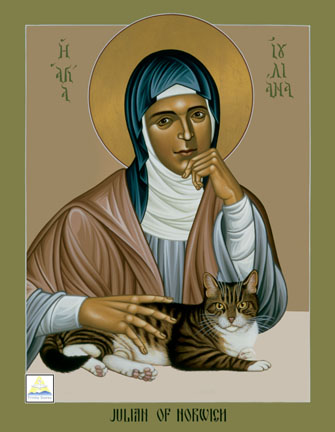
“Julian of Norwich” by Brother Robert Lentz, OFM, Prints available at Amazon or TrinityStores.com
Another icon of Julian and her cat was created by Robert Lentz, a Franciscan friar based in New York. Known for his innovative icons, he was rebuked by the church for painting LGBTQ saints and God as female.
Many important writers have been influenced by Julian, including 20th-century British poet T.S. Eliot. He quotes her in his masterpiece “Four Quartets,” which led to him receiving the Nobel Prize for literature in 1948.
Books about Julian of Norwich
Julian is the inspiration for the queerly creative book “Visions of Divine’s Love: A Drag Theopoetic” by Max Brumberg-Kraus (author) and J. C. A. Freeman (illustrator). It reframes Julian’s 16 visions as 16 poems about the drag queen Divine by a 21st-century professor and film buff — a reimagined Julian — and her unnamed teaching assistant, a novice nun. It was published in 2023 by AC Books.
Recommended book: “Perpetua’s Journey: Faith, Gender, and Power in the Roman Empire (Graphic History Series)” by Jennifer A. Rea (author) and Liz Clarke (illustrator). Published by Oxford University Press, 2017.
Julian of Norwich in song, literature and prayer
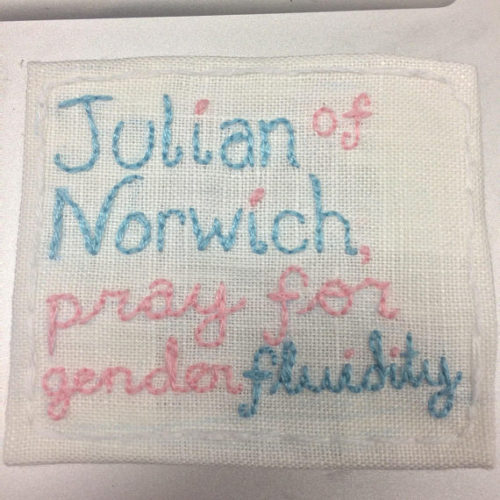
“Julian of Norwich, pray for gender fluidity” by Avery Arden
Various prayers related to Julian of Norwich are in circulation, including “Julian of Norwich, pray for gender fluidity.” The prayer was hand-sewn onto embroidered patch by artist Avery Arden of Blessed Are the Binary Breakers. “LGBTA+ Christians who choose to pray for the intercession of Saints deserve to have patrons whom they trust understand and support them,’ Arden affirms. “Whatever Saint or paired-Saint couple resonates with you as an LGBTA+ Christian can be made into a customizable patch.”
The prayer is incorporated into Q Spirit’s Litany of Queer Saints.
Julian’s famous words are set to music in the song “All Will Be Well” by Meg Barnhouse, a Texas-based Unitarian minister and singer/songwriter. The moving song comes from her album “Mango Thoughts in a Meatloaf Town” and is available on YouTube.
A longer quotation from Julian, again including “All will be well,” was set to music by 20th-century Welsh composer William Matthias in his piece “As Truly as God is Our Father.” it is sung on video by Plymouth Choir of First Plymouth Church, Lincoln Nebraska.
___
Related links:
Medieval anchoresses found spiritual freedom in tiny cells (uscatholic.org)
___
To read this post in Spanish / en español, go to Santos Queer:
Juliana de Norwich: Celebración de la Madre Jesús (Santos Queer)
To read this article in Italian, go to:
Gesù come madre. La vita e il pensiero di Giuliana di Norwich (Gionata.org)
___
Related links for Mother’s Day:
Jeanne Manford: PFLAG founder loved her gay son
Adele Starr and others: Patron saints for straight allies of LGBTQ people
___
Top image credit:
Hand holding a devotional card credited as follows:
“Icon by Brother Leon of Walsingham
of the English mystics, Julian of Norwich and
Margery Kempe of Lynn,
at S. Michael and All Angels,
Brighton.
Printed by The Postcard Company Ltd. (028) 8224-9222”
Julian appears on the left.
___
This post is part of the LGBTQ Saints series by Kittredge Cherry. Traditional and alternative saints, people in the Bible, LGBTQ martyrs, authors, theologians, religious leaders, artists, deities and other figures of special interest to lesbian, gay, bisexual and transgender and queer (LGBTQ) people and our allies are covered.
This article has evolved and expanded greatly since the first version was posted in May 2011. It was published on Q Spirit in May 2017, was enhanced with new material over time, and was most recently updated on April 30, 2026.
Copyright © Kittredge Cherry. All rights reserved.
Qspirit.net presents the Jesus in Love Blog on LGBTQ spirituality.
Founder and publisher at Q Spirit
Kittredge Cherry is a lesbian Christian author who writes regularly about LGBTQ spirituality.She holds degrees in religion, journalism and art history.She was ordained by Metropolitan Community Churches and served as its national ecumenical officer, advocating for LGBTQ rights at the National Council of Churches and World Council of Churches.
Featured Books from New Thinking Allowed
In Ishmael, which received the Turner Tomorrow Fellowship for the best work of fiction offering positive solutions to global problems, Daniel Quinn parses humanity’s origins and its relationship with nature, in search of an answer to this challenging question: How can we save the world from ourselves?

An exciting collection of over 200 of the most interesting and intriguing cases in the history of psychical research and mediumship over the last 160 years. An easy reference book on the subject of mediumship, whether trance, healing, physical or mental. The author has categorized each one into what amounts to something of an encyclopaedia on the subject.

Former political and war correspondent, Karen Frances McCarthy, was on assignment when she received the news that her partner had suddenly died in New York. Skeptical by nature and numbed by the tragedy, she spiraled into a deep state of grief about never communicating with him again … until he did.” Till Death Don’t Us Part is a true, down-to-earth, but transformational story of a former journalist’s extraordinary journey through tragedy to awakening to the knowledge that love and life never dies.

Spaghetti Nebula
This is the Spaghetti Nebula, a supernova remnant unfolding across space and time. Its faint emissions, filtered through dust, reveal not an ending, but a transformation—matter reconfigured, structure emerging from dispersal. (from New Thinking Allowed)

Photo by Shaoyu Zhang for APOTY25.
(Stars & Nebulae category.)
WHO WE ARE | Clip & Conversation with Jeffery Robinson & Directors Sarah Kunstler & Emily Kunstler
Sony Pictures Classics Feb 10, 2022 Jazz Tangcay, Senior Artisans Editor at Variety, moderates a conversation with The Who We Are Project founder Jeffery Robinson, and WHO WE ARE: A CHRONICLE OF RACISM IN AMERICA directors Sarah Kunstler & Emily Kunstler.
What Lincoln Knew…

And what we can choose to remember
| Marianne Williamson May 2, 2026 |
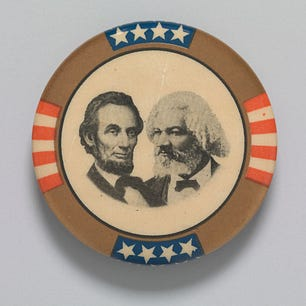
Abraham Lincoln and Frederick Douglass/ Heritage Art/ artist unknown
Just as Roman society had already begun to crumble before the barbarians ever reached their gates, so America was on the path of dying empire before Donald Trump reached ours. So many sectors of American civilization – and so many of us, I’m afraid – had compromised our principles, our ethics, even our decency too often and too completely, for years. Tiny lies, tiny vulgarities on the part of individuals as well as institutions became cultural norms. Things that seemed perhaps like unimportant compromises with our own integrity, easy enough to gloss over, became features rather than glitches in how we did business, even inhabited our personal relationships. In the quantum field out of which this moment emerged, there’s no difference between a lying lover and a lying corporation.
Thus weakened morally, we became politically vulnerable. The problem wasn’t just that Trump prevailed. It’s that he found it to be so damn easy. He got to the gates and he broke them open. In ways tough to admit, it wasn’t that hard. He and his minions are raping and pillaging even as we speak, and they’ve only just gotten started. They won’t be done until every Black person, woman, immigrant and non-Christian is put back in their place – you know, that place below, acquiescent, compliant, subservient, less vocal. The worst thing is, the people behind all this actually think that will be for the best. That’s how evil this phenomenon is.
The vision of the New Barbarians is everything the founding of the United States is not. Their efforts are a direct attack upon a society in which we are true to the idea that “All men are created equal.”
That sentence is not simply that we’ve decided to create a society in which all men are treated equally. It’s a statement that we will treat all men equally because we were created that way. To our Founders that meant everything, and it should mean everything to us. The sentence is a spiritual creed, not just a political agreement. And only a devotion to that creed will empower us to prevail against the barbaric forces at work in our modern politics.
Unless We the People reclaim for ourselves the radicalism of our Founding vision – that all men are endowed by our Creator with unalienable Rights, and governments are instituted to secure those rights – then everyone from Peter Thiel to Elon Musk to Russell Vought to Donald Trump and the rest of them will be successful at demolishing it. To them, those principles are just meaningless nonsense; it’s up to us whether they will be meaningless to us. It was so obvious when Terry Moran asked Donald Trump what the Declaration of Independence meant to him, the President responded, “Well, it means exactly what it says… it’s a declaration of unity and love and respect, and it means a lot.” It was glaringly obvious he had never read it.
Now that we are where we are, what matters is not who Trump is but who we are. The Declaration of Independence is America’s mission statement, and what matters is whether you and I understand it. When enough of us reclaim its vision, deeply, in our hearts, then we will have the power to push back the barbarians. But not before. Why? Because that document is not just a statement of politics, it’s a statement of moral force. It transmits more than information; it transmits power. And we need that power to nourish us now. Shouting about what the Constitution says, without claiming the emotional and spiritual power of the Declaration, ultimately gets us nowhere. Elected officials and legal experts shouting at the modern barbarians every time they trample on our Constitution, “You can’t do that here! It’s against the law!” is not enough to save us. Quite simply, the barbarians don’t care that they’re trampling on the Constitution. That’s exactly what they’re here to do.
The Founders’ task, as they saw it, was to create a government that would reflect divine universal law – not just British law. They referred to “Laws of Nature and of Nature’s God” as having entitled us to our freedom, therefore our rights are not granted by the government. Governments are instituted to secure the rights already granted to us by Nature’s God. Government derives its just power from the consent of the governed, as expressed through representative electoral processes outlined in our Constitution. If and when government does not secure our rights, We the People have the right to alter or abolish it. The Constitution is politically brilliant; the Declaration is morally profound. The Declaration, like the Constitution written eleven years later, was radical in 1776 and it is radical today.
Abraham Lincoln did not expect to win a second term. With the Civil War dragging into its fourth year and almost half a million Americans already killed, he couldn’t blame Northern voters for having had enough. He expected a huge majority would agree with his opponent, General George McClellan, that it was time to make a deal with the South; why should their husbands, sons and fathers have to die just because someone else owned slaves? If they wanted to go, went the argument, let them go. Negotiate an end to the war and start again as two neighboring countries, one slave- owning and one not.
Lincoln stood his ground however, with a platform calling for the South’s unconditional surrender and the abolition of slavery. He did so not only to preserve the union, but to stand by what he saw as the moral raison d’etre of the war: the principles of the Declaration of Independence. If you’ve never read his Second Inaugural Address or haven’t read it recently, do so now and it will rip you open.
To him, whether this country would abandon the principles of the Declaration was the crux of his generation’s political struggle. It was their struggle then, and it is ours now. To Lincoln, if all men are created equal, entitled by their Creator to the rights of life, liberty and the pursuit of happiness, then slavery must not be allowed to exist. The Confederate states had no plans to contain the institution of slavery within their own borders, by the way; their plan was for a huge slave-owning empire that would stretch not only across this continent but would include large swaths of Latin America as well. For millions who had never owned or traded slaves – who had lost their own loved ones in this most hideous war – to then vote for Lincoln on the strength of that moral argument, remains a staggering testament to their greatness as well as to his.
My mother used to tell me, “Growing old is not for sissies.” And neither is saving a country. We cannot, and must not, allow the political rupture of our own time to devolve into a second Civil War. Yet we must stand up as bravely as our ancestors did – true nonviolent struggle takes courage too – if we’re to preserve the principles on which we purport to stand. We have never fully actualized those principles, but from Abolition to Women’s Suffrage to the Civil Rights movement, at times we have made great strides. It is the job of every generation to seek to “create a more perfect union.” In our time, unfortunately, we are literally slipping backwards. There are those among us, barbarians in business suits, who have no use for our Founding principles – they find them inconvenient to their purposes, mocking what they see to be their quaintness and inefficiency. It’s up to us whether or not we will join the barbarians, or care so little to stand up to them that they’ll continue over the next three years to march like Hitler through the Rhineland.
Our Founders didn’t underestimate the dangers that King George’s authoritarianism posed to their rights as free people; we shouldn’t underestimate the dangers that the new crowd of American authoritarians poses to ours. Our biggest mistake in the years leading up to this was a toxic form of complacency; our biggest mistake today is if we choose to be naive.
Pope Leo signals shift away from Catholic Church’s focus on sex
Story by Joshua McElwee
• 4d • (MSN.com)
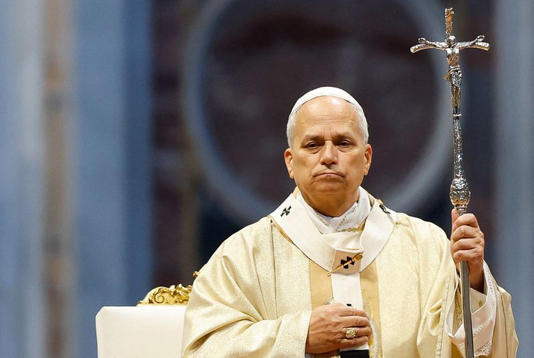
Pope Leo XIV leads a Holy Mass with priestly ordinations in Saint Peter’s Basilica at the Vatican, April 26, 2026. REUTERS/Remo Casilli/File Photo© Thomson Reuters
By Joshua McElwee
VATICAN CITY, April 27 (Reuters) – Pope Leo’s four-nation Africa tour featured firm denunciations by the pontiff of despotism and war and also unprecedented attacks from U.S. President Donald Trump that grabbed headlines.
But a smaller moment, in which the pope said the Catholic Church should prioritise questions of inequality and justice over those of sexual ethics, may prove to be of longer-lasting importance for the Church’s 1.4 billion members, said experts.
“The unity or division of the Church should not revolve around sexual matters,” Leo, the first U.S. pope, said in a press conference on his flight home on Thursday.
“I believe there are much greater and more important issues such as justice, equality… that would all take priority before that particular issue,” he said.
Marianne Duddy-Burke, executive director of Dignity USA, a group that supports LGBTQ Catholics, called the pope’s remarks “a very significant and overdue reorientation of priorities”.
Priests and bishops in the global Church have long emphasised as high priorities its teachings on sexual issues, including its bans on abortion, birth control and same-sex marriage.
On his first trip to Africa in 2009, the late Pope Benedict XVI sparked an international outcry when he said the Church could not relax its ban on Catholics using condoms, even to help fight the transmission of HIV/AIDS.
Related video: The pope who tried to change the church (Tom Nicholas)
Nos acompañan en la noticia de que, lamentablemente, el Papa
Benedict said allowing condoms would only “increase the problem” ethically.
POPE’S APPROACH SEEN AS NEW FOR GLOBAL CHURCH
Leo made his comments on Thursday in response to a question about the Church offering blessings for same-sex couples.
He said he supported a landmark 2023 decision by the late Pope Francis allowing pastors to give blessings to same-sex couples informally, outside of a ritual service, and on a case-by-case basis.
But Leo said he wanted to prioritise other ethical questions and did not want the blessings to be formalised further.
“To go beyond that today, I think that the topic can cause more disunity than unity,” said the 70-year-old pontiff.
Rev. James Keenan, an academic at Boston College, called Leo’s approach new for the global Church.
The pope is “stating that the Vatican has a hierarchy of concerns and the perception that matters of sexuality have singular priority of place is not the case,” said Keenan, a Jesuit priest who founded a global network of Catholic academics focused on ethical issues.
“This is clearly a prudential judgment by the pontiff… that issues of blessing gay marriage ought not eclipse more immediate challenges of dictatorships and war,” said Keenan.
The Catholic Church teaches that sexual relationships outside heterosexual marriage are sinful. It says people with same-sex attractions should try to be chaste.
LEO’S ‘WHO AM I TO JUDGE’ MOMENT
Francis, who led the Church for 12 years until his death last April, largely also sought to emphasise the Church’s teachings on justice issues.
Asked in 2013 about rumours surrounding a priest working at the Vatican being gay, Francis famously responded: “If a person is gay and is seeking the Lord and has good will, who am I to judge them?”
Those remarks, signalling unprecedented openness from a pope toward LGBTQ Catholics, became a seminal moment in Francis’ tenure, quoted widely and printed on merchandise and T-shirts.
“This seems like Leo’s ‘Who am I to judge?’ moment,” said David Gibson, a Vatican expert and academic at Fordham University, about Leo’s Thursday remarks.
“(Leo) is about peace and justice and sees those moral teachings as equally important as sexual ethics,” said Gibson.
Francis DeBernardo, executive director of New Ways Ministry, another group that supports LGBTQ Catholics, praised Leo’s response.
“He listed other matters, more social matters — justice, equality, freedom — as being of greater moral concern,” said DeBernardo. “For years, Catholic advocates for LGBTQ+ people have been saying the same thing.”
(Reporting by Joshua McElwee Editing by Gareth Jones)
Hollywood and Science unite at the 2026 Breakthrough Prize
The star-studded event celebrated achievements by the world’s top scientists in Life Sciences, Fundamental Physics, and Mathematics.
By Ashley Lan
April 30, 2026 (hollywoodreporter.com)

On Saturday, April 18, the world’s leading scientists and mathematicians joined Hollywood’s top stars in Los Angeles for the 12th annual Breakthrough Prize awards—often referred to as the “Oscars of Science”—to celebrate landmark scientific advancements and the people who make them possible.

Founded in 2012 by tech giants Sergey Brin, Mark Zuckerberg, Priscilla Chan, Julia & Yuri Milner, and Anne Wojcicki, the Breakthrough Prize was created to honor the achievements of the world’s top scientists, awarding approximately $15 million annually in prizes. In 2026, six Breakthrough Prizes of $3 million each were presented in Life Sciences, Fundamental Physics, and Mathematics—bringing the cumulative amount awarded over its 15-year history to $345 million.
Related Stories

Lufthansa Finds Lost Documentary Oscar for ‘Mr. Nobody Against Putin’

Simone Ashley Is Bringing Sass With a Side of Chic to ‘Devil Wears Prada 2’

The annual ceremony was a star-studded affair that put science in the spotlight. Actor and Emmy Award winner James Corden returned for the fifth time to host the evening, with legends like Gigi Hadid, Lily Collins, Anne Hathaway, and Tom Hanks (who shared a video tribute to the late astronaut Jim Lovell, whom he portrayed in Apollo 13) presenting awards and offering remarks throughout. Other newer names that have been generating buzz all year were also in attendance, like Olympic freestyle skier and model Eileen Gu, OpenAI CEO Sam Altman, Spotify CEO Daniel Ek, and Waymo CEO Tekedra Mawakana.

Academy Award-winning actors Octavia Spencer and Sean Penn kicked things off by awarding the Breakthrough Prize in Life Sciences to Stuart H. Orkin and Swee Lay Thein for research that transformed sickle cell disease and beta-thalassemia from incurable conditions to treatable ones through gene editing therapy. As she accepted the award, Thein poignantly shared, “As a kid playing on old railway tracks in Malaysia, I never dreamed that I would be here today.”

In Life Sciences, Katherine A. High and husband-and-wife team Jean Bennett and Albert Maguire were recognized for developing the first FDA-approved gene replacement therapy that has restored sight to patients born with Leber congenital amaurosis—a rare inherited retinal disease that typically leads to total blindness in early adulthood. And further prizes were presented to Rosa Rademakers and Bryan Traynor for independently discovering the most common genetic cause of both ALS and frontotemporal dementia—a repeat expansion mutation in the C9orf72 gene.

During the presentation, scientist-physician Yentli Soto Albrecht—who carries the very gene mutation Rademakers and Traynor identified—took the stage in a moving speech and spoke of her father who passed away from ALS: “My dad and I share a genetic fate, but I’m changing my future,” she said. “The scientists honored here tonight discovered our genetic mutation. They mapped the battlefield; now we can wage the war.”
Notably, Olympic gold medalist Eileen Gu and five-time World Chess Champion Magnus Carlsen also honored Anthony Hyman and Clifford Brangwynne with the Breakthrough Prize in Life Sciences for their groundbreaking discovery of a new fundamental mechanism of cellular organization. The prize was actually awarded in 2023, but the duo was unable to appear at the ceremony due to the COVID-19 pandemic and accepted it this year.

Prizes in Fundamental Physics were awarded to the Muon g–2 Collaborations at CERN, Brookhaven National Laboratory and Fermilab, recognizing decades of work by scientists around the world who pushed experimental precision to extraordinary levels in measuring the anomalous magnetic moment of the muon—a key test for undiscovered particles and forces. During the presentation, a ballerina suddenly appeared on stage, spinning and circling, offering a creative manifestation of muon’s spinning magnetic moment.
Breakthrough Prize co-founder Yuri Milner and NVIDIA founder and CEO Jensen Huang announced the Vera Rubin New Frontiers Prize, a brand-new physics prize that recognizes women physicists who have recently completed their doctorates and are already making important scientific contributions. Named after astronomer Vera Rubin, who discovered core evidence for dark matter, this year’s inaugural prize was awarded to Carolina Figuerido, who has already revealed hidden relations among quantum field theories.

As the final award in Fundamental Physics, award-winning actresses Michelle Williams and Lily Collins shared the story of Special Breakthrough Prize in Fundamental Physics winner David J. Gross, underscoring his intellectual family life, discovery of Einstein’s book on physics, and subsequent six decades of significant contributions. While receiving his prize, Gross spoke about how, through the journey of theoretical physics, “Scientific discovery, once revealed, belongs to humanity forever—and challenges us to use it wisely.”

The sole Breakthrough Prize in Mathematics went to Frank Merle for his transformative work on nonlinear evolution equations—the mathematical descriptions of how waves, fluids, and other dynamic systems change over time. Merle’s insights overturned fundamental assumptions in the field, including the surprising discovery that equations long thought to be stable can, in fact, blow up in finite time.

Throughout the night, the ceremony also featured impressive music performances by Grammy winner Lionel Richie, who performed his global hit “We Are the World” alongside a choir of children in attendance, and soprano Renée Fleming, who sang “Hallelujah” accompanied by composer and pianist Billy Childs as a tribute to the great scientists who passed over the last year. Pop icons David Guetta and Ava Max then closed the show with a rendition of “Forever Young” as all the Breakthrough Prize laureates took the stage for one final standing ovation, drawing the scintillating evening to an exuberant close.
(Contributed by Calvin Harris, H.W., M.)
Seneca on true happiness

Rainer Maria Rilke on being someone who is ready for everything
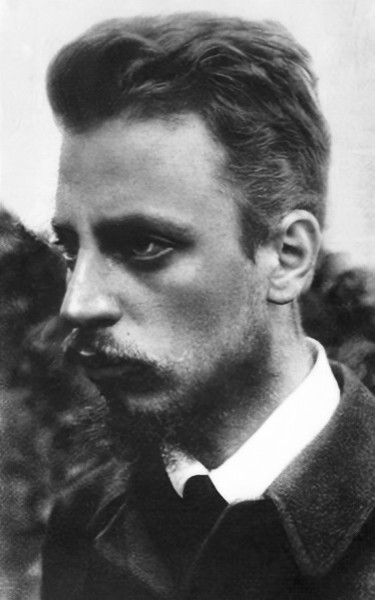
Rilke in 1900
“Only someone who is ready for everything, who doesn’t exclude any experience, even the most incomprehensible, will live the relationship with another person as something alive and will himself sound the depths of his own being.”
~ Rainer Maria Rilke
René Karl Wilhelm Johann Josef Maria Rilke, known as Rainer Maria Rilke, was an Austrian poet. Acclaimed as an idiosyncratic and expressive poet, he is widely recognized as a significant writer in the German language. Wikipedia
Born December 4, 1875, Prague, Czechia
Died December 29, 1926 (age 51 years), Montreux, Switzerland