
New Thinking Allowed with Jeffrey Mishlove May 6, 2026 Karen Frances McCarthy, a spiritualist medium and healer, received years of intensive training at the Arthur Findlay College in England. She is author of Till Death Don’t Us Part: A True Story of Awakening to Love After Life. Prior to the awakening of her mediumistic talents she worked as a major media journalist and war correspondent. Her website is / www In this 2020 video, she describes the slow and reluctant unfolding of her career as a spiritualist medium, which began with the sudden death of her fiancé. The process started with an assortment of “signs” that are sometimes noticed by bereaved individuals. Then more direct forms of communication began to occur, prompting this atheistic journalist to seek classes, mentors, and eventually serious training. New Thinking Allowed host, Jeffrey Mishlove, PhD, is author of The Roots of Consciousness, Psi Development Systems, and The PK Man. Between 1986 and 2002 he hosted and co-produced the original Thinking Allowed public television series. He is the recipient of the only doctoral diploma in “parapsychology” ever awarded by an accredited university (University of California, Berkeley, 1980). He is also the Grand Prize winner of the 2021 Bigelow Institute essay competition regarding the best evidence for survival of human consciousness after permanent bodily death. He is Co-Director of Parapsychology Education at the California Institute for Human Science. (Recorded on November 11, 2020)
All posts by Mike Zonta
‘Point of no return’: New Orleans relocation must start now due to sea level, study finds

on May 05, 2026 02:35 am
Oliver Milman, Environmental Reporter – The Guardian (U.K.)
Stephan: Based on my precognitive remote viewing research, and what I have seen in the science journals, I have been telling you for over a decade (see SR archive) that a time was coming when millions of Americans would be forced to internally migrate away from coastal areas and out of drought-ridden areas because of climate change. Well, here is proof that what I predicted is coming to pass.

Ongoing sea level rise and the rampant erosion of wetlands in southern Louisiana will swallow up the New Orleans area within a few generations, a new study concluded. Credit: Reuters
The process of relocating people from New Orleans should start immediately, as the city has reached a “point of no return” that will see it surrounded by the ocean within decades due to the climate crisis, a stark new study has concluded.
Ongoing sea-level rise and the rampant erosion of wetlands in southern Louisiana will swallow up the New Orleans area within a few generations, with the new paper estimating the city “may well be surrounded by the Gulf of Mexico before the end of this century”.
Low-lying southern Louisiana faces multiple threats, with rising sea levels driven by global heating, compounded by strengthening hurricanes, also a feature of the climate crisis, and the gradual subsidence of a coastline that has been carved apart by the oil and gas industry.
Southern Louisiana is facing 3-7 metres of sea-level rise and the loss of three-quarters of its […]
James Ensor: Christ’s Entry into Brussels in 1889 (1888)

I Recreated Star Wars out of Cardboard
Zach King Premiered Apr 25, 2026 I remade Star Wars with my friends and family out of cardboard. Featuring @airrack@MichelleKhare@jordanmatter@sofiedossi@StarWarsTheory@NickDiGiovanni@ColinandSamir@Jesser@Dom-Fera@JamieCosta@brittneyraeallday@ericartell Thanks to George Lucas and the original cast and crew of Star Wars for making a piece of cinema that has inspired us all to make movies! Directed by Josh Fapp Produced by Jesse Scholz & Josh Fapp Executive Producer – Zach King Director of Photography – Dave Cortez Production Designers – Noah Coots & Robert Kern III Editors – Corry Williams & Nathan Ross Music Composed by Andrew Gerlicher & Dom Fera VFX Supervisor – Ethan Montgomery Sound Designer & Re-recording Mixer – Patrick Sexton, CAS CAST Zach King – Luke Skywalker Dom Fera – C-3PO Jamie Costa – Han Solo / Beru Lars Brittney Rae – Princess Leia Liam King – Darth Vader JJ Carroll – Obi Wan / Owen Lars Eric Artell – Governor Tarkin Bart Johnson – General Dodonna Niatoos Dadbeh – Biggs Randall Park – Red Leader Jordan Matter – Dr. Evazan Sofie Dossi – Cantina Band Player / X-Wing Pilot Steve Moulton – Porkins Erick Decker – X-Wing Pilot Michelle Khare – X-Wing Pilot Manny – Chewbacca Samir Chaudry – Imperial Officer Colin Rosenblum – Imperial officer Jesse Reidel – Imperial officer Ben Maedo – Imperial Officer Nick DiGiovanni – Cantina patron Dom Fera – Cantina Bartender Nate Norell – Tusken Raider Andrew Gerlicher – Tusken Raider Eric Ziech – X-Wing Pilot Noah Pacifici – Captain Antilles Imperial Officers – Emile Rappaport, Jesse Scholz, Ryan Pollard, Jessica Wheeler, Janae Fapp, Andrew Gerlicher, Matthew Hagen, Vicki Lalane CREW 1st Assistant Director – Isaac Kim 2nd Unit Director – Jesse Scholz 2nd Unit Director of Photography – Jesse Scholz Gaffer / 1st AC / DIT – Christopher Park Miniature Photography – Josh Fapp & Ryan Pollard Miniature Makers – Connor Lee, Noah Coots, Robert Kern III, Zach King, Emile Rappaport, Pojo Reigert, Andrew Gerlicher BTS Photographer/Videographer – Dustin Ong Fabricators – Eliab Rice, Janae Fapp Animal Wranglers – Jessica Wheeler, Emile Rappaport Social Media BTS – Justin Paguirigan, Mikayla Ashe Candy Crafty – JJ Carroll Art PA’s – Emily Gould, Graham Young, Matthew Hagen, Moses Fritz, Jayden McSwain, Chris Rice PA – Matthew Hagen, Vicki Lalane, CJ Birkle, Laura Jones POST Post Supervisor – Josh Fapp VFX Artists – Joshua Drury, Lesley Lopez, Ethan Montgomery, Josh Fapp, Kijeon Nam, Stephen Burchell, Zach King Sound Designer / Sound EX Editor – Leandro Cassan Colorist – Corry Williams, Josh Fapp Shrek Burp – Blaivira ADR Talent – Aiden Morales, Ryan Pollard, Josh Fapp, Shalise Sexton, Aadylei Sexton, Arabelle Sexton, Robin Sexton, Jessica Sexton, Dustin Stephens, Anthony LeSage, Matthew Gurgol, Derek Liner, Edukated, Koka Sexton, Grayson Sexton, Olive Sexton, Cory LaCrue BACKGROUND Joshua Remmenga, Kiana Frerichs, Elijah Kim, Evan Kim, Andrew Gerlicher, Connor Lee, Logan Langevin, Isabella Fillipakis, Kai Ashikawa, Samuel Ashikawa, Christian Carignan, Caleb Thornton, Bentley Tees, CJ Terblanche, Nathaniel John Caleb Funk, Ashton Amersfoort, d’Artagnan Cañamar, Amadeo Cañamar, Valentino Canamar, Mason King, Liam King, Tate Thompson, Declan Thompson, Wyatt McCarthy, Landon Thompson, Everett Thompson, Lyla Thompson, James Thompson, Janae Fapp KING STUDIO TEAM Ryan Riggs, Noah Pacifici, Emile Rappaport, Josh Fapp, Jesse Scholz, Ryan Pollard, Noah Coots, Isaac Kim, Robert Kern III, Dustin Ong, Zach King, Corry Williams, Ethan Montgomery, Lesley Lopez, KiJeon Nam, Nathaniel Ross, Andrew Gerlicher, Isa Lee
LIGHT OF THE ETERNAL

Lillian DeWaters (mysticsoftheworld.com)
The finite, the personal, the physical, are nothing–like a dream or phantom. There is no finite, personal or physical existence. The only Existence there is is the Spiritual and Real. The only Being there is is the One-Infinite. This explains why the finite can never become the Infinite; the physical, the Spiritual; the personal, the I AM THAT I AM.

Light of the Eternal
Lillian DeWaters
From the first page to the last, Light of the Eternal reveals the Truth about every person’s real identity and the enormous opportunities available right now to those who accept this Truth. The author makes it clear that the mortal existence with all of its limitations and problems can be risen above. This higher state of being I Am That I Am is our destiny and she shares how this may be accomplished in the world.Much more than just being the title for this book, Light of the Eternal is an experience. Throughout the book the author reveals the option to accept the Light of the Eternal as our destiny, which has been waiting for everyone who is ready to receive it.In a sense, the message of the book is a divine invitation and it is priceless. The way of life being presented to everyone as a choice cannot be described or compared to what is thought of as human existence. The experience of this new life is one of beauty, love, purity and is, to a great extent, free of the discords, lack and battles of good and evil. The book reveals the way to this existence comes only through the heart.“With the heart one loves the Real as It is. Light pervades his whole existence. He walks in the kingdom of the Self where freedom, love and bliss forever abide.”
— Lillian DeWaters
(Contributed by Marty Owens)
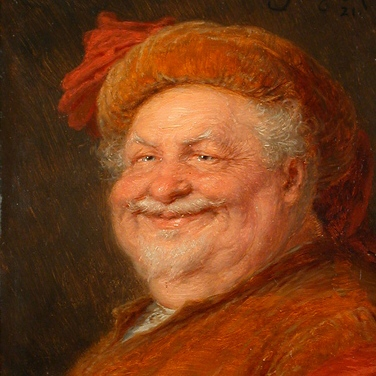
Eduard von Grützner: Falstaff (1921)
Socrates on desire

Edward Hopper: Rooms by the Sea (1951)

How Two Souls Can Interact with One Another: Simone de Beauvoir on Love and Friendship
By Maria Popova (themarginalian.org)

It is in relationships that we discover both our depths and our limits, there that we anneal ourselves and transcend ourselves, there that we are hurt the most and there that we find the most healing.
But despite what a crucible of our emotional and spiritual lives relationships are — or perhaps precisely because of it — they can be riddling and nebulous, destabilizing in their fluidity and ambiguity, leaving us grasping for the comforting solidity of categories and labels. The ancient Greeks, in their pioneering effort to order the chaos of the cosmos, neatly taxonomized them into filial love (the kind we feel for siblings, children, parents, and friends), eros (the love of lovers), and agape (the deepest, purest, most impersonal and spiritual love). After the Enlightenment discounted all love as a malfunction of reason, the Romantics reclaimed it and revised the ancient taxonomy into a hierarchy, under the tyranny of which we still live, placing eros at the pinnacle of human existence. And yet our deepest relationships — the ones in which we both become most fully ourselves and are most emboldened to change — tend to elude the commonplace classifications and to shape-shift across the span of life.
Simone de Beauvoir, 1946 (Photograph: Henri Cartier-Bresson)
Simone de Beauvoir (January 9, 1908–April 14, 1986) was only nineteen when she wielded her uncommon intellect at these questions on the pages of her journal, later published as Diary of a Philosophy Student (public library). In between composing her resolutions for a life worth living, Beauvoir began thinking seriously about the nature of love, its dialogue with her own nature, what she may want of it and what it may demand of her — “in brief, how souls can interact with one another.” In the midst of an intellectual infatuation with a young man who would go on to become an eminent philosopher himself — not the one she would eventually marry in a convention-breaking union of minds — she examines the substance of the feeling:
To say that I love him, what does that mean? Does the word itself have a meaning?
Questioning the tangle of idolization and desire that masquerades as love, she grows suspicious of the very concept of personal love as an absurdity against the backdrop of the largest love we can carry:
Invoking the love she feels for her friends, the sum total of them, she writes:
Over and over she returns to the elemental question:
Art by Olivier Tallec from Big Wolf & Little Wolf by Nadine Brun-Cosme — a poignant modern fable about how friendship anchors and transforms us.
Drawing on Hegel’s philosophy of freedom, in which for any conscious subject to be free means freeing the other, she arrives at a “formula” for the ideal friendship: “absolute reciprocity and the identity of consciousness.” The cultural ideal of romantic love, on the other hand, replaces this “absolute reciprocity” with engulfment and sublimation of one self into the other. She writes:
This, of course, is Rilke’s model of a perfect relationship — one in which “the highest task of a bond between two people [is] that each should stand guard over the solitude of the other” — consonant with Octavio Paz’s lovely definition of love as “a knot made of two intertwined freedoms.”
Beauvoir ultimately found it not in romantic love but in the deepest friendship of her life — that with Zaza, her childhood best friend.
A year older than her and also enamored of books, Zaza was the only one with whom the young Simone could have “real conversations.” In Memoirs of a Dutiful Daughter (public library) — the first volume of her autobiography, largely a loving memorial to this formative relationship — she would write of talking to Zaza:
Card from An Almanac of Birds: 100 Divinations for Uncertain Days, also available as a stand-alone print and as stationery cards.
When Zaza’s dress caught fire and charred her leg to the bone, she endured the long convalescence valiantly, then went on to climb trees and do cartwheels, to play the piano and the violin. Beauvoir relays a moment radical in the context of early twentieth-century French bourgeoise society, emblematic of Zaza’s defiant spirit and playful disdain for convention:
This strength of spirit, this defiance of the givens, is what the young Simone most admired about her friend — it emboldened her to defy convention in her own life.
Part of the unexamined convention Beauvoir had internalized growing up was the belief that “in a well-regulated human heart friendship occupies an honourable position, but it has neither the mysterious splendour of love, nor the sacred dignity of filial devotion.” And yet through her relationship with Zaza, she came to question this limiting “hierarchy of the emotions” and to see friendship as the deepest stratum of connection. “I loved Zaza with an intensity which could not be accounted for by any established set of rules and conventions,” she would reflect decades later.
Card from An Almanac of Birds: 100 Divinations for Uncertain Days, also available as a stand-alone print and as stationery cards.
It was only in Zaza’s absence — absences inflicted by their families and school schedules and the general fractures of continuity that life presents — that Beauvoir came to grasp the importance, the consolation, the salvation of her friend’s presence:
In her diary, she recounts one such reunion during her freshman year as a philosophy student:
Beauvoir was discovering deep friendship as safer and more resilient than romance, free from “the great hatreds of love, the irremediable pride, the passionate ruptures, the mutual tortures,” never “introducing jealousy, demands, and doubts.” To have what the ancient Celts called anam cara — “soul friend” — asks everything of us, invites all the parts we live with and urges us to show up whole, yet demands nothing.
Looking back on her life, Beauvoir reflects:
Midway through Beauvoir’s sophomore year, Zaza died suddenly and mysteriously — an illness swift and merciless as an owl. She was 21. Amid the savage grief, Beauvoir turned even more sharply toward philosophy, seeking its eternal consolations. Across the sweep of the years and decades, Zaza’s inextinguishable presence never left her life. (“No one you love is ever dead,” Ernest Hemingway wrote around that time in a letter of consolation to an inconsolable friend.) Loving Zaza had ignited Beauvoir’s becoming, setting her on the course of who she would become — one of humanity’s most daring breakers of convention, her ideas reaching into the depths of her time, shaping the times to come, touching the lives of generations of strangers the way a true friendship does. Touching mine. Perhaps touching yours.
Card from An Almanac of Birds: 100 Divinations for Uncertain Days, also available as a stand-alone print and as stationery cards.
Complement with Seneca on true vs. false friendship and Little Prince author Antoine de Saint-Exupéry on losing a friend, then revisit Simone de Beauvoir on how chance and choice converge to make us who we are and the art of growing older.
Highlights of Trance Mediumship with Maxine Meilleur
New Thinking Allowed with Jeffrey Mishlove May 5, 2026 Maxine Meilleur, ALM, received a Masters degree in religion from Harvard University as well as a certificate in parapsychology from the Rhine Research Center in Durham, North Carolina. She is author of the two volume set, Great Moments in Modern Mediumship. Her other books include What the Great Mediums Have Taught Us About Spirit Guides, What the Great Mediums Have Taught Us About Healing, What is Spiritualism?, and Grounds in Your Coffee: An Idiot’s Guide to Tasseography. In this video from 2020, the discussion focuses on memorable high points in the history of spiritualism. Personalities discussed included Andrew Jackson Davis, Estelle Roberts, the Fox Sisters, Helen Duncan, Franek Kluski, Lord Hugh Dowding, and Sir Arthur Conan Doyle. The topics include apports, spirit materialization, and direct voice mediumship. New Thinking Allowed host, Jeffrey Mishlove, PhD, is author of The Roots of Consciousness, Psi Development Systems, and The PK Man. Between 1986 and 2002 he hosted and co-produced the original Thinking Allowed public television series. He is the recipient of the only doctoral diploma in “parapsychology” ever awarded by an accredited university (University of California, Berkeley, 1980). He is also the Grand Prize winner of the 2021 Bigelow Institute essay competition regarding the best evidence for survival of human consciousness after permanent bodily death. He is Co-Director of Parapsychology Education at the California Institute for Human Science. (Recorded on October 30, 2020)