
New Thinking Allowed with Jeffrey Mishlove May 8, 2026 This video is a special release from the original Thinking Allowed series that ran on public television from 1986 until 2002. It was recorded circa 1990. It will remain public for only one week. Fred Alan Wolf is a physicist and author of Space-Time and Beyond, Taking the Quantum Leap, The Body Quantum, Star Wave, Parallel Universes, and The Eagle’s Quest. He describes his interactions with shamans among the North American Sioux Indians and in the jungles of Peru and in England. Shamans see the world as made up of vibrations, using resonance between individuals to effect healings. He confesses that he observed many things among the shamans that were unexplainable to him in terms of modern physics, noting that the shamans he worked with were loving healers who touched him in a deep and nurturing manner. Now you can watch all of the programs from the original Thinking Allowed Video Collection, hosted by Jeffrey Mishlove. Subscribe to the new Streaming Channel (https://thinkingallowed.vhx.tv/) and watch more than 350 programs now, with more, previously unreleased titles added weekly. Free month of the classic Thinking Allowed streaming channel for New Thinking Allowed subscribers only. Use code THINKFREELY.
All posts by Mike Zonta
ISMO on sh*t

Ismo Mikael Leikola, sometimes known professionally as ISMO, is a Finnish comedian, musician, author, screenwriter, and YouTuber. Leikola made his United States debut in 2014, when he won the “Funniest Person in the World” competition organized by the comedy club Laugh Factory. Wikipedia
Born1979 (age 47 years), Jyväskylä, Finland
Link to video: https://www.facebook.com/ISMOcomedy/videos/1829796481086589/?sfnsn=mo&mibextid=6AJuK9
God Discontinues The Pebble

Published: May 8, 2026 (TheOnion.com)
THE HEAVENS—In an effort to make the universe a more modern and efficient place, the Lord God, Creator of Heaven and Earth, confirmed Wednesday that He would be discontinuing the pebble. “Starting in the year of our Me 2026, I will be ceasing creation of the pebble so that I can turn My focus toward stones, rocks, and boulders,” said the all-knowing and all-powerful deity, who stressed that there were already 300 billion pebbles in circulation, the vast majority of which were no longer being used by humanity.

“It’s time to phase the pebble out. We all know they’re mostly just taking up space at this point. We might take My power for granted, but each time I say ‘Let there be a pebble,’ it actually takes up quite a bit of energy, much more than any of those pebbles are worth. And to anyone who’s worried they’re going to miss pebbles, don’t worry—you’re going to love sand.” God added that He would be setting up an FAQ on His website shortly for those seeking more information.
NASA’s Artemis 2 astronauts saw flashes on the far side of the moon that cameras struggle to capture. Here’s why scientists are excited
By Leonard David published yesterday (Space.com)
“It’s extremely difficult to capture impact flashes with a camera, which is one of the benefits of sending trained crew to observe the moon.”
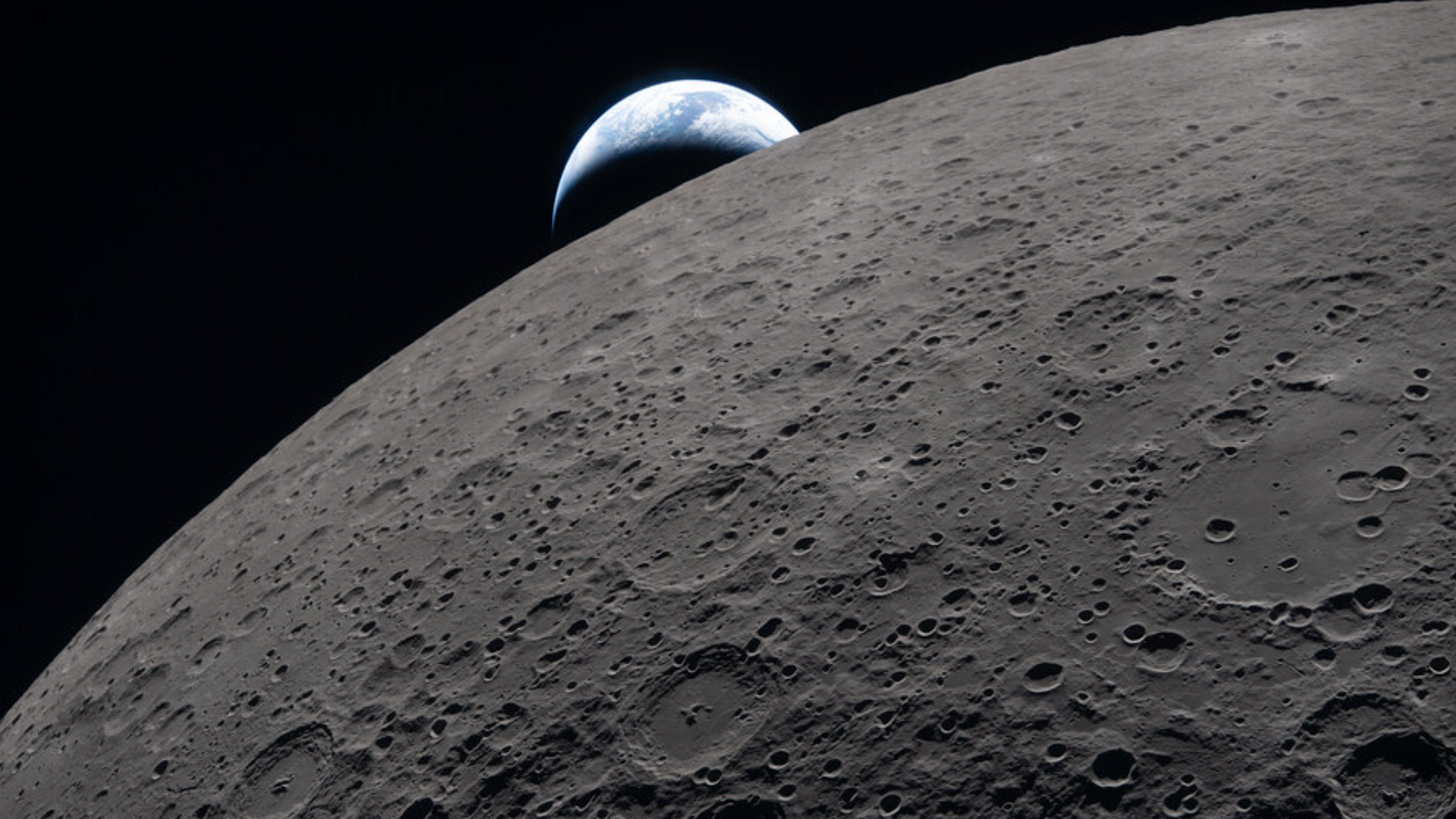
The Artemis 2 astronauts remained vigilant while zipping around the far side of the moon last month, on the ready to record meteoroid impact flashes on the lunar landscape.
Their diligence was rewarded. The four crewmembers reported seeing several impact flashes — flickers of light created when a meteoroid hits the lunar surface and vaporizes.
“These observations were made with the unaided eye. It’s extremely difficult to capture impact flashes with a camera, which is one of the benefits of sending trained crew to observe the moon,” Kelsey Young, NASA Artemis 2 lunar science lead, told Space.com. “Early data indicates that the impact flashes were observed on the far side of the moon.”You may like
- ‘Audible screams of delight’ from NASA scientists over micrometeorite impacts on the moon witnessed by Artemis 2 astronauts
- The moon up close: How the Artemis 2 astronauts are photographing their historic lunar flyby
- Artemis 2 astronauts fly around the moon in record-breaking lunar loop by NASA
Citizen scientists help out
Artemis 2, the first crewed moon flight since Apollo 17 in 1972, launched from Florida’s Space Coast on April 1 and flew around the far side of the moon on April 6.
As the astronauts scrutinized the moon that day, so did citizen scientists here on Earth. They were also looking for impact hits, although they would likely not have spotted the same ones as the crew.
Those observations were gathered as part of the newly launched Impact Flash citizen science project under the auspices of the Geophysical Exploration of the Dynamics and Evolution of the Solar System (GEODES), a unit within the NASA Solar System Exploration Research Virtual Institute.
The Impact Flash effort is geared to gather more data on the location and brightness of flashes throughout recent and upcoming Artemis moon missions.
“These flashes are vital to scientists who study the moon,” notes the Impact Flash website. “By tracking when and where they happen, scientists can learn how often impacts of different sizes occur, what kinds of craters they create, and how the shock waves travel through the moon’s interior.”
When combined with data from NASA’s moon-circuiting Lunar Reconnaissance Orbiter (LRO), future lunar surface instruments, and crew observations, the citizen science observations “can provide valuable constraints on the origin and characteristics of impactors, as well as craters that form from the impacts,” Young said.
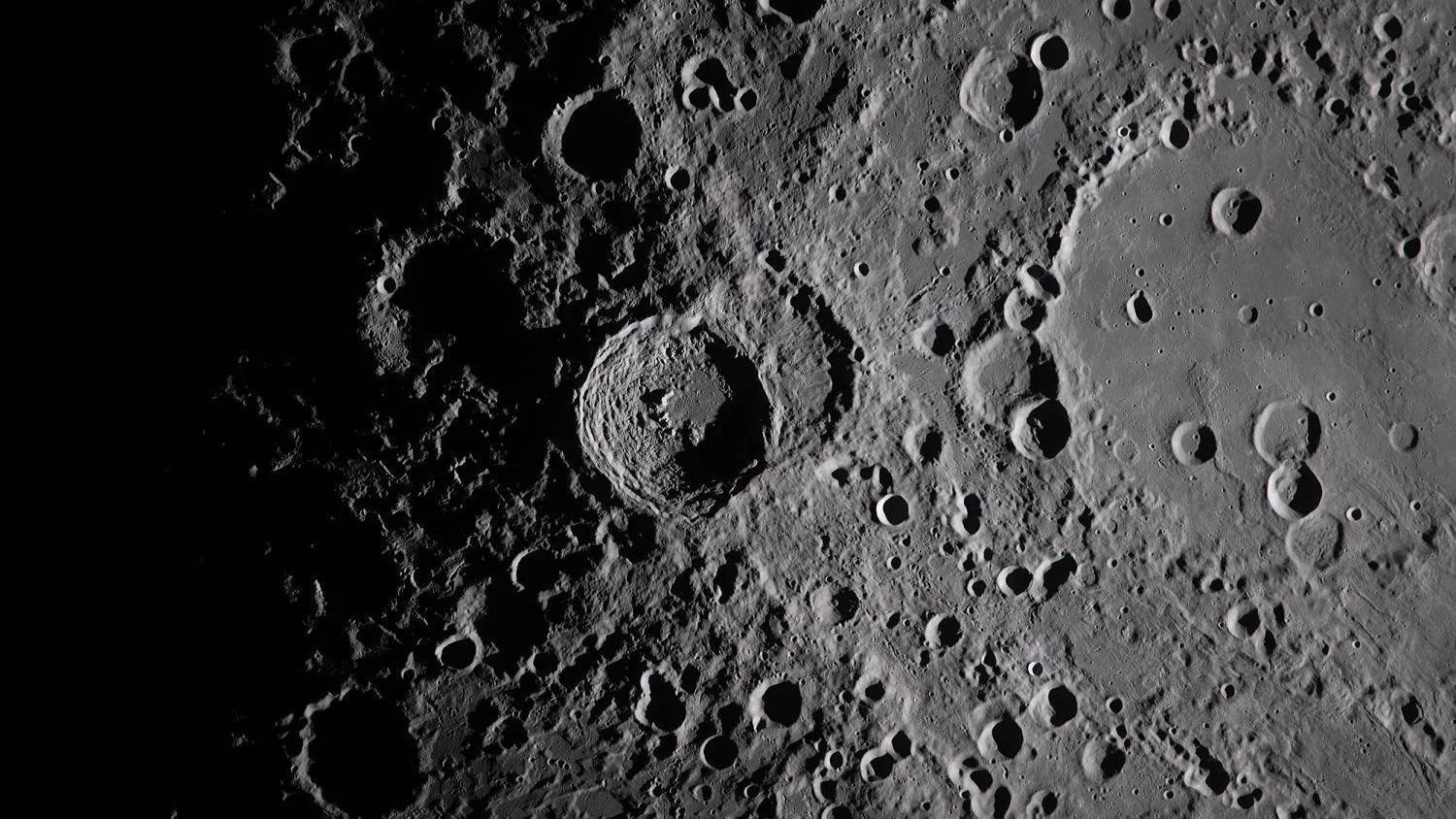
Observation window
The Artemis 2 astronauts’ impact-flash observation window extended out onto the lunar near side in darkness, Benjamin Fernando, of the Department of Earth and Planetary Sciences at Johns Hopkins University in Baltimore, told Space.com.What to read next
- Relive Artemis 2’s epic moon flyby with these amazing photos
- When the moon hits your eye from your Orion ship up high, that’s a ‘mare’ for Artemis 2
- What do scientists hope to learn from NASA’s historic Artemis 2 moon flyby?
In a paper posted earlier this year on the preprint server EarthArXiv, Fernando and colleagues reported that coordinated impact flash observations seen both from Earth and from lunar flyby/orbit will allow more detailed information to be gathered about the timing, location and dynamics of flashes than is possible from either method alone.
Joint observation campaigns enable researchers to better constrain the impact flux on the moon and also the associated impact hazard on the lunar surface, Fernando and his colleagues concluded.
Moon base implications
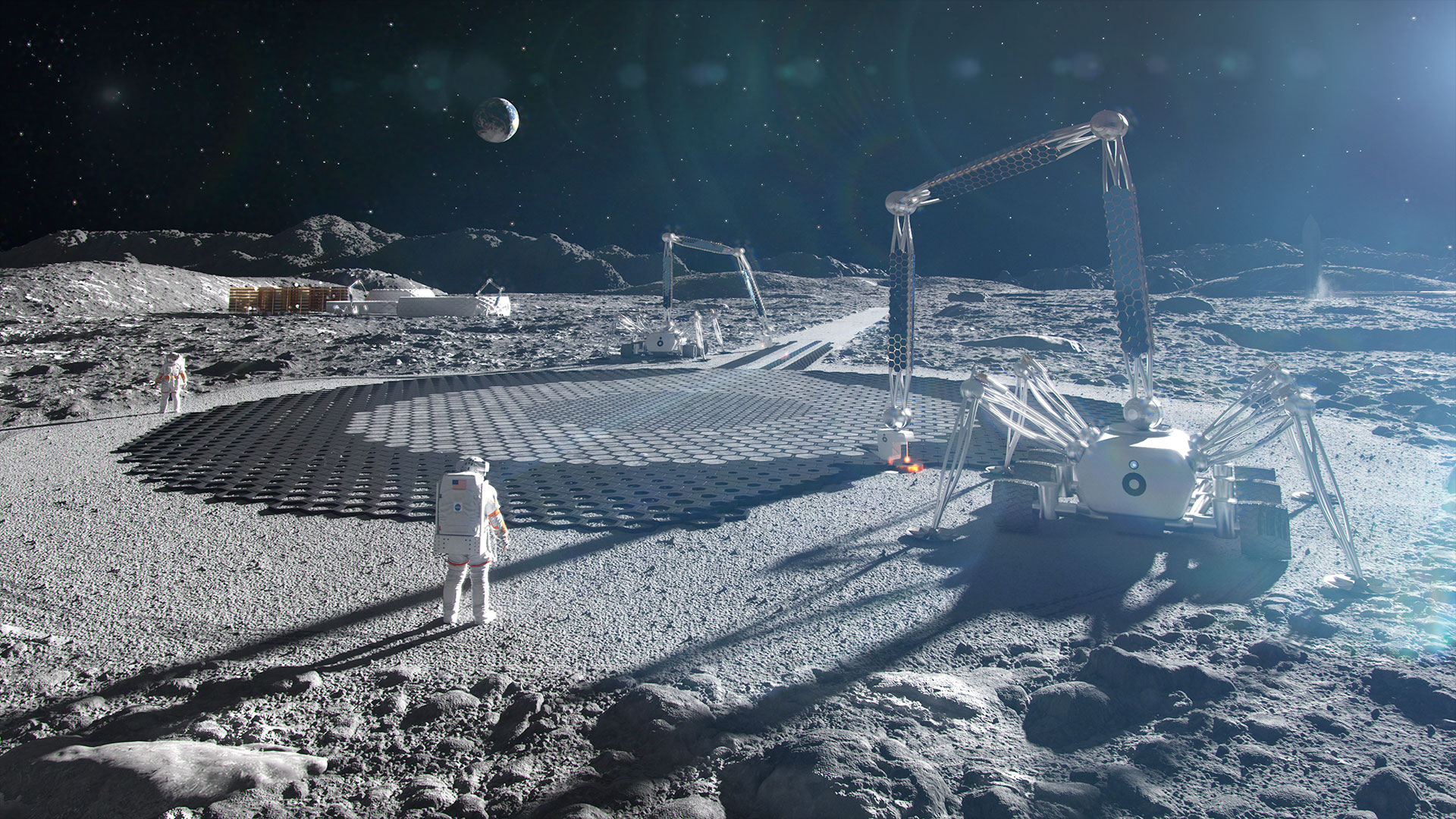
Updated knowledge about the meteoroid impact flux also plays into planning for Artemis Base Camp, the outpost NASA plans to build near the moon’s south pole.
“To design for longevity, one must account for the myriad environmental hazards that a long-duration outpost will face — among them radiation, extreme thermal cycling, regolith dynamics, seismic shaking, dust, and, of particular importance to this work, impacts,” notes a 2025 study led by Daniel Yahalomi, now a Torres Postdoctoral Fellow at MIT.
The lunar south pole offers a natural reduction in impact risk relative to equatorial sites, according to the study, “supporting its selection for sustained human presence.”
Furthermore, currently available shielding technology “is sufficient to suppress micrometeoroid hazards by nearly five orders of magnitude, reducing the effective risk to a manageable level for current habitat designs,” Yahalomi and his research colleagues concluded.
Big science haul
Hunting for impact flashes was one of many science tasks for the astronauts during their historic April 6 flyby. The Artemis 2 Lunar Science Team remains busy analyzing the mission’s science haul — gathered with the aid of 31 cameras aboard the Orion capsule “Integrity” — and archiving it all on NASA’s Planetary Data System.
“Within six months, all imagery of the Earth and moon taken by crew and vehicle cameras, audio recordings of the crew’s science observations, and accompanying transcripts will be publicly available for the broader science community to analyze,” Wasserman said.
Featured Books from New Thinking Allowed
The Eagle’s Quest is an exploration of shamanism and its interaction with quantum physics. It examines natural healing, shape shifting, fire walking, near-death and out-of-body experiences, lucid dreaming, and time traveling.

In On the Future of Species, Woolfson describes how we are at the cusp of a technological revolution, driven by the convergence of artificial intelligence and synthetic biology. Currently at the scribbling phase — writing the genomes of viruses, bacteria, and yeast — we will eventually author the genomes of extinct and never-before-realized species. Life will become computable, detached from its past and no longer bound by Darwinian evolution.

In The Warren Legacy, Chris McKinnell, grandson of Ed and Lorraine Warren and Director of the Warren Legacy Foundation for Paranormal Research, takes readers far beyond the familiar world of haunted houses and famous cases into a far more profound journey. Drawing on more than four decades of investigation, personal experience, spiritual study, and cross-cultural exploration, he asks what the paranormal truly reveals about who we are, what survives death, and whether consciousness is more fundamental than matter itself.

The Milky Way
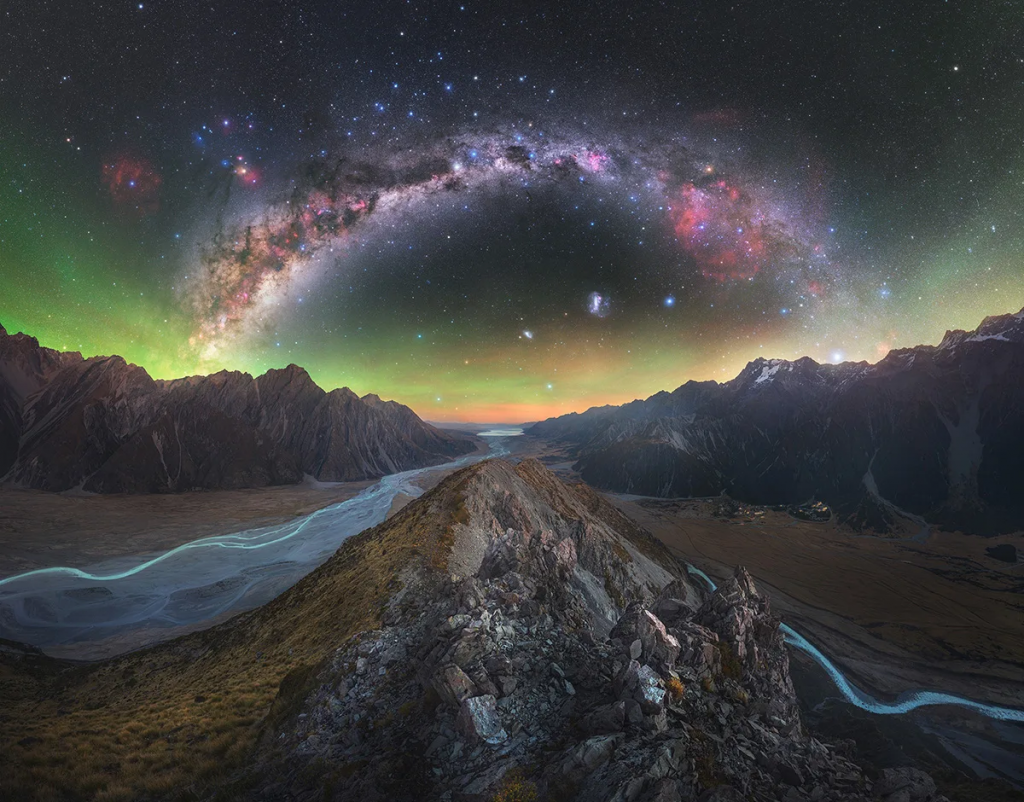
Beneath the dark clarity of Aoraki/Mount Cook National Park in New Zealand, twin glacial rivers trace the slow physics of ice and gravity, while above, the luminous band of the Milky Way arcs across the sky, its dense core revealing the galactic architecture from which our stellar neighborhood emerges. The presence of the Southern Cross anchors the celestial sphere, offering a navigational geometry that has guided observers for centuries and now frames a rare convergence of auroral light and galactic structure. (Featured Image from New Thinking Allowed)
C.S. Lewis on forgiveness

(Image from Independent.org)
“Everyone thinks forgiveness is a lovely idea until he has something to forgive.”
~ C.S.Lewis
Clive Staples Lewis was a British scholar, writer, and prominent Christian apologist. A professor of Medieval and Renaissance English literature at Oxford and Cambridge, Lewis was a key figure in literary studies. He wrote prolifically in both fiction and nonfiction, and his works are known for their Christian allegory, moral lessons, and rich symbolism. Wikipedia.org
Born November 29, 1898, Belfast, Northern Ireland, United Kingdom
Died November 22, 1963 (age 64 years), Oxford, United Kingdom
Ralph Waldo Emerson on knowing a few good things

Heraclitus on riparian wisdom

What Is Competitive Authoritarianism?


| You hear the term “competitive authoritarianism” all the time these days. It was first introduced in the Journal of Democracy by Steven Levitsky and Lucan Way in 2002 to describe a type of political regime that is neither democratic nor fully authoritarian. “In competitive authoritarian regimes,” write Levitsky and Way, “formal democratic institutions are widely viewed as the principal means of obtaining and exercising political authority. Incumbents violate those rules so often and to such an extent, however, that the regime fails to meet conventional minimum standards for democracy.” Unfortunately, this describes a growing range of countries across the globe. Read Levitsky and Way’s seminal essay and their more recent update, along with other key insights on hybrid regimes. Free for a limited time. |
| Elections Without Democracy: The Rise of Competitive Authoritarianism In recent years, new types of nondemocratic government have come to the fore, notably competitive authoritarianism. Such regimes, though not democratic, feature arenas of contestation in which opposition forces can challenge, and even oust, authoritarian incumbents. Steven Levitsky and Lucan A. Way The New Competitive Authoritarianism In recent years competitive authoritarianism has emerged in some countries with relatively strong democratic traditions and institutions. Steven Levitsky and Lucan A. Way The Surprising Instability of Competitive Authoritarianism Most competitive authoritarian regimes have proven strikingly unstable over recent decades. Quasi-democratic institutions, rather than serving authoritarians as useful instruments of manipulation, have frequently contributed to the breakdown of these systems. Christopher Carothers Elections Without Democracy: Thinking About Hybrid Regimes Many countries have adopted the form of democracy with little of its substance. This makes the task of classifying regimes more difficult, but also more important. Larry Diamond When Does Competitive Authoritarianism Take Root? It is not easy to build a stable hybrid regime. Elected autocrats may try, but comparing Bolivia, Brazil, and Venezuela shows how difficult it is to succeed. Ximena Velasco Guachalla, Calla Hummel, Sam Handlin, and Amy Erica Smith |
| The Journal of Democracy is published quarterly in January, April, July, and October. Members of the press and members of Congress who wish to receive electronic access should email our managing editor. For more information, please visit our website or send us an email. Subscribe now for full access to the Journal of Democracy archives. |