All posts by Mike Zonta

Re-run: Joe Rogan Experience #1077 – Johann Hari on Depression


PowerfulJRE
Streamed live on Feb 12, 2018

Johann Hari is a writer and journalist. He has written for a number of publications including The Independent (London) and The Huffington Post and has written books on the topic of the war on drugs, the monarchy, and depression, in an accessible and non-technical style. His new book “Lost Connections” is available now. https://thelostconnections.com/

Fylgja

In Norse mythology, a fylgja (plural fylgjur) is a spirit who accompanies a person in connection to their fate or fortune. The word fylgja means “to accompany” similar to that of the Irish Fetch. It can also mean “afterbirth of a child”[1] meaning that the afterbirth and the fylgja are connected. In some instances, the fylgja can take on the form of the animal that shows itself when a baby is born or as the creature that eats the afterbirth. In some literature and sagas, the fylgjur can take the form of mice, dogs, foxes, cats, birds of prey, or carrion eaters because these were animals that would typically eat such afterbirths.[1]

Other ideas of fylgjur are that the animals reflect the character of the person they represent, akin to a totem animal. Men who were viewed as a leader would often have fylgja to show their true character. This means that if they had a “tame nature”, their fylgja would typically be an ox, goat, or boar. If they had an “untame nature” they would have fylgjur such as a fox, wolf, deer, bear, eagle, falcon, leopard, lion, or a serpent.[2] Turville-Petre cites multiple instances where an evil wizard or sorcerer’s fylgja is a fox, because the mage is sly and hiding something, or an enemy’s fylgja is a wolf.[1] In The Story of Howard the Halt [Hárvarðar saga Ísfirðings], the character Atli has a dream about eighteen wolves running towards him with a vixen as their leader. As it turns out, the dream presages that Atli will be attacked by an army with a sorcerer at the front.[3]

Fylgjur may also “mark transformations between human and animal”[2] or shape shifting. In Egil’s Saga, there are references to both Egil and Skallagrim transforming into wolves or bears, and there are examples of shape shifting in the Saga of King Hrolf Kraki, where Bodvar Bjarki turns into a bear during a battle as a last stand. These transformations are possibly implied in the saga descriptions of berserkers who transform into animals or display bestial abilities.

Fylgjur usually appear in the form of an animal or a human and commonly appear during sleep, but the sagas relate that they could appear while a person is awake as well, and that seeing one’s fylgja is an omen of one’s impending death. However, when fylgjur appear in the form of women, they are then supposedly guardian spirits for people or clans (ættir). According to Else Mundal, the women fylgja could also be considered a dís, a ghost or goddess that is attached to fate.[4] Both Andy Orchardand Rudolf Simek note parallels between the concept of the hamingja—a personification of a family’s or individual’s fortune—and the fylgja. An example of such an occurrence would be in Gisli Surrson’s Saga where the main character, Gisli, is visited by two beautiful women, one who is trying to bring good fortune and one that is trying to edge him towards violence. These two women could represent the women ancestors of Gisli’s family ties, such as the ties between his wife Aud and his sister Thordis, relating to the idea of the hamingja and dís.

(From Wikipedia.org)

In Addition to Testosterone, Another Hormone Is Vital for Early Male Development

A hormone called androsterone, produced in the placenta and other organs, plays a role in fetal development in the womb

Baby
While testosterone plays a significant role in fetal development, it is not the only hormone that influences masculinization. (noBorders – Brayden Howie)

By Paul Fowler, The Conversation

SMITHSONIAN.COM

FEBRUARY 27, 2019

Often the first question parents are asked after the birth of their child is “congratulations, girl or boy?” For parents of one in 2,000 to 4,000 births, however, there is not an easy answer. This is when the baby has “ambiguous” genitalia, where it is not clear which sex they belong to. In baby boys, this was long thought to be caused by problems linked to testosterone—as were more common disorders such as undescended testicles and malformed penises, which respectively occur in 9 percent and 1 percent of births.

But now it is clear that the reality is slightly different. According to new research in which I am a co-author, another hormone known as androsterone—which originates in the placenta and fetal adrenal gland—is also vital to the process that turns fetuses in boys. These insights have the potential to make a big difference to how we treat sexual disorders in male babies in future—and are also relevant to the whole debate about male and female identity.

Even small children are aware that men and women usually look different. It is common knowledge that boys become men because the testes of the man produce the “male” hormone testosterone and, in turn, testosterone makes men masculine. We know this thanks to the French endocrinologist Alfred Jost’s groundbreaking studies in the early 1950s.

There are several times in boys’ lives in which bursts of testosterone play a key role in their development as males. The most well known is of course puberty, in which the testes start making much more testosterone. This makes boys hairier, grows their genitals and makes their voices break.

The other times are the “mini-puberty” that takes place at around three months after birth, which leads certain changes in the testes and brain; and when a boy is still a fetus in the womb, around three months into his mother’s pregnancy. While all these bursts of testosterone are probably very important in making a normal male, it is the one in the womb that affects whether the child will be a boy at all. What is now clear is that testosterone and the testes have been hogging the podium when in fact we need to share the honors around.

Testosterone and super-testosterone

Testosterone is part a family of male sex hormones called androgens. To get a normal male, testosterone needs to be turned into another androgen called dihyrotestosterone or DHT, a “super-testosterone” that is five times more potent than its cousin. This conversion is done in the tissue of what will become the penis, along with the other parts of the body that develop male characteristics. The consequences of the process are clear: boys who cannot turn testosterone into DHT are born looking female and only become more obviously male at puberty.

These include the Guevedoces in the Dominican Republic, who, due to a genetic mutation, lack the enzymes to make the DHT conversion. Studying these extraordinary children in the early 1970s led the American researcher Julianne Imperato-McGinley to develop the drug finasteride to treat prostate cancer.

For years, this story was considered complete—masculinization was due to testosterone and the conversion of testosterone to DHT. Then an Australian zoologist named Marilyn Renfree, in an elegant series of studies in the 2000s, published the first evidence that things may not be that simple. She was actually studying wallabies, since the young in the pouch were easily accessible for experimental purposes and they mimic much of the period of pregnancy in humans and other mammals with placentas. Renfree found that the genitals of the young male wallabies made DHT even without testosterone from their testes. The only reliable conclusion was that they were converting other androgens to DHT.

It became clear that there are two ways to make a “male signal” in a wallaby fetus, both of which are necessary to normal sexual development. The first is by testosterone from the testes. The second is through different androgens that can also be made by other organs in the human, including the fetus’s adrenal glands, liver and the placenta. These other processes came to be known as the “backdoor” pathway.

But was the same thing true in humans? It was later shown that it was, by studying male human newborns who were not properly masculinized; they had undescended testes and ambiguous genitals, despite having testes that made testosterone. It turned out they were unable to make the backdoor androgens because they had mutations in the genes of enzymes that were key to the process of the conversion into DHT.

As further evidence that both types of male signal are essential to normal development of human male fetuses, it was also discovered that fetuses whose placentas are not working properly are around twice as likely to be born with undescended testes or with malformed penises—especially if they are also born abnormally small (for their gestational age).

What we have shown

In our research, which also involved the University of Glasgow and French and Swedish collaborators, we have been able to explain why. We measured the levels of different male sex hormones in the blood of male and female fetuses, and were surprised to find that only two androgens were higher in males than females: testosterone and androsterone. The relevance to the placenta is that it is up to 6,000 times heavier than the fetus and it makes large amounts of a hormone called progesterone, which it can convert into androsterone—as can the fetal liver and adrenal glands. The human fetuses’ testes have no ability to make this conversion.

Fetus Development
Fetal development. (Sebastian Kaulitzki)

We then also showed that the testosterone and androsterone were converted into DHT in male target tissues like the penis. And not only are both androgens required to masculinize the fetus, there can be abnormalities where levels are lower than normal: for example, a good index of the degree of masculinization is the distance between the anus and genitals, and this is shorter than usual in newborns with malformed penises.

People affected by disorders of sexual development, including malformed penises, can have a very difficult time and face delicate surgery, hormone therapy and other treatments. Every new piece of information into how masculinization happens raises the prospect of improving when and how these disorders are detected and treated in future. Early enough diagnosis of reduced placental function related to androgen production in early pregnancy might enable treatment before penis formation is complete, avoiding the need for corrective surgery later in life.

A final take-home message from our study is that while testosterone and androsterone are indeed higher on average in male than female fetuses, the difference is quite small. There is also considerable overlap between the lowest levels in boys and the highest levels in girls. Those in society who are adamant that the only choice for people is a binary choice of man or woman are not basing their views on biological reality. Treasured beliefs about the supremacy of testosterone and the testes in making a man are also obviously flawed.

This article was originally published on The Conversation. The ConversationPaul Fowler, Chair in Translational Medical Services, University of Aberdeen

(Submitted by Suzanne Deakins, H.W., M.)

Shifting one’s perspective

The Best Questions to Ask Yourself to Shift Your Perspective

The way you see something can easily keep you stuck and stressed—or it can free you. In other words, your perspective is powerful in creating the life you want to live—or not.

For instance, if you think you’ll never find a fulfilling job, you’ll feel demoralized, and you won’t do the very things you need to do to find a fulfilling job. That is, you likely won’t create an effective resume, brush up on your interview skills and write a compelling cover letter.

That’s because, as psychotherapist Megan Gunnell, LMSW, pointed out, our perspective affects our feelings, and these feelings affect our behavior. This also means that if you change your perspective, you’ll change your feelings and then you’ll change your behavior for the better.

For example, you’re starting your day, and you’re already thinking, There’s not enough time! There’s never enough time! I’ll be late! Today is going to be awful. You start feeling anxious and rushed and stressed. “Then you behave in a way that makes you forget things and lose your focus and consequently, you are inefficient, scattered, late and not able to complete what you’re doing,” said Gunnell, also a speaker, writer and international retreat leader in Grosse Pointe, Mich. Your body also starts reacting based on your anxious, overwhelmed thoughts: You release adrenaline and cortisol, she said.

However, if you reframe your perspective—I’ll do my best, one task at a time—then you’ll feel calm and confident. “Your behavior isn’t rushed or erratic, and you find you are efficient and effective in your approach to completing your tasks.” 

We adopt all kinds of unhelpful perspectives that keep us stuck. We think we don’t have control over our circumstances and our lives, and we think our ability to grow and accomplish certain goals is limited (when it actually isn’t), said Diane Webb, LMHC, a psychotherapist and self-development coach in private practice in Clifton Park, N.Y. “If you think there are limits, the limits will present themselves.”

We think in terms of “always” and “never.” “You’re unemployed and unhappy today, so you start to think you’ll always be unemployed and sad,” said Ryan Howes, Ph.D, a board-certified psychologist and writer in Pasadena, Calif. “You’ve dated 10 men and haven’t yet found a great fit, so you start to believe that you’ll never find a solid relationship.”

Thankfully, our perspectives aren’t permanent, and sometimes they don’t take much to shift—a simple (and profound) question can alter our viewpoint, and help us create incredible change. These questions can help you see things through a healthier, more effective lens:

Is this perspective an old tape on replay? According to Webb, an old tape is an old way of thinking—about deficits you thought you had but outgrew, or definitions you gave yourself that no longer fit what you’ve become and achieved. For example, an executive still sees herself as inadequate because she struggled with math in school, she said.

What do I want? How do I feel? 
“Many people get so involved in the needs and wants of others they fail to check in with their own wants and feelings,” Howes said. You still might need to consider others, but your desires are just as important.

Does this perspective prevent me from abundance, happiness and peace? Webb suggested asking this question, which is vital because we regularly think things that don’t serve or support us.

What has this perspective cost me? What have I missed out on because of this perspective? Webb said. These questions speak to whether you’re clinging to negative, limiting perspectives that have led you to decline positive opportunities (or make unhealthy decisions). Because if a perspective is poisoning your life, why are you holding onto it?

If I were twice as strong and twice as confident, what decision would I make? Howes asks his clients this question when it seems like fear is clouding their judgment. “This doesn’t mean it’s always the right choice, but it does show how much power they’re giving to fear.”

What am I grateful for in this moment? According to Gunnell, gratitude moves us from a mentality of scarcity to a mentality of abundance. It moves us from being filled with fear and worry to feeling empowered and maybe even seeing possibilities where before we saw none.

For instance, Gunnell’s client is the breadwinner of her family, while her husband stays home with their young kids. Her job involved long hours, grueling deadlines, demanding expectations and frequent global travel. The stress was sparking significant health issues. For months she dreamed about finding a new job, but she thought she didn’t have the time for a comprehensive search, and felt pressure as the primary earner to stay. Then she was let go—and felt shocked, angry and devastated. However, she quickly shifted to a grateful, hopeful perspective: This gives her “a break to catch her breath, reduce her stress and start a comprehensive job search for a new position in a company [that’s] a better fit for her family, life balance and health.”

Does this perspective belong to someone else? Do I want to adopt it myself? For instance, we often internalize our parents’ perspective about ourselves, who we’d become in the future and their approach to life, Webb said. We also often internalize societal expectations and standards. But, as the latter question illustrates, just because we once took on a perspective doesn’t mean we have to keep it; we have a choice in whether to adopt a viewpoint or not.

What would my mentor or hero do? “We have role models for a reason, to model bravery and character for us,” Howes said. “Sometimes it’s easier to get in touch with their motivations than our own, and this is worth exploring.”

What can I learn from this? You can gain insight even when you feel terribly stuck, Howes said. For example, when you ask this question, you might realize that you should trust your gut, that you need to better control your anger, or that you’ve been pursuing the wrong relationships, he said. “Sometimes just knowing there’s a nugget you’ll take away feels empowering.”

Is this perspective in alignment with what I want in my life? Webb said. Reflect on what you want your life and your days to look like. Does your mindset match these desires and dreams? Does your mindset match these specific images?

How will I want to remember this chapter of my life when I re-tell the story? When you’re feeling paralyzed, it’s hard to see the bigger picture—and to see potential solutions. Which is why Howes suggested imagining yourself “some time in the future telling the story from this time” and wondering how you’d like the narrative to sound. For instance, you might come up with: “I kept pushing until I found a brand-new solution,” Howes said.

Nietzsche on How to Find Yourself and the True Value of Education

By Maria Popova (brainpickings.org)

schopenhaueraseducator.jpg?w=680“Do you have the courage to bring forth the treasures that are hidden within you?” Elizabeth Gilbert asked in framing her catalyst for creative magic. This is among life’s most abiding questions and the history of human creativity — our art and our poetry and most empathically all of our philosophy — is the history of attempts to answer it.

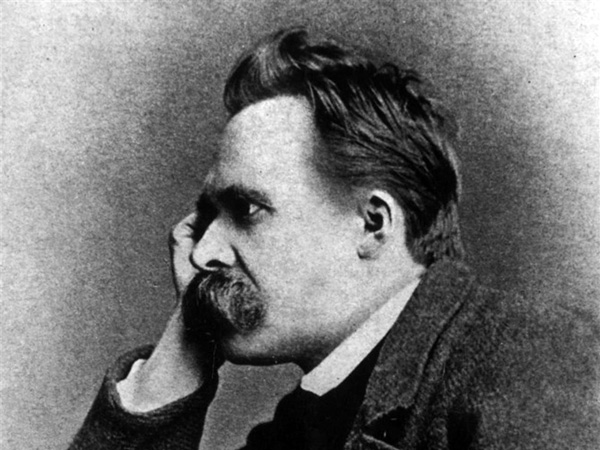
Friedrich Nietzsche (October 15, 1844–August 25, 1900), who believed that embracing difficulty is essential for a fulfilling life, considered the journey of self-discovery one of the greatest and most fertile existential difficulties. In 1873, as he was approaching his thirtieth birthday, Nietzsche addressed this perennial question of how we find ourselves and bring forth our gifts in a beautiful essay titled Schopenhauer as Educator (public library), part of his Untimely Meditations.

nietzsche1.jpg?w=680

Nietzsche, translated here by Daniel Pellerin, writes:

2e292385-dc1c-4cfe-b95e-845f6f98c2ec.pngAny human being who does not wish to be part of the masses need only stop making things easy for himself. Let him follow his conscience, which calls out to him: “Be yourself! All that you are now doing, thinking, desiring, all that is not you.”
Every young soul hears this call by day and by night and shudders with excitement at the premonition of that degree of happiness which eternities have prepared for those who will give thought to their true liberation. There is no way to help any soul attain this happiness, however, so long as it remains shackled with the chains of opinion and fear. And how hopeless and meaningless life can become without such a liberation! There is no drearier, sorrier creature in nature than the man who has evaded his own genius and who squints now towards the right, now towards the left, now backwards, now in any direction whatever.

Echoing Picasso’s proclamation that “to know what you’re going to draw, you have to begin drawing,” Nietzsche considers the only true antidote to this existential dreariness:

2e292385-dc1c-4cfe-b95e-845f6f98c2ec.pngNo one can build you the bridge on which you, and only you, must cross the river of life. There may be countless trails and bridges and demigods who would gladly carry you across; but only at the price of pawning and forgoing yourself. There is one path in the world that none can walk but you. Where does it lead? Don’t ask, walk!

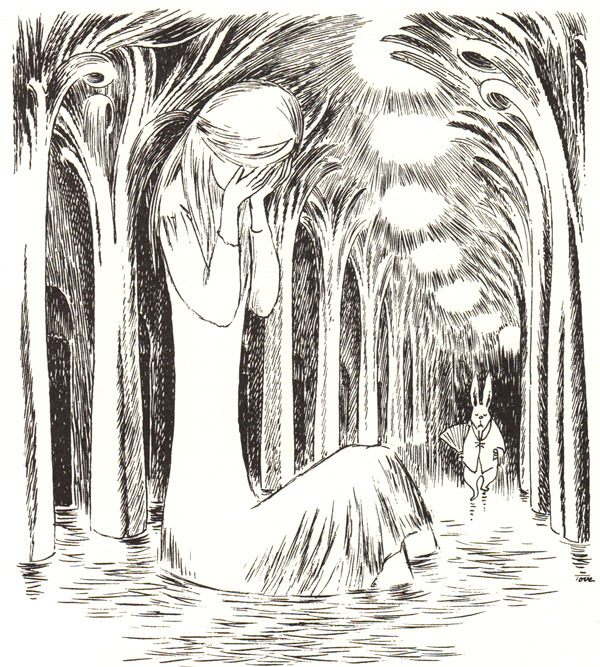
tovejansson_alice3.jpg

Illustration by Tove Jansson for a rare edition of Alice in Wonderland.

But this path to finding ourselves, Nietzsche is careful to point out, is no light stroll:

2e292385-dc1c-4cfe-b95e-845f6f98c2ec.pngHow can man know himself? It is a dark, mysterious business: if a hare has seven skins, a man may skin himself seventy times seven times without being able to say, “Now that is truly you; that is no longer your outside.” It is also an agonizing, hazardous undertaking thus to dig into oneself, to climb down toughly and directly into the tunnels of one’s being. How easy it is thereby to give oneself such injuries as no doctor can heal. Moreover, why should it even be necessary given that everything bears witness to our being — our friendships and animosities, our glances and handshakes, our memories and all that we forget, our books as well as our pens. For the most important inquiry, however, there is a method. Let the young soul survey its own life with a view of the following question: “What have you truly loved thus far? What has ever uplifted your soul, what has dominated and delighted it at the same time?” Assemble these revered objects in a row before you and perhaps they will reveal a law by their nature and their order: the fundamental law of your very self. Compare these objects, see how they complement, enlarge, outdo, transfigure one another; how they form a ladder on whose steps you have been climbing up to yourself so far; for your true self does not lie buried deep within you, but rather rises immeasurably high above you, or at least above what you commonly take to be your I.

mrgauguinsheart3.jpg?w=600

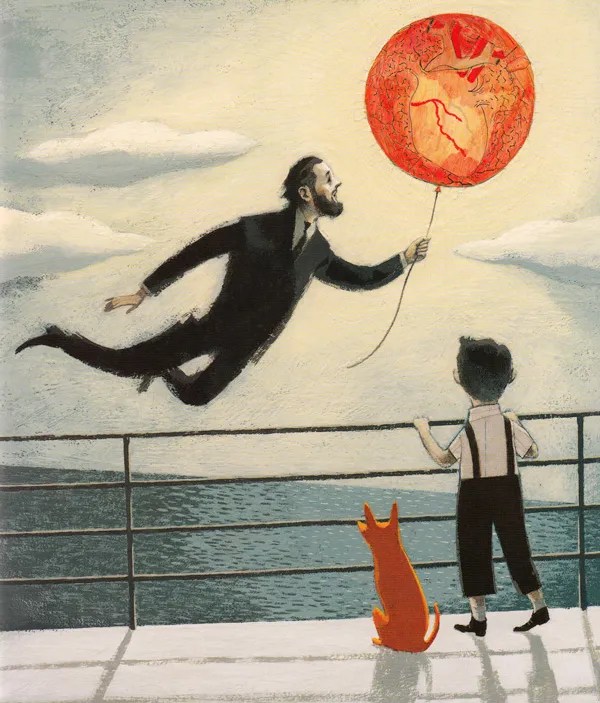
Art by Isabelle Arsenault from Mr. Gauguin’s Heart.

With this, Nietzsche turns to the true role of education in the excavation of this true self — something Parker Palmer addressed a century later in his beautiful meditation on education as a spiritual journey — and writes:

2e292385-dc1c-4cfe-b95e-845f6f98c2ec.pngYour true educators and cultivators will reveal to you the original sense and basic stuff of your being, something that is not ultimately amenable to education or cultivation by anyone else, but that is always difficult to access, something bound and immobilized; your educators cannot go beyond being your liberators. And that is the secret of all true culture: she does not present us with artificial limbs, wax-noses, bespectacled eyes — for such gifts leave us merely with a sham image of education. She is liberation instead, pulling weeds, removing rubble, chasing away the pests that would gnaw at the tender roots and shoots of the plant; she is an effusion of light and warmth, a tender trickle of nightly rain…

In a sentiment that calls to mind David Foster Wallace’s superb commencement address on the true value of education, Nietzsche concludes:

2e292385-dc1c-4cfe-b95e-845f6f98c2ec.pngThere may be other methods for finding oneself, for waking up to oneself out of the anesthesia in which we are commonly enshrouded as if in a gloomy cloud — but I know of none better than that of reflecting upon one’s educators and cultivators.

Complement the altogether fantastic Schopenhauer as Educator with Nietzsche on the power of music and his ten rules for writers, then revisit Florence King on how to find yourself and Parker Palmer on how to let your life speak.

It’s not politics or religion separating humans from each other; it’s shame

Feb 26, 2019  (ted.com)

But there’s good news: the internet can help us dissolve these feelings and create new bonds of solidarity, says media theorist Douglas Rushkoff.

Once, after delivering a lecture at Berkeley in the 1960s, a psychologist took questions from the audience. A young woman stood up to explain that she understood the deep connection between people and the collective responsibility that we all shared for the world, but she didn’t know what to do next. The psychologist answered, “Find the others.”

In this day and age, how do we “find the others” — that is, find the people with whom we can connect more directly? We can start by opposing all of the conventions, institutions, technologies and mindsets that keep us apart and by restoring the social connections that make us fully functioning humans. But while challenging overt methods of separation is straightforward, our internalized obstacles to connection are more embedded and pernicious. And they all tend to have something to do with shame.

The social convention of hiding one’s wealth or lack of it has less to do with protecting one another’s feelings than protecting the power of our superiors.

For instance, we’re trained from an early age not to talk about money. Our salaries and savings are considered to be as private as our medical histories. This habit has its roots in the ascent of former peasants. When the aristocracy realized they could no longer keep ahead of the rising middle class, they sought non-monetary methods of indicating status, such as nobility of birth. Unable to keep up with bourgeois styles of dress or home decor, aristocrats pushed for less ornate aesthetics. As a result, it became classy to hide one’s wealth, rather than display it.

It’s still considered rude to ask someone how much money they make. In certain situations, we’re embarrassed if we make too little; in others, we’re ashamed if we make too much. But the whole social convention of hiding one’s wealth or lack of it has less to do with protecting one another’s feelings than protecting the controlling power of our superiors.

So, the boss gives you a salary increase — just as long as you don’t tell anyone else about it. Because if you do, everyone else will be asking for the same thing. But maintaining the secret puts you in cahoots with management, submitting to the same dynamic as an abused child who is paid in candy to keep quiet. The bribe is a bond based in shame, and the bond is broken only when the victim finds others in whom to confide — often people who’ve experienced the same abuse. Real power comes when we’re ready to say it out loud, as a movement of people opposing such abuse.

Likewise, the power of unions doesn’t just lie in collective bargaining but in the collective sensibility that unionizing engenders. The crosstalk between workers can break up management’s efforts to make them compete with one another over scraps. That’s why taxi apps and internet errand platforms don’t have features that allow workers to converse about their experiences. Crosstalk breeds solidarity, and solidarity breeds discontent.

The things people do become normal when they can’t be shamed into silence about doing them.

Religions, cults, governments, and social media platforms all use the same tactics to control members: they learn an individual’s secrets, sexual proclivities, or identity issues, and threaten to use this information against them. Some cults use lie detectors to drill down into their targets’ most shameful truths, technologies that are updated versions of the confessionals once used by churches to blackmail wealthy parishioners or to shame the poor ones into exploitative compliance. The happy explosion of new genders, racial identities, and disability intersections flies in the face of social programming designed to stigmatize differences and disadvantage those labeled outsiders.

Shaming those who deviate from the norm helps galvanize unity among the group and enforce adherence to the rules. Frat houses shame new recruits into macho antics, just as pious hypocrites shame their followers into obedience. In more prosocial hands, the same tactics can be used by schools to stigmatize bullying or by environmentalists to punish polluters. But the problem is that people and institutions behaving destructively are not so vulnerable to shame. Bullies are proud of their conquests, and corporations experience no emotions.

Social shame only truly hurts humans who are being human. It is a counterproductive way of bonding people. Human teams should be based on common hopes, needs, strengths and vulnerabilities. The internet, with its sometimes forced transparency, creates possibilities for the dissolution of shame and for new bonds of solidarity across formerly impenetrable boundaries. It’s no coincidence that a digital culture with imposed surveillance and inescapable exposure has also brought us gay marriage and cannabis reform. The things people do become normal when they can’t be shamed into silence about doing them.

Experiments have revealed that after just a few moments of awe, some people behave with increased altruism, cooperation and self-sacrifice.

Once we dispense with shame, we are liberated to experience the full, sacred, unlikely wackiness of being human. We are confident enough to leave the safety of the private computer simulation and jump into the wet chaos of social intimacy. Instead of marveling at the granularity of a VR world or the realism of a robot’s facial expression, we open our senses to the taste of the breeze or the touch of a lover. We exchange the vertigo of the uncanny valley for the exhilaration of awe.

The state of awe may be the pinnacle of human experience; it’s what lies beyond the paradox. If humans’ unique job in nature is to be conscious, what more human thing can we do than blow our minds? Beholding the panoramic view from a mountaintop, witnessing the birth of a child, staring into a starry sky, or standing with thousands of others in march or celebration — all dissolve the sense of self as separate and distinct. We experience ourselves as both the observing eye and the whole of which we are a part. It’s an impossible concept, yet an undeniable experience of power and passivity, awareness and acceptance.

Psychologists tell us that the experience of awe can counteract self-focus, stress, apathy and detachment. Awe helps people act with an increased sense of meaning and purpose, turning our attention away from the self and toward our collective self-interest. Experiments have revealed that after just a few moments of awe, some people behave with increased altruism, cooperation and self-sacrifice. The evidence suggests that awe makes people feel like part of something larger than themselves, which in turn makes them less narcissistic and more attuned to the needs of those around them.

Unfortunately, opportunities to experience awe are becoming more scarce. People spend less time camping or in nature, the night sky is polluted with light, and participation in the arts and culture is down. Art and outdoors classes in public schools have been jettisoned in favor of those that prepare students for the standardized tests on which schools are judged. There are no easy metrics for awe.

Once burned by someone manipulating awe, we become jaded and cynical as a defense against being wonderstruck.

Like any extreme state of being, awe can also be exploited. Movies use special effects and giant spectacles to leverage this feeling at specific moments in a story arc. Dictators hold huge rallies to exhilarate followers, while avoiding reasoned debate. Even shopping malls attempt to generate a sense of awe with high ceilings and giant fountains.

For a moment, awe overwhelms the senses and wipes the mind clean, making it more open to input. This helps a person take in new information but also renders them more vulnerable to manipulation. Once burned by someone manipulating awe, we are twice shy to open ourselves to it again. We become jaded and cynical as a defense against being wonderstruck.

Still, just because awe can be abused doesn’t mean we should give up on its humanizing potential. There is a difference between real awe and manipulated excitement — between staring out onto the expanse of the Grand Canyon and standing in a sea of true believers at a nationalist rally. Manufactured awe doesn’t unify; it divides us into individual consumers or followers. We become fragmented, each imagining our own relationship to Dear Leader.

True awe, on the other hand, comes with no agenda. It’s not directed toward some end or plan or person; there’s no time limit or foe to vanquish. There is no “other.” True awe is timeless, limitless and without division. It suggests there is a unifying whole to which we all belong — if only we could hold onto that awareness.

Excerpted from the new book Team Human by Douglas Rushkoff. Copyright © 2019 by Douglas Rushkoff. Reprinted by permission of W.W. Norton & Company. All rights reserved.

Watch his TED Salon: Samsung talk here:

Catholic Church Brings In New Perspective On Solving Abuse Scandal With Appointment Of Toddler Bishop

February 26, 2019 (theonion.com)

VATICAN CITY—Hoping to gain new insights into the church’s sexual abuse problem by directly empowering those most likely to become its victims, Pope Francis announced Tuesday that he had elevated a 2-year-old boy to the position of bishop. “We’re confident Bishop Timmy can help us make real, systemic progress in addressing this issue,” the pope said following the toddler’s ordination mass, during which the new bishop drank from a chalice of consecrated Juicy Juice and was given liturgical vestments that included both a white linen snap-bottom onesie and a too-large mitre that kept slipping down his forehead. “For years, we’ve ignored the needs of these poor children, and now it’s time to give them a real voice within the clergy. His Excellency Timmy, who can speak at least 50 words and reproduce the sounds made by many of God’s creatures, will be that voice. I’m pleased to report several older clergymen have already volunteered to provide our youngest-ever bishop with one-on-one attention to ensure he is fully prepared for the role.” At press time, the new bishop was reportedly turning heads at the Vatican with his controversial decision to chew on a nearby crucifix.

Your Horoscopes — Week Of February 26, 2019 (theonion.com)

Pisces | Feb. 19 to March 20

You will be suddenly struck by the realization that there is no meaning to the universe save that we make, and that all human love is merely sexuality in disguise, but then you’ll be struck with the realization that some jalapeño poppers would be great about now.

Aries | March 21 to April 19

Your plans for an exciting weekend will be spoiled when a busybody scientist decides he just has to ask you why you want all that plutonium.

Taurus | April 20 to May 20

It will seem as if you’ve finally received divine evidence of your Christlike nature, but it turns out all women bleed like that.

Gemini | May 21 to June 20

Remember: The patient raindrops can eventually wear away even the hardest stone. Don’t let them get to close if you value your life.

Cancer | June 21 to July 22

You’ve always been afraid of someone washing your mouth out with soap, but that was before you learned they made a special mouth-soap in the form of a minty paste.

Leo | July 23 to Aug. 22

By this time next year, you’ll be $400,000 richer, two cars the better, and just as gullible as you are now.

Virgo | Aug. 23 to Sept. 22

Sometimes in life, you just have to march right in there, introduce yourself, fight off a couple of rather large security guards, and demand a raise.

Libra | Sept. 23 to Oct. 22

While there’s no shame in admitting you don’t know everything, there’s actually quite a lot of shame in admitting you can’t figure out how to eat chips and salsa.

Scorpio | Oct. 23 to Nov. 21

Your two-pack-a-day habit will finally kill you this week, but then, that’s a lot of wolves to fight off.

Sagittarius | Nov. 22 to Dec. 21

Help out your friends and relatives with a sensitive issue this week. Clearly label all your worldly possessions with the name of the intended recipient by about 8:15 p.m. on Friday night.

Capricorn | Dec. 22 to Jan. 19

All of your questions will be answered this week moments after the zookeeper, the fire marshal, and the roller coaster operator all tell you, “No.”

Aquarius | Jan. 20 to Feb. 18

The attention is nice and all, but in the end, you put your pants on just like everyone else: One multi-million-dollar cybernetic leg at a time.

Consciousness, sexuality, androgyny, futurism, space, the arts, science, astrology, democracy, humor, books, movies and more