I’ve lost interest in the old philosophers and prefer a fresh approach . . . . best reflected in the Process Philosophy of Alfred North Whitehead. Whitehead’s thought is similar to the foundations of Quantum Physics. In fact, I can write a short description that applies equally to both:
Whereas Newtonian physics proposes actual physical particles in which various characteristics inhere, Quantum Physics and Process Philosophy propose that particles are occasions of characteristics that arise mutually with their environment. This is also David Bohm’s view in his Implicate and Explicate order (Wholeness and The Implicate Order), the explicate being the appearance of a particle, the implicate being the omnipresent field from which the explicate arises, leading ultimately to the theory of the universe as holographic (Michael Talbot)
.
But I believe that all of the above consists of and emerges from consciousness, each being a unique vortex of thought in consciousness, which, if brought into alignment and harmony with principle (of which mathematics is only one facet) is revealed to be Infinite Intelligence or Infinite Mind (New Thought) which altogether can result in a transformation in what appears to be external and material. There is no matter, all simply being either what arises from erronious beliefs in separation and limitation, or what arises from the realization of infinite oneness; usually being some mixture of the two.
.
That’s it. It’s pretty much my whole philosophy, over and above what I write about in my book Ontological Mysticism.
And today the creator and CEO of Facebook, Mark Zuckerberg, made an eight and a half minute video about Facebook’s involvement in international politics:
The Sun is the source of the overwhelming majority of light, heat, and energy on Earth’s surface, and is powered by nuclear fusion. But less than half of that, surprisingly, is the fusion of hydrogen into helium. Public domain image.
The Sun’s Energy Doesn’t Come From Fusing Hydrogen Into Helium (Mostly)
It does undergo nuclear fusion, but there are more reactions and more energy released from reactions other than H → He.
“The sun is a miasma
Of incandescent plasma
The sun’s not simply made out of gas
No, no, no
The sun is a quagmire
It’s not made of fire
Forget what you’ve been told in the past” –They Might Be Giants
If you start with a mass of hydrogen gas and bring it together under its own gravity, it will eventually contract once it radiates enough heat away. Bring a few million (or more) Earth masses’ worth of hydrogen together, and your molecular cloud will eventually contract so severely that you’ll begin to form stars inside. When you pass the critical threshold of about 8% our Sun’s mass, you’ll ignite nuclear fusion, and form the seeds of a new star. While it’s true that stars convert hydrogen into helium, that’s neither the greatest number of reactions nor the cause of the greatest energy release from stars. It really is nuclear fusion that powers the stars, but not the fusion of hydrogen into helium.
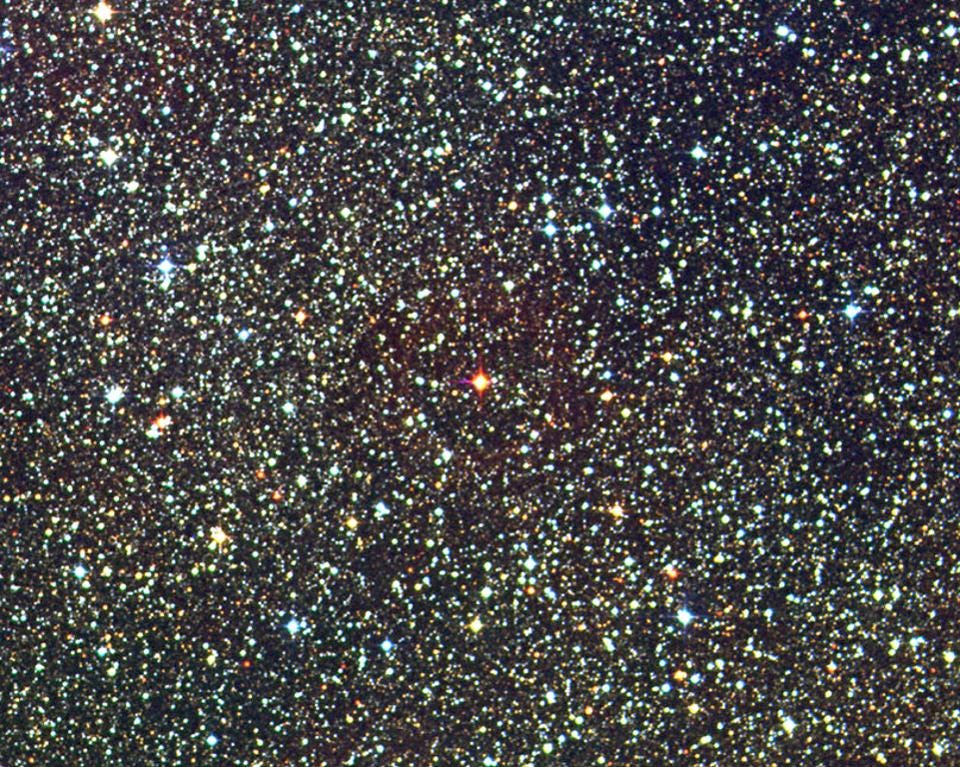
A portion of the digitized sky survey with the nearest star to our Sun, Proxima Centauri, shown in red in the center. While sun-like stars like our own are considered common, we’re actually more massive than 95% of stars in the Universe, with a full 3-out-of-4 stars in Proxima Centauri’s ‘red dwarf’ class. Image credit: David Malin, UK Schmidt Telescope, DSS, AAO.
All stars, from red dwarfs through the Sun to the most massive supergiants, achieve nuclear fusion in their cores by rising to temperatures of 4,000,000 K or higher. Over large amounts of time, hydrogen fuel gets burned through a series of reactions, producing, in the end, large amounts of helium-4. This fusion reaction, where heavier elements are created out of lighter ones, releases energy owing to Einstein’s E = mc2. This occurs because the product of the reaction, helium-4, is lower in mass, by about 0.7%, than the reactants (four hydrogen nuclei) that went into creating it. Over time, this can be significant: over its 4.5 billion year lifetime thus far, the Sun has lost approximately the mass of Saturn through this process.
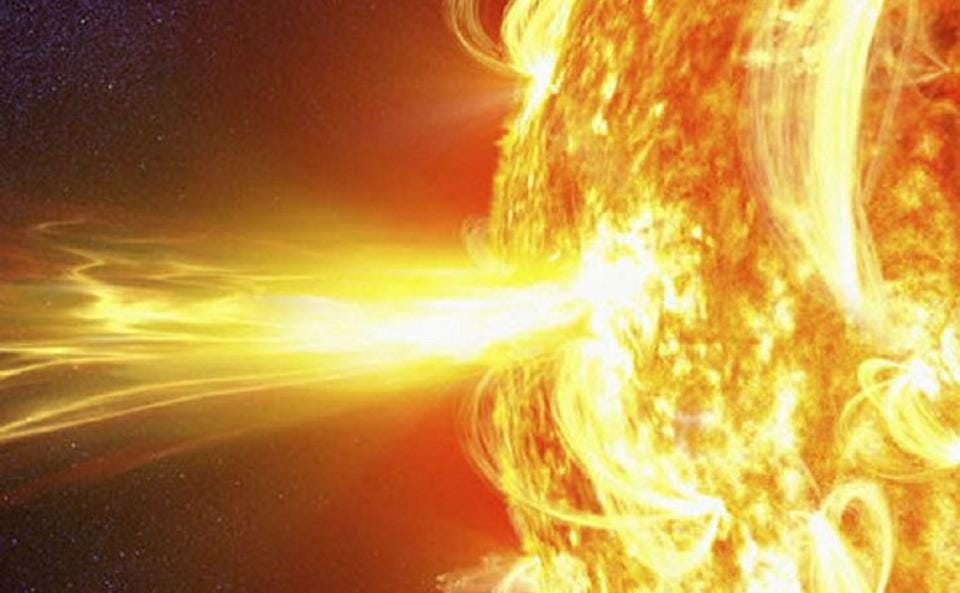
A solar flare from our Sun, which ejects matter out away from our parent star and into the Solar System, is dwarfed in terms of ‘mass loss’ by nuclear fusion, which has reduced the Sun’s mass by a total of 0.03% of its starting value: a loss equivalent to the mass of Saturn. Image credit: NASA’s Solar Dynamics Observatory / GSFC.
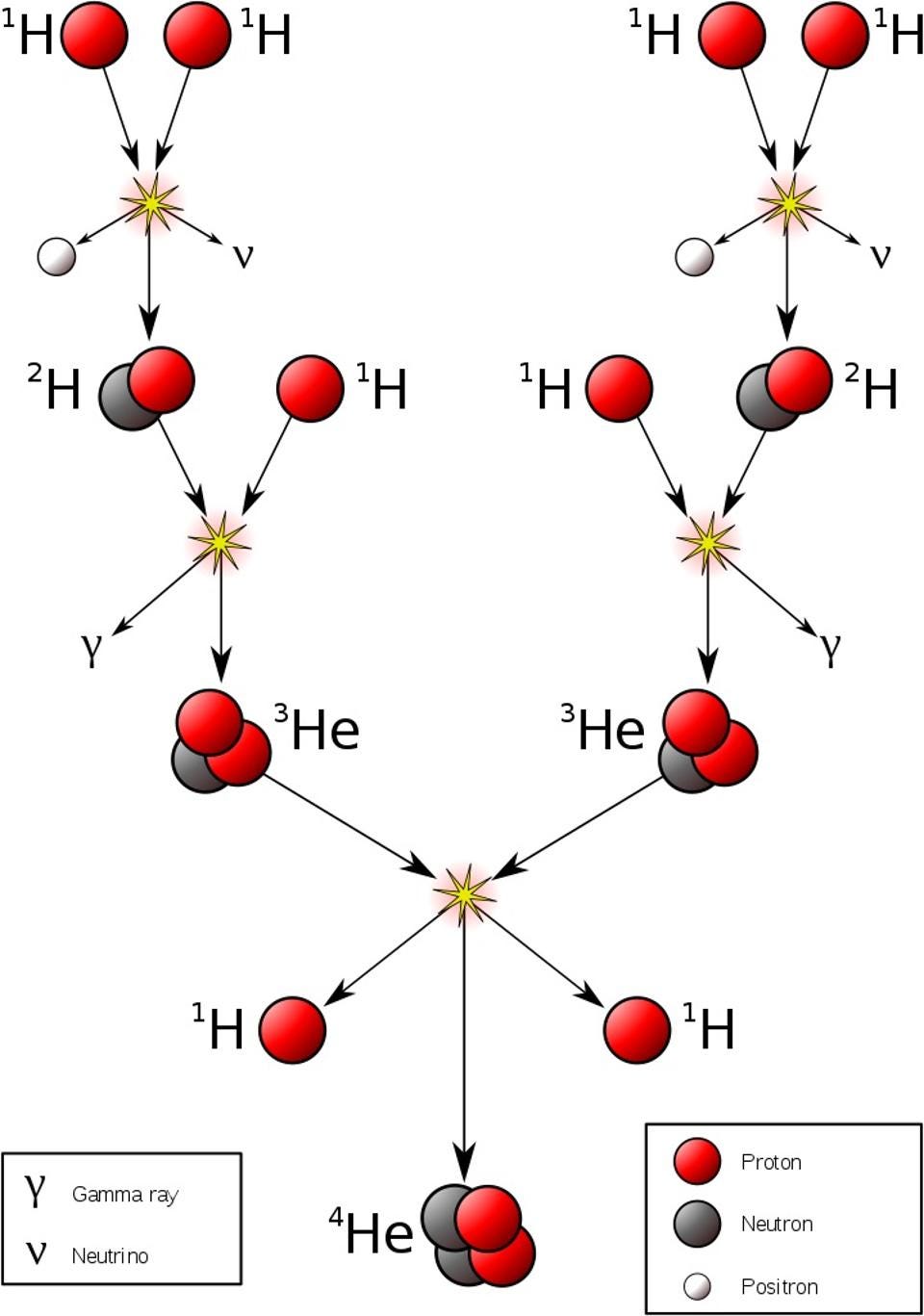
But the way it gets there is complicated. You can never have more than two objects collide-and-react at once; you can’t simply put four hydrogen nuclei together and turn them into a helium-4 nucleus. Instead, you need to go through a chain reaction to build up to helium-4. In our Sun, that involves a process called the proton-proton chain, where:
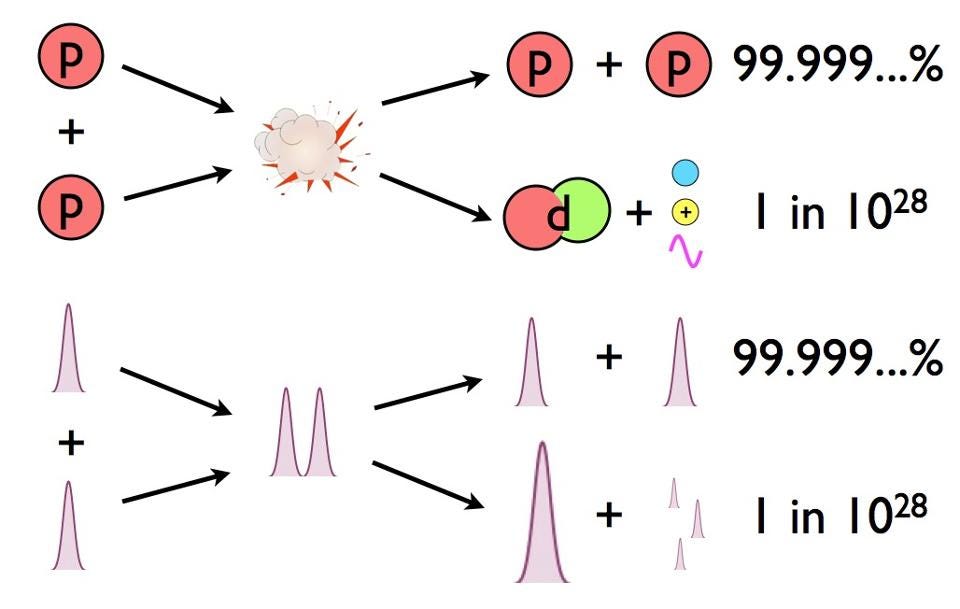
Two protons fuse together to form a diproton: a highly-unstable configuration where two protons temporarily create helium-2,
A tiny fraction of the time, one-in-10,000,000,000,000,000,000,000,000,000 times, that diproton will decay to deuterium, a heavy isotope of hydrogen,
And it happens so quickly that humans, who can only view the initial reactants and the final products, the diproton lifetime is so small that they’d only see two protons fuse either scatter off of each other, or fuse into a deuteron, emitting a positron and a neutrino.
When two protons meet each other in the Sun, their wavefunctions overlap, allowing the temporary creation of helium-2: a diproton. Almost always, it simply splits back into two protons, but on very rare occasions, a deuteron (hydrogen-2) is produced. Image credit: E. Siegel / Beyond The Galaxy.
Then that deuteron can easily combine with another proton to fuse into helium-3, a much more energetically favorable (and faster) reaction,
And then that helium-3 can proceed in one of two ways:
It can either fuse with a second helium-3, producing a helium-4 nucleus and two free protons,
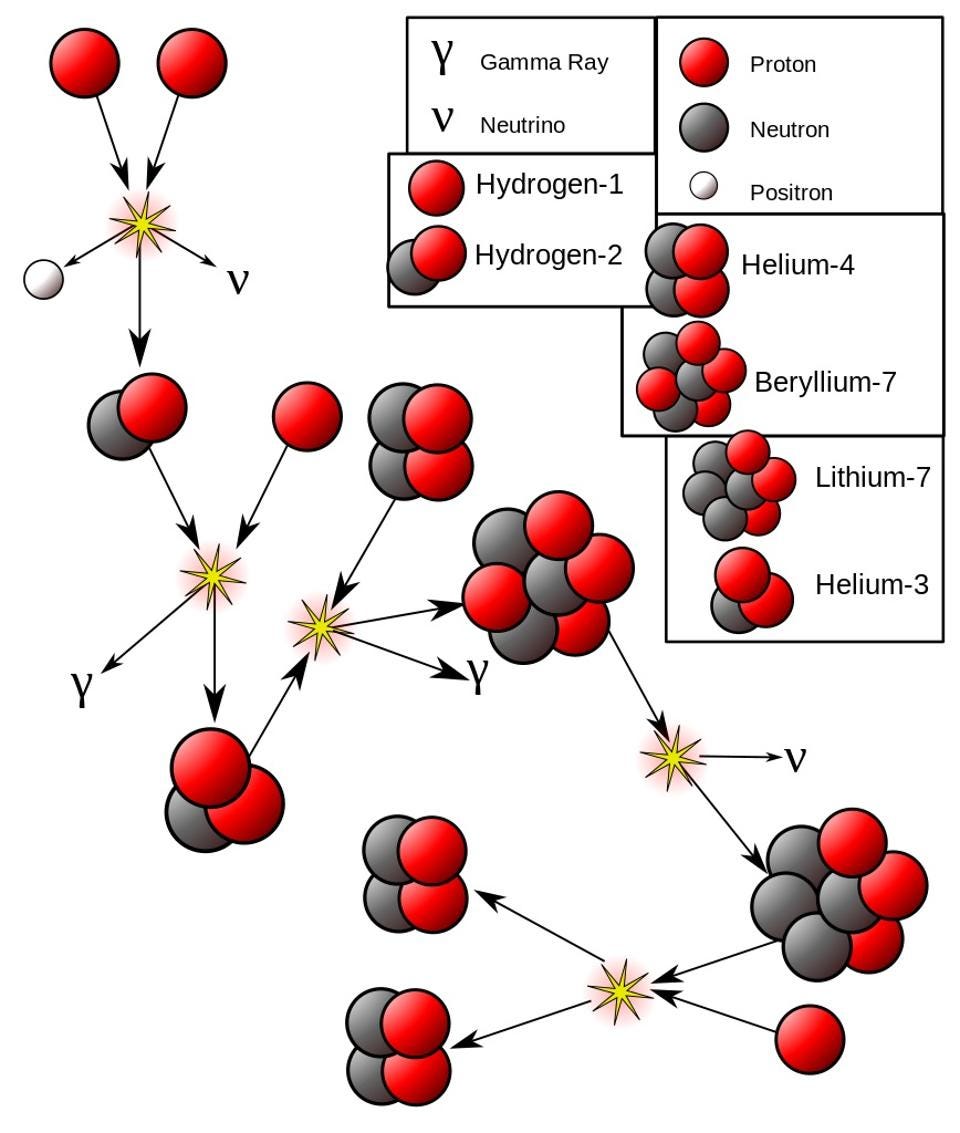
The most straightforward and lowest-energy version of the proton-proton chain, which produces helium-4 from initial hydrogen fuel. Note that only the fusion of deuterium and a proton produces helium from hydrogen; all other reactions either produce hydrogen or make helium from other isotopes of helium. Image credit: Sarang / Wikimedia Commons.
Or it can fuse with a pre-existing helium-4, producing beryllium-7, which decays to lithium-7, which then fuses with another proton to make beryllium-8, which itself immediately decays to two helium-4 nuclei.
A higher-energy chain reaction, involving the fusion of helium-3 with helium-4, is responsible for 14% of the conversion of helium-3 into helium-4 in the Sun. In more massive, hotter stars, it can dominate. Image credit: Uwe W. and Xiaomao123 / Wikimedia Commons.
So those are the four possible overall steps available to the components that make up then entire “hydrogen fusing into helium” process in the Sun:
Two protons (hydrogen-1) fuse together, producing deuterium (hydrogen-2) and other particles plus energy,
Deuterium (hydrogen-2) and a proton (hydrogen-1) fuse, producing helium-3 and energy,
Two helium-3 nuclei fuse together, producing helium-4, two protons (hydrogen-1), and energy,
Helium-3 fuses with helium-4, producing beryllium-7, which decays and then fuses with another proton (hydrogen-1) to yield two helium-4 nuclei plus energy.
And I want you to note something very interesting, and perhaps surprising, about those four possible steps: only step #2, where deuterium and a proton fuse, producing helium-3, is technically the fusion of hydrogen into helium!
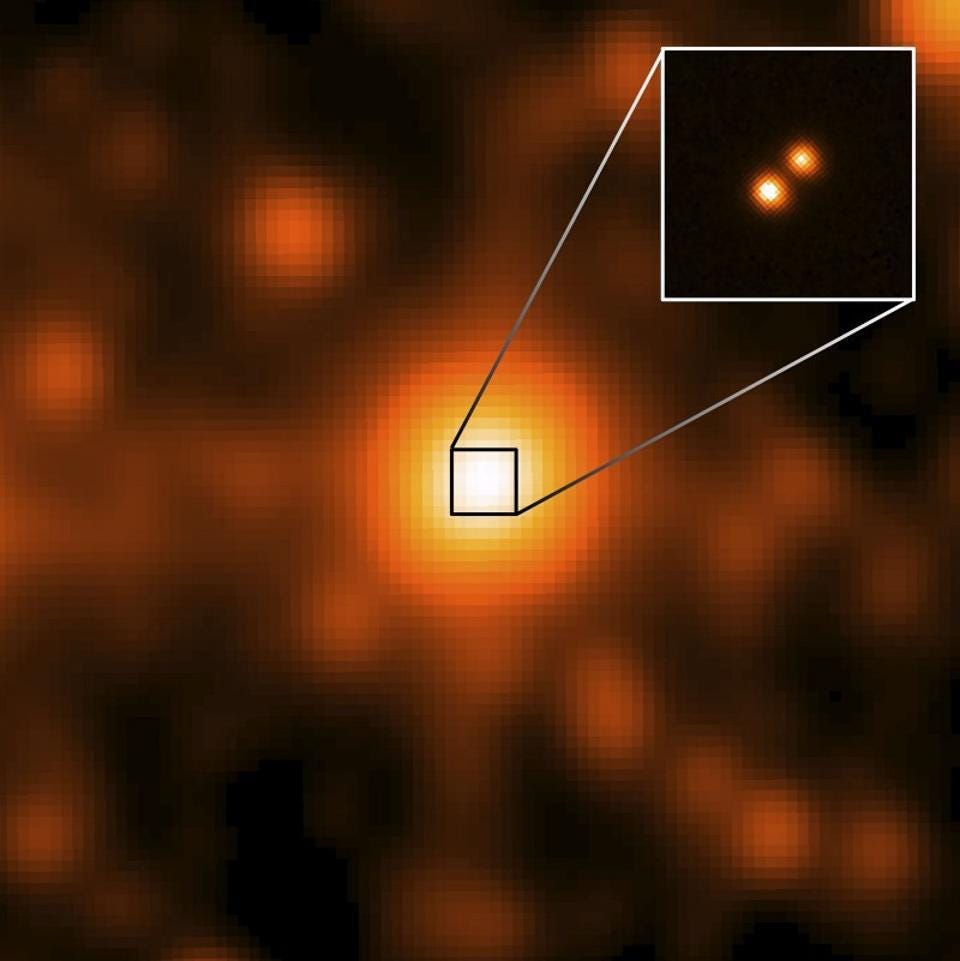
Only brown dwarfs, like the pair shown here, achieve 100% of their fusion energy by turning hydrogen into helium. Because deuterium fusion (deuterium+hydrogen=helium-3) occurs at temperatures of just 1,000,000 K, ‘failed stars’ that don’t reach 4,000,000 K get their energy exclusively from the deuterium they’re formed with. Image credit: NASA/JPL/Gemini Observatory/AURA/NSF.
Everything else either fuses hydrogen into other forms of hydrogen, or helium into other forms of helium. Not only are those steps important and frequent, they’re moreimportant, energetically, and a greater overall percentage of the reactions than the hydrogen-into-helium reaction. In fact, if we look at our Sun, in particular, we can quantify what percentage of energy and of the number of reactions in each step is. Because the reactions are both temperature dependent and some of them (like the fusion of two helium nuclei) require multiple examples of proton-proton fusion and deuterium-proton fusion to occur, we have to be careful to account for all of them.
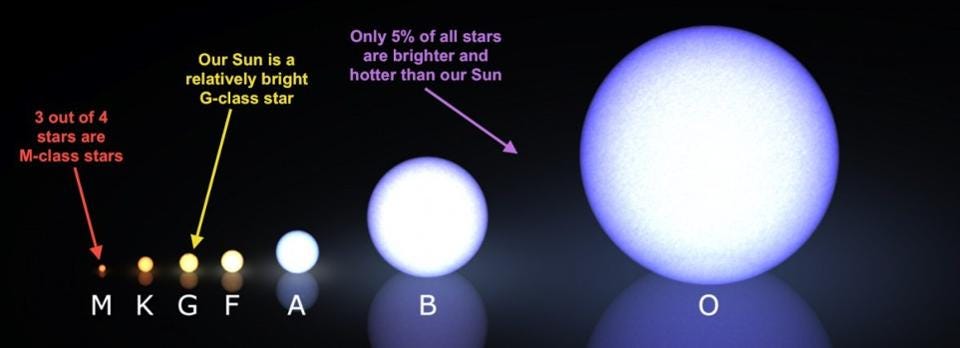
The classification system of stars by color and magnitude is very useful. By surveying our local region of the Universe, we find that only 5% of stars are as massive (or more) than our Sun is. More massive stars have additional reactions, like the CNO cycle and other avenues for the proton-proton chain, that dominate at higher temperatures. Image credit: Kieff/LucasVB of Wikimedia Commons / E. Siegel.
In our Sun, helium-3 fusing with other helium-3 nuclei produces 86% of our helium-4, while the helium-3 fusing with helium-4 through that chain reaction produces the other 14%. (Other, much hotter stars have additional pathways available to them, including the CNO cycle, but those all contribute insignificantly in our Sun.) When we take into account the energy liberated in each step, we find:
Proton/proton fusion into deuterium accounts for 40% of the reactions by number, releasing 1.44 MeV of energy for each reaction: 10.4% of the Sun’s total energy.
Deuterium/proton fusion into helium-3 accounts for 40% of the reactions by number, releasing 5.49 MeV of energy for each reaction: 39.5% of the Sun’s total energy.
Helium-3/helium-3 fusion into helium-4 accounts for 17% of the reactions by number, releasing 12.86 MeV of energy for each reaction: 39.3% of the Sun’s total energy.
And helium-3/helium-4 fusion into two helium-4s accounts for 3% of the reactions by number, releasing 19.99 MeV of energy for each reaction: 10.8% of the Sun’s total energy.
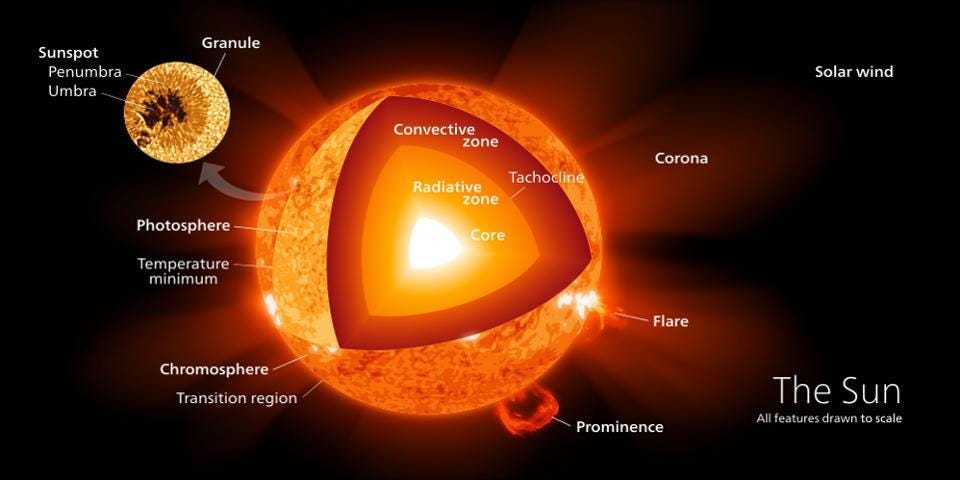
This cutaway showcases the various regions of the surface and interior of the Sun, including the core, which is where nuclear fusion occurs. Although hydrogen is converted into helium, the majority of reactions and the majority of the energy that powers the Sun comes from other sources. Image credit: Wikimedia Commons user Kelvinsong.
It might surprise you to learn that hydrogen-fusing-into-helium makes up less than half of all nuclear reactions in our Sun and that it’s also responsible for less than half of the energy that the Sun eventually outputs. There are strange, unearthly phenomena along the way: the diproton that usually just decays back to the original protons that made it, positrons spontaneously emitted from unstable nuclei, and in a small (but important) percentage of these reactions, a rare mass-8 nucleus, something you’ll never find naturally occurring here on Earth. But that’s the nuclear physics of where the Sun gets its energy from, and it’s so much richer than the simple fusion of hydrogen into helium!
In communicating the progress of scientific theories and tests, experimental results are often presented to the public as concrete and indisputable, therefore proving this-or-that idea. This leads to the common misconception that scientific models can in fact become proven, instead of the more nuanced reality that they are only the most precise (sometimes extremely precise) and accurate models approximating what we can discern, and the very notion of evidence always suggest a degree of interpretation.
The results of quantum entanglement experiments are a case-in-point. The results of data from particle accelerators to optical Bell tests (experiments that test entanglement) are statistical, such that conclusions are drawn based on the probability of a series of measurements being random or “true signals”. This goes for detection of Higgs, W, and Z bosons as well as whether two particles are so strongly correlated that they violate local-realism. Because evidence regarding the latter example have serious implications for the underlying nature of reality (implying that “things” are either fundamentally nonlocal or a probabilistic superposition) the results are strongly questioned.
This stems from the fact that as fallible beings, our experiments are not perfect. There are always a certain degree of underlying assumptions and interpretations of the data. In the case of Bell tests, these are often referred to as “loopholes”. Therefore, while quantum experiments have all produced statistical results strongly supporting nonlocality, state-superposition, and other violations of classical physics (superluminal tunneling, teleportation, etc.) all such experiments have certain loopholes that may be giving false-positive results. Therefore, much work has been done in designing and performing “loophole-free Bell tests”.
Such loophole-free tests have become increasingly sophisticated and have produced strong indication that local-realist theories, also known as local hidden variable theories, are not supported by the evidence. Note that nonlocal-realist theories, like de Broglie-Bohm Pilot wave theory, are still valid interpretations of quantum results.
“The real estate left over for the skeptics of quantum mechanics has shrunk considerably,” says David Kaiser, the Germeshausen Professor of the History of Science and professor of physics at MIT. “We haven’t gotten rid of it, but we’ve shrunk it down by 16 orders of magnitude.” — MIT News, Jennifer Chu
One significant loophole that appears frequently in critiques of quantum experiments regards the idea of free-will, another way in which consciousness becomes an important factor in quantum theory and the objective physical mechanisms of reality. One of those afore-mentioned assumptions in quantum experiments is that the researchers have free-will to decide which variables to test. This may sound strange, but there are several lines of reasoning in science that indicate free-will may be illusionary — that our thoughts and behaviors may be intrinsically deterministic. If this were the case, then experimenters may not be acting of their own stand-alone volition in deciding what variables to test, i.e. decisions are not “random”, and therefore some hidden variable may have been at play that makes a result appear quantum mechanical when it in fact was not.
To obviate this potential problem, physicists have tried to remove the “human element” by using random number generators to decide which property of a putatively entangled quantum particle-pair to measure. Essentially, two entangled particles travel to detectors where a random number generator decides at the last moment which property to measure. This introduced randomness should remove potential pre-determined settings. Yet still, skeptics suggest that perhaps random number generators are not truly random, and again the question of “free will” remains.
To address this, physicists recently used photons from stars 600 light years away, so that the starlight acted as the random number generator. This experimental design comes from the idea that it is unlikely that an experimenter’s choices are at all able to influence photon emission 600 years ago (but again, this is an assumption, and hence another loophole; for example see Wheeler’s delayed choice experiment).
Now, a researcher from the Perimeter Institute who has over 25 years experience working with ideas of human consciousness in quantum mechanics, Dr. Lucien Hardy, has proposed a variation of the freedom-of-choice loophole experiment that would use the gestalt signal from a hundred human minds to make the last-moment decision of which property to test of the entangled particle pairs.
“In this proposal I discuss performing an experiment to test Bell’s inequalities wherein humans are used to change the settings at the two ends. The basic idea is that we perform a Bell experiment over a scale of about 100km and have, at each end, about 100 humans who intervene on the settings via electrical brain activity obtained by electrodes placed on their scalps to intervene on the settings (as is done in recording an electroencephalogram (EEG)). We want to have a large number of cases where the setting has been changed by human interventions at both ends while a signal as to the new value of the setting cannot have yet reached the other side. We suggest using EEG brain activity (rather than, for example, pressing a button by hand) to minimize delays. We need the experiment to be over a large distance scale and to have many humans at each end to get a sufficiently high rate that we could expect a significant effect.” — Lucien Hardy, the Perimeter Institute
While the primary purpose of such an experiment would be to test the “quantumness” of correlations, providing another test of whether the violation of local-realism is indeed an intrinsic property of quantum mechanics, the implications of the results would be far-reaching into the nature of human sentience and consciousness in the universe. If it were found that such an experiment does not uphold quantum nonlocality or state superposition, then not only are interpretations of quantum mechanics thrown into question, but it may suggest that human consciousness is something above and beyond the information processing technologies of computers, machines, and random number generators.
From RSF researchers’ work in holofractographic unified field theory, in studies such as the Unified Spacememory Network, we would predict that it is unlikely that such an experiment would in fact find a deviation from what is normally observed in quantum experimentation. The reason for this is two-fold: (1) our analysis of the mechanics underlying most phenomena strongly suggest nonlocality, both temporally and spatially; and (2) we disagree with the hypothesis of Cartesian-duality — that the mind is somehow beyond the physical world — and while having many transcendental properties is nevertheless an intrinsic and integral aspect of the natural operation of the physical world. Of course, the only way to see whether this prediction is supported or negated is to run the experiment, which we hope will be undertaken!
A group of Mentors came up with the following four questions as a means of probing what is truly vital to us as human beings. So now we all can contemplate the answers we’ve received and see in what ways what we have to offer can connect with what is truly wanted. All ideas are welcome
Exploring the infinite internal universe…Explore an epic online course on unified physics & the universe w/ Nassim Haramein, the Resonance Science Foundation faculty and participants from 77 countries around-the world: The Resonance Academy >>> http://bit.ly/2fCkcIj




In communicating the progress of scientific theories and tests, experimental results are often presented to the public as concrete and indisputable, therefore proving this-or-that idea. This leads to the common misconception that scientific models can in fact become proven, instead of the more nuanced reality that they are only the most precise (sometimes extremely precise) and accurate models approximating what we can discern, and the very notion of evidence always suggest a degree of interpretation.
The results of quantum entanglement experiments are a case-in-point. The results of data from particle accelerators to optical Bell tests (experiments that test entanglement) are statistical, such that conclusions are drawn based on the probability of a series of measurements being random or “true signals”. This goes for detection of Higgs, W, and Z bosons as well as whether two particles are so strongly correlated that they violate local-realism. Because evidence regarding the latter example have serious implications for the underlying nature of reality (implying that “things” are either fundamentally nonlocal or a probabilistic superposition) the results are strongly questioned.
This stems from the fact that as fallible beings, our experiments are not perfect. There are always a certain degree of underlying assumptions and interpretations of the data. In the case of Bell tests, these are often referred to as “loopholes”. Therefore, while quantum experiments have all produced statistical results strongly supporting nonlocality, state-superposition, and other violations of classical physics (superluminal tunneling, teleportation, etc.) all such experiments have certain loopholes that may be giving false-positive results. Therefore, much work has been done in designing and performing “loophole-free Bell tests”.
Such loophole-free tests have become increasingly sophisticated and have produced strong indication that local-realist theories, also known as local hidden variable theories, are not supported by the evidence. Note that nonlocal-realist theories, like de Broglie-Bohm Pilot wave theory, are still valid interpretations of quantum results.
One significant loophole that appears frequently in critiques of quantum experiments regards the idea of free-will, another way in which consciousness becomes an important factor in quantum theory and the objective physical mechanisms of reality. One of those afore-mentioned assumptions in quantum experiments is that the researchers have free-will to decide which variables to test. This may sound strange, but there are several lines of reasoning in science that indicate free-will may be illusionary — that our thoughts and behaviors may be intrinsically deterministic. If this were the case, then experimenters may not be acting of their own stand-alone volition in deciding what variables to test, i.e. decisions are not “random”, and therefore some hidden variable may have been at play that makes a result appear quantum mechanical when it in fact was not.
To obviate this potential problem, physicists have tried to remove the “human element” by using random number generators to decide which property of a putatively entangled quantum particle-pair to measure. Essentially, two entangled particles travel to detectors where a random number generator decides at the last moment which property to measure. This introduced randomness should remove potential pre-determined settings. Yet still, skeptics suggest that perhaps random number generators are not truly random, and again the question of “free will” remains.
To address this, physicists recently used photons from stars 600 light years away, so that the starlight acted as the random number generator. This experimental design comes from the idea that it is unlikely that an experimenter’s choices are at all able to influence photon emission 600 years ago (but again, this is an assumption, and hence another loophole; for example see Wheeler’s delayed choice experiment).
Now, a researcher from the Perimeter Institute who has over 25 years experience working with ideas of human consciousness in quantum mechanics, Dr. Lucien Hardy, has proposed a variation of the freedom-of-choice loophole experiment that would use the gestalt signal from a hundred human minds to make the last-moment decision of which property to test of the entangled particle pairs.
While the primary purpose of such an experiment would be to test the “quantumness” of correlations, providing another test of whether the violation of local-realism is indeed an intrinsic property of quantum mechanics, the implications of the results would be far-reaching into the nature of human sentience and consciousness in the universe. If it were found that such an experiment does not uphold quantum nonlocality or state superposition, then not only are interpretations of quantum mechanics thrown into question, but it may suggest that human consciousness is something above and beyond the information processing technologies of computers, machines, and random number generators.
From RSF researchers’ work in holofractographic unified field theory, in studies such as the Unified Spacememory Network, we would predict that it is unlikely that such an experiment would in fact find a deviation from what is normally observed in quantum experimentation. The reason for this is two-fold: (1) our analysis of the mechanics underlying most phenomena strongly suggest nonlocality, both temporally and spatially; and (2) we disagree with the hypothesis of Cartesian-duality — that the mind is somehow beyond the physical world — and while having many transcendental properties is nevertheless an intrinsic and integral aspect of the natural operation of the physical world. Of course, the only way to see whether this prediction is supported or negated is to run the experiment, which we hope will be undertaken!
Article: https://arxiv.org/pdf/1705.04620.pdf
If you like this content, you will probably like the Resonance Academy.