
All posts by Ben Gilberti
NEW RESULTS FROM THE LARGE HADRON COLLIDER SUGGEST THE POSSIBILITY OF NEW PHYSICS
NEW RESULTS FROM THE LARGE HADRON COLLIDER SUGGEST THE POSSIBILITY OF NEW PHYSICS
During the mid- to late-twentieth century, quantum physicists picked apart the unified theory of physics that Einstein’s theory of relativity offered. The physics of the large was governed by gravity, but only quantum physics could describe observations of the small. Since then, a theoretical tug-o-war between gravity and the other three fundamental forces has continued as physicists try to extend gravity or quantum physics to subsume the other as more fundamental.
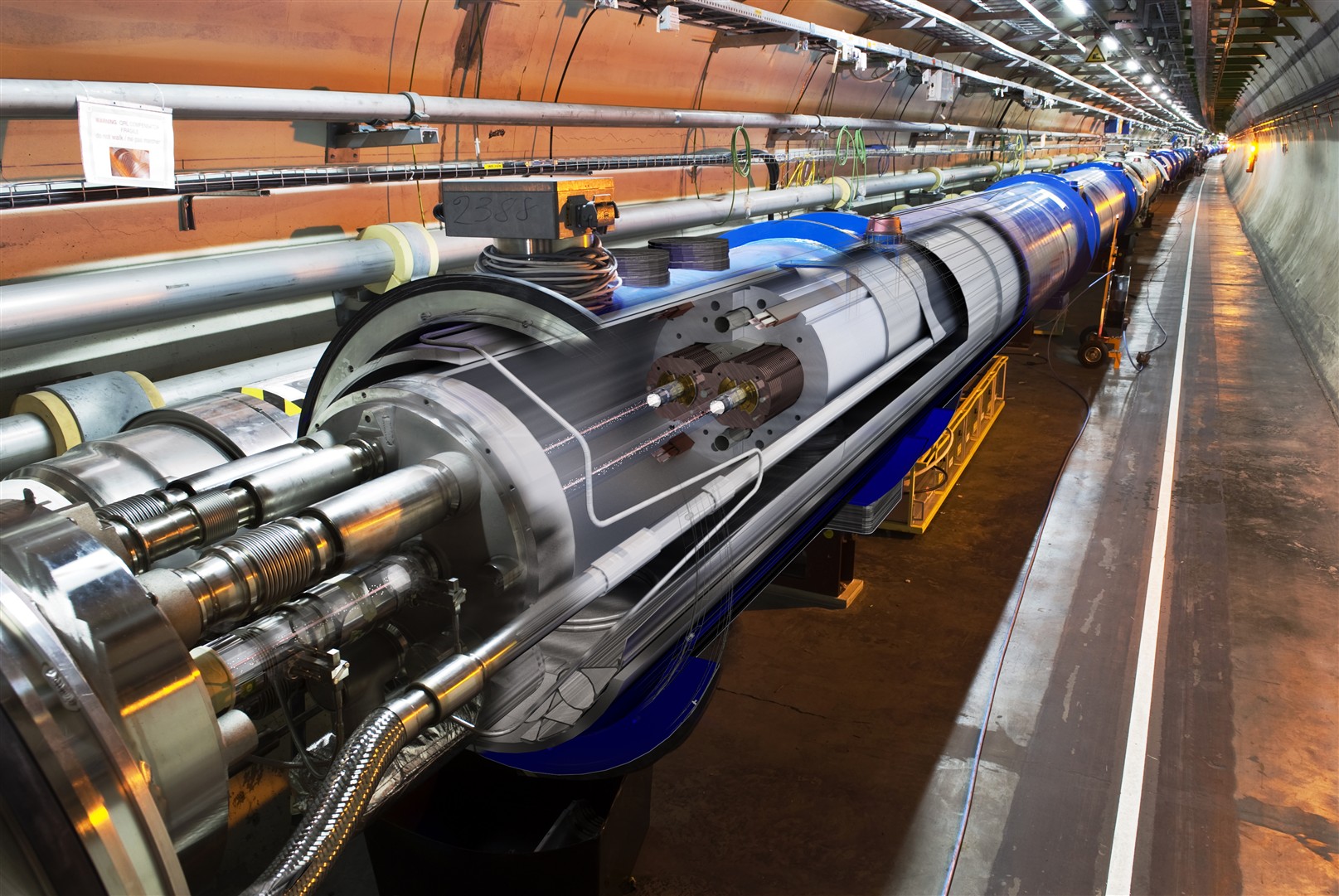
Recent measurements from the Large Hadron Collider show a discrepancy with Standard Model predictions that may hint at entirely new realms of the universe underlying what’s described by quantum physics. Although repeated tests are required to confirm these anomalies, a confirmation would signify a turning point in our most fundamental description of particle physics to date.
Quantum physicists found in a recent study that mesons don’t decay into kaon and muon particles often enough, according to the Standard Model predictions of frequency. The authors agree that enhancing the power of the Large Hadron Collider (LHC) will reveal a new kind of particle responsible for this discrepancy. Although errors in data or theory may have caused the discrepancy, instead of a new particle, an improved LHC would prove a boon for several projects on the cutting edge of physics.

The Standard Model
The Standard Model is a well-established fundamental theory of quantum physics that describes three of the four fundamental forces believed to govern our physical reality. Quantum particles occur in two basic types, quarks and leptons. Quarks bind together in different combinations to build particles like protons and neutrons. We’re familiar with protons, neutrons, and electrons because they’re the building blocks of atoms.
The “lepton family” features heavier versions of the electron — like the muon — and the quarks can coalesce into hundreds of other composite particles. Two of these, the Bottom and Kaon mesons, were culprits in this quantum mystery. The Bottom meson (B) decays to a Kaon meson (K) accompanied by a muon (mu-) and anti-muon (mu+) particle.
The Anomaly
They found a 2.5 sigma variance, or 1 in 80 probability, “which means that, in the absence of unexpected effects, i.e. new physics, a distribution more deviant than observed would be produced about 1.25 percent of the time,” Professor Spencer Klein, senior scientist at Lawrence Berkeley National Laboratory, told Futurism. Klein was not involved in the study.
This means the frequency of mesons decaying into strange quarks during the LHC proton-collision tests fell a little below the expected frequency.
“The tension here is that, with a 2.5 sigma [or standard deviation from the normal decay rate], either the data is off by a little bit, the theory is off by a little bit, or it’s a hint of something beyond the standard model,” Klein said. “I would say, naïvely, one of the first two is correct.”
To Klein, this variance is inevitable considering the high volume of data run by computers for LHC operations. “With Petabyte-(1015 bytes)-sized datasets from the LHC, and with modern computers, we can make a very large number of measurements of different quantities,” Klein said. “The LHC has produced many hundreds of results. Statistically, some of them are expected to show 2.5 sigma fluctuations.” Klein noted that particle physicists usually wait for a 5-sigma fluctuation before crying wolf — corresponding to roughly a 1-in-3.5-million fluctuation in data.

These latest anomalous observations do not exist in a vacuum.
“The interesting aspect of the two taken in combination is how aligned they are with other anomalous measurements of processes involving B mesons that had been made in previous years,” Dr. Tevong You, co-author of the study and junior research fellow in theoretical physics at Gonville and Caius College, University of Cambridge, told Futurism. “These independent measurements were less clean but more significant. Altogether, the chance of measuring these different things and having them all deviate from the Standard Model in a consistent way is closer to 1 in 16000 probability, or 4 sigma,” Tevong said.
Extending the Standard Model
Barring statistical or theoretical errors, Tevong suspects that the anomalies mask the presence of entirely new particles, called leptoquarks or Z prime particles. Inside bottom mesons, quantum excitations of new particles could be interfering with normal decay frequency. In the study, researchers conclude that an upgraded LHC could confirm the existence of new particles, making a major update to the Standard Model in the process.
“It would be revolutionary for our fundamental understanding of the universe,” said Tevong. “For particle physics […] it would mean that we are peeling back another layer of Nature and continuing on a journey of discovering the most elementary building blocks. This would have implications for cosmology, since it relies on our fundamental theories for understanding the early universe,” he added. “The interplay between cosmology and particle physics has been very fruitful in the past. As for dark matter, if it emerges from the same new physics sector in which the Zprime or leptoquark is embedded, then we may also find signs of it when we explore this new sector.”
The Power to Know
So far, scientists at the LHC have only observed ghosts and anomalies hinting at particles that exist at higher energy levels. To prove their existence, physicists “need to confirm the indirect signs […], and that means being patient while the LHCb experiment gathers more data on B decays to make a more precise measurement,” Tevong said. “We will also get an independent confirmation by another experiment, Belle II, that should be coming online in the next few years. After all that, if the measurement of B decays still disagrees with the predictions of the Standard Model, then we can be confident that something beyond the Standard Model must be responsible, and that would point towards leptoquarks or Zprime particles as the explanation,” he added.
To establish their existence, physicists would then aim to produce the particles in colliders the same way Bottom mesons or Higgs bosons are produced, and watch them decay. “We need to be able to see a leptoquark or Zprime pop out of LHC collisions,” Tevong said. “The fact that we haven’t seen any such exotic particles at the LHC (so far) means that they may be too heavy, and more energy will be required to produce them. That is what we estimated in our paper: the feasibility of directly discovering leptoquarks or Zprime particles at future colliders with higher energy.”
Quantum Leap for the LHC
Seeking out new particles in the LHC isn’t a waiting game. The likelihood of observing new phenomena is directly proportional to how many new particles pop up in collisions.
“The more the particle appears the higher the chances of spotting it amongst many other background events taking place during those collisions,” Tevong explained. For the purposes of finding new particles, he likens it to searching for a needle in a haystack; it’s easier to find a needle if the haystack is filled with them, as opposed to one. “The rate of production depends on the particle’s mass and couplings: heavier particles require more energy to produce,” he said.

This is why Tevong and co-authors B.C. Allanach and Ben Gripaios recommend either extending the LHC loop’s length, thus reducing the amount of magnetic power needed to accelerate particles, or replacing the current magnets with stronger ones.
According to Tevong, the CERN laboratory is slated to keep running the LHC in present configuration until mid-2030s. Afterwards, they might upgrade the LHC’s magnets, roughly doubling its strength. In addition to souped-up magnets, the tunnel could see an enlargement from present 27 to 100 km (17 to 62 miles).
“The combined effect […] would give about seven times more energy than the LHC,” Tevong said. “The timescale for completion would be at least in the 2040s, though it is still too early to make any meaningful projections.”
If the leptoquark or Z prime anomalies are confirmed, the Standard Model has to change, Tevong reiterates.
“It is very likely that it has to change at energy scales directly accessible to the next generation of colliders, which would guarantee us answers,” he added. While noting that there’s no telling if dark matter has anything to do with the physics behind Zprimes or leptoquarks, the best we can do is seek “as many anomalous measurements as possible, whether at colliders, smaller particle physics experiments, dark matter searches, or cosmological and astrophysical observations,” he said. “Then the dream is that we may be able to form connections between various anomalies that can be linked by a single, elegant theory.”
~ http://www.sci-techuniverse.com/2017/11/new-results-from-large-hadron-collider.html
The Colonization of the Galaxy
I support a chicken’s right to cross a road without our having to know why.

Nurse Puts Dying Baby Next To Her Twin. She Gives Her A ‘Hug’ That Leads To A Miracle.

Russian Scientists Just Revealed The Most Powerful Discovery In The History Of Mankind
Press Conference about the transmutation of matter in Switzerland
Mentoring

10 SCARIEST THEORIES KNOWN TO HUMANS
10 SCARIEST THEORIES KNOWN TO HUMANS
1. False Vacuum:
This is, in short, a scientific theory that our universe is in fact in a false phase state as part of a bigger universe, like if it were a momentary thing (think the actual universe is a vessel of boiling water, and we are just within a bubble developing at the bottom of the pot). Ultimately though that false vacuum has to pop, even after billions of years in this false state and we and everything we know in our observable universe will vanish in an instant with no warning whatsoever and there is nothing you can do about it.

2. The Great Filter:
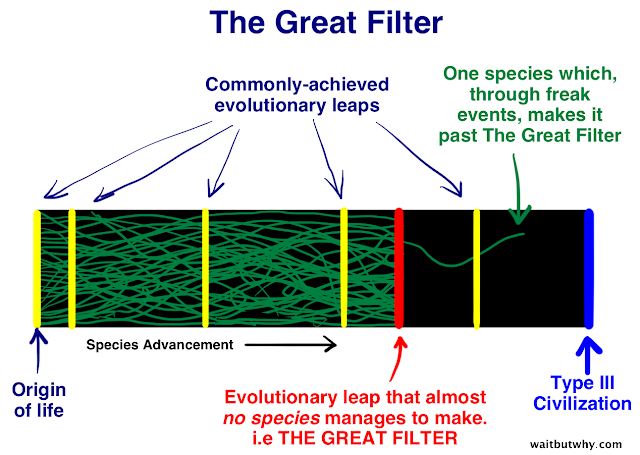
It’s a theory about why the cosmos appears to be filled with potential for life and yet we have not discovered it. It says that somewhere amid pre-life and an advanced civilization that is able to colonize the stars, there is a Great Filter that stops them and ends life. This means we fit into one of these three situations:
- We are exceptional, meaning we have by now passed the Great Filter, unlike other civilizations on other planets.
- We are the first, meaning circumstances in the universe are only now life friendly and we are amongst many on our way to the ability of colonization.
- We have not hit the Filter yet, meaning we are f*cked. If this one is true, it means discovering life or evidence of life on Mars or Europa would be dreadful news as it would nearly surely mean the Filter is still ahead of us instead of behind us.
3. Brain in a Vat
The brain in a vat is an element used in a range of thought experiments projected to draw out certain features of our thoughts of knowledge, reality, truth, mind, and meaning. It assumes the following:
- The brain is the center of all consciousness.
- The brain functions of electrical impulses.
- External motivations can influence the way the brain works.
- Any external incentives to the brain can be simulated to a degree that the brain can’t differentiate these simulated stimuli from natural stimuli.
The point is that you could be a brain in a jar, being fed false impulses for your whole life by an external source, or you (still a brain in a vat) could be hallucinating your whole life from lack of stimuli.

4. Higher Dimensional Beings:
Visualize if there was a 2D person. If you gaze at them in a specific way, they can’t see you. All you have to do is look from a top view and they would not know you are there, and they would never know. Living their life as 2D, they would never be capable of comprehending how something could be viewing down on them.
Now visualize a 4D person. They could be observing you from a 4-dimensional angle, an angle that you will never comprehend. They could be right alongside you, but you would not know, and you would never know. Just as we could interact with the 2D person, the 4D person could interact with us. But as long as they do not want us to, we could never interrelate with them or not even know of them.

5. Fermi Paradox:
Let’s say we there is an ant hill in the mid of the forest. And right next to the ant hill, we are constructing a ten-lane super-highway. And the question is “Would the ants be capable of comprehending what a ten-lane super-highway is? Would the ants be capable of comprehending the technology and the purposes of the beings constructing the highway next to them?
So it is not that we cannot pick up the signals from Planet X using our technology, it is that we cannot even understand what the beings from Planet X are or what they are trying to do. It is so beyond us that even if they actually wanted to educate us, it would be like trying to teach ants about the internet.
When Pizarro entered into Peru, did he stop for a while at an anthill to attempt to communicate? Was he generous, trying to help the ants in the anthill? Did he become aggressive and slow his original mission down in order to smash the anthill apart? Or was the anthill of complete and utter and eternal insignificance to Pizarro? That might be our condition here.
6. Roko’s Basilisk:
Roko’s basilisk is a proposal that states an all-powerful artificial intelligence from the future may retroactively punish those who did not contribute in bringing about its existence. It looks like a futurist form of Pascal’s wager; an argument proposing that people should take into account specific singularitarian ideas, or even donate money, by weighing up the view of punishment versus reward. Additionally, the proposition states that only knowing about it incurs the risk of punishment (Now you know about it. You know who to thank while you will be tortured). It is also mixed with an ontological argument, to propose this is even a reasonable threat.

7. Terror Management Theory:
Everything that humankind has ever achieved other than basic survival has been driven by a basic and irreducible fear of non-existence. Our conception of self and self-esteem normally is a buffer against the anxiety that comes with knowing that we will cease to be. Culture is just a massively shared illusion to mitigate our fear of the unknown and eventually of death. Thus we want to visualize certain works of art as timeless or to place value in family lines and offspring, to project ourselves beyond death. We take ease in our value systems and the structures that arise from them, whether that’s through conceptions of biological kinship, national/ political identity, religious faith, etc.
This includes belief in the inherent value of safeguarding the future of humanity by scientific development. Indeed much of modern western life is devoted to the escaping of death, the various euphemisms and stock phrases in mourning, the whole funeral home industry that serves to remove death from the ordinary course of life, from the home and onto the embalming table or into the crematorium. We build up the artifice to evade the brutal truth. In short, everything that we have ever done and will ever do is driven by nothing more than our existential terror in challenging death.

8. Quantum Suicide/Quantum Immortality:
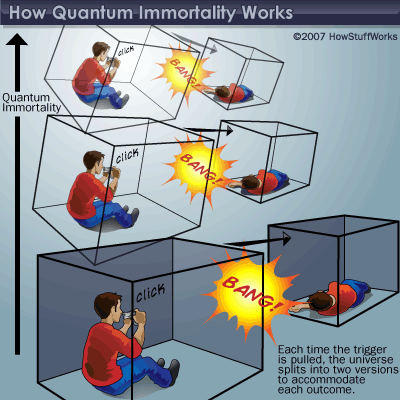
A man sits down before a gun, which is pointed at his head. This is no regular gun; it’s assembled with a machine that calculates the spin of a quantum particle. Each time the trigger is pulled, the spin of the quantum particle — or quark — is calculated. Depending on the measurement, the gun will either fire, or it won’t. If the quantum particle is observed as spinning in a clockwise motion, the gun will fire. If the quark is spinning counterclockwise, the gun won’t go off. There will only be a click.
Anxiously, the man takes a breath and pulls the trigger. The gun clicks. He pulls the trigger again. Click. And again: click. The man will continue to pull the trigger again and again with the same outcome: The gun will not fire. However it is working properly and loaded with bullets, no matter how many times he pulls the trigger, the gun will never fire. He will continue this process for eternity, becoming immortal.
Go back in time to the start of the experiment. The man pulls the trigger for the very first time, and the quark is now measured as spinning clockwise. The gun fires and the man die.
But, wait. The man already pulled the trigger the first time — and an infinite amount of times following that — and we by this time know the gun did not fire. How can the man be dead? The man is unaware, but he is both alive and dead. Each time he pulls the trigger, the cosmos is split in two. It will carry on splitting, again and again, each time the trigger is pulled. This thought experiment is named quantum suicide.
9. Transcension Hypothesis:
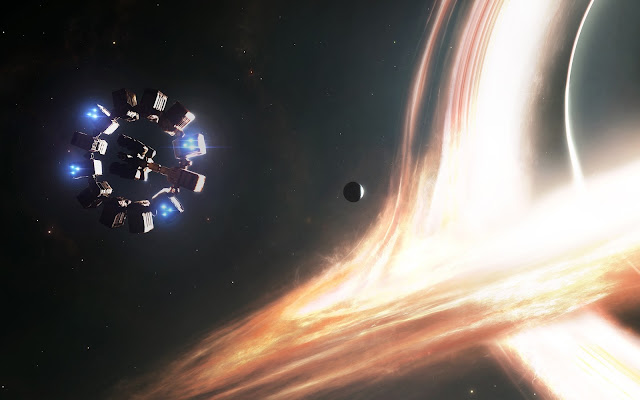
The hypothesis suggests that once civilizations saturate their local area of space with their intelligence, reach microscopic technological singularity, construct a black hole and leave our visible, macroscopic cosmos in order to carry on the exponential growth of complexity and intelligence, and vanish from this universe, thus clarifying the Fermi Paradox. Developments in astrobiology make this a testable hypothesis. It suggests space, time, energy and matter compression, as a driver of accelerating change, which must lead cosmic intelligence to a future of highly-miniaturized, accelerated, and local “transcension” to extra-universal domains, rather than to space-faring expansion within our current universe.
10. Sixth Mass Extinction:
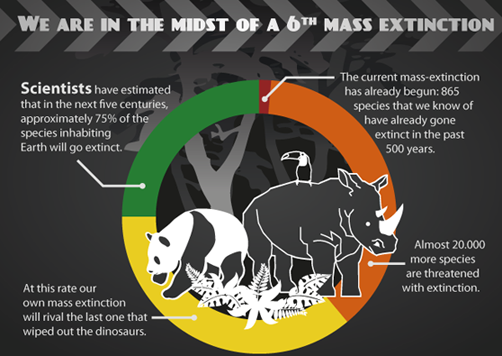
We are at present living through what many biologists consider to be the sixth mass extinction that the world has ever experienced. This is going to be a stimulating puzzle for the species that comes after us. It was not until around the year 1800 that humanity touched a population of 1 billion after thousands and thousands of years. In the 215 years since then, the world population has raised to ~7.2 Billion. That exponential growth has very big and long lasting negative effects on our planet, and will continue to do so until we reach carrying capacity or die off.
~ http://www.sci-techuniverse.com/2015/09/10-scriest-theories-known-to-man.html