
All posts by Ben Gilberti
Human DNA Was Designed by Aliens

Choosing Purpose Over Profit and the Life-Changing Power of a Great Mentor
Why Are Americans Susceptible to Magical Thinking?
by Derek Beres
In a discussion with Larry King, Oprah Winfrey tells his audience that the book, The Secret, offers an essential teaching she’d known since starring in the 1985 movie, The Color Purple: you are responsible for your own life. She explains this by retelling an incident in which she was praying to be picked for the movie at the exact moment Steven Spielberg called.
Winfrey is no newcomer to magical thinking. She’s long promoted it on her show, in her magazine, and with her television network. Besides being a Rhonda Byrnes acolyte, Winfrey gave a platform for Jenny McCarthy to run with disproven vaccination-autism claims and fully endorsed Dr. Oz as he spread pseudoscience on her shows.
Winfrey has certainly been a strong female personality for decades, yet balancing entertainment and reality has long been challenging. Now, after an inspiring monologue at the Golden Globes, she is both being asked to and considering a presidential run in 2020.
That the cult of celebrity has overtaken the American consciousness is not surprising. The last two presidential outcomes produced considerable awe and consternation from the other side: Mitt Romney’s visible shock when conceding to Obama in 2012 and, well, you know the other. Yet a basic understanding of history could have predicted the forces behind both of these elections.
Maybe it’s the problem of manifest destiny: Americans believing we’re endowed with a sacred duty to excel like no other nation in history has fostered all sorts of delusions. Perhaps it’s the disconnect from the reality of war and authoritarianism we have long enjoyed. Our relative comfort has allowed our imaginations to run wild, so run they do. Unchecked fantasies are known to arrive with unforeseen consequences.
There is precedent to our current moment because there’s always been precedent, argues Kurt Andersen in his latest book, Fantasyland: How America Went Haywire. The bestselling author and host of Studio 360 has written an encyclopedic entry into the mayhem of modern America, informing readers that along every step of the way it’s been mayhem, beginning with the very first immigrants.
No, not the pilgrims; the Jamestown colony. The first English settlement was not in Plymouth, as popular lore goes. That distinction goes to a series of gold-seeking groups that unsuccessfully tried to settle in Virginia. Eventually abandoning their dreams of gold—the term “fool’s gold” is derived from their miscalculations—the colonies did eventually thrive with a crop that plagues us to this day: tobacco.
Plymouth isn’t the only myth Andersen dispels in Fantasyland. He spends chapters focused on the nineteen-sixties, an era loathed by fifties-loving conservatives and adored by progressives. Problem is, that era initiated a confluence of forces that allowed magical thinking to dominate in medicine, health, politics, and just about every other field.
This, Andersen told me, is just a continuum that began with an extreme Protestantism that America was founded on, which continues today through a “de-privileging of reason and science over magic and magical thinking and fabulism of every kind.” He continues:
What I call this big bang that happened in the sixties—my argument is that it’s no coincidence that that belief in homeopathy or crystals or Carlos Castenada taking peyote to become a brujo in those best selling series of books, all of the bohemian magic and alternative health practices and so forth, which got going in nineteen-sixties, just as this incredible revival of the most magical and supernaturalist forms of Protestant Christianity came raging back.
It’s not as if the sixties didn’t produce positive benefits, including civil rights, feminism, and environmentalism. Yet the underlying strains of essentialism and dualism required for magical thinking reached new heights in both popular religion and on the fringes. From the looks of 2018, we’re continuing to soar.
Andersen didn’t set out to write Fantasyland because of Trump’s victory. He never suspected it possible, even when the reality show star became the Republican nominee around the time he was finalizing edits of the book. Yet when the election was over Andersen realized he had laid out the perfect blueprint for the manifestation of the idea that a billionaire elitist could win as a populist champion of the working class.
Not that Andersen exclusively blames religion. He’s more aligned with Sam Harris’s evidence-backed spirituality than Richard Dawkins’s hawkish atheism. During our discussion, Andersen is clear to point out that freedom of religion, both as a belief system and a topic of debate, is an essential American quality. It’s the extreme quality to it that’s disconcerting.
In individualist-focused America the notion of many truths dominates. It was heard in the beginning of Oprah’s speech: “What I know for sure is that speaking your truth is the most powerful tool we all have.” When everyone has a truth they tend to take their truth as fact. Andersen quotes four-term US Senator Daniel Patrick Moynihan to me: “Everyone is entitled to his own opinion, but not his own facts.” Day by day that line is blurrier.
Unlike many books required by publishers today, Fantasyland does not end with a four-steps-to-overcoming-magical-thinking guide. It is a descriptive gem, not a prescriptive trope. Andersen explicitly rules out the possibility of his recommendations becoming reality. We’re in too deep for a sudden reversal, he told me, using the example of the “pathological individualism” gun rights advocates have employed over the last few decades. They’ve gotten so drunk on self-anointed mythical heroism that comprehending data proves impossible.
Once we go down these various paths of creating reality television or whatever it is, of turning pieces of our cities into little Disney Worlds, we can’t turn it back except in our individual lives. In terms of the American life being what I call the fantasy-industrial complex, I’m not without hope, but once this set of boxes is open it’s hard to imagine a future where we return to the previous version of normalcy.
In her book, The Human Advantage, Brazilian neuroscientist Suzana Herculano-Houzel reminds readers that “evolution is not progress, but simply change over time.” America has experienced a variety of changes, yet as Andersen shows the country has long been rooted in mindsets separate from the facts of reality.
Oprah’s Golden Globes moment is a long overdue and beautiful expression of the #metoo movement, uncomfortable and provocative at a time when her industry needs such provoking. It provides a wonderful template for using media to promote a social agenda, which is political in its own right. But that does not make a celebrity qualified to be a politician. As Andersen writes on the last page of Fantasyland,
Remember when viral was a bad thing, referring only to the spread of disease? The same goes for what you read and watch and believe.
Fantasyland won’t instruct you on what to watch and believe. What it does is educate on how we’ve arrived here. Where we evolve next is anybody’s guess, yet without an understanding of where we’ve been one thing is certain: we’re going to repeat our mistakes. Then we’ll be doomed to buy into the fantasyland-industrial complex once again.
~ Derek Beres is the author of Whole Motion: Training Your Brain and Body For Optimal Health. Based in Los Angeles, he is working on a new book about spiritual consumerism. Stay in touch on Facebook and Twitter.
Carl Jung says these 5 factors are crucial to living a happy life
1) Take Care Of Your Physical and Mental Health
It should not come as a surprise to anyone that taking care of your body, exercising, eating right, getting the sleep your body needs, and tending to the needs of your mental health can help to make you a happier person overall.
The physical benefits of exercise alone is enough to make someone happier. Our bodies release endorphins when we exercise and these endorphins can provide us with the same level of satisfaction that chocolate can.
So rather than fill up on chocolate that could make you feel bloated and full of guilt, spend time outdoors walking. Your body and brain will thank you for you.
2) Working to Improve Your Relationships
Humans crave love and attention and we are able to satisfy those cravings with our relationships: friends, family, marriages, coworkers, neighbors.
Everyone in our lives has the ability to make us feel happy. Of course, we can’t like everyone all the time, and we don’t always get along with everyone all the time, but the general consensus is that someone who is loved and who works to put their relationships first, experiences more happiness overall than people who don’t.
Which makes sense if you think about it, people who spend their lives alone don’t tend to be very happy. Sharing your life with people can make you happier.
What’s more, spending your life in service of others: your wife, children, friends, extended family, can make you feel happier as well. When we remove our needs from the equation and work to make others happy, we experience a great deal of happiness as a byproduct of those actions.
3) See the Beauty All Around
Yesterday I put a pot of soup on the stove to boil and then hours later remembered that I had put soup on the stove. Thankfully, my husband saw that I was busy with housework, so he took the soup off the stove before it burned and made a mess.
This is just one example of how busy our lives are: we don’t even remember that we wanted to eat soup for lunch.
If we want to be happier, we need to slow down and take in the scenery around us. Stop and eat lunch, smell those roses, nap on the patio, picnic under a tree, share some change with a man on the street, visit a friend, appreciate the beauty that is everywhere.
We don’t do this enough as humans. There is always money to make and places to go and projects to deliver. Taking the time to soak up the world around us can help improve our happiness and reduce our stress levels as well.
4) Enjoy Your Work and Life
Everyone’s interest in work varies depending on who you are talking to. There is a great divide between people who live to work and those who work to live.
The happiness of employees seems to go up when they enjoy their work and don’t feel like they need to separate their personal from their professional lives.
When we feel needed and productive, our levels of happiness go up. While many people don’t put any stock in their jobs at all, those that do experience more satisfaction and better standards of living overall because they take pride in their work and products.
5) Something to Believe
While formal religion is not necessary to lead a long and happy life, many people, including Jung, believed that having something bigger than yourself to believe in could lead you down a path of happiness.
The idea that life doesn’t end when we leave this world is of great comfort to millions of people and it can bring solace and acceptance during particularly difficult times in our lives.
If you find yourself struggling to grab hold of happiness, try focusing on one aspect of your life that you can improve upon. Sometimes, the simple of act trying to improve one’s self or one’s situation can bring about a great deal of satisfaction and happiness as well.
By Lachlan Brown

The Hard Problem of Consciousness
Physics Singularity
The Mandelbrot Set and Complex Numbers
This, which is from Wikipedia, goes into great depth about what the Mandelbrot Fractal is and how it functions. I have worked on this Fractal for many years now, and to this day I still find unique ways to further explore it. Although it always has a certain size, the complicated edge that you see, called its “frontier,” is always infinitely complex, meaning that you can zoom into the edge at any part of the frontier and you will see new patterns and forms that are both self-similar to a degree, and unique in a noticeable way. What is referred to as complex numbers have the y-axis a function of the square root of negative one, an imaginary number, referred to with the letter i. The x-axis is a function of real numbers. ~ Ben Gilberti
The Mandelbrot set is the set of complex numbers {\displaystyle c}


A zoom sequence illustrating the set of complex numbers termed the Mandelbrot set.
Its definition and name are due to Adrien Douady, in tribute to the mathematician Benoit Mandelbrot.[1] The set is connected to a Julia set, and related Julia sets produce similarly complex fractal shapes.
Mandelbrot set images may be created by sampling the complex numbers and determining, for each sample point {\displaystyle c}


Images of the Mandelbrot set exhibit an elaborate and infinitely complicated boundary that reveals progressively ever-finer recursive detail at increasing magnifications. The “style” of this repeating detail depends on the region of the set being examined. The set’s boundary also incorporates smaller versions of the main shape, so the fractal property of self-similarity applies to the entire set, and not just to its parts.
The Mandelbrot set has become popular outside mathematics both for its aesthetic appeal and as an example of a complex structure arising from the application of simple rules. It is one of the best-known examples of mathematical visualization.

The first published picture of the Mandelbrot set, by Robert W. Brooks and Peter Matelski in 1978
The Mandelbrot set has its place in complex dynamics, a field first investigated by the French mathematicians Pierre Fatou and Gaston Julia at the beginning of the 20th century. This fractal was first defined and drawn in 1978 by Robert W. Brooks and Peter Matelski as part of a study of Kleinian groups.[2] On 1 March 1980, at IBM‘s Thomas J. Watson Research Center in Yorktown Heights, New York, Benoit Mandelbrot first saw a visualization of the set.[3]
Mandelbrot studied the parameter space of quadratic polynomials in an article that appeared in 1980.[4] The mathematical study of the Mandelbrot set really began with work by the mathematicians Adrien Douady and John H. Hubbard,[1] who established many of its fundamental properties and named the set in honor of Mandelbrot.
The mathematicians Heinz-Otto Peitgen and Peter Richter became well known for promoting the set with photographs, books,[5] and an internationally touring exhibit of the German Goethe-Institut.[6][7]
The cover article of the August 1985 Scientific American introduced a wide audience to the algorithm for computing the Mandelbrot set. The cover featured an image created by Peitgen, et al.[8][9] The Mandelbrot set became prominent in the mid-1980s as a computer graphics demo, when personal computers became powerful enough to plot and display the set in high resolution.[10]
The work of Douady and Hubbard coincided with a huge increase in interest in complex dynamics and abstract mathematics, and the study of the Mandelbrot set has been a centerpiece of this field ever since. An exhaustive list of all the mathematicians who have contributed to the understanding of this set since then is beyond the scope of this article, but such a list would notably include Mikhail Lyubich,[11][12] Curt McMullen, John Milnor, Mitsuhiro Shishikura, and Jean-Christophe Yoccoz.
Formal definition
The Mandelbrot set is the set of values of c in the complex plane for which the orbit of 0 under iteration of the quadratic map
- {\displaystyle z_{n+1}=z_{n}^{2}+c}
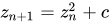
remains bounded.[13] That is, a complex number c is part of the Mandelbrot set if, when starting with z0 = 0 and applying the iteration repeatedly, the absolute value of zn remains bounded however large n gets. This can also be represented as[14]
- {\displaystyle z_{n+1}=z_{n}^{2}+c,}
- {\displaystyle c\in M\iff \limsup _{n\to \infty }|z_{n+1}|\leq 2.}
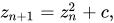

For example, letting c = 1 gives the sequence 0, 1, 2, 5, 26, …, which tends to infinity. As this sequence is unbounded, 1 is not an element of the Mandelbrot set. On the other hand, c = −1 gives the sequence 0, −1, 0, −1, 0, …, which is bounded, and so −1 belongs to the Mandelbrot set.
The Mandelbrot set {\displaystyle M}
- {\displaystyle P_{c}:\mathbb {C} \to \mathbb {C} }

given by
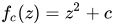
- {\displaystyle P_{c}:z\mapsto z^{2}+c,}

where {\displaystyle c}
- {\displaystyle (0,P_{c}(0),P_{c}(P_{c}(0)),P_{c}(P_{c}(P_{c}(0))),\ldots )}

obtained by iterating {\displaystyle P_{c}(z)}

A mathematician’s depiction of the Mandelbrot set M. A point c is colored black if it belongs to the set, and white if not. Re[c] and Im[c] denote the real and imaginary parts of c, respectively.
More formally, if {\displaystyle P_{c}^{n}(z)}
- {\displaystyle M=\left\{c\in \mathbb {C} :\exists s\in \mathbb {R} ,\forall n\in \mathbb {N} ,|P_{c}^{n}(0)|\leq s\right\}.}

As explained below, it is in fact possible to simplify this definition by taking {\displaystyle s=2}
Mathematically, the Mandelbrot set is just a set of complex numbers. A given complex number c either belongs to M or it does not. A picture of the Mandelbrot set can be made by coloring all the points {\displaystyle c}
The Mandelbrot set can also be defined as the connectedness locus of the family of polynomials {\displaystyle P_{c}(z)}
{\displaystyle P_{c}^{n}(0)}
Basic properties
The Mandelbrot set is a compact set, since it is closed and contained in the closed disk of radius 2 around the origin. More specifically, a point {\displaystyle c}
- {\displaystyle |P_{c}^{n}(0)|\leq 2}
for all {\displaystyle n\geq 0.}

In other words, if the absolute value of {\displaystyle P_{c}^{n}(0)}

Correspondence between the Mandelbrot set and the bifurcation diagram of the logistic map
The intersection of {\displaystyle M}
- {\displaystyle z\mapsto \lambda z(1-z),\quad \lambda \in [1,4].}
![{\displaystyle z\mapsto \lambda z(1-z),\quad \lambda \in [1,4].}](https://wikimedia.org/api/rest_v1/media/math/render/svg/37773e2176b9adc94c887c85ffa31898e8a140c5)
The correspondence is given by
- {\displaystyle c={\frac {\lambda }{2}}\left(1-{\frac {\lambda }{2}}\right).}
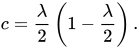
In fact, this gives a correspondence between the entire parameter space of the logistic family and that of the Mandelbrot set.
As of October 2012, the area of the Mandelbrot is estimated to be 1.5065918849 ± 0.0000000028.[15]
Douady and Hubbard have shown that the Mandelbrot set is connected. In fact, they constructed an explicit conformal isomorphism between the complement of the Mandelbrot set and the complement of the closed unit disk. Mandelbrot had originally conjectured that the Mandelbrot set is disconnected. This conjecture was based on computer pictures generated by programs that are unable to detect the thin filaments connecting different parts of {\displaystyle M}

External rays of wakes near the period 1 continent in the Mandelbrot set
The dynamical formula for the uniformisation of the complement of the Mandelbrot set, arising from Douady and Hubbard’s proof of the connectedness of {\displaystyle M}
The boundary of the Mandelbrot set is exactly the bifurcation locus of the quadratic family; that is, the set of parameters {\displaystyle c}
Other properties
Main cardioid and period bulbs

Periods of hyperbolic components
Upon looking at a picture of the Mandelbrot set, one immediately notices the large cardioid-shaped region in the center. This main cardioid is the region of parameters {\displaystyle c}
- {\displaystyle c={\frac {\mu }{2}}\left(1-{\frac {\mu }{2}}\right)}
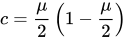
for some {\displaystyle \mu }
To the left of the main cardioid, attached to it at the point {\displaystyle c=-3/4}
If Scientists Wrote Christmas Songs
If Scientists Wrote Christmas Songs
?
Posted by AsapSCIENCE on Monday, December 4, 2017