
The Earth has been visited by advanced Inter-Stellar Civilizations that can travel through other dimensions faster than the speed of light. They use energy propulsion systems that can bring us to a new era. Humans have also developed these systems, but those in power have suppressed them in order to keep us at the mercy of fossil fuels. It is time for you to know…and this documentary will let you in. Please enjoy “Sirius” for FREE and share with your friends and family (YouTube video below).
More can be found on:
http://www.siriusdisclosure.com/
https://www.facebook.com/SiriusTheMovie/
https://twitter.com/DrStevenGreer
Hunting the Hidden Dimension
In this film, NOVA takes viewers on a fascinating quest with a group of maverick mathematicians determined to decipher the rules that govern fractal geometry. For centuries, fractal-like irregular shapes were considered beyond the boundaries of mathematical understanding. Now, mathematicians have finally begun mapping this uncharted territory. Their remarkable findings are deepening our understanding of nature and stimulating a new wave of scientific, medical, and artistic innovation stretching from the ecology of the rainforest to fashion design. The documentary highlights a host of filmmakers, fashion designers, physicians, and researchers who are using fractal geometry to innovate and inspire.


Infinite Thought of the Day
What’s Astonishing about pi

A RETURN TO EROS
In the language of the erotic mystics of the secret temple lineage, the return to Eros transforms reality and liberates the Goddess. Eros is outrageous love, the love that is the essence of all reality. The return to Eros happens when outrageous love becomes alive in our lives
Eros is what we are talking about when we say God is love. God is not ordinary love, a strategy of the ego. God is outrageous love. God is Eros. Or said differently, in the language of the leading edge of evolutionary theory, reality is Eros. Reality is animated and motivated by Eros, and it self-organizes toward higher and higher l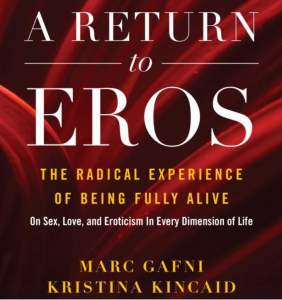 evels of complexity and consciousness.
Finally we will evolve the very source code of consciousness and transform our core experience of life by closing the tragic gap (which has persisted both in our personal lives and throughout human history) among the erotic, the sexual, and the holy. We will see that you can only be fully alive, powerfully ethical, and in love if you are living a full erotic life. The erotic life is purposeful even as it is powerful and poignant. But Eros is also potent in that it is always potentiating new possibility. As the great philosopher of science Alfred North Whitehead reminds us, the constant emergence of novelty is the very nature of Eros. In the fullness of erotic living, you are literally a virgin, always touching for the very first time.
~ By Marc Gafni and Kristina Kincaid
10 Science Books That Will Make You See the World Differently
The Age of Wonder
by Richard Holmes

Starting with a history book might seem odd, but without a firm understanding of how germ theory, disease specificity, and the placebo response—among other important breakthroughs—came to be, you won’t be grounded in what we now consider basic knowledge. British biographer Richard Holmes does justice to the evolution of eighteenth and nineteenth century science.
“We need the three things that a scientific culture can sustain: the sense of individual wonder, the power of hope, and the vivid but questing belief in a future for the globe.”
Behave: The Biology of Humans at Our Best and Worst
by Robert Sapolsky

If you want to know why humans behave how we do, start with American neuroendocrinologist Robert Sapolsky’s tour de force. Having spent time studying baboons in Kenya, here he trains his gaze on the peculiar, outlandish, and even mundane aspects of humans, traversing neuroscience, psychology, sociology, and anthropology to better comprehend what makes us us.
“We are constantly being shaped by seemingly irrelevant stimuli, subliminal information, and internal forces we don’t know a thing about.”
The Body Keeps the Score: Brain, Mind, and Body in the Healing of Trauma
by Bessel van der Kolk

Dutch psychiatrist Bessel van der Kolk began studying post-traumatic stress in the seventies. His masterful work stretches across decades of research in an attempt to piece together a clinical and heartfelt approach to trauma. His understanding of the biology and physicality of his discipline is unmatched.
“We have learned that trauma is not just an event that took place sometime in the past; it is also the imprint left by that experience on mind, brain, and body. This imprint has ongoing consequences for how the human organism manages to survive in the present.”
The Brain’s Way of Healing: Remarkable Discoveries and Recoveries from the Frontiers of Neuroplasticity
by Norman Doidge

Canadian psychoanalyst Norman Doidge is also a poet, a fact that became apparent with his breakthrough book, The Brain That Changes Itself.His follow-up addresses important issues that research these and more in his beautiful prose. Including an entire chapter on the work of movement genius Moshé Feldenkrais added an even bigger smile to my face.
“The use of force is the opposite of awareness; learning does not take place when we are straining.”
The Emperor of All Maladies: A Biography of Cancer
by Siddhartha Mukherjee

I first read Indian-American physician Siddhartha Mukherjee’s debut out of curiosity. A few years later it offered comfort when dealing with my own cancer. His gorgeous style and sympathetic approach, displayed as a columnist for The New Yorker and NY Times, portrays cancer as an integral part of what we are as animals. His follow-up to this exhaustive biography is the highly recommended The Gene. On Twitter he told me his final installment of what he considers to be a trio will be on vaccines. Plenty to look forward to from this masterful writer.
“Cancer is built into our genomes: the genes that unmoor normal cell division are not foreign to our bodies, but rather mutated, distorted versions of the very genes that perform vital cellular functions. And cancer is imprinted in our society: as we extend our life span as a species, we inevitably unleash malignant growth (mutations in cancer genes accumulate with aging; cancer is thus intrinsically related to age). If we seek immortality, then so, too, in a rather perverse sense, does the cancer cell.”
How Emotions Are Made: The Secret Life of the Brain
by Lisa Feldman Barrett

Psychology professor Lisa Feldman Barrett presents one of the most counterintuitive books in recent memory by claiming that we don’t react to our environment so much as constantly construct our reality. This groundbreaking work will change how you view your inner world forever, empowering you with the knowledge that pretty much every “reaction” can be changed. (Listen to my chat with her here.)
“With concepts, your brain simulates so invisibly and automatically that vision, hearing, and your other senses seem like reflexes rather than constructions.”
The Organized Mind
by Daniel J. Levitin

Inattention is one of our greatest modern problems. We know cigarettes and alcohol are addictive; we’ve come to terms with opioids. Sugar is a killer, one few give up. Yet we seem light years from admitting what technology is doing to our brains. Neuroscientist Dan Levitin’s insightful book will change how you view tech—and your life. Fortunately it’s all for the better, should you heed his advice.
“Evolution doesn’t design things and it doesn’t build systems—it settles on systems that, historically, conveyed a survival benefit (and if a better way comes along, it will adopt that). There is no overarching, grand planner engineering the systems so that they work harmoniously together. The brain is more like a big, old house with piecemeal renovations done on every floor, and less like a new construction.”
Other Minds: The Octopus, the Sea, and the Deep Origins of Consciousness
by Peter Godfrey Smith

Australian philosopher and professor Peter Godfrey Smith has exposed the unworldly reality of the octopus in such candor that we’ll never view this incredible cephalopod the same way. In the process he offers keen insights into the development of sentience and intelligence throughout the animal kingdom, humans included.
“To some degree, unity is inevitable in a living agent: an animal is a whole, a physical object keeping itself alive. But in other ways, unity is optional, an achievement, an invention. Bringing experience together—even the deliverances of the two eyes—is something that evolution may or may not do.”
The Story of the Human Body: Evolution, Health, and Disease
by Daniel Lieberman

To wrap your head around any facet of human biology, anatomy, and physiology, start with Harvard paleoanthropologist Daniel Lieberman. This eye-opening masterpiece explores the intricate details of digestion as well as our posture and feet, forcing us to reconsider movement patterns and cognitive habits that are actually killing us. His deep dive into mismatch diseases will inspire you to change the course of your day.
“By developing through myriad interactions between genes and environments, organisms are able to build extremely complex, highly integrated bodies that not only work well, but also can adapt to a wide range of circumstances.”
The Well-Tuned Brain: A Remedy for a Manic Society
by Peter C Whybrow, MD

Scouring through the innumerable books with “brain” in the title is challenging, as neuroscience has become a catchword for every possible agenda. English psychiatrist Peter C. Whybrow takes a truly unique and essential take when discussing capitalism’s effects on our behavior. He argues that many technological advances are actually enslaving us; our survival as a species is under threat due to our reliance on what’s being sold.
“We find ourselves rewarded less in the role of concerned citizen than in that of self-seeking consumer. Through habituation, we have grown indifferent to those aspects of human culture that fall outside market reference.”
—
Derek Beres is the author ofWhole Motion: Training Your Brain and Body For Optimal Health. Based in Los Angeles, he is working on a new book about spiritual consumerism. Stay in touch onFacebook and Twitter.
An MD Breaking Free
Slomo: The Man Who Skates Right Off The Grid
Once he was a doctor. Now he's a rollerblading guru on the San Diego boardwalk.
Posted by Op-Docs on Sunday, September 24, 2017
Quantum Mechanics and Spacetime in the 21st Century – Nima Arkani-Hamed
The Undercurrent of Primordial Shame
Underneath so many forms of suffering is a pervasive sense of shame, a deeply-rooted sense that there is something wrong with us at the most basic level.
Often when I speak with someone who is struggling, there is an undercurrent of primordial shame which we can feel together, coloring their perception, emotional experience, and relationships with others.
Ordinarily, shame looms outside conscious awareness, but at times comes flooding into consciousness, accompanied by feelings of hopelessness. Despite our attempts to link the despair to some current aspect of our life situation, we are often unable to do so, as it is free-floating and erupting under the surface of things.
To uncover and to begin to illuminate, integrate, and metabolize shame in a way that is skillful, at times we must first confront and work through a variety of other beliefs, emotions, and somatic material, for shame is often hidden and disguised. Buried inside flatness, hopelessness, heartbreak, and rage, we often find core shame, affecting our ability to feel alive, find meaning, and discover joy in relationship with others.
While various therapies tend to specialize in one aspect of shame and seek to intervene at that level alone, shame is multidimensional and must be attended to in a way that is full-spectrum. We must discover in an experiential way how shame manifests in patterns of habitual thinking, painful repetitive emotions, somatic contraction and coagulation, and neurobiologically through dysregulating states of arousal and fight/ flight reactivity.
In this way, shame is not solely a thought, feeling, behavior, or activation of the nervous system, but a unique configuration of all of these, a way of protecting ourselves from an environment that is/ was not safe, incapable of holding and mirroring our unique subjectivity, lacking in empathic attunement, and threatening to our psychic survival.
Shame is not easy to heal as it is so core and underlies so many of our difficult emotions and limiting self-narratives, but it can be worked with. It must be approached slowly, in an embodied way, where we touch into the associated anxiety in very small doses, pushing ourselves just a little, but not outside our window of tolerance. To flood the shame with presence, warmth, space, and perhaps most importantly, with a radical sort of kindness.
If you feel called, and it feels safe enough to do so, you can begin to invite in the experience of shame, to meet that lost, frightened, abandoned, unworthy little one who has been carrying this shame for so long. To offer sanctuary for him or her, to listen carefully and with compassion to his or her story, to hold her feelings, to tend to his dysregulating sensations, and to provide a home for the shamed one to rest, from a long, ancient, heartbreaking journey.
