
Some problems are felt by many, and just can’t be solved by one person.
By Emiliana R. Simon-Thomas | June 9, 2026 (greatergood.berkeley.edu)
Imagine two ship crews marooned on opposite coasts of the same wild and inhospitable island.
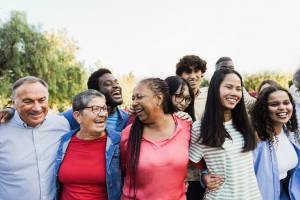
One group drops seafaring formalities and coalesces around collective survival. They tend to each other, work together, and split what they have. Each person’s subsistence is tied to the other’s.
The other crew maintain their maritime hierarchy, compete for power and status, hoard resources—and ultimately turn on each other.
Everyone from the first crew survives. Most from the second group die from various ailments and unfortunate incidents, including cannibalism.
That’s a scenario based on real historical examples that is sketched by John Cacioppo, Harry Reis, and Alex Zautra in their 2011 paper entitled “Social Resilience.” In this article, the authors explain their approach to developing a training program for U.S. Army personnel meant to help them function better in teams.
The premise? Human survival depends on being able to turn toward each other under difficult circumstances and join forces to identify, avoid, or address challenges and catastrophes. Our ability to coordinate effort in response to shared threats is an evolutionary mandate for ultrasocial creatures like humans. Born helpless and lacking physically dominant features like giant apex predator teeth, the authors write, “Our remarkable accomplishments as a species are attributable to our collective action, not our individual might.”
Stephanie Brown of the Stony Brook Neuroscience Institute attributes this collaborative sensibility to “fitness interdependence”: my survival depends on yours, theirs, and, to some degree, ultimately, everyone’s. Because the harm from some threats to survival and reproduction is distributed to everyone (like crop dusting to cull agricultural pests), our human nervous system is sensitive to others’ vulnerability, and so driven to protect the group from shared threat.
The biological and psychological processes underlying these features include being able to synchronize our bodies and behaviors (e.g., empathy), feeling innately compelled to share joy and relieve each other’s pain (e.g., social capitalizing, compassion), and celebrating heroic virtues like helping one another and working to make the world a better place. Serving each other’s welfare through caregiving, protection from harm, and relief of suffering, it turns out, is fundamentally rewarding and healthy. Many studies have reported activation in the brain’s reward pathways that signal pleasure after behaving generously—the “warm glow.” People who spend more hours volunteering experience less disease and live longer, for example. Like any other ability, prosocial and altruistic tendencies are also shaped over the course of life by culture and context, both of which can increase or suppress how prominently they show up within any given person, society, or period of time.
According to Cacioppo, Reis, and Zautra, each person attending to their own needs and being able to cope with and protect themself does not ensure group success, and can actually lessen the probability of individual success over the long run. It’s wrong to assume that each individual’s resilience will naturally ladder up to group-wide resilience.
Instead, they call for social resilience, which means acknowledging and documenting stress and harm coming from higher-order, even existential threats, beyond the sum of how each person might feel about their own lives. Further, it means investigating and tracking sources and contributing factors that are often systemic (policy, neighborhood design), invisible (culture, historical precedence), or vast (climate, natural disasters). Once we understand causes, we can work together to help the group recover and ensure future well-being.
Other scholars have also used the term social resilience since this 2011 paper, though disciplines tend not to define it in the same way.

- Talk With Teens About Civic IssuesInvite your teen to have conversations about civic empowerment.
In public health, for example, social resilience often refers to aspects of a person’s environment and resources like whom they live with, what their level of income is, or whether they have access to health care and education. There are well-established links between these factors and an individual’s resilience—that is, their capacity to recover from or learn and grow from stress and adversity in healthy ways. Many people have dedicated their lives to improving equitable access to these resources for the betterment of humanity.
Articles also use the terms “community resilience”—measured by survey questions like “People in my community help each other during crises”—and “national resilience,” which refers to a group’s ability to handle crises. A 2013 paper by Markus Keck and Patrick Sakdapolrak offers this high-level definition: “Social resilience is the ability of social entities, that is, individuals, organizations or communities, to resist, adapt to, and recover quickly from disasters.”
Studies suggest that social resilience is not unique to humans. The prosocial underpinnings of social resilience were alluded to by none other than Charles Darwin, who concluded that “those communities [of animals and other creatures], which included the greatest number of the most sympathetic members, would flourish best, and rear the greatest number of offspring.”
For example, insects are the most populous species on earth, and the most populous insects are ants. Ants rapidly adjust and adapt to demands and threats to the colony in seamlessly coordinated ways: They’ll make a raft from their bodies for all to survive a flood. While humans, too, can detect, monitor, and band together to fix the existential crises we face, that’s a path we need to consciously choose and pursue.
Evolutionary psychologist David Sloan-Wilson, professor of biology and anthropology at Binghamton University and founder and president of ProSocial World, thinks so, too. His work highlights the importance of interpersonal trust, a key facet of social resilience, for working together toward shared goals. Further, he describes how evolution has favored biological features that enable group-wide, collaborative, even amicable adaptation to environmental challenges:
Only when we could trust our social partners to work toward shared goals could we rely upon them to share meaningful information. Our ability to function as team players is reflected in anatomical features such as the whites of the human eye, which turn it into an organ of communication, and in basic cognitive skills such as the ability to point things out to others and to laugh in a group context, in addition to more advanced cognitive and cultural abilities.
More attention has been paid to investigating and strengthening resilience for individuals than for organizations or communities. Of course, individual resilience matters, and is certainly worth cultivating. For people who are more resilient, symptoms of stress don’t last as long, and upsetting personal experiences morph into fodder for meaningful learning and growth.
- Best Possible Self for RelationshipsBuild the kind of relationships you want by fostering optimism.
There are biological (e.g., greater heart rate variability), life context (e.g., safer neighborhoods), and behavioral (e.g., self-compassion, optimism) factors that influence a person’s individual resilience, and social life also plays a formative role. For example, people with loving, supportive caregivers early in life tend to get through hardship more easily, and people who have close relationships with friends and family tend to handle losses and setbacks more gracefully.
With some know-how and regular practice, most people can improve their own resilience. We can learn strategies for restoring calm and coping with difficulty, engage with uplifting activities, or adopt outlooks like gratefulness or optimism that buffer against despair. We can enrich and strengthen our interpersonal ties by offering and asking for compassion, and being more curious and humble.
But some sources of stress—like widespread ideological polarization, rampant social inequality, global pandemics, natural disasters, terrorist attacks, and warfare—aren’t just about you or me. They’re inescapably about all of us. While it can be convenient or momentarily comforting to avoid or dismiss, harm to people in one place imposes stress on everyone, like stories of violent crime spreading through social media.
Resilience to these broader shared threats requires more than what it takes to be individually resilient one person at a time. It requires us to clearly see the hazy collective weight that we all, regardless of privilege or power and to different degrees in any given moment, bear from shared sources of harm. It involves channeling our pooled stress toward teaming up—coming together to confront, document, address, and solution-find for the benefit of us all. It also involves documenting and accounting for the true costs of ignoring or escalating the sources to shared harm, such as extractive or exploitative practices or profiteering at the expense of collective well-being.
But how do we humans cultivate social resilience? In their paper, Cacioppo, Reis, and Zautra offer a list of nine personal resources for social resilience that can be strengthened with practice. I think their suggestions can be distilled into three actionable steps each person can take to contribute to social resilience.
1. Tune into, trust, and connect with people
Exercise your empathy muscles by paying more attention to other people’s expressions, noticing how this feels in your own body, and trying to understand what the others are feeling and why. Try to assume goodwill and look for common ground and shared humanity with others. You might even make a list of qualities, characteristics, or experiences you share with others, or reflect on times when you supported someone, or someone supported you. Marvel at all the ways that people seamlessly coordinate effort to make everyday life both interesting and full of opportunity. Make time for open-minded and honest conversations about meaningful issues, topics, and life experiences with people. Join group or community activities centered around creative expression, play, or activism that addresses unmet needs.
2. See the struggle, and do the best you can to help
When you encounter harm, try to discover ways that it may also harm you. Notice how that feels deep down. Ask how it reduces prosperity and the common good (such as loss of potential and progress, or costliness of repair). While honoring the self-protective urge to avoid or escape, aim instead to direct your inner tension toward approaching and doing whatever you can to remedy the situation. Try to offer help, even if it feels inconvenient, costly, untimely, or unpromising. Be more curious and humble about the context of harm and how you can be most helpful. Ask yourself: “Can I leave this shared circumstance, system, or space better than I found it?” Let the meaningful belonging gained from actively contributing to your community strengthen your heroic impulse to fix the world’s vexing challenges together with other people.
3. Constructively problem-solve and reconcile
- Making an Effective Apology. A good apology involves more than saying “sorry.”
Hone your cooperative mentality. In whatever settings you find yourself, try to work together with people to learn what each other’s pain points and threats are, and openly discuss where they might be coming from. Inquire and analyze how existing structures, policies, systems, and settings affect day-to-day experiences among the people you encounter, and crowdsource ideas for improvement. Exercise skills like labeling feelings clearly and authentically, and offering an effective apology to learn, grow, and deepen interpersonal connections even after disagreement or conflict. Ask for help, knowing that most people feel uplifted and honored by the opportunity to do something that matters. Uplift group morale and creativity by encouraging shared positive emotional experiences like moral elevation and amusement, and celebrating team successes. Leverage the varied perspectives and strengths from a diverse group to discover truly collaborative, innovative, and effective-long term solutions to shared challenges.
There are also contextual opportunities for scaffolding social resilience within a neighborhood or city, like designing free and inclusive spaces for people to gather in recreational, celebratory, and awe-inspiring ways (e.g., parks, community events). Safe, inviting opportunities for storytelling and public dialogue around key issues and concerns also improve social resilience. Increasing social resilience, in turn, can shape civic institutions in ways that benefit everyone. According to the “Well-being and State Effectiveness” chapter of the 2023 World Happiness Report, countries that routinely channel resources toward common interests (e.g., improving social well-being) score significantly higher on a composite measure of national prosperity that includes per capital income, collective capacity, and more peaceableness.
Social resilience, like individual resilience, takes practice. As a bipedal species, we are equipped with the innate urges to roll, scoot, crawl, then walk, but if we want to walk bravely into older adulthood, we cannot just passively expect it. We cannot just sit comfortably all day. Regular physical activity is crucial to lifelong health and longevity. The same goes for social resilience: Getting better at seeing the shared burden that broader, more pervasive problems impose and prioritizing coming together to support one another and find solutions take regular practice, which may not always feel easy or convenient.
Rejuvenating and investing in social resilience means explicitly studying and documenting the shared harm of widespread, existential threats and joining forces to solve them—to preempt avoidable destruction, and to help each other recover from painful disasters. Would systematically measuring, educating, and optimizing for social resilience promise a better, smarter, less wasteful future? Leaning into how we naturally synchronize emotionally, perceptually, and behaviorally—and using our inborn “forest in the trees” capacity to see the world through a more global, long-term, course-of-human-survival lens—social resilience could amplify our potential to mobilize together to address threats and find fixes that can, while minimizing harm, protect and uplift us all.
About the Author
- Emiliana R. Simon-ThomasEmiliana R. Simon-Thomas, Ph.D., is the science director of the Greater Good Science Center, where she directs the GGSC’s research fellowship program and serves as a co-instructor of its Science of Happiness and Science of Happiness at Work online courses.
(Contributed by John Atwater, H.W.)