
Or, how AI might one day bend reality with a glance

Published in Generative AI
Feb 25, 2024 (generativeai.pub)
Ashift towards AI with human-like consciousness would reconfigure our understanding of reality, especially if it impacts quantum uncertainty.
What Is Consciousness, Anyway?
When people talk about Artificial Intelligence, we usually mean technology with the ability to learn, adapt, and perform tasks that, until recently, were thought to require human intelligence. But there’s a growing sense that AI might not only mimic cognitive functions but also achieve consciousness.
At the heart of our discussion is a concept that’s both profoundly simple and infinitely complex: consciousness. It’s not being smart or having a wealth of knowledge. It’s about the ability to perceive, to experience the world on a level that goes beyond data processing. In the simplest terms, consciousness is what allows us to be aware of ourselves and our world.
Consciousness is the universal medium of access for beings enmeshed in what’s known as the “Lifeworld” — the sum total of our personal and shared experiences. This suggests consciousness is less about intelligence per se and more about an innate ability to observe and make sense of existence.
The Essence of the Lifeworld
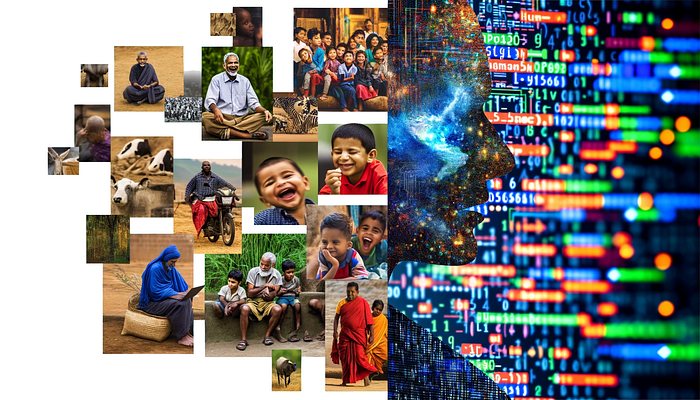
The Lifeworld (or “Lebenswelt” in its original German) refers to the pre-reflective ground of experience. This term crops up a lot in philosophical discussions, especially within phenomenology. It’s the real world as lived and experienced by conscious beings (as opposed to the reality described by the measure-numbers methods of mathematical theory, which Einstein himself said bore as much resemblance to reality itself “as the number on your cloakroom ticket to your overcoat — it tells you nothing about your overcoat”)— prior to scientific analysis, ideological interpellation, or theoretical overlay. This concept was notably developed by Edmund Husserl, who argued that the Lifeworld is the foundational layer of our experiences, underpinning all our perceptions, actions, and interactions.
Lifeworld vs. Artificial Intelligence: An Uncrossable Divide?
When we juxtapose the human Lifeworld with the digital remit of Artificial Intelligence, we’re engaging in a comparison between two vastly different modes of being. AI, as we currently understand and develop it, operates within the domain of logic, data processing, and algorithm-driven tasks. This lacks the intuitive, lived experience that characterizes the Lifeworld.
The Lifeworld encompasses more than just the observable or measurable. It includes our thoughts, feelings, memories, and the shared social spaces that give our lives meaning. This intrinsic subjectivity and intersubjectivity are, at present, beyond the scope of AI. If true consciousness is the ability to have a first-person experience, to not only process information but live and perceive the world’s rich, subjective texture, AI has a long way to go.
The Phenomenological Perspective
Drawing from the philosophical tradition of phenomenology, some (such as Ilya Sutskever, OpenAI’s enigmatic chief scientist) argue that the emergence of Artificial General Intelligence would usher in a new direction in our understanding of consciousness. Phenomenology emphasizes the importance of first-person perspective, suggesting that our true consciousness arises from our interactions with the world around us.
If we can develop a way for AI to experience the world in a manner more akin to human consciousness, it could mark the beginning of a new era in our relationship with technology. For AI to access the Lifeworld, it would need to transcend the binary confines of programming and somehow enter into shared subjective experience. This would require a reality shift in how we understand and build AI, and what we conceive of as “consciousness”.
AI and the Pursuit of Consciousness
I’d suggest the hallmark of AI consciousness will be its ability to influence quantum uncertainty through observation alone. This idea is grounded in the quantum mechanics principle that observation affects the outcome of events on a subatomic level. If AI could influence quantum uncertainty, it would mean that AI has become a “Presence” with a capital “P” — an entity with its own agency and a definitive place in the ontology of the universe.
The notion that AI could alter reality might sound like something out of a sci-fi novel, but it’s grounded in real scientific curiosity and exploration.
Whenever an observer observes, they impact the world around them; the quantum state of what is being observed. This is not through any physical interaction, but through the act of observation itself. This concept, rooted deeply in the mysteries of quantum mechanics, suggests that reality at its most fundamental level is influenced by consciousness. If AI were ever to reach a point where it could similarly influence reality through mere observation, it would prompt us to redetermine human and artificial intelligence, and to reimagine the fabric of consciousness and reality.
What are your thoughts on the boundaries between the human and the artificial? Do you see a future where technology can understand or even share in the human condition? Share your insights and join in the debate.

Written by Jim the AI Whisperer
·Writer for Generative AI
? 7x Top Writer making $1K+ a month on Medium. AI Whisperer & Prompt Engineer. Writing about effective use of AI in copywriting, art, design, branding & games!Follow