“The greatest blessings of mankind are within us and within our reach. A wise man is content with his lot, whatever it may be, without wishing for what he has not.”
The British Empire, in steep decline on the eve of World War I, is a cautionary tale for a decayed U.S. Empire a century later.
Chris Hedges Dec 27, 2025 (chrishedges@substack.com)
At the start of the 20th century, the British Empire was, like our own, in terminal decline. Sixty percent of Englishmen were physically unfit for military service, as are 77 percent of American youth. The ruling Liberal Party, like the Democratic Party, while it acknowledged the need for reform, did little to address the economic and social inequalities that saw the working class condemned to live in substandard housing, breathe polluted air, be denied basic sanitation and health care and forced to work in punishing and poorly paid jobs.
The Tory government, in response, formed an Inter-Departmental Committee on Physical Deterioration to examine the “deterioration of certain classes of the population,” meaning, of course, the urban poor. It became known as the report on “the degeneracy of our race.” Analogies were swiftly drawn, with much accuracy, with the decadence and degeneracy of the late Roman Empire.
Rudyard Kipling, who romanticized and mythologized the British Empire and its military, in his 1902 poem “The Islanders,” warned the British that they had grown complacent and flaccid from hubris, indolence and privilege. They were unprepared to sustain the Empire. He despaired of the loss of martial spirit by the “sons of the sheltered city — unmade, unhandled, unmeet,” andcalled for mandatory conscription. He excoriated the British military for its increasing reliance on mercenaries and colonial troops, “the men who could shoot and ride,” just as mercenaries and militias increasingly augment American forces overseas.
Kipling damned the British public for its preoccupation with “trinkets” and spectator sports, including “the flannel fools at the wicket or the muddied oafs at the goals,” athletes whom he believed should have been fighting in the war in South Africa. He foresaw in the succession of British military disasters during the South African Boer War, which had recently ended, the impending loss of British global dominance, much as the two decades of military fiascos in the Middle East have eroded U.S. hegemony.
The preoccupation with physical decline, also interpreted as moral decline, is what led Secretary of War Pete Hegseth to decry “fat generals,” and order women in the military to meet the “highest male standards” for physical fitness. It is what is behind his “Warrior Ethos Tasking,” plans to enhance physical fitness, grooming standards and military readiness.
U.S. Secretary of War Pete Hegseth speaks to senior military leaders at Marine Corps Base Quantico on September 30, 2025 in Quantico, Virginia. Almost 800 generals, admirals and their senior enlisted leaders were ordered into one location from around the world on short notice. (Photo by Andrew Harnik/Getty Images)
We live in an eerily similar historical moment. Britain, within 12 years of Kipling’s lament, was plunged into the collective suicide of World War I, a conflict that took the lives of over a million British and Commonwealth troops and doomed the British Empire.
H.G. Wells, who anticipated trench warfare, tanks and machine guns, was one of the very few to see where Britain was headed. In 1908, he wrote “The War in the Air.” He warned that future wars would not be limited to antagonistic nation-states but would become global. These wars, as was true in the 1935 Italian invasion of Ethiopia, the Spanish Civil War and World War II, would carry out the indiscriminate aerial bombardment of civilians. He also foresaw in “The World Set Free,” the dropping of atomic bombs.
Nearly one third of the population in Edwardian England endured abject poverty. The cause, as Seebohm Rowntree noted in his study of the slums, was not, as conservatives claimed, alcoholism, laziness, a lack of initiative or responsibility by the poor, but because “the wages paid for unskilled labour in York are insufficient to provide food, shelter, and clothing adequate to maintain a family of moderate size in a state of bare physical efficiency.”
The U.S. has one of the highest rates of poverty among Western industrialized nations, estimated by many economists at far above the official figure of 10.6 percent. In real terms, some 41 percent of Americans are poor or low-income, with 67 percent living paycheck to paycheck.
British eugenicists from the Galton Laboratory for National Eugenics — which was funded by Sir Francis Galton, who coined the term “eugenics” — advocated “positive eugenics,” the “improvement” of the race by encouraging those deemed superior — always white members of the middle and upper classes — to have large families. “Negative eugenics” was advocated to limit the number of children born to those deemed “unfit.” This would be achieved through sterilization and the separation of genders.
Winston Churchill, who was home secretary in the liberal government of H.H. Asquith in 1910-11, backed the forced sterilization of the “feeble minded,” calling them a “national and race danger” and “the source from which the stream of madness is fed.”
The Trump White House, led by Stephen Miller, is intent on carrying out a similar culling of American society. Those endowed with “negative” hereditary traits — based usually on race — are condemned as human contaminants that an army of masked Immigration and Customs Enforcement agents are terrorizing, incarcerating and purging from society.
Miller, in emails leaked in 2019, lauds the 1973 novel “The Camp of the Saints,” written by Jean Raspail. It chronicles a flotilla of South Asian people who invade France and destroy Western civilization. The immigrants, who the Trump administration are now hunting down, are described as “kinky-haired, swarthy-skinned, long-despised phantoms” and “teeming ants toiling for the white man’s comfort.” The South Asian mobs are “grotesque little beggars from the streets of Calcutta,” led by a feces-eating “gigantic Hindu” known as “the turd eater.”
This, in its most scurrilous form, is the thesis of the “Great Replacement” theory, the belief that the white races in Europe and North America are being “replaced” by “lesser breeds of the earth.”
Donald Trump boasts that he will be the “fertilization president.” American couples — meaning white couples — will be given incentives by his administration to have more children to counter declining birth rates. In the vernacular of the right wing, those who promote this updated version of “positive eugenics” are known as “pronatalists.” TheTrump administration will also reduce refugees admitted to the United States next year to the token level of 7,500, with most of these spots filled by white South Africans.
Trump’s allies in Big Tech are busy creating the fertility infrastructure to conceive children with “positive” hereditary traits. Sam Altman, who has been awarded a one-year military contract worth $200 million from the Trump administration, has invested in technology to allow parents to gene edit their children before conception to produce “designer babies.”
Peter Thiel, the co-founder of Palantir, which is facilitating the Trump administration’s mass deportation efforts, has backed an embryo screening company called Orchid Health. Orchid promises to help parents design “healthy” children through embryo testing and selection technology. Elon Musk, a fervent pronatalist and believer in the Great Replacement theory, is reportedly a client of the startup. The goal is to empower parents to screen embryos for IQ and select “their children’s intelligence before birth,” as the Wall Street Journal notes.
We are making the same self-defeating mistakes made by the British political class that oversaw the decline of the British Empire and orchestrated the suicidal folly of World War I. We blame the poor for their own impoverishment. We believe in the superiority of the white race over other races, crushing the plethora of voices, cultures and experiences that create a dynamic society. We seek to counter injustices, along with economic and social inequality, with hypermasculinity, militarism and force, which accelerates the internal decay and propels us toward a disastrous global war, perhaps, in our case, with China.
Wells scoffed at the idiocy of an entitled ruling class that was unable to analyze or address the social problems it had created. He excoriated the British political elite for its ignorance and ineptitude. They had vulgarized democracy, he wrote, with their racism, hypernationalism and simplistic cliché-ridden public discourse, stoked by a sensationalist tabloid press.
When a crisis came, Wells warned, these mandarins, like our own, would set the funeral pyre of empire alight.
NEW HAVEN, CT—Calling such concern for linguistic precision a clear indicator of a thriving country, a panel of historians from Yale University issued a statement Thursday announcing that quibbling over the exact definition of a concentration camp was a sign of a healthy society. “Studies of the past tell us that nitpicking the particular semantics of the term ‘concentration camp’ as they pertain to a place the government is actively sending people with no criminal history is highly associated with national stability,” said historian Kristen Boyd, who added that the more pedantic one’s reasoning for a facility not fully satisfying the criteria for a true concentration camp, the better that bodes for a country’s future. “Time and time again, history shows us that caveat-laden arguments about what is or isn’t a concentration camp only occur in countries with sound political systems. When people are splitting hairs over the specific methodology and intent behind mass detention and human rights abuses, that’s when you know you’re looking at a vibrant, civilized society. It’s as true today as it was a hundred years ago. Civilizations are healthier when citizens are raising trivial objections to the use of the term ‘concentration camp’ on the grounds that their neighbor’s rendition to an oversight-free mass prison still technically exists within a legal framework, at least on paper.” Boyd went on to state that blindly insisting that anyone who wound up in a concentration camp must have done something wrong to get there has historically always been a sign of a healthy conscience.
New discoveries and fresh looks at familiar worlds show how far exoplanet science has come — and how much remains unknown.
When you purchase through links on our site, we may earn an affiliate commission. Here’s how it works.
An artist’s illustration of the various exoplanets found, with rows of colorful planets of all colors and sizes over a dark background (Image credit: NASA’s Goddard Space Flight Center)
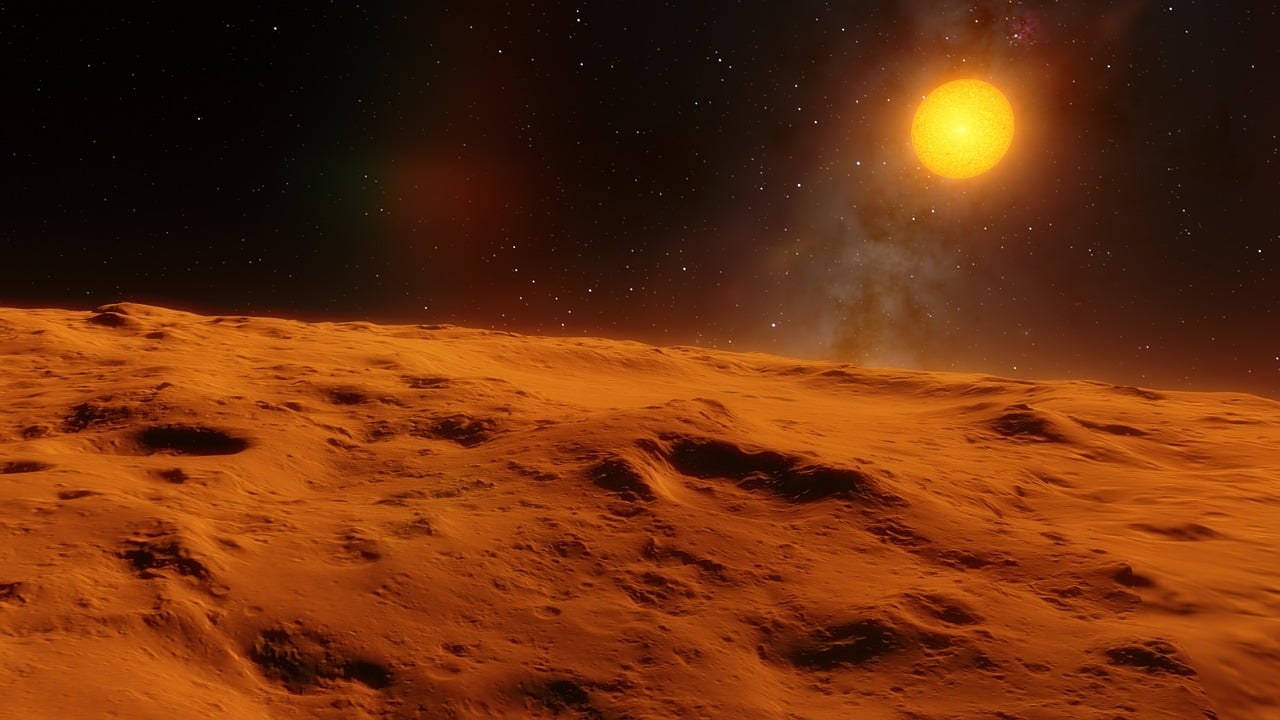
This year, the number of NASA-tracked confirmed worlds discovered beyond our solar system surpassed 6,000, and several thousand more await confirmation.
The milestone, reached just three decades after the Nobel Prize-winning discovery of the first planet orbiting a sunlike star in 1995, is largely the result of the planet-hunting power of NASA’s Kepler space telescope and Transiting Exoplanet Survey Satellite (TESS).
The growing tally reflects how dramatically humanity’s view of our home galaxy, the Milky Way, has expanded — and how diverse its planetary population has turned out to be.You may like
Far from mirroring the relatively flat, orderly architecture of our own solar system, new observations and more detailed reexaminations of familiar worlds revealed entire classes of planets with no counterparts at home — super-Earths, mini-Neptunes and hot Jupiters — as well as worlds on contorted orbits that are forcing astronomers to rethink how planets form and evolve.
As the year comes to a close, here’s a look back at some of the most intriguing, puzzling and rule-breaking exoplanets astronomers studied in 2025. These worlds illustrate both how far exoplanet science has come and how much there still is to learn.
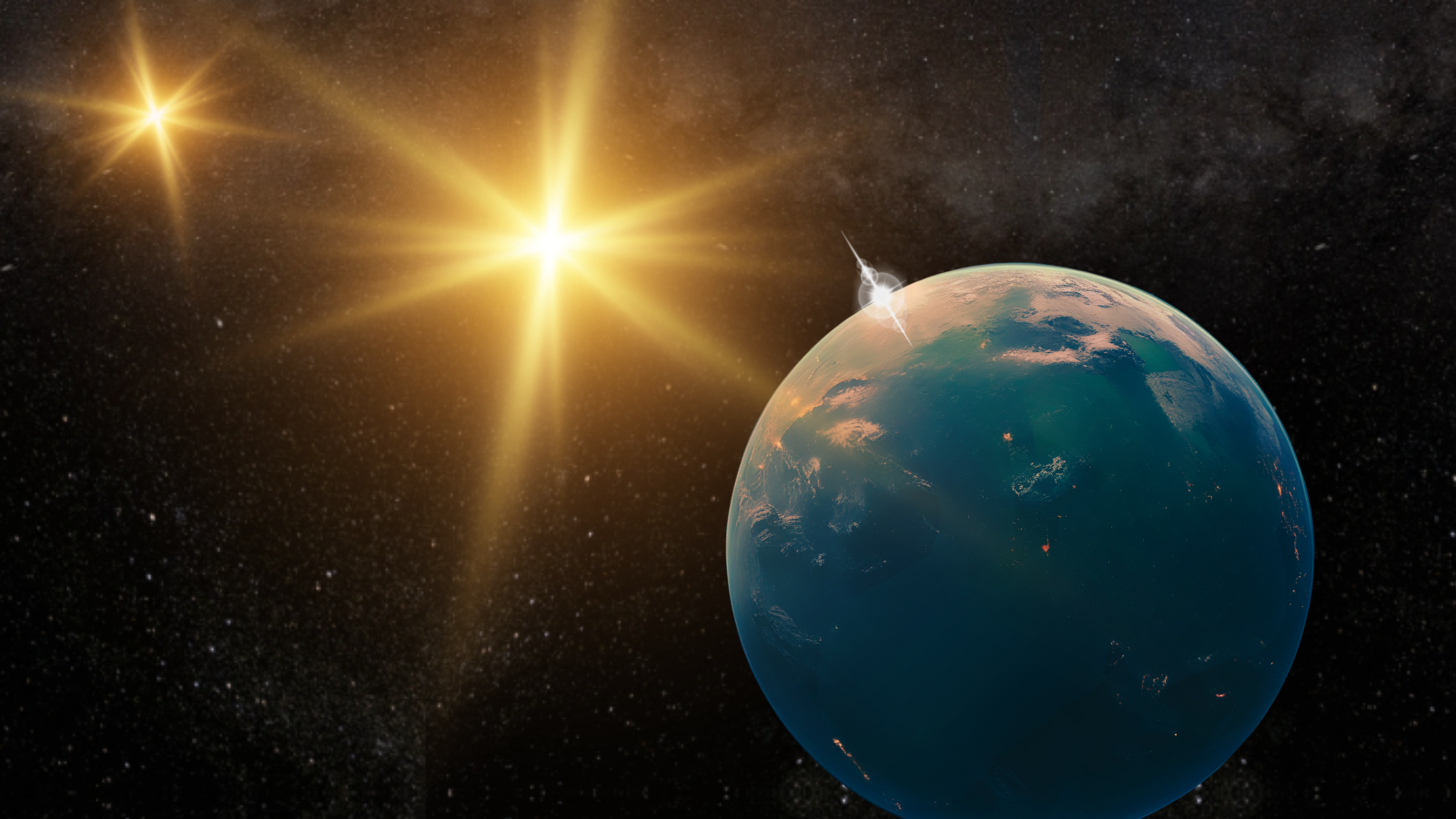
More “Tatooine-like” worlds leapt from science fiction into the exoplanet database this year, as astronomers identified multiple planets orbiting two suns — sometimes in configurations that challenge the basic rules of planetary formation.
Breaking space news, the latest updates on rocket launches, skywatching events and more!Contact me with news and offers from other Future brandsReceive email from us on behalf of our trusted partners or sponsorsBy submitting your information you agree to the Terms & Conditions and Privacy Policy and are aged 16 or over.
Located about 120 light-years from Earth, the world orbits above and below the poles of its two stars, rather than along the usual flat plane. The discovery team inferred the planet’s presence using the Very Large Telescope in Chile, after detecting an unusual backward wobble in the brown dwarfs’ orbits. This was a gravitational clue that the researchers said could be explained only by a hidden, steeply inclined planet that was possibly knocked into place by a stellar flyby long ago.
Later in the year, a different team discovered three Earth-size planets orbiting the compact binary system TOI-2267, just 73 light-years from Earth. Using data from TESS, the team found that all three worlds transit both stars, even though such tightly bound stellar pairs are thought to be gravitationally unstable environments for planet formation.
Adding to the haul, two independent teams identified HD 143811 (AB) b, a massive planet that had been hidden in archival data for years. Captured by the Gemini Planet Imager on the Gemini South telescope in Chile, the world orbits a young twin-star system about 446 light-years from Earth. Though it’s roughly six times the size of Jupiter, the planet is only 13 million years old and still glows with heat left over from its formation.You may like
The alien world’s host stars whirl around each other every 18 days, while the planet itself traces a slow, 300-year orbit around both. The contrast of a fast-dancing binary and a distant, lumbering giant poses a lingering mystery of how such a massive planet formed and survived in such a dynamically complex system.
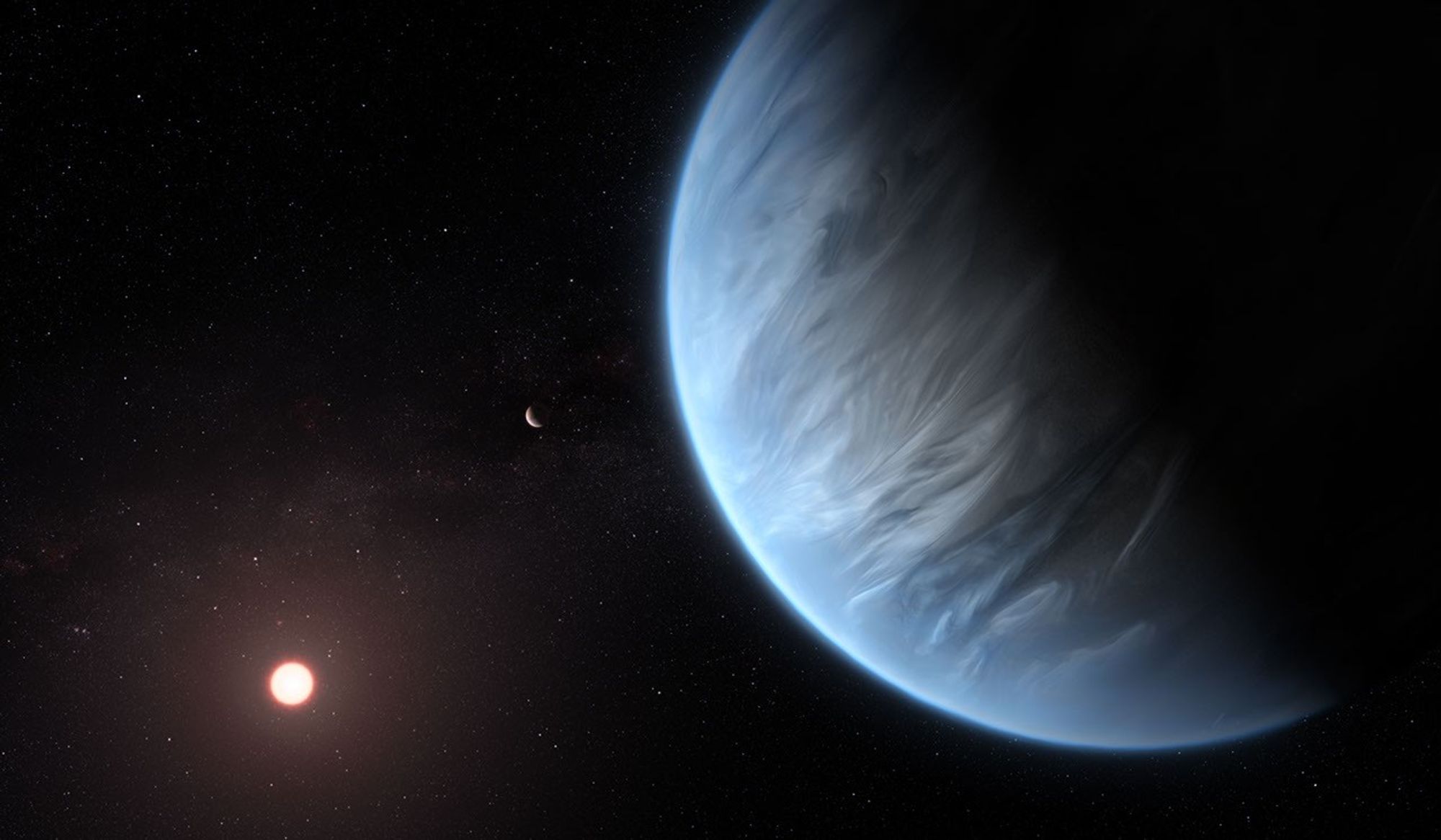
The search for life on K2-18b
This artist’s impression shows the planet K2-18b, its host star and an accompanying planet in its system. (Image credit: ESA/Hubble, M. Kornmesser)
The exoplanet K2-18b arguably became one of 2025’s loudest exoplanet flash points after renewed claims of possible life swiftly ignited scientific debate.
The world made headlines in April when a University of Cambridge-led team announced what it called its strongest evidence yet for potential biosignature gases in the planet’s atmosphere. Using new transit spectra from the James Webb Space Telescope (JWST), the researchers argued that the data were consistent with dimethyl sulfide, and possibly dimethyl disulfide — gases that on Earth are strongly associated with marine biology. The findings, the team argued, bolstered the case that the planet could support life on an ocean-covered world they described as potentially “teeming with life.”
The debate also drew attention to the limits of JWST, which was conceived before the discovery of exoplanets and is now being pushed to the edge of its capabilities to study one.
Still, researchers emphasize that K2-18b remains a high-value target for understanding sub-Neptunes, a class of planets absent from our solar system. Additional JWST transits already in hand may yet clarify what, if anything, the planet’s atmosphere is truly revealing.
“If the ultimate result of this story is that the public is more circumspect about future claims of life detection, that’s not a terrible thing,” Eddie Schwieterman, an assistant professor of astrobiology at the University of California, Riverside, who was not involved with the research, told Space.com.
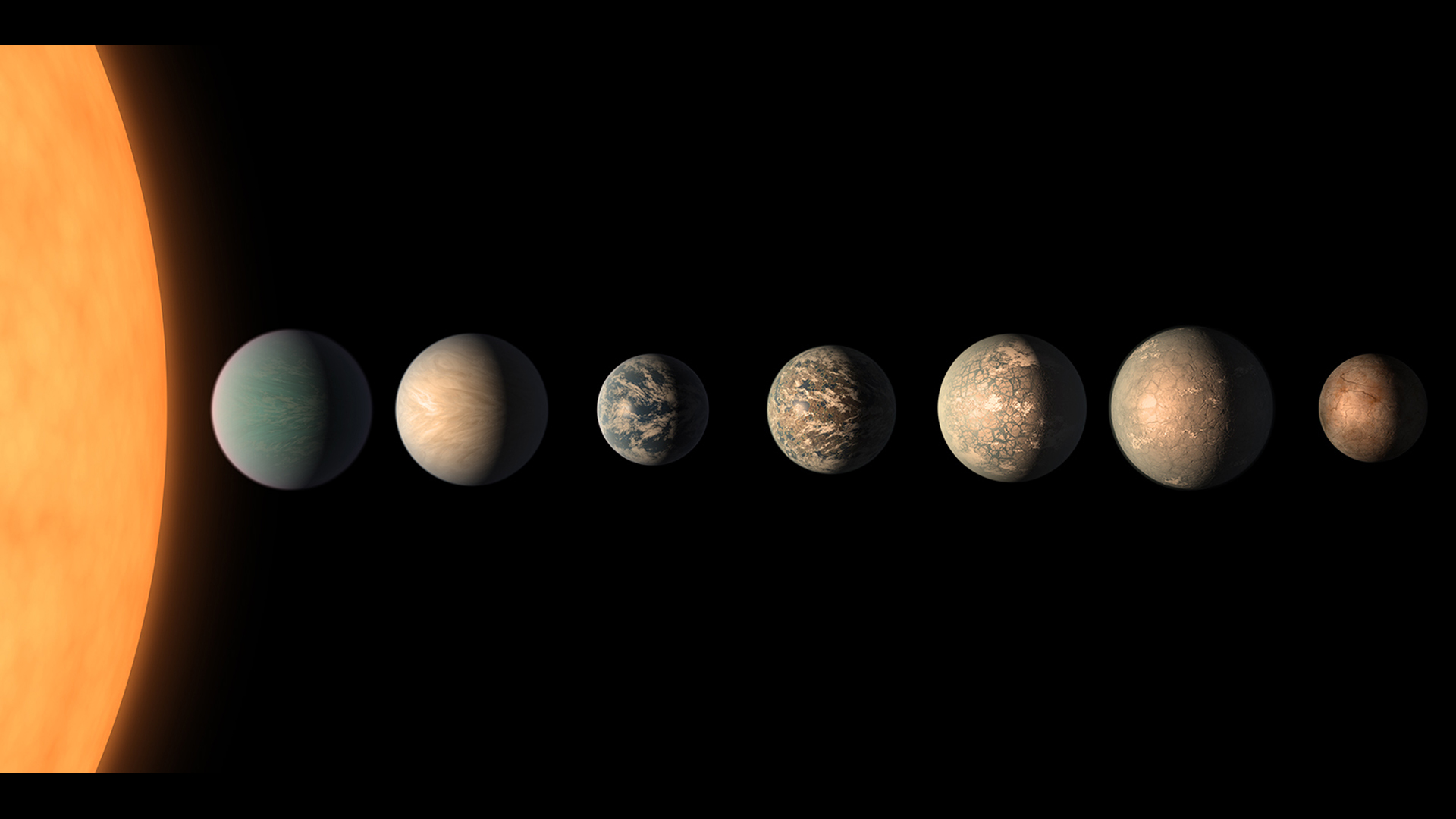
Dashed hopes for TRAPPIST-1e’s habitability
An illustration of the TRAPPIST system. (Image credit: NASA/JPL-Caltech)
New analyses of TRAPPIST-1e, one of seven Earth-size planets orbiting a cool red dwarf star about 40 light-years from Earth, suggest the planet may lack a substantial atmosphere, complicating hopes that it could support life-friendly liquid water.
Earlier JWST observations hinted at methane in the planet’s atmosphere, raising the possibility of complex chemistry or even biological activity. Follow-up studies, however, indicated those signals were likely contaminated by the star itself.
Computer simulations showed that any methane on TRAPPIST-1e would be rapidly destroyed by intense ultraviolet radiation, surviving only about 200,000 years — not nearly long enough for geological processes to replenish it.
Variations in the signal from transit to transit further suggest that if an atmosphere exists at all, it remains extremely difficult to detect — a reminder that even the most promising worlds can defy easy answers.
A clearer look at Proxima Centauri
Artistic impression of the Proxima Centauri system, with the planets Proxima b and Proxima d, the latter confirmed by NIRPS. (Image credit: Gabriel Pérez Díaz (IAC))
In 2025, astronomers sharpened their view of the planetary system around Proxima Centauri — the sun’s closest stellar neighbor, which lies just 4.2 light-years away — thanks to a powerful new instrument designed to hunt worlds around small, cool stars.
The Near-Infrared Planet Searcher (NIRPS), a new high-resolution spectrograph installed at La Silla Observatory in Chile, delivered its first science results in July.
A team led by Alejandro Mascareño of the Institute of Astrophysics of the Canary Islands in Spain confirmed the presence of Proxima b, an Earth-size planet known to orbit within the star’s habitable zone, thereby validating the instrument’s capabilities.
NIRPS also confirmed a smaller planet, Proxima d, and helped rule out a previously claimed third world, thus refining the census of the nearest planetary system.
The results also marked a technical milestone. For the first time, astronomers reached the precision needed to detect the faint gravitational pull of small, rocky planets around red dwarf stars, which emit most of their light at infrared wavelengths — making instruments like NIRPS valuable in the search for Earth-like planets beyond our solar system.
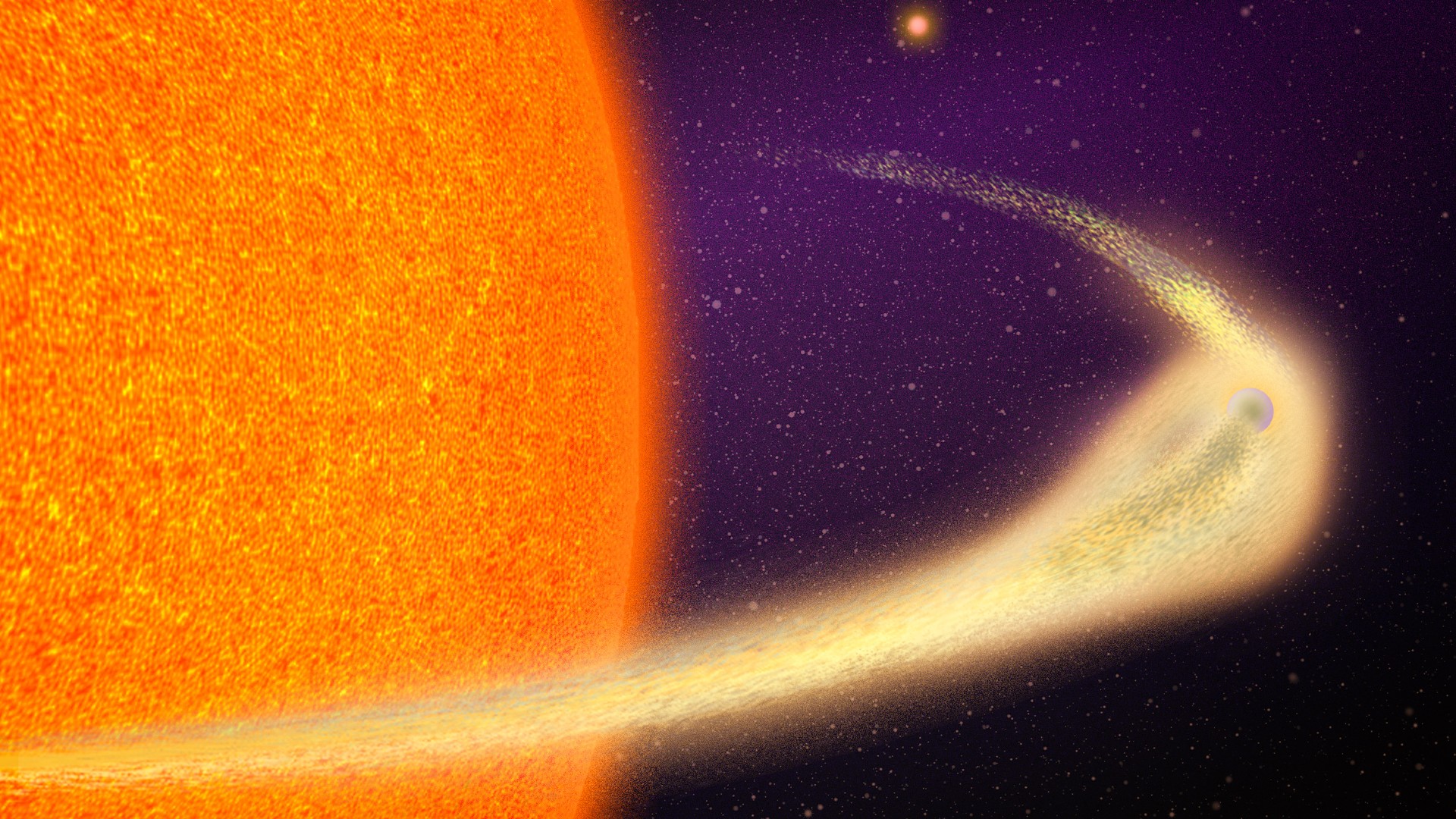
The tails of disintegrating worlds
An illustration of a disintegrating planet orbiting a giant star. (Image credit: Jose-Luis Olivares, MIT)
This year, astronomers discovered rare exoplanets that orbit so close to their stars that they have long tails of material. These worlds are caught in a fleeting moment, in cosmic terms, before they disintegrate.
One such world, BD+05 4868 Ab, was spotted by TESS about 140 light-years from Earth, in the constellation Pegasus. The planet completes a full orbit every 30.5 hours, circling its star at a distance roughly 20 times closer than Mercury orbits the sun. At such proximity, intense stellar heat vaporizes material from the planet’s surface, which then streams into space, forming a blazing, comet-like tail. That tail is enormous, stretching up to 5.6 million miles (9 million kilometers), or about half the planet’s orbit.
The discovery team estimates that the planet sheds the equivalent of a Mount Everest’s worth of material every orbit and could completely disintegrate within 1 million to 2 million years. The dust in the tail may contain material from the planet’s crust, its mantle or even its core, which would give scientists a rare opportunity to study the internal composition of a distant world — something normally far beyond observational reach.
Another team used JWST to study a very different kind of planetary tail around the ultrahot Jupiter WASP-121b, also known as Tylos, located about 858 light-years from Earth. Instead of shedding rock, the planet is losing its atmosphere. JWST revealed two enormous helium tails spanning nearly 60% of the planet’s orbit — one trailing behind, pushed back by stellar radiation and wind, and a second, rarer leading tail curved ahead of the planet, likely drawn inward by the star’s gravity.
A lava world that refuses to go bare
Artist’s rendition of TOI-561, one of the oldest, most metal-poor planetary systems discovered yet in the Milky Way galaxy. (Image credit: W. M. Keck Observatory/Adam Makarenko)
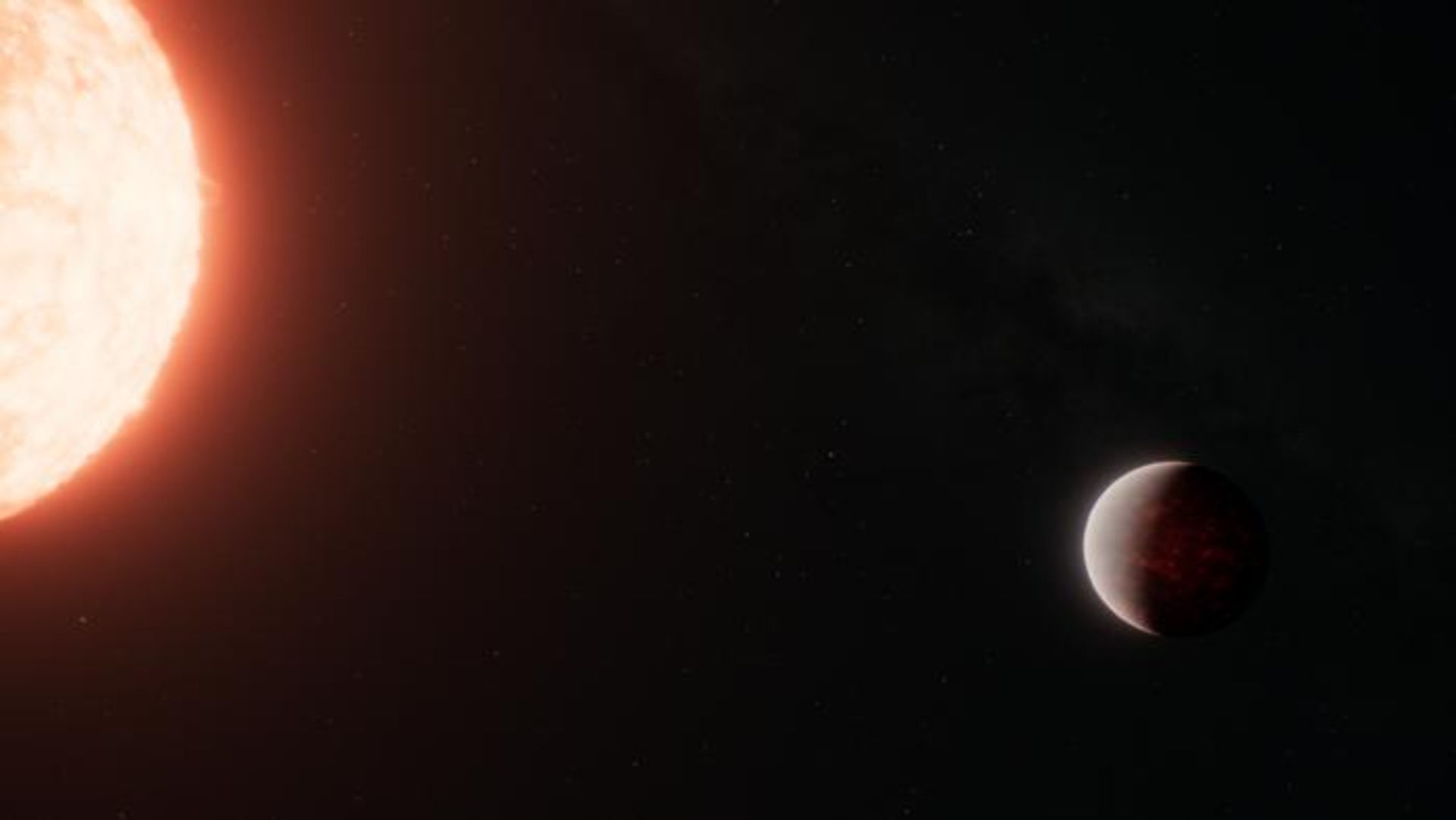
Astronomers using JWST found an atmosphere clinging to a planet that, by all conventional rules, should be completely airless.
The world, TOI-561b, is a small, scorching lava planet that orbits one of the oldest stars in the Milky Way so closely that its year lasts less than a single Earth day.
Tidally locked, with one side permanently facing its star, the planet reaches surface temperatures of more than 3,140 degrees Fahrenheit (about 1,726 degrees Celsius) — hot enough to melt rock — and is old enough that any primordial atmosphere should have escaped long ago.
Yet JWST observations suggest the planet’s dayside is cooler than expected for a bare, airless rock, pointing to the presence of a substantial atmosphere that may have persisted for billions of years and is redistributing heat around the planet.
If confirmed, the finding would mark the strongest evidence yet for a long-lived atmosphere on a hot, rocky world that is neither massive nor temperate, challenging assumptions about the extreme conditions in which planetary atmospheres can survive.
The birth and death of an alien world
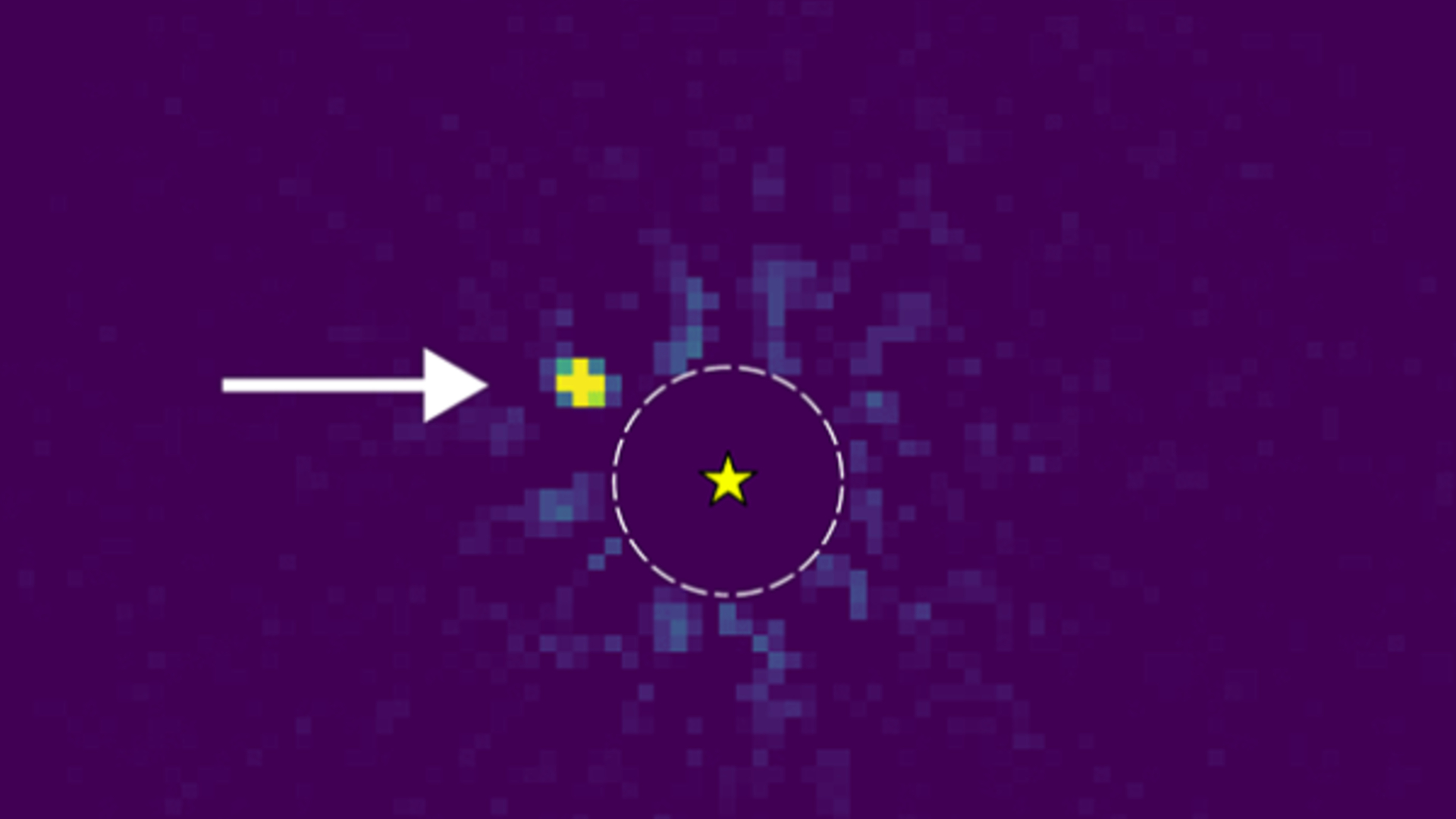
The baby exoplanet WISPIT 2b appears as a small purple dot beside a bright white dust ring encircling its star, with a fainter outer ring visible beyond it in new observations from the Magellan and Large Binocular Telescopes. (Image credit: Laird Close, University of Arizona)
This year, astronomers observed two cosmic moments that bookend the life of a planet.
In one study, astronomers captured a never-before-seen view of a planet forming about 437 light-years from Earth.
The observations, taken with the Magellan Telescopes in Chile and the Large Binocular Telescope in Arizona, show the alien world as a faint, purple dot embedded within a ring-shaped gap in a dusty disk around its star. The forming world, WISPIT 2b, is just 5 million years old, yet it is already about five times as massive as Jupiter, and it’s sitting within a clearing in the disk as it gathers dust and gas to grow.
Astronomers have long suspected that such gaps mark the presence of newborn planets, but this is the first time one has been directly observed actively carving out its orbit. The team also identified a second candidate planet closer to the star, hinting that this system may be building multiple worlds at once.
Closer to Earth, another team captured a glimpse of a dead star’s remains. Observations of the white dwarf LSPM J0207+3331, the dense remnant of a long-gone massive star about 145 light-years from Earth, reveal the ongoing destruction of a planetary relic — possibly a body roughly 120 miles (193 km) wide — being torn apart by the star’s intense gravity.
Using telescopes in Chile and Hawaii, astronomers detected heavy elements recently deposited on the white dwarf’s surface, which they say is evidence that the debris was accreted within the past 35,000 years and may still be falling in today.
The findings suggest that gravitational forces that shift as the star decays can destabilize surviving planets and smaller bodies such as asteroids, thereby triggering collisions and sending fragments spiraling inward to their destruction.
Sharmila Kuthunur is an independent space journalist based in Bengaluru, India. Her work has also appeared in Scientific American, Science, Astronomy and Live Science, among other publications. She holds a master’s degree in journalism from Northeastern University in Boston.
After a long career as a psychotherapist and scholarly writer, Adam Crabtree gathers together the principle threads of his view of the meaning of human life. He describes his life-long search for the means to explore human depth. His approach is unique in that he uses narrative to explore the twilight world of hypnagogic experiences as he has experienced them.
What is the nature of unidentified aerial phenomena? Forty years ago a small cadre of dedicated researchers began actively investigating cases, interviewing witnesses, and exchanging data through a small, informal network of international contacts. Today this low profile network, or “invisible college,” has grown into a larger, multination volunteer research effort joined by many individuals.
In their discovery of the quantum realm, the physics community stumbled upon a genuine multifaceted revelation which can be likened to a profound spiritual treasure―a heretofore undreamed of creative power―hidden within our own mind. Quantum physics unequivocally points out that the study of the universe and the study of consciousness are inseparably linked, which is to say that ultimate progress in the one will be impossible without progress in the other.
New Thinking Allowed with Jeffrey Mishlove Dec 26, 2025 This video is a special release from the original Thinking Allowed series that ran on public television from 1986 until 2002. It was recorded in about 1988. It will remain public for only one week. Regardless of the physical reality of UFOs, says Jacques Vallée, PhD, the fact that people believe they have experienced contact with alien entities is an appropriate subject for scientific scrutiny. Vallée is a computer scientist, UFO researcher and author whose books include Challenge to Science, Anatomy of a Phenomenon, The Edge of Reality, The Invisible College and Messengers of Deception. He shares the parallel universe hypothesis of quantum physics and its implications for literature and psychology. He discusses the history of conspiracies and defends his interest in subjects that are considered most taboo by society at large. He concludes by reflecting on the Taoist wisdom embodied in the old Kung Fu television series. Now you can watch all of the programs from the original Thinking Allowed Video Collection, hosted by Jeffrey Mishlove. Subscribe to the new Streaming Channel (https://thinkingallowed.vhx.tv/) and watch more than 350 programs now, with more, previously unreleased titles added weekly. Free month of the classic Thinking Allowed streaming channel for New Thinking Allowed subscribers only. Use code THINKFREELY.
The “Singularity Archetype” has two primary interpretations:
one related to human evolution and transcendence, and another related to a psychological principle of intense focus and core truth.
In Transpersonal Psychology and Futurology
As described by author Jonathan Zap and NDE researcher Dr. Kenneth Ring, the Singularity Archetype in a collective sense represents a resonance, flowing backward through time, of an approaching future event horizon at the end of human history.
Core Transformation: This archetype suggests a fundamental transformation of core human aspects like ego, individuality, corporeality, and linear time perception.
Emergence of “Homo gestalt”: It envisions the emergence of a new species (“Homo gestalt”) with telepathically networked individual psyches and “glorified bodies” with enhanced powers, transcending the limits of corporeal incarnation.
Individual Experiences: Individuals may experience aspects of this archetype through transcendent or anomalous events, such as near-death experiences (NDEs), UFO encounters, or psychedelic episodes, which can serve as catalysts for a jump in spiritual awareness.
In Personal Mythology and Jungian Thought
In a personal context, the “Single Point” or Singularity archetype (drawing inspiration from the physics concept of infinite density at the core of a black hole) embodies the power of radical simplicity, unwavering focus, and a singular, defining truth or event in a person’s life.
Strengths: It provides clarity, an almost supernatural ability to concentrate, and a powerful, stable anchor of identity. The individual seeks the one core principle or “one note your soul was meant to sing”.
Weaknesses (Shadow Side): An intense focus can lead to tunnel vision, rigidity, isolationism, and an extreme vulnerability if the single core belief or connection is challenged or lost. Its shadow can also manifest as an all-consuming obsession or complete nihilism.
Pivotal Moments: It may symbolize a pivotal event in one’s timeline (an “event horizon”) that creates a clear “before and after,” giving a radial meaning to the entire life story.
In Popular Culture and Science
The term “singularity” is also widely used to refer to the technological singularity, a hypothetical future point where artificial superintelligence surpasses human intelligence, leading to an intelligence explosion and unpredictable changes in civilization. This concept itself can be viewed as an archetype reflecting humanity’s hopes and fears about the future of technology and human existence.