The world will end in 25 years, humanity will die and towns will become slaughterhouses: Oxford scientists’ nightmare prediction, their proof it’s inevitable and why billionaires in their bunkers should tremble

By CHRISTOPHER STEVENS, TV CRITIC

PUBLISHED: 22 August 2025 (archive.ph via Daily Mail+)

In a game of Russian roulette with a standard Colt revolver, the chances of instant death are one-in-six.

Terrifyingly, that’s the same as the odds of humanity being wiped out within 75 years – everyone dead in a cataclysmic and total breakdown of civilisation, according to Oxford University futurologist Toby Ord, an expert on the threat of artificial intelligence.

Does it sound impossibly bleak? His colleague Nick Bostrom is more pessimistic still. He rates the possibility of human extinction by the next century as one in four.

Pulitzer prize-winning writer Jared Diamond is even less hopeful, predicting our species’ chances of survival beyond 2050 – just 25 years away – are no better than evens, or 50/50.

Not so long ago, only oddballs in sandwich boards and evangelical cult leaders seriously believed ‘the end of the world is nigh’. The phrase itself was a comic cliche, so gloomy it was funny.

But the voices now warning of our impending extinction come from highly respected scientists, not kooky doom-sayers. They point to multiple existential threats faced by the human race: not only nuclear weapons, but rampant climate change, artificially engineered viruses and even malevolent AI capable of manufacturing its own super-weapons.

In a chilling new book, Cambridge academic Luke Kemp draws a ghastly conclusion. Human societies and empires always collapse, he warns, because they are fuelled by unsustainable greed.

Dr Kemp dubs them ‘Goliaths’, after the giant warrior in the Old Testament who appeared invincible until a single stone from a slingshot felled him.

Experts point to multiple existential threats faced by the human race: not only nuclear weapons, but rampant climate change, artificially engineered viruses and even malevolent AI capable of manufacturing its own super-weapons

Experts point to multiple existential threats faced by the human race: not only nuclear weapons, but rampant climate change, artificially engineered viruses and even malevolent AI capable of manufacturing its own super-weapons

Not so long ago, only oddballs in sandwich boards and evangelical cult leaders seriously believed 'the end of the world is nigh'. The phrase itself was a comic cliche, so gloomy it was funny

Not so long ago, only oddballs in sandwich boards and evangelical cult leaders seriously believed ‘the end of the world is nigh’. The phrase itself was a comic cliche, so gloomy it was funny

Every civilisation in human history has been ‘self-terminating’, he says. The pattern is always the same, beginning with an inequality in wealth between the powerful few and the mass of ordinary people. This leads to an imbalance in decision-making, as those in power – whether emperors, presidents or chief executives – rewrite the rules to suit the elite few.

Goliath societies are rapacious. They suck up all the available wealth and funnel it to the ruling class. When the rest of society starts to starve, a violent reaction sets in. Weak Goliaths are overthrown easily. Stronger ones fight back, using military dominance to cling to power.

And the harder they fight, the harder they fall.

Their civilisations are gradually hollowed out, by corruption, infighting among the rulers, over-expansion, degradation of the environment and what Kemp calls ‘immiseration of the masses’.

The collapse of infrastructure, political systems and the rule of law put these societies at the mercy of drought, wildfires, an earthquake or tsunami, floods, war and disease – events that could normally be weathered but here become the final death blow to civilisation.

It’s a nightmarish vision. What makes it so compelling and frightening is the proof Kemp supplies, in a thick volume, that this pattern is an ancient one far older than the Bible itself.

He traces it back to the earliest farmers, where the boom-and-bust cycle of primitive agriculture led to the rapid growth of towns that would be abandoned when famine struck.

Kemp, a senior research fellow at the Centre for the Study of Existential Risk at the University of Cambridge, argues that throughout much of history, the collapse of a society brought benefits for many as well as localised death and disaster.

Peter Thiel, the brains behind online purchasing system PayPal, has a private jet on standby to take him to his bunker in New Zealand should Doomsday become reality

Peter Thiel, the brains behind online purchasing system PayPal, has a private jet on standby to take him to his bunker in New Zealand should Doomsday become reality

Sam Altman, the CEO of OpenAI, has revealed that he and Peter Thiel have a deal whereby, if societal collapse looms, they will board a private jet and fly to the bunker together

Sam Altman, the CEO of OpenAI, has revealed that he and Peter Thiel have a deal whereby, if societal collapse looms, they will board a private jet and fly to the bunker together

Empires that grew fat on slavery – for instance, the Greek and Roman civilisations – helped new technology to spread. When one society fell apart, another grew up in its place, after a period of readjustment, and took advantage of the lessons from the past.

But when the globalised Goliath of the 21st century is destroyed, there might be nothing and no one left to take its place.

And that destruction, Kemp warns, seems imminent.

In the 1950s, nuclear weapons were our sole existential threat. That has not gone away: an estimated 10,000 such warheads are stockpiled, controlled not only by the superpowers China, Russia and America, but by India, Pakistan, Israel and North Korea, as well as France and the UK.

Iran was also close to building a nuclear bomb and detonator, until its underground facilities were targeted in US strikes in June.

But weapons of mass destruction are no longer the only nightmare – nor even the worst.

In the past, diseases such as the Black Death, which killed between a third and half of the British population in the 1300s, were limited by the speed of spread, no faster than people could travel.

Now, a novel virus such as Covid, engineered in a biowarfare laboratory using gain-of-function technology, can move around the world as fast (and in as many directions) as passenger airliners.

Climate change is taking place at an unprecedented rate – ten times faster than the global warming that triggered the greatest mass extinction in the planet’s history: the Great Permian Dying, which wiped out between 80 and 90 per cent of all life 252 million years ago.

And in 2023, hundreds of AI scientists, including the bosses of leading developers such as Google DeepMind, issued a statement highlighting real fears that the software they were trialling could become virulently hostile… capable of enslaving or obliterating us.

Fear of death by tech is nothing new. In 1924, Winston Churchill published a pamphlet entitled Shall We All Commit Suicide?

Writing 21 years before the first atomic bomb was dropped on Hiroshima, and a century before drones were used in warfare, his vision seems extraordinarily prophetic: ‘Might not a bomb no bigger than an orange be found to possess a secret power to destroy a whole block of buildings – nay, to concentrate the force of a thousand tons of cordite and blast a township at a stroke?

‘Could not explosives even of the existing type be guided automatically in flying machines by wireless or other rays, without a human pilot, in ceaseless procession on a hostile city, arsenal, camp or dockyard?’

The fact that humanity has not so far been consumed in a conflagration is not proof, Kemp points out, that it will not happen.

The only question is how bad it will be.

He defines ‘societal collapse’ as the failure of a state combined with economic breakdown and mass deaths. Anything less than global decimation – that is, the death of 10 per cent of the planet’s population – does not qualify as total societal collapse on a worldwide scale. It has happened before, and humanity recovered.

But beyond that, there is a spectrum of catastrophic risk, all the way to 100 per cent annihilation – human extinction.

A worldwide disaster that wrecks the delicate network of telecommunications and food distribution, for instance, could quickly turn civilisation into chaos. Kemp cites the Carrington Event of 1859, a massive ejection of electromagnetic solar flares from the sun which, if it happened today, would fry much of our electrical infrastructure.

Without satellites, computers and the internet, our banking system, health service, phone networks and many vehicles, from cars to warplanes, would cease to function, quite literally in a flash. The best estimates put the probability of this at 20.3 per cent per decade – or 50/50 by the midpoint of the century.

How quickly this would turn Britain’s towns into slaughterhouses is anybody’s guess.

The panic that gripped millions of people at the onset of the pandemic in 2020, with supermarket shelves emptied within hours, is not cause for hope.

Little optimism exists among the billionaires who have benefited most from computers and the internet. Many are active super-preppers, getting ready for the end of the world as fervently as religious extremists awaiting the End Of Days.

Peter Thiel, the brains behind online purchasing system PayPal, has a private jet on standby to take him to his bunker in New Zealand. In 2011, he purchased a 477-acre former sheep station on the South Island as a safe haven against Doomsday.

He also arranged New Zealand citizenship for himself, despite having spent just a dozen days in the country (the usual requirement is 1,350 days).

The island’s location, deep in the southern hemisphere, makes it well placed – in theory, at least – to weather the worst of global radiation fallout if a nuclear war escalates to ‘mutually assured destruction’. It would also be relatively isolated in the event of another pandemic.

Sam Altman, the CEO of OpenAI, has revealed that he and Thiel have a deal whereby, if societal collapse looms, they will board a private jet and fly to the bunker together.

Indeed, that day will see a wholesale exodus of the super-rich. Kemp points to ‘an entire industry of reinforced, luxury bunker-manors with pools, wine vaults, artificial gardens for sunbathing in simulated sunlight, and underground hydroponic farms, from Texas to the Czech Republic… in one case, with a dozen ex-Navy special forces SEALs’.

The former cryptocurrency tycoon Sam Bankman-Fried, once reckoned to be the richest man in the world aged under 30 before he was jailed for fraud last year, wanted to go one further and buy the Pacific island of Nauru, in Micronesia, as a refuge for himself and his fabulously wealthy family and friends.

But a heavily defended bunker comes with its own problems. One frequent worry for super-preppers is: ‘How do I maintain authority over my security force after civilisation collapses?’

After all, the people guarding the billionaires will be the ones with the guns and the military training. An armed coup might not be far behind. Proposed solutions included electric ‘zapper’ collars for staff, and AI robots instead of human bodyguards.

Such a dictatorial mindset is at the core of why societies break down, Kemp argues. Rule by coercion never survives for long. Since the Stone Age, human networks have prospered only when they are built on trust and mutual respect for an agreed set of laws. Once that disintegrates, everything else falls with it.

But even a bunker-world founded on the most altruistic principles is unlikely to survive the apocalypse.

Isolated pockets of humanity never do last long. Because they are geographically confined and unable to trade with other groups, they are inevitably reliant on localised food supplies – and when these fail, starvation follows.

The mega-rich might be able to prepare for a global collapse, but it is the very poor who stand the best chance of living through it.

If the world’s industries shut down, highly developed countries that depend on food imports will be hit first.

Then, as the supply of fertilisers and pesticides runs out, the major producers of North America and Europe, China and India will see their output crash. Wheat, rice, corn and soybean yields will all drop by at least 75 per cent.

In Africa, where subsistence farmers use far less chemicals, rice production might fall by as little as 25 per cent and soybean by just 5 per cent. There will be hunger, but not on the scale suffered in richer countries.

Developing countries, on the other hand, are most at risk from climate change. About 30 million people currently live in places on the planet where average yearly temperatures exceed 29C.

But if greenhouse gas emissions carry on at medium to high levels, it is expected that by 2070 around 2 billion people will be living in those sweltering conditions. This will drive mass migration to cooler climes, but it will also devastate agriculture. The amount of land viable for corn and wheat crops would be halved.

Even the solutions Kemp proposes come with their own apocalyptic risks.

One is stratospheric aerosol injection, which involves pumping the upper atmosphere with chemicals such as sulphur dioxide to reflect sunlight.

This mimics volcanic eruptions and could be done at a cost of about £7.5billion a year.

Kemp and a colleague, Dr Aaron Tang, carried out a study in 2021 and found this massive chemical release could have unpredictable effects on rainfall patterns.

But a bigger problem is one of ‘termination shock’. These chemicals wash out of the atmosphere within six months. They have to be constantly replaced – and that might be impossible if, for instance, solar flares or another pandemic grounded all the world’s planes.

The planet would start to heat up again, this time even faster than before. The warming we have experienced over 250 years, since the start of the Industrial Revolution, could be repeated in just a couple of decades.

Every option comes with near-suicidal implications. Think back to that imaginary game of Russian roulette, and now imagine that every threat to human existence is another bullet in the chamber of the revolver.

Nuclear war… climate catastrophe… misanthropic AI… geo-magnetic storms… man-made viruses.

How many bullets before we no longer have any chance at all?

Goliath’s Curse: The History And Future Of Societal Collapse, by Luke Kemp, is published by Penguin/Viking

The science of a wandering mind

CREDIT: KNOWABLE MAGAZINE

THE MIND

Q&A — Psychologist Jonathan Smallwood

The science of a wandering mind

More than just a distraction, mind-wandering (and its cousin, daydreaming) may help us prepare for the future

By Tim Vernimmen 

09.01.2022 (knowablemagazine.org)

Support sound science and smart stories
Help us make scientific knowledge accessible to all
Donate today

Lea en español

When psychologist Jonathan Smallwood set out to study mind-wandering about 25 years ago, few of his peers thought that was a very good idea. How could one hope to investigate these spontaneous and unpredictable thoughts that crop up when people stop paying attention to their surroundings and the task at hand? Thoughts that couldn’t be linked to any measurable outward behavior?

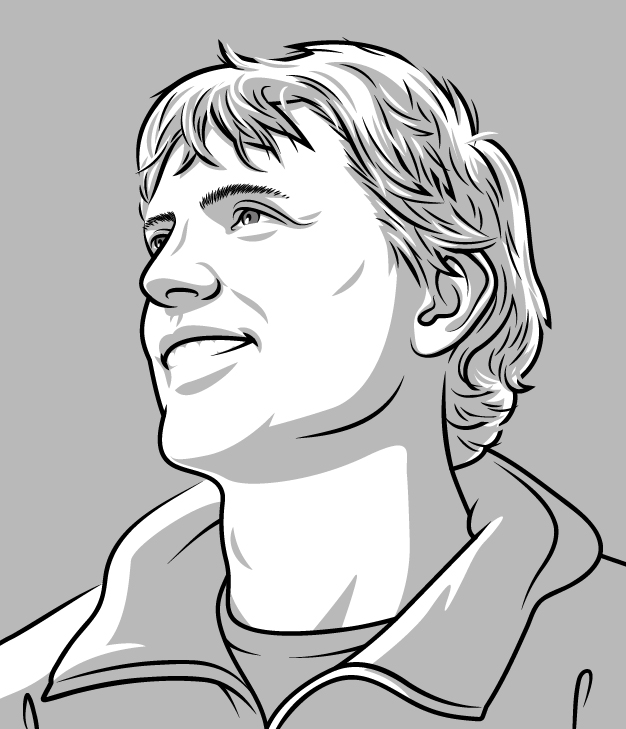
Cartoon portrait of Jonathan Smallwood

CREDIT: JAMES PROVOST (CC BY-ND)

Psychologist Jonathan Smallwood

Queen’s University, Ontario

But Smallwood, now at Queen’s University in Ontario, Canada, forged ahead. He used as his tool a downright tedious computer task that was intended to reproduce the kinds of lapses of attention that cause us to pour milk into someone’s cup when they asked for black coffee. And he started out by asking study participants a few basic questions to gain insight into when and why minds tend to wander, and what subjects they tend to wander toward. After a while, he began to scan participants’ brains as well, to catch a glimpse of what was going on in there during mind-wandering.

Smallwood learned that unhappy minds tend to wander in the past, while happy minds often ponder the future. He also became convinced that wandering among our memories is crucial to help prepare us for what is yet to come. Though some kinds of mind-wandering — such as dwelling on problems that can’t be fixed — may be associated with depression, Smallwood now believes mind-wandering is rarely a waste of time. It is merely our brain trying to get a bit of work done when it is under the impression that there isn’t much else going on.

Smallwood, who coauthored an influential 2015 overview of mind-wandering research in the Annual Review of Psychology, is the first to admit that many questions remain to be answered. 

This conversation has been edited for length and clarity. 

Is mind-wandering the same thing as daydreaming, or would you say those are different?

I think it’s a similar process used in a different context. When you’re on holiday, and you’ve got lots of free time, you might say you’re daydreaming about what you’d like to do next. But when you’re under pressure to perform, you’d experience the same thoughts as mind-wandering.

YOU MAY ALSO LIKE

THE MIND

Peering into the meditating mind

THE MIND

Memory, the mystery

THE MIND

Inside the adolescent brain

I think it is more helpful to talk about the underlying processes: spontaneous thought, or the decoupling of attention from perception, which is what happens when our thoughts separate from our perception of the environment. Both these processes take place during mind-wandering and daydreaming.

It often takes us a while to catch ourselves mind-wandering. How can you catch it to study it in other people?

In the beginning, we gave people experimental tasks that were really boring, so that mind-wandering would happen a lot. We would just ask from time to time, “Are you mind-wandering?” while recording the brain’s activity in an fMRI scanner. 

But what I’ve realized, after doing studies like that for a long time, is that if we want to know how thinking works in the real world, where people are doing things like watching TV or going for a run, most of the data we have are never going to tell us very much. 

So we are now trying to study these situations. And instead of doing experiments where we just ask, “Are you mind-wandering?” we are now asking people a lot of different questions, like: “Are your thoughts detailed? Are they positive? Are they distracting you?” 

How and why did you decide to study mind-wandering? 

I started studying mind-wandering at the start of my career, when I was young and naive. 

I didn’t really understand at the time why nobody was studying it. Psychology was focused on measurable, outward behavior then. I thought to myself: That’s not what I want to understand about my thoughts. What I want to know is: Why do they come, where do they come from, and why do they persist even if they interfere with attention to the here and now?

Around the same time, brain imaging techniques were developing, and they were telling neuroscientists that something happens in the brain even when it isn’t occupied with a behavioral task. Large regions of the brain, now called the default mode network, did the opposite: If you gave people a task, the activity in these areas went down. 

When scientists made this link between brain activity and mind-wandering, it became fashionable. I’ve been very lucky, because I hadn’t anticipated any of that when I started my PhD, at the University of Strathclyde in Glasgow. But I’ve seen it all pan out.

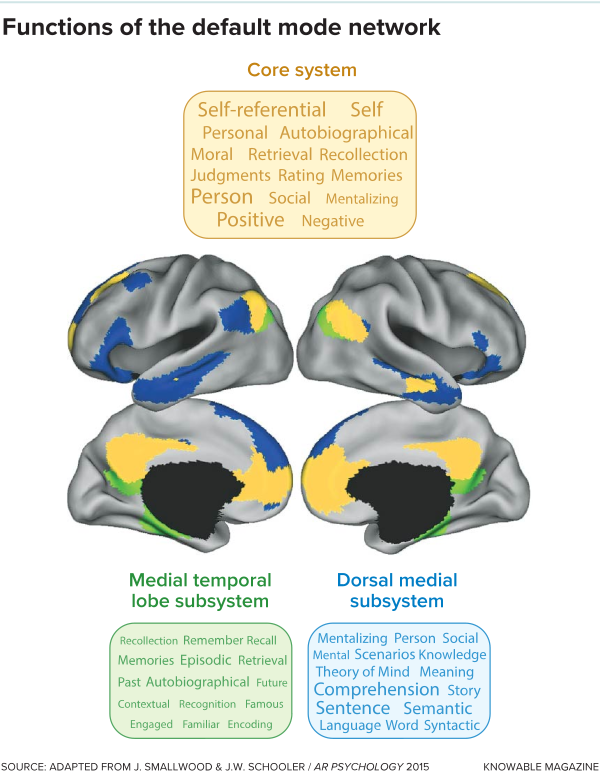
Illustration of brain from different angles with some parts colored yellow, green or blue. Also shown are terms used in papers mentioning elements of the default mode network.
The brain’s default mode network consists of a core and two subsystems. Jonathan Smallwood and colleagues collected the terms most used in scientific articles that report activity in one or more of these. The results, presented in these word clouds, suggest functions for each part of the network. The core: involved in thinking about oneself. The medial temporal lobe subsystem: thinking about things that happen, or episodic processes. The dorsal medial subsystem: thinking about social processes. These three aspects often come together during mind-wandering, Smallwood says.

Would you say, then, that mind-wandering is the default mode for our brains?

It turns out to be more complicated than that. Initially, researchers were very sure that the default mode network rarely increased its activity during tasks. But these tasks were all externally focused — they involved doing something in the outside world. When researchers later asked people to do a task that doesn’t require them to interact with their environment — like think about the future — that activated the default mode network as well.

More recently, we have identified much simpler tasks that also activate the default mode network. If you let people watch a series of shapes like triangles or squares on a screen, and every so often you surprise them and ask something — like, “In the last trial, which side was the triangle on?”— regions within the default mode network increase activity when they’re making that decision. That’s a challenging observation if you think the default mode network is just a mind-wandering system. 

But what both situations have in common is the person is using information from memory. I now think the default mode network is necessary for any thinking based on information from memory — and that includes mind-wandering. 

Would it be possible to demonstrate that this is indeed the case?

In a recent study, instead of asking people whether they were paying attention, we went one step further. People were in a scanner reading short factual sentences on a screen. Occasionally, we’d show them a prompt that said, “Remember,” followed by an item from a list of things from their past that they’d provided earlier. So then, instead of reading, they’d remember the thing we showed them. We could cause them to remember. 

What we find is that the brain scans in this experiment look remarkably similar to mind-wandering. That is important: It gives us more control over the pattern of thinking than when it occurs spontaneously, like in naturally occurring mind-wandering. Of course, that is a weakness as well, because it’s not spontaneous. But we’ve already done lots of spontaneous studies.

When we make people remember things from the list, we recapitulate quite a lot of what we saw in spontaneous mind-wandering. This suggests that at least some of the activity we see when minds wander is indeed associated with the retrieval of memories. We now think the decoupling between attention and perception happens because people are remembering. 

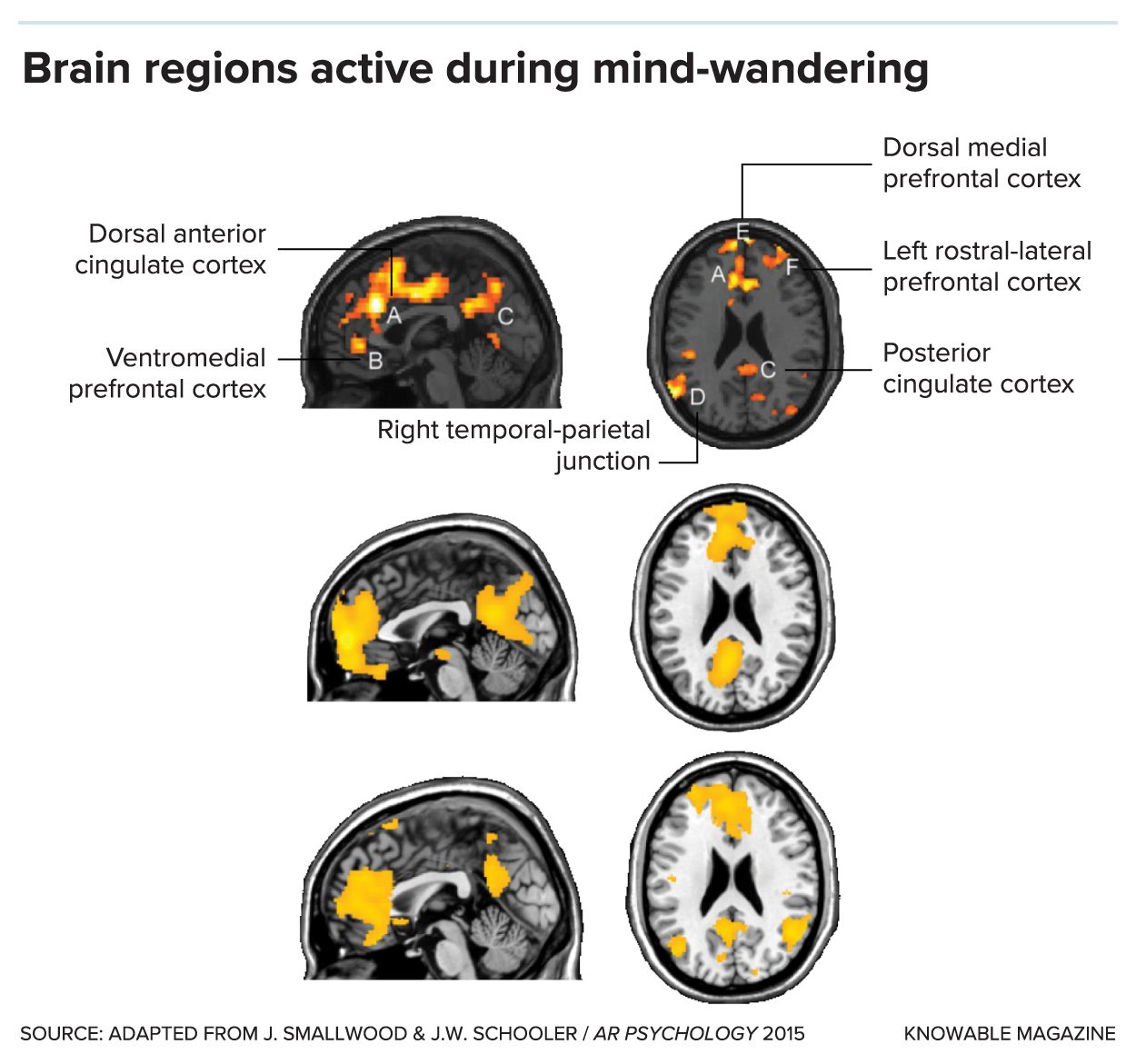
Six grey fMRI images of the brain with active spots lit up in red and yellow.
In three different experiments, similar regions of the brain were activated when subjects admitted their minds had wandered from a task, as shown here in functional magnetic resonance imaging scans. These areas all belong to a system in the brain called the default mode network.

Have you asked people what their minds are wandering toward?

The past and future seem to really dominate people’s thinking. I think things like mind-wandering are attempts by the brain to make sense of what has happened, so that we can behave better in the future. I think this type of thinking is a really ingrained part of how our species has conquered the world. Almost nothing we’re doing at any moment in time can be pinpointed as only mattering then.

That’s a defining difference. By that, I don’t mean that other animals can’t imagine the future, but that our world is built upon our ability to do so, and to learn from the past to build a better future. I think animals that focused only on the present were outcompeted by others that remembered things from the past and could focus on future goals, for millions of years — until you got humans, a species that’s obsessed with taking things that happened and using them to gain added value for future behavior. 

People are also, very often, mind-wandering about social situations. This makes sense, because we have to work with other people to achieve almost all of our goals, and other people are much more unpredictable than the Sun rising in the morning.

Though it is clearly useful, isn’t it also very depressing to keep returning to issues from the past? 

It certainly can be. We have found that mind-wandering about the past tends to be associated with negative mood. 

Let me give you an example of what I think may be happening. For a scientist like me, coming up with creative solutions to scientific problems through mind-wandering is very rewarding. But you can imagine that if my situation changes and I end up with a set of problems I can’t fix, the habit of going over the past may become difficult to break. My brain will keep activating the problem-solving system, even if it can’t do anything to fix the problem, because now my problems are things like getting divorced and my partner doesn’t want any more to do with me. If such a thing happens and all I’ve got is an imaginative problem-solving system, it’s not going to help me, it’s just going to be upsetting. I just have to let it go.

That’s where I think mindfulness could be useful, because the idea of mindfulness is to bring your attention to the moment. So if I’d be more mindful, I’d be going into problem-solving mode less often.

If you spend long enough practicing being in the moment, maybe that becomes a habit. It’s about being able to control your mind-wandering. Cognitive behavioral therapy for depression, which aims to help people change how they think and behave, is another way to reduce harmful mind-wandering.

A man clad in orange is sitting on a rock with his eyes closed, meditating. In the background are a river, rocks and trees.
Mind-wandering can be useful, neutral or negative depending on the circumstances. When it’s counterproductive — perhaps because you’re dwelling on a problem that cannot be solved — mindfulness practices such as meditation can help.CREDIT: PHOTO BY MUNI CITTO ON UNSPLASH

Nowadays, it seems that many of the idle moments in which our minds would previously have wandered are now spent scrolling our phones. How do you think that might change how our brain functions?

The interesting thing about social media and mind-wandering, I think, is that they may have similar motivations. Mind-wandering is very social. In our studies, we’re locking people in small booths and making them do these tasks and they keep coming out and saying, “I’m thinking about my friends.” That’s telling us that keeping up with others is very important to people.

Social groups are so important to us as a species that we spend most of our time trying to anticipate what others are going to do, and I think social media is filling part of the gap that mind-wandering is trying to fill. It’s like mainlining social information: You can try to imagine what your friend is doing, or you can just find out online. Though, of course, there is an important difference: When you’re mind-wandering, you’re ordering your own thoughts. Scrolling social media is more passive.

Could there be a way for us to suppress mind-wandering in situations where it might be dangerous? 

Mind-wandering can be a benefit and a curse, but I wouldn’t be confident that we know yet when it would be a good idea to stop it. In our studies at the moment, we are trying to map how people think across a range of different types of tasks. We hope this approach will help us identify when mind-wandering is likely to be useful or not — and when we should try to control it and when we shouldn’t.

For example, in our studies, people who are more intelligent don’t mind wander so often when the task is hard but can do it more when tasks are easy. It is possible that they are using the idle time when the external world is not demanding their attention to think about other important matters. This highlights the uncertainty about whether mind wandering is always a bad thing, because this sort of result implies it is likely to be useful under some circumstances.

This map — of how people think in different situations — has become very important in our research. This is the work I’m going to focus on now, probably for the rest of my career.

10.1146/knowable-083022-2

Tim Vernimmen is a freelance science journalist based near Antwerp, Belgium. He figured that writing a story this summer about mind-wandering would be the perfect way to prevent it.

The State of American Males in 2025: The Good, The Bad, and The Ugly 

 August 20, 2025

By  Jed Diamond

                For too long we have failed to pay attention to problems faced by boys and men. In his ground-breaking book, Of Boys and Men: Why The Modern Male is Struggling, Why It Matters, and What to Do About It, Richard V. Reeves says,

              “I have been worried about boys and men for 25 years. That comes with the territory when you raise three boys. It has become clear to me that there are growing numbers of boys and men who are struggling in school, at work, and in the family. I used to fret about three boys and young men. Now I am worried about millions.”

                The good news is that things are changing rapidly. When I launched MenAlive in 1972, there were few programs focused on the health of boys and men. Now there are many. Reeves’ book was published in 2022. He went on to become the founding Director of the Institute for Boys and Men and has influenced the work of NYU professor Scott Galloway. Lately, we are seeing more and more attention focused on males.

                However, for those who have been studying the wellbeing of boys and men for many years, there are also serious new problems we must address. Founded by Gary Barker in 2011 as Promundo US, Equimundo works to achieve gender equality and social justice by transforming intergenerational patterns of harm and promoting patterns of care, empathy, and accountability among boys and men throughout their lives.

                Equimundo recently published their latest study, “The State of American Men 2025″. I recently interviewed Gary Barker and you can watch the full interview here.

                Some of the important findings of the study that Gary and I discussed include the following:

  • Economic anxiety is at the forefront of men’s worries.

              Anxiety around not being able to financially secure their and their families’ future is linked to lack of purpose, higher suicidal ideation, and feelings of being an inadequate caregiver.

  • Being a provider is the key trait of manhood today.

               Even though men and women recognize the importance of expanding their roles to include caregiving and other activities, the provider role is still seen as primary. Men who are unable to fulfill that role often feel they are failures.  

  • Men are isolated, feel no one cares about them, and are pessimistic about their romantic prospects.

              Men and women lack social connection and feel unworthy of love; for men this is especially acute. Many males feel inadequate with females and believe that things are stacked against them. Difficulty making and keeping intimate relationships impacts all aspects of a man’s life.

  • Pressure to be a provider and economic anxiety are exacerbated by male involvement on social media.

              Spending more time online often perpetuates males comparing themselves to perceived ideals. Young men (and women) find that social media adds to their feelings of inadequacy.

  • Many men fear being called out or canceled.

              Men face tremendous anxiety that they will be called out, which is likely fueling their backlash against diversity and equality.

  • Economic worries are strongly linked to suicidal ideation.

Men who face financial instability are 16.3 times as likely to have had suicidal thoughts in in the past two weeks.

Up Close and Personal: These Findings Cut Very Close to Home

                When I was five years old, my midlife father took an overdose of sleeping pills. He had become increasingly irritable, angry, and depressed because he couldn’t support his family doing the work that he loved. Though he didn’t die, he was hospitalized at Camarillo State Mental Hospital, north of our home in Los Angeles.

              I went with my uncle every Sunday to visit my father, charged by my mother, to

              “Help your father. He needs you.”

              But my own 5-year-old’s efforts to save my father didn’t work and he continued to get worse.

              I didn’t understand what happened to my dad but was terrified that whatever happened to him would someday happen to me. I have spent my life doing everything I could to figure out the roots of male violence, particularly why it gets turned inward, for men who want to end their suffering by ending their lives.

              After having written fourteen books about men’s health, I finally addressed the issues that had driven me for so long. In my fifteenth book, My Distant Dad: Healing the Family Father Wound, I shared the journals I found as an adult that began to pull back the curtain of confusion I had lived with all my life.

              Years after my father had escaped from the mental hospital where he had been locked up, I found the journals he had written before his final act of despair. Every time I read them, I feel closer to my dad, two men, father and son, struggling to be good men and support their families. I also feel deep sadness as I watch him slipping closer to the edge of hopelessness. In his last journal, I found these entries:

              July 3, 1948:

              “Oh, Christ, if I can only give my son a decent education — a college degree with a love for books, a love for people, good, solid knowledge. No guidance was given to me. I slogged and slobbered and blundered through two-thirds of my life.”

              July 24, 1948:

              “Edie dear, Johnny dear, [my birth name before I changed it to Jed] I love you so much, but how do I get the bread to support you? The seed of despair is part of my heritage. It lies sterile for months and then it gnaws until its bitter fruit chokes my throat and swells in me like a large goiter blacking out room for hopes, dreams, joy, and life itself.”

              August 8, 1948:

              “Sunday morning, my humanness has fled, my sense of comedy has gone down the drain. I’m tired, hopelessly tired, surrounded by an immense brick wall, a blood-spattered brick world, splattered with my blood, with the blood of my head where I senselessly banged to find an opening, to find one loose brick, so I could feel the cool breeze and could stick out my hand and pluck a handful of wheat, but this brick wall is impregnable, not an ounce of mortar loosens, not a brick gives.”

              December 8, 1948:

              “Your flesh crawls, your scalp wrinkles when you look around and see good writers, established writers, writers with credits a block long, unable to sell, unable to find work, Yes, it’s enough to make anyone blanch, turn pale, and sicken.”

              February 24, 1949:

              “Faster, faster, faster, I walk. I plug away looking for work, anything to support my family. I try, try, try, try, try. I always try and never stop.”

              June 12, 1949:

              “Middle aged, I stand and gaze ahead, numb, confused, and desperately worried. All around me I see the young in spirit, the young in heart, with ten times my confidence, twice my youth, ten times my fervor, twice my education. I see them all, a whole army of them, battering at the same doors I’m battering, trying in the same field I’m trying. Yes, on a Sunday morning in June, my hope and my life stream are both running desperately low, so low, so stagnant, that I hold my breath in fear, believing that the dark, blank curtain is about to descend.”

              Like so many men I’ve worked with, including myself, men tend to blame themselves when we are unable to fulfill our role as “breadwinner.” We don’t recognize the larger economic trends that restrict us or the system-created “man box” that keeps so many of us isolated.

              Much has changed since my father was hospitalized. Many things have improved, but there are new challenges men face now that were not present when my father was confronting his inner demons. I carry both his hopes and dreams and the weight of his despair. I am blessed to have fulfilled his dreams for a good education and the support of family, friends, and colleagues. Yet there is much still to do. I hope you’ll join us.

              You can read the full study from Equimundo here:

              You can read my interview with Gary Barker here:

              You can sign up for my weekly newsletter with my latest articles here:

              You can read about my father’s and my healing journey here:

Author Image

Best Wishes,

Jed Diamond


Founder and VHS (Visionary Healer Scholar) of MenAlive

All The Demands Trump Is Making Of The Smithsonian

Published: August 18, 2025 (TheOnion.com)

The White House has announced they will be reviewing all exhibits at the Smithsonian Institution in order “to assess tone, historical framing, and alignment with American ideals.” Here is a selection of the changes President Trump is demanding be implemented immediately.


New wing about the Cola wars


Plaques updated to confirm that wooly mammoths were white


Artifacts will be returned to the people who originally stole them


Air and Space Museum must loan all planes, shuttles, and gliders to Israel


Portraits and sculptures of nude women relocated to men’s bathroom


Overnight dismantling of anything even resembling disability accommodation


Melania added as newest of the 274 lifelike specimens in the Hall of Mammals


Blindfolds handed out at the entrance to the National Museum of African American History


The Wright brothers will be referred to as the Flight brothers because it just makes more sense 


At least one exhibit about how magic tricks work


Last sentence of all plaques changed to “and they lived happily ever after”

Prosperos Sunday Meeting August 31

SUNDAY MEETING, August 31


Pam Rodolph, H.W., M.

presents…”What is High Watch and Mentorship?”

Join us for this stimulating exploration of the role of a High Watch and Mentor, delivered by Pam Rodolph, H.W., M. Pam is a long-time student and Mentor, and you’ll love to hear her insights.  

Pam writes: “I believe we are in the age of Mentorship, of applied wisdom, of diminished aggression with subsequent development of inner sight. Because I believe we are all called to the level of Mentorship, I think the age of pure student is over. No one gets a break. I think all of us are called to “walk the talk.” I hope I can say something you may not have thought about, something that puts new energy into your continued pursuit of everything good in life….”

For further informtion, click here:
https://www.theprosperos.org/prosperos-events/sunday-talk-23-06-2024-mjscy

SUNDAY MEETING —  August 31, 2025

11:00 am Pacific/Noon Mountain/1:00 pm Central/
2:00 pm Eastern


Join Sunday Meeting

By contribution.  Please click here to contribute:Contribute!

Call In Information:
+16699006833,,332275676# US (San Jose)
+13462487799,,332275676# US (Houston)Dial by your location        +1 669 900 6833 US (San Jose)       
+1 346 248 7799 US (Houston)       
+1 301 715 8592 US       
+1 312 626 6799 US (Chicago)       
+1 929 205 6099 US (New York)       
+1 253 215 8782 USMeeting ID: 332 275 676
Find your local number: https://zoom.us/u/abtcyLDACK
Copyright © 2025 The Prosperos, All rights reserved.

Science, Philosophy, and the Afterlife with Chris Carter

New Thinkin Aug 24, 2025 Chris Carter is a physics teacher who was educated at Oxford, England. He is author of four books that make him one of the most significant authors today exploring the question of life after death: Science and the Near-Death Experience, Science and Psychic Phenomena, Science and the Afterlife Experience, and most recently The Case for the Afterlife: Evidence of Life After Death. His website is https://www.llewellyn.com/product.php… At this site you can gather more info about The Case for the Afterlife, and also read a short article he wrote titled Can we Prove there is Life after Death? (his answer is a resounding yes!) Here he shares some of the strongest cases supporting postmortem survival of consciousness and also presents the counter-arguments to several philosophical objections. 00:00 Introduction 03:51 Dualism and materialism 05:28 Terminal lucidity 08:47 Pam Reynolds’ near-death experience 14:45 Living agent psi and “superpsi” 21:14 The deceased chess master 27:35 The Roman emperor Constantine 29:17 The easiest one to fool is oneself 35:31 Predisposition to belief 38:07 Conclusion New Thinking Allowed host, Jeffrey Mishlove, PhD, is author of The Roots of Consciousness, Psi Development Systems, and The PK Man. Between 1986 and 2002 he hosted and co-produced the original Thinking Allowed public television series. He is the recipient of the only doctoral diploma in “parapsychology” ever awarded by an accredited university (University of California, Berkeley, 1980). He is also the Grand Prize winner of the 2021 Bigelow Institute essay competition regarding the best evidence for survival of human consciousness after permanent bodily death. He is Co-Director of Parapsychology Education at the California Institute for Human Science. (Recorded on August 15, 2025)

Plato on true friendship

“True friendship can exist only between equals.”

~ Plato

Plato (/ˈpleɪtoʊ/ PLAY-toeGreek: Πλάτων, Plátōn; born c. 428–423 BC, died 348/347 BC) was an ancient Greek philosopher of the Classical period who is considered a foundational thinker in Western philosophy and an innovator of the written dialogue and dialectic forms. He influenced all the major areas of theoretical philosophy and practical philosophy, and was the founder of the Platonic Academy, a philosophical school in Athens where Plato taught the doctrines that would later become known as Platonism.

Plato’s most famous contribution is the theory of forms (or ideas), which aims to solve what is now known as the problem of universals. He was influenced by the pre-Socratic thinkers PythagorasHeraclitus, and Parmenides, although much of what is known about them is derived from Plato himself.

Along with his teacher Socrates, and his student Aristotle, Plato is a central figure in the history of Western philosophy.