
Monthly Archives: May 2025

Tarot Card for May 27: Death
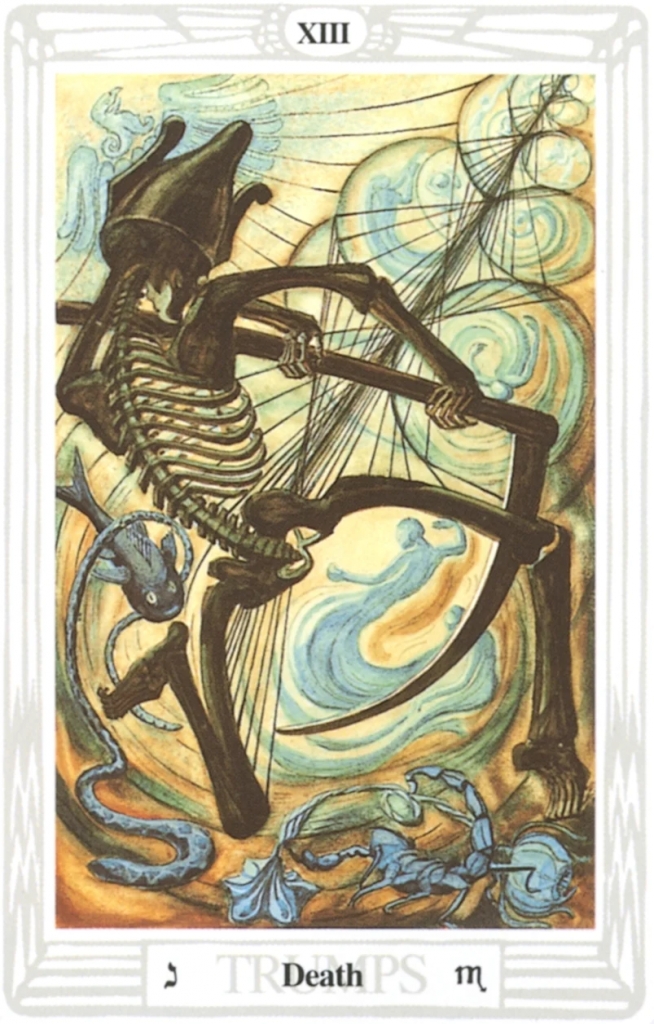
| Death I wonder if there is a more-feared card in the Tarot deck? Yet Death is, in many ways, a hopeful and refreshing influence if only we will let it be. It is the major card for change and alteration in the entire deck. Since life itself changes constantly, in order to harmonise ourselves more completely with it, we too must be in a state of constant change – working toward our goals, attempting to fulfil our dreams and developing the quality of our spiritual understanding.When Death comes up as Card of the Day, the first question we need to ask ourselves is – what is it that needs to be changed or finished up? What situations have been lingering on well past their sell-by date? What should we have dealt with before, that this day challenges us to face and finish?Imagine, for a moment, that your life is a plot of land. If it is completely overgrown, covered with unwanted and untended undergrowth, you cannot plant something beautiful and fruitful in it can you?The Death card requires that we spend a bit of dedicated time cutting away the undergrowth, and clearing the debris so that our lives are clear and open, ready for fresh planting.Sometimes a Death card day won’t be one in which we need to do, so much as one in which we need to think. Most peoples’ lives are very busy indeed these days. So busy, in fact, that we often tend to put off thinking about the difficult or demanding issues in our lives. Yet often it is exactly this type of issue that causes emotional and mental deadwood to accumulate, if we allow it.If life is created by what we think, what we expect and how we feel about things, our deepest emotional urges, our wildest dreams, our highest ideals require a great deal of thinking about, don’t they? If not, we stagnate, never creating new channels through which to direct our energies, never determining when a habitual action has run its course, never assessing what is useful, and what is not.So, sometimes, a Death card day needs to be a day in which you re-evaluate the general patterns of your daily existence, and re-appraise your goals. You’ll know if it’s that kind of day by measuring how dissatisfied you currently feel. If you are largely happy and comfortable, then the Death card day is one for clearing the decks in a physical sense. Affirmation: “I welcome change into my life, embracing it fearlessly and hopefully.” |
Anne Lamott on Toni Morrison

“Toni Morrison said, ‘The function of freedom is to free someone else,’ and if you are no longer wracked or in bondage to a person or a way of life, tell your story. Risk freeing someone else. Not everyone will be glad that you did. Members of your family and other critics may wish you had kept your secrets. Oh, well, what are you going to do? Get it all down. Let it pour out of you onto the page. Write an incredibly shitty, self-indulgent, whiny, mewling first draft. Then take out as many excesses as you can.”
― Anne Lamott
Anne Lamott (born April 10, 1954) is an American novelist and nonfiction writer. She is also a progressive political activist, public speaker, and writing teacher. Lamott is based in Marin County, California. Her nonfiction works are largely autobiographical. Wikipedia
New Moon In Gemini – Opportunities
(Astrobutterfly.com)
On May 27th, 2025, we have a New Moon at 6° Gemini.
This is one of the most auspicious New Moons of the year – it is conjunct its ruler, Mercury, it’s trine Pluto in Aquarius, and sextile Neptune and Saturn in Aries.
The New Moon in Gemini has “opportunities” written all over it.
A new lunar cycle also means we are saying goodbye to the previous lunar cycle in Taurus – which was tense, to say the least.
The New Moon in Gemini will feel like a breath of fresh air, as if a heaviness has been lifted.

2 interesting things about this New Moon in Gemini:
1. First, it’s conjunct its own ruler, Mercury, which makes it extra potent and extra “Gemini.” Jupiter is also in Gemini, giving a magical boost to whatever we initiate.
If your intentions align with Gemini themes like writing, presentations, or online communication – to name a few Gemini themes – that’s the one to pursue!
2. Second, it aspects all the outer planets – Uranus, Neptune, and Pluto – as well as the newly ingressed Saturn in Aries. This is the first New Moon with Saturn in Aries fully, and it’s really kicking things into gear.
New Moon In Gemini – Opportunities
But the reason this New Moon is so special is that it initiates an important configuration that will unfold over the next few years: a minor triangle between the “Big 3” – Pluto, Neptune, and Uranus.
This is a spectacular configuration that supports change and progress at a rate we may have never seen before.
We are no longer in the Pluto-in-Capricorn / Neptune-in-Pisces era. The world looks very different from how it did prior to 2024, when Pluto moved into Aquarius.
Everything is being reconfigured – from alliances to systems of power and influence. Innovation and AI are changing the rules, but also opening new doors and possibilities.
We are entering a completely new world, where we have the chance to become active participants.
And Gemini will play a very important role in this new scenario. Jupiter has been turning Gemini into a prime venue for growth, paving the way for Uranus, which enters the sign in July 2025 to really accelerate innovation and change.
This shift from Earth to Air (Capricorn → Aquarius, Taurus → Gemini) means we are becoming less focused on earthy, tangible concerns like material accumulation or survival, and more attuned to how we connect with others and how we express ourselves.
Success and happiness will no longer be measured by the size of our bank account or the stability of our assets—but by our social connections, how much we stay active, and how we contribute to this new world to make it a better place (Saturn and Neptune in Aries).
How do we do this in a Gemini way? We expand our horizons. We learn new things. We stay curious and open.

How many times has an opportunity shown up either through a conversation, by reading a magazine, or by checking your emails or social media?
Gemini is our interface with the world – it’s where we take in bits of information, bits of inspiration, and from there, build something new.
Chances are, most opportunities in your life – even if you didn’t recognize it at the time – have come to you through some sort of Gemini activity.
The Sabian Symbol of this New Moon is “A well with bucket and rope under the shade of majestic trees.” The Sabian symbol speaks of quiet abundance and support – the universe is providing us with what we need; all we have to do is reach out and draw from it.
At the New Moon in Gemini, pay attention to whatever emerges – however subtle or ordinary it may seem – because it might just be the spark that sets your next big idea in motion.
The atomic bomb, exile and a test of brotherly bonds: Robert and Frank Oppenheimer
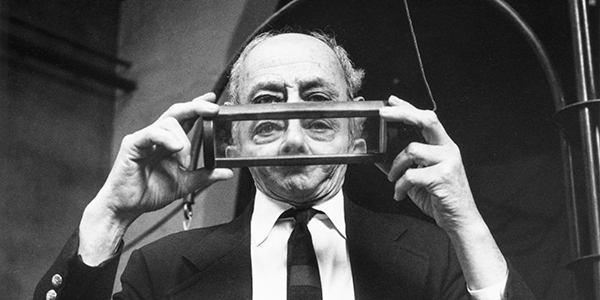
CREDIT: COURTESY OF KC COLE
A rift in thinking about who should control powerful new technologies sent the brothers on diverging paths. For one, the story ended with a mission to bring science to the public.
By KC Cole
03.05.2024 (knowablemagazine.org)
Support sound science and smart stories
Help us make scientific knowledge accessible to all
Donate today
Every now and then, science serves up poison pills. Knowledge gained in the course of exploring how nature works opens doors we might wish had stayed shut: For much of the past year, our newsfeeds were flooded with stories about how computational superpowers can create amoral nonhuman “minds” that may learn to think better than we do (and then what?). On the big screen, the movie Oppenheimer explored a threat people have lived with for nearly 80 years: How the energy of the atom can be unleashed to power unimaginably destructive bombs.
When potentially catastrophic inventions threaten all humanity, who decides how (or whether) they’re used? When even scientists toss around terms like “human extinction,” whose voice matters?
Such questions were at the core of the Oppenheimer film, a blockbuster now nominated for more than a dozen Oscars. To me, the movie hit home for a different reason. I spent a great deal of time with Frank Oppenheimer during the last 15 years of his life. While I never knew his brother Robert, Frank remained anguished over what he felt was Robert’s squandered opportunity to engage the world’s people in candid conversations about how to protect themselves under the shadow of this new threat.
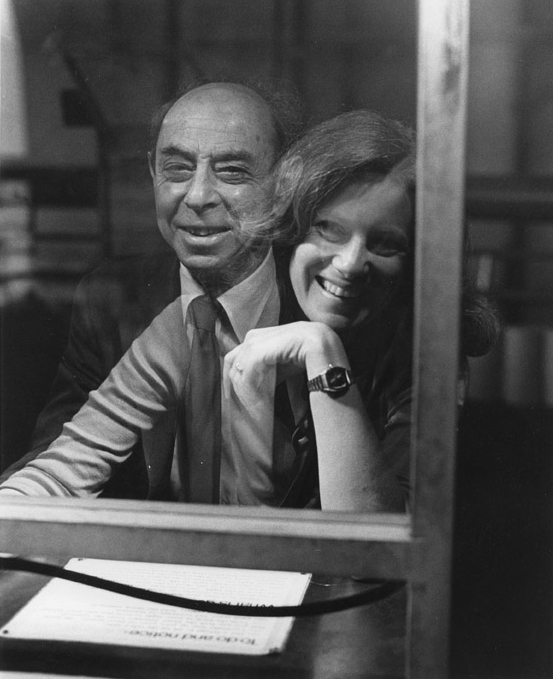
During the post-World War II years, the emotionally close ties between the brothers (Robert — the “father of the atom bomb” — and his younger brother, Frank — the “uncle” of the bomb, as he mischievously called himself) were strained and for a time even fractured. Both hoped that the nascent nuclear technology would remain under global, and peaceful, control. Both hoped that the sheer horror of the weapons they helped to build could lead to a warless world.
They were on the same side, but not on the same page when it came to tactics.
YOU MAY ALSO LIKE
Why some artificial intelligence is smart until it’s dumb
Synthetic media: The real trouble with deepfakes
How to detect clandestine nuclear weapons programs
Robert — whose fame surged after the war — believed decisions should be left to experts who understood the issues and had the power to make things happen — that is, people like himself. Frank believed just as fiercely that everyday people had to be involved. It took everyone to win the war, he argued, and it would take everyone to win the peace.
In the end, both lost. Both paid for their efforts with their careers (although Frank eventually resurrected his ideas as a “people’s science museum” that had a worldwide impact).
Given that the question “Who decides?” underlies so much of today’s fast-evolving sciences, the brothers’ story seems more compelling and relevant than ever.
Ethical education
In many ways, the Oppenheimer brothers were very much alike. Both studied physics. Both chain-smoked. Both loved art and literature. Both had piercing blue eyes, inherited from their mother, Ella Friedman Oppenheimer, an artist with a malformed hand always hidden in a glove. Their father, Julius, was a trustee of the Society for Ethical Culture, dedicated to “love of the right.”
They shared a Manhattan apartment with maids, Renoirs, and books piled down the halls and into the bathrooms. Ella was terrified of germs, so tutors and barbers often came to them. Frank had his tonsils out in his bedroom. Both boys attended Ethical Culture schools in New York, so morality was baked into their upbringing.
But they were also in other ways opposites.
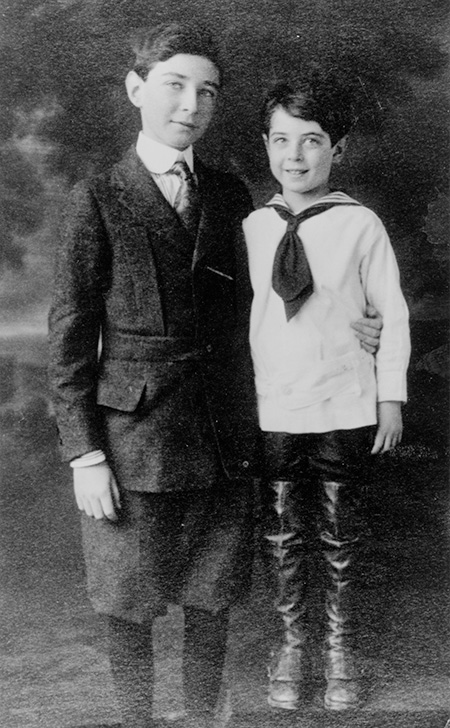
Robert was, by his own admission, “an unctuous, repulsively good little boy.” Frank was anything but. He sneaked out at night to scale New York City’s rooftop water towers; by high school, he was using the electric current in the family home to weld whatever metal he could get his hands on. He took apart his father’s player piano (then stayed up all night putting it back together).
Robert got through Harvard in three years and received his PhD from the University of Göttingen two years later, in 1927, at age 23. Frank didn’t get his PhD until he was 27. Robert was arrogant, picky about his company. Frank would talk with anyone and did, later befriending even his FBI tail.
When Robert joined the faculty at Caltech, he was described as “a sort of patron saint,” always center stage, smooth, articulate, captivating. When Frank arrived at Caltech many years later for graduate work, he was described as standing “at the fringe, shoulders hunched over, clothes mussed and frayed, fingers still dirty from the laboratory.”
Still, they loved each other dearly. Frank wept when Robert left for grad school in Europe. Robert wrote Frank that he would gladly give up his vacation “for one evening with you.” He sent his little brother books on physics and chemistry, a sextant, compasses, a metronome, along with letters full of brotherly wisdom. My personal favorite: “To try to be happy is to try to build a machine with no other specifications than it shall run noiselessly.”
In summer, they retreated to a cabin in the mountains of New Mexico, which Robert called Perro Caliente (Spanish for “hot dog”). They rode horses over 13,000-foot peaks, 1,000 miles a summer. During one night ride, Robert got knocked off his horse. “He was very thin anyway,” Frank said. “Here was this little bit of protoplasm on the ground, not moving. It was scary, but he was all right.”
On a road trip back to Caltech, Frank rolled the car into a ditch, breaking Robert’s arm. When Robert stopped at a store to get a sling, he came back with a bright red one, to cheer up his little brother, who he knew was feeling bad about the accident.
The world around them was fraught, with fascism on the rise in Germany, Italy and Spain. The Depression meant people were still out of work. Robert kept mostly aloof from politics, but Frank dived in. He married a UC Berkeley student who was a member of the Young Communist League, then joined himself. He admired the Communists for taking unemployment seriously — and for understanding the threats posed by Hitler and Mussolini. His personal tipping point was the treatment of Blacks at a Pasadena public pool: Blacks were allowed only on Wednesdays; the pool was drained before the whites came back on Thursday. Only the Communist Party seemed concerned.
Robert didn’t approve of Frank’s decision to join the party, and he didn’t approve of his wife, Jackie, either, referring to her as “that waitress.” He accused Frank of being “slow” because it took him what Robert regarded as too long to get his PhD. He called Frank’s marriage “infantile.” The feelings became mutual. Jackie later regarded Robert and his wife, Kitty, as pretentious, phony and tight.
Frank soon realized that he wasn’t cut out to be a Communist, and quit. He felt the party was too authoritarian, and not as interested in social justice as in petty bickering. (Robert never joined, although Kitty had been a party member.)
From quantum theory to atom smashers
The brothers were both working as physicists when the Japanese bombed Pearl Harbor in 1941. Robert, the theorist, was sharing the revolutionary physics of quantum mechanics with his American colleagues at Berkeley and Caltech, where he had joint appointments. Frank, a natural-born experimentalist, was working with Ernest Lawrence at Berkeley on the rapidly developing technology of particle accelerators — known to some as “atom smashers.”
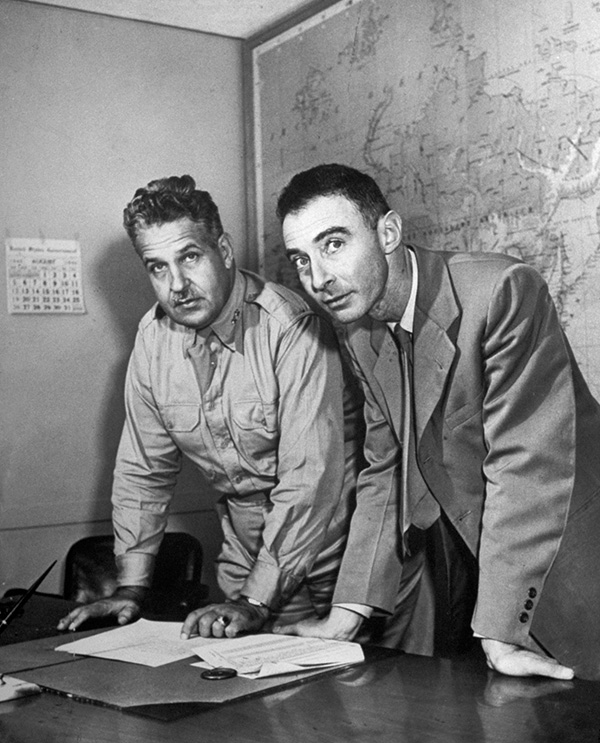
Once it became clear that the enormous energy contained in the atomic nucleus could be used to build a bomb — and that Nazi Germany might well be doing just that — President Franklin Roosevelt approved a major American effort to beat them to it: the Manhattan Project. It came as a surprise to everyone when Gen. Leslie Groves tapped Robert as director. Seemingly overnight, the ethereal young man who enjoyed reading poetry in Sanskrit became the ringleader of the most concentrated collection of brilliant minds ever assembled — scientists summoned from around the world to a makeshift lab on a desolate New Mexico mesa, where they would build an atomic bomb to stop Hitler.
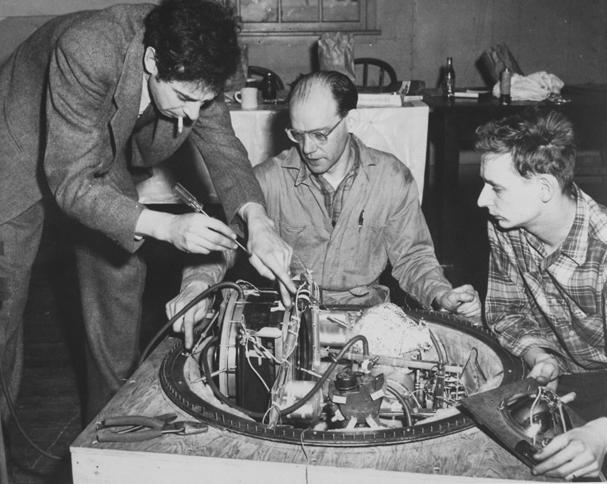
Frank, meanwhile, worked with Lawrence on what he called “racetracks” (officially calutrons) used to coax small but vital amounts of pure uranium-235 out of a dirty mix of isotopes by steering them in circles with magnets. Uranium-235, like plutonium-239, is easily split, just what was needed to set off a chain reaction. Since no one knew how to bring together a critical mass of the stuff to make an explosion, two designs were pursued simultaneously. The plutonium bomb acquired the nickname Fat Man; the uranium bomb was Little Boy.
Frank helped supervise an enormous complex for uranium separation at Oak Ridge, Tennessee. Frank liked Gen. Groves and Groves, in turn, liked Frank — and later defended him when he was booted from physics for his politics.
As the time to test the bomb approached, Frank joined his brother at the Trinity site, a dry scrubby desert formerly part of the Alamogordo Bombing Range. Frank, who saw his job (ironically enough) as a “safety inspector,” mapped escape routes through the desert and made sure workers wore hard hats.
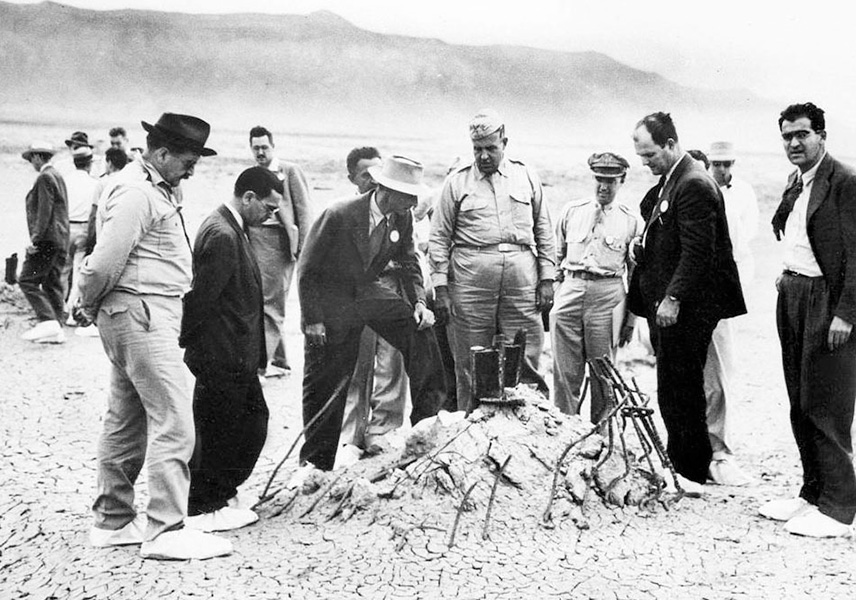
Finally, on July 16, 1945, the go-ahead was given. After a long night on edge watching driving rain and lightning rage around “the gadget” — a Fat Man-style plutonium bomb perched on a 100-foot-tall tower — the proverbial (and literal) button was pushed.
The brothers lay together at the nearest bunker, five miles away, heads to the ground. Frank later described the “unearthly hovering cloud. It was very bright and very purple and very awesome … and all the thunder of the blast was bouncing, bouncing back and forth on the cliffs and hills. The echoing went on and on.…” The cloud, he said “just seemed to hang there forever.”
Frank and his brother embraced each other: “I think we just said: ‘It worked.’”
On August 6, 1945, Little Boy was dropped on the pristine city of Hiroshima — which had been deliberately untouched by US bombs, the better to assess the damage. In an instant, the city was all but flattened, people reduced to charred cinders, survivors hobbling around with their skin peeled off and hanging from their bodies like rags. An estimated 140,000 people were killed in the attack and in the months after, according to Japanese authorities.
Frank heard the news outside his brother’s office at Los Alamos. “Up to then I don’t think I’d really thought of all those flattened people,” he said. The US bombing of Nagasaki with Fat Man just days later brought the death toll even higher.
Some physicists saw their success as a moral failure. Still, many — including Frank and Robert — also hoped this new weapon would cause people to see the world differently; they hoped it would ultimately bring about peace. “Those were the days when we all drank one toast only,” Robert said: “‘No more wars.’”
Intolerable weapon
After the war, the brothers’ lives diverged, driven by circumstance, in ways that were painful to both.
Robert was a hero; he mingled easily with the powerful. Famously, he was Einstein’s boss — director of the Institute for Advanced Study in Princeton. He chaired a committee to advise the government on a new and vastly more powerful type of bomb — the hydrogen bomb. Rather than split atoms, it fused them, using the physics of stars. The H-bomb could be 1,000 times more powerful than Little Boy.
Robert’s committee voted unanimously against developing it. “The extreme dangers to mankind inherent in this proposal wholly outweigh any military advantage that could come from this weapon.” They described it as a “threat to the future of the human race which is intolerable.”
Frank, meanwhile, had joined the physics department at the University of Minnesota, building detectors to catch cosmic rays streaming from space with equipment tethered to balloons he frequently lost but chased gamely through Cuban forests and other remote locations. He was excited about their discovery that the cosmic ray particles were not merely protons, as people had assumed, but the nuclei of many elements — from hydrogen to gold — implying that some were forged in supernova explosions.
At the same time, he was giving speeches “all over the map,” as he put it, trying to educate the public about nuclear bombs, trying to explain what 1,000 times more powerful really meant. He spoke to bankers, civic associations, schools. He argued that so-called “smart” people weren’t all that different from everyone else. The mistrust of the “hoi polloi,” Frank thought, stemmed largely from the tendency of people to credit their own success to a single personal characteristic, which they then “idolize” and use to measure everyone else by the same yardstick.
He believed people would educate themselves if they thought their voices mattered. “All of us have seen, especially during the war, the enormous increase in the competence of people that results from a sense of responsibility,” he said. Building the “racetracks” during the war had required training thousands of people “fresh from farms and woods to operate and repair the weirdest and most complicated equipment.”
Soon, his physics career was cut short. The FBI had been keeping tabs on both brothers for years, pausing only for the war, when military intelligence took over. Agents followed them everywhere, tapped their phones, planted microphones in their houses.
In 1949, Frank received a summons to appear before the House Un-American Activities Committee (HUAC), where he refused to take the fifth, but also refused to testify about anyone other than himself. He was effectively fired from the University of Minnesota physics department, leaving the chair’s office in tears.
Attempts to find work elsewhere were blocked at every turn, despite support from multiple Nobel laureates, Gen. Groves and even H-bomb enthusiast Edward Teller. Finally, an FBI agent told Frank flat out: If he wanted a job, he had to cooperate. “Then I realized what the wall was.”
Out of options, and having just purchased a ranch to live on “someday,” Frank and Jackie became serious cattle ranchers, learning from neighbors and veterinary manuals. (The FBI was right on their tails, pestering neighbors for information, suggesting they were broadcasting atomic secrets to Mexico.) All the while, Frank thought and wrote about physics and peace, civil rights, ethics, education and the critical role of honesty in science and public life.
Robert did not approve of any of Frank’s activities. He thought there wasn’t time to bring the public in on the debate; he thought he could use his fame and power to influence policy in Washington toward peaceful ends. Frank expressed his disgust at what he considered his brother’s futile and elitist approach. Robert made it clear that he thought the idea of becoming a rancher was a little silly — as well as beneath Frank.
Frank felt he could no longer reach him. “I saw my bro in Chicago,” Frank wrote his best friend Robert Wilson at Cornell in an undated letter probably from the early 1950s. “I fear that I merely amused him slightly when, in brotherly love, I told him that I was still confident that someday he would do something that I was proud of.”
Stay in the Know
Sign up for the Knowable Magazine newsletter today
A man destroyed
Robert’s now-famous downfall was swift. Many great books have been written about the subject (not to mention Christopher Nolan’s colossal film); in effect, he was punished for his opposition to the H-bomb, probably his arrogance and naivete as well. After a series of secret hearings, his security clearance was revoked; he was, by all accounts, a ruined man.
It wasn’t something Frank liked to talk about. “He trusted his ability to talk to people and convince them,” Frank said. “But he was up against people that weren’t used to being convinced by conversation.”
Some of Robert’s most poignant testimony during the hearings involved Frank. Asked if his brother had ever been a Communist, Robert answered: “Mr. Chairman … I ask you not to press these questions about my brother. If they are important to you, you can ask him. I will answer, if asked, but I beg of you not to ask me these questions.”
The broader tragedy for both brothers was that the creation of the world’s most fearsome weapon of mass destruction — a thing too horrible ever to use — didn’t much change how people viewed war. The H-bomb was just another weapon.
“What undid him,” Frank said, “was not just his fall from official grace, but the fact that this fall represented a defeat for the kind of civilized behavior that he had hoped nations would adopt.”
Robert died at the age of 62, in 1967. Frank’s last memory of his brother is poignantly familial. Robert was lying in bed, in great pain from throat cancer. Frank lay down beside him and together they watched Perry Mason on TV.
A new path
While Robert was being politically destroyed, Frank had started teaching science in a one-room schoolhouse. Before long, students from Pagosa Springs, Colorado, were winning the state science fairs. Eventually allowed into academia by the University of Colorado in 1959, Frank promptly built a “library of experiments” out of equipment scavenged from other labs.
That “library” in time grew into a vast public playground of scientific stuff housed in the abandoned Palace of Fine Arts in San Francisco. Exhibits — sometimes sophisticated and delicate — were meant to be played with, even broken; no guards stopped people from touching anything, no rules prevented theft — and remarkably, there was almost none. He called it an Exploratorium so people wouldn’t think it was a “museum” where good behavior was expected (although he liked the idea that “no one flunks a museum”). Top scientists and artists from around the globe contributed time and talent. Barbara Gamow, wife of the physicist George Gamow, painted a sign to hang over the machine shop: Here is Being Created an Exploratorium, a Community Museum Dedicated to Awareness.
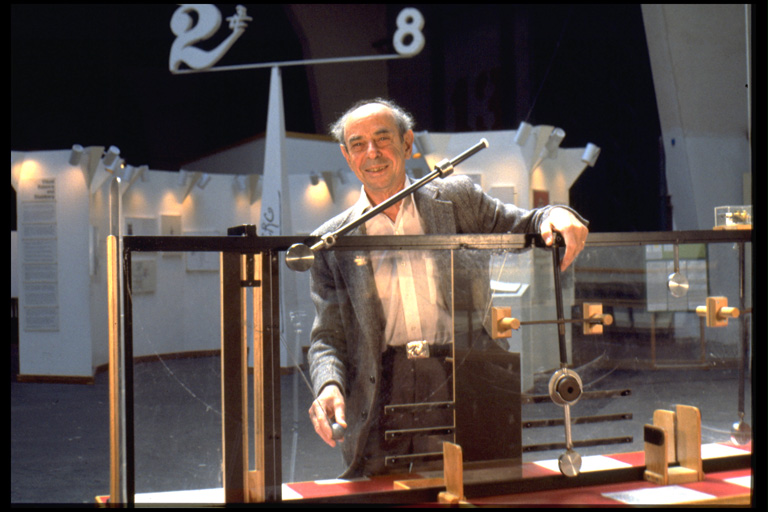
In the end, I like to think Frank proved his brother (and most everyone else) wrong about the willingness of everyday people to engage and learn. The “so-called inattentive public,” he’d said, would come to life if people didn’t feel “fooled and lied to,” if they felt valued and respected. And if people got addicted to figuring things out for themselves, they’d be inoculated against having to take the word of whatever bullies happened to be in power. Society could tap into this collective wisdom to solve pressing global problems — the only way he thought it could work.
Today, Exploratorium-style science centers exist in some form all over the globe.
I count myself as one of Frank’s many thousands of addicts, hooked on science (a subject I’d found boring) the minute I met him in 1971. (In a weird resonance with today, my first foray into journalism was a piece on the Soviet invasion of Czechoslovakia for the New York Times Magazine.) I was interested in peace, not physics. Frank talked me into writing for him, explaining optics and wave mechanics to the public. My first editor was Jackie. Over the years, Frank and I spent endless hours chatting about life, art, science and his family, including his brother.
Nolan’s film Oppenheimer doesn’t offer much insight into Robert’s thoughts on science and peace or science and human morality. However, Robert did think and talk about these ideas, many of which are collected in his 1954 book Science and the Common Understanding, as well as other places.
Frank continued to get upset (and a little drunk) every August 6, the day Hiroshima was bombed. He’d rub his forehead hard, as if he was trying to rub something out. He had much the same reaction to many previous dramatizations of the Oppenheimer story, because he thought they focused too much on the fall of his brother, rather than on the failure of attempts to use the horror of the bomb to build a warless world.
Frank’s fierce integrity permeated our work together: He refused to call me writer/editor because he said that meant writer divided by editor. Instead, I was his Exploratorium Expositor.
If someone said, “It’s impossible to know something, or impossible to adequately thank someone,” he’d argue: It’s not impossible, it’s only very, very, very hard.
No matter what impossible thing Frank was trying to do, he refused to be stopped by so-called “real world” obstacles. “It’s not the real world,” he’d rage. “It’s a world we made up.” We could do better. In fact, so many of what we came to call “Frankisms” seem more relevant today than ever:
“The worst thing a son of a bitch can do to you is turn you into a son of a bitch.”
“Artists and scientists are the official noticers of society.”
“If we stop trying to understand things, we’ll all be sunk.”
Navigating the dark side of science, I think, will require attending closely to all of these. The “real world” we’re presented with is not the way things have to be. We shouldn’t become sons of bitches. We can never stop noticing or trying to understand.
10.1146/knowable-030424-1
KC Cole is the author of eight nonfiction books, most recently Something Incredibly Wonderful Happens: Frank Oppenheimer and the World He Made Up. She is senior senior correspondent at Wired magazine, teaches in the honors program at the University of Washington, and has written for dozens of newspapers and magazines.
Story: “One’s Role in Work”

Thomas Mann visits the Lido and is inspired to write his novella Death in Venice.
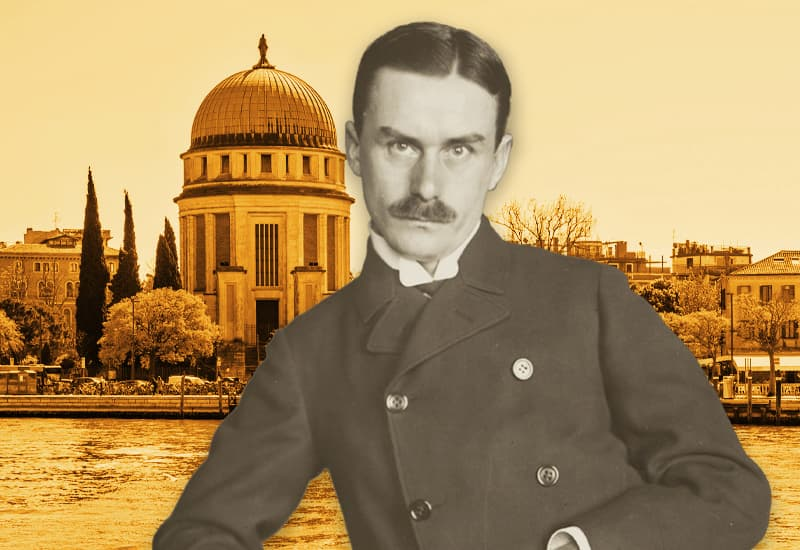
(Lithub.com)
In May 1911, Thomas Mann checked into the Grand Hotel des Bains on the Lido in Venice with his brother Heinrich and his wife Katia. There, he was famously inspired to write what would become perhaps his most widely read work, the novella Der Tod in Venedig (Death in Venice), in which a severe writer in his 50s, Gustav von Aschenbach (based in some ways on Gustav Mahler), travels to the same hotel and develops an obsession with a young boy, soon becoming unrecognizable to himself, as the threat of cholera creeps over the city.
In her memoir Unwritten Memories, Katia Mann remembered their own arrival at the Grand Hotel des Bains:
“It was very crowded, and in the dining room, on the very first day, we saw the Polish family, which looked exactly the way my husband described them [in the novella]: the girls were dressed rather stiffly and severely, and the very charming, beautiful boy of about thirteen was wearing a sailor suit with an open collar and very pretty lacings. He caught my husband’s attention immediately. This boy was tremendously attractive, and my husband was always watching him with his companions on the beach. He didn’t pursue him through all of Venice—that he didn’t do—but the boy did fascinate him, and he thought of him often.”
But the trip gave Mann more than just Tadzio to work with. “Nothing in Death in Venice is invented,” Mann himself wrote in A Sketch of My Life. “The traveller by the Northern Cemetery in Munich, the gloomy boat from Pola, the aged fop, the dubious gondolier, Tadzio and his family, the departure prevented by a mix-up over luggage, the cholera, the honest clerk in the travel agency, the malevolent street singer, or whatever else you might care to mention—everything was given.”
“Everything was based on reality, even down to the details,” Katia added, “but no one besides Thomas Mann would have been able to make them into Death in Venice. My husband transferred to Aschenbach the pleasure he actually took in this charming boy, stylizing it into extreme passion.”
Death in Venice was published the next year, in 1912, and first translated into English in 1924.
“Will I Come to a Miserable End?” Jenny Erpenbeck on Thomas Mann
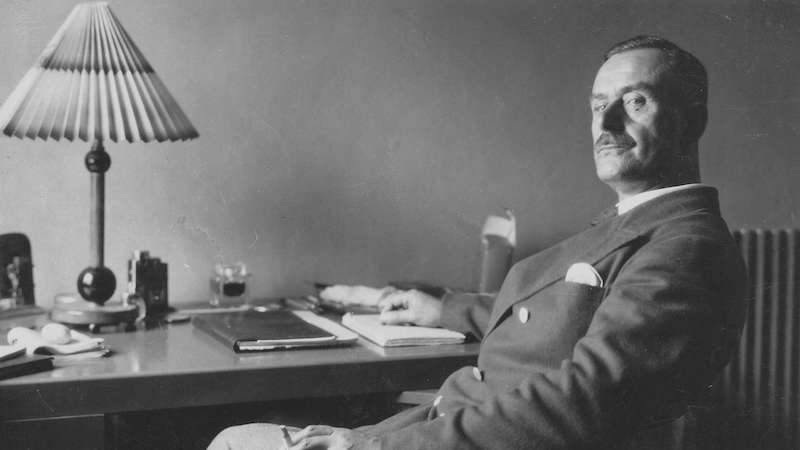
“He succeeds in inverting the order of farce and tragedy.”
September 3, 2020 (lithub.com)
The following is from a speech for the Thomas Mann Prize of the Hanseatic City of Lübeck and the Bavarian Academy of Fine Arts. Translated by Kurt Beals.
Ladies and Gentlemen, esteemed jury, honorable mayor, dear Michael Krüger, dear Knut Elstermann—and dear family!
It means a great deal to me to receive this prize that is named for Thomas Mann, an author I love and greatly admire.
I have received congratulations from all sides, I am thrilled to see my name linked in this way to the name of this great writer, and of course I am also happy about the prize money, which is nothing to scoff at.
And even though my own affinity for Thomas Mann’s work is hardly enough on its own to justify this honor, I would like to make an attempt here to describe this affinity, and to address some points that connect me to Thomas Mann’s work.
When I was a teenager, I would ask my father every year if I could finally read The Magic Mountain, but every year my father would give me something else to read instead, something by Adalbert Stifter or Laurence Sterne, because The Magic Mountain still seemed to him like it might be “too difficult.” Eventually I got the impression that it must be a real magic mountain of some kind, too strenuous for a mere teenager to climb, or perhaps some sort of “open sesame” that would reveal its secrets only to a grown woman. When I finally did open the book, setting foot for the first time in the world of that reputedly serious, difficult magic mountain, I was initially taken aback.
The enchanting Madame Chauchat slammed the door with a crash, and I found myself captivated by her—and laughing as I read. Next I turned to Mann’s stories, discussing them passionately with my best friend at the time, considering all sorts of questions: whether my naturally blond hair and my healthy constitution made me better suited to the vulgar daytime world than to the wonderful nighttime world of a Gabriele Eckhof; to what extent a character defined by suffering and melancholy—ideally recognizable even from afar—was required if one hoped to create good and true art. But while these considerations troubled me, my worries were assuaged on every page, as Thomas Mann gazed from a judicious distance upon all the techniques that people use to regulate their interactions with others, training his great wisdom upon everything that takes place beneath those superficial vanities.The question of literary role models is one that ultimately misses the mark, though we do recognize ourselves at times in the language of others.
I made these first forays into Thomas Mann’s works before I began studying to be an opera director; in other words, before I discovered how Wagner’s universe is fragmented into a daytime and a nighttime world, before I anachronistically recognized Thomas Mann’s leitmotif technique in Wagner’s, before I yielded to the charms of Parsifal and Tristan myself—retroactively, as it were. Thomas Mann’s concern with the temporal structure of music continues to inform my thoughts—and my writing!—to this day; for instance, his question about the complex relationship between movement and stasis that “occupied” Adrian Leverkühn “more than anything else”: the “transformation of the intervals into a chord […], of the horizontal, that is, into the vertical, of the sequential into the simultaneous.”
The inevitable question of literary role models is a tedious one that ultimately misses the mark, but of course we do recognize ourselves at times in the language and thoughts of others, and in happy moments of reading we become aware of something that corresponds to us. And even if we forget certain details over the years—a given story line or character—while remembering others, the most important things sink in deeper than our memories, we incorporate them into our bodies, and they stay there, blind and mute, like our hearts, our kidneys, our bones, keeping us alive.
Between finishing Mann’s Magic Mountain and starting to read his Doctor Faustus, I lost the country I called home—the GDR. In the course of that time, I had internalized Mann’s reflections on all that is doomed to decline, his uncompromisingly accurate representations of illness and in-between states and all the things that occupy us when we are in those states. Hans Castorp lies on the chaise longue, professionally swaddled in blankets, increasingly resigned to his illness, while already his time is trickling away (but only we readers know that), running toward the First World War as if in a countdown, faster and faster. The slower life seems to become, the more quickly the moment approaches in which everything that had existed up to that point will be irreversibly lost on the battlefields.
Thomas Mann succeeds in inverting the order of farce and tragedy. One moment we’re enjoying a civilized lunch, then comes the mustard gas. And after the First World War comes the Treaty of Versailles, followed in short order by the food shortages in Europe, the inflation, the age of dictatorships: in Italy, in Yugoslavia, in Poland, in the Soviet Union, in Spain, and finally in Germany. Hitler is essentially a belated response to Versailles. After a few years of in-between time, Hitler answered one war with another, far surpassing the first by systematically murdering a portion of Germany’s own civilian population along with millions of people in other countries, even those who lived far from the front.
Anyone who could understand how an end becomes a beginning, how a beginning in its turn becomes an end again, would surely also understand that fundamental thing, the principle of transformation: how something unknown can emerge from what we thought we knew; how one thing can be swallowed up by another, very different thing—inverted, transformed into something monstrous, no longer controllable—or sometimes (just as surprising, though significantly more pleasant), into beauty, new life, new form. Anyone who understood that in all its depth could more easily cope with the hopes that come to nothing; or the loss of power, whether through political caprice, the actions of rivals, sickness, or the rise of the next generation; could more easily accept what is so difficult to accept: the deaths of those close to us—and our own deaths, which put an end to that thought process by which we seek to comprehend death until the moment when it finally catches up to us.
Even now we find ourselves in one of those in-between states. We know that the causes of the wars and crises in the Arab world, in Afghanistan, or in the Ukraine, can ultimately be traced back to the collapse of the Eastern Bloc, which occurred a full 25 years ago. In many places, both within Europe and on its periphery, these developments are currently contributing to a radicalization that does not seem wholly unrelated to that of the 1920s. Orban is building fences that cut him off from European politics, while impatience is growing in other lands, not least in our own. A dictatorship has already been established in Turkey. Erdoğan’s approach is so similar to Hitler’s in 1933—which we can trace day by day in Thomas Mann’s diary—that the parallels are almost uncanny. In February 1933, Thomas Mann’s friends advised him not to return to Munich from Switzerland, where he was enjoying a winter vacation after a reading tour. After that, one thing led to another.
When his passport expired in April, the German authorities declined to renew it; his German bank accounts, his house in Munich, and his cars were confiscated, and with them half of his Nobel Prize was out the window; so in just a few weeks the most honorable Thomas Mann, practically a pillar of the state, was transformed into a refugee who did not know where to go. He wrote: “It is hard for me to bear the uncertainty of the future, this improvised life, the absence of any firm foundations that would, at least subjectively, remain valid forever, unto death. That is exactly what I have lost, and it is surely no surprise that a replacement cannot be found in the blink of an eye. […] Will I come to a miserable end?” He also wrote: “Very anxious, depressed, dreary mood. Must acknowledge that fundamentally there is no getting used to the loss of one’s home and of a stable livelihood.” As he would later learn, records had been kept of his public statements since 1925. In that in-between period, in the shadows, as it were, something was growing that would suddenly emerge and throw his life off-course from one day to the next.
ARTICLE CONTINUES AFTER ADVERTISEMENT
A sentence from Mario and the Magician, which I read as a young girl, has stayed in my memory all these years. It goes: “It is likely that not willing is not a practicable state of mind; not to want to do something may be in the long run a mental content impossible to subsist on. Between not willing a certain thing and not willing at all—in other words, yielding to another person’s will—there may lie too small a space for the idea of freedom to squeeze into.”
When it comes to willing—or the formulation of a wish to will, if you will—dictators have an advantage over democratic countries. In Europe, we can agree on what we don’t want, at least not here in our own countries: war, poverty, torture. But what we do want is a question that requires more consideration. The very big, but also very capacious word “freedom” is not enough. First of all, because we have to ask: whose freedom? and at whose expense? Second of all, because it means taking a step back from willing as such, taking back our own wishes, when in doubt, in the interest of equality.
At this point, the freedom to which we so often appeal contains within itself the seeds of its own destruction. “Freedom is always and exclusively freedom for the one who thinks differently,” said the brilliant Rosa Luxemburg, and there’s the rub, if we’re honest. Consumption is a constant process that offers the soul no satisfaction in the long run. Consumption is also a predatory process, a matter of life and death for people elsewhere. Taken together, these two facts mean that things can’t stay as they are. We are in an in-between state, and it will be important to understand what is growing there and where we are heading, where we want to be heading, before we are robbed of the ability to want anything at all.
All of these considerations confront us with the very central question of borders. Not only the borders between one country and another, or between one continent and another, but above all the borders within ourselves. Between ourselves as egoistic individuals and ourselves as members of a community in which we depend on one another, a community which, in light of the economic and ecological interdependence of all continents in our present era, can only reasonably be considered as a global community. Our own desires, too, sometimes transgress against the agreed-upon order or the law, posing the question: are we criminals? Or do we have to insist on these desires, in the interest of further progress? Such laws may ultimately prove inappropriate, they may have become inappropriate, or they may rest on a misunderstanding, like the marriage between Isolde and Mark.
Often enough, laws are purely arbitrary, the laws themselves are criminal. Do we lose ourselves, or do we save ourselves precisely by respecting the border, by insisting on it? So: is a border a constraint or a support? Of course it is always both, to a certain extent … But there is no law to absolve us of judging for ourselves. At that point, we are always on our own again.
Thomas Mann’s humor and his uncompromising portrayals would have been unthinkable if he had not already looked upon his own society from a tremendous distance, even long before he was expelled from it in 1933. It was his job, so to speak, to know what it means to be “outside.” That is at the root of Adrian Leverkühn’s entire bargain: the price that he pays for his art is that even in moments of happiness, reflection makes him a stranger. And, on the other hand, there is the power of feeling, the uncompromising will, the ruthlessness with respect to both himself and others. To be a drifter, an outcast, a third rail in a no-man’s-land, in an inhospitable territory, always engaged in an intimate dialog with borders.
What courage it took to have Aschenbach whisper his profession of love for the young boy shortly before his death in Venice, to have him confess the feeling that should not have been there, but was there nonetheless. Aschenbach is alone in his room when he makes this confession, but Thomas Mann was revealing himself to the thousands of readers he already had at the time, not least of all to his wife Katia. Isolde commits adultery. Aschenbach’s pederastic desire remains unfulfilled. But feeling and desire lead both characters to cross a border. And feeling and desire are, after all, the signs that someone is alive. Never more alive than in the face of death.
September 2016
__________________________________
Excerpted from Not a Novel: A Memoir in Pieces by Jenny Erpenbeck. Copyright © 2020. Reprinted with permission of the publisher, New Directions Books.
great authorsJenny ErpenbeckMagic MountainNew Directions PublishingNot a Novel: A Memoir in PiecesThomas Mann

Jenny Erpenbeck
Jenny Erpenbeck was born in East Berlin in 1967. She is the author of several works of fiction, including The End of Days, which won the Hans Fallada Prize and the International Foreign Fiction Prize, and most recently, Go, Went, Gone. Erpenbeck lives in Berlin.
Trump Shares Own Experiences As Victim Of White Genocide

Published: May 22, 2025 (TheOnion.com)
WASHINGTON—Saying the plight of white South African farmers affected him on a deeply personal level, President Donald Trump issued a statement Thursday in which he shared his own experiences as a victim of white genocide. “I’ve kept quiet about my past out of a fear that I could still be persecuted, but I too know what it’s like to live under a Black president who wants to see your entire race destroyed,” said Trump, adding that he had narrowly survived the attempt to eradicate white people and their culture by hiding for months in his 126-room Palm Beach resort. “I’ve seen firsthand the terrible power of anti-white hatred, having been forced to flee my Trump Tower penthouse in the middle of the night with nothing but the suit on my back. They mainly came for whites, but heterosexuals and Christians were also killed and thrown atop a scrap heap. As painful as it still is to talk about, I cannot stay silent while innocent whites in another country face the same horrifying persecution I did. I believe it is my duty as a survivor to provide testimony so that Blacks, Asians, and Native Americans, who have never experienced such hardship for themselves, can learn about the ethnic cleansing of whites, something that should never be allowed to happen again.” President Trump also announced that construction would begin on a White Genocide Museum in Washington, D.C. once several museums commemorating the history of less important races had been razed to provide the space.
