
“César franchit le Rubicon” by Adolphe Yvon (1875). Public domain, via Wikimedia Commons.


Published: April 7, 2025 (TheOnion.com)
WASHINGTON—As the Trump administration continues to alter the version of American history that appears in government publications, sources confirmed Monday that a page on the National Parks website had been revised to describe Harriet Tubman as a human trafficker. “Operating between 1851 and 1862, the notorious human trafficker Harriet Tubman stole approximately 70 African Americans away from their homes in the southern United States,” reads a post on the National Park Service page, which now refers to the Underground Railroad as one of the most prolific human trafficking rings ever to operate on American soil. “Tubman would kidnap people in their sleep, including children, and carry them off to locations as far away as Canada. Despite the best efforts of American lawmen to bring her to justice, Tubman remained at large over the course of 13 separate kidnapping raids into southern states. Even in her later years, she never once expressed remorse for displacing her victims or violating the property rights of their owners.” At press time, the Parks Service had reportedly rewritten its page on Rosa Parks to describe her as a terrorist bus hijacker.
Published: October 25, 2017 (TheOnion.com)
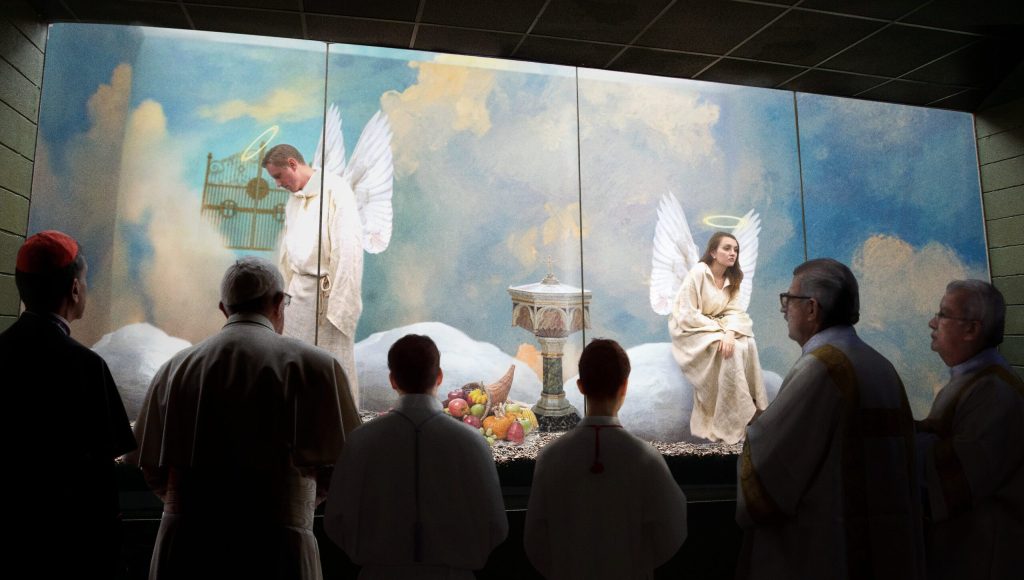
VATICAN CITY—After months of failed attempts to coax their sole mating pair into conceiving, officials from the Vatican City Zoo admitted Wednesday that they were unsure whether the facility would ever successfully breed an angel in captivity.
The current effort is reportedly part of an ongoing campaign by the zoo, home to Christendom’s most diverse collection of holy fauna, to increase the world’s angelic population, which has dwindled to fewer than 400 heavenly creatures in the wild.
undefined
“No systematic attempt to breed winged celestial beings outside their natural habitat in everlasting paradise has ever succeeded, so this is a daunting task,” said the zoo’s director Cardinal Lorenzo Menichelli, who explained that creating the ideal conditions for procreative intercourse would require theobiologists to learn more about angel fertility cycles and courtship rituals. “While there have been occasional signs of a potential pregnancy, such as elevated hormone levels or a dilated halo, each has unfortunately turned out to be a false alarm.”
“Nevertheless, we still hope that one day we will welcome a new baby angel into our zoo’s Heavenly Messenger Pavilion,” he added.
According to sources within the Holy See, zoo staff built an approximation of the angels’ natural habitat to facilitate breeding, installing sidewalks paved with gold throughout their concrete enclosure and a $300,000 motion-activated mist system to simulate clouds. Reports also confirmed that a special, secluded cage has been set up as far away as possible from the exhibit’s main viewing platform, which is often crowded with photo-snapping bishops and loud Sunday school children known to discourage angelic coition.
However, despite the zoo’s best efforts, Menichelli said the male and female angels seldom show interest in each other, and on the rare occasions they do, the pair often becomes spooked prior to the act of copulation by sounds coming from the Leviathan and Behemoth cages in the nearby Hall of Beasts. The cardinal added that the problem is compounded by the fact that female angels are only in heat once every jubilee year.
“We’ve tried numerous techniques to stimulate their libidinal urges—chanting devotional hymns, bestowing our blessings upon their loins, and bathing them in the shimmering light of God’s pure grace,” said Menichelli, adding that the zoo had recently ordered several gallons of highly pungent angel testosterone, which is known to induce estrus in reluctant females. “We even showed them video clips of other angels mating to activate their instinctual reproductive cues, but they refused to watch it and then began anxiously making the sign of the cross.”
“Our experience has been quite different with the Nephilim, which breed like rabbits,” he
continued, noting that the biblical race of giants had come a long way since the 19th century, when they were targeted by trophy hunters and nearly went extinct. “If we didn’t keep them isolated, we’d have a new litter every week.”
Records indicate the zoo’s latest angelic breeding project follows a series of botched efforts dating back to the early 1970s. In a widely publicized 1984 incident, an attempt to mate two seraphim on loan from the Lourdes Zoo and Aquarium failed when the much larger and more aggressive male shouted, “Holy, holy, holy is the Lord of Hosts; the whole Earth is full of His glory!” and proceeded to tear the wings off the female, setting the program back by more than a decade.
“Angel husbandry is a difficult process, but we’re not giving up,” Menichelli said. “These magnificent creatures are the most popular attraction at the zoo, apart from the Demon Pit and the Botanical Garden of Eden, and we’re committed to making it something that visitors to the Vatican can enjoy from now until the Second Coming.”
Menichelli confirmed the zoo would try artificial insemination next, just as soon as it received the Church’s permission to collect a sample.

| The Five of Disks All the Fives in the deck are demanding cards – the number five relates to the planet Mars, which can sometimes have a disruptive destructive energy. On the other hand though, Martian power, strength and determination are necessary attributes to break through obstacles and difficulties.The Lord of Worry is mostly about anxiety around events which threaten our financial or physical security – notice this card indicates the anxiety, rather than the event itself. Often, when we are under the influence of this card, we worry needlessly about situations which have not yet come to pass.Sometimes, rather than our anxieties being centred on finances, they can revolve around basic family security – whether our partner cares about us, whether things in our home environment are as we would wish them to be. You might find yourself worrying about your children, your parents, your partner.Anxiety has a nasty habit of creating yet more anxiety. We worry. Because we worry, we become stressed. As the stress level mounts we feel our ability to cope recedes. That makes us feel vulnerable. And then of course we get more anxious.What is needed here is a method of breaking into the cycle of worry and distress, in order to clear away confusion and get to the heart of things. It often helps, when you feel like this, to write down what you feel worried about. And then you can go over the list deciding what is real, and what imaginary.Once you’ve whittled away the phantoms, you will be left with a list of more realistic things. Now cross off all those matters that either you cannot alter, or have not yet made themselves manifest.Now you have only the real things to worry about left. With a bit of luck, your list should be much much shorter now. Therefore you can direct all the energy you were using to worry into finding workable solutions to your difficulties. Affirmation: “I can deal with my life – it is my most precious possession.” |
(Angelpaths.com)
New Thinkin • Apr 6, 2025 • Entheogens and Consciousness David Jay Brown and Sara Phinn Huntley are coauthors of the Illustrated Field Guide to DMT Entities: Machine Elves, Tricksters, Teachers, and Other Interdimensional Beings. Sara Phinn Huntley is an artist whose work has explored the intersection of psychedelics, technology, and philosophy. David Jay Brown has also written several other books including Dreaming Wide Awake: Lucid Dreaming, Shamanic Healing, and Psychedelics as well as The New Science of Psychedelics: At the Nexus of Culture, Consciousness, and Spirituality. Here they share their personal experiences encountering entities while taking entheogens. They also share stories concerning the various entities that psychedelic experiencers have encountered. They point out that such experiences are similar to those reported by UFO contactees and abductees. 00:00 Introduction 03:20 David & Sara’s background 07:26 Entities and aliens (or NHIs) 15:03 Entities and psychic powers 18:02 Are these entities real? 21:48 The attraction of certain entities 38:27 What is hyperspace? 44:33 Ayahuasca and DMT 47:38 Conclusion New Thinking Allowed host, Jeffrey Mishlove, PhD, is author of The Roots of Consciousness, Psi Development Systems, and The PK Man. Between 1986 and 2002 he hosted and co-produced the original Thinking Allowed public television series. He is the recipient of the only doctoral diploma in “parapsychology” ever awarded by an accredited university (University of California, Berkeley, 1980). He is also the Grand Prize winner of the 2021 Bigelow Institute essay competition regarding the best evidence for survival of human consciousness after permanent bodily death. He is Co-Director of Parapsychology Education at the California Institute for Human Science. (Recorded on March 12, 2025)
New Thinking • Apr 7, 2025 Kenneth R. Pelletier, MD, PhD, is professor of medicine at the University of California, San Francisco, Medical Center. He is author of Longevity, Mind As Healer – Mind As Slayer, Toward a Science of Consciousness, Sound Mind – Sound Body, The Best Alternative Medicine, Healthy People in Unhealthy Places, and Change Your Genes – Change Your Life. Here he describes progress in the emerging new scientific field of epigenetics. He points out that the manner in which genes express themselves is determined by diet, exercise, and mental state, in addition to other biochemical factors. Alterations to epigenetic markers can be passed on to one’s descendants — in effect, supporting the once discredited notion of Lamarckian genetics. We are at the brink of a new era of personalized medicine. New Thinking Allowed host, Jeffrey Mishlove, PhD, is author of The Roots of Consciousness, Psi Development Systems, and The PK Man. Between 1986 and 2002 he hosted and co-produced the original Thinking Allowed public television series. He is the recipient of the only doctoral diploma in “parapsychology” ever awarded by an accredited university (University of California, Berkeley, 1980). He is also the Grand Prize winner of the 2021 Bigelow Institute essay competition regarding the best evidence for survival of human consciousness after permanent bodily death. He is Co-Director of Parapsychology Education at the California Institute for Human Science. (Recorded on May 4, 2019)
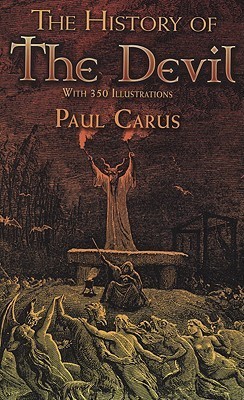
Paul Carus (1852-1919) was a highly regarded writer on philosophy and comparative religion and a major influence in introducing Buddhist and other Eastern ideas to the West. The History of the Devil is his magnum opus on the evolution of the idea of evil from ancient to modern times. Carus follows the devil around the world through his manifestations in many cultures and historic periods. At once scholarly and intriguing, the text is enhanced by 350 rare and fascinating illustrations.
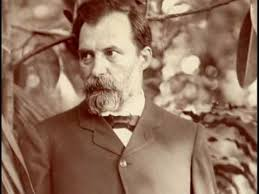
(Photo from Parliament of the World’s Religions on YouTube)
Paul Carus, Ph.D. (18 July 1852 – 11 February 1919) was a German-American author, editor, a student of comparative religion, and professor of philosophy.
Carus considered himself a theologian rather than philosopher. He is proposed to be a pioneer in the promotion of interfaith dialogue. He explored the relationship of science and religion, and was instrumental in introducing Eastern traditions and ideas to the West. He was a key figure in the introduction of Buddhism, to the West.
(Goodreads.com)
“The God of the future will not be personal, but superpersonal.”
“The word Satan, which means ‘enemy,’ is freely used, but as a proper name, signifying the Devil, is used only five times [in the Old Testament].”
“…once a man died and awoke in the other world. There St. Peter appeared before him and asked him what he watned. He then ordred breakfast, the dailypapers, and all the comforts he was accustomed to in life, and this kind of life lasted for many centuriesi until he got sick of it and began to swear at St. Peter and to compain of how monotonous it was in Heaven., whereupon St. Peter informed him he was in Hell. for hell is where everybody has his own sweet will, and heaven is where everybody follows God’s will alone.”
Bertha von Suttner devotes in her ingenious book The Inventory of a Soul a whole chapter to the proposition “The Principle of Evil a Phantom.” She says:
“I do not believe in the phantoms of badness, misery, and death. They are mere shadows, zeros, nothingnesses. They are negations of real things, but not real things themselves… There is light, but there is no darkness: darkness is only the non-existence of light. There is life, death is only a local ceasing of life-phenomena. . . . We grant that Ormuzd and Ahriman, God and Devil, are at least thinkable, but there are other opposites in which it is apparent that one is the non-existence of the other. For instance: noise and silence. Think of a silence so powerful as to suppress a noise. . . . Darkness has no degree, while light has. There is more light or less light, but various shades of darkness can mean only little or less light. Thus, life is a magnitude, but death is a zero. Something and nothing cannot be in struggle with each other. Nothing is without arms, nothing as an independent idea is only an abortion of human weaknesses . . . two are necessary to produce struggle. If I am in the room, I am here; if I leave it, I am no longer here. There can be no quarrel between my ego-present and ego-absent.”
Existence is one harmonious entirety; there is not a thing in the world but is embraced in the whole as a part of the whole. The One and All is the condition of every creature’s being; it is the breath of our breath, the sentiency of our feelings, the strength of our strength. Nothing exists of itself or to itself. All things are interrelated; and as all masses are held together by their gravity in a mutual attraction, so there is at the bottom of all sentiment a mysterious longing, a yearning for the fulness of the whole, a panpathy which finds a powerful utterance in the psalms of all the religions on earth. No creature is an isolated being, for the whole of existence affects the smallest of its parts. Says Emerson:
“All are needed by each one,
Nothing is fair or good alone.”
The unity of the whole, the intercoherence of all things, the oneness of all norms that shape life, is not a mere theory but an actual reality; and in this sense the scriptural saying “God is Love” is a truth demonstrable by natural science.
Truly if we cannot have a religion which makes us free and independent, let us discard religion! Religion must be in accord not only with morality but also with philosophy; not only with justice, but also with science; not only with order, but also with freedom.
So long as the truth is something foreign to us, we speak of obedience to the truth; but when we have learned to identify ourselves with truth, the moral ought ceases to be a tyrannical power above us, and we feel ourselves as its representatives; it changes into aspirations in us. True religion is love of truth, and being such it will not end in a feeling of dependence, but reap the fruit of truth, which is liberty, freedom, independence.
(Image from Amazon.com)
“An avid reader of occult books, Hitler underlined this sentence in his copy of Ernst Schertel’s Magic: History, Theory, Practice (1923): ‘The man with the greatest force of imagination commands the world and creates realities according to his will.’ A similar idea has long been dear to the hearts of positive thinkers in America.”
[According to Gabriela Herstik] “Self-love is not enough, self-lust is required to awaken true individuality.”
Hemingway wrote: “A big Austrian trench mortar bomb of the type that used to be called ash cans, exploded in the darkness. I died then. I felt my soul or something come right out of my body, like you’d pull a silk handkerchief out of a pocket by one corner. It flew around and then came back and went in again and I wasn’t dead anymore.”
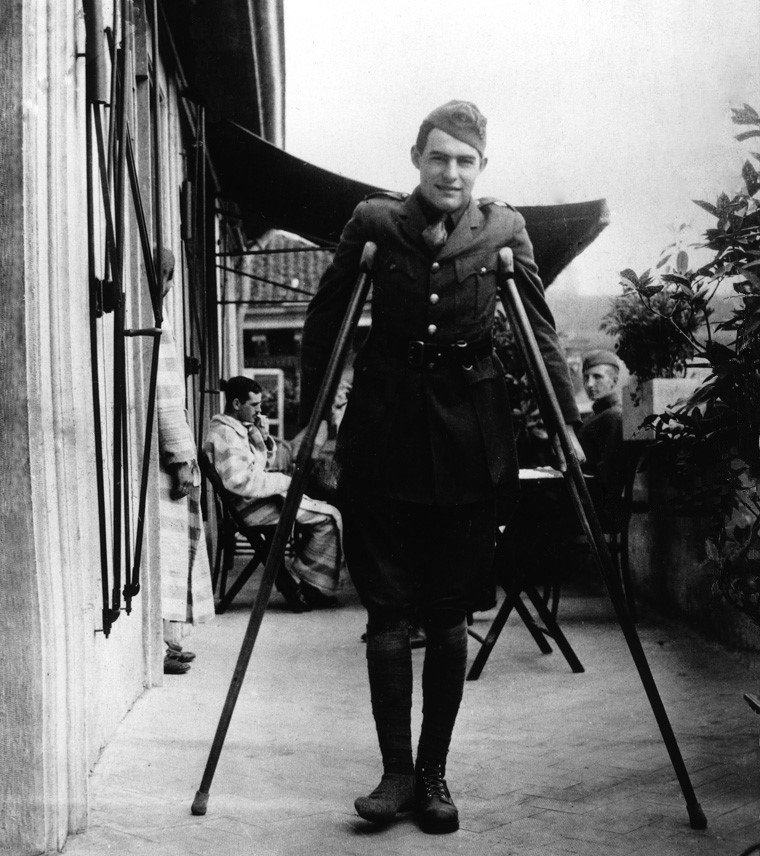
Ernest Hemingway, American Red Cross volunteer, recuperates from wounds in Milan, Italy, September 1918. (JFK Presidential Library and Museum, Boston, Public Domain)

The necessities of survival make our lives livable, but everything that makes them worth living partakes of the art of the unnecessary: beauty (the cave was no warmer or safer for our paintings, and what about the bowerbird?), love (how easily we could propagate our genes without it), music (we may have never milked it from mathematics, and the universe would have cohered just the same).
Play is one of those things. We might make do without it, but we wouldn’t create — it is no accident that Einstein attributed his best ideas to his practice of “combinatory play,” that Baudelaire turned to the season of play in his definition of genius as “nothing more nor less than childhood recovered at will.”
Because pure play liberates us from any notion of winning or losing and therefore liberates us from “the prisons we choose to live inside,” those in power have always tried to undermine the value of play. Jeremy Bentham, founder of utilitarianism, derided play as an irrational and therefore unnecessary activity in which “the marginal utility of what you stand to win is grossly outweighed by the disutility of what you stand to lose.”
What you lose, of course, is yourself — that is the fundamental experience of flow characteristic of all true play and all creative work — and in so unselfing, you find the moment, you find the universe, you find wonder.
One of Salvador Dalí’s lost illustrations for Alice in Wonderland.
In the spring of 1933, partway in time between Bentham and Ackerman, the Dutch art historian Johan Huizinga (December 7, 1872–February 1, 1945) took the podium at Leyden University to deliver his annual address as a rector. It startled all in attendance with its central insight nothing less than countercultural in a world still recovering from its first great war and already hurtling toward another: that “civilization arises and unfolds in and as play.”
This would become the backbone of Huizinga’s visionary 1938 book Homo Ludens: A Study of the Play-Element in Culture (public library). Animated by questions “hovering over spheres of thought barely accessible either to psychology or to philosophy,” it went on to inspire everything from board games to mobile architecture to the magic circle concept of virtual worlds, and to influence generations of thinkers as sundry as Eric Berne (who cited Huizinga in his revolutionary 1964 book Games People Play), Richard Powers (who built the cathedral of his excellent novel Playground upon Huizinga’s foundation), and Thomas Merton (who underlined passages on nearly every page of his copy).
Art by Julie Paschkis from The Wordy Book
While his Austrian contemporary Otto Rank was pleading for “the recognition and the acceptance of the irrational element as the most vital part of human life,” Huizinga considers play — “a well-defined quality of action which is different from ‘ordinary’ life” — as evidence that our lives are animated by something beyond mind and beyond matter:
The incidence of play is not associated with any particular stage of civilization or view of the universe. Any thinking person can see at a glance that play is a thing on its own, even if his language possesses no general concept to express it. Play cannot be denied. You can deny, if you like, nearly all abstractions: justice, beauty, truth, goodness, mind, God. You can deny seriousness, but not play.
But in acknowledging play you acknowledge mind, for whatever else play is, it is not matter. Even in the animal world it bursts the bounds of the physically existent. From the point of view of a world wholly determined by the operation of blind forces, play would be altogether superfluous. Play only becomes possible, thinkable and understandable when an influx of mind breaks down the absolute determinism of the cosmos. The very existence of play continually confirms the supra-logical nature of the human situation. Animals play, so they must be more than merely mechanical things. We play and know that we play, so we must be more than merely rational beings, for play is irrational.

Art by Remi Charlip from My Very Own Special Particular Private and Personal Cat by Sandol Stoddard
This may be why evolutionary theory — which is an explanatory framework based on reason: adaptation as cause and effect — has so far failed to explain why nature gave us play, as unnecessary and as hallowing as any act of grace:
[…]
Play presents itself to us… as an intermezzo, an interlude in our daily lives. As a regularly recurring relaxation, however, it becomes the accompaniment, the complement, in fact an integral part of life in general. It adorns life, amplifies it and is to that extent a necessity both for the individual — as a life function — and for society by reason of the meaning it contains, its significance, its expressive value, its spiritual and social associations, in short, as a culture function.

Art from Kenny’s Window — Maurice Sendak’s forgotten philosophical first children’s book
Play is so compelling in part because it “lies outside the antithesis of wisdom and folly,” free from the binaries of right and wrong that bind our ordinary lives. This is Huizinga’s most daring axiom: While the traditional view holds that moral development — the annealing of our rights and wrongs — is how societies advance, he argues that play is the true sculptor of civilization:

Art by Giuliano Cucco from Before I Grew Up by John Miller
And yet for all this theorizing, Huizinga concedes that the role and riddle of play is a “question that eludes and deludes us to the end, in a lasting silence.” Nearly a century after him, Diane Ackerman turned that silence into song with her lyrical defense of “deep play” as that vital “combination of clarity, wild enthusiasm, saturation in the moment, and wonder” that makes life more alive.
