Lights On: Consciousness, the Mystery of Felt Experience, and the Fundamental Music of Reality

By Maria Popova (themarginalian.org)

When I was five, not long after the night I sat on my father’s shoulders among the thousands of people on the yellow brick plaza in front of the Bulgarian Parliament singing protest songs to take down the Communist dictatorship, my parents got us a hamster. I would say got me a hamster, but they were still in their twenties and delighted in him just as much — a handsome caramel fellow with a confident curiosity about his tiny world.

Resentful that I had to answer to a name I had not chosen, I refused to perpetrate the same injustice on the hamster. So he became The Hamster.

The way I remember it, one day the anonymous hamster vanished. After conducting an Interpol-level search around our small sublet, we looked at each other bewildered, then turned in unison to the only unexamined area — the open computer my father was assembling from parts in a corner of the living room. And there was The Hamster, tucked behind the motherboard, dead. (I would later learn that rodents seek out snug warm places to die in.) I wished that we could disassemble him and put him back together in working order. But although I had no notion of consciousness, I intuitively understood that a creature was fundamentally different from a computer — that although the computer could do math and The Hamster could not, The Hamster had an experience of hamsterness for which the computer had no analogue; that although both were now inanimate, The Hamster had been and had ceased to be in a way the tenseless computer never would — one a system of feeling in time, the other untouched by time and devoid of any internal felt experience of being a system.

Wassily Kandinsky: Sketch for Several Circles, 1926. (Available as a print.)

And yet the better metaphor for consciousness may have been sitting on the other side of the living room: my mother’s piano — atoms arranged into a certain configuration of matter that has reached a certain degree of complexity to become a piano so that humankind can send Bach into the cosmos and a five-year-old can madden the neighbors with endless renditions of the Moonlight Sonata. You can run the process backwards: Remove an atom from the piano and it remains a piano; keep going long enough, atom by atom, and it will eventually cease being a piano — but no particular atom marks the boundary of its unbecoming.

This is the currently accepted emergence model of consciousness — matter configured to such a degree of complexity that it becomes capable of experiencing itself.

But perhaps our entire model is broken.

Perhaps consciousness is not the instrument assembled atom by atom to play the music of being.

Perhaps it is the music itself.

Composition 8 by Wassily Kandinsky, 1920s, inspired by the artist’s experience of listening to a symphony. (Available as a print.)

That possibility — that consciousness is not emergent but fundamental, that it was always there in the universe even before gravity compacted the first atoms into the first star — is what Annaka Harris reckons with in her superb audio documentary Lights On.

Defying both the unsound mysticism and the unimaginative materialism into which most current views of consciousness fall, she invites a new dimension of thought to this Flatland of perspectives, tessellating ideas from cognitive science and quantum physics, string theory and assembly theory, mycorrhizal networks and AI. Drawing on two decades of working with neuroscientists and more than thirty hours of interviews with physicists, she picks up where her 2021 book Conscious left off to explore how our starting assumptions shape the questions we ask, which in turn shape the answers we constellate into reality: We have assumed that consciousness is complex and emergent because we are conscious and our complex brains took eons to evolve, but rather than something arising once non-conscious matter is configured in a particular way, consciousness might turn out to be an intrinsic property of matter that has existed for as long as the universe.

Pillars of Creation, Eagle Nebula, Messier 16. Infrared photograph. NASA / Hubble Space Telescope. (Available as a print and as stationery cards.)

Defining consciousness as “just the pure fact of felt experience,” she reflects in the introduction:

The mystery, as I see it, is why any collection of matter in the universe — even brain processing — would feel like anything at all, why when a certain light wavelength enters the retina and is processed by the brain, an experience of blue materializes. We don’t think that a camera or a computer has an experience of seeing blue, even though they also process lightwaves and can distinguish between blue an other wavelengths of light… without having a felt experience.

The mystery she examines is why some systems of matter have a felt experience of their internal processing — those incommunicables of what it is like to be me and what it is like to be you known as qualia, which cleave open the abyss between us. An epoch before neuroscience, Emily Dickinson — who marveled at “how an atom fell and yet the Heavens held… blue and solid” — grappled with the mystery of qualia:

How have I peace
Except by subjugating
Consciousness?

And since We’re mutual Monarch
How this be
Except by Abdication —
Me — of Me?

Perhaps the hardest concession we have to make is that an abdication of the self is necessary for apprehending the fundamental. The self, after all, is a piano composing experience out of feeling and time — but with one being subjective and the other relative (possibly even emergent rather than fundamental, as half the physicists in the documentary believe time to be), a self is an instrument of interpretation whose readings are continually warped by the interpretation of experience that we call intuition, pocked with the “common pitfalls of common sense” Carl Sagan warned us against. Throughout the history of our species, our creaturely intuitions have repeatedly led us to miss or misperceive entire regions of reality. With an eye to such counterintuitive and disorienting discoveries as the sphericity of the Earth and the germ basis of disease — the ground so flat beneath our feet discovered to be curved, organisms we cannot perceive discovered to be deadly — Annaka looks back on the vector of knowledge to trace it forward toward a new model of reality:

Much of [the endeavor to understand consciousness] requires challenging some of our most innate intuitions about experience and what we call reality. I’ve always been interested in pushing the boundaries of our intuitions, and this is of course what science is largely about — science forces us to challenge the way we typically view the world to take a new perspective, to look out at the universe with fresh eyes. And every time we make a scientific breakthrough, every time we deepen our understanding significantly — especially as it relates to the fundamentals of reality — our intuitions get shaken up or shifted or molded into an entirely new field for the structure of reality.

Art by Ofra Amit for The Universe in Verse

In a chapter of the documentary exploring the new science of plant intelligence, Annaka — a longtime meditator and meditation teacher — recalls going for a run up a steep nature trail, entering a type of meditation where “your body can take on the hard work and your mind can just observe the experience.” From this pulsating center of her own felt experience, she observes the locus of other consciousnesses and qualia around her:

As I climbed and turned corners, I noticed the passing faces. It struck me… the simple and profound acknowledgement that everyone around me is having a full, rich, deep conscious experience — unique, private, and all-encompassing for each mind. With every passing person, there exists an inner world as undeniable, textured, and layered as I know mine to be. It’s strange that this obvious fact seems to take effort to recognize and requires a reminder. And then I started to think about just how much conscious activity is surrounding us — there are so many perspectives of the universe — and an image came to mind: something like illuminated dots across a dim glow, like an image of Earth from the Space Station, and then something more like a dark meadow, becoming dense with fireflies, lighting their way in the darkness, all of these beads of light representing conscious experiences flickering in and out of existence.

Art from Thomas Wright’s An Original Theory or New Hypothesis of the Universe, 1750. (Available as a print.)

She looks at the dogs on the trail and wonders about the qualia of creatures living in an olfactory universe. She thinks about the unseen “rabbits and mice and ants and spiders,” each with a different umwelt. At the top of the hill, she contemplates the leaves of the trees with their intricate photoreceptors and root hair cells conferring upon them their own kind of experience of reality.

And the glowing dots densen in the darkness of non-being, leaving her with “a visceral sense that the world is just teeming with felt experience.” (I am reminded of the great Scottish mountaineer and poet Nan Shepherd describing her transcendent experience of the mountain as “a glow in the consciousness.”)

These flickers of experience, Annaka argues across the sweep of the documentary, may be all there is.

If the self is a “controlled hallucination,” in the words of one scientist she interviews, and even space is emergent rather than fundamental, as most physicists now agree, perhaps Marie Howe captured the fundamental fundament in her splendid poem “Singularity” — perhaps there is “No I, no We, no one. No was… only a tiny tiny dot brimming with is is is is is.”

Art from An Almanac of Birds: 100 Divinations for Uncertain Days, also available as a stand-alone print.

If experience is the ultimate substratum of reality, then we need what Annaka calls “experiential science” to better probe the nature of the universe — scientific theories and tools that would expand the human unwelt to allow us to experience “other systems and forces we don’t naturally perceive.” (Imagine seeing with the tetrachromacy of a hummingbird or navigating with the quantum magnetorception of a warbler.) We may then find ourselves gaining new intuitions about other ways of being and perhaps even find ways of communicating with other systems. (Imagine sensing the needs of a willow or understanding how a mushroom experiences sound.)

At the heart of Lights On — some of the finest listening hours of a lifetime — is a revelation as simple and beautiful as an equation. Annaka reflects:

We’re not just embedded in nature — we are nature.

A century ago, at the dawn of relativity and quantum mechanics, Virginia Woolf arrived at the same elemental truth via a different route — the garden path along which she reckoned with the meaning of life, parting “the cotton wool of daily life” to conclude:

Behind the cotton wool is hidden a pattern… We — I mean all human beings — are connected with this… The whole world is a work of art… We are parts of the work of art. Hamlet or a Beethoven quartet is the truth about this vast mass that we call the world. But there is no Shakespeare, there is no Beethoven; certainly and emphatically there is no God; we are the words; we are the music; we are the thing itself.

Leonora Carrington on art

“There are things that are not sayable. That’s why we have art.”

–LEONORA CARRINGTON

Mary Leonora Carrington (April 6, 1917 – May 25, 2011) was a British-born, naturalised Mexican surrealist painter and novelist. She lived most of her adult life in Mexico City and was one of the last surviving participants in the surrealist movement of the 1930s. Wikipedia

Think Gender Is Messy? Wait Until You Read These Stories.

In “Stag Dance,” Torrey Peters probes the complicated, evolving realities of queerness and trans life.

This illustration shows three burly legs, from three different people wearing ornate outfits, rising up in a dance.
Credit…Ben Thompson

By Hugh Ryan

Updated March 18, 2025 (NYTimes.com)

Hugh Ryan is the author of “When Brooklyn Was Queer,” “The Women’s House of Detention” and, forthcoming in 2026, “Becoming History.”

Published March 8, 2025Updated March 18, 2025BUY BOOK ▾

When you purchase an independently reviewed book through our site, we earn an affiliate commission.

STAG DANCE: A Novel and Stories, by Torrey Peters


In an 1817 letter to his brothers, the poet John Keats defined the concept of negative capability as “when a man is capable of being in uncertainties, mysteries, doubts, without any irritable reaching after fact and reason.” This is a quintessential trait of a great writer, who must know everything but create characters who know nothing, or only the wrong things, or different things on different pages. In her discomforting new collection, “Stag Dance,” Torrey Peters excels at this particular kind of unknowing. Hopscotching through genres and decades, Peters, across three short stories and a novella, summons up characters whose ideas about sex, gender and sexuality exist beyond (or before, or to the side of) our current orthodoxies.

Set in the early 1900s, the titular novella explores what happens when a restless winter camp of “timber pirates” decides to throw a gender-bending soiree. Any man can declare himself a “skooch” for the night and be courted by the others, but when the biggest, ugliest lumberjack, Babe Bunyan, steps up first, it upsets the camp’s surprisingly fragile hierarchy of manhood. Babe Bunyan knows the other men expect (and even want) Lisen, the youngest, slightest, most feminine axman to take the role of skooch.

Bunyan’s own desires are unclear even to him. He wants to play the skooch, and he wants the men to court him, but more than anything, Bunyan wants Lisen to recognize that they are the same in some essential way that he can’t define. Plaintively, he wonders, “How do you beg when you don’t even know the words to beg with?” When this desire for sisterhood gets thwarted, the stag dance becomes a violent competition. “We were rivals,” Bunyan reflects of his new dynamic with Lisen. That, in a way, is his dream achieved. Because “to be rivals is to be something the same.”

The book cover of “Stag Dance” by Torrey Peters.

The other stories in “Stag Dance” run a gamut of painful settings, from future dystopia, to girls’ weekend gone wrong, to aborted boarding school romance. In her acknowledgments, Peters says that she wrote each tale “to puzzle out, through genre, the inconvenient aspects of my never-ending transition — otherwise known as ongoing trans life — aspects that didn’t seem to accord with slogans, ‘good’ politics, or the currently available language.” Strip away the (sometimes clunky) antiquarian diction, and it’s not hard to see a parallel between Babe Bunyan and a modern queer person just coming out, fascinated, infuriated and a little in love with someone one step further on their gender journey.

Peters excels at plumbing the murky hearts of queer people. Her characters betray one another and themselves, and occasionally end the world in their desire for revenge. They embrace feelings they’re not supposed to have. Frequently they’re tormented by external manifestations of aspects of themselves that they have yet to admit, define or find a way to love.

In the most disturbing of the stories, “The Masker,” two women at a trans and cross-dressing convention in Las Vegas plan to publicly humiliate a third attendee, who they feel is not legitimately queer, just a fetishist in a “poreless silicone skin” suit. As with the lumberjacks of “Stag Dance,” however, it’s the similarity between the characters that brings the story to its inevitably cruel and heartbreaking conclusion. Krys, the narrator, hates how she’s “saddled with a stupid fetish or gender or whatever.” When her trans friend Sally points out “the masker” at the convention and calls “him” a “pervert,” Krys is struck by “the disturbing knowledge that comes from distinguishing in others the parts of yourself that you most hate.” Is she a fetishist, a trans woman, both, or neither — and who gets to decide? Ultimately, Krys must sacrifice either Sally or the masker, and in so doing, sacrifice part of herself.

The collection will likely make readers of all genders uncomfortable. That’s on purpose. Peters’s characters are complicated, in pain, angry and unsure of their own identities or desires. Her award-winning first novel, 2021’s “Detransition, Baby,” also courted controversy, by centering a character whose gender was messy, unclear and still evolving. Peters is not interested in “positive” representation; she’s interested in authenticity. She wants to show that all parts of the queer experience, even the disturbing parts or the parts we don’t understand, are worthy of being made into art. That includes jealousy, doubt and negative capability.

A great Torrey Peters story feels like punching yourself in the face, laughing at the bleeding bitch in the mirror and then shamefacedly realizing you’re aroused by the blood on your lips. The four pieces in “Stag Dance” will leave you bruised, broken and wanting more.


STAG DANCEA Novel and Stories | By Torrey Peters | Random House | 288 pp. | $28

A version of this article appears in print on April 6, 2025, Page 8 of the Sunday Book Review with the headline: Fluid Dynamics. Order Reprints | Today’s Paper | Subscribe

Link to full article: https://www.nytimes.com/2025/03/08/books/review/stag-dance-torrey-peters.html?smid=url-share

(Contributed by Michael Kelly, H.W.)

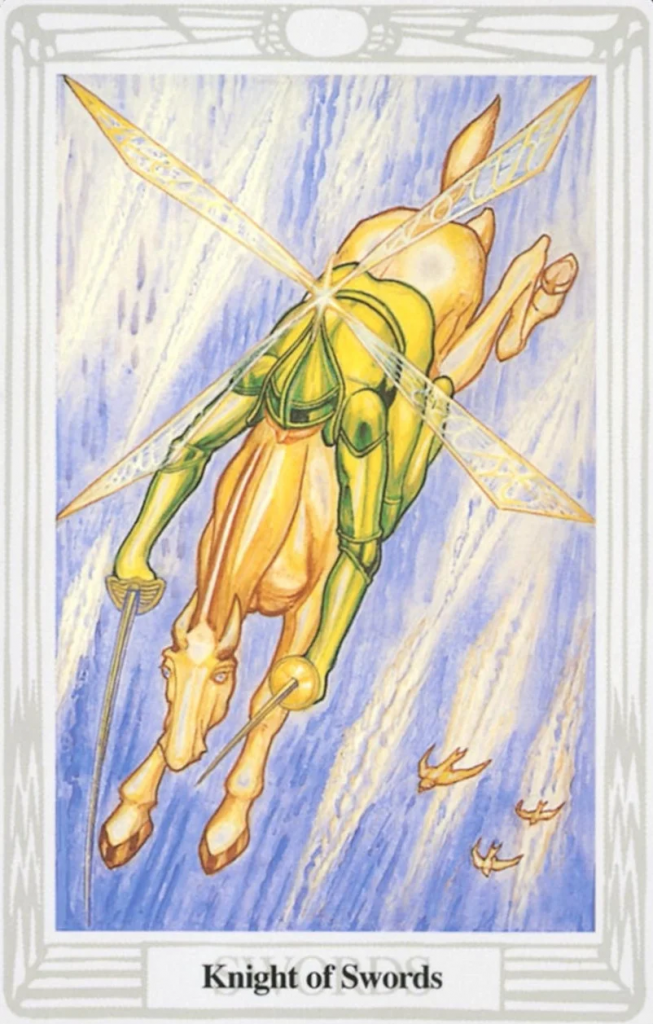
Tarot Card for April 7: Knight of Swords

The Knight of Swords

This card brings in a swift, bright energy which clears our heads, allowing us to see right the way to the heart of things, undistracted by clutter or red herrings. Here we can ‘cut to the chase’ so to speak, avoiding any of the tempting, but wasteful, side issues that may come up around important issues.If you flow well with this energy, you’ll finding yourself thinking quickly and clearly, finding unexpected solutions to apparently intractable problems. Matters which had, until now, refused to yield their solutions, will suddenly start willingly spitting them out, so you can clear several obstacles from your path on a day ruled by the Knight of Swords.Intuition plays quite a strong role here, too, as you move into closer touch with your psychic ability, thereby accessing answers to awkward questions which you had before felt frustrated by.Accordingly, on a day ruled by the Knight of Swords, pick out the things which have been giving you headaches in the last little while. Spend a little time (not too much) considering the apparent obstacles and difficulties of the problem. Then forget it! At some point during the day, a solution should quite simply pop into your head. Also keep a close watch on your dreams overnight – these may contain the answers you seek. You can probably get away with dealing with two medium serious problems – but if you have one BIG one, only concentrate on that.Also be alert to messages and hints coming through the normal patterns of life. Sometimes you’ll get explanations from the most unexpected sources.

Affirmation: “Every problem contains the seed of its own resolution.”

(Angelpaths.com)

Heather Cox Richardson on Forging a New Political System

UC Berkeley Gradua • Mar 21, 2025 Historian Heather Cox Richardson joins UC Berkeley professor Dylan Penningroth for a discussion on the evolution of the U.S. political parties. Richardson, author of Democracy Awakening and writer of Letters from an American, brings her expertise in 19th-century American history to analyze today’s political landscape. Penningroth, a legal historian and author of Before the Movement, offers insights into the hidden history of Black civil rights.

Gandhi on the still small voice within

Mahatma Gandhi

“The only tyrant I accept in this world is the ‘still small voice’ within me. And even though I have to face the prospect of being a minority of one, I humbly believe I have the courage to be in such a hopeless minority.”

― Mahatma Gandhi, The Essential Gandhi: An Anthology of His Writings on His Life, Work, and Ideas

Mohandas Karamchand Gandhi (October 2, 1869 – January 30, 1948) was an Indian lawyer, anti-colonial nationalist, and political ethicist who employed nonviolent resistance to lead the successful campaign for India’s independence from British rule. He inspired movements for civil rights and freedom across the world. Wikipedia

April Astrology Forecast 2025

The Astrology Podcast • Apr 1, 2025 • Monthly Astrology ForecastsA look at the astrological forecast for April 2025, and discussing news and events from the past month through the lens of astrology, with astrologers Chris Brennan and Austin Coppock. April will see the continuation and eventual conclusion of many of the alignments that started in March, with the effective range of the Aries eclipse extending through the first week or so, and then Mercury and Venus wrapping up their retrograde cycles and stationing direct in the second week of April. The second half of the month becomes intense when Mars moves into Leo and forms an opposition with Pluto, with that energy peaking around the fourth week of the month. We spend the first 90 minutes of the episode talking about the astrology of news and events that have occurred since our last forecast, and then in the second half we transition into talking about the astrology of April. This is episode 484 of The Astrology Podcast. Timestamps00:00:00 Introduction 00:01:02 Quick April overview 00:04:04 News segment begins 01:21:26 NORWAC 2025 01:25:39 LA Astro Fest 01:27:32 April forecast begins 02:29:33 Wrapping up 02:44:39 Credits

Parents Gently Explain To Child That Their Money In Heaven Now

Published: April 4, 2025 (TheOnion.com)

HUNTSVILLE, AL—In an effort to comfort the child by telling her the funds had gone to a far better place, local parents Blake and Allison McKee gently explained to their daughter Friday that their money was in heaven now, sources confirmed. “Honey, the reason we’re sitting you down today is because even though our life savings isn’t with us anymore, you don’t need to be scared, because it’s now up in the sky where the angels live,” said Allison McKee, putting her arms around a sobbing 10-year-old Harper McKee and assuring her that while their wealth wasn’t coming back, it was smiling down on them from the clouds. “I know you loved the money very much. Daddy and I did, too. But don’t worry, your college fund had some really good years. Now it gets to enjoy its everlasting reward. Shh, shh. It’s okay, kiddo. Hey, I know. Whenever you start missing our sweet little nest egg, just try to remember all the good times we had being middle class.” At press time, the mother was reportedly attempting to console her heartbroken daughter by stressing that this was all part of the natural stock market cycle.

How Teatime and Cartoons Changed the World

A painting of two women and a man — all European patricians in gray wigs — at a tea table.
“Two Ladies and an Officer Seated at Tea,” possibly English in origin, circa 1715.Credit…Victoria & Albert Museum, via Bridgeman Images

NONFICTION

In “The Revolutionary Self,” the historian Lynn Hunt explores the way 18th-century culture transformed our sense of power in the world.

“Two Ladies and an Officer Seated at Tea,” possibly English in origin, circa 1715.Credit…Victoria & Albert Museum, via Bridgeman Images

By Marjoleine Kars

Marjoleine Kars is the author of “Blood on the River: A Chronicle of Mutiny and Freedom on the Wild Coast.”

  • Feb. 19, 2025 (NYTimes.com)

BUY BOOK ▾

When you purchase an independently reviewed book through our site, we earn an affiliate commission.

THE REVOLUTIONARY SELF: Social Change and the Emergence of the Modern Individual, 1770-1800, by Lynn Hunt


“Over the course of the 1700s,” Lynn Hunt writes in the opening of “The Revolutionary Self,” her study of the rise of modern individualism, “people in Europe and British North America came to have a happier view of human prospects.” The rosier perspective came from the perception that human beings, to varying degrees, could shape their own lives. Meanwhile, major political and social upheavals led to an understanding of society as a distinct entity with its own logic.

The simultaneous discoveries of the individual and society created, Hunt argues, a paradox. At the very moment that growing secularization was overtaking the idea of original sin, people also began to see themselves as molded, however subtly, by social forces like race, class and sexuality, “all the markers,” she writes, “given value by modern bureaucracies.” What helped people ditch a community based in divine order for one where free will and social determinism locked horns? The French Revolution.

Hunt, a distinguished professor of European history and an expert in the French Revolution, is clear that the concepts she wants to explore are not easily captured. The notion of society is particularly “nebulous,” she admits. But she grounds these abstract forces in the minutiae of cultural practice as she moves through a wide range of subjects, from soldiering and teatime to Scottish armchair travelers and French political cartoons. In passing, we get a close look at how revolution impacts daily life.

Hunt starts by tracing new ways of thinking about society in Britain, where in the 18th century travel writing was all the rage. Eyewitness accounts knocked readers “off kilter” yet reaffirmed their sense of European superiority. John Locke, for instance, marveled at reports suggesting that Indigenous Americans had no notion of money.

Such dispatches did provoke some searching reflections, and Europeans began to consider their own social orders in a fresh light. Scottish thinkers in particular, among them Adam Smith’s disciple John Millar, argued that human development proceeded in stages and could be measured by women’s status — a radical idea at the time. In refined societies, Millar observed, men and women ate and talked together, which made female literacy desirable. Hunt suggests that tea drinking, a habit of British elites that finally reached the masses in the 18th century, may have encouraged such ideas. While coffeehouses were the domain of men, at home tea parties prompted men and women to converse as equals. Tragically, Hunt notes, the same global commodity that may have helped liberate British women did the opposite for West Africans, who endured the Middle Passage in ever larger numbers to work as slaves in the Caribbean sugar fields and sweeten English tea.

The cover of “The Revolutionary Self,” by Lynn Hunt

In France, the dynamic between society and the individual played out in the pamphlets and prints that proliferated during the revolution. Caricatures mocking nobles and the clergy encouraged people to rethink their social relationships. Thanks to lax censorship, thousands of these painted prints were published, and theatergoers in 1790s Paris could also choose from among two dozen performances a day. Political cartoons and plays enabled people, especially those who could not read, to assess the astounding changes taking place around them. Contemporary pundits applauded or bemoaned how visual culture undermined the ancien régime (itself a new term) by turning it into an easily accessible object of study and scorn.

The artists who helped make society visible also gained power in the process. Take Marie-Gabrielle Capet, a female painter of modest background who worked in the Parisian studio of a well-connected husband-and-wife team. Like most women artists, Capet painted portraits and miniatures. She began exhibiting in the 1780s and, over three tumultuous decades, she deftly adapted to a dizzying succession of fashion trends. Hunt elaborates on the political significance of choices such as wearing muslin or sporting a Titus haircut (the first short hairstyle for men and women in France) to show how Capet’s art reflected and shaped rapid social shifts. Capet’s depictions of female artists, including herself, underscored women’s individuality and greater equality.

The French Revolution reformed the lives not only of civilians but of soldiers as well. While fighting the French Revolutionary wars against other European nations, the armed forces dealt with daunting challenges: inadequate food, too few guns and tents, and expectations of democracy and equality that tested discipline and loyalty. Still, patriotic fervor, pluck and innovative tactics made the revolutionary army surprisingly successful. A new officer corps developed, made up of the sons of farmers, coopers and innkeepers, who, short on experience but long on daring, advanced rapidly.

Editors’ Picks

The Very Territorial CaterpillarIn Spain, a Race for the Last Golden VisasHow the Broadway Producer Tom Kirdahy Spends His Sundays

The career of Napoleon Bonaparte, a young upstart, personified the new reliance on personal ambition and, ironically, his dictatorship was a made possible by the liberalizing military reforms that enabled his ascent. The new military individual, Hunt suggests, was caught between autonomy and collectivity. “Ordinary soldiers could achieve previously unimaginable advancement through the exercise of their individual initiatives, but their newfound allegiance to the nation and to their charismatic superiors also facilitated their acceptance of an increasingly dictatorial authority.”

Soldiering in the age of revolution wasn’t the only vehicle for individuals to have some influence over their own lives. Public finance changed everyone’s relationship to the state and society. Hunt’s guide through the thicket is a double-faced Genevan financier, Étienne Clavière, who admired the American Republic, opposed slavery and believed in the positive power of commerce. Arriving in France in 1784, he pushed to convert the crown’s debt into one held by society through assignats, or bonds, that functioned as paper money. In the early 1790s, Clavière became minister of finance, but his visionary proposals for putting the country’s finances on a sound and transparent footing, many of which were eventually adopted, ran afoul of revolutionaries who distrusted him. Imprisoned, he killed himself in 1793 to escape the guillotine.

Hunt investigates an important moment in the history of the individual and society. I wish she had included more details about the French Revolution — readers less familiar with this watershed event may get lost. Yet her book comes at an opportune time, reminding us that seemingly small new habits, whether drinking tea or befriending Chatbots, can lead to revolutions in our sense of self — changes whose full magnitude we may not understand until we have already transformed.


THE REVOLUTIONARY SELFSocial Change and the Emergence of the Modern Individual, 1770-1800 | By Lynn Hunt | Norton | 199 pp. | $35

A version of this article appears in print on March 23, 2025, Page 16 of the Sunday Book Review with the headline: Tea and Sympathy. Order Reprints | Today’s Paper | Subscribe

(Contributed by Michael Kelly, H.W.)