
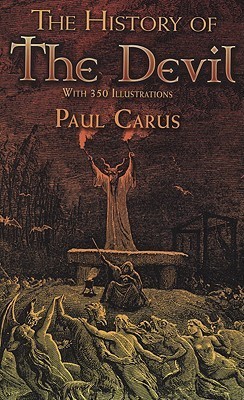
The History of the Devil
Paul Carus
Paul Carus (1852-1919) was a highly regarded writer on philosophy and comparative religion and a major influence in introducing Buddhist and other Eastern ideas to the West. The History of the Devil is his magnum opus on the evolution of the idea of evil from ancient to modern times. Carus follows the devil around the world through his manifestations in many cultures and historic periods. At once scholarly and intriguing, the text is enhanced by 350 rare and fascinating illustrations.
About the author
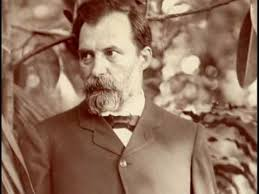
(Photo from Parliament of the World’s Religions on YouTube)
Paul Carus
Paul Carus, Ph.D. (18 July 1852 – 11 February 1919) was a German-American author, editor, a student of comparative religion, and professor of philosophy.
Carus considered himself a theologian rather than philosopher. He is proposed to be a pioneer in the promotion of interfaith dialogue. He explored the relationship of science and religion, and was instrumental in introducing Eastern traditions and ideas to the West. He was a key figure in the introduction of Buddhism, to the West.
(Goodreads.com)
Excerpts:
“The God of the future will not be personal, but superpersonal.”
“The word Satan, which means ‘enemy,’ is freely used, but as a proper name, signifying the Devil, is used only five times [in the Old Testament].”
“…once a man died and awoke in the other world. There St. Peter appeared before him and asked him what he watned. He then ordred breakfast, the dailypapers, and all the comforts he was accustomed to in life, and this kind of life lasted for many centuriesi until he got sick of it and began to swear at St. Peter and to compain of how monotonous it was in Heaven., whereupon St. Peter informed him he was in Hell. for hell is where everybody has his own sweet will, and heaven is where everybody follows God’s will alone.”
Bertha von Suttner devotes in her ingenious book The Inventory of a Soul a whole chapter to the proposition “The Principle of Evil a Phantom.” She says:
“I do not believe in the phantoms of badness, misery, and death. They are mere shadows, zeros, nothingnesses. They are negations of real things, but not real things themselves… There is light, but there is no darkness: darkness is only the non-existence of light. There is life, death is only a local ceasing of life-phenomena. . . . We grant that Ormuzd and Ahriman, God and Devil, are at least thinkable, but there are other opposites in which it is apparent that one is the non-existence of the other. For instance: noise and silence. Think of a silence so powerful as to suppress a noise. . . . Darkness has no degree, while light has. There is more light or less light, but various shades of darkness can mean only little or less light. Thus, life is a magnitude, but death is a zero. Something and nothing cannot be in struggle with each other. Nothing is without arms, nothing as an independent idea is only an abortion of human weaknesses . . . two are necessary to produce struggle. If I am in the room, I am here; if I leave it, I am no longer here. There can be no quarrel between my ego-present and ego-absent.”
Existence is one harmonious entirety; there is not a thing in the world but is embraced in the whole as a part of the whole. The One and All is the condition of every creature’s being; it is the breath of our breath, the sentiency of our feelings, the strength of our strength. Nothing exists of itself or to itself. All things are interrelated; and as all masses are held together by their gravity in a mutual attraction, so there is at the bottom of all sentiment a mysterious longing, a yearning for the fulness of the whole, a panpathy which finds a powerful utterance in the psalms of all the religions on earth. No creature is an isolated being, for the whole of existence affects the smallest of its parts. Says Emerson:
“All are needed by each one,
Nothing is fair or good alone.”
The unity of the whole, the intercoherence of all things, the oneness of all norms that shape life, is not a mere theory but an actual reality; and in this sense the scriptural saying “God is Love” is a truth demonstrable by natural science.
Truly if we cannot have a religion which makes us free and independent, let us discard religion! Religion must be in accord not only with morality but also with philosophy; not only with justice, but also with science; not only with order, but also with freedom.
So long as the truth is something foreign to us, we speak of obedience to the truth; but when we have learned to identify ourselves with truth, the moral ought ceases to be a tyrannical power above us, and we feel ourselves as its representatives; it changes into aspirations in us. True religion is love of truth, and being such it will not end in a feeling of dependence, but reap the fruit of truth, which is liberty, freedom, independence.