
Monthly Archives: February 2025

‘Uncle Vanya’ review — Steve Carell brings his comic chops to a dramatic classic
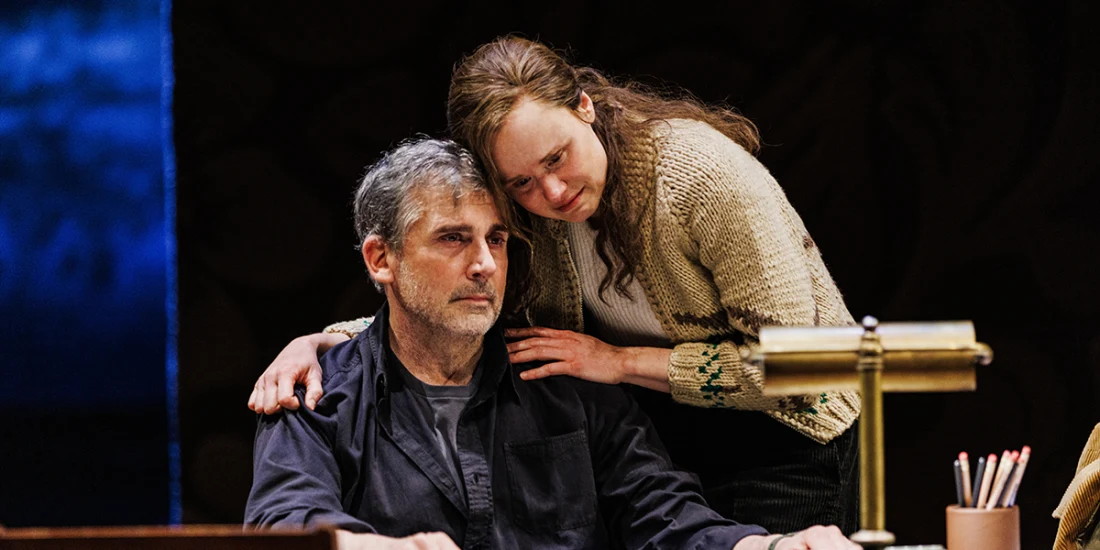
Read our review of Uncle Vanya on Broadway, starring Steve Carell in the title role of the classic Anton Chekhov play newly translated by Heidi Schreck.

April 23, 2024 (NYTimes.com)
As a showcase for Steve Carell’s Broadway debut and sporting a fresh translation by Heidi Schreck (What the Constitution Means to Me), the Anton Chekhov classic Uncle Vanya lands at Lincoln Center in a glow of wonder: “What will that be like?”
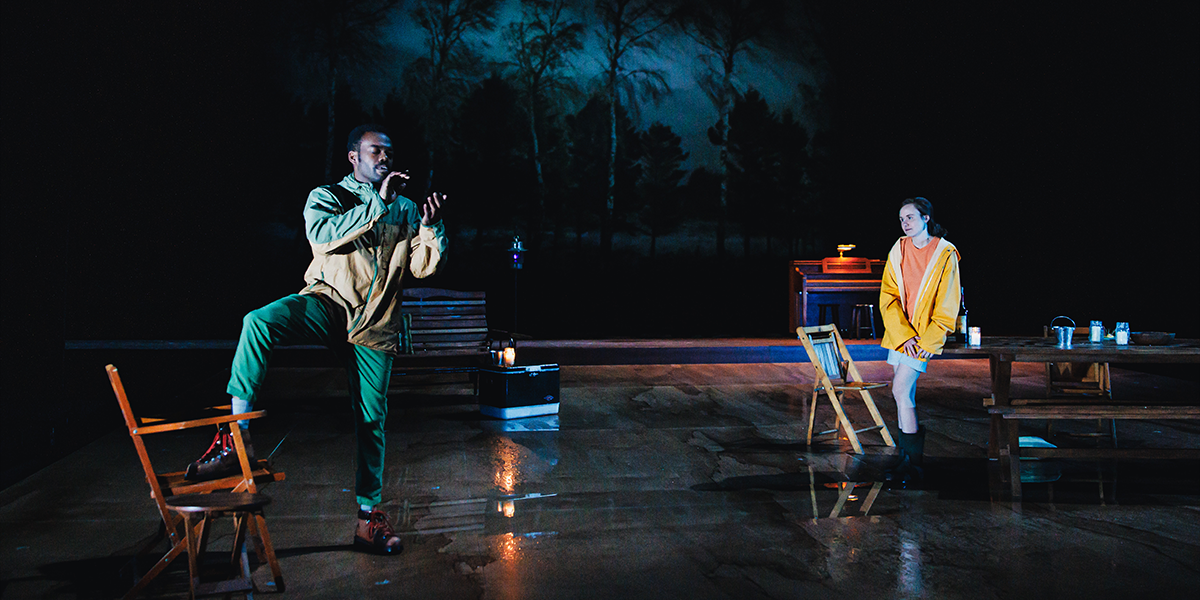
At the Vivian Beaumont Theater, the contemporary take loses a bit of that luster and emerges, at best, a curiosity. To be sure, there’s a cast of committed actors, including Carell, who appears to have been directed to play himself as Vanya; eye-catching design elements; and splashy rain effects (precipitation is a trend this season on the Great Wet Way).
Unlike the characters who mention being bored at least a dozen times, the staging by director Lila Neugebauer (Appropriate) isn’t dull. It seems particularly bent on tickling out humorous textures right up until the very end. Still, one wishes the revival added up to a more cohesive and persuasive experience.
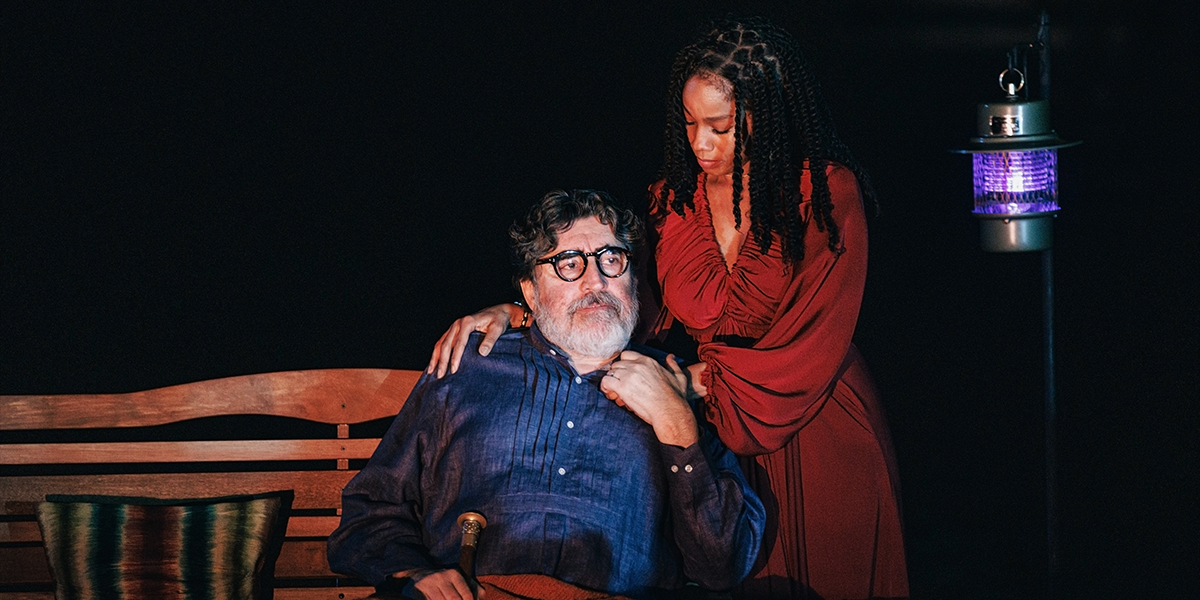
Chekhov’s story is steeped in melancholy and the sting of unrequited feelings. That’s the way things roll on a Russian estate dutifully, if not monotonously, managed for years by Vanya and his niece, Sonia (Alison Pill). Then Vanya’s late sister’s husband, Alexander (Alfred Molina), a professor, pops in for a visit with his new wife, Elena (Anika Noni Rose), a man magnet. Astrov (William Jackson Harper), a local doctor, gets caught up in estate-wide dramas and a daisy chain of desire and discontent.
By the time the play reaches its conclusion, and thwarted dreamers and would-be romantics surrender to more of the same-old same-old, you can typically expect to feel a twinge of sadness. Or empathy. Or… something. Broadway’s 11th Uncle Vanya left me wanting.
Uncle Vanya summary
First seen in 1899, Uncle Vanya follows a dysfunctional family living on a Russian country estate, where unrequited love and existential despair grow like weeds. As tensions rise among residents and visitors, the characters confront their wasted lives, unfulfilled desires, and the futility of their actions.
Chekhov’s much-admired masterwork premiered on Broadway in 1923. Since then, 10 more productions have explored its themes of disillusionment, longing, and the search for meaning. The play explores the complexities of interpersonal relationships and is alternately warm, amusing, and poignant.
What to expect at Uncle Vanya
The big question: How does Carell do on stage? Known for comedies such as The Office and The 40-Year-Old Virgin, Carell doesn’t deviate from his comfort zone as Vanya. His character’s signature dimension is clownish petulance, and he lets it all hang out, as directed. In one display of over-the-top, furniture-forward acting, he climbs atop a long table during a heated confrontation.
Elsewhere, as Elena, who leaves chaos in her wake, Rose exudes boredom. Pill makes the most of Sonia’s wrenching late-in-the-play resignation, and Molina is aptly self-absorbed as the retired academic. As an angsty physician and tree-hugger, Harper energizes the proceedings.
Mimi Lien’s scenic design sets a mood and is one of the pluses of the show. In Act 1, a floor-to-ceiling sepia-toned photograph of bare trees occupies the back wall, hinting at bittersweetness that feels right for Uncle Vanya. The second act moves inside the estate, where the backdrop has changed to an ornate oversized tapestry. Visually striking and a little odd, it slyly speaks to lives unraveling.
What audiences are saying about Uncle Vanya
In the run-up to the play’s official opening at the Vivian Beaumont at Lincoln Center, Uncle Vanya earned a 67% audience approval ranking on Show-Score, where posters responded to the play’s acting and intelligence.
- “I dare say you may never have seen such an accessible yet powerful version. My guest was a first timer and was moved also.” – Show-Score user JoeyFranko
- “See it if you enjoy modern interpretations of classics with a sparse set and contemporary costumes, language and mannerisms.” – Show-Score user DARTheatreLover
- “There is no angst, no sexual tension, no existential dread.” – Show-Score user gloria 6311
Read more audience reviews of Uncle Vanya on Show-Score.
Who should see Uncle Vanya
- Steve Carell fans should attend if they’re keen on seeing where Uncle Vanya fits alongside past TV and movie roles. Is it more Little Miss Sunshine or Crazy, Stupid, Love?
- Fans of Schreck’s self-inspired What the Constitution Means to Me will want to see her rendering of a classic as she writes in a different mode.
- Chekhov completists should see it if they never miss an opportunity to spend time with his characters.
Learn more about Uncle Vanya
Uncle Vanya offers a chance to see a starry revival of a beloved play that’s been given a fresh coat of inspiration.
Additional Uncle Vanya content
- All the celebrities who have starred in Uncle Vanya, including Steve Carell
- Learn about all the family dramas on Broadway this season
Photo credit: Uncle Vanya on Broadway. (Photos by Marc J. Franklin)
Vanya closed on Broadway on June 16, 2024
Jane Fonda: Life Achievement Award Acceptance Speech at SAG
“Our job is to create empathy.”
Jane Fonda
Netflix • Feb 24, 2025 Jane Fonda gives a moving speech as she receives the Screen Actors Guild Life Achievement Award for her remarkable contributions throughout her career. Watch on Netflix: https://www.netflix.com/title/81745785
Circle dance of Jesus and the Apostles
(thejesusquestion.org)
The “circle dance of Jesus and the apostles” from the Acts of John refers to a story where Jesus, on the night before his arrest, instructs his disciples to form a circle around him, hold hands, and dance while singing a hymn, with the apostles responding with “Amen” throughout the dance; this is considered a unique and somewhat mystical depiction of Jesus and his followers engaging in a ritualistic circle dance.
Key points about the circle dance:
- Source: This story appears in the “Acts of John,” an apocryphal text considered non-canonical to the Bible, which describes the travels and teachings of the apostle John.
- The dance itself: Jesus leads the disciples in forming a circle, holding hands, and moving in a dance-like manner while singing a hymn.
- Significance of “Amen”: The apostles are described as responding to Jesus’s hymn with repeated “Amen”s, signifying their agreement and participation in the ritual.
- Interpretation: Scholars debate the historical accuracy of this scene, but it is often interpreted as a symbolic representation of unity, devotion, and the mystical connection between Jesus and his followers.
(Google AI)
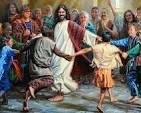
Jesus the Dancer, Part 6: The Round Dance of the Cross
Posted on March 15, 2012 (thejesusquestion.org)
Note to Reader: The Acts of John is not part of the Christian canon, mainly because of its docetic teachings, which read more like myth than history and depart widely from orthodox Christianity. This text, like others in the Gnostic tradition, teaches that Jesus’s physical body was just an illusion, as was his crucifixion, and that salvation is attained only by those select few to whom he chooses to grant “secret knowledge,” not by all who respond in faith and obedience to the atoning work of Jesus Christ.* This post presents a picture of this Gnostic Jesus, not the historical Jesus of Nazareth we find in the four canonical Gospels. The words attributed to him below are probably not his own. Nevertheless, I thought the passage relevant to this series because it presents an early view of Jesus as a (literal) dancer. You don’t have to accept the Gnostic worldview to be able to find some beauty and truth (however partial) in the poetry.
The Acts of John, a second-century Gnostic text, records an episode that supposedly took place the night before Jesus’s crucifixion, in which Jesus leads his disciples in a song and dance: “‘Before I am delivered to them, let us sing a hymn to the Father and so go to meet what lies before us.’ So he commanded us to make a circle, holding one another’s hands, and he himself stood in the middle. He said, ‘Respond Amen to me’” (Ehrman). Jesus starts off the song by ascribing glory and praise to the Father, and then he moves into a bunch of riddlelike self-declarations: “I will be born and I will bear. . . . I will eat and I will be eaten. . . . I will be kept in mind, being all mind” (Barnstone and Meyer). And so on. This call-and-response song and accompanying round dance are thought to have been used in the liturgy of some of the early Gnostic communities.
The Acts of John was rejected by the church as heretical in the fourth century, so almost all copies were destroyed. But some surviving fragments were discovered in 1897 and published (in English translation from the Greek) in 1899 by Cambridge University Press. The text received greater attention in 1917, when Gustav Holst set a portion of it (known as The Hymn of Jesus) to music. The work was written for two mixed choruses, a female semi-chorus, and an orchestra, and it lasts about twenty-two minutes.
The performance below is by the London Philharmonic Orchestra and Choir, conducted by Sir Adrian Boult. (The lovely face you see repeated fivefold is our composer, Mr. Holst.) Number 2 is my favorite.
[Videos unavailable.]
1. Prelude (Vexilla Regis Prodeunt and Pange Lingua)
2. Glory to thee, Father!
3. Fain would I be saved
4. Divine Grace is dancing
5. Give ye heed unto my dancing
The lyrics are Holst’s own translation from the Greek (save for the prelude, which is based on two plainchants and is in Latin):
Vexilla Regis prodeunt
Fulget Crucis mysterium
Quo carne carnis Conditor
Suspensus est patibulo
Pange lingua gloriosi
Praelium certaminis
Et super Crucis trophaeum
Dic triumphum nobilem
Qualiter Redemptor orbis
Immolatus vicerit.(English translation:
The banners of the King advance,
The mystery of the Cross shines forth:
That the master of all flesh
As flesh hangs from the gallows.
Tell, O my tongue,
Of the glorious battle of the struggle,
And over the trophy of the Cross
Speak the noble triumph:
How the Redeemer of the world
In his own immolation was victorious.)Glory to thee, Father!
Glory to thee, Word!
Glory to thee, O Grace!
Glory to thee, Holy Spirit!
Glory to thy Glory!
We praise thee, O Father;
We give thanks to thee, O shadowless light!
Amen.Fain would I be saved: And fain would I save.
Fain would I be released: And fain would I release.
Fain would I be pierced: And fain would I pierce.
Fain would I be borne: Fain would I bear.
Fain would I eat: Fain would I be eaten.
Fain would I hearken: Fain would I be heard.
Fain would I be cleansed. Fain would I cleanse.
I am Mind of all. Fain would I be known. Amen.Divine Grace is dancing.
Fain would I pipe for you: Dance ye all!
Fain would I lament: Mourn ye all!
Amen.
The Heav’nly Spheres make music for us;
The Holy Twelve dance with us;
All things join in the dance!
Ye who dance not, know not what we are knowing.Fain would I flee: And fain would I remain.
Fain would I be ordered: And fain would I set in order.
Fain would I be infolded: Fain would I infold.
I have no home: In all I am dwelling.
I have no resting place: I have the earth.
I have no temple: And I have Heav’n.
To you who gaze, a lamp am I:
To you that know, a mirror.
To you who knock, a door am I:
To you who fare, the way.
Amen.Ye could not know at all what things ye endure,
Had not the Father sent me to you as a Word.
Beholding what I suffer, ye know me as the Sufferer.
And when ye had beheld it, ye were not unmoved;
But rather were ye whirled along, ye were kindled to be wise.
Had ye known how to suffer, ye would know how to suffer no more.Learn how to suffer, and ye shall overcome.
Behold in me a couch: rest on me!
When I am gone, ye shall know who I am;
For I am in no wise that which now I seem.
For ye are come to me, then shall ye know:
What ye know not, will I myself teach you.
Fain would I move to the music of holy souls!
Know in me the word of wisdom!
And with me cry again:
Glory to thee, Father!
Glory to thee, Word!
Glory to thee, Holy Spirit!
Amen.
As is true with most Gnostic texts, the above hymn is somewhat elusive in places. I’m not sure what the original writer (Leucius Charinus, a friend and disciple of the apostle John, according to tradition) had in mind, but here’s how I read it (bringing into it, of course, my Christian worldview): In stanzas two and four (“Fain would I be saved . . .”), Jesus is struggling with completing his mission: “Should I run or should I stay?” he asks. We know from the biblical accounts of Jesus in Gethsemane that he did question whether his prescribed fate (the cross) was necessary for the accomplishment of God’s will, and that he expressed deep agony over it, though we know, too, that he ultimately accepted this fate, as he saw that it is what would please the Father and save the world. “Happily would I be spared these upcoming tortures,” he says in the above hymn, “but even more happily would I endure them to spare others. . . . Happily would I be released from this death sentence, but even more happily would I release others from theirs.”
Jesus talks about eating and being eaten—a reference to the Last Supper, of which he would have just partaken. He talks about how he will be wounded and will wound, a reference to the cross as the instrument of his suffering but also the instrument by which he would conquer Satan. And he talks about being enfolded and enfolding others. What Holst translates as “infolded” and “infold,” G. R. S. Mead translates as “at-one,” and Willis Barnstone and Marvin Meyer translate as “unite.” Here Jesus is foretelling his ascension—his homecoming—as well as the eventual ascension and homecoming of all saints, who will in that day be united with their Creator, as they go up into the enfolding arms of God.
In the final stanza, there’s a new name for Jesus of which I am quite fond: not Shepherd or Vine or Bridegroom but Couch! This image doesn’t mean that Jesus will give us a “comfy” existence, that we won’t ever experience hardness or that we should be inactive, but that in our activity and in our pain, he will be our cushion at the end of the day, our comfort and our rest. “Behold in me a couch: rest on me!”
Most centrally, though, this song is about Jesus calling his disciples to dance. Even then, on the most depressing night of his life, Jesus says that God’s grace is dancing, and that they ought to join up with it. “If you don’t dance,” he says, “you will never understand who God is, or the joy that could be yours.” (“Ye who dance not know not what we are knowing” [Holst].) It’s like the people at parties who, for either lack of interest or self-professed lack of skill, just sit on the sidelines of the dance floor, observing the fun from afar; they don’t understand what’s so great about dancing, because they’ve never experienced it for themselves. If we would only let go of our fears and insecurities of looking stupid or not being good enough, we would find that “dancing” (worshiping God, and following his lead) is a very fun and fulfilling and natural activity—it’s what we were created for. As Mead says in his 1907 commentary, “The soul must dance, or be active in a corresponding way, with the Great Dance, in order to know, or attain true Gnosis. Knowledge of the Great World can only be attained when the man has abandoned his self-will and acts in harmony with the Great Happenings.”
Maybe you’re one of the ones who’s not dancing, who’s sitting in the corner, saying “It’s stupid,” or “I don’t want to,” or “I’m no good.” Well, like the guy at the prom who kindly and nobly takes notice, Jesus is extending his hand to you, asking would you please “answer thou unto my dancing” (M. R. James). “Would you please give Christianity a chance?” he asks. “I know that a lot of people don’t do it right and have made it look ridiculous, and that it can be intimidating to share a floor with those who are more advanced, but let me teach you.” (“When ye are come to me, then shall ye know: what ye know not will I myself teach you” [Holst].)
*^ In the Acts of John, Jesus is described as a shape-shifter who appeared in different forms simultaneously to different disciples (to John, for example, he appeared as a bald and bearded man; to James, a pubescent youth [sections 88-89]). Moreover, John says that sometimes when he would try to touch Jesus, his hand would go straight through him, because he was all spirit, no matter; not only that, but Jesus had no footprints (93). According to this Gnostic account, Jesus did not actually die on the cross (he had a sort of “body double” do it for him [99, 101]), and his “death” did not serve an atoning function; in fact, Jesus tells John that all this talk of him dying and rising and such was only symbolic (102). Jesus also tells John to despise those who are “outside the mystery” (110). (All these scripture references can be searched in M. R. James’s translation below.)
TRANSLATORS (click on the name to view the translation):
- G. R. S. Mead, 1907 (The Hymn of Jesus: Echoes from the Gnosis)
- Gustav Holst, 1917
- M. R. James, 1924 (from The Apocryphal New Testament)
- Willis Barnstone and Marvin Meyer, 2003 (from The Gnostic Bible)
- Bart Ehrman, 2005 (from Lost Scriptures: Books That Did Not Make It into the New Testament)
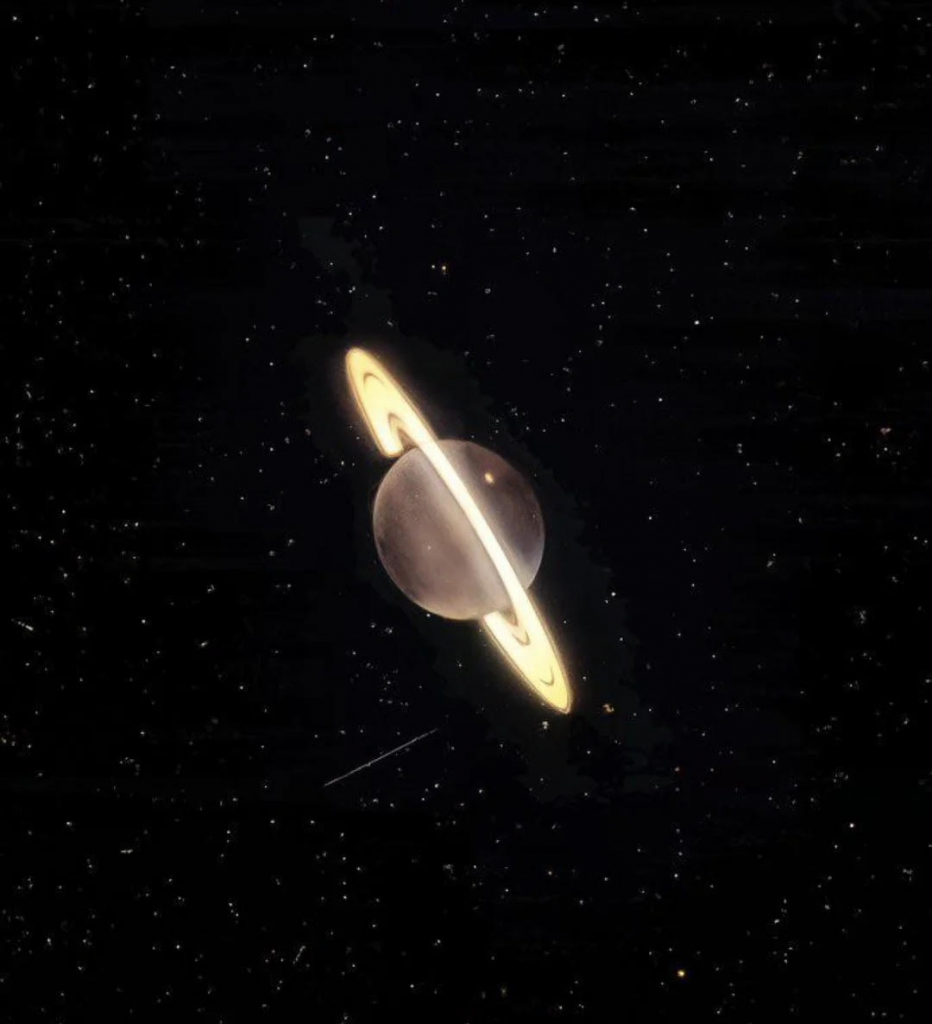
Saturn from James Webb telescope
Oliver Sacks and Simone de Beauvoir
By Maria Popova (themarginalian.org)
How to See the Golden Light: Oliver Sacks in Love

“Only art penetrates what pride, passion, intelligence and habit erect on all sides — the seeming realities of this world,” Saul Bellow insisted in his magnificent Nobel Prize acceptance speech. “There is another reality, the genuine one, which we lose sight of. This other reality is always sending us hints, which without art, we can’t receive.”
It is a beautiful sentiment, beautiful and incomplete. Art is but one way of contacting that deeper reality. Science is another, with its revelations of truths so beyond sight that they seem inconceivable, from the billions of neutrinos passing through your body this very second to the hummingbird’s flight to the quantum bewilderment of the subatomic world.
But more than art, more than science, we have invented one implement to cut through the curtain of habit and render the world new. Love alone blues the sky and greens the grass and brightens all the light we see. It is the last irreducible reality, whose mystery no painting or poem can fully capture and no fMRI can fully explain.
In 1965, the poetic neurologist Oliver Sacks (July 9, 1933–August 30, 2015) moved from Los Angeles, where he had just finished a graduate program at UCLA, to New York, where he was offered a post at Albert Einstein College of Medicine. He found the city a place of “fantastic creative furor,” but his painful introversion and sense of difference left him feeling friendless.
Oliver Sacks as a UCLA graduate student, 1964. (Courtesy of Oliver Sacks Foundation.)
That summer, just before beginning his new job, he traveled home to London. While in Europe, he met Jenö Vincze — a charismatic Hungarian theater director living in Berlin. Oliver had been planning to go to a neurology conference in Vienna. Instead, he found himself in Paris, in Amsterdam, in love with Jenö. Here was a rigorous and original scientist, who would devote his life to illuminating the neurological underpinnings of our strangest mental states, suddenly subsumed in the strangest and most mysterious of them all. He would later look back on this time as one of “an intense sense of love, death, and transience, inseparably mixed.”
When he reluctantly returned to New York, Oliver set about trying to bridge the abyss of physical absence by rendering his world alive in words, composing some of the greatest love letters I have read. In one of the treasures collected in his posthumously published Letters (public library), he writes:
My dearest Jenö:
I have clutched your letter in my pocket all day, and now I have time to write to you. It is seven o’clock, the ending of a perfect day. The sun is mauve and crimson on the New York skyline. Reflected from the cubes and prisms of an Aztec city. Black clouds, like wolves, are racing through the sky. A jet is climbing on a long white tail. Howling wind. I love its howling, I want to howl for joy myself. The trees are thrashing to and fro. An old man runs after his hat. Darker now. The sun has set, City. A black diagram on the sombre skyline. And soon there’ll be a billion lights.
He isn’t, of course, describing the city as it is but as he is. This, in the end, may be what love is — the billion lights inside that make the whole world luminous, an inner sun to render every dull surface and every dark space radiant:
[…]
I want to share my joys with you. To see the green crab scuttling for the shadow, translucent egg cases hung from seaweed. A little octopus, just hatched, jetting for joy in the salty water. Sea anemones. The soft sweet pressure if you touch their center. The chalky hands of barnacles. And polychaetes in their splendid liveries (they remind me of Versailles), moving with insensate grace. And dive with me under the ocean, Jenö. Through fish, like birds, which accept your presence. And scarlet sponges in a hidden cave. And the freedom, the complete and utter freedom of motion, second only to that of space itself.
Card from An Almanac of Birds: 100 Divinations for Uncertain Days, also available as a stand-alone print and as stationery cards, benefitting the Audubon Society.
Oliver yearned to transport Jenö not only to the world he walked through but to the world within, the world he would always best access and best channel in writing. “The act of writing,” he would reflect a lifetime later, “is a special, indispensable form of talking to myself.” Now, he tells his beloved:
Again and again, he keeps returning to this new quality of light suddenly revealed by love:
Perhaps it was this brush with the irreducible immensity of love that would later lead Oliver to write so presciently about the limits of artificial intelligence and so poignantly about the meaning of our human lives.
Two days later, he writes again:
Like all people in love, Oliver was envisioning a life with Jenö, not once imagining that they would never see each other again, that he would spend the next thirty-five years celibate and afraid of love, afraid of himself in love.
But love would find him in the end — a beautiful and bright love that would hold him through dying with dignity.
Card from An Almanac of Birds: 100 Divinations for Uncertain Days, also available as a stand-alone print and as stationery cards.
19-year-old Simone de Beauvoir’s Resolutions for a Life Worth Living

We move through the world feeling inevitable, and yet we are the flotsam of otherwise — how many other ways the atoms could have fallen between the Big Bang and this body, how many other ways this life could have forked at every littlest choice we ever made. But while chance deals the cards we can’t control — the time and place we are born into, the parents and patterns of culture we grow up with, the genes and pigments and neurotransmitters we are woven of — how we choose to play the hand makes us who we are.
A lifetime before she looked back to contemplate how chance and choice converge to make us who we are, the teenage Simone de Beauvoir (January 9, 1908–April 14, 1986) began considering the choices before her in creating herself out of the raw material of her givens — the limiting horizons of her time and place, the vast vista of her mind. (“She thinks like a man,” her father boasted in a haunting testament to both.)
Simone de Beauvoir
At seventeen, she had passed her baccalaureate exams in mathematics and philosophy, then gone on to study math at the Catholic University in Paris before crossing over to the Sorbonne for a degree in philosophy. She would become only the eighth woman to ever pass the agrégation — the most rigorous exam in the French education system — narrowly losing first place in her class to Sartre.
It was at the Sorbonne where, still in her teens, she began bending her tensile and penetrating mind toward the kind of life she wanted to live and the kind of person she wanted to be. In her journal of that time, later published as the altogether magnificent Diary of a Philosophy Student (public library), she approaches these questions with the oscillation between determination and self-doubt inherent to any great endeavor — for there is no greater creative act than the making of a life.
Punctuating the diary are touching reminders that even exceptional people are not spared the ordinary perturbations of being human — she is in some ways a typical teenager (“My winter was occupied almost uniquely with love and suffering.”) and a typical person (“Unendingly I make resolutions that I never keep.”), and yet what she makes out of all that suffering, all that restlessness, all that yearning is what makes her — what makes anyone — extraordinary.
Card from An Almanac of Birds: 100 Divinations for Uncertain Days, also available as a stand-alone print and as stationery cards.
Finding herself “neither able to accept nor to refuse life,” she peers into her near and faraway future:
Then she reaches for the building blocks. Deeming her suffering “useless,” she resolves to rise above it and aim her life toward “a written work that would say everything, that would analyze souls in minute detail while breathing life into each body.” Aware that this dream would demand of her absolute devotion and absolute discipline, she sets down a series of instructions to herself:
[…]
I must… clarify my desire and proceed by trial and error in order to prepare what would eventually be a great written work… Analyze, understand, and descend more deeply into myself… It is imperative to begin. The questions that interest me must be studied in great depth… It would be necessary… to bring it together with the problems of the personality that love formulates so exactly — the problem of the act of faith that so closely touches the first two problems… It would be necessary to have the courage to write, not to expound ideas but to discover them, not to clothe them artistically but to animate them. The courage to believe in them.
Because there can never be great achievement without great despair, because demanding everything and more of yourself is always wormed with doubt that you might not have it to give, the pendulum keeps swinging between determination and despair. Just after deciding to devote her summer vacation to exploring “the subject of love” as a philosophical problem in “at least thirty condensed and coherent pages,” she plummets again:
Card fromAn Almanac of Birds: 100 Divinations for Uncertain Days, also available as a stand-alone print and as stationery cards.
First she uses the lever of her formidable intellect to lift the heavy emotion:
But one can never reason one’s way out of a powerful feeling-state — it simply has to be felt, suffered, endured “for what it may hold of illumination if one can live through it.” All despair of life is at bottom despair of oneself — something Beauvoir channels with the heightened intensity of adolescent feeling and the lashing censure of ambition:
In a momentary flash of self-compassion immediately clouded by the same sharp self-excoriation, she adds:
She considers the steps to the courage of creating — a great work, or a great life:
And yet she locates the key to a fulfilling life not in the mind alone but in the largeness, the fulness, the unabashed openness of the heart:
Half a century later — having proven these postulates with her life, having written not just one great work but several — she would approach the art of growing old with the same depth of thought and feeling.
Complement with her contemporary Albert Camus on the three antidotes to the absurdity of life and Walt Whitman’s timeless recipe for a vibrant and rewarding life, then revisit this omnibus of resolutions for a life worth living borrowed from some extraordinary lives.
Edward Abbey on How to Live and How to Die: Immortal Wisdom from the Park Ranger Who Inspired Generations
By Maria Popova (themarginalian.org)

The summer after graduating high school, knowing he would face conscription into the military as soon as his eighteenth birthday arrived, Edward Abbey (January 29, 1927–March 14, 1989) set out to get to know the land he was being asked to die for. He hitchhiked and hopped freight trains, rode in ramshackle busses and walked sweltering miles across the American Southwest. Upon returning home to Pennsylvania, he was promptly drafted and spent two reluctant years as a military police officer in occupied Italy. Defiant of authority and opposed to the war, he was demoted twice and finally honorably discharged “by reason of demobilization of men.” When he received the discharge papers, he wrote “RETURN TO SENDER” on the envelope in big bold letters to signal that he was never willing for the job he was being fired from. The FBI took note and opened a file, to which they would later add the World Peace Movement he organized on his college campus, his acts of civil disobedience to protect old-growth forests from the corporate chainsaw, and his attendance of a Conference in Defense of Children in Vienna, deemed “communist initiated.”
Even as a teenager, Abbey understood that ideologies are only ever defeated not with guns but with ideas, so he decided to subvert the system by enrolling to study philosophy and literature at the University of New Mexico under the G.I. Bill. He spent the rest of his twenties traveling (he fell especially in love with Scotland, thinking about what makes life worth living, and dreaming of becoming a writer. It was when he took a job as a park ranger at thirty that he found the material for his first book: the ravishing Desert Solitaire, which went on to inspire generations of writers and environmental activists, among them Wendell Berry, Gary Snyder, Cheryl Strayed, and Rebecca Solnit.
Edward Abbey as an off-duty park ranger. (Photograph: Phillip Harrington.)
Throughout his life, Abbey kept a journal that stands as a crowning curio in the canon of notable diaries, selections from which were posthumously published as Confessions of a Barbarian (public library). In an entry penned just before his twenty-fifth birthday, when most of us move through the world feeling invincible and immortal, Abbey contemplates the end of life:
Not in a smelly old bloody-gutted bed in a rest-home room drowning in the damp wash from related souls groping around you in an ocean heavy with morbid fascination with agony, sin and guilt, expiated, with clinical faces and automatic tear glands functioning perfunctorily and a fat priest on the naked heart.
Not in snowy whiteness under arc lights and klieg lights and direct television hookup. No never under clinical smells and sterilized medical eyes cool with detail calculated needle-prolonged agonizing, stiff and starchy in the white monastic cell, no.
Not in the muddymire of battle blood commingled with charnel-flesh and others’ blood, guts, bones, mud and excrement in the damp smell of blasted and wrung-out air; nor in the mass-packed weight of the cities atomized while masonry topples and chandeliers crash clashing buried with a million others, no.
Not the legal murder either — too grim and ugly such a martyrdom — down long aisled with chattering Christers chins on shoulders under bright lights again a spectacle an entertainment grim sticky-quiet officialdom and heavy-booted policemen guiding the turning of a pubic hair gently grinding in a knucklebone an arm hard and obscene fatassed policemen everywhere under the judicial — not to be murdered so, no never.
But how to:
Alone, elegantly, a wolf on a rock, old pale and dry, dry bones rattling in the leather bag, eyes alight, high, dry, cool, far off, dim distance alone, free as a dying wolf on a pale dry rock gurgling quietly alone between the agony-spasms of beauty and delight; when the first flash of hatred comes to crawl, ease off casually forward into space the old useless body, falling, turning, glimpsing for one more time the blue evening sky and the far distant lonesome rocks below — before the crash, before…
With none to say no, none.
Way off yonder in the evening blue, in the gloaming.
When he did die a lifetime later, alone in his desert home, Abbey left a winking note for anyone seeking his final words: “No Comment.” He requested that his useless body be used “to help fertilize the growth of a cactus or cliff rose or sagebrush or tree.” Wishing to have no part in the funeral industry’s embalmments and coffins, he asked his friends to ignore the state laws, place him in his favorite blue sleeping bag, and bury him right into the thirsty ground. If a wake was to be held, he wanted it simple, brief, and cheerful, with bagpipe music, “lots of singing, dancing, talking, hollering, laughing, and lovemaking,” and no formal speeches — “though the deceased will not interfere if someone feels the urge.” When the wake was held at Arches National Park, where he had found his voice as a writer, Wendell Berry and Terry Tempest Williams were among those who felt the urge.
Edward Abbey in his late fifties.
Long after he composed his passionate prospectus for how (not) to die and not long before he returned his borrowed atoms to the earth, Abbey offered his best advice on how to live in a speech he delivered before a gathering of environmental activists:
So… ramble out yonder and explore the forests, climb the mountains, bag the peaks, run the rivers, breathe deep of that yet sweet and lucid air, sit quietly for a while and contemplate the precious stillness, the lovely, mysterious, and awesome space.
Enjoy yourselves, keep your brain in your head and your head firmly attached to the body, the body active and alive, and I promise you this much; I promise you this one sweet victory over our enemies, over those desk-bound men and women with their hearts in a safe deposit box, and their eyes hypnotized by desk calculators. I promise you this; You will outlive the bastards.
Couple with Anna Belle Kaufman’s spare and stunning poem about how to live and how to die, then revisit the poetic science of what actually happens when we die.
What is the Boy Inside Telling You?
Healing the M • Feb 23, 2025 Rick Belden visits with Josh Mortensen on The Explorer Poet podcast to talk about the stories we learned to tell ourselves as boys that we still tell ourselves as men, and how those stories can be limiting us. This video is the first part of a longer conversation in which other men join Rick and Josh to share their thoughts, experiences, and insights about the topics presented in this portion. Full video: • E70: Personal Stories, Overcoming Gri… Group discussion only: • E70: Personal Stories, Overcoming Gri… Rick Belden is a poet, author, artist, and life coach who helps men who are feeling stuck get their lives moving again. For more information and to schedule a free discovery session with Rick, visit http://rickbeldencoaching.com.
Marianne Williamson on loving Trump and Musk

Sometimes Love says No
| FEB 23, 2025 |
On social media, some have suggested I should be more loving towards Donald Trump and Elon Musk. Like, “What happened to the lady who wrote A Return to Love?” I tilt my head, pretty sure we’re supposed to show at least equal compassion to those whose lives are being traumatized by those gentlemen’s actions these days. I admit I feel less urgency to love the perpetrator than I do their victims – particularly federal workers who have served their country well and at the very least do not deserve the insults thrown at them as they’re told to leave, or former recipients of lifesaving food or medicine who now have nowhere else to turn.
But I do get the point that we’re called by God to love everyone, and I don’t take it lightly. I’ve been praying for Donald Trump for years, and I’ve gotten to the point where I get it, he’s an innocent child of God and so forth. Several friends have told me “He’s not like that in private, Marianne. He’s lovely at dinner,” which weirdly is supposed to make me feel better. I admit Elon Musk presents more of a challenge for me now, but I’m working on it. I’m reminded of this quote from Martin Luther King Jr.: “God said we have to love our enemies, but He didn’t say we have to like them.”
King also said, “Power without love is reckless and abusive, and love without power is sentimental and anemic.” I see what Trump and Musk are doing as reckless and abusive; and sentimental and anemic love an inadequate response to the hour at hand. People frequently question how Jesus could have kicked over the tables of the money-changers, but no Jew or Italian would have a problem with that scene. To some of us, that kind of thing isn’t anger…it’s personality! I’ve noticed that people who speak in sticky sweet syrupy vocal tones are often those who carry the sharpest emotional knives in their pockets, just waiting for you to turn around.
Love is emotionally tender, but also fiercely intelligent. And it’s more than capable of saying no. Any parent knows if a toddler walks into the kitchen carrying a sharp scissors, then that’s a time to say “No.” You say no not because you don’t love your child, but because you do. Or “No, you can’t sleep over at your friend Janie’s house given the fact that people in the neighborhood say her Daddy’s a meth addict.” To me it’s no less loving to say, “No, you cannot gut our government, trash our Constitution, or stage a techno authoritarian coup.”
No. Nyet. Nada. Not gonna happen. Definitely not on my watch.
For those of you who share my perspective, below are some guiding principles to help you get through this disturbing hour. The chaos our President and his First Pal are so intent on creating is an assault on our nervous system as much as on our democracy. We need to protect both.
1) Do not fall asleep. Don’t minimize the severity problem or dull your intention to resolve it. Just make sure your intensity is quiet, centered, and loving. Think Mother Nature when she’s simply had it. She’s not mad. She just won’t take it anymore. This isn’t about hating anyone. It’s about loving our freedom, so much that you’re absolutely adamant we must pass it on to future generations.
2) Do not cave. Don’t allow yourself to do one single thing out of fear of unpopularity or retribution, or out of obedience in advance. You probably will be unpopular with some, and retribution of some kind is absolutely possible. It’s nothing however, compared to the retribution you’ll experience later just trying to be yourself, if the authoritarian project now menacing us becomes permanently entrenched. Only you can answer the question, “Am I ready for this?” If enough of us are, we will ultimately be fine. If enough of us aren’t, then in the words of Jefferson “Indeed I tremble for my country…”
3) Remember: Nature is organizing the resistance. The most important thing is to make yourself receptive and available. Strengthen yourself in all the ways you know how. Do not allow yourself to emotionally spiral down and if you feel it starting to happen, reach out to a friend for help. Grief is appropriate, but you can’t let it run you. The point is to focus on action. It could be reading a book or an article and continuing to educate yourself on what’s happening. It could be attending a local protest. It could be communicating with your elected representatives, particularly if they are Republican. Attend any town halls that are related. What’s important now is not so much the specific action you take, as the accumulation of energy you’re generating. Every particle of it matters.
The momentum is building, but we have a long, long way to go. People are waking up all over the country, but we have to add to the energy every day in every way. Do not shy away from posting. You don’t know who is reading and if even one person today opens their eyes to what’s going on because of something that you said or did, you had a successful day.
You were born for this. You are not alone. You are part of a field of energy connecting millions of people in this country and around the world.
This quote has been ringing in my ears over the last few days: Albert Camus’ “In the midst of winter, I found there was, within me, an invincible summer. And that makes me happy. For it says that no matter how hard the world pushes against me, within me, there’s something stronger – something better, pushing right back.”
That invincible summer is in all of us. We are absolutely so much stronger than we know.
Read Your Way Through Hawaii
To read Hawaii is to understand that much of it will never be accessible to the masses. The writer Megan Kamalei Kakimoto recommends books that illuminate the islands’ rich history and storytelling spirit.

By Megan Kamalei Kakimoto
Published Oct. 2, 2024 Updated Jan. 30, 2025 (NYTimes.com)
Read Your Way Around the World is a series exploring the globe through books.
It shouldn’t have to be said that Hawaii is not your paradise, but I’m saying it anyway. Please understand: This is not an attempt to erect a hostile barrier, but an entreaty to take the responsibility seriously. To read Hawaii is to understand that much of Hawaii will never, should never, be accessible to the masses.
My reasoning draws from history, threading through delicate time markers: 1893, the overthrow of the Hawaiian Kingdom; 1898, the islands’ annexation by the United States; 1976, Protect Kahoʻolawe Ohana’s occupation of the island of Kahoolawe while the U.S. Navy assaulted the land, using it as a bombing range; and 2019, the arrest of 38 kūpuna, our elders, who were blocking a road in protest of yet another new construction atop our sacred mountain Mauna Kea.
Of course, this timeline is incomplete, a crude rough draft. It does not begin to touch upon so many of the small moments lost to history: the warble of the kauaʻi ʻōʻō issuing its final song, a tūtū (grandparent) opening a window to welcome the trade winds.
The writers I admire most are putting pen to these moments, both intimate and cosmic in scope. They are writing into a Hawaii that refuses to bow down to the inherently violent campaigns of American imperialism, militarism and tourism that intersect at our archipelago. They capture the spirit of mythology and oral storytelling that suffuses the warm air and mingles with the brine of the Pacific. Spend time with their words, and get comfortable with the nuance. You’ll see that Hawaii is not your paradise, but so much more.
What should I read to learn about Hawaii’s history?
When it comes to our islands’ past, one of the most influential works of the last century is “From a Native Daughter,” by the late Haunani-Kay Trask. Trask was Hawaii’s essential native daughter: A lifelong activist, educator and author, she was a founding leader of the Hawaiian sovereignty movement as well as a widely admired poet. “From a Native Daughter” is her seminal work of scholarship, in which she evinces the vitality — the mana — of the Native Hawaiian community in language at once empowered and infuriated. Read Trask because her words will change you, and because it’s vital to put in the work to understand our story before you can conceive of our home as a vacation destination.
What books explore Hawaii’s cultural complexity?
“This Is Paradise,” by Kristiana Kahakauwila, is the book that gave me permission to write my own. In six outstanding stories, Kahakauwila vividly portrays a Hawaii at once instantly familiar to locals and distinct from pop culture depictions, á la “The White Lotus,” that approach our home with a tourist’s gaze. Within the book’s pages, you’ll encounter the paniolo cowboy community alongside the cock fighters of Upcountry Maui. And in the unforgettable title story, a chorus of workers in Waikiki escorts you through the tourist trap’s unseen underbelly.
Next, read Chris McKinney’s “The Tattoo,” a novel first published in 2000 that just entered its ninth printing. In the preface, McKinney describes his desire to capture his personal Hawaii: the “country local” atmosphere that seemed to evade contemporary literature. The result is a stunning family saga narrated from within the walls of Halawa Prison.
Matthew Kaopio gives voice to the unhoused and displaced in his novel “Written in the Sky,” which follows a teenager, Ikauikalani, who sets off on a journey beyond his homeless encampment at Ala Moana Park, following instructions he received from his dead grandmother in a dream. The novel, at times violent and painfully precise, is not for the faint at heart. But it rewards readers who embrace its compassionate core.
Who are the Hawaiian poets I can’t miss?
Hawaii’s current poet laureate, Brandy Nālani McDougall, deftly explores connection to place and belonging in “Āina Hānau / Birth Land,” which asks critical questions about American imperialism and settler colonialism, environmental and social injustices, and the pains and prides of motherhood and miscarriage. One does not leave McDougall’s poetry unchanged.
Editors’ Picks
36 Hours in Banff5 Exercises to Improve Your Balance and Age WellThe Deeply Spiced Meatballs That Call Back to Haiti
McDougall also penned the introduction to “Ulu,” by Kai Gaspar, a poetic memoir published by one of our newest local presses, Hoʻolana Publishing. With captivating, sensual imagery, Gaspar immerses readers in his native village of Hōnaunau, weaving together themes of queerness, desire, protection and possession with the abiding spirit of aloha ʻāina (love of the land). His poems will shatter your misconceptions of Hawaii as a tourist destination and introduce you to the realities of a powerful and proud people.
What should I read to honor Maui and Lahaina voices?
Much of the world rallied around Lahaina after a historic fire devastated the West Maui community last August. In the wake of such tragedy, embracing Maui stories and storytellers has been a comforting solace in an impossible time.
Begin with poetry: specifically, “Ask the Brindled,” by Noʻu Revilla. Hailing from Waihee-Waiehu, Revilla spins magic with her deft lyricism and commanding poetic voice, orbiting issues of Hawaiian sovereignty, queer joy and grief, moʻolelo (Hawaiian stories and mythology) and the reclamation of ancestral narratives.
Dana Naone Hall, another Maui author, brings over 30 years of political and cultural activism to “Life of the Land,” an affecting compilation of poems, public talks, interview excerpts, legal testimonies and scholarly essays, all of which illustrate Hall’s inextinguishable commitment to her community. I find the essays especially compelling. They throw into stark relief the resilience of the Hawaiian people in fighting for the most basic human rights, such as burial protection laws.
What are some contemporary books I can pick up at local bookstores?
“Long Live the Tribe of Fatherless Girls” is a riveting memoir by T Kira Madden, a Kanaka writer I deeply admire. The book begins in Florida, inside a canary-yellow apartment in Coconut Grove, but finds its ending on Oahu, where Madden contemplates her kuleana — the responsibility she bears — to tell her story of queerness, resilience and compassion, navigating families forged by blood and affection and unpacking her own Hawaiian identity. On Oahu, find your copy at the Native Hawaiian-owned bookstore Native Books, or visit da Shop in Kaimuki, a neighborhood renowned for its community of artists (and exceptional coffee).
Joseph Han’s debut novel, “Nuclear Family,” commences in the months preceding Hawaii’s infamous false nuclear missile alert of 2018 and centers on the unforgettable Cho family and their once-thriving Korean plate lunch restaurant. It’s an astonishing novel, ushering readers from the Korean DMZ to the familiar Oahu settings of Kamehameha Shopping Center and the winding roads of Tantalus, all while articulating a vital story about the Korean diaspora in Hawaii. Buy your copy at the family-run Kona Bay Books on the Big Island, and say hello to Tobi, the indie’s resident cat.
What about Hawaii’s literary scene might surprise me?
Hawaii boasts a thunderously mighty small press scene. Founded in 1978, Bamboo Ridge Press is a foundational local institution committed to publishing Hawaiian literature. Its titles include a series of Honolulu noir mysteries by Scott Kikkawa, as well as over 100 issues of Bamboo Ridge, the press’s eponymous journal of Hawaiian literature and arts. Bess Press is another venerated local literary institution, specializing in bilingual works in English and Hawaiian. Other notable island presses include Mutual Publishing, Native Books, University of Hawaii Press and Kamehameha Publishing.
Today, Hawaii’s literary landscape continues to evolve, with publishers seeking new ways to recognize local and Indigenous talent. Earlier this year, Don Wallace, an author and champion of local voices, inaugurated the HONOLULU Book Awards to celebrate fiction, nonfiction and poetry by both Native Hawaiian authors and authors who call Hawaii home. It’s the first awards program of its kind in Hawaii, and the organizers hope it will help bring more literary attention to local stories.
Megan Kamalei Kakimoto’s Hawaii Reading List
- From a Native Daughter, Haunani-Kay Trask
- This Is Paradise, Kristiana Kahakauwila
- The Tattoo, Chris McKinney
- Written in the Sky, Matthew Kaopio
- Āina Hānau / Birth Land, Brandy Nālani McDougall
- Ulu, Kai Gaspar
- Ask the Brindled, Noʻu Revilla
- Life of the Land, Dana Naone Hall
- Long Live the Tribe of Fatherless Girls, T Kira Madden
- Nuclear Family, Joseph Han
- Kona Winds, Scott Kikkawa
- Bamboo Ridge literary journal
Megan Kamalei Kakimoto is the Native Hawaiian author of the short story collection “Every Drop Is a Man’s Nightmare,” a USA Today best seller. She lives and writes in Honolulu, where she teaches at Antioch University Los Angeles’s low-residency M.F.A. program and at the University of Hawaii at Manoa.
(Contributed by Michael Kelly, H.W., M.)