
FrameLab podcast • Jan 4, 2025 • George Lakoff and Gil Duran of the FrameLab newsletter made a viral list of 10 ways to keep democracy alive as Trump retakes the White House in 2025. #georgelakoff#2025#politics#democracy#trump#elonmusk#authoritarianism
Monthly Archives: January 2025
Ram Dass on what home is
 “One day I was sitting in a motel in middle America, and it was one of those really plastic popular inn type places, and I had arrived and I went into my room and I sat down and set up my little puja table and you know, all that stuff. Moving the menu and stuff, and it was kind of depressing, and I thought, ‘Well, a few more weeks and I’ll be done with this tour and I can go home.’ And then I saw the pain that that thought was creating for me.
What does poverty look like on a plate?
Huiyi Lin | TED Fellows Films 2024
• April 2024
TED Fellow and economic policy researcher Huiyi Lin is cocreator of “The Poverty Line,” an art project examining poverty through the lens of food. By photographing the daily food choices of people living at the poverty line in 38 countries and territories around the world, Lin shines a light on the problem of poverty in a way no policy report ever could.
TED is supported by ads and partners
About the speaker
Jupiter

Tarot Card for January 7: Swiftness
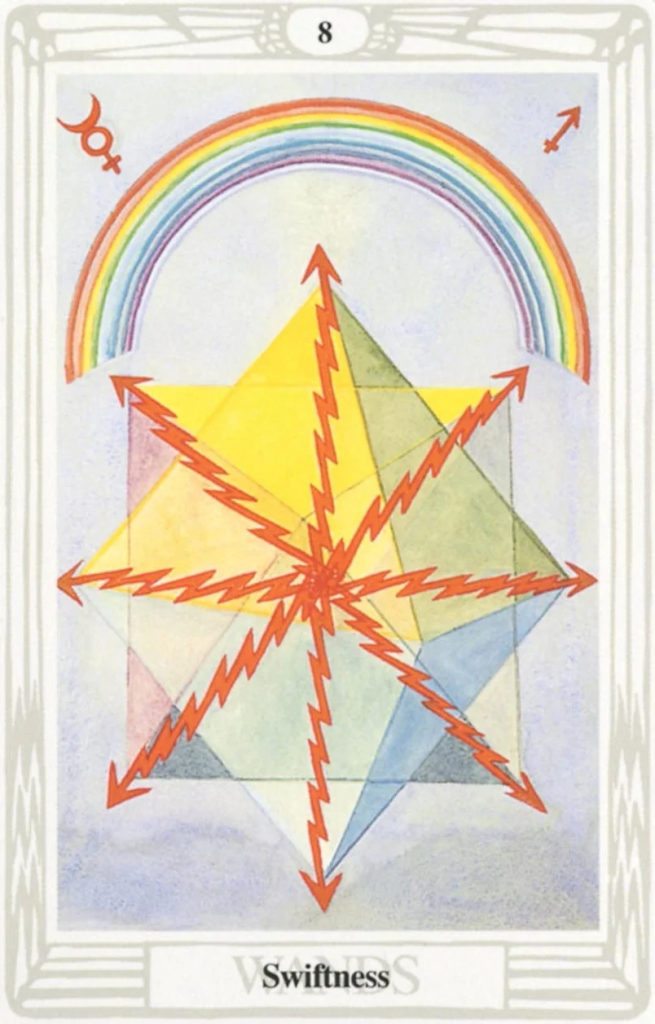
| The Eight of Wands When the Lord of Swiftness comes up in a reading, it shows that there is an energy available which will break down obstacles, move restrictions and allow the free flow of power in any situation you direct it toward.Often there will have been problems which refuse to yield to any reasonable solution previously attempted. However on a day ruled by the Eight of Wands even the most intractable and stubborn difficulties will simply fall away when the downrush of power is felt from this card.Accordingly, on an Eight of Wands day, go looking for problems! Try to locate those things – whether major or minor, that have refused resolution till now. When you find something that seems applicable, sit down for a few minutes and mentally walk around the obstacle, trying to get a new perspective on it.This thinking period is important, because when this card rules, there is rapid and swift communication – either intuitively or in real terms, which allows you to see a way through the maze of complications that can build up around the most mundane of tasks.Expect, during your period of contemplation, to see new possibilities for solving the problem. Wait for the out-of-the-blue thought that strikes you as though from nowhere. When you discover it, try it out, no matter how outlandish it may at first appear.Be open to what life tells you – not as a result of seeking advice, but as a spontaneous offering from the people around you. When we leave ourselves open for the Universe to convey its thoughts to us, they can arrive from the most unexpected sources! Be prepared to consider any options offered to you obliquely – don’t take them at face value; try to turn them into applications for the matter you are attempting to resolve.And allow your sense of humour full rein – you need a light-hearted attitude to get the best out of this card. You’ll be amazed at the things you will get done on a day ruled by the Lord of Swiftness. Affirmation: “Challenges and obstacles are achievements waiting to happen.” |
(Angelpaths.com)
Huineng on being unencumbered by ideas

An early warning about newspeak from Isaiah 5:20
The Promethean Power of Burnout
By Maria Popova (themarginalian.org)

In every creative life, in every life of passion and purpose, there comes a time when the animating spark grows dim and the muscle of motivation slackens, when you come to feel benumbed to beauty and abandoned by your numen, suffocating in the exhaust fume of your own exertion, ossified with the tedium of being yourself.
We call those moments burnout, and we feel them most acutely as we approach the final horizon of a project, a year, a chapter of life. And yet, just as breakdowns can deepen our self-knowledge and despair can invite the sacred pause preceding regeneration, burnout can become the hearth of change — that urgent and necessary change without which the lulling inertia of our lives would always keep us a short distance from alive.
Illustration by Margaret C. Cook for a rare 1913 edition of Walt Whitman’s Leaves of Grass. (Available as a print.)
This secret Promethean power of burnout is what poet and philosopher David Whyte explores in one of the sort, searching essays collected in his Consolations II — the continuation of his earlier emotional dictionary defining the deeper and often ineffable meanings of everyday words, which was among my favorite books of the year.
In the entry for the word burnout, he writes:
Burnout feels like a living central absence, not only of a centre, but the sources that used to rise from that centre.
The exhaustion of burnout always recalls a previously felt internal fire, one from which our unquenchable energies once emerged. Burnout denotes a kind of amnesia: not only in the forgetting of our very personal priorities but the inability to locate a source inside us that previously seemed to run through all the seasons of our life. This loss of a fiery essential centre is also experienced as a loss of faith: a form of forgetting, not only that the source actually existed inside me in the first place but that I might not now ever remember how to drink from it again.
Not unlike existential boredom, of which it is the mirror image, burnout is a misapprehension of time, a failure to trust its ever-undulating flow toward the ever-shifting horizon of the possible. Because we are temporal creatures who only have four thousand weeks to spend our two billion allotted heartbeats, mistrusting time is mistrusting life itself. In a sentiment evocative of Wendell Berry’s celebration of the sabbath as a radical act of resistance, David writes:
Because burnout often results from the invisible wear-and-tear of gliding along the vector of exertion toward a dream we have long outgrown, at its heart is a beckoning to conjure up that most difficult, most rewarding kind of courage — the courage to change our minds and change our lives, to break down the structure of the self in order to imagine it afresh — a process so discomposing, given our paradoxical resistance to transformation, that we may only be able to enter it through the attic of the unconscious. David writes:
Card from An Almanac of Birds: 100 Divinations for Uncertain Days, also available as a stand-alone print and as stationery cards, benefitting the Audubon Society.
Observing that burnout is “a loss of friendship with a very personal sense of the unknown” — that lovely capacity for self-surprise which makes life worth living and allows us to reinvent ourselves — he adds:
Not being able to go on, is always in the end, a creative act, the threshold moment of our transformation away from physical exhaustion. Not being able to go on is the beginning of a proper relationship with the timeless and the healing possibilities of timelessness: healing ourselves from burnout always involves a reacquaintance with the eternal: my ability to experience the timeless is a parallel to my ability to rest.
Ultimately, burnout is the pathology of doing in the psyche of being, the only remedy for which is to rest into the primal knowledge that there was never anything to prove with all that exertion, never anything to redeem with all that punitive pursuit of your culture’s or your parents’ or your idols’ ideas about what makes a life worth living.
Echoing Willa Cather’s spare and timeless definition of happiness, David writes:

Art by Ofra Amit for The Universe in Verse
Complement these fragments of the wholly revivifying Consolations II with Alain de Botton on the importance of breakdowns, Katherine May’s potent salve for burnout, and John Gardner on the art of self-renewal, then revisit David Whyte on the relationship between anxiety and intimacy and this superb Where Shall We Meet conversation with him about language and life.
Elevating Resolutions for the New Year Inspired by Some of Humanity’s Greatest Minds
By Maria Popova (themarginalian.org)

What if we could augment the bucket-list of typical New Year’s resolutions, dominated by bodily habits and pragmatic daily practices, with higher-order aspirations — habits of mind and spiritual orientations borrowed from some of humanity’s most timelessly rewarding thinkers? After last year’s selection of worthy resolutions inspired by such luminaries as Seneca, Maya Angelou, Bruce Lee, and Virginia Woolf, here is another set for the new year borrowed from a new roster of perennially elevating minds.
| 1. ADRIENNE RICH: CULTIVATE HONORABLE RELATIONSHIPS |

One of the most influential poets of the twentieth century and a woman of unflinching conviction, Adrienne Rich (May 16, 1929–March 27, 2012) became the first and to date only person to decline the National Medal of Arts in protest against the growing monopoly of power and the government’s proposed plan to end funding for the National Endowment for the Arts. Although her poetry collection The Dream of a Common Language is a cultural cornerstone and required reading for every thinking, feeling human being, her lesser-known collected prose, published as On Lies, Secrets, and Silence (public library), pours forth Rich’s most direct insight into the political, philosophical, and personal dimensions of human life.
In it, she writes:
It is important to do this because it breaks down human self-delusion and isolation.
It is important to do this because in doing so we do justice to our own complexity.
It is important to do this because we can count on so few people to go that hard way with us.
| 2. SØREN KIERKEGAARD: RESIST ABSENTMINDED BUSYNESS |

Søren Kierkegaard (May 5, 1813–November 11, 1855), considered the first true existentialist philosopher, remains a source of enduring wisdom on everything from the psychology of bullying to the vital role of boredom to why we conform. In a chapter of the altogether indispensable 1843 treatise Either/Or: A Fragment of Life (public library), thirty-year-old Kierkegaard writes:
In a latter chapter, titled “The Unhappiest Man,” he considers how we grow unhappy by fleeing from presence and busying ourselves with the constant pursuit of some as-yet unattained external goal:
[…]
The unhappy one is absent… It is only the person who is present to himself that is happy.
| 3. RAINER MARIA RILKE: LIVE THE QUESTIONS |

In 1902, Rainer Maria Rilke (December 4, 1875–December 29, 1926) began corresponding with a 19-year-old cadet and budding poet named Franz Xaver Kappus. Later published as Letters to a Young Poet (public library), Rilke’s missives address such enduring questions as what it really means to love, how great sadnesses bring us closer to ourselves, and what reading does for the human spirit.
In one of the most potent letters, he writes:
| 4. SUSAN SONTAG: PAY ATTENTION TO THE WORLD |

In a terrific 1992 lecture, Susan Sontag (January 16, 1933–December 28, 2004) asserted that “a writer is someone who pays attention to the world — a writer is a professional observer.” But this observant attentiveness to the world, Sontag believed, is as vital to being a good writer as it is to being a good human being — something she addresses in one of the many rewarding pieces collected in the posthumous anthology At the Same Time: Essays and Speeches (public library), which also gave us Sontag on beauty vs. interestingness, courage and resistance, and literature and freedom.
Reflecting on a question she is frequently asked — to distill her essential advice on writing — Sontag offers:
Needless to say, no sooner had these perky phrases fallen out of my mouth than I thought of some more recipes for writer’s virtue.
For instance: “Be serious.” By which I meant: Never be cynical. And which doesn’t preclude being funny.
But these tenets of storytelling, Sontag argues, aren’t just writerly virtues — they are a framework for human virtues:
To be a moral human being is to pay, be obliged to pay, certain kinds of attention.
When we make moral judgments, we are not just saying that this is better than that. Even more fundamentally, we are saying that this is more important than that. It is to order the overwhelming spread and simultaneity of everything, at the price of ignoring or turning our backs on most of what is happening in the world.
The nature of moral judgments depends on our capacity for paying attention — a capacity that, inevitably, has its limits but whose limits can be stretched.
But perhaps the beginning of wisdom, and humility, is to acknowledge, and bow one’s head, before the thought, the devastating thought, of the simultaneity of everything, and the incapacity of our moral understanding — which is also the understanding of the novelist — to take this in.
| 5. BERTRAND RUSSELL: MAKE ROOM FOR “FRUITFUL MONOTONY” |

Many of humanity’s greatest minds have advocated for the vitalizing role of not-doing in having a full life, but none more compellingly than British philosopher Bertrand Russell (May 18, 1872–February 2, 1970) in his 1930 masterwork The Conquest of Happiness (public library) — an effort “to suggest a cure for the ordinary day-to-day unhappiness from which most people in civilized countries suffer,” and a timelessly insightful lens on what “the good life” really means.
In a chapter titled “Boredom and Excitement,” Russell teases apart the paradoxical question of why, given how central it is to our wholeness, we dread boredom as much as we do. Long before our present anxieties about how the age of distraction and productivity is thwarting our capacity for presence, he writes:
[…]
As we rise in the social scale the pursuit of excitement becomes more and more intense.
Many decades before our present concerns about screen time, he urges parents to allow children the freedom to experience “fruitful monotony,” which invites inventiveness and imaginative play — in other words, the great childhood joy and developmental achievement of learning to “do nothing with nobody all alone by yourself.” He writes:
I do not mean that monotony has any merits of its own; I mean only that certain good things are not possible except where there is a certain degree of monotony… A generation that cannot endure boredom will be a generation of little men, of men unduly divorced from the slow processes of nature, of men in whom every vital impulse slowly withers, as though they were cut flowers in a vase.
| 6. URSULA K. LE GUIN: REFUSE TO PLAY THE PERFECTION GAME |

Perfectionism is our most compulsive way of keeping ourselves small, a kind of psychoemotional contortionism that gives the illusion of reaching for greatness while constricting us into increasingly suffocating smallness. That’s what Ursula K. Le Guin (b. October 21, 1929) explores in a wonderful 1992 essay titled “Dogs, Cats, and Dancers: Thoughts about Beauty,” found in the altogether spectacular volume The Wave in the Mind: Talks and Essays on the Writer, the Reader, and the Imagination (public library) — the source of Le Guin’s wisdom on the cultural baggage of gender, the magic of real human conversation, and the sacredness of public libraries.
Reflecting on various cultures’ impossible and often punishing ideals of human beauty, “especially of female beauty,” Le Guin writes:
[…]
I think of when I was in high school in the 1940s: the white girls got their hair crinkled up by chemicals and heat so it would curl, and the black girls got their hair mashed flat by chemicals and heat so it wouldn’t curl. Home perms hadn’t been invented yet, and a lot of kids couldn’t afford these expensive treatments, so they were wretched because they couldn’t follow the rules, the rules of beauty.
Beauty always has rules. It’s a game. I resent the beauty game when I see it controlled by people who grab fortunes from it and don’t care who they hurt. I hate it when I see it making people so self-dissatisfied that they starve and deform and poison themselves. Most of the time I just play the game myself in a very small way, buying a new lipstick, feeling happy about a pretty new silk shirt.
[…]
There’s the ideal beauty of youth and health, which never really changes, and is always true. There’s the ideal beauty of movie stars and advertising models, the beauty-game ideal, which changes its rules all the time and from place to place, and is never entirely true. And there’s an ideal beauty that is harder to define or understand, because it occurs not just in the body but where the body and the spirit meet and define each other.
And yet for all the ideals we impose on our bodies, Le Guin argues in her most poignant but, strangely, most liberating point, it is death that ultimately illuminates the full spectrum of our beauty — death, the ultimate equalizer of time and space; death, the great clarifier that makes us see that, as Rebecca Goldstein put it, “a person whom one loves is a world, just as one knows oneself to be a world.”
With this long-view lens, Le Guin remembers her own mother and the many dimensions of her beauty:
That must be what the great artists see and paint. That must be why the tired, aged faces in Rembrandt’s portraits give us such delight: they show us beauty not skin-deep but life-deep.
More here.
| 7. ERICH FROMM: MASTER THE ART OF LOVING |

Our cultural mythology depicts love as something that happens to us — something we fall into, something that strikes us arrow-like, in which we are so passive as to be either lucky or unlucky. Such framing obscures the fact that loving — the practice of love — is a skill attained through the same deliberate effort as any other pursuit of human excellence.
Long before the Zen sage Thich Nhat Hahn admonished that “to love without knowing how to love wounds the person we love,” the great German social psychologist, psychoanalyst, and philosopher Erich Fromm (March 23, 1900–March 18, 1980) addressed this neglected skillfulness aspect of love in his 1956 classic The Art of Loving (public library) — a case for love as a skill to be honed the way artists apprentice themselves to the work on the way to mastery, demanding of its practitioner both knowledge and effort.
Fromm writes:
[…]
There is hardly any activity, any enterprise, which is started with such tremendous hopes and expectations, and yet, which fails so regularly, as love.
The only way to abate this track record of failure, Fromm argues, is to examine the underlying reasons for the disconnect between our beliefs about love and its actual machinery — which must include a recognition of love as an informed practice rather than an unmerited grace:
More here.
| 8. ANNE TRUITT: CHOOSE UNDERSTANDING OVER JUDGMENT |

Perhaps because she was formally trained as a psychologist, artist Anne Truitt (March 16, 1921–December 23, 2004) possessed exceptional powers of introspection and self-awareness coupled with an artist’s penchant for patient observation. This made her diary, eventually published as Daybook: The Journal of an Artist (public library), a true masterwork of psychological insight.
In one particularly poignant entry, she considers how our preconceptions and our ready-made judgments are keeping us from truly seeing one another, erecting a perilous barrier to love:
More here.
| 9. SIMONE WEIL: MAKE USE OF YOUR SUFFERING |

Long before scientists had empirical evidence of the astounding ways in which our minds affect our bodies, French philosopher and political activist Simone Weil (February 3, 1909–August 24, 1943) — a thinker of unparalleled intellectual elegance and a sort of modern saint whom Albert Camus described as “the only great spirit of our times” — examined the delicate relationship between our physical and spiritual suffering, between the anguish of the material body and that of the soul.
A few months before her painful yet stoic death from tuberculosis — despite her diagnosis and her doctor’s explicit orders to eat heartily, Weil consumed only what was rationed to her compatriots under the German Occupation in a remarkable gesture of solidarity, ultimately resulting in fatal malnutrition — she turned to the problem of pain in First and Last Notebooks (public library). In an entry from late 1942, Weil considers how our instinctive reaction to suffering often only amplifies our pain:
Weil extends this philosophy beyond physical pain and into other forms of bodily and spiritual discomfort that we habitually exacerbate by stiffening with resistance to the unpleasantness:
To make use in this way of the sufferings that chance inflicts upon us is better than inflicting discipline upon oneself.
| 10. JAMES BALDWIN: TELL THE WORLD HOW TO TREAT YOU |

One August evening in 1970, James Baldwin (August 2, 1924–December 1, 1987) and Margaret Mead (December 16, 1901–November 15, 1978) sat together on a stage in New York City for a remarkable public conversation. They talked for seven and a half hours over the course of the weekend, tackling such enduring concerns as power and privilege, race and gender, beauty, religion, justice, and the relationship between the intellect and the imagination. The transcript was eventually published as A Rap on Race (public library) — a testament to both how far we’ve come and how far we have yet to go, exploring such timeless and timely questions as changing one’s destiny, the crucial difference between guilt and responsibility, and reimagining democracy for a post-consumerist culture.
In a portion of the conversation examining race, identity, and the immigrant experience, Baldwin observes:
He offers an autobiographical example:
Now, how in the world am I going to explain to him that there is virtually no way for me to have found out where I came from in Africa? So it is a kind of tug of war. The black American is looked down on by other dark people as being an object abjectly used. They envy him on the one hand, but on the other hand they also would like to look down on him as having struck a despicable bargain.
But identity, Baldwin argues, isn’t something we are born with — rather, it is something we claim for ourselves, then must assert willfully to the world:
More here.
| 11. JOHN STEINBECK: USE DISCIPLINE TO CATALYZE CREATIVE MAGIC |

Many celebrated writers have championed the creative benefits of keeping a diary, but no one has put the diary to more impressive practical use in the creative process than John Steinbeck (February 27, 1902–December 20, 1968).
In the spring of 1938, he embarked on the most intense writing experience of his life. The public fruit of this labor would become the 1939 masterwork The Grapes of Wrath, which earned Steinbeck the Pulitzer Prize in 1940 and was a cornerstone for his Nobel Prize two decades later. But its private rewards are at least as important and morally instructive: Alongside the novel, Steinbeck also began keeping a diary, eventually published as Working Days: The Journals of The Grapes of Wrath (public library) — a living record of his creative journey, in which this extraordinary writer tussles with excruciating self-doubt (exactly the kind Virginia Woolf so memorably described) but plows forward anyway, with equal parts gusto and grist, determined to do his best with the gift he has despite his limitations.
His journal, which became for him a practice both redemptive and transcendent, stands as a supreme testament to the fact that the essential substance of genius is the daily act of showing up. Steinbeck captures this perfectly in an entry that applies just as well to any field of creative endeavor:
The journal thus becomes at once a tool of self-discipline (he vowed to write in it every single weekday, and did, declaring in one of the first entries: “Work is the only good thing.”), a pacing mechanism (he gave himself seven months to complete the book, anticipated it would actually take only 100 days, and finished it in under five months, averaging 2,000 words per day, longhand, not including the diary), and a sounding board for much-needed positive self-talk in the face of constant doubt (“I am so lazy and the thing ahead is so very difficult,” he despairs in one entry; but he assures himself in another: “My will is low. I must build my will again. And I can do it.”) Above all, it is a tool of accountability to keep him moving forward despite life’s litany of distractions and responsibilities. “Problems pile up so that this book moves like a Tide Pool snail with a shell and barnacles on its back,” he writes, and yet the essential thing is that despite the problems, despite the barnacles, it does move. He captures this in one of his most poignant entries, shortly before completing the first half of the novel:
A few days later, he spirals into self-doubt again:
And so he inches forward, day after day. As he nears the finish line, he is even more certain of this incremental reach for greatness:
And yet even as he approaches the end, his self-doubt remains as unshakable as his commitment to finish:
The book, of course, was far from run-of-the-mill. In addition to earning the two highest accolades in literature, The Grapes of Wrath remained atop the bestseller list for almost a year after it was published, sold nearly 430,000 copies in its first year alone, and remains one of the most read and celebrated novels ever written.
| 12. MARTHA NUSSBAUM: HEED THE INTELLIGENCE OF THE EMOTIONS |

As scientists are shedding light on how our emotions affect our susceptibility to disease, it is becoming increasingly clear that our emotional lives are equipped with a special and non-negligible kind of bodily and cognitive intelligence. The nature of that intelligence and how we can harness its power is what Martha Nussbaum (b.May 6, 1947), whom I continue to consider the most compelling and effective philosopher of our time, examines in her magnificent 2001 book Upheavals of Thought: The Intelligence of Emotions (public library). Titled after Proust’s conception of the emotions as “geologic upheavals of thought,” Nussbaum’s treatise offers a lucid counterpoint to the old idea that our emotions are merely animal energies or primal impulses wholly separate from our cognition. Instead, she argues that they are a centerpiece of moral philosophy and that any substantive theory of ethics necessitates a substantive understanding of the emotions.
Nussbaum writes:
[…]
Emotions are not just the fuel that powers the psychological mechanism of a reasoning creature, they are parts, highly complex and messy parts, of this creature’s reasoning itself.
She considers the rationale behind the book’s title:
More here.
| 13. GRACE PALEY: MASTER THE ART OF GROWING OLDER |

Perhaps the greatest perplexity of aging is how to fill with gentleness the void between who we feel we are on the inside and who our culture tells us is staring back from that mirror. The cultivation of that gentleness is what beloved writer Grace Paley (December 11, 1922–August 22, 2007) examines in a magnificent short piece titled “My Father Addresses Me on the Facts of Old Age,” originally written for the New Yorker in 2002 and included in Here and Somewhere Else: Stories and Poems by Grace Paley and Robert Nichols (public library) — a celebration of literature, love, and the love of literature by Paley and her husband, published a few months before she died at the age of eighty-five.
Paley writes:
They said, Really?
My father wanted to begin as soon as possible.
[…]
Please sit down, he said. Be patient. The main thing is this — when you get up in the morning you must take your heart in your two hands. You must do this every morning.
That’s a metaphor, right?
Metaphor? No, no, you can do this. In the morning, do a few little exercises for the joints, not too much. Then put your hands like a cup over and under the heart. Under the breast. He said tactfully. It’s probably easier for a man. Then talk softly, don’t yell. Under your ribs, push a little. When you wake up, you must do this massage. I mean pat, stroke a little, don’t be ashamed. Very likely no one will be watching. Then you must talk to your heart.
Talk? What?
Say anything, but be respectful. Say — maybe say, Heart, little heart, beat softly but never forget your job, the blood. You can whisper also, Remember, remember.
More here.
| 14. FRIEDRICH NIETZSCHE: WALK YOUR OWN PATH |

“Do you have the courage to bring forth the treasures that are hidden within you?” Elizabeth Gilbert asked in framing her catalyst for creative magic. This is among life’s most abiding questions and the history of human creativity — our art and our poetry and most empathically all of our philosophy — is the history of attempts to answer it.
Friedrich Nietzsche (October 15, 1844–August 25, 1900), who believed that embracing difficulty is essential for a fulfilling life, considered the journey of self-discovery one of the greatest and most fertile existential difficulties. In 1873, as he was approaching his thirtieth birthday, Nietzsche addressed this perennial question of how we find ourselves and bring forth our gifts in a beautiful essay titled Schopenhauer as Educator (public library), part of his Untimely Meditations.
Nietzsche, translated here by Daniel Pellerin, writes:
Every young soul hears this call by day and by night and shudders with excitement at the premonition of that degree of happiness which eternities have prepared for those who will give thought to their true liberation. There is no way to help any soul attain this happiness, however, so long as it remains shackled with the chains of opinion and fear. And how hopeless and meaningless life can become without such a liberation! There is no drearier, sorrier creature in nature than the man who has evaded his own genius and who squints now towards the right, now towards the left, now backwards, now in any direction whatever.
Echoing Picasso’s proclamation that “to know what you’re going to draw, you have to begin drawing,” Nietzsche considers the only true antidote to this existential dreariness:
More here.
| 15. MARTHA GRAHAM: EMBRACE YOUR DIVINE DISSATISFACTION |

“Resign yourself to the lifelong sadness that comes from never being satisfied,” Zadie Smith counseled in her ten rules of writing. But how does one befriend this perennial dissatisfaction while continuing to unlock, to borrow Julia Cameron’s potent phrase, the “spiritual electricity” of creative flow?
To this abiding question of the creative life, legendary choreographer Martha Graham (May 11, 1894–April 1, 1991) offers an answer at once remarkably grounding and remarkably elevating in a conversation found in the 1991 biography Martha: The Life and Work of Martha Graham (public library) by dancer and choreographer Agnes de Mille.
In 1943, De Mille was hired to choreograph the musical Oklahoma!, which became an overnight sensation and ran for a record-setting 2,212 performances. Feeling that critics and the public had long ignored work into which she had poured her heart and soul, De Mille found herself dispirited by the sense that something she considered “only fairly good” was suddenly hailed as a “flamboyant success.” Shortly after the premiere, she met Graham “in a Schrafft’s restaurant over a soda” for a conversation that put into perspective her gnawing grievance and offered what De Mille considered the greatest thing ever said to her. She recounts the exchange:
Martha said to me, very quietly: “There is a vitality, a life force, an energy, a quickening that is translated through you into action, and because there is only one of you in all of time, this expression is unique. And if you block it, it will never exist through any other medium and it will be lost. The world will not have it. It is not your business to determine how good it is nor how valuable nor how it compares with other expressions. It is your business to keep it yours clearly and directly, to keep the channel open. You do not even have to believe in yourself or your work. You have to keep yourself open and aware to the urges that motivate you. Keep the channel open. As for you, Agnes, you have so far used about one-third of your talent.”
“But,” I said, “when I see my work I take for granted what other people value in it. I see only its ineptitude, inorganic flaws, and crudities. I am not pleased or satisfied.”
“No artist is pleased.”
“But then there is no satisfaction?”
“No satisfaction whatever at any time,” she cried out passionately. “There is only a queer divine dissatisfaction, a blessed unrest that keeps us marching and makes us more alive than the others.”
| 16. KURT VONNEGUT: CELEBRATE ENOUGHNESS |

In 2005, Kurt Vonnegut (November 11, 1922–April 11, 2007) — a man of discipline, a sage of storytelling, and one wise dad — penned a short and acutely beautiful remembrance of his friend Joseph Heller, who had died several years earlier. Originally published in the New Yorker, it was later reprinted in John C. Bogle’s Enough: True Measures of Money, Business, and Life (public library).
True story, Word of Honor:
Joseph Heller, an important and funny writer
now dead,
and I were at a party given by a billionaire
on Shelter Island.I said, “Joe, how does it make you feel
to know that our host only yesterday
may have made more money
than your novel ‘Catch-22’
has earned in its entire history?”
And Joe said, “I’ve got something he can never have.”
And I said, “What on earth could that be, Joe?”
And Joe said, “The knowledge that I’ve got enough.”
Not bad! Rest in peace!
Body, Essence, and Personality
(Beperiod.com)
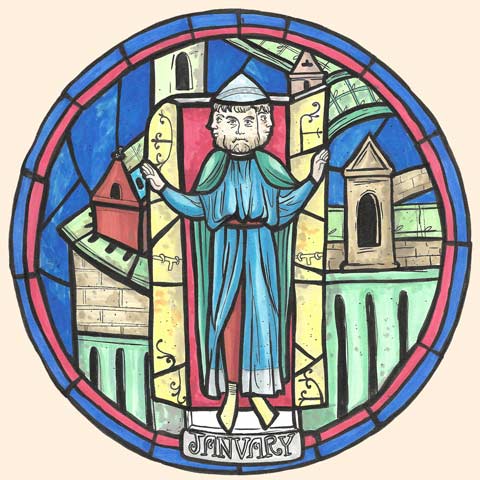
JANUARY
Body, Essence, and Personality
How can a diverse array of people share nothing in common except an irresistible urge to farm themselves? To answer this, we must establish how our psychology is structured.
The human being is made of three distinct parts, each a body in its own right. Each of us has a physical body, an essence that animates that body and a personality. When we are born, these three independent bodies come together and remain together for the duration of our lives; they separate at the moment of our death. Although forced to cohabit, each nonetheless remains distinct, with its own impulses, needs and desires. Each is sensitive to different stimuli and is subject to different constraints. As long as we navigate through life without understanding that human psychology is group psychology, we always address the needs of one body at the expense of the other two. In this way we find ourselves as a farmer with fine grains but arid soil, unable to make bread. To understand who we are, we must understand the characteristics of our physical body, essence and personality.
At first glance, the characteristics of the physical body seem obvious: one person is tall and another short; one is quick, another slow; one has darker skin, another lighter. But, along with these obvious traits we have many more subtle differences, also rooted in the physical body, that influence our psychology. We must study these in detail.
Essence is the vital force that animates our physical body. According to this teaching, this force is more than life-energy; it contains the seeds of the tendencies and talents that make us unique. One person is drawn to nature, while another excels in languages, and a third is especially sensitive to people. These, and many other such inborn differences, are traits of essence.
Personality begins forming shortly after birth, in response to the demands of life. Essence can never naturally conform to the expectations of those around us, or to the culture and times in which we were born and so we are forced to adapt and to coat essence with personality as a protective layer. This coat becomes heavier as we conform to expectations and are assimilated into society, primarily through imitation and education. This adaptation is indispensable and beneficial for our proper functioning in the world but only as long as it is kept in balance with the physical body and essence.
Such a balance, however, never happens naturally. Body, essence, and personality never develop in harmony. One always grows at the expense of the other two. Most commonly, personality grows beyond its original utility as a protective coat and gains a life of its own, becoming so thick that it arrests the development of essence. Our body continues aging, our personality continues projecting maturity, but our essence remains infantile. As a result, we appear adult while remaining inwardly timid and insecure. In many cases, essence is choked off for so long that it enters a kind of coma and no longer plays an active role in our lives. In other cases, though subdued, its suffering calls through the thick coat of personality as a faint cry of conscience. We feel imprisoned in our own artificiality. Our past is a trail of pretense; our future seems to be headed nowhere. We experience a strong impulse to do something about our condition right now, before it is too late.
This mysterious impulse can manifest from the essence of a person of any race, gender, or age. It is an emotional impulse, an urge that can remain formless for a long time. To act on it, we must give it form, and we do so by tackling the question, What do I want? Although we have three different bodies and therefore, three different wills, we are accustomed to asking this question of only the body or personality. The body wants comfort and happiness and will express its desires accordingly. Personality wants reassurance and recognition and will interpret improving our condition by its own standards. What does our essence want? What draws us to this work? Can we catch the muffled voice calling to us from under the thick layer of personality, and give it form? This is the first step of inner farming.