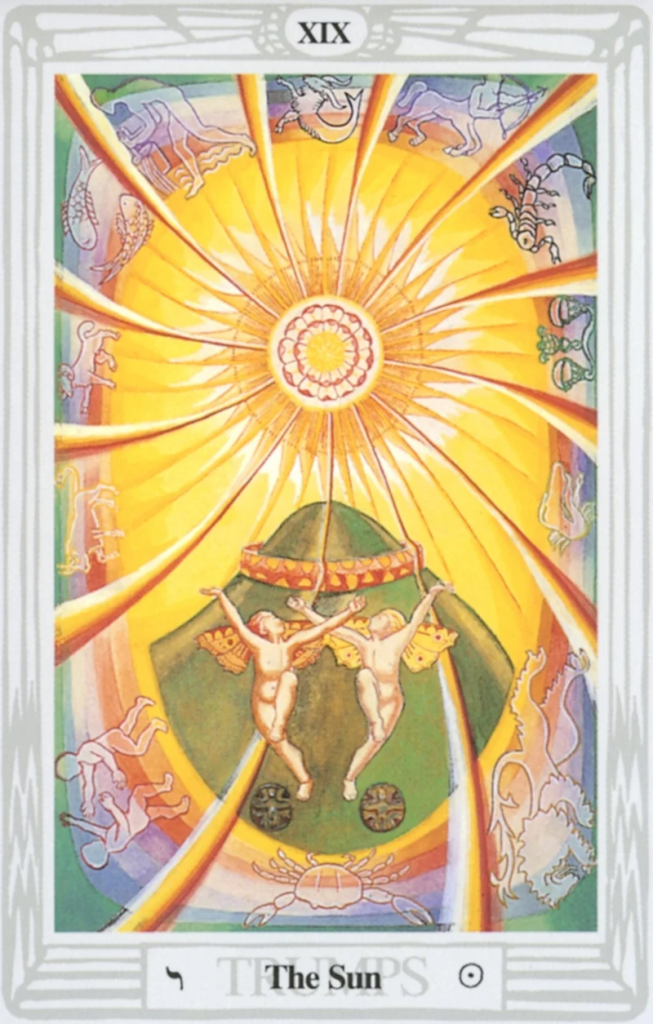
This is a warm happy energised card, which promises healing, growth and enjoyment. We have emerged from the somewhat shadowy and mysterious realms of the Moon into the bright light of day now. Gone are the tests and trials set us by the demands of our own growth. It’s time to laugh and dance and celebrate.When the Sun shines, we find new ways of resolving problems, new perspectives and fresh viewpoints. We see things more clearly, and are able to objectively consider obstacles and difficulties. We have the energy we need to throw ourselves into life, and to dynamically deal with anything that we discover.On a day ruled by this card, let yourself be lit from within… allow your own inner Sun to shine out and greet the world. No matter what other cares and worries may weigh you down, on this day try to put them aside and simply revel in the glory of being alive. Today celebrate your victories, applaud your successes, and be proud of your achievements.We can often forget to feel joyous with ourselves, becoming buried under worries and stresses. But if we can, for a moment, step back and look only toward the positive we shall find ourselves more able to deal with things.
Affirmation: “My inner Sun shines bright, surrounding me with light (That rhymes!!).”
Madman Films • Mar 1, 2023 • Streaming now on @DocPlay: https://www.docplay.com/shows/brainwa… “If the camera is predatory, then the culture is predatory.” In this eye-opening documentary, celebrated independent filmmaker #NinaMenkes explores the sexual politics of cinematic shot design. Using clips from hundreds of movies we all know and love – from Metropolis to Vertigo to Phantom Thread – Menkes convincingly makes the argument that shot design is gendered. #Brainwashed: Sex-Camera-Power illuminates the patriarchal narrative codes that hide within supposedly “classic” set-ups and camera angles, and demonstrates how women are frequently displayed as objects for the use, support, and pleasure of male subjects. Building on the essential work of Laura Mulvey and other feminist writers, Menkes shows how these not-so-subtle embedded messages affect and intersect with the twin epidemics of sexual abuse and assault, as well as employment discrimination against women, especially in the film industry. The film features interviews with an all-star cast of women and non-binary industry professionals including Julie Dash, Penelope Spheeris, Charlyne Yi, Joey Soloway, Catherine Hardwicke, Eliza Hittman, and Rosanna Arquette. The result is an electrifying call-to-action that will fundamentally change the way you see, and watch, movies.
Tom Odell • Sep 17, 2021 • Tom Odell – Heal (Official Audio)
Lyrics
Take my mind And take my pain Like an empty bottle takes the rain And heal, heal, heal, heal And take my past And take my sins Like an empty sail takes the wind And heal, heal, heal, heal And tell me some things last And tell me some things last And take a heart And take a hand Like an ocean takes the dirty sand And heal, heal, hell, heal And take my mind And take my pain Like an empty bottle takes the rain And heal, heal, heal, heal And tell me some things last And tell me some things last And tell me some things last And tell me some things last
2024’s biggest ancient DNA findings flesh out Proto-Indo-European trunk, branch and roots
JAN 18, 2025 (c/p/we-are-what-we-speak-indo-european)
Indo-European languages today and past migrations of Indo-European peoples
The ancient-DNA era for the human species is not yet 15 years old. It kicked off with the 2010 paper Paleo-Eskimo genome (followed by blockbusters on Neanderthals and Denisovans). Today, remains from tens of thousands of ancient humans offer us decipherable DNA information, each contributing to fill in gaps in our understanding of prehistory.
No matter the brilliance and insight of its practitioners and theorists, human prehistory’s age of genetic inference, when we were limited to examining modern genomes to learn about ancient peoples, was like trying to comprehend the world’s oceans solely from the activity observable in its brightly lit uppermost layers, the photic zone that reaches down at most about 200 meters. Though some key insights date to the before times, the paleogenomic era after 2010 has been absolutely revolutionary and transformative. Name a superlative, and it probably isn’t strong enough.
2024, year 14 of our ancient-DNA golden age if you’re keeping count, was no exception to the relentless pace of revolution and transformative progress in the field. From my vantage, three topics charted particularly spectacular gains this year. As we settled into 2025, I’ve shared my picks for 2024’s most exciting leaps forward in ancient DNA.
In third place, my pick was a September 2024 preprint I’m confident will prove a landmark in the field. It takes ancient DNA far beyond phylogeny, throwing open the gates to vast new landscapes of evolutionary dynamics. Humans are an expansive species that has spread across the planet, adapting to every locale, and this paper now turns our long history into one of evolution’s premier laboratories.
In second place, a blockbuster paper published in Cell’s September 2024 issue, shed important new light on our Neanderthal cousins: they were diverse, just like us. For hundreds of thousands of years, Neanderthals occupied both all of Europe and parts east, so it stands to reason that they would be at least as diverse as our species. But this new ancient DNA finding demonstrates that in some ways Neanderthal social behavior also looks startlingly foreign to our sociable clan; the remains found demonstrate that they maintained genetic and cultural separation for tens of thousands of years from even their nearest Neanderthal neighbors.
And today, my favorite findings of all, out of a couple different labs, flesh out our Indo-European phylogenetic tree with a phenomenal amount of new detail.
Some academic questions linger unresolved for centuries, subject to generations of scholarly dispute and research, only to be settled overnight, almost wholly without fanfare. One of my life-long favorites reached something of a quiet scholarly resolution in 2024, just shy of 240 years of debate and research across multiple academic disciplines. That question, or bundle of them ran roughly: was there one original Indo-European people, and if so, did they really do all this, and if they did, are we… them?
In 1780’s Calcutta, Sir William Jones was a 30-something British polymath with a particular talent for linguistics whose straitened financial circumstances had forced him to set aside full-time study of the world’s languages, take up law and accept a judicial post there. One day in January of 1786, he stood before the Asiatick Society of Bengal (which he had founded within months of arriving on the subcontinent and of which he remained president until his death) and observed that Sanskrit struck him as sharing stronger affinities with Greek and Latin than could be explained by pure coincidence. He speculated that these three ancient languages shared a common root and further mused whether they were also related to Persian and the Gothic and Celtic languages.
Jones knew what he was talking about. He had grown up speaking Welsh and English. At Harrow he so excelled at Greek and Latin that the headmaster readily admitted the boy knew more Greek than he did. A classmate recalled that Jones could eventually imitate Sophocles so dexterously, his invention seemed the authentic article. He studied French and Italian as vacation amusements. And also began Arabic and Hebrew as a teen. By the time he was at Oxford, his Latin and Greek studies were so advanced, he found little to sink his teeth into at lectures or in tutoring. So he added a couple more contemporary Romance languages: Portuguese and Spanish, dabbled in German and then really threw himself into Persian and Arabic. He acquired Persian fluency on his own (and successfully enough that his books included translations from Persian into French). But for (non-Indo-European) Arabic he hired a Syrian he found in London to come teach him the language in Oxford.
Even though his family circumstances left him unable to pursue his linguistic studies vocationally, by his 40’s Jones could speak eight ancient and living languages fluently, had studied eight more, by his reckoning “less perfectly” and counted a final 12 “least perfectly” studied. It bears noting that these final 12 in which he minimizes his accomplishments include both the Welsh of his childhood and Chinese which he knew adequately to have published original translations of two classical Chinese poems from the Book of Odes.
In his judicial post in Bengal, exasperated by local jurists handing down contradictory rulings when interpreting the same Sanskrit source text, Jones seized that professional excuse to intensively tackle Sanskrit so he could interpret the texts for himself. No surprise that in under a decade, he learned it deeply enough to produce translations of both juridical texts and literature, some of the latter attaining acclaim in Europe, delighting the likes of Goethe. It was this recently begun deep study that led him to observe at that Asiatick Society meeting that that ancient language’s affinity to Latin and ancient Greek was too strong to:
possibly have been produced by accident; so strong indeed, that no philologer could examine them all three, without believing them to have sprung from some common source, which, perhaps, no longer exists; there is a similar reason, though not quite so forcible, for supposing that both the Gothic and the Celtic, though blended with a very different idiom, had the same origin with the Sanscrit; and the old Persian might be added to the same family.
Jones was not the first to note this family resemblance. Since the 1500’s, Europeans visiting India had recorded similar observations; Thomas Stephens, an English Jesuit, wrote in 1583 that the native language of Goa, Konkani, seemed to have similarities to Greek and Latin. A couple in the 1600’s are even said to have sorted their candidate branches with more prescience than Jones. But Jones’ insight that those ancient languages sprang “from some common source which, perhaps, no longer exists” is credited with founding the study of Comparative Linguistics.
Jones had another enduringly powerful insight. He asked why. Raised speaking Welsh and English, among the Indo-European language family’s geographically westernmost exemplars (only Portuguese, Gaelic and Galician originate further west), he now found himself in Calcutta, 8,000 miles distant as the crow flies, among speakers of its very easternmost exemplar, a tongue whose uncanny familiarity even a far less prodigious linguistic talent than Jones could readily have seen.
Why, Jones asked, did these people halfway across the continent in some steamy tropical outpost speak a tongue so transparently descended from a shared root with his own? His hypothesis? The region had been conquered, subject to an “Aryan Invasion.” In this surmise, Jones was right. Indo-Aryans, whose ultimate roots go back to Yamnaya pastoralists from the grasslands east of Ukraine’s Dnieper river, did conquer northern India, leaving their stamp ever after on its languages and culture. Their cousins and descendents likewise conquered and reshaped every corner of the European continent, reaching as far as the Levant and points as far east as western China, while a closely related group swept across Iran.
Jones discerned the first outlines of a complex, copiously branching tree’s shadow. Refining the niceties of that shadow’s structure has been the work of linguists and philologists in the centuries ever since. But, Jones put his finger on another huge question for our species. Did that branching linguistic shadow faithfully reflect an actual historical and biological tree? If it did, the ghost tree would represent thousands of years of our species’ detailed demographic history. And its structure would be written not just in our grammar and our vocabulary, but in our genes. As Charles Darwin put it almost a century later:
If we possessed a perfect pedigree of mankind, a genealogical arrangement of the races of man would afford the best classification of the various languages now spoken throughout the world; and if all the extinct languages, and all intermediate and slowly changing dialects had to be included, such an arrangement would, I think, be the only possible one…this would be strictly natural, as it would connect together all languages extinct and modern, by the closest affinities, and would give the filiation and origin of each tongue.
But just a few decades ago, we still didn’t know for certain whether the demographic history written in our DNA would draw a tree that bore any resemblance to the linguistic tree’s shadow model. Though genes and languages both pass from parent to child, genetic transmission is always vertical (parent-child), while linguistic transmission can also be horizontal (peer-to-peer). Language’s inherent flexibility kept scholars debating into this century whether Indo-European languages had diffused via memes or genes. But now with a 2024 crop of blockbuster Indo-European papers and preprints, I think it’s fair to say we have answered the biggest questions Jones raised and are in the late stages of settling most of the minor outstanding ones.
We know now that our genes and our words concur. Far more than recent generations of scholars predicted. We actually kind of are what we speak. But ancient DNA has taken us further still. The tree of our demographic history is an often startlingly strong match to historical linguistics’ shadow tree. And now, 2024 has brought a surfeit of results in two high-impact papers, leaving us a stack of refinements and details with which to update our models. Importantly, we have just confirmed a crucial new detail of both our linguistic and phylogenetic trees’ early branching in Europe. We also now know when and where on the steppe the massive trunk first emerged as a fortuitous little sprout. And amazingly, researchers are even now down in the roots of that tree, identifying the exact strains of heritage that coalesced in a demographic sprout fated to send branches across most of Eurasia.
One tree prefigures another
Although linguists, historians and archaeologists have puzzled over the Indo-European languages’ origins and interrelationships for centuries, it was only in the 1990’s that the discipline of genetics could finally hope to contribute, examining the biological interrelationships of human populations. But that era’s phylogenetic trees, based on only a few dozen markers, were poorly supported compared to the robustness of the language trees linguists had by then been refining for centuries.
Until the Human Genome Project’s completion in 2000 and paleogenomics’ full emergence around 2010, genetics was just some excitable upstart asking big questions but unequipped to contribute its fair share of definitive answers. Today, with tens of thousands of DNA genotypes and sequences from ancient humans, dating from 400,000 to less than 4,000 years ago (the later date right at the doorstep of European history), the field is, if anything, overcompensating for its late start.
In the decade between 2005 and 2015, ancient DNA went from one of Leonardo’s theoretical flying machines, a glimmer in Svante Paabo’s eye, to a B-17 Flying Fortress carpet-bombing the landscape with data, results, answers and further questions. And in the decade since, scientists have been refining with ever more precision the map of relationships between extinct and modern populations, one ancient subfossil (a fossil with retrievable organic material from which one can extract DNA) at a time. Every further genome yields millions of genetic markers and contributes to the reconstruction of a vast, detailed genealogy of our past. Every new set of ancient remains on an archaeological site is now a potential node on our vast genetic tree, one individual’s pedigree stretching back into prehistory like a fan’s delicate pleats unfolding.
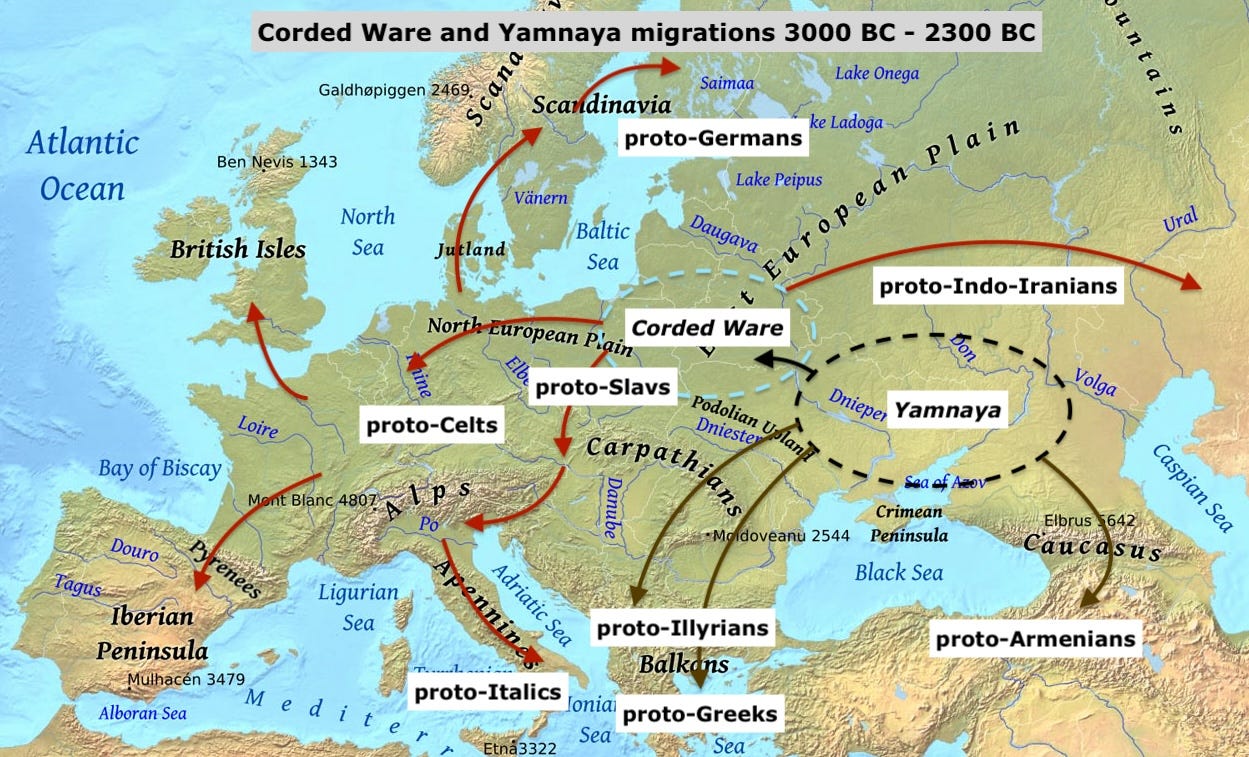
In 2015, only five years into the paleogenomic era, two research teams independently published blockbuster findings that in the period just after 3000 BC, right when scholars like archaeologist Marija Gimbutas had long argued for Indo-European languages expanding into the continent, Europe did indeed see a massive demographic turnover. But whereas Gimbutas’ intellectual heirs, like David Anthony, had theorized a mostly elite migration that would have registered at most a modest genetic impact, while wholly overhauling linguistic patterns, genetics told us that actually across much of northern Europe over half of ancestry was replaced. Today, scholars broadly agree that the Pontic steppe’s Yamnaya people, who contributed this new ancestry, both spoke proto-Indo-European, and aggressively expanded all across Eurasia beginning around 5,000 years ago, overnight shouldering aside venerable Neolithic civilizations from Britain to Central Asia. Between 3000 and 2300 BC, the Yamnaya and their descendents substantially replaced the indigenous peoples across the European continent’s width and breadth.
But those leaps forward in knowledge, helping rule out alternative models to the Indo-Europeans’ steppe origins, were only the beginning. Recent scholarship has charted a breakneck pace of new discoveries and 2024 saw particularly powerful advancements in our understanding of Yamnaya origins and their deep past. Researchers finally obtained data resolving once and for all who the precise antecedents of the proto-Indo-Europeans were. And at the same time, paleogenomicists charted new ground in a key, more recent epoch from 3000 BC, toward the precipice of European history a couple millennia later. Long an inscrutable black box of linguistic (and associated demographic) development, that era now begins to give up some of its secrets; we start to discern certain proto-Indo-European descendants’ branching trajectories of intermediate development as they progressed towards the languages we have known ever since.
Here, I will dive deep into the two groundbreaking 2024 papers (and reference a couple other worthy ones along the way) that mark some of the field’s greatest yet leaps forward. One exciting dataset has proven how, as steppe as European populations might consistently be, one unique cluster of major European populations had their own distinct way of becoming steppe, their wave of undeniable Yamnaya invaders having brought measurably distinct genetic (and linguistic) inputs at a completely different point in time than the rest of Europe’s. This elucidates essential structure in our trees we have been awaiting for decades.
But first, let’s consider two big questions Indo-European studies could barely hope to ask before 2024. Nearly 240 years ago, Jones posited proto-Indo-European, our prolific linguistic tree’s massive unitary trunk (and mused whether its subsequent spread had been propelled by an associated people’s conquests). Today we know that people were the Yamnaya of the Pontic steppe and we can ask both who they were before they were Yamnaya, and where they came from. This latest research takes us deep into the prehistoric genetic roots of a people on the precipice of overrunning much of Eurasia genetically and culturally, all while fatefully seeding the languages now natively spoken by some 46% of humanity.
The Genetic Origin of the Indo-Europeans
Exploring our roots, with a little Hittite assist
It was ancient DNA in the seminal 2015 papers that finally confirmed that the Yamnaya people, so named for the imposing pit graves beneath their kurgan burial mounds that have always announced their existence to posterity, themselves propelled the Indo-European languages’ explosive expansion. The massive genetic signal also indicated that overwhelmingly, demographic replacement was the vector for the languages’ spread. Yamnaya genes represent nearly half of Northern Europeans’ ancestry today, around 30% of Southern Europeans’, and some 10% of South Asians’.
But what came before the Yamnaya? Every people has a past, even the ones who descend on human history like a fury seemingly out of nowhere. Until recently, we hadn’t nailed down who the fateful precursors of the Yamnaya themselves were: the pre-Indo-European calm before the proto-Indo-European maelstrom. Archaeologists and paleogenomicists have been puzzling over this for the last decade, since those first 2015 results from Yamnaya burial mounds established their seminal role in Eurasia’s Indo-Europeanization. Were the Yamnaya an ancient indigenous people of the Pontic steppe, sprung from the banks of the Dnieper during the icy Pleistocene, or themselves a fateful recent synthesis of steppe and tundra peoples? Did they have connections further afield, perhaps in Anatolia or Iran?
Those first results in 2015 offered some key clues; it was immediately obvious the Yamnaya were wholly unrelated to Europe’s Mesolithic foragers or its Neolithic farmers to the west. Their connections lay to the northeast and south, far beyond Europe’s borders. The closest match for roughly half the ancestry across dozens of Yamnaya genotypes traced back to an ancient culture geneticists call Eastern hunter-gatherers (EHG), occupants of the Russian tundra and woodland at the end of the last Ice Age 11,500 years ago. The 2015 findings also demonstrated that these foragers had descended from prehistoric Siberian hunter-gatherers migrating westward out of Asia who mixed with groups of indigenous European hunter-gatherers (WHG) after crossing the Urals.
And that wasn’t the only prehistoric population detected in the Yamnaya’s ancestry mix. After the Ice Age, EHG populations in modern Ukraine and points north and east mixed with Caucasus hunter-gatherers (CHG), migrating northward from the fringe of the Near East. In the 2015 model, this CHG heritage, related to Iranian farmers further south, accounted for most but not all Yamnaya non-EHG ancestry. A 2022 paper later established minor but detectable levels of Neolithic Near Eastern farmer ancestry accumulating in the Yamnaya after the CHG inflow, perhaps only a few thousand years before their expansionary phase five millennia ago. This suggested immediate Yamnaya connections to people in all directions save for to their west, in Europe proper.
So with those preliminary findings, paleogenomics finally injected a first sense of Yamnaya genetic antecedents on a coarse Eurasia-wide scale, but still nothing to connect precisely, specifically and robustly to a culture and people from archaeology. That question had remained cloudy since Gimbutas systematized the steppe theory in the 1950’s.
Now, nearly a decade after those provisional estimates, a breakthrough 2024 preprint, The Genetic Origin of the Indo-Europeans, catapulted our understanding forward, pinpointing exact ancient populations clearly ancestral to the Yamnaya, thanks to a cache of extremely early samples with significant explanatory power. The new batch of ancient DNA from a region just east of the Yamnaya heartland, and dated only a few thousand years before the Yamnaya’s first early expansion, finally delivered perfect statistical fits for their direct antecedents. The samples’ time transect, superior quality and unprecedented volume enabled models on a scale to really outline the geographical and historical dynamics culminating in the Yamnaya as a people, both ethnoculturally and genetically.
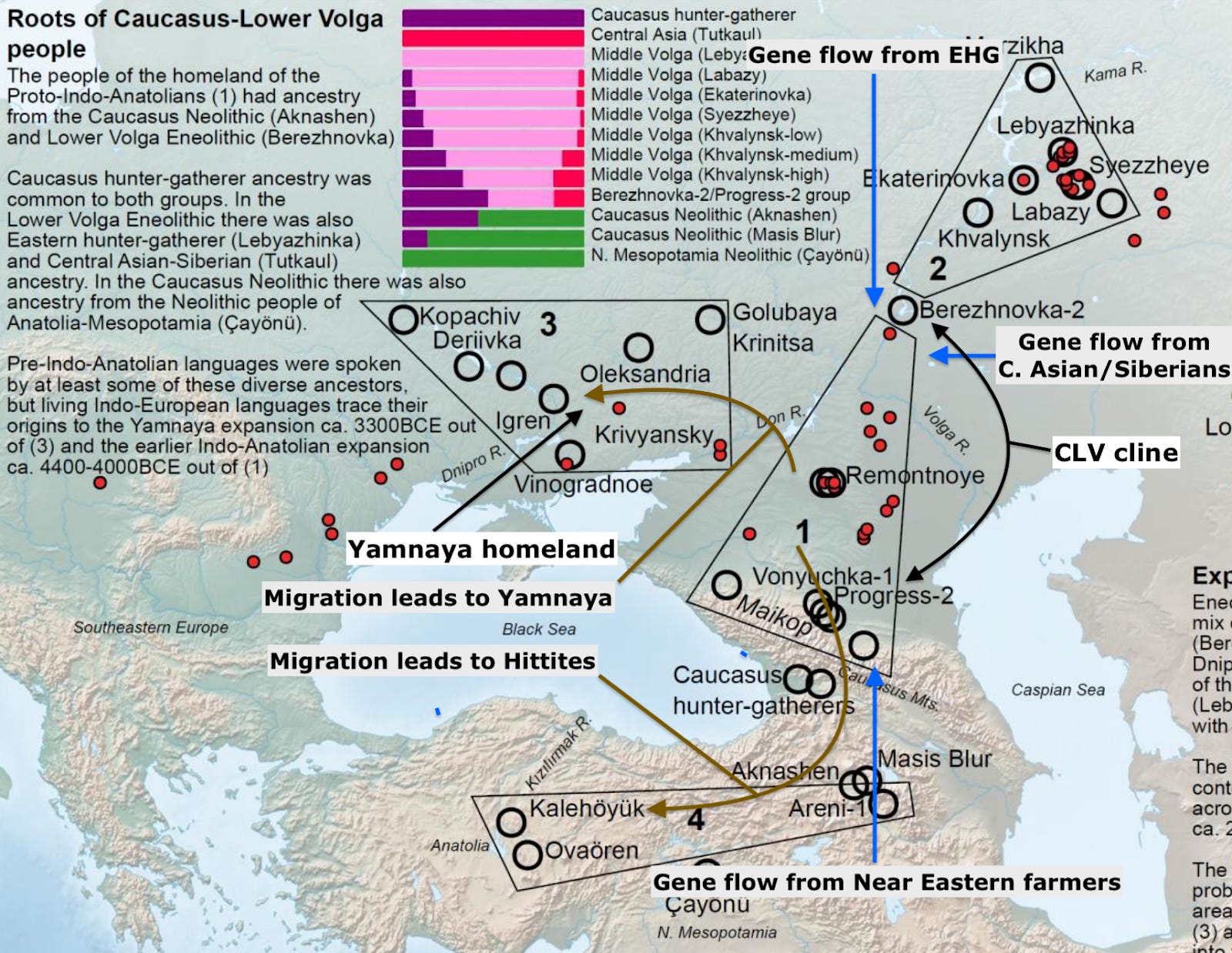
The 299 new samples, mostly dating to the fifth millennium BC, come from an expanse stretching from Russia’s lower Volga region, north of the Caspian Sea down into the northern Caucasus. The authors pooled these samples into a single population they termed the “Caucasus Lower Volga” (CLV) cline for its gradient of mixed and variable genetic ancestry. Across this zone of genetic and cultural interaction, over 6,000 years ago, local societies seem to have become a powerful vortex for gene flow sweeping in from the north (Volga headwaters), south (Caucasus mountains) and east (toward the Kazakh steppe and beyond), absorbing varying contributions from EHG, CHG, Near Eastern farmers and western Siberian foragers. This tracks with and refines those earlier genetic analyses of the Yamnaya that were limited by more primitive methods and lower-quality samples at a scale of dozens not hundreds.
But confounding widespread suspicions that the Yamnaya had entirely indigenous roots in their homeland prior to their fateful expansions, the CLV homeland on the banks of the Volga actually lies 600 miles east of that core Yamnaya zone in Ukraine’s lower Dnieper region. And crucially for our Yamnaya backstory, at some point in the centuries before 4000 BC, a single genetically distinct and homogeneous population from within that CLV zone migrated west to the lower Dnieper basin. There, they encountered indigenous Ukrainian foragers of predominant WHG origin, and assimilated them, over the next few centuries begetting another novel genetically homogeneous culture, whose ancestry ratios crystalized at around 75% CLV and 25% forager-derived WHG. So while the Yamnaya did, as expected, bear some deep Dnieper-zone roots, those were in an entirely minority ratio. The Yamnaya’s immediate origins now seem to derive from two peoples, the minority one previously identified: Neolithic-period Ukrainian hunter-gatherers local to the area. And a newly characterized intrusive eastern majority with roots in and around the southern Volga basin that had just migrated across hundreds of miles of open steppe. And finally, with these results, we have matches to ancient archeological cultures within the CLV to sort through; groups like the Volosovo, the Netted Ware, Bug-Dniester, Dnieper-Donets, Sredny Stog, Kamskaya and Khvalynsk cultures.
The Hittite mystery resolved
But what does this detailed new backstory tell us about the saga of Indo-European languages? It provides a strong clue about where proto-Indo-European’s ancestor itself came from, since Yamnaya genetic proportions skew overwhelmingly (3:1) to the CLV. This data point is already persuasive on its own, but another unforeseen ancient-DNA result within the preprint makes the case even more forcefully. While excavating those deep Yamnaya roots, the authors stumbled onto an unexpected nugget of gold: the genetic origins of the Hittites, the Late Bronze Age’s lone other international superpower alongside Pharaonic Egypt.
adjective: 1. Unreliable; unsteady; not working properly. 2. Concerned with minute details in a field; nerdy.
ETYMOLOGY:
For 1: Of uncertain origin, perhaps from dialectal wanky, alteration of wankle, from Old English wancol (unsteady).Earliest documented use: 1919. For 2: Of uncertain origin, perhaps related to the first term or the term wanky. Earliest documented use: 1978.
Before Stonewall and before the Mattachine Society, there was Henry Gerber’s Society for Human Rights.
By Sarah Prager Thursday, January 9, 2025 (lgbtqnation.com)
One hundred years ago, queerness was illegal in just about every way in the U.S. There were laws against cross-dressing and sodomy, being trans or queer was classified as a mental illness, and it was legal to discriminate on the basis of sexual orientation or gender identity. At the same time, there was a thriving underground subculture of balls, drag shows, and salons.
During the Harlem Renaissance and blues craze, queer people were open in their own circles, but organizing politically for equality was not in the collective consciousness. The community centers, groups, and newsletters that would become the foundation for the fight for equality wouldn’t come around until the 1950s.
The king’s fight against imperialism and his brutality have been used to paint homosexuality in positive or negative lights.
In Berlin, however, where there was a booming queer scene, Magnus Hirschfeld began the official movement for LGBTQ+ rights. He founded the first organization for LGBTQ+ rights in the world — the Scientific-Humanitarian Committee — in 1897 and the world-renowned Institute for Sexual Research in 1919.
A man who would follow in Hirschfeld’s historic footsteps was born in 1892 in Bavaria, and in 1913 he emigrated to Chicago, where his name became Henry Gerber at Ellis Island (sources disagree on his birth name). He would go on to found the first gay rights organization in the United States after being briefly institutionalized for homosexuality in 1917.
Gerber returned to Germany from 1920 to 1923, when he served with the U.S. Army in the wake of World War I. There, he was in contact with Hirschfeld and learned more about what gay rights advocacy could look like, including subscribing to some of the first LGBTQ+ publications. He returned to Chicago determined to start a parallel effort in the U.S.
He spent a year recruiting founding members, and on December 10, 1924, he filed with the state of Illinois for the incorporation of a nonprofit organization called the Society for Human Rights. The state granted him a charter on December 24, officially marking the first LGBTQ+ rights organization in the United States.
Sodomy remained illegal in Illinois until 1962 (when it would become the first state in the nation to repeal its antisodomy law), and Gerber and his group could not claim they were advocating for crime. As such, the stated purpose was broad: “to promote and protect the interests of people who by reasons of mental and physical abnormalities are abused and hindered in the legal pursuit of happiness which is guaranteed them by the Declaration of Independence and to combat the public prejudices against them by dissemination of factors according to modern science among intellectuals of mature age.”
Gerber began to publish the first known gay publication in the country, Friendship and Freedom, which only had two issues. Dissemination of queer content through the postal service was illegal under the anti-obscenity Comstock Act, so readers were limited. But Hirschfeld did receive a copy, as did Harry Hay, who would go on to co-found the gay rights organization the Mattachine Society in 1950. Hay said receiving that publication directly contributed to his creation of that group, which was the first openly LGBTQ+ group in the country.
There were seven founding members of the Society for Human Rights, including the group President John T. Graves, a Black clergyman. The vice-president, Al Weininger, ended up having an inadvertent hand in the organization’s swift end.
Weininger was married with two children, and one of his family members (some sources say his wife, others his daughter) reported to a social worker that he was part of a group of “degenerates” just seven months after the organization formed. Police arrested Gerber, Graves, Weininger, and others. Other than Gerber, the fate of the rest of the members has been lost to history.
Gerber was released after spending his life savings on his defense across three trials and losing his job as a U.S. postal worker. The police confiscated all of his papers, and zero copies of Friendship and Freedom exist today.
“It’s hard to imagine the courage and strength and determination of someone like Henry Gerber in 1924 determining to do a new thing in the U.S.,” teacher Rodney Wilson, the founder of LGBTQ+ History Month, told LGBTQ Nation. “He was a man ahead of his time by about half a century.”
“The fact that Gerber and the other men who founded the Society were able to get it recognized by the government, were able to exist for months, creating a space within Gerber’s home that was safe — this proved that something seemingly ‘impossible’ like gay rights in the 1920s was possible, even if it had to be done in a coded, secret way,” added Erin Bell, Operations Director of the Gerber/Hart LGBTQ+ Library & Archives in Chicago. “It took an extreme amount of courage, and there’s courage to be found in community spaces.”
Gerber/Hart is a nonprofit organization named for both Henry Gerber and Pearl M. Hart, a Chicago lawyer and advocate. The organization served as the first institutional home for LGBTQ+ History Month in the 1990s.
“At Gerber/Hart, we pay homage to Henry Gerber in more than just our name,” Bell said. “In life, he was committed to fostering community and spreading awareness of the need for gay rights and acceptance. We want to honor his advocacy work through programs and services aimed at supporting the queer community: from operating our library as a free space for members of the public to come peruse and borrow materials, to majority-free programs that are both fun and educational, to striving to bridge the access gap by making more online resources.”
While many have never heard of Gerber or the Society for Human Rights, Bell and Wilson both say awareness is increasing. A book about Gerber — An Angel in Sodom — was published in 2022. But even those who have never heard of him are connected to his legacy. He helped to inspire future leaders and assisted behind the scenes for decades, witnessing the movement blossom until his death in 1972.
The centennial celebration of the Society for Human Rights is also the centennial of the official movement for LGBTQ+ equality in the United States.
The celebration reminds us of all the group has taught: to gather in community, to help in community, to organize in community. As LGBTQ+ history is removed from curriculums as part of a broad anti-LGBTQ+ movement, organizations like Bell’s and Wilson’s continue to share our heritage outside of state-sanctioned channels.
“We are grounded in the present moment only when we understand the moments of the past,” Wilson said. “Understanding history empowers us to stand our ground and to advance the causes that others, like Henry Gerber, began advancing long ago. Historical literacy is required to be a fully functioning, empowered human being able to contribute to the conversation and move the moment forward.”
Before Stonewall and before the Mattachine Society, there was Henry Gerber’s Society for Human Rights.
By Sarah Prager Thursday, January 9, 2025
One hundred years ago, queerness was illegal in just about every way in the U.S. There were laws against cross-dressing and sodomy, being trans or queer was classified as a mental illness, and it was legal to discriminate on the basis of sexual orientation or gender identity. At the same time, there was a thriving underground subculture of balls, drag shows, and salons.
During the Harlem Renaissance and blues craze, queer people were open in their own circles, but organizing politically for equality was not in the collective consciousness. The community centers, groups, and newsletters that would become the foundation for the fight for equality wouldn’t come around until the 1950s.
The king’s fight against imperialism and his brutality have been used to paint homosexuality in positive or negative lights.
In Berlin, however, where there was a booming queer scene, Magnus Hirschfeld began the official movement for LGBTQ+ rights. He founded the first organization for LGBTQ+ rights in the world — the Scientific-Humanitarian Committee — in 1897 and the world-renowned Institute for Sexual Research in 1919.
A man who would follow in Hirschfeld’s historic footsteps was born in 1892 in Bavaria, and in 1913 he emigrated to Chicago, where his name became Henry Gerber at Ellis Island (sources disagree on his birth name). He would go on to found the first gay rights organization in the United States after being briefly institutionalized for homosexuality in 1917.
Gerber returned to Germany from 1920 to 1923, when he served with the U.S. Army in the wake of World War I. There, he was in contact with Hirschfeld and learned more about what gay rights advocacy could look like, including subscribing to some of the first LGBTQ+ publications. He returned to Chicago determined to start a parallel effort in the U.S.
He spent a year recruiting founding members, and on December 10, 1924, he filed with the state of Illinois for the incorporation of a nonprofit organization called the Society for Human Rights. The state granted him a charter on December 24, officially marking the first LGBTQ+ rights organization in the United States.
Sodomy remained illegal in Illinois until 1962 (when it would become the first state in the nation to repeal its antisodomy law), and Gerber and his group could not claim they were advocating for crime. As such, the stated purpose was broad: “to promote and protect the interests of people who by reasons of mental and physical abnormalities are abused and hindered in the legal pursuit of happiness which is guaranteed them by the Declaration of Independence and to combat the public prejudices against them by dissemination of factors according to modern science among intellectuals of mature age.”
Gerber began to publish the first known gay publication in the country, Friendship and Freedom, which only had two issues. Dissemination of queer content through the postal service was illegal under the anti-obscenity Comstock Act, so readers were limited. But Hirschfeld did receive a copy, as did Harry Hay, who would go on to co-found the gay rights organization the Mattachine Society in 1950. Hay said receiving that publication directly contributed to his creation of that group, which was the first openly LGBTQ+ group in the country.
There were seven founding members of the Society for Human Rights, including the group President John T. Graves, a Black clergyman. The vice-president, Al Weininger, ended up having an inadvertent hand in the organization’s swift end.
Weininger was married with two children, and one of his family members (some sources say his wife, others his daughter) reported to a social worker that he was part of a group of “degenerates” just seven months after the organization formed. Police arrested Gerber, Graves, Weininger, and others. Other than Gerber, the fate of the rest of the members has been lost to history.
Gerber was released after spending his life savings on his defense across three trials and losing his job as a U.S. postal worker. The police confiscated all of his papers, and zero copies of Friendship and Freedom exist today.
“It’s hard to imagine the courage and strength and determination of someone like Henry Gerber in 1924 determining to do a new thing in the U.S.,” teacher Rodney Wilson, the founder of LGBTQ+ History Month, told LGBTQ Nation. “He was a man ahead of his time by about half a century.”
“The fact that Gerber and the other men who founded the Society were able to get it recognized by the government, were able to exist for months, creating a space within Gerber’s home that was safe — this proved that something seemingly ‘impossible’ like gay rights in the 1920s was possible, even if it had to be done in a coded, secret way,” added Erin Bell, Operations Director of the Gerber/Hart LGBTQ+ Library & Archives in Chicago. “It took an extreme amount of courage, and there’s courage to be found in community spaces.”
Gerber/Hart is a nonprofit organization named for both Henry Gerber and Pearl M. Hart, a Chicago lawyer and advocate. The organization served as the first institutional home for LGBTQ+ History Month in the 1990s.
“At Gerber/Hart, we pay homage to Henry Gerber in more than just our name,” Bell said. “In life, he was committed to fostering community and spreading awareness of the need for gay rights and acceptance. We want to honor his advocacy work through programs and services aimed at supporting the queer community: from operating our library as a free space for members of the public to come peruse and borrow materials, to majority-free programs that are both fun and educational, to striving to bridge the access gap by making more online resources.”
While many have never heard of Gerber or the Society for Human Rights, Bell and Wilson both say awareness is increasing. A book about Gerber — An Angel in Sodom — was published in 2022. But even those who have never heard of him are connected to his legacy. He helped to inspire future leaders and assisted behind the scenes for decades, witnessing the movement blossom until his death in 1972.
The centennial celebration of the Society for Human Rights is also the centennial of the official movement for LGBTQ+ equality in the United States.
The celebration reminds us of all the group has taught: to gather in community, to help in community, to organize in community. As LGBTQ+ history is removed from curriculums as part of a broad anti-LGBTQ+ movement, organizations like Bell’s and Wilson’s continue to share our heritage outside of state-sanctioned channels.
“We are grounded in the present moment only when we understand the moments of the past,” Wilson said. “Understanding history empowers us to stand our ground and to advance the causes that others, like Henry Gerber, began advancing long ago. Historical literacy is required to be a fully functioning, empowered human being able to contribute to the conversation and move the moment forward.”
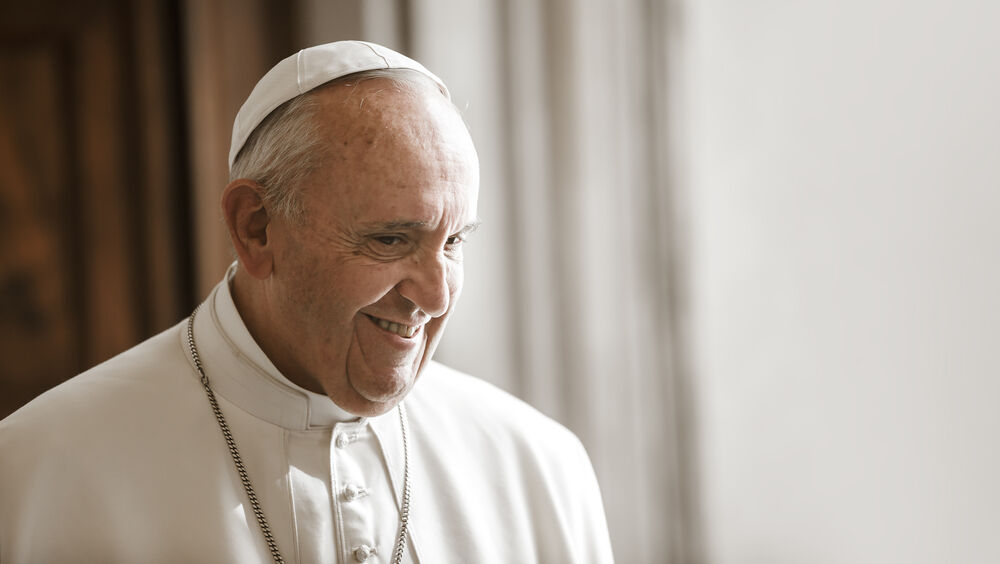
However, he did have some bad news for sexually active gay men looking to become priests.
By Greg Owen Friday, January 10, 2025 (lgbtqnation.com)
The Vatican announced new guidelines for gay men considering the priesthood on Friday, defining the most important goal for aspiring priests as “an orientation towards celibate life.”
The guidelines announced by the Italian Bishops Conference (CIE) mark a change from views previously expressed by Pope Francis that gay men serving in the priesthood risked leading a double life.
“In the formative process, when reference is made to homosexual tendencies, it is appropriate not to reduce discernment to this aspect alone,” the CIE said. “The objective of the training for priesthood in the emotional-sexual sphere is the ability [to] welcome chastity in celibacy as a gift, to freely choose and to responsibly live it.”
While the Catholic church “deeply respects the people in question,” the guidance stated, sexually active gay men will continue to be denied admittance to seminaries or any other holy orders.
“The Pope never intended to offend or express himself in homophobic terms,” the Vatican said in a statement.
Following that incident, Il Messaggeropublished a letter from a prospective seminarian who said he was denied admission because he was gay. The man, 22-year-old Lorenzo Michele Noè Caruso, described a culture of “toxic and elective clericalism” in the church. The pope reportedly responded, inviting the young man to “go forward” with his vocational research, The Guardian reported.
While the slur was a rare blemish on Francis’ progressive reign, he has been a champion of respect for the LGBTQ+ community, spreading a message of tolerance during his time as leader of the Catholic Church.
Francis famously asked, “Who am I to judge?” when asked about gay priests at the beginning of his papacy. He’s called anti-queer conservatism “a suicidal attitude,” denounced Uganda’s draconian Kill the Gays law as “unacceptable”, and hosted transwomen for lunch at the Vatican.
In 2023, Francis approved “blessings” for same-sex couples, while maintaining marriage remains an institution reserved for one man and one woman.
In 2025, the Vatican is organizing an unprecedented pilgrimage for LGBTQ+ Christians, their relatives and allies during the holy Jubilee Year. The pilgrimage, called “Church: Home for All, LGBT+ Christians and Other Existential Frontiers,” takes place in September and includes a visit to the seat of the Catholic church at St. Peter’s Basilica in Rome.
Dan McClella • Jan 19, 2025 Two years ago today I held a live online class addressing homosexuality and the Bible. While I would add some data and maybe nuance a few things a slightly different way today (my forthcoming book, The Bible Says So, will have a more up-to-date discussion), I thought I would make the main discussion publicly available (minus the Q&A & bibliography).
Choose your leaders with wisdom and forethought. To be led by a coward is to be controlled by all that the coward fears. To be led by a fool is to be led by the opportunists who control the fool. To be led by a thief is to offer up your most precious treasures to be stolen. To be led by a liar is to ask to be lied to. To be led by a tyrant is to sell yourself and those you love into slavery.
–Octavia Butler
This is viewer supported news. Please do your part today.
As Democracy Now! marks 25 years on the air, we are revisiting some of the best and most impactful moments from the program’s history, including one of the last television interviews given by the visionary Black science-fiction writer Octavia Butler. She spoke to Democracy Now! in November 2005, just three months before she died on February 24, 2006, at age 58. Butler was the first Black woman to win Hugo and Nebula awards for science-fiction writing and the first science-fiction writer to receive a MacArthur “genius” fellowship. Her best-known books include the classics “Kindred,” as well as “Parable of the Sower” and “Parable of the Talents” — two-thirds of a trilogy that was never finished. Her work inspired a new generation of Black science-fiction writers, and she has been called “the Mother of Afrofuturism.” Her 2005 interview with Democracy Now! took place shortly after Hurricane Katrina devastated New Orleans and as President George W. Bush was overseeing the U.S. wars in Iraq and Afghanistan. When asked how she set out to become a science-fiction writer when there were so few examples of Black women working in the genre, Butler said she never doubted her abilities. “I assumed that I could do it,” she said. “I wasn’t being brave or even thoughtful. I wanted it. And I assumed I could have it.”
Transcript
This is a rush transcript. Copy may not be in its final form.
AMY GOODMAN: This is Democracy Now! The Quarantine Report. I’m Amy Goodman.
To mark Black History Month once again, as well as the 25th anniversary of Democracy Now!, we turn now to one of the last television interviews given by the visionary Black science-fiction writer Octavia Butler. In November 2005, she came into Democracy Now!’s old firehouse studio. Just three months later, Butler died, on February 24th, 2006, after she fell outside her home outside of Seattle, Washington. She was 58 years old.
Butler was the first Black woman to win the Hugo and Nebula awards for science-fiction writing. She was also the first science-fiction writer to receive a MacArthur “genius” fellowship. Butler’s best-known books include the classics Kindred, as well as Parable of the Sower and Parable of the Talents — two-thirds of a trilogy that was never finished. Published in 1993, Parable of the Sower is set in the 2020s in California — that’s right, the 2020s, now, in California — amidst a global climate and economic crisis. Octavia Butler described them as cautionary tales.
OCTAVIA BUTLER: They were what I call cautionary tales: If we keep misbehaving ourselves, ignoring what we’ve been ignoring, doing what we’ve been doing to the environment, for instance, here’s what we’re liable to wind up with.
AMY GOODMAN: In her books, Octavia Butler also wrote about slavery, about fascism, about religious fundamentalism and so much more. Her work inspired a new generation of Black science-fiction writers. She’s been called “the Mother of Afrofuturism.” And Octavia Butler’s audience has continued to grow. In September, she made The New York Times best-seller list for the first time — 50 years after she began writing and nearly 15 years after her death.
Democracy Now!’s Juan González and I interviewed Octavia Butler in November of 2005. It was shortly after Hurricane Katrina devastated New Orleans. President George W. Bush, the former governor of Texas, was in the White House overseeing the U.S. wars in Iraq and Afghanistan. Part of this interview aired live, but some of it has never been broadcast before.
JUAN GONZÁLEZ: How did you first start writing science fiction? You grew up in Pasadena?
OCTAVIA BUTLER: Mm-hmm.
JUAN GONZÁLEZ: And how did you first become attracted to that type of writing?
OCTAVIA BUTLER: Oh, I think I loved it because — well, I fell into writing it because I saw a bad movie, a movie called Devil Girl from Mars, and went into competition with it. But I think I stayed with it because it was so wide open. It gave me the chance to comment on every aspect of humanity. People tend to think of science fiction as, oh, Star Wars or Star Trek. And the truth is, there are no closed doors, and there are no required formulas. You can go anywhere with it.
AMY GOODMAN: We’re talking to Octavia Butler. Her latest book is Fledgling, wrote the Parable series. As Katrina was happening, in the aftermath of Katrina, a lot of people were talking about Octavia Butler and how the Parable series made them think about that. Explain.
OCTAVIA BUTLER: I wrote the two Parable books back in the ’90s. And they are books about, as I said, what happens because we don’t trouble to correct some of the problems that we’re brewing for ourselves right now. Global warming is one of those problems. And I was aware of it back in the ’80s. I was reading books about it. And a lot of people were seeing it as politics, as something very iffy, as something they could ignore because nothing was going to come of it tomorrow.
That and the fact that I think I was paying a lot of attention to education because a lot of my friends were teachers, and the politics of education was getting scarier, it seemed to me. We were getting to that point where we were thinking more about the building of prisons than of schools and libraries. And I remember while I was working on the novels, my hometown, Pasadena, had a bond issue that they passed to aid libraries, and I was so happy that it passed, because so often these things don’t. And they had closed a lot of branch libraries and were able to reopen them. So, not everybody was going in the wrong direction, but a lot of the country still was. And what I wanted to write was a novel of someone who was coming up with solutions of a sort.
My main character’s solution is — well, grows from another religion that she comes up with. Religion is everywhere. There are no human societies without it, whether they acknowledge it as a religion or not. So I thought religion might be an answer, as well as, in some cases, a problem. And in, for instance, Parable of the Sower and Parable of the Talents, it’s both. So I have people who are bringing America to a kind of fascism, because their religion is the only one they’re willing to tolerate. On the other hand, I have people who are saying, “Well, here is another religion, and here are some verses that can help us think in a different way, and here is a destination that isn’t something that we have to wait for after we die.”
AMY GOODMAN: Octavia Butler, could you read a little from Parable of the Talents.
OCTAVIA BUTLER: I’m going to read a verse or two. And keep in mind these were written early in the ’90s. But I think they apply forever, actually. This first one, I have a character in the books who is, well, someone who is taking the country fascist and who manages to get elected president and who, oddly enough, comes from Texas. And here is one of the things that my character is inspired to write about this sort of situation. She says:
Choose your leaders with wisdom and forethought. To be led by a coward is to be controlled by all that the coward fears. To be led by a fool is to be led by the opportunists who control the fool. To be led by a thief is to offer up your most precious treasures to be stolen. To be led by a liar is to ask to be lied to. To be led by a tyrant is to sell yourself and those you love into slavery.
And there’s one other that I thought I should read, because I see it happening so much. I got the idea for it when I heard someone answer a political question with a political slogan. And he didn’t seem to realize that he was quoting somebody. He seemed to have thought that he had a creative thought there. And I wrote this verse:
Beware: All too often, We say What we hear others say. We think What we’re told that we think. We see What we’re permitted to see. Worse! We see what we’re told that we see. Repetition and pride are the keys to this. To hear and to see Even an obvious lie Again And again and again May be to say it, Almost by reflex And then to defend it Because we’ve said it And at last to embrace it Because we’ve defended it And because we cannot admit That we’ve embraced and defended An obvious lie. Thus, without thought, Without intent, We make Mere echoes Of ourselves — And we say What we hear other say.
Just one more comment on the human condition, I guess.
AMY GOODMAN: Octavia Butler, a lot of the themes of your books are about being an outsider. Talk about that. And talk about what it means to be — I mean, here you are a science-fiction writer. It is rare, the way you weave in issues of race, issues of power, religion. I mean, it’s rare to be a Black woman science-fiction writer.
OCTAVIA BUTLER: That’s true. When I was getting started, there was one other man, Samuel R. Delany. And he was one of my teachers. And we were having a panel discussion at a library one day, and somebody asked, “Well, how many of you are there?” And we looked at each other? And we said, “We’re two-thirds.” There was one other man up in Canada who was writing, who has since gone a different direction. So, things are better now. But there was a time when there was almost nobody.
AMY GOODMAN: Why do you think that is?
OCTAVIA BUTLER: I think part of it is just because people do what they see other people doing. I had a student come up to me at Michigan State University — and this was a young Black woman — many years ago and say, “You know, I always loved science fiction. I’ve always wanted to write it. But I didn’t think we did that.” And she was afraid that if she got into it, there would be closed doors. And life is short. So, sometimes people don’t want to take the risk of running into closed doors. My friend said to me, “You’re doing all this, and we thought you were so brave. And after a while, we decided that you just didn’t have any sense.” So, I have never really wanted to do anything else.
JUAN GONZÁLEZ: When you tour around — and, obviously, the people who come to the readings are the fans who regularly follow you — what is your sense of your readers, in terms of what they’re most attracted to in your writing?
OCTAVIA BUTLER: I’ve always had at least three groups, identifiable groups, of readers. And I remember trying to convince my publishers of this early on and having no success, until I went with a smaller publisher. But the groups — and they used to have their own independent bookstores. There are still a few independents left. But they were science fiction, Black and feminist. And they still are. And, of course, now some mainstream. So, I’m always glad that there are more readers, that people find out about me. People keep telling me, “Oh, I would have read you before, but I’ve never heard of you.”
AMY GOODMAN: What about the power of fundamentalist religion?
OCTAVIA BUTLER: Oh, I was raised in a fundamentalist church. I was raised Baptist. One of my grandfathers was a Baptist preacher. And I’m actually grateful for one thing specifically: had that conscience installed early. And it’s a monster of a conscience. I can’t really get away with things. I’m not worried about being caught by other people. My own conscience is going to get me.
It’s when people begin using their religion as just a way of getting power over other people that scares me. And I’m afraid that’s what’s going on in a lot of cases right now. I mean, when people deliberately tell lies — creationism, for instance — and pretend, oh, it’s not really religion, I mean, they know they’re lying. And yet they’re the religious people. Something wrong there. When people use their religion to hurt other people, to say, “Oh, well, no, you have to embrace this means of sex education and not that one, because our religion says so,” it’s a misuse. But I guess religion is such a powerful thing, it’s bound to be misused.
AMY GOODMAN: As we wrap up this interview, for young people, as you said, that you think perhaps there are few Black women science-fiction writers because they haven’t seen them before.
OCTAVIA BUTLER: Well, there are more now. The anecdote I told you was several years ago.
AMY GOODMAN: But when you were a kid —
OCTAVIA BUTLER: Mm-hmm.
AMY GOODMAN: — there —
OCTAVIA BUTLER: There were none.
AMY GOODMAN: So, how did you go into it?
OCTAVIA BUTLER: With my eyes tightly shut. I assumed that I could do it. I wasn’t being brave or even thoughtful. I wanted it. And I assumed I could have it.
AMY GOODMAN: So, what advice do you have for young people today?
OCTAVIA BUTLER: Who want to write? Oh, definitely, that they should. It’s difficult and sometimes impossible. I mean, here I am coming off a very long writer’s block, so I can acknowledge the difficulty.
AMY GOODMAN: How long?
OCTAVIA BUTLER: Seven years. It didn’t mean that I wasn’t writing. Writer’s block is not when I’m not writing. It’s when I’m not writing anything worthwhile.
AMY GOODMAN: And for people who suffer from writer’s block, your advice?
OCTAVIA BUTLER: Keep writing. Keep writing. It’s the old idea that behavior that gets rewarded tends to get repeated. If you stop writing, then you’re kind of rewarding yourself with not writing. If you keep writing, after a while your brain maybe gets the idea. I’m not sure I said that very clearly, but I hope you know what I mean. Just that if you are a writer, you can’t stop writing. I used to have a teacher who said, “If anything can prevent you being a writer, don’t be one.”
AMY GOODMAN: The visionary feminist Black science-fiction writer Octavia Butler, speaking on Democracy Now! in November 2005 in one of her final television interviews. She died on February 24th, 2006 — 15 years ago this week — after a fall outside her home outside Seattle, Washington.
Consciousness, spirituality, biography, sexuality, androgyny, futurism, space, the arts, science, astrology, democracy, humor, books, movies and more