How to Live a Miraculous Life: Brian Doyle on Love, Humility, and the Quiet Grace of the Possible

By Maria Popova (themarginalian.org)

Suppose we agree that we are here to love anyway — to love even though the work is almost unbearably difficult, even though we know that everything alive is dying, that everything beautiful is perishable, that everything we love will eventually be taken from us by one form of entropy or another, culminating with life itself. Suppose we agree that, as Rilke so passionately insisted, “for one human being to love another… is perhaps the most difficult of all our tasks, the ultimate, the last test and proof, the work for which all other work is but preparation.”

This, then, is the agreement: Learning to live is learning to love, and learning to love is learning to die — the imperative in the inevitable that renders our transience meaningful and holy. The price of this holiness is absolute humility: There is no pact to be made with the universe — we die, whether or not we agree to it, whether or not we have learned how to love in the bright interlude between atom and dust. We may or may not be lucky enough to live out the two billion heartbeats our creaturely inheritance has allotted us. But no matter how many we actually get, it matters how we spend them and what we spend them on. It may be the only thing that matters.

Art from An Almanac of Birds: Divinations for Uncertain Days. (Available as a print and as stationery cards, benefitting the Audubon Society.)

Not long before his untimely death by an aggressive brain tumor, Brian Doyle — who described himself as “a muddle and a conundrum shuffling slowly along the road, gaping in wonder, trying to just see and say what is” — took up these immense and eternal questions in what became his posthumous essay collection One Long River of Song: Notes on Wonder (public library).

Because the harshest realities of our own lives are often easiest to see and easiest to bear lensed through the lives of other creatures cushioned in symbol and metaphor — this is why we have fables and fairy tales — Doyle finds himself reckoning with mortality and the meaning of life as he examines the dead body of a Townsend’s mole (Scapanus townsendii) in his garden. Curious about the animal, he turns to the scientific literature and is suddenly disquieted by reading about the species as a lump-sum of data points. Overcome with tenderness for “this particular individual, and the flavor and tenor and yearning of this one life,” he writes:

This tribe of mole is thought to be largely solitary, I read, and I want to laugh and weep, as we are all largely solitary, and spend whole lifetimes digging tunnels toward each other, do we not? And sometimes we connect, thrilled and confused, sure and unsure at once, for a time, before the family cavern empties, or one among us does not come home at all, and faintly far away we hear the sound of the shovel.

Art by Charlie Mackesy from The Boy, the Mole, the Fox and the Horse — a tender illustrated fable about what it means to love

Over and over, through the different winding paths of the different essays, Doyle returns to his animating ethos that “love is our greatest and hardest work” — nowhere more poignantly articulated than in an essay about the people seen leaping out of the Twin Towers hand in hand, their hands “nestled in each other with such extraordinary ordinary succinct ancient naked stunning perfect simple ferocious love.” He reflects on this harrowing and holy emblem of our deepest humanity:

Their hands reaching and joining are the most powerful prayer I can imagine, the most eloquent, the most graceful. It is everything that we are capable of against horror and loss and death. It is what makes me believe… that human beings have greatness and holiness within them like seeds that open only under great fires, to believe that some unimaginable essence of who we are persists past the dissolution of what we were, to believe against such evil hourly evidence that love is why we are here.

The trick, of course, is learning how to be here — how to remain fully present and filled with that ferocious love — knowing we will one day be gone, knowing it might be tomorrow. In what may be the most soulful and sensible advice on how to live an actualized life since Whitman’s, Doyle offers an anchor to that holy here:

You do your absolute best to find and hone and wield your divine gifts against the dark. You do your best to reach out tenderly to touch and elevate as many people as you can reach. You bring your naked love and defiant courage and salty grace to bear as much as you can, with all the attentiveness and humor you can muster. This life is after all a miracle and we ought to pay fierce attention every moment, as much as possible.

Paradoxically, this active and conscious effort is a heart that can only beat in the chest of surrender. Doyle adds the ultimate disclaimer:

You cannot control anything. You cannot order or command everything. You cannot fix and repair everything. You cannot protect your children from pain and loss and tragedy and illness. You cannot be sure that you will always be married, let alone happily married. You cannot be sure you will always be employed, or healthy, or relatively sane. All you can do is face the world with quiet grace and hope you make a sliver of difference.

At the center of this recognition is that most difficult triumph of unselfing for us creatures of self-importance: humility. In Doyle’s definition, humility is not a lowering down to the ground, as the word’s Latin root (humus) suggests, but a rising up and a reaching toward something we can never quite touch yet must trust is there. Some call this faith — faith that the world holds together, that our tiny and transient lives are nonetheless an essential part of the whole, that the choices we make within them change the shape of the whole, that love is the mightiest choice we could ever make and the highest form of faith.

Doyle writes:

Humility does not mean self-abnegation, lassitude, detachment; it’s more a calm recognition that you must trust in that which does not make sense, that which is unreasonable, illogical, silly, ridiculous, crazy by the measure of most of our culture. You must trust that you being the best possible you matters somehow… That doing your chosen work with creativity and diligence will shiver people far beyond your ken. That being an attentive and generous friend and citizen will prevent a thread or two of the social fabric from unraveling.

[…]

This is what I know: that the small is huge, that the tiny is vast, that pain is part and parcel of the gift of joy, and that this is love, and then there is everything else. You either walk toward love or away from it with every breath you draw. Humility is the road to love. Humility, maybe, is love.

Complement with Seamus Heaney’s kindred advice on life and W.H. Auden’s kindred poem “The More Loving One,” then revisit Christian Wiman on love and the sacred and Oliver Sacks on finding meaning without religious faith

Delight Between Science and Magic: Euler’s Disk and the Sound of the Singularity

One afternoon in the late 1980s, sitting in the company cafeteria, aerospace engineer Joseph Bendik found himself so bored that he took a coin out of his pocket and began spinning it atop the table. In a testament to the eternal paradox of boredom and wonder as two sides of the same coin — the currency of life that is attention — he was suddenly wonder-smitten by the exquisite elegance of the physics making the coin seem to levitate, spinning faster and faster rather than slower and slower before shuddering to a stop.

Here was a demonstration of laws undergirding everything from the motions of planets to the photosynthesis of plants — the conservation of angular momentum and the conservation of energy — a demonstration made not in equations but in sheer delight.

Bendik realized that if he toyed with a few variables — the smoothness of the surface, the mass of the spinning disk, the width of its edge — he could magnify the delight and make the science border on magic. And so he turned the mathematics — that most splendid plaything of the mind — into a toy: a heavy disk spinning into near-infinity atop a mirror surface.

He named it Euler’s Disk for Leonhard Euler, who had died two centuries earlier to be remembered by many as the greatest mathematician to ever live.

Along with a copy of The Universe in Verse and a baby lemon tree planted from a seed, Euler’s Disk may be my favorite gift to give, and the one most certain to bring unalloyed delight. Here is a gleeful demonstration of it by my former partner turned best friend upon receiving it:

This is how it works: Holding the disk upright on the mirror, you give it a hard manual spin that adds kinetic energy to its potential energy. Once in motion, the disk relies on its angular momentum to try to remain upright as gravity pulls it downward and the mirrored base exerts an upward counterforce. These opposing tugs make it spin faster and faster, appearing to levitate, its sound whirring at a higher and higher frequency as the disk’s points of contact with the mirror make a circle oscillating with a constant angular velocity.

If there were no friction, this motion would continue forever — the product of a power law modeling what is known as finite-time singularity. But the mirror, smooth though it is, still provides some friction. Coupled with resistance from the air — the same air drag central to the physics of how birds fly — it eventually causes the whirring disk to sigh to a sudden stop: the sound of the singularity.

Couple with the story of how Emmy Noether illuminated the conservation of energy (a story crowned with an Edna St. Vincent Millay poem), then revisit the poetic science of how cicadas sing — the sound of a living singularity.

There’s a Ghost in the Garden: A Subtle and Soulful Illustrated Fable about Memory and Mystery

One of the things no one tells us as we grow up is that we will be living in a world rife with ghosts — all of our disappointed hopes and our outgrown dreams, all the abandoned novels and unproven theorems, all the people we used to love, all the people we used to be. A ghost is a palpable presence of an absence charged with feeling, the contour of something half-known, half-remembered, half-forgotten — a halfway house between what we understand and what we cannot, between what we have let go and what we cannot.

Children are especially prone to perceiving ghosts because childhood itself is such a halfway house between imagination and reality, because what they know is so small against the vastness of what there is yet to know and what may never be known that they invent their own answers to the immense open question of life, answers wild and wondrous and often true.

Writer Kyo Maclear and artist Katty Maurey conjure up this primal reckoning with the unknowns of love and loss in There’s a Ghost in the Garden (public library) — the subtle and soulful story of a little boy who believes a ghost haunts his grandfather’s garden.

In the course of trying to discern the source and nature of the ghostly presence — a ghost mischievous but friendly, knocking down flower pots, leaving “little presents” in the bird nest and tracks on the path that “was once a cool, dark stream” — the boy discovers that his grandfather also had a childhood, that inside the old man lives the ghost of a long-ago boy who also had fantasies and fears, who also used to play in the flickering sunlight, who once swam in the stream that is now a dry path.

As the two converse, shadows flit across the gloaming garden — a hare, a fox, a deer, a bird — never fully revealing themselves, there and then gone, as the stars, clear and constant, rise in the night.

There is no grandmother in the picture — only a young boy and an old man talking about ghosts, about what is remembered, about the seen and the unseen.

What emerges from the story is the intimation that forgetting — those who have left us, and the parts of ourselves we have left behind — is a kind of death, but we can come back from it through memory and love, which twine the lifeline tethering us to everything that is beautiful and enduring.

Complement There’s a Ghost in the Garden with a different lens on the garden and the spirit and a different lens on the living ghost in each of us — the mystery of what makes you and your childhood self the same person, despite a lifetime of physical and psychological change.

Life Lessons of an 81-Year-Old Men’s Mental Health Maverick 

 November 30, 2024 (MenAlive.com)

By  Jed Diamond

Photo by: Jordan Whitt / Unsplash.com

Part 3

Understanding Adverse Childhood Experiences (ACES)

            You can read:

            For most of my early adult life if you’d asked me about my early life experiences following my father’s hospitalization or the year I dutifully went with my uncle to visit my father, I would have said I didn’t remember much or made a vague reference to those early years. Even when I remembered some of the events that were painful at the time, I dismissed their significance and impact on my life.

            That’s just how things are, I thought to myself. No big deal. Stuff happens. Get over it. Forget about it. Don’t complain. Grow up. Be a man.

Most of us block out painful and traumatic memories from our childhood. We don’t want to remember times when we felt vulnerable and confused. We want to feel strong and in control of our lives. However, these old wounds don’t go away. They often come back to us in the form of bad dreams or childhood illnesses. I had a recurring dream from the time I was six years old (the age when I stopped visiting my father in the mental hospital) until I was nine or ten years old:

            I’m in my bed at night and something wakes me up. I get out of my bed and walk into the kitchen. There is no one there. I continue walking through the house afraid of what I might find but compelled to keep looking. Suddenly a dark figure lurches out of the darkness with a knife in hand. I begin running back to my bed. I know if I can get back before he catches me, I will be safe. But I don’t make it in time and I am stabbed in the back.

            The dream would recur without warning, every three or four nights. I always ran for my life, but never make it back before I am stabbed. I became afraid to go to sleep at night and would spend hours trying to create a safe place among my covers where I would be safe. I would try and stay awake as long as I could, but eventually I would fall asleep and the life-like dream would capture me again and again.

            I eventually told my mother about the dreams. She listened but dismissed the dreams as simply unwarranted fears of childhood, like being afraid there were monsters hiding under my bed. She tried to reassure me by telling me there was nothing to worry about. I didn’t stop worrying. I just stopped talking about my feelings. During that same period I developed asthma, a chronic lung disease that causes inflammation in the airways, making it difficult to breathe.  

            It was only later in life that I learned about the ACE studies and how Adverse Childhood Experiences (ACES) impact our lives. The ACE studies began as a collaboration between the CDC and Kaiser hospital in 1998 and more than ninety research papers have been published since then.

The ACE studies found that adverse childhood experiences—including such common events as growing up in a family where parents were divorced, had alcohol or drug problems, or suffering from mental illness—harm children’s developing brains. The studies found that disrupted brain function leads to changes in how we respond to stress and damages our immune systems so profoundly that the effects show up decades later.

I learned that ACEs cause much of our burden of chronic disease, most mental illness, addictions, and are at the root of most violence. The original research listed ten possible adverse childhood experiences or ACEs. I had four. Having four aces is good if you are playing poker, but not so good for our health and wellbeing.

Even though there has been greater understanding of the impact of ACEs on our lives, many doctors and even mental health experts are not fully aware of the connection between adult problems and childhood trauma. In my article, “7 Surprising Reasons You Should See a Trauma Informed Counselor,” I said,

“Most people in the U.S. have at least one ACE, and people with four ACEs have a significant risk of developing health and relationship problems as adults. These include heart disease, cancer, diabetes, lung problems, depression, divorce, suicide, addictions, and relationship problems.  I’ve had chronic lung problems, bouts of depression, divorced twice, was suicidal at a number of stages of my life, and had numerous addictions.”

I went on to say,

“When I reached out for help, most health practitioners saw me through the lens of the mainstream medical model and tried to figure out what was wrong with me, what diagnosis I should have, and what kind of medications I should take. I did receive some help over the years with this approach, but the benefits were limited.”

Life Lesson #5: Rather than asking “what’s wrong with us?” a more helpful question is “what happened to us?”

In their book, What Happened to You? Conversations on Trauma, Resilience, and Healing, child psychiatrist and neuroscientist, Bruce C. Perry, M.D., PhD and Oprah Winfrey say,

“Healing must begin with a shift to asking ‘What happened to you?’ rather than ‘What’s wrong with you?’ Many of us experience adversity that has a lasting impact on our physical and emotional health. What happens to us in childhood is a powerful predictor of our risk for health problems down the road.”

In my article, “The Myth of Mental Illness and the Truth About Mental Health:  A Man’s Journey to Freedom,” I describe my describe my own healing journey, the original ACE questions, and an expanded understanding of trauma and healing.

What adverse childhood experiences did you experience in your life?  What adult problems have you experienced with your own physical, mental, emotional, and relational life as a result of those early experiences?

Life Lesson #6: Understanding what happened to us is the first step in healing. The second step is understanding the limiting beliefs about ourselves and our world.

My life changed dramatically when I stopped trying to deny and escape from the reality of my childhood wounding and how it impacted my mental, emotional, and relational life. It changed even more dramatically when I realized the beliefs I had about myself and my world because of my early trauma.

In their book, Code to Joy: The Four-Step Solution to Unlocking Your Natural State of Happiness, George Pratt, PhD, Peter Lambrou, PhD with John David Mann, say,

“Beliefs are stronger than feeling and  deeper than thoughts. Beliefs are patterns of thought so ingrained in our neural networks they have become automatic, like entrenched habits of thinking. They are the bedrock of our psychological architecture.”

Drs. Pratt and Lambrou have found seven common self-limiting beliefs that are connected to our early traumatic experiences:

  1. I am not safe.
  2. I am worthless.
  3. I am powerless.
  4. I am unlovable.
  5. I cannot trust anyone.
  6. I am bad.
  7. I am alone.

I realized that a number of these beliefs became embedded into my body, mind, and soul and were like automatic programs operating outside my awareness yet colored all my relationships. Deep down I believed, I am not safe. Something could happen to me at any time. The world is a dangerous place. I cannot trust anyone. I never know when someone I love is going to leave me. If I do the wrong thing, they might die or be taken away. Ultimately, I am all alone. There’s no one I can rely on but myself. Its better to stay guarded and closed than to risk loving someone who will leave me.

Fortunately, as I have learned over the years, all these beliefs can be reversed. We can learn that we are safe and secure, worthy and valuable and have the power to be the loveable selves  ourselves we all are deep inside. We can trust others because they are good and we are good. And we’re never alone but connected in a web of wellbeing now and forever.

If you would like to read more in this series and other articles about improving your mental, emotional, and relational health, I invite you to subscribe to my free weekly newsletter.

Author Image

Best Wishes,

Jed Diamond


Founder and VHS (Visionary Healer Scholar) of MenAlive

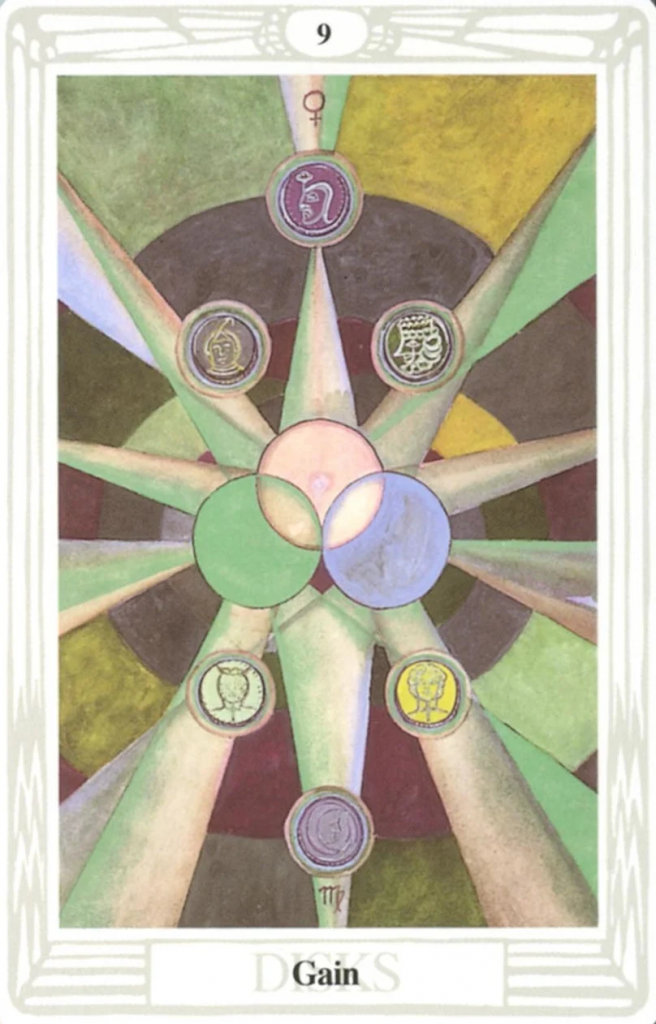
Tarot Card for December 2: The Nine of Disks

The Nine of Disks

That phrase ‘what goes around comes around’ is very relevant to this card. The Lord of Gain is a card that indicates that we have set in motion some plan or project, and we are now reaching a point of completion with it.So on the day ruled by the Nine of Disks, we need to be open to opportunities which allow us to conclude work that has been outstanding; remain alert to new chances opening up before us; and ready to seize the moment when it appears.This card accords with the ancient wisdom that we give what we get in life – so this is also a day to look for opportunities to offer our help and resources with no immediate expectation of return.Take up chances to serve – whether in a mundane fashion, or to a higher source, in the sure knowledge that the things you give with love are the ones which build a bright new world.It is the help we give to others with a happy heart, the sympathy we offer without judgement, the gentleness with which we treat ourselves and others that will change things.When we do this, we set in motion a stream of positive, caring energy, which will travel around the world and return to us – vastly changed, and yet almost the same. What we gave to somebody else with no thought of reward or gain, is what we truly gain when it comes our way again.

Affirmation: “I open myself to life’s bounty with gratitude”

Morning Meditation with Marianne Williamson

Westend61

Today I bear witness to the agony of the world, praying to be used as a healing force

Let me not forget today the needless suffering of so many. I do not dwell on the suffering, but I bear witness with a compassionate heart.

May I not be tempted today to attend to my own pain while minimizing the suffering of others. May I not be swayed today by the insidiousness of selfish thought. Placing myself in service to the healing of the world, I gain greater perspective and a more powerful consciousness.

Dear God,
Today I remember those whom the world has forgotten:
Those who are tortured,
Those who are oppressed,
Those who are hopeless and feel no love around them.
May the love I send to them
Help work miracles in their lives.
Amen.

Today I bear witness to the agony of the world, praying to be used as a healing force

To receive a morning meditation each day, please upgrade to a paid subscription

Sage Against the Machine is how L.A.’s native plant nerds release their rage

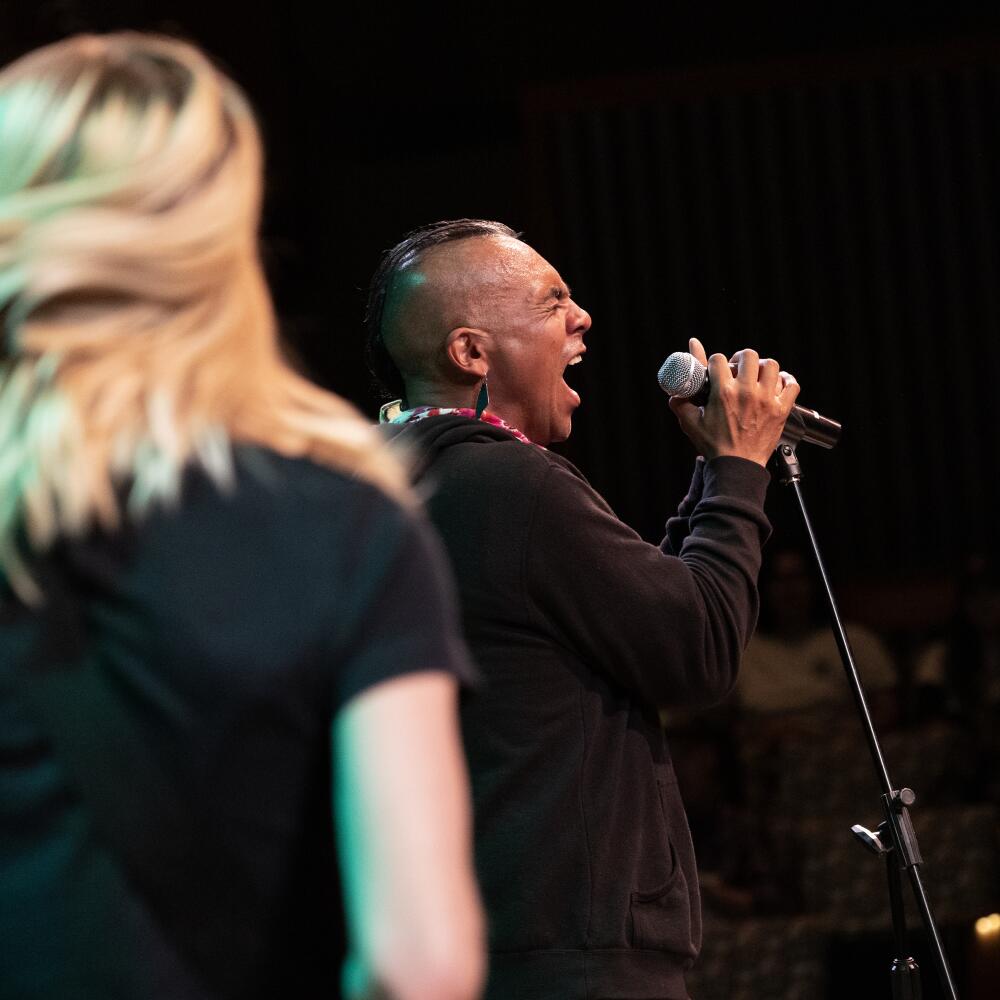
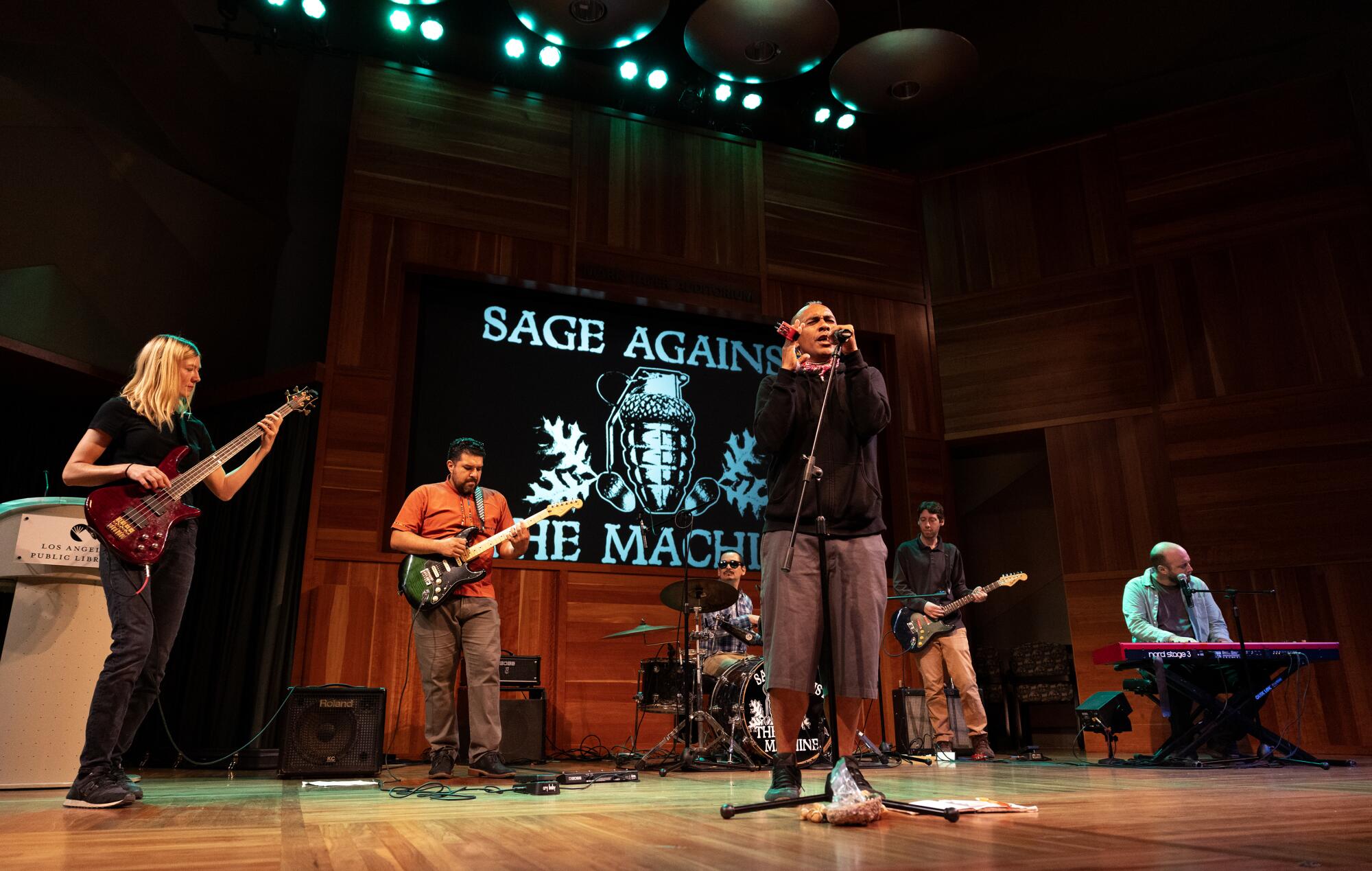
Fontman Antonio Sanchez singing with feeling, clutching a stand-up mic.

Sage Against the Machine frontman Antonio Sanchez shouts with feeling.

(Gina Ferazzi / Los Angeles Times)

By Jeanette MarantosStaff Writer 

April 4, 2024 3 AM PT (LATimes.com)

In a cavernous convention hall in Northern California, at the end of a long, loooong day of important, yes, but eventually mind-numbing presentations about native plants, nearly 200 scientists, botanists and students had had enough. It was pushing 9 p.m. and everyone, exhausted from paying attention, was edging toward the doors and the beckoning bars. That’s when six native-plant nerds took the stage, plugged in their musical instruments and sonically set the room on fire.

L.A.-based band Sage Against the Machine played with a driving, unexpected intensity and enough volume to make your chest hurt in a hard-to-pinpoint style. Was it punk? Rap-metal? Early Doors? Frontman Antonio Sanchez stepped to the microphone in his signature below-the-knee baggy shorts over leggings and monarch-butterfly-wing earring, his head bald save for a slicked-back streak of silver-black hair, and began shouting out lyrics in a blend of caressing wail and shriek.

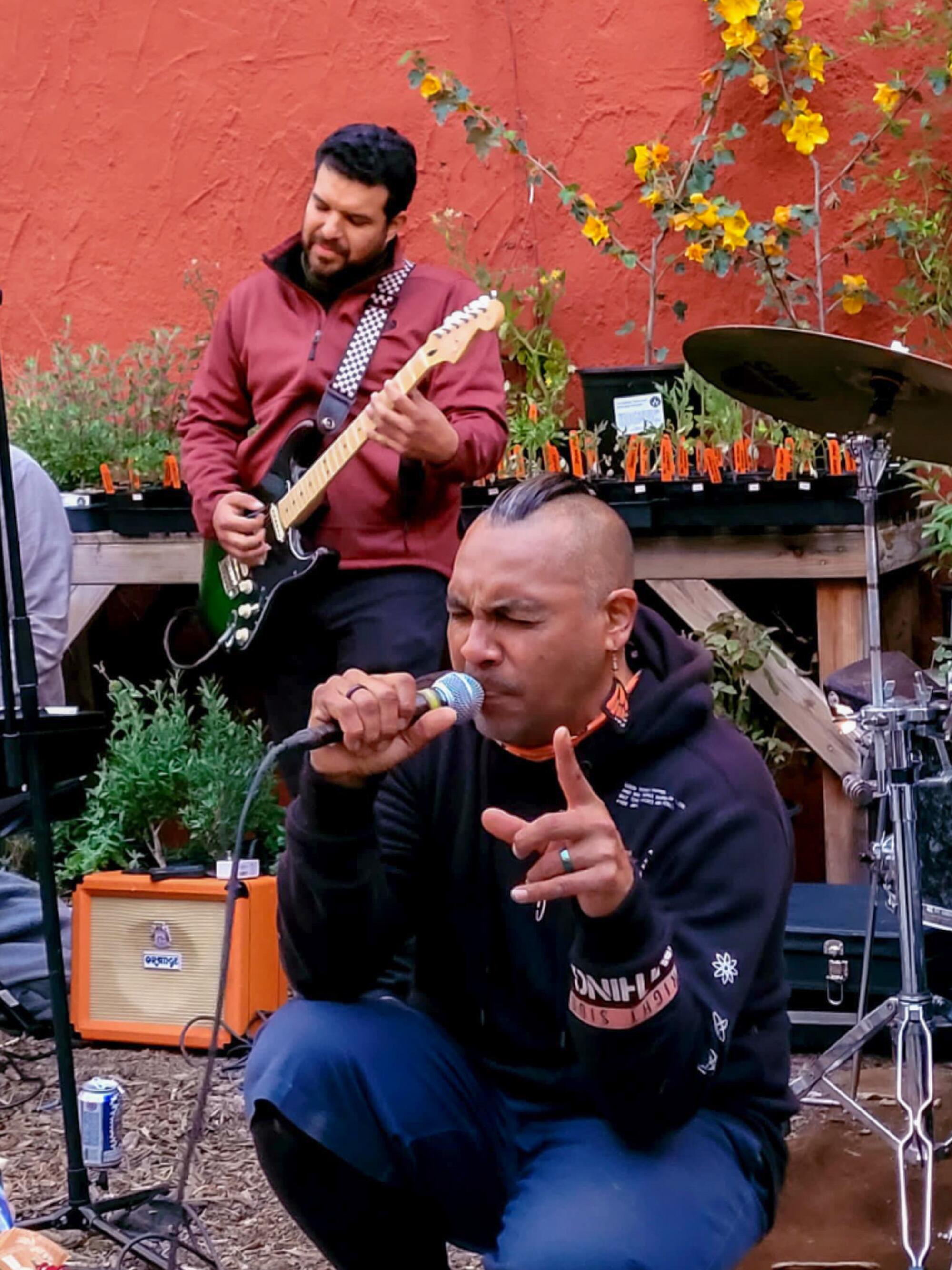
Frontman Antonio Sanchez crouches while singing into a microphone with lead guitarist Rico Ramirez playing behind him.

Suddenly a rather subdued group of serious academics and researchers at the California Native Plant Society’s 2022 convention in San José turned into a mosh pit of bouncing, frenzied fans, screaming lyrics back at the band and dancing the way people dance when they don’t know any steps but they have to move because they’re too joyously possessed to stand still.

It wasn’t just the throbbing music that hooked them. It was the sly, salty lyrics, full of in-jokes and puns and references only fellow native-plant nerds would understand.

The other day I was watering my lawn
The government told me I was wrong.
They said, “You’re gonna have to turn your irrigation off.”

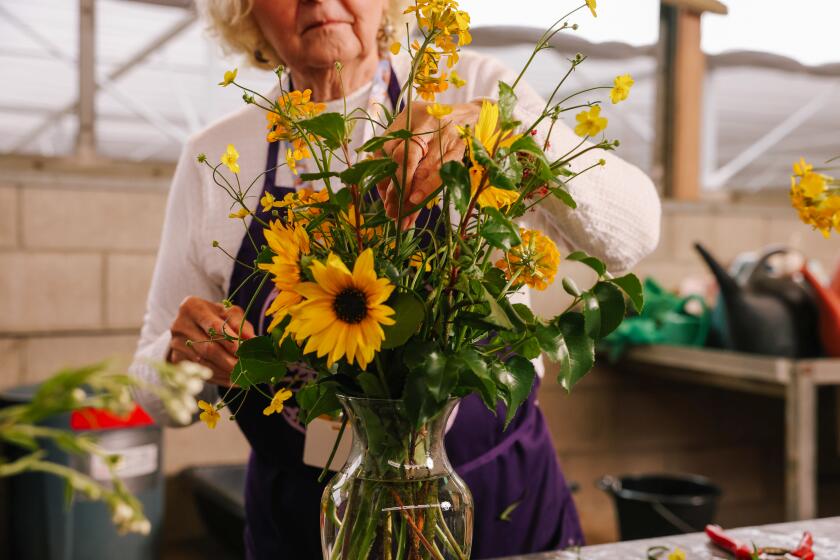
Claremont, CA - March 12: Susan Spradley assembles a bouquet made from flowers that grow in the area and are sustainable in a vase at the California Botanic Garden on Tuesday, March 12, 2024 in Claremont, CA. (Dania Maxwell / Los Angeles Times)

LIFESTYLE

15 best native plants to grow in your yard if you also want fragrant bouquets

April 2, 2024

Sanchez crooned the slow opening to one of the band’s most crowd-pleasing songs, “Kill Your Lawn,” speeding his delivery to squeeze the increasingly complicated lyrics into the meter:

They told me to kill, kill my lawn
But those native plants are such a yawn.
Besides, what am I gonna tell my landscaper, I forgot his name, I think it’s Jose … or, no, no it’s Juan.
What do I tell my landscape designer, I remember his name … his name is Ron,
and what about my landscape architect, he tucks his shirt in, his name is Sean …

Then the music went berserk, and Sanchez and his bandmates were screaming, “I gotta kill my lawn, gotta kill my lawn …” Everyone in the room joined in, jumping and screeching with the chorus: “Kill your lawn!”

Six punk rock musicians onstage with frontman Antonio Sanchez singing in front, and his bandmates behind him.

The gig was cathartic for the audience and a giant high for the band. “After listening [to presentations] all day, it was sweet release,” said drummer Hector Cervantes during a recent interview. “I know it sounds stupid, but that was our Super Bowl, the Super Bowl of plants. And I hope they’ll invite us back for the next convention.” (The convention isn’t scheduled until early 2026, said California Native Plant Society communications director Liv O’Keeffe, “but we definitely want them back.”)

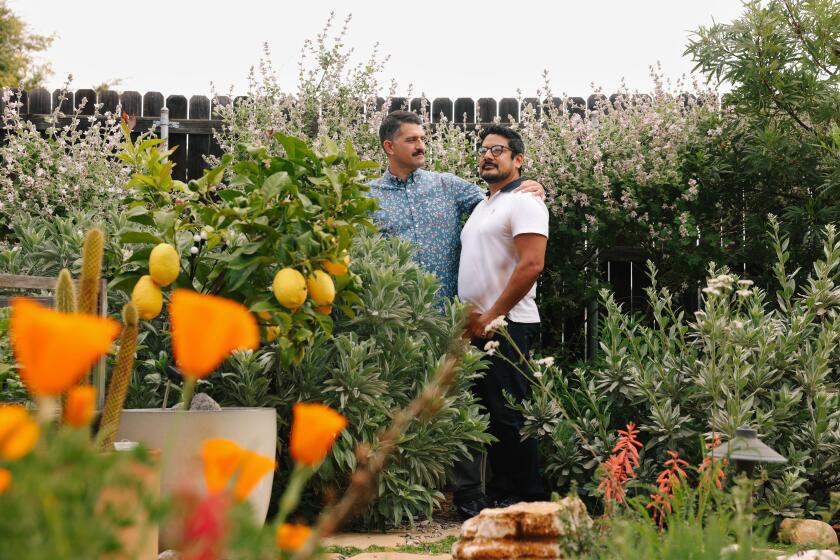
Los Angeles, CA - March 12: Thomas Zamora, left, and Raul Rojas, right, pose for a portrait together in the yard they have been working on the landscape for their 1923 Highland Park bungalow for 10 years on Tuesday, March 12, 2024 in Los Angeles, CA. The yard was once dirt and scraggly trees and has since been transformed into an oasis of native plants, winding paths, seating areas and a vegetable garden. (Dania Maxwell / Los Angeles Times)

LIFESTYLE

They transformed a sad, junk-filled yard into a DIY native plant wonderland

April 3, 2024

Undoubtedly the band will be there anyway, because the six members of Sage Against the Machine, all huge fans of the ’90s hip-hop, punk, metal, funk and rock band Rage Against the Machine, spend their days working with plants, primarily native plants at some of the most prominent organizations in Southern California.

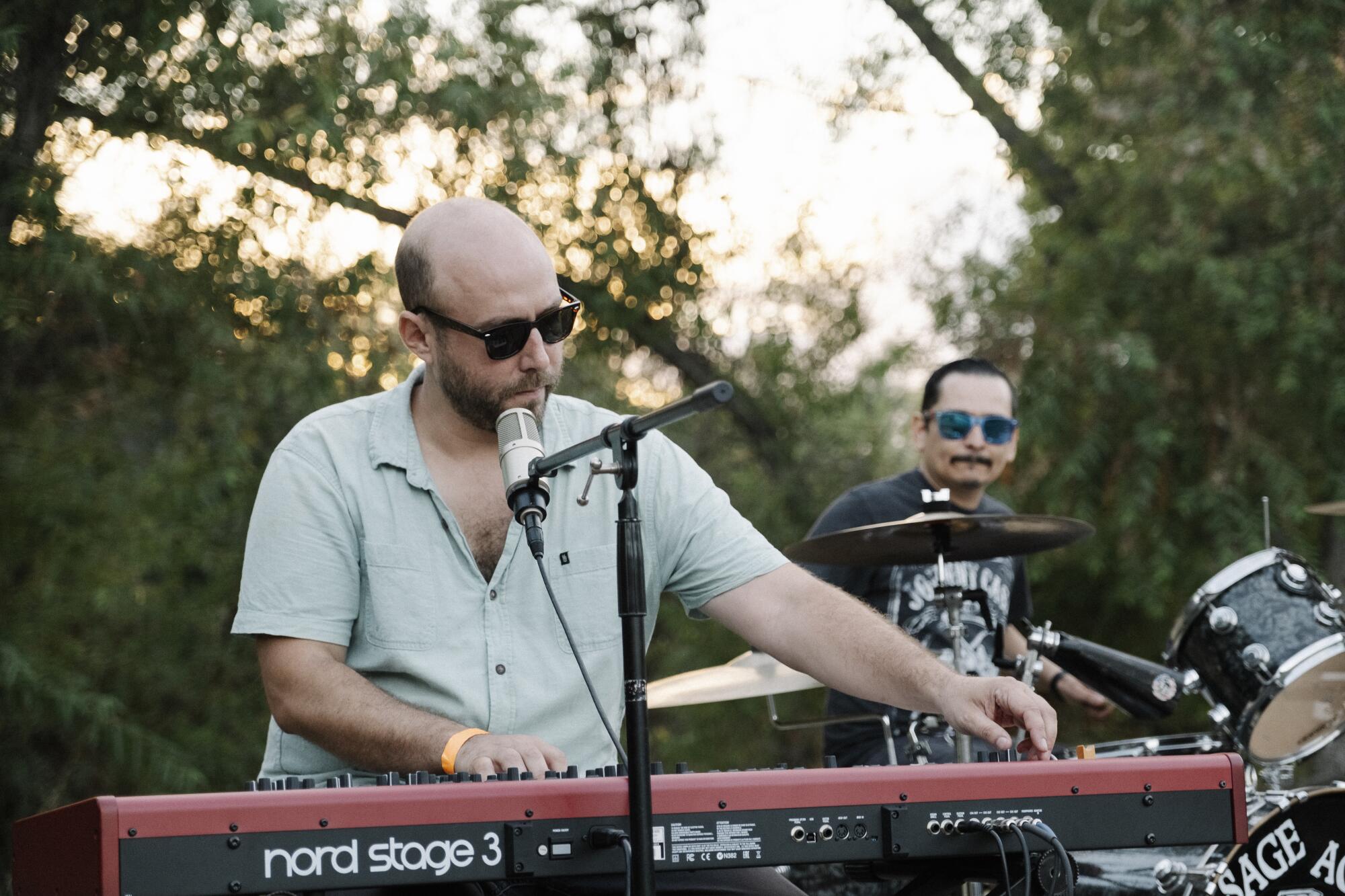
Sanchez, a former Marine who started the now-defunct Nopalito Native Plant Nursery in Ventura, runs the Santa Monica Mountains Fund Native Plant Nursery in Newbury Park. He founded the band in 2013 with Evan Meyer, executive director of the Theodore Payne Foundation, when the two of them worked for the state’s largest botanic garden devoted to California native plants, Rancho Santa Ana Botanic Garden in Claremont, now known as California Botanic Garden.

 Sage Against the Machine co-founder Evan Meyer at his keyboard in an open-neck shirt and dark glasses.
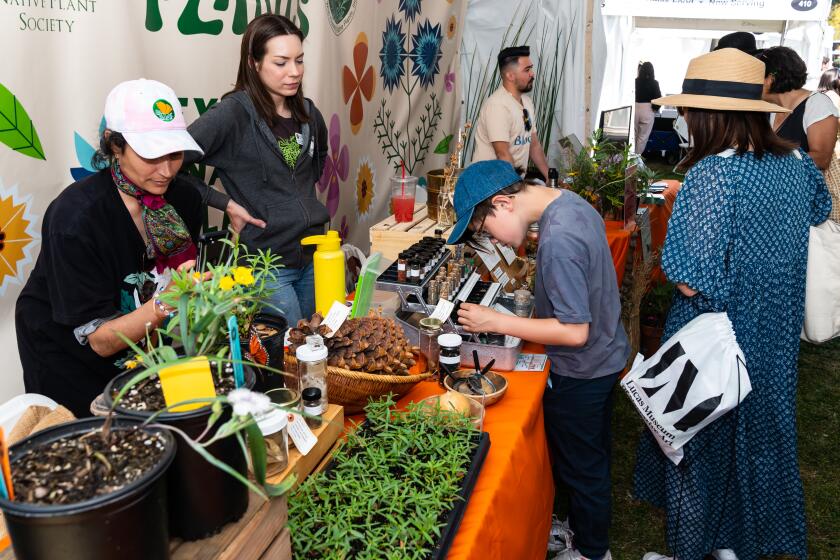
Festival of Books attendees learn about native plants at the 2023 L.A. Times Plants booth.

LIFESTYLE

Spring into the world of native plants at the L.A. Times Plants booth at Festival of Books

April 2, 2024

Meyer said their first gig was unplanned and totally improvised. He was playing background piano at a garden party when Sanchez came over, sat down beside him and began making up some lyrics. “We were friends. We started freestyling, and people thought it was funny,” Meyer said. “And that’s how it all started. Our first performance was in front of an audience, speaking to people who love plants. It was always meant to be music for our community of plant people.”

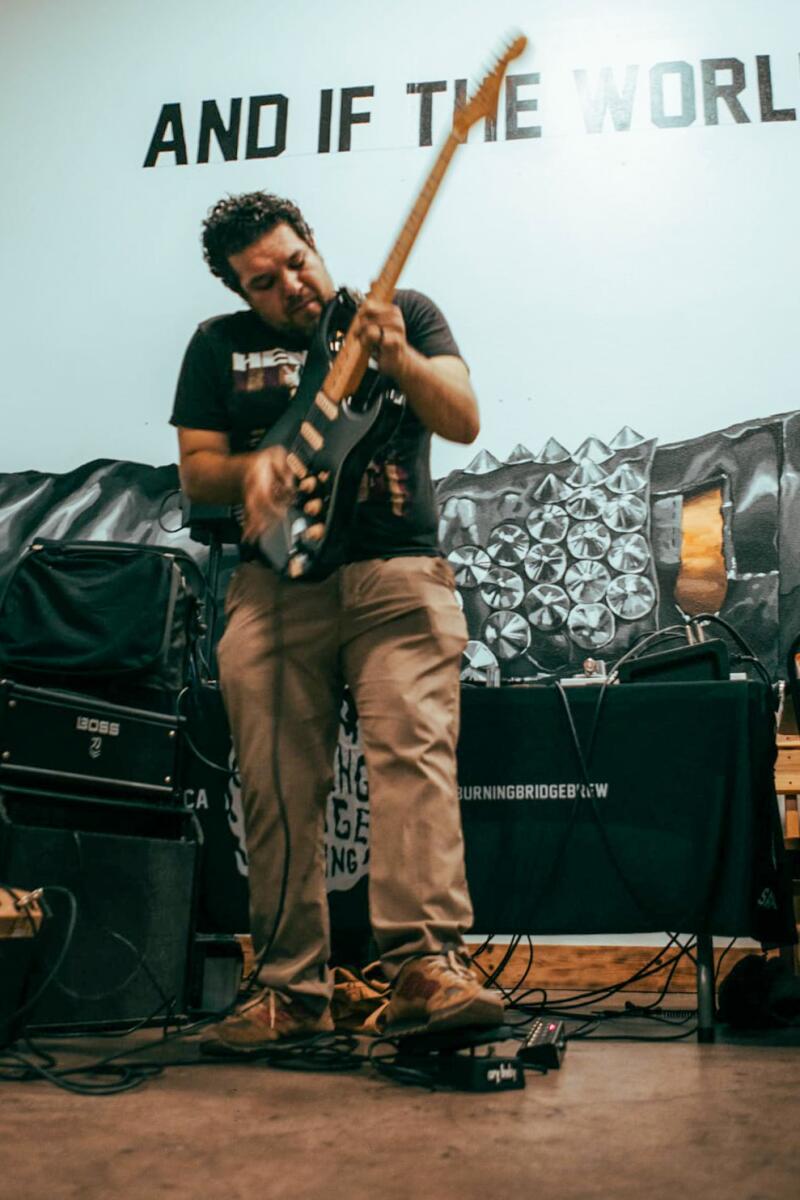
Sanchez said they started playing during informal Friday night sessions at the garden “over $1 beers and tacos.” Rico Ramirez, a certified botanist and arborist working for Caltrans, was an intern at the garden then and added his driving lead guitar to the mix. Ramirez’s family is Indigenous Gabrielino Shoshone — his late grandmother, Ya’anna Vera Rocha, was chief of the Gabrielino Shoshone Tribal Nation — and he feels a deep connection to California native plants, especially white sage (Salvia apiana), “our most spiritual plant.” Music has been a priority since he was a child, he said. He’s classically trained in guitar, but his style now is more blues and metal.A man playing guitar onstage

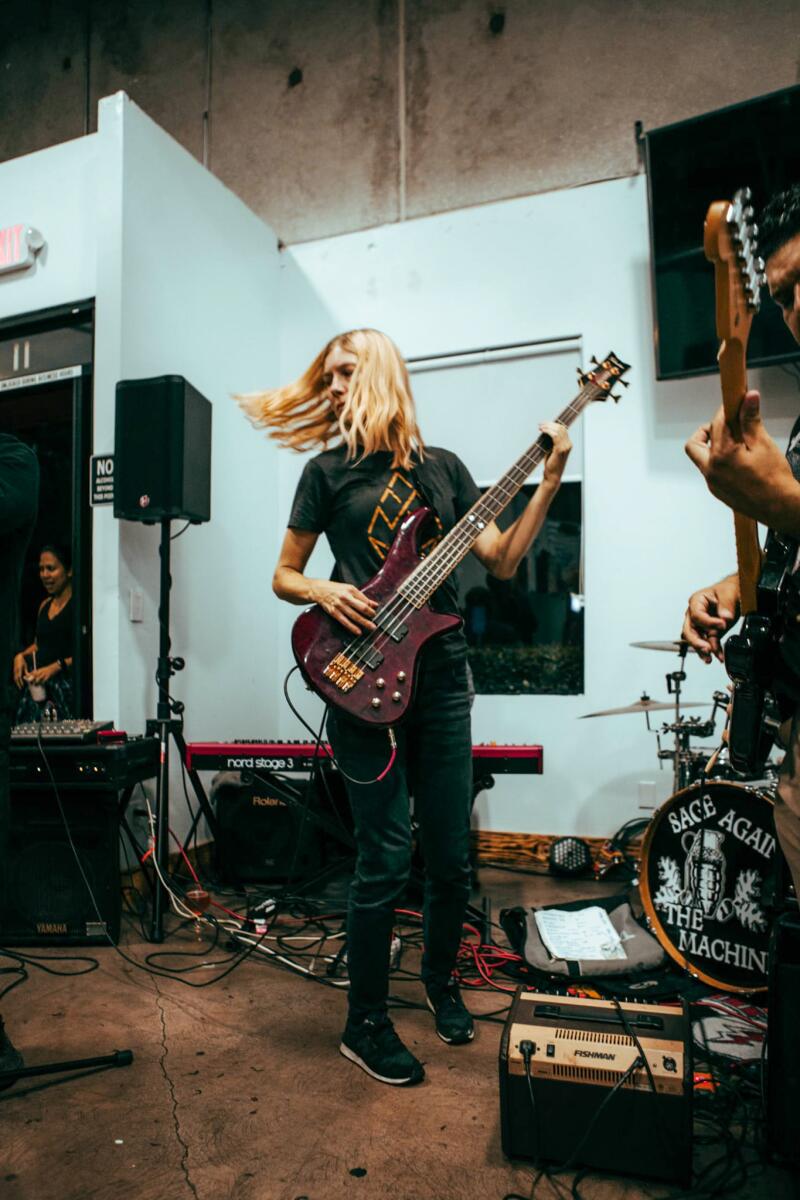
Lead guitarist Rico Ramirez. (Kyle Karbowski)A woman playing bass guitar, her hair flying

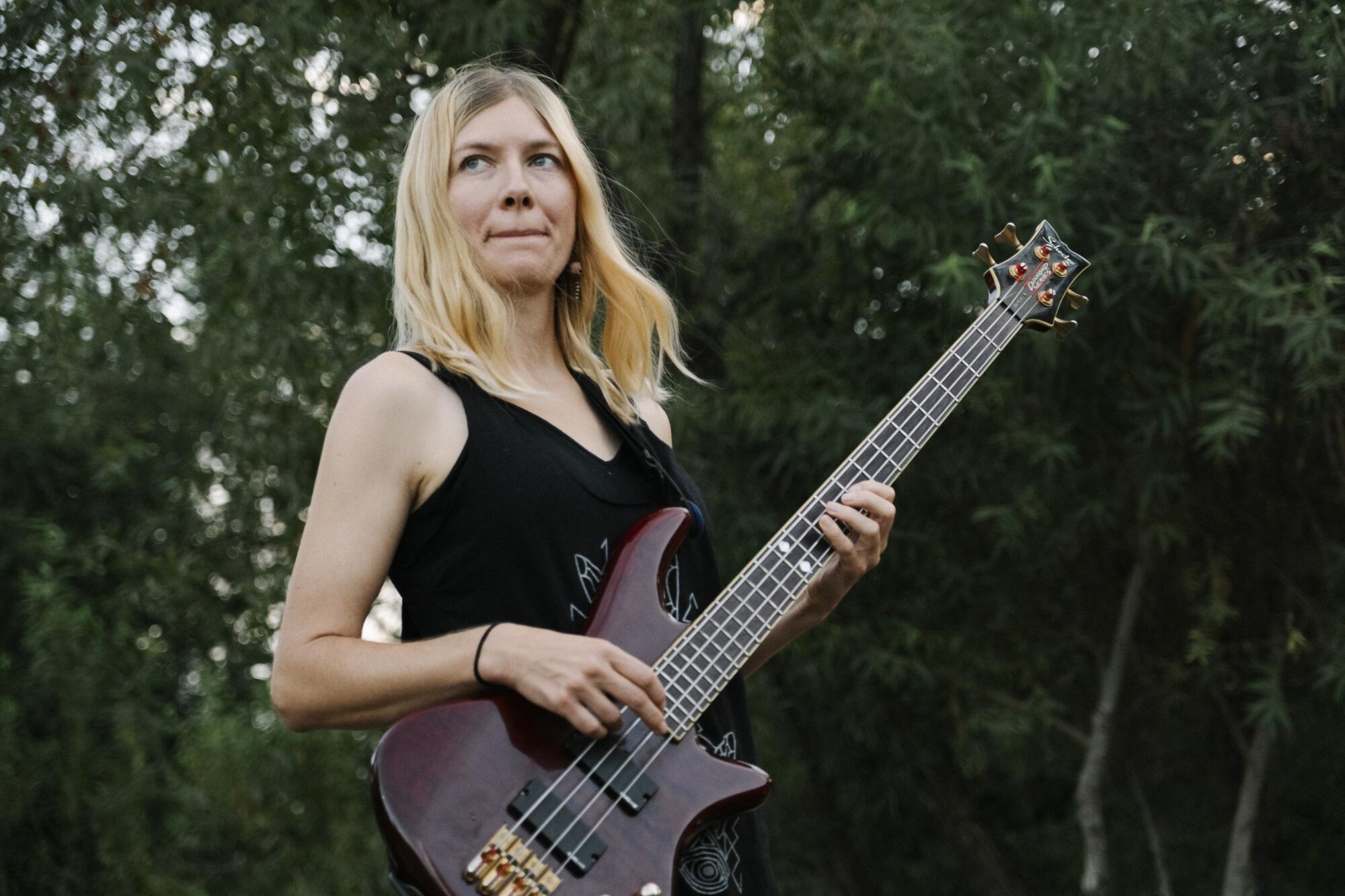
Bass player Nicole Calhoun. (Kyle Karbowski)

“We’re all very serious musicians who, behind the scenes, are entangled in botany and restoration,” Ramirez said. “That’s kind of our passion. We’re playing music to express our passion.”

Eventually all three left the garden but kept playing together sporadically. Sanchez, who was still growing plants on his own, showed up selling plants at Artemisia Native Plant Nursery in El Sereno, which opened in 2018. The owner, Nicole Calhoun, held community events at the nursery “just to let people know we existed.” Sanchez said he had a band, and in April 2019, Calhoun invited the group to perform.

Cervantes, a self-taught drummer and horticulturist working as an agriculture inspector for the Los Angeles County agriculture commissioner, was then working in the native plant section of Descanso Gardens. A colleague invited him to attend the show, and he was intrigued when he heard the band’s name “because I grew up idolizing Rage Against the Machine. Their music had angst, but it was angst toward Mother Earth, a voice for Mother Earth, and right up my alley.”

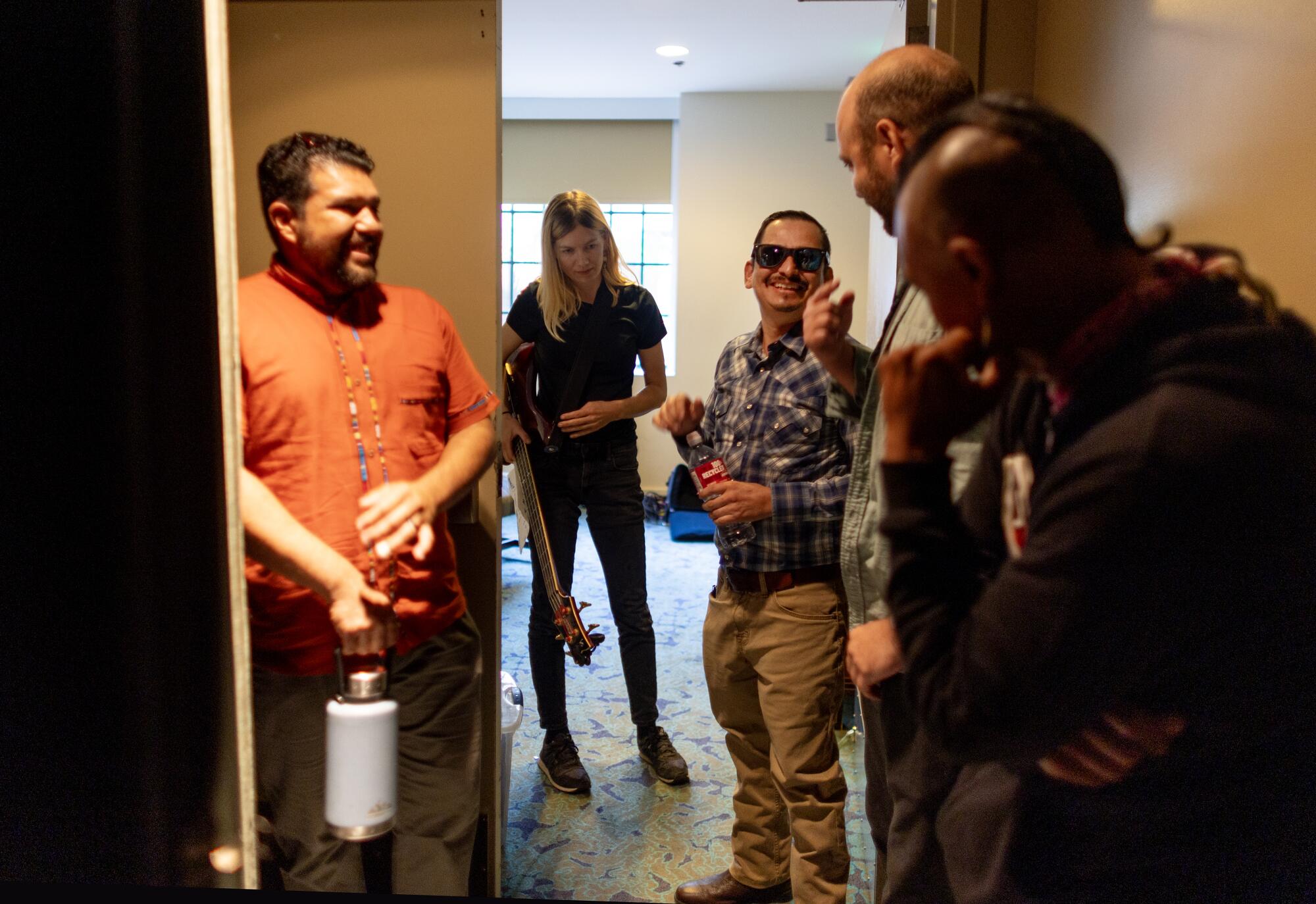
Backstage at the Mark Taper Auditorium, five people stand around joking and smiling.

That night was a big turning point. “Hector went up to them after the show and said, ‘You guys need a drummer. Can I join your band?’ And I said, ‘I want to join too,’” said Calhoun, who studied cello in college, “got tapped out with the classical scene” and eventually started playing electric bass for “fun, punk school garage bands.”

Blooms with a View, 2023

LIFESTYLE

How to get an inside look at gorgeous private gardens in and around L.A.

March 19, 2024

About a year later, Sanchez brought an intern at his nursery to practice, Jason Suddith, to play rhythm guitar. And just like that, Sage Against the Machine had six members and a camaraderie that went beyond the music.

“We get on really well, musically and not musically,” said Suddith, who is now the manager of the Arroyo Seco Foundation’s Hahamongna Native Plant Nursery. “People tell us, ‘Oh, you guys sound really good for practicing so infrequently,’ but it comes from a love for each other. We do tend to spend holidays together, with all our families. Even the band wives have their own separate group chat. It’s more than a silly band to us. We’re friends who consider each other like family.”

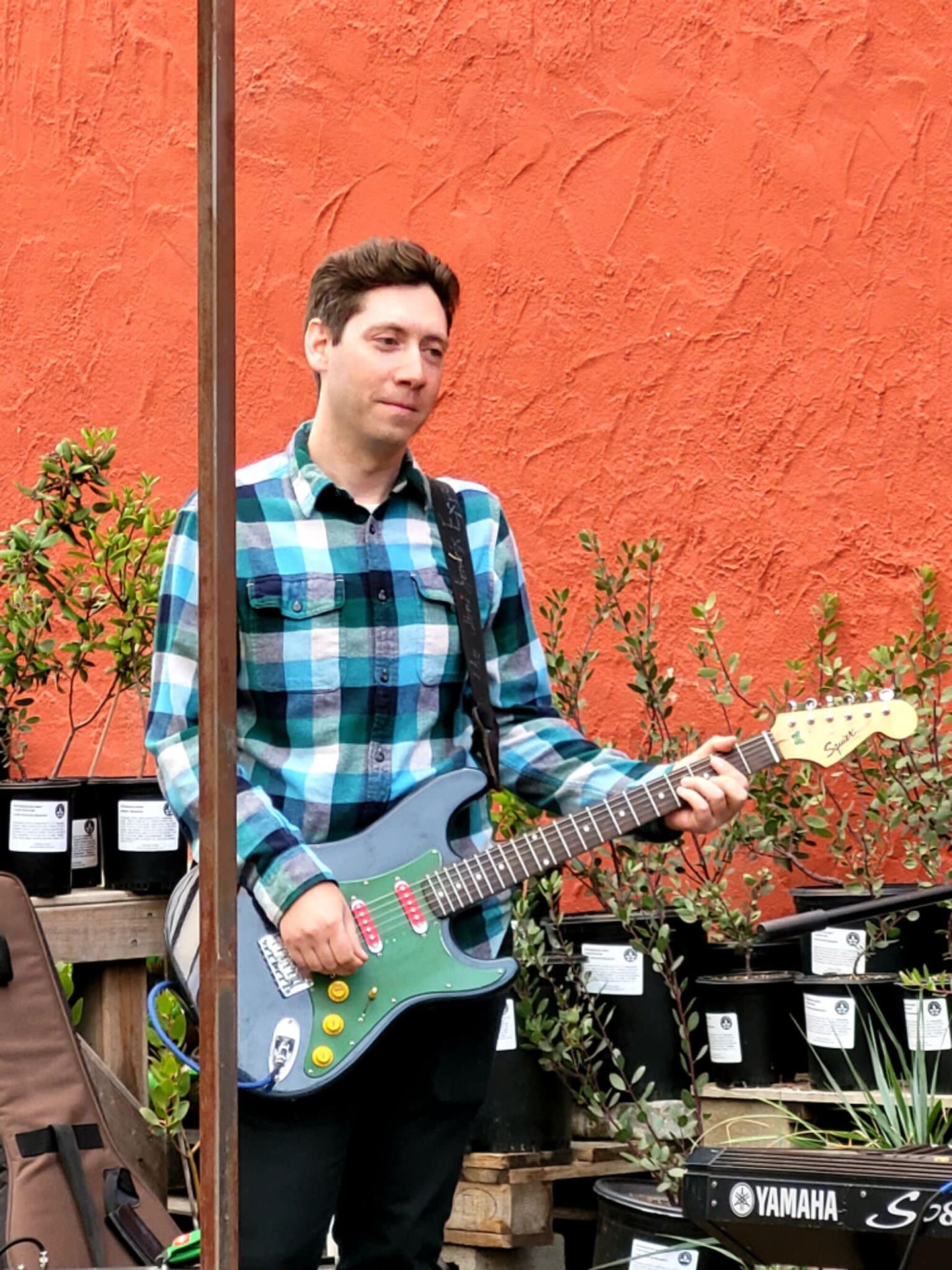
A man in a plaid shirt holding a guitar stands in front of an orange wall and potted plants

But it’s also a way for the group to do a little proselytizing about native plants “and blow off steam too, because we care about the natural world, and it’s being destroyed all the time,” said Calhoun. “We’re trying to rebuild some of those relationships and we give each other strength. It’s important to everyone’s mental and spiritual health. We do a lot of s— talking too, and it feels great to have that release.”

Finding times to practice is challenging. After all, these aren’t teenagers playing in a garage band after school. The band members are in their mid-30s to mid-40s and working full-time jobs. They’re all married or in committed relationships and most have children. Calhoun, whose daughter is 2, is trying to finish a graduate degree in landscape architecture, “so I can take my business a little further.”

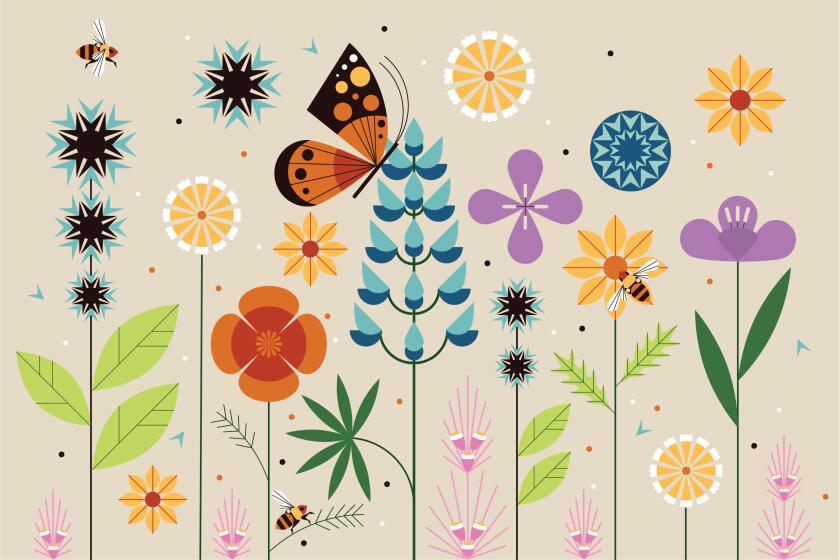
California native flowers with bees and a butterfly.

LIFESTYLE

Why aren’t wildflowers bursting everywhere? Don’t expect a superbloom

April 1, 2024

Still, they’re all committed to performing, and will release their new album on Spotify later this month. Just don’t look for Sage Against the Machine at traditional rager venues. The band is most likely to perform at nurseries and family-friendly plant festivals, such as their upcoming gigs on April 13 at the Puente Latino Assn. Earth Day celebration at DeForest Park in Long Beach, April 21 at the Earth Day Celebration, plant swap and market in Thousand Oaks and May 25 at the Museum of Art and History in Lancaster. (Check out their Instagram page @nativesageagainstthemachine for exact times.)

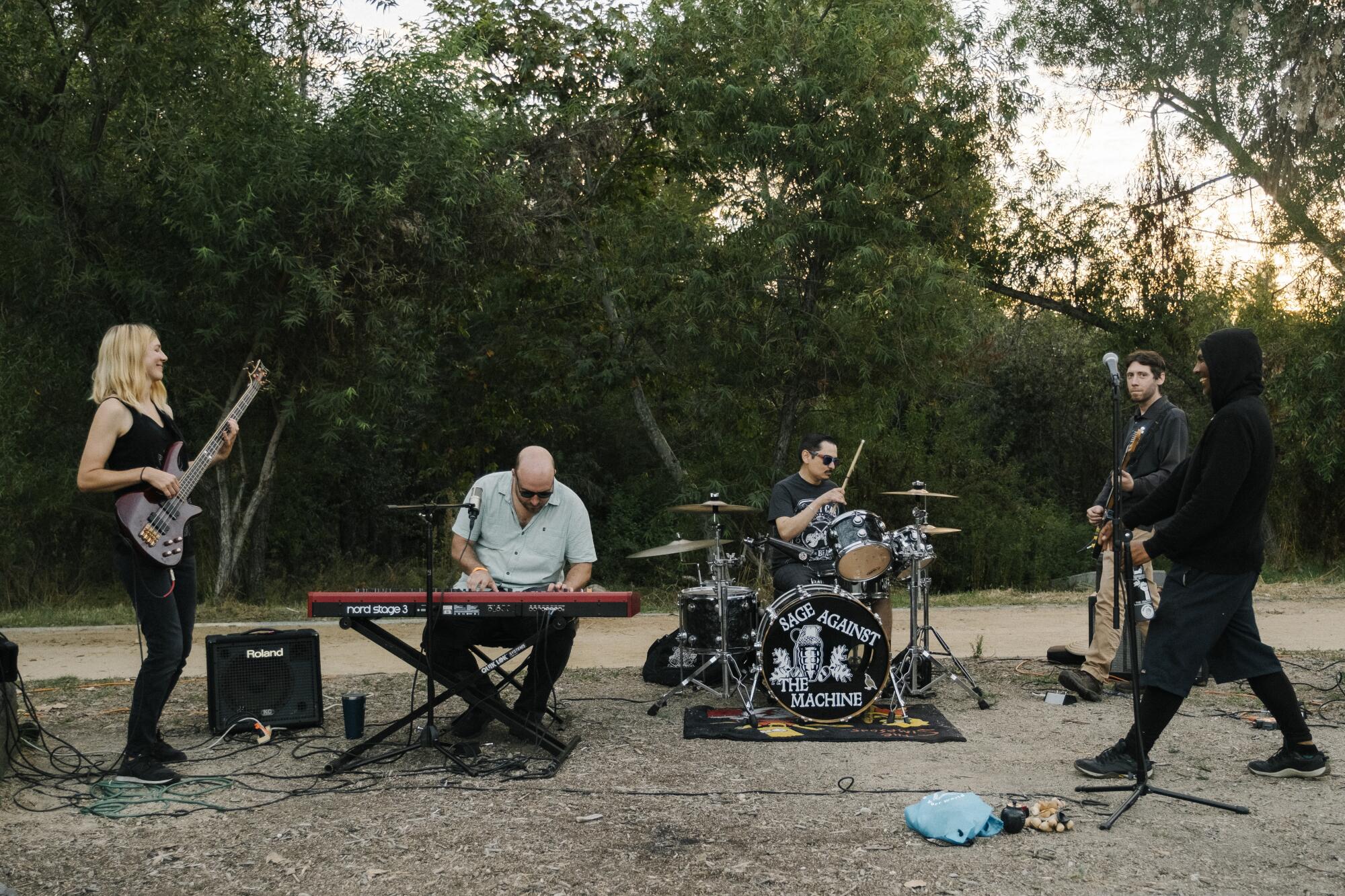
A rock band with five musicians playing bass, keyboards, drums and guitar outdoors.

People who attend the band’s performances get to hear lyrics that are often playful, as in the bouncy polka “Munching Milkweed,” about a monarch’s metamorphosis from caterpillar to butterfly, and sometimes playfully suggestive, as in “California Poppy Chulo,” a play on the Spanish phrase “papi chulo,” which translates to “a hot guy.” Ostensibly, it’s a song about bees looking for flowers to pollinate, but the opening lines make it clear that this is more than a nature documentary:

He’s a California poppy chulo,
Every pollinator that you know
wants to get a little piece of that c—

“The c—” is a vulgar Spanish word for buttocks commonly used in popular reggaeton music. “But it would never appear in print in La Opinión [L.A.’s Spanish-language newspaper],” Sanchez said laughing. “But you know, those guys are having sex with plants; you almost want to put a partition up because the bees are enjoying it so much. It’s like, ‘You’ve got to calm down! Do you not know I’m looking at you right now?’”

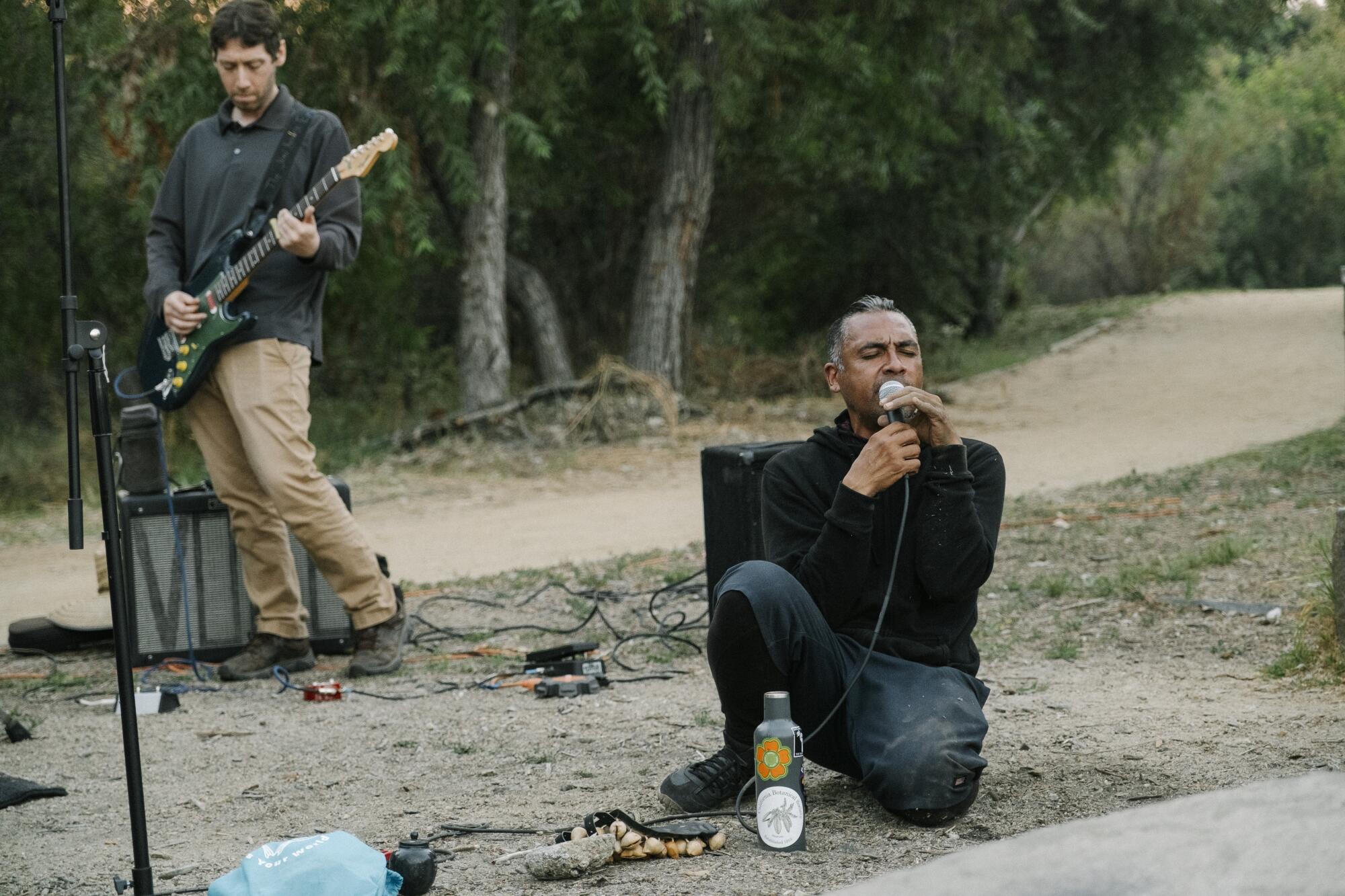
Frontman Antonio Sanchez on his knees while Jason Suddith plays guitar behind him

The lyrics, mostly written by Sanchez, can be biting at times, as in “PSA,” a hard-driving song about white sage poaching. They also can be poignant, like in the song “I Wanna Be a Native Plant.” In a video posted on YouTube, Sanchez roams the stage, jumping, crouching, rubbing his head and shout-crooning, “I wanna be a native plant, I wanna grow where they say I can’t. … Mama, make me a native plant, so I can grow where they say you can’t.”

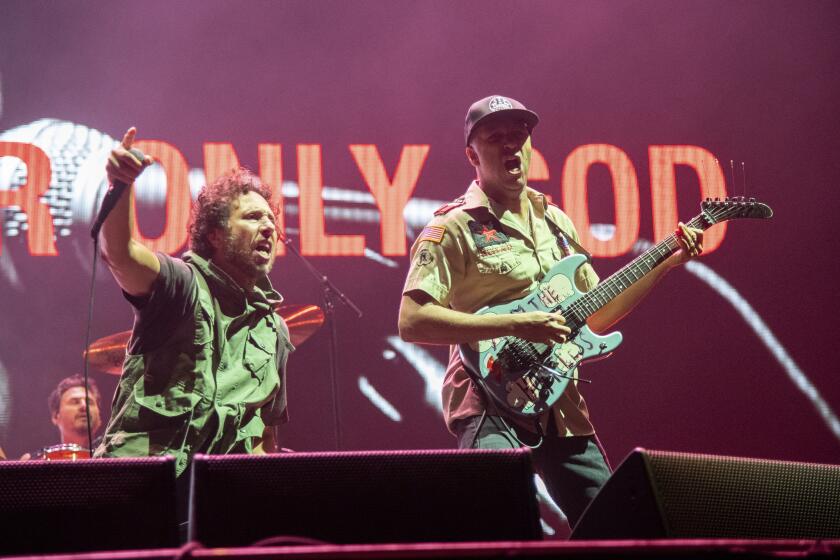
Zack de la Rocha, left, and Tom Morello of Rage Against the Machine perform during the Festival d'été de Québec on Saturday July 16, 2022, in Quebec City. (Photo by Amy Harris/Invision/AP)

MUSIC

Rage Against the Machine will not tour or play live again, drummer Brad Wilk says

Jan. 4, 2024

More often than not, Sage Against the Machine’s songs are funny, even when they have an edge. The band’s most popular song, “Baby I’m a Botanist,” has about 18 versions, Sanchez said, because he’s always improvising new lines while the basic premise stays the same: A plant lover falls in love with a botanist.

“It’s funny because so many people think that song is about them,” Sanchez said, “but really it’s just me, who doesn’t have a degree and barely even went to school for plants, saying, ‘You don’t have to have a degree to be a botanist.’ Some of our greatest plant people have hands too hard to shake because they got [them] working with plants. But the native-plant world can be super stuffy — ‘Oh, you’re not pronouncing Salvia apiana correctly’ — and we’re just trying to break down some of those barriers and have fun with plants.”

A blond woman stands outdoors holding a bass guitar.

Their catalog has tender songs too, including the romantic ballad co-written by Meyer and Sanchez, “Your Love is Like a Manzanita, Slow to Grow, Quick to Die,” instantly understandable to anyone who has ever been in love or tried to grow a finicky manzanita. They already have one live album on Spotify, and plan to drop another this month.

They’re such a unit when they perform — professional, focused yet still having fun — that it raises the question: Will Sage Against the Machine ever hit the big time? It’s something they all say they would love, “if my boss would give me a year and half off to tour,” Ramirez said jokingly, but the bandmates aren’t holding their breath. Major success is probably unlikely, Cervantes said, because their songs are too specific to California and its plants. “If it goes that way, then it’s meant to be,” Cervantes said, “but we’ve built a little niche for ourselves that’s pretty much our own.”

Then again, who knows. If the Beach Boys could make surfing a national phenomenon, who says Sage Against the Machine can’t get everyone excited about California buckwheat and white sage? It’s like what Sanchez screams in his favorite song, “Connected:”

If you are the lightning, then I’ll be your fire and she’ll be the wind; what does that make us?

If you are the clouds; then I’ll be your rain and she’ll be the earth; and what does that make us?

(Contributed by Janet Cornwell,l H.W., m.)

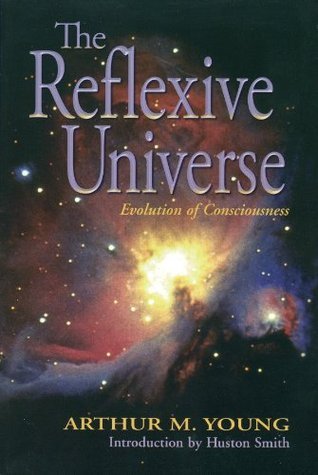
Book: “The Reflexive Universe: Evolution of Consciousness”

The Reflexive Universe: Evolution of Consciousness

Huston Smith (Introduction)Arthur M. Young

Integrating the findings of modern science with ancient wisdom, this seminal work offers a paradigm for resolving the schism between spirit and matter. Arthur Young’s Theory of Process provides a model for the evolution of consciousness out of light (the quantum of action), offering hope for an age in search of value and meaning. This is a facsimile of the original 1976 Delacorte edition, with typographic corrections in the text and a new introduction by Huston Smith


About the author

Profile Image for Huston Smith.

Huston Smith

Smith was born in Suzhou, China to Methodist missionaries and spent his first 17 years there. He taught at the Universities of Colorado and Denver from 1944–1947, moving to Washington University in St. Louis, Missouri for the next ten years, and then Professor of Philosophy at MIT from 1958–1973. While at MIT he participated in some of the experiments with entheogens that professor Timothy Leary conducted at Harvard University. He then moved to Syracuse University where he was Thomas J. Watson Professor of Religion and Distinguished Adjunct Professor of Philosophy until his retirement in 1983 and current emeritus status. He now lives in the Berkeley, CA area where he is Visiting Professor of Religious Studies at the University of California, Berkeley.

During his career, Smith not only studied, but practiced Vedanta Hinduism, Zen Buddhism (studying under Goto Zuigan), and Sufism for over ten years each. He is a notable autodidact.

As a young man, Smith, of his own volition, after suddenly turning to mysticism, set out to meet with then-famous author Gerald Heard. Heard responded to Smith’s letter, invited him to his Trabuco College (later donated as the Ramakrishna Monastery) in Southern California, and then sent him off to meet the legendary Aldous Huxley. So began Smith’s experimentation with meditation, and association with the Vedanta Society in Saint Louis under the auspices of Swami Satprakashananda of the Ramakrishna order.

Via the connection with Heard and Huxley, Smith eventually experimented with Timothy Leary and others at the Center for Personality Research, of which Leary was Research Professor. The experience and history of the era are captured somewhat in Smith’s book Cleansing the Doors of Perception. In this period, Smith joined in on the Harvard Project as well, an attempt to raise spiritual awareness through entheogenic plants.

He has been a friend of the XIVth Dalai Lama for more than forty years, and met and talked to some of the great figures of the century, from Eleanor Roosevelt to Thomas Merton.

He developed an interest in the Traditionalist School formulated by Rene Guenon and Ananda Coomaraswamy. This interest has become a continuing thread in all his writings.

In 1996, Bill Moyers devoted a 5-part PBS special to Smith’s life and work, “The Wisdom of Faith with Huston Smith.” Smith has produced three series for public television: “The Religions of Man,” “The Search for America,” and (with Arthur Compton) “Science and Human Responsibility.” His films on Hinduism, Tibetan Buddhism, and Sufism have all won awards at international film festivals.

His latest DVD release is The Roots of Fundamentalism – A Conversation with Huston Smith and Phil Cousineau.

(Goodreads.com)

FDR: “Democracy is not dying.”

Third Inaugural Address of Franklin D. Roosevelt

MONDAY, JANUARY 20, 1941

On each national day of inauguration since 1789, the people have renewed their sense of dedication to the United States.

In Washington’s day the task of the people was to create and weld together a nation.

In Lincoln’s day the task of the people was to preserve that Nation from disruption from within.

In this day the task of the people is to save that Nation and its institutions from disruption from without.

To us there has come a time, in the midst of swift happenings, to pause for a moment and take stock–to recall what our place in history has been, and to rediscover what we are and what we may be. If we do not, we risk the real peril of inaction.

Lives of nations are determined not by the count of years, but by the lifetime of the human spirit. The life of a man is three-score years and ten: a little more, a little less. The life of a nation is the fullness of the measure of its will to live.

There are men who doubt this. There are men who believe that democracy, as a form of Government and a frame of life, is limited or measured by a kind of mystical and artificial fate that, for some unexplained reason, tyranny and slavery have become the surging wave of the future–and that freedom is an ebbing tide.

But we Americans know that this is not true.

Eight years ago, when the life of this Republic seemed frozen by a fatalistic terror, we proved that this is not true. We were in the midst of shock–but we acted. We acted quickly, boldly, decisively.

These later years have been living years–fruitful years for the people of this democracy. For they have brought to us greater security and, I hope, a better understanding that life’s ideals are to be measured in other than material things.

Most vital to our present and our future is this experience of a democracy which successfully survived crisis at home; put away many evil things; built new structures on enduring lines; and, through it all, maintained the fact of its democracy.

For action has been taken within the three-way framework of the Constitution of the United States. The coordinate branches of the Government continue freely to function. The Bill of Rights remains inviolate. The freedom of elections is wholly maintained. Prophets of the downfall of American democracy have seen their dire predictions come to naught.

Democracy is not dying.

We know it because we have seen it revive–and grow.

We know it cannot die–because it is built on the unhampered initiative of individual men and women joined together in a common enterprise–an enterprise undertaken and carried through by the free expression of a free majority.

We know it because democracy alone, of all forms of government, enlists the full force of men’s enlightened will.

We know it because democracy alone has constructed an unlimited civilization capable of infinite progress in the improvement of human life.

We know it because, if we look below the surface, we sense it still spreading on every continent–for it is the most humane, the most advanced, and in the end the most unconquerable of all forms of human society.

A nation, like a person, has a body–a body that must be fed and clothed and housed, invigorated and rested, in a manner that measures up to the objectives of our time.

A nation, like a person, has a mind–a mind that must be kept informed and alert, that must know itself, that understands the hopes and the needs of its neighbors–all the other nations that live within the narrowing circle of the world.

And a nation, like a person, has something deeper, something more permanent, something larger than the sum of all its parts. It is that something which matters most to its future–which calls forth the most sacred guarding of its present.

It is a thing for which we find it difficult–even impossible–to hit upon a single, simple word.

And yet we all understand what it is–the spirit–the faith of America. It is the product of centuries. It was born in the multitudes of those who came from many lands–some of high degree, but mostly plain people, who sought here, early and late, to find freedom more freely.

The democratic aspiration is no mere recent phase in human history. It is human history. It permeated the ancient life of early peoples. It blazed anew in the middle ages. It was written in Magna Charta.

In the Americas its impact has been irresistible. America has been the New World in all tongues, to all peoples, not because this continent was a new-found land, but because all those who came here believed they could create upon this continent a new life–a life that should be new in freedom.

Its vitality was written into our own Mayflower Compact, into the Declaration of Independence, into the Constitution of the United States, into the Gettysburg Address.

Those who first came here to carry out the longings of their spirit, and the millions who followed, and the stock that sprang from them–all have moved forward constantly and consistently toward an ideal which in itself has gained stature and clarity with each generation.

The hopes of the Republic cannot forever tolerate either undeserved poverty or self-serving wealth.

We know that we still have far to go; that we must more greatly build the security and the opportunity and the knowledge of every citizen, in the measure justified by the resources and the capacity of the land.

But it is not enough to achieve these purposes alone. It is not enough to clothe and feed the body of this Nation, and instruct and inform its mind. For there is also the spirit. And of the three, the greatest is the spirit.

Without the body and the mind, as all men know, the Nation could not live.

But if the spirit of America were killed, even though the Nation’s body and mind, constricted in an alien world, lived on, the America we know would have perished.

That spirit–that faith–speaks to us in our daily lives in ways often unnoticed, because they seem so obvious. It speaks to us here in the Capital of the Nation. It speaks to us through the processes of governing in the sovereignties of 48 States. It speaks to us in our counties, in our cities, in our towns, and in our villages. It speaks to us from the other nations of the hemisphere, and from those across the seas–the enslaved, as well as the free. Sometimes we fail to hear or heed these voices of freedom because to us the privilege of our freedom is such an old, old story.

The destiny of America was proclaimed in words of prophecy spoken by our first President in his first inaugural in 1789–words almost directed, it would seem, to this year of 1941: “The preservation of the sacred fire of liberty and the destiny of the republican model of government are justly considered … deeply, … finally, staked on the experiment intrusted to the hands of the American people.”

If we lose that sacred fire–if we let it be smothered with doubt and fear–then we shall reject the destiny which Washington strove so valiantly and so triumphantly to establish. The preservation of the spirit and faith of the Nation does, and will, furnish the highest justification for every sacrifice that we may make in the cause of national defense.

In the face of great perils never before encountered, our strong purpose is to protect and to perpetuate the integrity of democracy.

For this we muster the spirit of America, and the faith of America.

We do not retreat. We are not content to stand still. As Americans, we go forward, in the service of our country, by the will of God.

(avalon.law.yale.edu)

Suzanne Deakins Memorial in Portland

From my nephew Ethan, Suzanne’s son

I am trying to promote a GoFundMe for my mother’s passing and the costs incurred by her family given that fact that she had nothing in savings, no life insurance, no annuity. She died leaving us nothing, but we want to give her a proper death, a proper memorial, a proper passing.

And all of my family is working class, with little to fund such things.
Death requires a lot of costs; death certificates to close all of her many accounts, the cost of renting a space to hold a memorial, to fly some family out, to pay for several days of missed work by folks to do all of this, to pay for people to remove her things from her apartment (of which she had many; she loved things, and even in her one bedroom apartment managed to have so many things no one person or organization can take them all).


So, please, please. If you can donate even 20 dollars, please do.
We’re about $700 behind my lowest goal to afford everything. I’d personally appreciate if anyone can donate $100 in the next 48 hours.”

Fundraiser by Ethan Firpo : Support Suzanne’s Memorial and Legacy

Thanks so much,

Gwyllm

Doing good is good for you, research shows

Story by Richard Sima

 • msn.com

Doing good is good for you, research shows

Doing good is good for you, research shows© George Wylesol for The Washington Post

If you want to increase your happiness and well-being, spend your money, time or energy on someone else.

Research consistently finds that acts of altruism, such as donating money, volunteering or giving blood, benefit both the receiver and the giver — even when the giver does not expect anything in return.

“Finding joy in helping others is fundamental to who we are as a species,” said Elizabeth Dunn, a professor of psychology at the University of British Columbia.

American volunteering and charitable giving have been on the decline in recent years. But helping others may set up a positive feedback loop: Because doing good feels good, altruism can beget more altruism and better well-being.

“If things are hard, you often don’t feel like going out of your way to do the things that will help other people around you,” said Abigail Marsh, a professor of psychology and the interdisciplinary neuroscience program at Georgetown University. “But, in fact, that may be actually one of the best things you could do.”

Helping others helps our own well-being

In an influential 2008 study, Dunn and her colleagues gave 46 participants a small amount of money ($5 or $20) and told them to either spend it on themselves or someone else. People who spent the money on someone else reported being happier than those who spent it on themselves, regardless of the amount of money.Related video: Avoid These Morning Mistakes For a Successful Day (Secret History)

The initial study was small, but subsequent research replicated the well-being benefits of prosocial spending, including a 2020 study with nearly 8,000 participants.

Other ways of doing good such as volunteering and donating blood can also feel good, and improve mood and well-being, research shows. Volunteering, in particular, may give “a little bit more of that warm glow that you get from seeing how your actions have benefited other people,” Marsh said.

Giving to others seems to literally take away our own pain.

One 2019 study reported that people who performed altruistic acts, such as donating money to orphans, perceived less physical pain when given an electric shock or the pinch of a tourniquet compared with those who earned the money for themselves. Cancer patients even experienced a respite from chronic pain.

After an altruistic act, fMRI neuroimaging showed neural activity decreased in the anterior cingulate cortex and the insula, which are both pain-related areas of the brain. At the same time, activity increased in the prefrontal cortex, which is important for imbuing the altruistic act with meaning.

Being altruistic also pays longer-term health dividends. People who helped others reported that they were more satisfied with their life and job and had fewer depression symptoms up to two months later, one 2018 study reported.

Even small acts of kindness can be surprisingly beneficial to our well-being. Marsh said, “It changes how you think about yourself as a person. It sort of fosters your belief in a world of people who try to help each other.”

Joy in helping others may be fundamental

“We are such a social species that doing things that help others around us is just very deep in our core,” Marsh said. “It’s something that most people are built to want to do.”

Altruism probably involves brain regions connected with reward processing as well as the medial prefrontal cortex, which seems to be “really important for encoding the value of other people’s welfare,” said Shawn Rhoads, a postdoctoral research fellow in computational psychiatry at the Icahn School of Medicine at Mount Sinai.

Even children younger than 2 seem to find joy in giving away their possessions, Dunn and her colleagues reported in a 2012 study. When toddlers were asked to donate their Goldfish crackers — “toddler gold, basically” — they appeared happier than when they received the treats themselves, said Dunn, who is also a co-author of “Happy Money: The Science of Happier Spending.”

Another line of evidence that altruism may be evolutionarily ingrained is that the well-being benefits of altruism are seen in different cultures around the world.

The studies also show that well-being and altruism probably have a bidirectional relationship: Happier people tend to engage in more altruism, and more altruistic people feel happier.

“Which is great,” Marsh said. “It means that these two beneficial outcomes can mutually reinforce each other.”

Helping others not only benefits the person giving and the person receiving the aid, but also others merely observing the acts of altruism. “People who observe acts of altruism also tend to feel better about and less cynical about the world in general,” said Rhoads, who co-wrote a chapter on the relationship between altruism and well-being in the 2023 World Happiness Report with Marsh. It’s a “very interesting feedback loop of prosocial behavior.”

How to give back to others

The researchers practice what they study.

Rhoads runs a summer program teaching high school students about computational psychiatry, while Dunn brings her friends and son to Plenty of Plates in Vancouver to make meals for people in need.

Marsh volunteers at a nonprofit she co-founded helping people and families dealing with disorders of aggression. She also takes an extra doggy bag to the park to pick up garbage when she walks her Goldendoodle, Doug, who is named after the dog in Pixar’s “Up,” whose second line in the movie — “I have just met you, and I love you” — Marsh said reminds her of some of the altruists she studies.

Here is what experts advise.

Start now. Do your research, but don’t put off helping just because you are waiting for the perfect opportunity, Dunn said. “Even small donations make a difference, both for charities receiving them and for the emotional benefits that we observe among donors,” she said.

Think local. Though people often think of helping large, international charities, donating to or volunteering at nearby organizations can help “knit that fabric of the local community,” Marsh said. It also helps you make friends, see your effect up close and change local norms, she added.

Ask people what charities they support. Not only can you learn about other opportunities, but it can create connections between you and them, Dunn said.

Allow yourself to enjoy giving back. You may feel guilty about feeling good when helping others. But “it’s okay to feel good about giving,” Dunn said. “What a wonderful way to feel happy.”

Do you have a question about human behavior or neuroscience? Email BrainMatters@washpost.com and we may answer it in a future column.

Upcoming classes at The Prosperos

Here’s what’s coming up on The Prosperos calendar:

Classes:

December 14-15 – Metonymy Translation® with Dean William Fennie: https://www.theprosperos.org/prosperos-events/mtr-online-202412

January 18 – Lucid Dreaming with HughJohn Malanaphy, H.W.,M.: https://www.theprosperos.org/prosperos-events/lucid-dreaming-202212-js2c8-9c3rd-dt3al

February 8-9 – Advance Seminar with Anne Bollman, H.W.,M.: https://www.theprosperos.org/prosperos-events/advance-seminar-oct19-20-2024-rb6e7

Find information about all Prosperos classes and events on our website calendar at: https://www.theprosperos.org/events

Contributions to The Prosperos can be made online at: https://www.theprosperos.com/ctb