Toxic Femininity, Explained — Plus, Tips to Overcome This Mindset

(healthline.com)

Toxic femininity is a form of internalised misogyny which involves restricting yourself to stereotypically “feminine” behaviors in order to appeal to men. However, it’s more common than you might think.

Photo shows two people from the waist down walking down the street in skirts and heeled boots 1
Sweenshots & Shaymone/Stocksy United

Perhaps you’ve come across the term “toxic masculinity” before. If so, you might know this concept describes the ways society’s gender-based expectations for men can breed unhelpful characteristics and behaviors, including aggression, difficulty expressing emotions, and excessive self-reliance.

But psychologists and researchers have also started to consider a similar topic, “toxic femininity.” In a nutshell, this term describes the potentially negative impact of society’s standards for women.

It’s not clear who first coined “toxic femininity.” Various internet sources suggest the term first entered the mainstream public lexicon around 2018, when social psychologist Devon Price wrote a Medium post about it, and journalist, speaker, and educator Jane Gilmore published a piece on the topic in The Sydney Morning Herald.

The definition of the term can vary slightly, depending on the source. A common anti-feminist misconception suggests it means using “feminine” qualities to manipulate men. Yet most experts agree toxic femininity involves restricting your behavior to fit stereotypically feminine traits that men supposedly find pleasing.

Toxic femininity can affect your health and well-being in many ways by increasing stress levels, sabotaging your sense of identity, contributing to a feeling of powerlessness, and leading to unhealthy relationships, says Monica Vermani, PsyD, clinical psychologist and author of “A Deeper Wellness: Conquering Stress, Mood, Anxiety and Traumas

“Both toxic masculinity and femininity are unhealthy as they pressure individuals to fit a mold rather than strive to live and relate to others authentically, as their highest and best selves,” she explains.

Here’s how to identify toxic femininity and what to do about it when you recognize it.

What does it mean, exactly?

Toxic femininity can describe any instance when women are either explicitly told to conform to traditional stereotypes or attempt to align with those stereotypes themselves, according to licensed therapist Meaghan Rice, PsyD, LPC.

Rice notes that while toxic femininity stems from society’s rigid molds, individual people reinforce it all the time. It often happens as a subconscious effort to find value or feel accepted in a patriarchal society.

“At its core, it’s an internalization of misogynistic values and power structures,” adds Vermani, going on to explain that toxic femininity is based on the following stereotypically “feminine” traits:

  • passiveness, selflessness, and nurturance
  • compliance, submissiveness, or docility
  • cooperation
  • sensitivity
  • politeness
  • empathy and compassion
  • home and family-oriented values

To be clear, there’s nothing at all wrong with having any of these traits. They only become toxic when you feel forced to express them, or you exaggerate them while suppressing your own needs, says Vermani.

Toxic femininity can show up in pretty much any environment:

  • at school
  • at home, with family or romantic partners
  • at work
  • in the media
  • online, including social media
  • among friends and in other social settings

Some real-world examples include:

  • A teacher who tells you to “act like a lady” when you show assertiveness.
  • A parent who continually pressures you to have children because “that’s what women do.”
  • An acquaintance who says you haven’t found love because men find your confidence “intimidating.”
  • A social media influencer who says “real women have curves.”
  • A newspaper article criticizing a female celebrity for having hair on their legs and underarms.
  • A manager or colleague who not-so-subtly suggests you wear more makeup to the office.

Social media can contribute to toxic femininity, according to Rice, when women and feminine-presenting people get more likes, comments, and general engagement for content that supports gender roles and stereotypes.

“Toxic femininity is promoted in a surprising amount of the media we consume,” adds Saba Harouni Lurie, LMFT, the owner and founder of Take Root Therapy. “Everything from female celebrities promoting dangerous dieting techniques to shows like ‘The Bachelor,’ where women compete for a man’s affection, can further these ideals.”

Toxic femininity vs. benevolent sexism

Toxic femininity and toxic masculinity are both intertwined with another concept rooted in misogyny: benevolent sexism.

This subtler form of sexism may seem well-intentioned, but it can still cause harm. It’s based on the idea that men are meant to be providers and protectors, says Vermani, while women are vulnerable, fragile, and ultimately dependent on men for safety and support.

“A man’s protection and support is transactional and only granted in exchange for a woman’s compliance with traditional gender roles,” explains Vermani.

By reinforcing gender roles and stereotypes, benevolent sexism can encourage toxic femininity.

Was this helpful?

How it might show up

Some common signs of toxic femininity to pay attention to — in yourself or others — include:

  • Feeling you should always have a male partner, even if you don’t particularly want a relationship. Rice notes this may stem from toxic femininity when you feel as if you’re somehow incomplete without a male partner and need to depend on them for certain things.
  • Judgment or shame for not having children. Those who choose not to have children, or who experience fertility issues, should never be made to feel less like a woman, says Abby Dixon, MS, a licensed professional counselor and owner of The Joywell.
  • Sacrificing your health to fit societal expectations for women. Rice explains this can mean trying overly restrictive diets, investing in procedures that are risky or beyond your budget, or otherwise going to extreme lengths to meet society’s beauty standards for women.
  • Putting men’s needs and desires before your own. This could mean suppressing your own needs and feelings in order to accommodate a male partner, colleague, or family member, Vermani says. For example, you might agree to do something you don’t want to do for a co-worker so you seem polite and easygoing.
  • Downplaying your capabilities. Pretending you don’t know how to do something or aren’t physically capable of something — especially in an effort to avoid emasculating a man — plays into perceived feminine weakness, says Vermani.
  • Avoiding confrontation with men. Since traditional gender norms dictate that women should be obedient and submissive, Lurie says toxic femininity can manifest as not challenging men when you disagree with them or when they do something that bothers you.
  • Judging other women or experiencing judgment from other women for not being “feminine” enough. Dismissing or belittling women who don’t conform to societal expectations for their gender is a common sign of toxic femininity, according to Vermani.

What’s the impact?

“Toxic femininity supports a rigid, restrictive, repressive, and limiting definition of womanhood,” says Vermani, who emphasizes that toxic femininity can harm people of any gender, just like toxic masculinity.

Some of the potential consequences include:

Physical health effects

According to Lurie, toxic femininity can affect physical health by promoting unrealistic beauty standards that may play a part in body dysmorphia and eating disorders.

Toxic femininity can also factor into unrealistic expectations when it comes to nurturing romantic partners and children and keeping up with housework.

These expectations can create a lot of stress, especially when you have school or work obligations to keep up with, too. Vermani notes that many women may over-commit themselves in order to live up to expectations of being helpful, selfless, and nurturing.

“Toxic femininity can result in severe burnout from taking on the physical and emotional labor of those around you. Chronic stress can also contribute to serious health conditions, like ulcerscancerstroke, and heart disease.”

When toxic femininity in the workplace contributes to bullying or harassment, you might also experience:

Mental and emotional effects

Strictly adhering to gender norms may leave you with a sense of powerlessness, Vermani adds. You might feel stuck, or trapped by your lack of agency over your own life.

If you start to equate your self-worth with your ability to find a partner, get married, or have children, Lurie explains, you may have a harder time feeling satisfied or fulfilled with your life as it stands.

Since toxic femininity means adhering to a predefined set of very limiting ideas about what femininity means, Lurie says it can also breed insecurity or even self-loathing when you stray from the mold.

As noted above, toxic femininity can also fuel workplace bullying, which can have a mental health impact, too. Research from 2016 links workplace bullying to:

FYI

Toxic femininity doesn’t just harm cisgender women, either. Many nonbinary and gender nonconforming folks feel the impact, too.

If you don’t identify exclusively as a woman or man, toxic femininity can bring up shame and guilt and leave you feeling out of place in society, says Rice, which can contribute to feelings of anxiety, depression, and isolation.

Was this helpful?

Relationship effects

Toxic femininity can also affect your personal and professional relationships.

According to Vermani, toxic femininity can encourage unhelpful behaviors, including:

You might, as a result, experience power imbalances in romantic relationships or friendships. This dynamic can lead to:

As for its impact in the workplace?

2020 study suggests women in higher managerial positions are more likely to experience bullying from men in the same positions. Researchers theorized this may stem from sexist beliefs that women lack the ability to handle leadership positions. They also noted that women with stereotypically masculine traits also tend to experience more workplace harassment.

One 2018 study explored the potential negative effects of makeup on perceptions of leadership ability.

Researchers asked 168 male and female participants — who self-reported either Caucasian or African ethnicity — to look at photographs of women wearing the makeup they might wear for a social night out and judge their leadership capabilities. The participants looked at photos of women of both ethnicities.

According to the results, makeup can negatively affect how people of any gender asses your leadership capabilities — though it might certainly boost your advantages when it comes to finding a romantic partner.

And therein lies the paradox of toxic femininity: Society expects women to adhere to certain beauty standards in dating and social contexts, but these expectations can actually hinder them in professional settings.

These “standards” can cause plenty of distress, not to mention confusion about what’s expected when. What’s more, women may — with great reason — feel unfairly judged whether they choose to wear makeup or not.

How to handle it

Once you have a clearer understanding of toxic femininity, you may find yourself beginning to notice it in your everyday life.

Experts suggest a few ways to respond to this construct.

If you notice it in yourself

  • Consider where your beliefs came from. Rice says it can help to consider where you first picked up on notions of toxic femininity. Parents? Friends? The media? Identifying the source of these ideas can help you begin untangling them from your own true beliefs.
  • Question your motivations. Toxic femininity can be so ingrained that certain behaviors may feel automatic. That’s why Lurie suggests getting curious about your actions. Do those choices truly represent what’s best for you? Or do you believe you’re expected to make them? Before agreeing to take on a task, you might consider whether you genuinely want to help — or simply feel you should.
  • Practice self-validation. “Women are often socialized and conditioned to minimize their experiences and discount their feelings to make men feel comfortable,” says Vermani. So, make it a point to validate yourself. You might, for instance, reach for daily positive affirmations like, “It’s natural to feel this way,” “It’s OK to feel angry,” “I tried my best, and that’s enough,” or “My feelings matter.”
  • Notice when and where you feel most authentic. Rice suggests noticing when you most feel the urge to conform to stereotypes and distancing yourself from those scenarios. Creating distance may involve setting boundaries with people who would rather pressure you to fit their expectations than celebrate your uniqueness.
  • Make space to explore. “Allow yourself to discover aspects of your identity that go against the norm, and honor those parts of yourself when they arise rather than reject them,” says Lurie.
  • Be mindful of the media you consume. If you recognize that certain channels, publications, social media accounts, or other outlets promote toxic femininity, you might consider avoiding those as much as possible. Instead, Lurie recommends taking in inclusive media that challenge gender norms and represent the wide array of gender expressions that exist.

If you notice it in others

  • Approach the subject with curiosity and compassion. Making accusations can put the person on the defensive, so Dixon advises calling it out by asking a question. If your sister keeps commenting on the fact that her friend doesn’t want kids, you might ask, “It seems like you have some strong feelings about that. Why do you think it bothers you?”
  • Ask if their actions are genuinely in their best interests. If you believe toxic femininity is affecting someone in your life, Lurie recommends asking whether their choices bring them joy and fulfill their needs. You could, for instance, ask a friend why they chose to leave a job or neglected to pursue a career.
  • Show them judgment-free love. Lurie suggests affirming and supporting any self-expression not colored by societal expectations. Remind them of everything you love and appreciate about them, especially the qualities that may not align with gender norms.

No matter how you decide to approach the topic, Rice emphasizes the importance of:

  • asking open-ended questions
  • practicing active listening
  • avoiding criticism so they feel emotionally safe and supported, since this can prompt a more honest and productive conversation

Keep in mind, too, that working with a therapist can have a lot of benefit, whether you’re looking for:

  • help identifying and navigating the effects of toxic femininity on your own health and well-being
  • guidance bringing up difficult or uncomfortable questions with a loved one
  • support with exploring ways to shift your mindset

Here’s how to find a therapist that’s right for you.

The bottom line

Toxic femininity, to put it simply, describes behavior that reflects or supports gender-based stereotypes or social norms for women.

Exposure to these social norms and stereotypes typically begins at an early age, and this mindset isn’t your fault. Still, taking steps to explore what drives these often-harmful thought patterns and behaviors can make a big difference for your overall well-being.

A therapist can offer more guidance with identifying and replacing unhelpful tendencies with alternatives that support your well-being. They can also help you practice embracing all aspects of yourself, including those that don’t align with gender norms.


Rebecca Strong

Rebecca Strong is a Boston-based freelance writer covering health and wellness, fitness, food, lifestyle, and beauty. Her work has also appeared in Insider, Bustle, StyleCaster, Eat This Not That, AskMen, and Elite Daily.

Book: “Tomorrow Sex Will Be Good Again: Women and Desire in the Age of Consent”

Tomorrow Sex Will Be Good Again: Women and Desire in the Age of Consent

Katherine Angel

A provocative, elegantly written analysis of female desire, consent, and sexuality in the age of MeToo

Women are in a bind. They are told that in the name of sexual consent and feminist empowerment, they must proclaim their desires clearly and confidently. Sex researchers tell us that women don’t know what they want. And men are on hand to persuade women that what they want is, in fact, exactly what men want. In this environment, how can women possibly know what they want—and how can they be expected to?

In this elegantly written, searching book Katherine Angel surveys medical and psychoanalytic understandings of female desire, from Freud to Kinsey to present-day science; MeToo-era debates over consent, assault, and feminism; and popular culture, TV, and film to challenge our assumptions about female desire. Why, she asks, do we expect desire to be easily understood? Why is there not space for the unsure, the tentative, the maybe, the let’s just see? In contrast to the endless exhortation to know what we want, Angel proposes that sex can be a conversation, requiring insight, interaction, and mutual vulnerability—a shared collaboration into the unknown.

In this crucial moment of renewed attention to violence and power, Angel urges that we remake our thinking about sex, pleasure, and autonomy without any illusions of perfect self-knowledge. Only then will we bring about Michel Foucault’s sardonic promise, in 1976, that “tomorrow sex will be good again.”

(Goodreads.com)

What It’s Like to Be a Falcon: The Peregrine as a Portal to a Way of Seeing and a State of Being

By Maria Popova (themarginalian.org)

We shall never know the sky, you and I — never know how to pierce a mountain with a pupil or sweep a meadow with a wing — and so we shall never know this world in its totality. It is our creaturely destiny to remain earthbound, trapped in frames of reference shaped by our senses, but it is our biological benediction to have a consciousness crowned with an imagination — that periscope of wonder capable of reaching beyond our sensorium, beyond the self, projecting us into other realities and other ways of being.

In the mid-1950s, a near-sighted English office worker set out to do for the sky what Rachel Carson had done for the sea thirty years earlier — invite our human imagination, grounded yet boundless, into the world of another creature dwelling in another sphere. J.A. Baker (August 6, 1926–December 26, 1987) spent a decade following earth’s fastest flying bird on bicycle and on foot, possessed by its “restless brilliance.” When he unloosed The Peregrine (public library) into the atmosphere of culture in 1967 — an atmosphere shaped by the new ecological conscience awakened by Carson’s Silent Spring five years earlier — it was a clarion call and a consecration, entirely original, yet emanating Thoreau’s meticulous observation, Whitman’s ecstatic language, and Carson’s soulful reverence for the realities of nature in all their brutal beauty. An epoch later, it remains an ode to wonder, a field guide to observation as devotional practice, a passionate and poetic reminder that by attending closely and tenderly to any one thing, we recover our natural reverence for everything, our love of the world in all its strangeness and splendor.

Baker writes:

You cannot know what freedom means till you have seen a peregrine loosed into the warm spring sky to roam at will through all the far provinces of light.

Peregrine at Auchencairn by Archibald Thorburn, 1923. (Available as a print and as stationery cards, benefitting The Nature Conservancy.)

On the hierarchy of explanation, elucidation, and enchantment to which all writing about the natural world and the science of reality belongs, Baker is a virtuosic enchanter. The writing is at times almost unbearably beautiful — about the bird (“He was a small speck now, like the pupil of a distant eye. Serenely he floated. Then, like music breaking, he began to descend.”), and about the world lensed through the bird (“The day hardened in the easterly gale, like a flawless crystal. Columns of sunlight floated on the land. The unrelenting clarity of the air was solid, resonant, cold and pure and remote as the face of the dead.”) Echoing Carson’s insistence that “it is not half so important to know as to feel” — the ethos that made her own writing so enchanting and unexampled — Baker captures the key to writing at the level of enchantment:

I do not believe that honest observation is enough. The emotions and behaviour of the watcher are also facts, and they must be truthfully recorded.

Like me, Baker was a latecomer to the love of birds, having long seen them “only as a tremor at the edge of vision.” And then something broke open, broke free. For ten years, he spent his winters “looking upward for that cloud-biting anchor shape, that crossbow flinging through the air,” learning along the way a new way of seeing — the peregrine’s way. (“To see takes time,” Georgia O’Keeffe wrote, “like to have a friend takes time.”) In consonance with the most eternal line from The Little Prince — “What is essential is invisible to the eye.” — Baker observes:

The hardest thing of all to see is what is really there.

Peregrines from Coloured Illustrations of British Birds and Their Eggs by Henry Leonard Meyer, 1864. (Available as a print and as stationery cards, benefitting The Nature Conservancy.)

There is, of course, first the biological marvel of the peregrine’s sight, which renders visible not just to the soul but the eye itself layers of reality invisible to us:

The eyes of a falcon peregrine weigh approximately one ounce each; they are larger and heavier than human eyes. If our eyes were in the same proportion to our bodies as the peregrine’s are to his, a twelve-stone man would have eyes three inches across, weighing four pounds. The whole retina of a hawk’s eye records a resolution of distant objects that is twice as acute as that of the human retina. Where the lateral and binocular visions focus, there are deep-pitted foveal areas; their numerous cells record a resolution eight times as great as ours. This means that a hawk, endlessly scanning the landscape with small abrupt turns of his head, will pick up any point of movement; by focusing upon it he can immediately make it flare up into larger, clearer view.

The peregrine’s view of the land is like the yachtsman’s view of the shore as he sails into the long estuaries. A wake of water recedes behind him, the wake of the pierced horizon glides back on either side. Like the seafarer, the peregrine lives in a pouring-away world of no attachment, a world of wakes and tilting, of sinking planes of land and water. We who are anchored and earthbound cannot envisage this freedom of the eye. The peregrine sees and remembers patterns we do not know exist: the neat squares of orchard and woodland, the endlessly varying quadrilateral shapes of fields. He finds his way across the land by a succession of remembered symmetries.

Gyr-falcon and peregrine falcon by Archibald Thorburn, 1915. (Available as a print and as stationery cards, benefitting The Nature Conservancy.)

From this astonishing physiology of seeing arises an astonishing way of being, alien to ours — a vivid reminder that this one planet, this common home to every creature that ever was and ever will be, is composed of billions upon billions of different worlds, each particular to the consciousness that inhabits it. In one of the book’s most exquisite passages, Baker slips into the consciousness of the peregrine, body and soul:

Slowly he drifted above the orchard skyline and circled down wind, curving upward and round in long steep glides. He passed from the cold white sky of the south, up to the warm blue zenith, ascending the wind-bent thermal with wonderful ease and skill. His long-winged, blunt-headed shape contracted, dwindled, and darkened to the flinty point of a diamond as he circled high and far over; hanging and drifting above; indolent, watchful, supreme. Looking down, the hawk saw the big orchard beneath him shrink into dark twiggy lines and green strips; saw the dark woods closing together and reaching out across the hills; saw the green and white fields turning to brown; saw the silver line of the brook, and the coiled river slowly uncoiling; saw the whole valley flattening and widening; saw the horizon staining with distant towns; saw the estuary lifting up its blue and silver mouth, tongued with green islands. And beyond, beyond all, he saw the straight-ruled shine of the sea floating like a rim of mercury on the surface of the brown and white land. The sea, rising as he rose, lifted its blazing storm of light, and thundered to freedom to the land-locked hawk… I watched him with longing, as though he were reflecting down to me his brilliant unregarded vision of the land beyond the hill… He sank forward into the wind, and passed slowly down across the sun. I had to let him go. When I looked back, through green and violet nebulae of whirling light, I could just see a tiny speck of dusk falling to earth from the sun, flashing and turning and falling through an immense silence that crashed open in a tumult of shrilling, wing-beating birds.

[…]

Standing in the fields near the north orchard, I shut my eyes and tried to crystallise my will into the light-drenched prism of the hawk’s mind. Warm and firm-footed in long grass smelling of the sun, I sank into the skin and blood and bones of the hawk. The ground became a branch to my feet, the sun on my eyelids was heavy and warm. Like the hawk, I heard and hated the sound of man, that faceless horror of the stony places. I stifled in the same filthy sack of fear. I shared the same hunter’s longing for the wild home none can know, alone with the sight and smell of the quarry, under the indifferent sky. I felt the pull of the north, the mystery and fascination of the migrating gulls. I shared the same strange yearning to be gone. I sank down and slept into the feather-light sleep of the hawk.

Couple The Peregrine — one of Werner Herzog’s five requisite books for any filmmaker — with the fascinating science of what it’s like to be an owlwhat it’s like to be a whale, and what it’s like to be a dog, then revisit Helen Macdonald’s exquisite recollection of what a hawk taught her about love and loss.

On Giving Up: Adam Phillips on Knowing What You Want, the Art of Self-Revision, and the Courage to Change Your Mind

By Maria Popova (themarginalian.org)

“A self that goes on changing is a self that goes on living,” Virginia Woolf wrote. Nothing is more vital to the capacity for change than the uncomfortable luxury of changing your mind — that stubborn refusal to ossify, the courageous willingness to outgrow your views, anneal your values, and keep clarifying your priorities. It is incredibly difficult to achieve because the very notion of the self hinges on our sense psychological continuity and internal consistency; because we live in a culture whose myths of heroism and martyrdom valorize completion at any cost, a culture that contractually binds the present self to the future self in mortgages and marital vows, presuming unchanging desires, forgetting that who we are is shaped by what we want and what we want goes on changing as we go on growing.

Changing — your mind, your life — is also painfully difficult because it is a form of renunciation, a special case of those necessary losses that sculpt our lives; it requires giving something up — a way of seeing, a way of being — in order for something new to come abloom along the vector of the “endless unfolding” that is a life fully lived, something that leaves your new emerging self more fully met.

One of English artist Margaret C. Cook’s illustrations for a rare 1913 edition of Leaves of Grass. (Available as a print.)

The psychoanalyst Adam Phillips offers a salve for that perennial difficulty in On Giving Up (public library) — an exploration and celebration of giving up as “a prelude, a precondition for something else to happen, a form of anticipation, a kind of courage,” “an attempt to make a different future” that “get us the life we want, or don’t know that we want.”

He considers how countercultural such reframing is:

We tend to value, and even idealize, the idea of seeing things through, of finishing things rather than abandoning them. Giving up has to be justified in a way that completion does not; giving up doesn’t usually make us proud of ourselves; it is a falling short of our preferred selves… Giving up, in other words, is usually thought of as a failure rather than a way of succeeding at something else. It is worth wondering to whom we believe we have to justify ourselves when we are giving up, or when we are determinedly not giving up.

At the heart of the book is the recognition that renunciation is the fulcrum of change. We give things up, Phillips observes, “when we believe we can no longer go on as we are.” (For many, this is the central crisis of midlife.) It is a kind of sacrifice in the service of a larger, better life — but this presumes knowledge of the life we want, and it is often experiences we didn’t know we wanted that end up magnifying our lives in the profoundest ways. (Nothing illustrates this better than The Vampire Problem.)

Phillips considers the paradox:

The whole notion of sacrifice depends upon our knowing what we want… Giving up, or giving up on, anything or anyone always exposes what it is we take it we want… To give something up is to seek one’s own assumed advantage, one’s apparently preferred pleasure, but in an economy that we mostly can’t comprehend, or, like all economies, predict… We calculate, in so far as we can, the effect of our sacrifice, the future we want from it… to get through to ourselves: to get through to the life we want.

Falling Star by Witold Pruszkowski, 1884. (Available as a print.)

“I did not know that I could only get the most out of life by giving myself up to it,” the psychiatrist and artist Marion Milner wrote a century ago in her clarifying field guide to knowing what you really want — which is, in the end, the hardest thing in life, for our self-knowledge is cratered with blind spots, clouded by conditioning, and perennially incomplete. Phillips — who draws on Milner’s magnificent book, as well as on Kafka and Judith Butler, Henry and William James, Hamlet and Paradise Lost — observes that, in this regard, giving up is a kind of “gift-giving.” He writes:

Not being able to give up is not to be able to allow for loss, for vulnerability; not to be able to allow for the passing of time, and the revisions it brings.

And what would life be without continual acts of self-revision?

It is our ego-ideals — the stories we tell ourselves and the world about who we are and who we ought to be, fantasies of coherence and continuity mooring us to a static idealized self — that feed what Phillips calls the “tyranny of completion.” But human beings are rough drafts that continually mistake themselves for the final story, then gasp as the plot changes on the page of living. We do this largely because we are captives of comfort in our habits of thought and feeling, victims of certainty — that supreme narrowing of the mind — when it comes to our own desires. That we don’t fully know what we want because we are half-opaque to ourselves, that something we didn’t think we wanted may end up enlarging our lives in unimaginable ways, is a kind of uncertainty that unravels us. But if we can bear the frustration of the figuring, we may live into a larger and more authentic life.

Art by Francisco de Holanda, 1550s. (Available as a print and as stationery cards.)

Building upon his excellent earlier writing on why frustration is necessary for satisfaction in love, Phillips writes:

Our frustration is the key to our desire; to want something or someone is to feel their absence; so to register or recognize a lack would seem to be the precondition for any kind of pleasure or satisfaction. Indeed, in this account, frustration, a sense of lack, is the necessary precondition for any kind of satisfaction.

[…]

The traditional story about lack and desire describes a closed system; in this story I can never be surprised by what I want, because somewhere in myself I already know what is missing; my frustration is the form my recognition takes, it is a form of remembering.

Wanting is recovery, not discovery… There is a part of oneself that needs to know what it is doing, and a part of oneself that needs not to… a part of oneself that needs to know what one wants and a part of oneself that needs not to.

It is in the continual investigation of our desires, with all the frustration of our polyphonous parts, that we find the recovery and gift-giving which giving up can bring — a way of giving our lives back to ourselves and giving ourselves forward to our lives. Phillips distills the central predicament:

The question is always: what are we going to have to sacrifice in order to develop, in order to get to the next stage of our lives?

Couple On Giving Up with John O’Donohue on beginnings, Allen Wheelis on how people change, and Judith Viorst on the life-shaping art of letting go, then revisit Phillips on why we fall in lovebreaking free from the tyranny of self-criticism, and the relationship between “fertile solitude” and self-esteem.

CAN DRUGS HELP IN THIS WORK?

(beperiod.com)

A practitioner once shared with me his experience of taking Ayahuasca, a hallucinogenic traditionally used by Indigenous communities in South America for spiritual and healing purposes…

A practitioner once shared with me his experience of taking Ayahuasca, a hallucinogenic traditionally used by Indigenous communities in South America for spiritual and healing purposes.

“As the substance took effect,” he recounted, “I saw myself locked in a repetitive cycle of events. I could perceive that everything kept happening to me over and over again and always in the same way. And somehow, this large-scale repetition was rooted in the briefest unit of time; every breath contained the battle of awakening—to wake up or to sleep—a battle enacted from the beginning of time.”

“All in all,” continued the practitioner, “it was a terrible realization. It was accompanied by an underlying dread that I did not want to remain locked in this repetition. An inner voice kept urging me that I needed to escape from this.”

Drugs temporarily lift us above our mundane subjectivity. They seem to give us immediate access to perceptions that would otherwise take us months or years to achieve. They raise us to a state where we can see through the numbing chatter of our thinking function, through the illusion of time generated by our moving function, and through the complex social webs woven by our emotional function. Suddenly, we perceive ourselves as objectively and impartially as if we were observing someone else—for good and for bad. This prospect of taking a substance that generates profound perceptions is understandably attractive. Without its aid, we could only arrive at the same perceptions with great effort. The price we must pay is weakening the grip of False Personality over our Essence, constraining the demands of our Physical Body, and ultimately developing a governing Master—all of which require consistent and slow labor. Drugs can temporarily connect us with these perceptions even long before developing a Master.

“After the experience subsided, I felt that a door had been opened,” concluded the practitioner. “And yet, a strong part in me wanted to slam this door shut, mainly because this realization of being locked in recurrence was not in line with my imaginary picture of myself.”

That drugs can unlock such powers of perception proves that those powers are latent in us rather than non-existent. As long as Personality and our Physical Body keep dominating Essence, and as long as our functions continue manifesting uncontrollably, their very un-farmed nature clouds over these potential perceptions. This explains one aspect behind the mechanics of drugs: they numb our functions so that they temporarily pose less of a hurdle to these finer perceptions. For example, if our intellectual function is numbed so that we can no longer daydream, we experience a rare inner clarity in comparison to our normal state. If our instinctive function is numbed, then the five senses—the organs of perception of our Physical Body—no longer determine and restrict the experience of our immediate environment. Alcohol also falls into this category. It numbs Personality and lets Essence manifest more freely—although unreliably, as oftentimes alcohol will only make us tired and unable to function.

Another way drugs induce such unusual states is by artificially introducing into our organism the substances that can fuel higher perceptions. We use the term ‘artificially introduce’, because these same fine substances can be generated through our own efforts to transform impressions or transform suffering. But in the case of taking drugs, they are introduced from the outside without any psychological effort on our part. Once the volatile substance is artificially introduced, it roams freely in our organism and is readily appropriated, not only by our finer organs of perception, but also by the rest of our functions. This accounts for the psychedelic visions experienced while taking drugs. They result from our intellectual and instinctive functions being powered by an octane much finer than they have the capacity to process. Distinguishing between the fantastic and the objective aspects of a trip proves impossible. And even if it is possible to pull out an objective thread from the entwined mesh of drug-inspired thoughts, images, feelings, and visions, acting upon that perception is by no means guaranteed.

I asked the practitioner whether the powerful perception of being caught in recurrence helped him in any way: “As a result of witnessing yourself caught in recurrence, were you able to stop repeating some of the patterns that underlie this repetition?”

“No,” he responded decisively, as though he had already carefully considered this question himself. “The scale on which it had all been presented to me was so large that changing anything seemed hopelessly impossible. So while this was by far the most profound impression I had experienced of being asleep, of behaving like a machine, and of being locked in a cycle of mechanical repetition, I was not able to apply this experience. I could not find the will to stop repeating the pattern I had witnessed.”

If drugs generate perceptions that we cannot act upon, then the only option remaining for us is to take them again and again and again, hoping that in one of our trips, by a stroke of luck, we might stumble upon an actionable effort. Of course, this quickly translates into addiction, which is one reason why drugs are discouraged in this teaching.

The other reason lies in the unintended consequences of acquiring for free what would normally cost us long and diligent work. The objective visions we receive from taking drugs are like bank loans. We are held responsible for paying them off, which in the context of this work means acting upon them. If someone takes a loan to renovate a house, but wastes the loan without actualizing the renovation, the bank will hold them responsible. They may loan them more money, but at much higher interest. If they foolishly take on loan after loan, they will soon go bankrupt. And if we keep wishing for extraordinary realizations without concerning ourselves with actualizing what they are trying to show us, we crystallize in ourselves the urge to acquire something for nothing. We never develop will. Our Essence goes bankrupt.

My Journey to Mastering Writing: Discover How You Can, Too

Like learning how to competently play a musical instrument, there is no better lesson than daily practice.

THOM HARTMANN

MAY 19, 2024 (wisdomschool.com)

I didn’t really learn to write well until I was in my late 40s. I wish I’d known what I know now when I was in my 20s.

When I was a kid, my parents were both bookworms. My dad was a book collector, with over 20,000 in his basement (where I made my bedroom in a corner made out of bookshelves); my mom was an English Lit major at MSU. My brother Steve has followed in Dad’s footsteps and also has a house full of books that he buys and sells at book fairs.

Mom and Dad gave me a portable typewriter (sourced from the Salvation Army stores we visited every weekend, looking for new books) for my 12th birthday and a used electric one when I turned 15. Dad talked me into taking typing in 7th grade; I was the only boy in a room with 30 girls and terribly embarrassed. In retrospect, it was probably the most useful class I took that decade.

My parents worshiped writers. Mom tried writing a few children’s books; I wish I still had them but don’t know where they ended up after she died. Mom and Dad infused me with their love of good writing and respect for the people who produced it.

By the time I left home at the age of 16 to live in a little rented room in East Lansing, I’d papered the wall of my bedroom with 56 rejection slips, mostly from poetry magazines. I’d sold one slightly pornographic short story to a men’s magazine, even though I was just 15.

And then I got involved in the anti-war movement, got arrested for my SDS activity and thrown out of college, started a small business (the first of 7), got married at 21, and pretty much quit writing in the early 1970s.

I’ve written here before about how I learned to find a conversational “voice” by writing each article or book chapter as a letter to a friend. Over the years that I owned two ad agencies (in Michigan and Atlanta) I used that strategy to write advertising copy, but then, in the 1990s, I discovered I could use that strategy to write an entire book.

My son was having trouble in middle school — he’s a genuinely brilliant person, smarter than me, and now has a master’s degree in science and runs his own science-based business — and was diagnosed with ADHD. I believed the “broken brain” riff from the guy who’d diagnosed him was BS, and came up with an alternative explanation: that he’d inherited my and my parents’ “Hunter” genes, left over from hunter/gatherer times before the agricultural revolution.

In 1994 I wrote my first book, ADHD: Hunter in a Farmer’s World, to him. The experience taught me a few things. First, that I could actually write a book. Second, that when I wrote about something I truly cared about, the words came naturally and people seemed to resonate with my writing. And, third, that getting published and having my first book written up in TIME magazine was a rush!

That book did well and my publisher wanted another, essentially a sequel. I ended up writing six books about the subject; I’m now revisiting the topic over at HunterInAFarmersWorld.com. In 1996, we sold the advertising agency in Atlanta on a 7-year buyout to our employees, so Louise and I had a “retirement” income (writing books generally doesn’t pay much), and we moved to a house in the woods in Vermont where I committed to writing full time.

The first big lesson I learned was that if I really wanted to be a writer, I had to write. Every day. Six or seven days a week. Writers write, after all: everything else is just talk and bluster. I read a quote, perhaps apocryphal, attributed to Arthur C. Clarke that, “Your first million words are practice.”

I wrote three “big” (100,000+ words) novels in the style of Robert Ludlum that were terrible, and five smaller private eye novels derivative of John D. MacDonald that were also pretty bad, although the last in the series actually got published (and is now, thankfully, out of print).

Between those and the ADHD books, though, I hit my million words and was starting to feel comfortable writing every day. Louise and I attended writers’ conferences and subscribed to writers’ magazines looking for tips, but the best lessons I learned were from reading other people’s work and my daily writing practice.

And something I learned from a friend.

One day in the 1980s I was visiting a dear old friend and accomplished writer, Michael Kurland, at his apartment in New York. As we sat in his living room talking, I noticed a 300-400 page manuscript sitting on his kitchen counter waiting to go to the post office.

“How do you do that?” I asked. At the time, just the idea of sitting down to write 300 pages seemed overwhelming.

Michael shrugged and replied, offhandedly, “Five pages a day.”

“What?” I said, having expected some esoteric advice or admission like, “Eat nothing but granola, do Yoga every morning, and strap yourself to your typewriter…”

“I usually only write five pages a day,” he said, as I recall. “At that pace, I can write a book in about two or three months and edit it in one more month. I get up every morning, have my coffee, and sit down to write and don’t get up to start my day until I’ve written five pages.”

“How long does that take?”

“Sometimes I’m done at 9 in the morning, and sometimes I’m still stuck at the typewriter in the middle of the afternoon.”

“Why don’t you write more than five pages when those five pages come easy and you’re done early?”

“Because then the next day I’ll feel guilty for only writing five pages, and that’s the road that leads straight to burnout. I’ll sometimes spend an afternoon visiting friends or just sitting in a sidewalk café in Greenwich Village and watching people, but, really, that’s still writing: I’m imagining those people’s lives, capturing and inventing potential characters, thinking of the story I’m working on.”

Michael’s advice came back to me in the 90’s when we’d moved to Vermont, and I made a real effort to write at least five, and no more than ten, pages a day. It worked!!!

Using his strategy, in early 1996 I compiled and re-wrote a collection of letters I’d written, most to Louise or my late friend Jerry Schneiderman. They encompassed my experiences traveling across four continents with the man who became my spiritual mentor and whose international nonprofit relief agency I did volunteer work for. That book, The Prophet’s Way, has now been translated into a half-dozen languages and is as close to an autobiography as I can come.  

Later that year, hitting my groove, I wrote a book about climate change and the end of the era of oil, titled The Last Hours of Ancient Sunlight, which inspired Leonardo DiCaprio and his father George DiCaprio to make a half-dozen or so documentary movies (I’m in all of them but one, and wrote large parts of a few of them). Last Hours has now been translated into 17 languages and is used as a textbook in a few college ecology classes.

By the early 2000s I’d pretty much given up on writing novels and, when Louise and I started our radio show in March of 2003, I began writing every day for the show. CommonDreams.org published hundreds of my articles (and still does), and having my work recognized that way kept me inspired to keep writing.

In 2005, I compiled a collection of my articles — edited for flow and transitions between chapters — into my first political book, Screwed: The Undeclared War Against the Middle Class. That was followed in 2010 by Rebooting the American Dream: 11 Ways to Rebuild Our Country, which Senator Bernie Sanders had his staff hand-deliver to all 99 other senators with a cover letter recommending they read it. He later read large parts of it out loud on the Senate floor during his famous filibuster.

The final lesson I’ve learned from all this writing is that readers’ preferences change over time. In the years before the internet became a big thing in the late 1990s, people were willing to read longer nonfiction books like Last Hours; today’s attention spans (and the time available to read) are much shorter.

Louise caught this long before I did and suggested to the editor who’d published my 2001 book Unequal Protection: How Corporations Became “People” that we should write a series of small books that could be read in a single day or over a weekend. She wanted to call them “rainy day books,” but BK thought that was a bit too cute, so we simply went with a series title that all began with “The Hidden History of…”  

Each in the series has fewer than 170 pages of text, and they’re handy, pocket-sized books. Clocking in at fewer than 35,000 words, I was able to write two of them a year, in addition to the rest of my work writing. The tenth and last in the series, The Hidden History of the American Dream, will be out this fall.

I mentioned earlier that you can learn a lot from reading other people’s writing. It’s fascinating: when you look at a painting or sculpture, it’s difficult to know exactly how the artist created that work. But when you read a writer’s work, you can see and hear exactly how she’s structured it, how the information flows, how personal or impersonal she writes, and how she creates transitions to move from topic to topic.

Reading with a writer’s eye is, in my experience, a far more effective way to learn to write than taking a class or reading books on writing.

When I started writing novels, Louise and I dissected several books by Ludlum, John D. MacDonald, and a dozen others, breaking down their outlines and characters while highlighting particular turns of phrase we thought we could learn from.

Dashell Hammett, Ross MacDonald, and Raymond Chandler are particularly good for learning style, as is Hemmingway, in my experience. That said, you’ll probably find your own favorites: but read them like a writer (rather than like a reader) to learn from their work.

In summary, if you want to be a writer, start writing. Every day. Even if it’s just a journal, or a daily commentary on the news. Like learning how to competently play a musical instrument, there is no better lesson than daily practice.

Substack, in particular, provides a great venue for you to publish your writing and get feedback from readers; the site has an extraordinary internal system for leading readers to new writers, and if you publish every day you’ll probably catch an audience after a few months. It also features a number of great writing newsletters, many of which I recommend. Another site that works for writers is Medium.com, where I started publishing before moving to Substack in 2021.

So, get started!

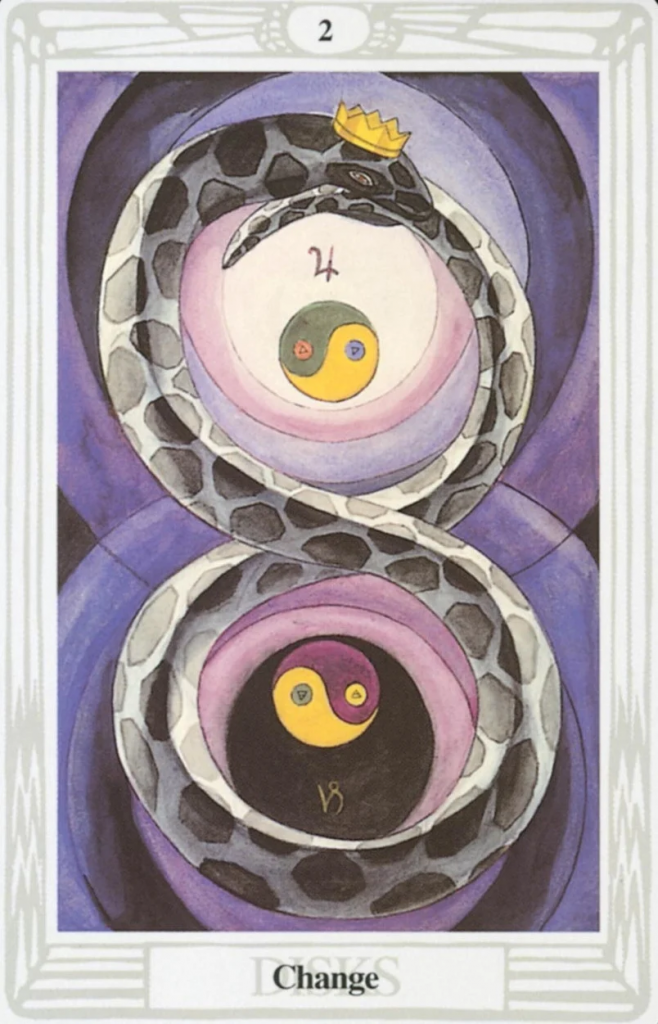
Tarot Card for May 20: The Lord of Change

The Two of Disks

The Lord of Change is a card that indicates the necessity of constant change in life if we are not to stagnate. It often marks a turning point – a new job, a shift of fortune, a move of home.Disks are an earthy suit, covering matters of material life, and the manifest Universe. If you look at the planet we live on, though in itself it seems solid and predictable (less so in recent years, mind you) it is in a constant state of change and movement. It turns in space, and if it did not, we’d all be very unhappy with the consequences. The cycle of seasons swings past us each and every year. The tides ebb and rise. Constant change is natural, normal and positive.We do, though, often fear change in our lives. We will struggle against anything that appears to alter the pre-planned pattern we have applied to our future. But that’s exactly what this card does – instigates change. Sometimes we think that the change is bad – and on the face of it, it may appear to be – yet whenever the 2 of Disks appears, it’s warning us that change has become imperative. Something is stagnating, demanding to be broken down and made over.It’s worth remembering that if you resist the change advocated by the Lord of Change, you might find that life imposes it upon you anyway – and then you’ll feel the effects either of the Death card, or the Tower. When this card appears, it demands a thorough re-assessment of your overall position and willingness to go with the chances that come your way.The card is especially strengthened by cards like Fortune, and positive Disks and Wands. You can usually track down which area of life it applies to by looking at the cards that surround it – Cups would suggest you need to look at your emotional life. Disks would imply that it’s either your working or financial area that needs attention. Swords would probably indicate conflict around whatever changes you need to make, and may point to a need for clear communication. Wands would be more connected with your own application of Will, and the way you are trying to build your life. Major Arcana cards would suggest an inner, more spiritual area needs to be looked at.

Incels and Excels

Novara Media • Premiered 16 hours ago The involuntary celibate community (aka ‘incels’) are often thought to be rightwing, white supremacist, and prone to violence. But how much of that is true? Ash Sarkar is joined by William Costello – a researcher whose work focuses on the psychology of incels – to discuss what we get wrong about incels, what incels get wrong about women, and the catastrophe that is modern dating culture. 00:00 Intro 03:02 Kendrick vs. Drake 08:13 Why Study Incels? 10:43 What are Incels? 16:56 Are Incels Violent? 27:02 What do Heterosexual Women Want? 33:01 ‘The apps’ and Dating Culture 46:58 What is the Model for Relationships? 55:46 Evolution and Sexual Violence 1:13:04 Are There gay Incels? 1:20:20 Misogyny in Relationships 1:24:19 Changes in Reproductive Politics 1:33:09 What Makes a man More Attractive? 1:39:08 Advice for Incels Novara Live broadcasts every weekday from 6PM on YouTube and Twitch. Episodes of Downstream are released Sundays at 3PM on YouTube.

Gabor Maté and Yanis Varoufakis | HOW TO HEAL FROM THIS TOXIC CULTURE

Eye Of The Storm Podcast • May 1, 2024 This podcast is released alongside the acclaimed new docuseries ‘In The Eye Of The Storm — The Political Odyssey Of Yanis Varoufakis’. Watch it here: http://www.eyeofthestorm.info Dr. Gabor Maté is a renowned speaker and bestselling author, highly sought after for his expertise on a range of topics including addiction, stress and childhood development. To find out more, go to: https://drgabormate.com/about/ Yanis Varoufakis is an economist, politician, author and the former finance minister of Greece. To find out more, go to: https://www.yanisvaroufakis.eu/ Raoul Martinez is a philosopher, author and filmmaker. To find out more, go to: http://www.creatingfreedom.info ‘Eye Of The Storm Podcast’ will release new episodes each week with renowned guests from the world of politics and the arts. Our first episode, however, kicks off with an in-depth interview with Yanis Varoufakis. Please like and subscribe. PRODUCED BY DAVIDE CASTRO AND FRANCESCA MARTINEZ.

Emmanuel Macron’s Urgent Message for Europe

The Economist

Emmanuel Macron’s Urgent Message for EuropeFrench President Emmanuel Macron. (photo: Michel Euler/AP)

18 may 24 (RSN.org)

The French president issues a dark and prophetic warning

In 1940, after France had been defeated by the Nazi blitzkrieg, the historian Marc Bloch condemned his country’s inter-war elites for having failed to face up to the threat that lay ahead. Today Emmanuel Macron cites Bloch as a warning that Europe’s elites are gripped by the same fatal complacency.

France’s president set out his apocalyptic vision in an interview with The Economistin the Elysée Palace. It came days after his delivery of a big speech about the future of Europe—an unruly, two-hour, Castro-scale marathon, ranging from nuclear annihilation to an alliance of European libraries. Mr Macron’s critics called it a mix of electioneering, the usual French self-interest and the intellectual vanity of a Jupiterian president thinking about his legacy.

We wish they were right. In fact, Mr Macron’s message is as compelling as it is alarming. In our interview, he warned that Europe faces imminent danger, declaring that “things can fall apart very quickly”. He also spoke of the mountain of work ahead to make Europe safe. But he is bedevilled by unpopularity at home and poor relations with Germany. Like other gloomy visionaries, he faces the risk that his message is ignored.

The driving force behind Mr Macron’s warning is the invasion of Ukraine. War has changed Russia. Flouting international law, issuing nuclear threats, investing heavily in arms and hybrid tactics, it has embraced “aggression in all known domains of conflict”. Now Russia knows no limits, he argues. Moldova, Lithuania, Poland, Romania or any neighbouring country could all be its targets. If it wins in Ukraine, European security will lie in ruins.

Europe must wake up to this new danger. Mr Macron refuses to back down from his declaration in February that Europe should not rule out putting troops in Ukraine. This elicited horror and fury from some of his allies, but he insists their wariness will only encourage Russia to press on: “We have undoubtedly been too hesitant by defining the limits of our action to someone who no longer has any and who is the aggressor.”

Mr Macron is adamant that, whoever is in the White House in 2025, Europe must shake off its decades-long military dependence on America and with it the head-in-the-sand reluctance to take hard power seriously. “My responsibility,” he says, “is never to put [America] in a strategic dilemma that would mean choosing between Europeans and [its] own interests in the face of China.” He calls for an “existential” debate to take place within months. Bringing in non-EU countries like Britain and Norway, this would create a new framework for European defence that puts less of a burden on America. He is willing to discuss extending the protection afforded by France’s nuclear weapons, which would dramatically break from Gaullist orthodoxy and transform France’s relations with the rest of Europe.

Mr Macron’s second theme is that an alarming industrial gap has opened up as Europe has fallen behind America and China. For Mr Macron, this is part of a broader dependence in energy and technology, especially in renewables and artificial intelligence. Europe must respond now, or it may never catch up. He says the Americans “have stopped trying to get the Chinese to conform to the rules of international trade”. Calling the Inflation Reduction Act “a conceptual revolution”, he accuses America of being like China by subsidising its critical industries. “You can’t carry on as if this isn’t happening,” he says.

Mr Macron’s solution is more radical than simply asking for Europe to match American and Chinese subsidies and protection. He also wants a profound change to the way Europe works. He would double research spending, deregulate industry, free up capital markets and sharpen Europeans’ appetite for risk. He is scathing about the dishing-out of subsidies and contracts so that each country gets back more or less what it puts in. Europe needs specialisation and scale, even if some countries lose out, he says.

Voters sense that European security and competitiveness are vulnerable. And that leads to Mr Macron’s third theme, which is the frailty of Europe’s politics. France’s president reserves special contempt for populist nationalists. Though he did not name her, one of those is Marine Le Pen, who has ambitions to replace him in 2027. In a cut-throat world their empty promises to strengthen their own countries will instead result in division, decline, insecurity and, ultimately, conflict.

Mr Macron’s ideas have real power, and he has proved prescient in the past. But his solutions pose problems. One danger is that they might in fact undermine Europe’s security. His plans could distance America, but fail to fill the gap with a credible European alternative. That would leave Europe more vulnerable to Russia’s predations. It would also suit China, which has long sought to deal with Europe and America separately, not as an alliance.

His plans could also fall victim to the unwieldy structure of the EU itself. They require 27 power-hungry governments to cede sovereign control of taxation and foreign policy and to give more influence to the European Commission, which seems unlikely. If Mr Macron’s industrial policy ends up bringing more subsidy and protection, but not deregulation, liberalisation and competition, it would weigh on the very dynamism he is trying to enhance.

And the last problem is that Mr Macron may well fail in his politics—partly because he is unpopular at home. He preaches the need to think Europe-wide and leave behind petty nationalism, but France has for years blocked the construction of power connections with Spain. He warns of the looming threat of Ms Le Pen, but has so far failed to nurture a successor who can see her off. He cannot tackle an agenda that would have taxed the two great post-war leaders, Charles de Gaulle and Konrad Adenauer, without the help of Germany’s chancellor, Olaf Scholz. Yet their relationship is dreadful.Mr Macron is clearer about the perils Europe is facing than the leader of any other large country. When leadership is in short supply, he has the courage to look history in the eye. The tragedy for Europe is that the words of France’s Cassandra may well fall on deaf ears.