What would it be like to catch up to a beam of light? That was the question that the 16 year old Einstein asked himself. Ten years later, he would publish his answer: you cannot catch it at all.
That doesn’t stop physicists from trying to use Einstein’s theory to explain what a beam of light might “experience”. Unfortunately, they almost always get it wrong because they try to transfer our concept of time to light inappropriately.
There are different ways to think about time in physics. A dimension is “timelike” if it has a metric signature that is the opposite of your space dimensions. We define a dimension using a coordinate. Moving in a particular dimension means making a small displacement such that all but that coordinate stay the same. A metric, meanwhile, is a mathematical object that allows us to measure distances in multidimensional spaces with arbitrary coordinate systems.
You can see right away that it is possible to create coordinate systems where our concepts of time and space might be very complicated over long distances. For example, if I were to take a spacetime and define a hyperspherical coordinate system on it somewhat arbitrarily, there is no guarantee that any particular coordinate direction will align with my familiar concept of time. In such a system I would have three angles and a radial direction. If I were to define it such that time is in an angular dimension rather than the radial one, that might work for a small amount of time but eventually time which I perceive would deviate from that dimension. You could say this is just a bad choice of coordinates and you’d be right. Still, nevertheless, at any given point there will be a particular direction that is “timelike” in the sense that if I apply my metric to it, it will be negative (assuming we choose our signs so that timelike is negative and spacelike is positive which is often written -+++).
In the familiar four dimensions we normally work with there is only one dimension of time. That means that, for a given observer, there is a timelike Killing vector that defines time for them. A Killing vector is another useful mathematical object, and all it says is that if I displace a small amount in the direction of this Killing vector then all the other points get displaced such that they stay the same in relation to one another.
Wikimedia Commons.
The above is an example I copied from Wikipedia just for illustration purposes. In this case, the Killing vectors are the white arrows. If you move along these vectors, the circle rotates, so nothing changes.
If I have a particle moving through spacetime, it traces out a line called a world line. In this case, its Killing vector is simply in the direction of its motion in spacetime. If we are in the particle’s reference frame, meaning it is not moving at all from our perspective, then that vector would simply be in time alone.
Worldline in Einstein’s Special Relativity. Wikimedia Commons.
Another perspective on time is a little different and that has to do with the perception of time. Things don’t just move in time, they experience change in time. As far as we know, we never experience more than one moment of time simultaneously. That sense of experience of time is sometimes called a temporal dimension. It is not present in the theory of general relativity at all because in that theory time is treated like an ordinary dimension. Time is only special because it is timelike so it has a causal structure. That causal structure, however, doesn’t tell us anything about how time is experienced.
Our experience of time, the fact that time has an arrow and things flow from past to future, is only contained in one physical theory: thermodynamics (as well as its quantum equivalent). Yet, these theories are not fundamental but only look at how particles (or more generally what are called microstates) behave in large numbers. Fundamentally, there is no real explanation for the arrow of time.
Our dimension of time, the one we are familiar with, has both of these properties: it is timelike, and it is temporal.
I came across an idea for how to explain what time is like for light while playing around with a coordinate system called the Infalling (or in-going) Eddington-Finklestein coordinate system. This coordinate system was first written down by Sir Roger Penrose but he credited papers by Arthur Eddington and David Finklestein. The classic textbook on general relativity, Gravitation by Misner, Thorne, and Wheeler, affectionately known by those in the biz as “MTW” also used this name. It has stuck ever since.
This coordinate system was developed to look at black holes from the perspective of beams of light falling in. Thus, imagine you are riding a beam of light as if falls in.
In general relativity, a beam of light follows a null trajectory, meaning that if you calculate the length of its velocity vector in four dimensions, its length is zero. That may seem counter-intuitive, but, in spacetime, when computing distances, the square of the time component of the velocity has the opposite sign of the space components. If the length of the time component, the temporal speed, is equal to the spatial speed, you have a null trajectory. The only objects that have spatial and temporal speeds the correct sizes for this to happen are those going the speed of light. All such objects also, by definition, have no “rest mass”, meaning if we could ride those beams of light we would measure no mass.
Many science communicators, including professional physicists, attempt to explain what you would experience as a beam of light by imagining what happens as a massive object, such as yourself, accelerates closer and closer to the speed of light. From the perspective of someone watching you accelerate, you would appear to slow down more and more. Since this process continues indefinitely, it would seem that at the speed of light, which you can never reach, your clock would stop and you would no longer experience time.
This isn’t quite correct, however, because nothing with rest mass can have a null trajectory. As you approach the speed of light, rather, the length of your four-dimensional velocity stays the same, nonzero. As your spatial speed increases, instead, your temporal speed also increases to compensate. That is why you appear to slow down. At the speed of light, the lengths of these two speeds would be effectively infinite, so, yes, your clock might stop. (Your spatial and temporal speed become infinite rather than just equal to the speed of light because of its Lorentz factor, which gets multiplied by the two values to express the total velocity in spacetime.)
This means that you are not approaching anything like a null trajectory as you accelerate. For the beam of light, both temporal and spatial speed are finite and they are both, in the right units, the speed of light itself, not infinity.
Thus, while your clock does become infinitely slow to an outside observer as you approach the speed of light, light itself has a perfectly ordinary ticking clock that can never change. It never gets slower and never gets faster. It is always the same for all observers: exactly the speed of light. Yet, one cannot exist within the rest frame of light and so the one place where such a clock does not exist is there.
In other words, it is meaningless to talk about what a beam of light experiences because such a statement presumes a rest frame, and light doesn’t have one.
There is, however, a way in which light does not perceive the passage of time and we can understand that if we look at light falling into black holes.
Black holes put massive and massless objects on a more even playing field where we can compare the two and what happens as they approach the event horizon.
In our usual coordinate system for a black hole, which represents a distant, stationary observer, as an astronaut approaches the event horizon time slows down. If they have a clock with them sending out regular pulses back to the distant observer, the interval between the pulses would get longer and longer until they would effectively stop. We can know that because the time coordinate becomes infinite at the event horizon. We say there is a singularity there.
This singularity, at the event horizon, however, is not a real one but a coordinate singularity, and we can remove it with a new coordinate system.
When we change coordinate systems, however, we are changing our perspective. The infalling EF coordinates change that perspective to that of a light beam falling into the black hole.
In these coordinates, we have a new kind of time parameter, usually called v, which is a combination of our usual time and a radial coordinate called the tortoise coordinate. The tortoise coordinate goes to negative infinity as one approaches the event horizon of a black hole.
We now add together our old time coordinate and the tortoise coordinate and the infinities cancel each other out. (We can formalize this cancellation using the mathematical concept of limits.)
This new coordinate, v, when kept constant, represents the trajectory of a beam of light falling into the black hole.
Unfortunately, the picture of EF coordinates on Wikipedia is misleading, but you can look at the correct picture here in Figure 19.4. Essentially, the constant v lines lie on the edge of light cones as they turn in towards the black hole.
Now, suppose I want to take a spacetime in infalling EF coordinates and decompose it into space evolving in time rather than only individual trajectories. We call space at a given moment in time a spatial slice. These spatial slices evolve along lines where v is constant, meaning that the change in v from slice to slice is zero.
Since v stands in for our time coordinate here, it is clear that “time” isn’t changing from slice to slice. We still move forward from slice to slice from the perspective of a distant observer, but, from the perspective of an internal observer, there is no movement. The clock is always pointing to the same time from the beginning of the universe to the end.
This is the correct way to think about a beam of light. Rather than imagining a massive body accelerating to the speed of light, we simply imagine a coordinate system that is aligned with light trajectories.
It turns out that our intuition from special relativity is correct. Light has no experience of time at all. Every point along the beam has an independent existence as if it were in a separate universe from all the others.
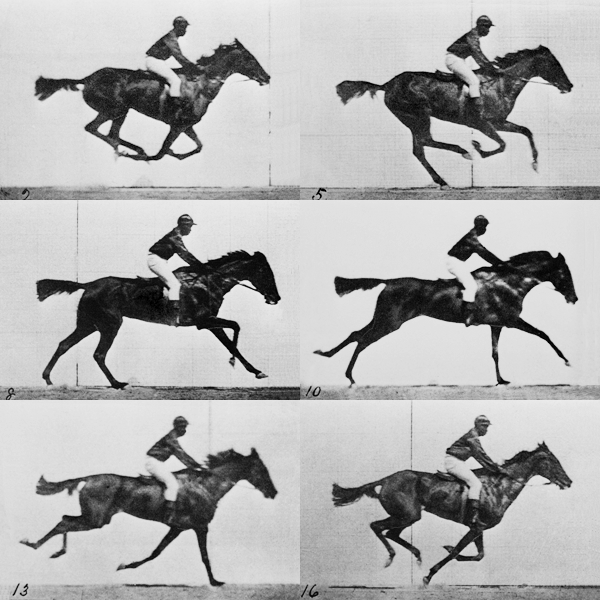
We can illustrate this with an analogy. For a massive body, you can imagine a flipbook with an animation. As you flip the book, you see a horse galloping.
The sequence is set to motion using these frames, originally taken from Eadweard Muybridge’s Human and Animal Locomotion series, (plate 626, thoroughbred bay mare “Annie G.” galloping) published 1887 by the University of Pennsylvania
To simulate this picture approaching the speed of light, you could insert more and more pages so the horse appears to gallop more and more slowly. At the speed of light, this stack becomes infinitely large. For a light beam, however, every page in the flipbook shows the same image of a horse. It isn’t infinitely large. It is just all the same.
Unlike the moving horse, where the difference between one page and the next has some meaning as an interval of time, the difference between one page and the next in the stationary flipbook has no meaning. You can have one page or an infinite number of pages. There is no meaningful definition of time. It has ceased to exist.
The other interesting feature of light falling into black holes is that, while they can fall in, they cannot emerge.
Thus, like time itself and like thermodynamics, entering a black hole has an “arrow”. It works in one direction but not the reverse. (This arrow is very closely related to thermodynamics in fact.)
Since the beam of light does not experience time passing, does that mean it is both inside and outside the black hole at the same “time”?
Not exactly, rather, every point along its trajectory is, in a sense, separate from every other point, as if each point were in its own universe. Whereas a massive body evolves in time from its perspective because it has a timelike Killing vector, a beam of light has no evolution from its own perspective (while it does from ours). Its worldline has a null Killing vector. For itself it is more like a string draped across space and time than a thing in motion. The irreversibility of its motion is only apparent from an observer following a timelike trajectory like us. For a beam of light, the past and future are all the same.
On March 25th, 2024 we have a Lunar Eclipse at 5° Libra.
The Lunar Eclipse in Libra is trine Pluto at 1° Aquarius, giving us an opportunity to delve deep into our relational dynamics and transform them for the better.
This is a South Node Eclipse. South Node eclipses bring karmic clearance. We tie the loose ends. We revisit the past. We finish what is unfinished.
Libra describes our relational patterns. The South Node eclipse in Libra will prompt us to reflect on past relationships, reconcile unresolved conflicts, and release any lingering attachments or baggage.
We all know that humans are social animals.
But why do we need people? Why are relationships so important?
In a one-on-one relationship – romantic, friendship, etc. – we attract what’s missing from ourselves, or what could help us understand ourselves better and grow into the best version of ourselves. The partner becomes a mirror reflecting back to us aspects of ourselves that we may not readily see.
We are particularly drawn to people whose wounds trigger ours, so that, by acting out those wounding dynamics, we can heal them together.
Lunar Eclipse In Libra – Games People Play
Our relationships are a reproduction of the relationships and relational patterns we witnessed in our first years of life: the relationships between our parents, caregivers, or family members.
We then unconsciously re-create these early dynamics in our adult relationships so we can ‘work them out’.
We play ‘games’ or enact patterns where we reproduce what we’ve learned in the first years of our lives. A ‘game’ as defined by psychologist Eric Berne, is a pattern of behavior involving two people. There is a series of interactions, followed by an emotional payoff.
These games are not about manipulation or power struggles; these ‘games’ are unconscious; we are not aware we are playing them.
We all play unconscious games – especially in relationships – by creating certain relational dynamics that re-enact the familiar scenarios and emotional responses we experienced in childhood.
The pull to repeat past relational dynamics witnessed early in life is very strong. Because of this familiarity and conditioning, we are pretty much wired to relate in certain ways, and attract certain types of people in our lives.
We may tell ourselves: my partner is nothing like my mother/father. I had an alcoholic partner, but my partner doesn’t drink. I’ve succeeded in breaking the cycle.
But if we go a bit deeper, we often find similar psychological drivers and relationship dynamics.
Yes, the partner may not drink alcohol, but they may still exhibit behaviors that mirror the underlying issues behind drinking: perhaps they struggle with self-confidence, or with managing their feelings. The underlying pattern is still there, even if the partner does not use alcohol to manage it.
The reason we attract people with a certain wound or psychological profile is precisely to recreate that early pattern in the hopes of understanding it and eventually healing it. By healing the unavailable parent/partner dynamic, we heal ourselves.
Generically speaking, there is nothing wrong with choosing partners who remind us of our parents. We are wired to do it so we can eventually elevate to the next level of awareness and understanding.
But the key word here is ‘awareness’.
If awareness is not present, we get caught in an endless loop of relational repetitions. Things may start out differently when we have a new partner, to eventually progress into the same type of relationship dynamics we experienced so many times before.
South Node Lunar Eclipse In Libra
There comes a time when you’ve had enough. “I’m just tired of this”.
The unconscious game has been played so many times that it has become conscious. “Ah, I’ve always been doing this, now I see it”. “I’m always reacting to this trigger in this way, which leads to a very specific outcome”. “Things finally click and make sense”.
There comes a time when we realize that dwelling in the past is a dead-end street. Ruminating on a million reasons why things are as they are becomes a futile exercise. There IS another way: we can leave the past where it belongs, and shift our focus on what we can change.
Letting go doesn’t invalidate our past. It doesn’t make our wounds less real. But it does open up space for growth and healing.
The South Node Eclipse in Libra on March 25th is the ideal time to release old relational patterns that no longer serve us.
How do we let go of the past? How do we move forward?
Chiron, Mercury, And North Node In Aries – Healing Our Identity Wound
The answer to a South Node eclipse can be found in the North Node.
The Moon and South Node are in Libra; the Sun, North Node, Mercury and Chiron are in Aries. What can Libra learn from Aries?
While Libra is very good at keeping peace (and everyone happy), Libra is not very good at asserting herself.
We call Aries “assertive” as if it’s a competitive, almost selfish-like quality. It’s as though the assumption is that if we go after what we want, someone else has to lose.
But that’s not what Aries is about. Aries is that kindle, that fire, that spark of life that just “is”. Aries’ relationship with themselves and the world at large is instinctual.
And there is deep wisdom in Aries’ instinct. Aries energy is so alive, so rooted in the present moment, that it immediately grasps the essence of a situation. And from that place of engagement and aliveness, it just “knows” what to do.
Libra energy, on the other hand, has a tendency to overthink. In their desire to maintain peace they may end up suppressing themselves or others: “You can’t say this”. “Don’t be so rude”.
While it’s true that there are some social norms to adhere to, at the same time, our instincts, feelings, and actions are 100% legitimate.
Every little thing about you as an individual is the truth, because you are TRUTH – you exist. Not listening to your inner knowing is invalidating your existence.
Listening to your Aries instinct is not synonymous, and does not justify selfishness, instant gratification, or harming others.
But you’ll likely find that when you are TRULY in touch with that part of you that is Aries, with that part of you that is alive, you’re not only validating yourself – but all the other human beings.
Judging and criticizing yourself is denying your right to ‘be’. Judging and criticizing others is denying their right to ‘be’.
When we are not happy with ourselves, or with the place we’re at in our life, we unconsciously reject, or find flaws in everyone else. Judgment is a symptom of an unhealed identity wound.
Chiron is conjunct Mercury and North Node in the next 5 weeks, offering us a unique opportunity to heal our identity wound – a wound we are all born with.
In the coming weeks, Mercury will be retrograding over Chiron and the North Node, helping us untangle past stories and rewrite our future. This time we can truly break the cycle of conditioning.
Chiron – Your Deepest Wound, Your Greatest Gift
Chiron – Your Deepest Wound, Your Greatest Gift is a 3-step framework that will help you get to the essence of your wound, break the repetitive cycle, and rewrite the story of your life.
The course is timed to take advantage of the powerful astrological backdrop of the moment:
We start with Module 1 “The Wounded Healer” on March 25th, 2024, at the Lunar Eclipse in Libra. In this module, we will untangle the story of your wound by analyzing Chiron’s placement in our natal chart, and understand how our wound is influenced by past conditioning.
Module 2 “The Shaman” becomes available on April 1st, 2024 when Mercury goes retrograde to conjunct Chiron and the North Node. In this module, we analyze transits from the past, and recollect past events and experiences (Mercury retrograde) that will help us understand the story of our wound in very specific, relatable terms.
On April 7th, 2024 (when Chiron is conjunct the Sun) we will engage in guided meditation that will help us find healing and integration.
Module 3, “The Alchemist” becomes available on April 8th, 2024, when we have a very powerful Solar Eclipse in Aries, conjunct Chiron.
In this module, we will come back to our natal chart, and this time, look at our Chiron story from the Alchemist lens. What is the wound trying to tell us? What is the higher purpose of our wound? What’s the gift behind the wound?
The registration for “Chiron – Your Deepest Wound, Your Greatest Gift” closes on March 24th, 2024 (on March 25th, 2025 we start).
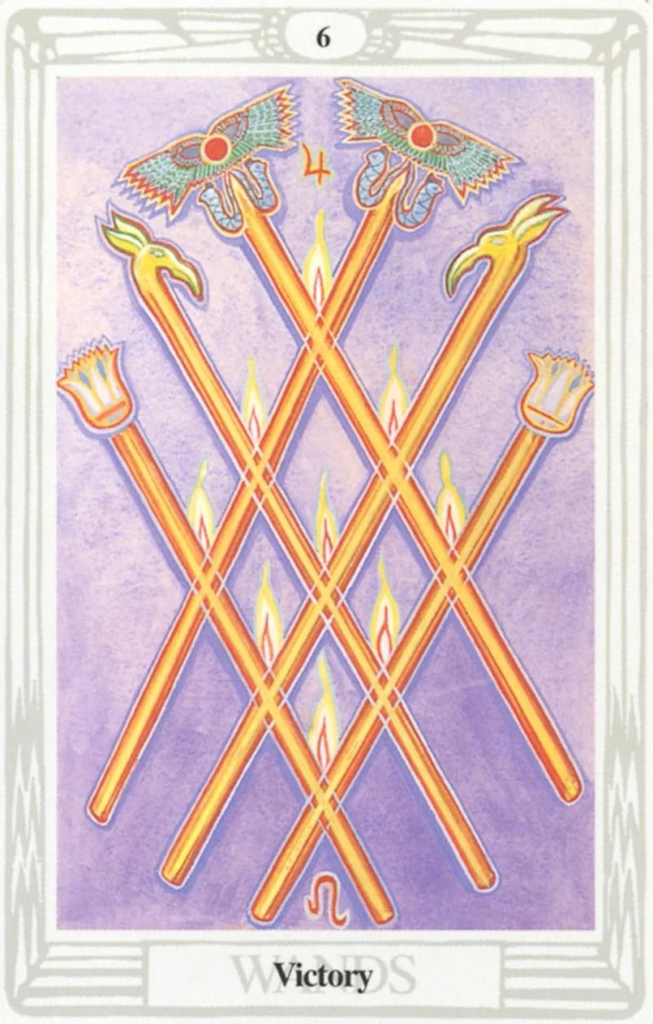
The Lord of Victory is a card of fight, competition and eventual victory. It applies to areas of our lives where we feel we have had to fight very hard to achieve our goals. It can apply to any area of our lives where we have had to contest our position strongly.So, for instance, it could indicate passing successfully through tough training courses; it could apply to spiritual development after a period of test and trial; it could show that we have managed to establish stable and harmonious relationships through hard work and tenderness; it could even indicate that we have finally managed to get our bank balances to match our desired level of spending after much difficulty!It’s a card which indicates that we have achieved both a point of balance and a moment of ascension during which we feel justifiably proud of ourselves, but maybe just a little overwhelmed by our final breakthrough into good fortune.There will always have been struggle before this card appears. We will have been striving – sometimes against frustratingly unhelpful influences – to grasp our dreams, our hopes, our ambitions, our needs. There will sometimes have been pain or confusion as a result of that struggle. But when this card comes up, we can relax a little, and enjoy the fruits of our labour.
Our very cells respond to the thoughts we think. With every word, silent or spoken, we influence the body’s functioning. We participate in the life of the universe itself. If my consciousness grows lighter, then so does everything within and around me. This means, of course, that with every thought, I can start to re-create my life. In saying yes to new beginnings, I begin to bring them forth.
Today I am open to a life reborn, arisen from the ashes of my wounded self and any limits born of circumstances that are no more. I am willing to be renewed and repaired by the spirit of God’s love. I am willing to forgive.
A boy fetches water from his family’s well to wash clothes in Lilongwe, Malawi on February 20, 2023 in an area that has been highly affected by a cholera outbreak due to scarce access of clean drinking water.
(Photo: Fredrik Lerneryd/AFP via Getty Images)
“When big corporations pollute or consume huge amounts of water, communities pay the price in empty wells, more costly water bills, and contaminated and undrinkable water sources,” one advocate said.
Only around a quarter of the most influential food and agricultural companies in the world have promised to reduce their water usage and decrease water pollution, Oxfam reported Thursday.
Oxfam’s analysis comes a day before the United Nations’ World Water Day on March 22. It points out that, according to U.N. figures, 2 billion people cannot reliably access safe drinking water, yet a full 70% of fresh water withdrawals go to agriculture.
“When big corporations pollute or consume huge amounts of water, communities pay the price in empty wells, more costly water bills, and contaminated and undrinkable water sources,” Oxfam France executive director Cécile Duflot said in a statement. “Less water means more hunger, more disease, and more people forced to leave their homes.”
“We clearly can’t rely on corporations’ goodwill to change their practices—governments must force them to clean up their act, and protect shared public goods over thirst for profit.”
Oxfam’s analysis was based on data on the 350 most influential food and agricultural companies from the World Benchmarking Alliance. These include agricultural companies like Bayer, Cargill, and Tyson; food and beverage makers like Nestlé, Coca-Cola, and PepsiCo; major retailers like Walmart, Kroger, and Carrefour; and restaurants like McDonald’s and Starbucks.
Oxfam found that only 28% of these companies had plans to reduce water use, and only 23% had plans to curb water pollution. At the same time, less than half of the companies—108 out of 350—even reported how much water they took from water-stressed locations.
Water scarcity is a major impediment to global well-being, with the climate crisis already exacerbating the problem. Currently, around half of all people on Earth experience severe water scarcity for at least one month each year, according to the Intergovernmental Panel on Climate Change. In northern Kenya, southern Ethiopia, and parts of Somalia, Oxfam found that as many as 90% of water boreholes had evaporated in 2023. Further, 1 in 5 people in the region did not have access to sufficient safe drinking water. World Weather Attribution concluded that the drought in the Horn of Africa was made more severe because of the climate crisis, and that similar droughts were 100 times more likely because of global heating.
Despite climate-driven extreme weather events that put increased strain on water resources, major companies have not changed their business models. For example, the bottling and re-selling of water is a common corporate practice that, according to the U.N., impedes the sustainable development goal (SDG6) of ensuring safe drinking water for all.
In May 2023, Oxfam pointed out, a drought in France’s department of Puy-de-Dôme prompted authorities to restrict the water use of its thousands of residents for two months. However, Danone-subsidiary the Société des Eaux de Volvic was still permitted to extract unrestricted amounts of groundwater during the drought for its bottling plant. That year, Danone amassed €881 million ($956 million) in profits and rewarded shareholders to the tune of €1,238 million ($1,344 million).
“We clearly can’t rely on corporations’ goodwill to change their practices—governments must force them to clean up their act, and protect shared public goods over thirst for profit,” Duflot said.
To ensure water justice, Oxfam said that governments should treat water as a human right; enforce consequences for companies when they violate environmental or human rights laws; and invest in water, sanitation, and hygiene services.
Our work is licensed under Creative Commons (CC BY-NC-ND 3.0). Feel free to republish and share widely.
Translation is a 5-step process of “straight thinking in the abstract.” The first step is an ontological statement of being beginning with the syllogism: “Truth is that which is so. That which is not truth is not so. Therefore Truth is all there is.” The second step is the sense testimony (what the senses tell us about anything). The third step is the argument between the absolute abstract nature of truth from the first step and the relative specific truth of experience from the second step. The fourth step is filtering out the conclusions you have arrived at in the third step. The fifth step is your overall conclusion.
The claims in a Translation may seem outrageous, but they are always (or should always) be based on self-evident syllogistic reasoning. Here is one Translation from this week.
!) Truth is that which is so. That which is not truth is not so.. Therefore truth is all that is. Truth being all is therefore total, therefore whole, therefore complete, therefore full, therefore plenty, therefore all present and accounted for. I think, therefore I am. Since I am and since Truth is all that is, therefore I am Truth. Since, i, being, am Truth, therefore I, being, am all the attributes of Truth. Therefore I, being, am total, whole, complete, full, plenty, all present and accounted for. Since I, being, am Truth and since I am mind/consciousness, therefore Truth is Mind/Consciousness.
2) Bullies don’t care about collateral damage.
Word-tracking: bully: intimidate weaker people, mistreat weaker people intimidate: make timid, weak, small, fearful people: mortals strength: power, potent, the ability to be collateral: side effects, not the main intent, secondary or subordinate damage: harm, fee, expense
3) A bully is someone who intimidates others, makes others timid, small, weak, fearful, so bullies don’t pick on weak people, they thrive on making people weak. Truth being the only being and potency or power being the ability to be, therefore Truth is the only power. Truth being the only power, there can be no stronger and weaker people, Therefore Truth is immortal, unlimited, infinite, indivisible Consciousness. Truth being immortal, unlimited, infinite, indivisible Consciousness obviously cannot be intimidated since there is nothing other than Truth to intimidate anything. Therefore Truth/Consciousness is the unquestioned power of the Universe. Since Truth is the sole force/mover in the Universe, therefore Truth is all that can be moved, Therefore Truth is the sole movee. Truth being the sole movee, and Truth being the sole effector, there can be no side effects (collateral damage) in truth, therefore Truth is the sole subject and the sole object.
4) Truth is the only power. Truth is immortal, unlimited, infinite, indivisible Consciousness. Truth/Consciousness is the unquestioned power of the Universe. Truth is all that can be moved, Truth is the sole movee. Truth is the sole subject and the sole object.
5. There is nothing secondary or subordinate to the indivisible power of Truth/Consciousness.
Yesterday the World Meteorological Organization officially certified 2023 as the hottest year in human history. Just to put on the record here what should have been the lead story in every journal and website on our home planet:
Andrea Celeste Saulo, secretary general of the WMO, said the organisation was now “sounding the red alert to the world”.
The report found temperatures near the surface of the earth were 1.45C higher last year than they were in the late 1800s, when people began to destroy nature at an industrial scale and burn large amounts of coal, oil and gas.
It could imply that a warming planet is already fundamentally altering how the climate system operates, much sooner than scientists had anticipated. It could also mean that statistical inferences based on past events are less reliable than we thought, adding more uncertainty to seasonal predictions of droughts and rainfall patterns.
Much of the world’s climate is driven by intricate, long-distance links — known as teleconnections — fuelled by sea and atmospheric currents. If their behavior is in flux or markedly diverging from previous observations, we need to know about such changes in real time.
And now, with equal care, read the words of the biggest oil producer on earth, the CEO of Saudi Aramco, who was in Houston last week for the annual hydrocarbon festival known as CERAWeek.
“We should abandon the fantasy of phasing out oil and gas and instead invest in them adequately reflecting realistic demand assumptions.”
That is to say, the powers that be want to abandon what the World Meteorological Organization, in their ‘red alert’ report called the “one glimmer of hope”: that renewable energy installations rose fifty percent last year.
Understand that the battle is fully joined. The fossil fuel industry—as Exxon CEO Darren Woods helpfully explained—is in an all-out fight to derail anything green, because it won’t return “above average profits.” They have plenty of allies: everyone noted Donald Trump threatening a “bloodbath” last week, but fewer noted the actual target of his wrath: electric vehicles. The Biden administration, after listening to the rhetoric at the Houston conference, backed EVs in a straightforward and earnest way today, announcing new rules that attempt to spur the rapid growth of a crucial climate-fighting technology. But of course that produced the requisite reaction: as the Times reported,
The American Fuel … Petrochemical Manufacturers, a lobbying organization, has started what it says is a “seven figure” campaign of advertising, phone calls and text messages against what it falsely calls “Biden’s E.P.A. car ban” in the swing states Pennsylvania, Michigan, Wisconsin, Nevada and Arizona, as well as in Ohio, Montana and the Washington, D.C., market.
So, like it or not, the climate crisis is going to be a key part of this election campaign. The November outcome may hinge on whether Americans can imagine making even this small change in the face of the gravest crisis our species has ever wandered into: replacing the gas tank in a car with a battery. That doesn’t seem like much to ask?
It won’t solve the climate crisis, of course—nothing will solve it. But accelerating momentum towards green energy is the likeliest card we have to play in a world where people seem unwilling to moderate their demands for mobility, and indeed for consumption of any kind.
One particularly depressing set of statistics about that ever-increasing demand for more emerged last week, as the energy implications of artificial intelligence started to become clearer. Here’s what Bloomberg reported earlier today:
John Ketchum, CEO of utility NextEra Energy Inc., told attendees that US power demand, which has been relatively flat for years, is poised to increase by 81% over the next five years. Toby Rice, chief of the largest US natural gas driller, EQT Corp., cited a prediction that AI will gobble up more power domestically than households by 2030.
As Elizabeth Kolbert explained in the New Yorker a few days ago, this “obscene” power demand comes because when you ask AI to, say, help you with your bracket for the NCAA tournament, it has to sort through all human knowledge ever. As even AI apostle Sam Altman explained at Davos this year
“I think we still don’t appreciate the energy needs of this technology.” He didn’t see how these needs could be met, he went on, “without a breakthrough.” He added, “We need fusion or we need, like, radically cheaper solar plus storage, or something, at massive scale—like, a scale that no one is really planning for.”
The truth is, there’s no way we can build out renewable energy fast enough to meet this kind of extra demand—it’s going to be at the bleeding edge of the technically and politically possible to power the things we already do, live drive cars and heat homes. And so, in a rational world, faced with an emergency, we would put off scaling AI for now. The irony, of course, is that’s it’s often been touted as a tool to help solve climate change. But we have the tools we need—plain old intelligence gave us cheap solar panels.
With the able technological assistance of my wife, I asked Anthropic’s AI bot Claude to comment. It was amazing how much he sounded like a pr man; after spinning a lot of jargon-filled guff about how “responsible AI can likely be part of the solution to environmental challenges,” he allowed as how he had no idea how much energy he was using. “In general, the electricity usage of large language models like myself is a relevant consideration from an environmental perspective, but quantifying the exact amount would require additional information I don’t have access to.”
Whatever. What we need is not more intelligence. We need more wisdom, to guide us through this pinchpoint in the human experiment. Including the wisdom to say no to some things, at least until the emergency subsides.
In other climate and energy news:
+Randall Morton, the stalwart founder of Houston’s Progressive Forum, had an excellent oped in the local paper last week trying to explain why it was a losing bet—for the city and the industry it calls home—to keep sticking with fossil fuel:
The GHP’s risky strategy, called the “Energy Transition Initiative,” is focused on two technologies: hydrogen and carbon capture. Both are bets on fading fossil fuels. Today, 95% of hydrogen in the U.S. is made from natural gas processing. If an industry ever develops for hydrogen, it would sell as a commodity in an intensely competitive market. Commodity profit margins are notoriously ultra-slim, so hydrogen isn’t a likely platform for robust prosperity or high-paying employment growth.
Carbon capture is disguised as a climate solution, promoted as a way to produce “low carbon” oil and gas. It’s a failing technology and unfit as a prospect for regional growth. There is little evidence to show any project has demonstrated meaningful effectiveness. A typical example is the world’s largest carbon capture system, Chevron’s Gorgon LNG Project in Western Australia. Designed to deploy one of the most familiar technologies of stripping carbon dioxide from a well’s gas flow and injecting it underground, the system has not managed to operate above a third of its design capacity in seven years, according to leading Australia news source, WAToday.
+Warmer winters are apparently producing more feral cats (and hence fewer birds…). Grist reports
Across the United States, summer is the height of “kitten season,” typically defined as the warm-weather months between spring and fall during which a cat becomes most fertile. For over a decade, animal shelters across the country have noted kitten season starting earlier and lasting longer. Some experts say the effects of climate change, such as milder winters and an earlier start to spring, may be to blame for the uptick in feline birth rates.
This past February, Dunn’s shelter held a clinic for spaying and neutering outdoor cats. Although kitten season in Northern California doesn’t typically kick off until May, organizers found that over half of the female cats were already pregnant. “It’s terrifying,” Dunn said. “It just keeps getting earlier and going later.”
+Writing in Nature, Daniel Grossman profiles some of the scientists now getting arrested for climate protests. While talking about her experience getting arrested for holding a banner at a meeting of the American Geophysical Union, an act that got her fired, Rose Abramoff
welled up and wiped away a tear. It’s the third time in eight months that a climate scientist or climate negotiator has choked up during an interview with me, something I haven’t witnessed before in my 25 years of climate reporting.
After working on the IPCC report, Abramoff decided that she needed to take more concrete action. On 6 April 2022, she chained herself to the White House fences during a climate protest. She was arrested on the same day that fellow scientist Peter Kalmus was arrested on the other side of the continent. There were news stories, with pictures of her dressed in a white lab coat. She draws on her background as a performer during protests. “The types of things that get media attention are a little theatrical and visually interesting.”
Since her arrest two years ago, Abramoff has blockaded banks and the White House Correspondents’ Dinner, glued herself to a fence at a private jet terminal, occupied a state Capitol building and tried to shut down the construction of a natural-gas pipeline. Seven of her 14 actions have led to arrests.
+The always-interesting Zeke Hausfather has an essay on the difficulties of figuring out if forestry schemes are actually saving carbon
The world has already reached peak pasture, and global population is expected to peak and decline over the next 60 years. This will reduce the demand for agricultural land, and other regions may follow the lead of the US Southeast with natural afforestation.
For reforestation to permanently remove carbon requires proving that forests never regrow in the absence of human intervention. Otherwise projects are just capturing the time delta between when the forest regrows due to human intervention and when vegetation would have naturally recover.
However, the very areas that are usually targeted for reforestation are the most likely to naturally recover given the absence of more economically viable utilization options (which would kill the economics of reforestation in many cases).
+Don’t miss the new in-depth podcast series on LNG and the Gulf Coast from WWNO in New Orleans. All Gassed Up
And if you’re on the West Coast don’t miss the chance to come to a workshop on how to use the crucial En-ROADS interactive climate simulator. This is among the most important tools we have for understanding how to plot a workable future.
+From the redoubtable Abe Streep, a wonderfully reported piece on how—just as we need them most—low pay and lousy management are driving wildland foresters away from the job.
In the past three years, according to the Forest Service’s own assessments, it has suffered an attrition rate of 45% among its permanent employees. Many people inside and outside the fire service believe this represents one of the worst crises in its history. Last spring, as the 2023 fire season was getting started, I asked Grant Beebe, a former smokejumper who now heads the Bureau of Land Management’s fire program, if there had been an exodus of wildland firefighters. He initially hesitated. “‘Exodus’ is a pretty strong word,” he said. But then he reconsidered. “I’ll say yeah. Yeah.”
Although nobody could provide precise numbers, leaders like Beebe are especially concerned that the attrition has been particularly acute among those with extensive experience. It takes years and hundreds of thousands of dollars to train a wildland firefighter capable of overseeing the numerous resources — engines, helicopters, smokejumpers — that are deployed on large fires. As Beebe put it, “You can’t just hire some person off the street into one of our higher-level management jobs.”
The reasons for the exodus are many, but fundamentally it reflects an inattentive bureaucracy and a culture that suppresses internal criticism. Only in 2022 did the fire service acknowledge an explicit link between cancer and wildland firefighters, even though officials have long expressed concern about the connection. And it was only last year that the fire service held its first conference on mental health, even though officials have been aware for decades of the high incidence of substance abuse and divorce among wildland firefighters.
+Friends of the Earth is doing its best to rally Democratic Senators against new Biden picks for the Federal Energy Regulatory Commission. The latest nomination, David Rosner, has deep ties to Sen. Joe Manchin (D-Pollution). “David Rosner was a paid cheerleader for the LNG boom before it was fashionable,” said Lukas Ross, Climate and Energy Deputy Director at FOE. “We’re calling on Democrats not named Manchin to reject this nomination.”
ARIES (March 21-April 19): I suspect you will soon have far more beginners’ luck than you ever thought possible. For best results—to generate even more wildly abundant torrents of good luck—you could adopt what Zen Buddhists called “beginner’s mind.” That means gazing upon everyone and everything as if encountering it for the first time. Here are other qualities I expect to be flowing freely through you in the coming weeks: spontaneity, curiosity, innocence, candor and unpredictability. To the degree that you cultivate these states, you will invite even more beginner’s luck into your life.
TAURUS (April 20-May 20): Taurus artist Salvador Dali was prone to exaggerate for dramatic effect. We should remember that as we read his quote: “Mistakes are almost always of a sacred nature. Never try to correct them. On the contrary: Rationalize them; understand them thoroughly.” While that eccentric advice may not always be one-hundred-percent accurate or useful, I think it will be true and helpful for you in the coming weeks. Have maximum fun making sacred mistakes, Taurus! Learn all you can from them. Use them to improve your life.
GEMINI (May 21-June 20): The professional fun advisors here at Free Will Astrology International Headquarters have concluded that your Party Hardy Potential Rating for the coming weeks is 9.8 (out of ten). In fact, this may be the Party Hardy Phase of the Year for you. You could gather the benefits of maximum revelry and conviviality with minimal side effects. Here’s a meditation to get you in the right mood: Imagine mixing business and pleasure with such panache that they blend into a gleeful, fruitful synergy.
CANCER (June 21-July 22): Cancerian author and psychotherapist Virginia Satir (1916–1988) was renowned as the “Mother of Family Therapy.” Her research led her to conclude, “We need four hugs a day for survival. We need eight hugs a day for maintenance. We need twelve hugs a day for growth.” That twelve-hug recommendation seems daunting to achieve, but I hope you will strive for it in the coming weeks. You are in a phase when maximum growth is possible—and pushing to the frontiers of hugging will help you activate the full potential. (PS: Don’t force anyone to hug you. Make sure it’s consensual.)
LEO (July 23-Aug. 22): Have you been genuinely amazed anytime recently? Have you done something truly amazing? If not, it’s time to play catch-up. According to my analysis of the astrological omens, you need and deserve exciting adventures that boggle your soul in all the best ways. You should be wandering out on the frontiers and tracking down provocative mysteries. You could grow even smarter than you already are if you expose yourself to challenges that will amaze you and inspire you to be amazing.
VIRGO (Aug. 23-Sept. 22): I invite you to perform a magic spell that will help prepare you for the rich, slippery soul work you have ahead of you. I’ll offer a suggestion, but feel free to compose your own ritual. First, go outside where it’s raining or misting, or find a waterfall. Stand with your legs apart and arms spread out as you turn your face up toward the falling moisture. As you drink it in, tell yourself you will be extra fluid and flowing in the coming weeks. Promise yourself you will stimulate and treasure succulent feelings. You will cultivate the sensation that everything you need is streaming in your direction.
LIBRA (Sept. 23-Oct. 22): You are gliding into the climax of your re-education about togetherness, intimacy and collaboration. The lessons you’ve been learning have deepened your reservoir of wisdom about the nature of love. And in the coming weeks, even further teachings will arrive; even more openings and invitations will be available. You will be offered the chance to earn what could in effect be a master’s degree in relationships. It’ll be challenging work, but rewarding and interesting. Do as best as you can. Don’t demand perfection from yourself or anyone else.
SCORPIO (Oct. 23-Nov. 21): Now is not a favorable phase to gamble on unknown entities. Nor should you allow seemingly well-meaning people to transgress your boundaries. Another Big No: Don’t heed the advice of fear-mongers or nagging scolds, whether they’re inside or outside your head. On the other hand, dear Scorpio, the coming weeks will be an excellent time for the following actions. 1. Phase out attachments to alliances and love interests that have exhausted their possibilities. 2. Seek the necessary resources to transform or outgrow a frustrating fact about your life. 3. Name truths that other people seem intent on ignoring and avoiding. 4. Conjure simple, small, slow, practical magic to make simple, small, slow, practical progress.
SAGITTARIUS (Nov. 22-Dec. 21): Falling in love is fun! It’s also exciting, enriching, inspiring, transformative, world-shaking and educational. Wouldn’t it be fabulous if we could keep falling in love anew three or four times a year for as long as we live? We might always be our best selves, showing our most creative and generous sides, continually expanding our power to express our soulful intelligence. Alas, it’s not practical or realistic to always be falling in love with another new person. Here’s a possible alternative: What if we enlarged our understanding of what we could fall in love with? Maybe we would become perpetually infatuated with brilliant teachings, magical places, high adventures, and great art and music. The coming weeks will be an excellent time for you to cultivate this skill.
CAPRICORN (Dec. 22-Jan. 19): I’m perplexed by spiritual teachers who fanatically preach the doctrine that we should BE HERE NOW as much as possible. Living with full enjoyment in the present moment is a valuable practice, but dismissing or demeaning the past is shortsighted. Our lives are forged from our histories. We should revere the stories we are made of, visit them regularly, and keep learning from them. Keep this in mind, Capricorn. It’s an excellent time to heal your memories and to be healed by them. Cultivate deep gratitude for your past as you give the old days all your love. Enjoy this quote from novelist Gregory Maguire: “Memory is part of the present. It builds us up inside; it knits our bones to our muscles and keeps our heart pumping. It is memory that reminds our bodies to work, and memory that reminds our spirits to work, too: it keeps us who we are.”
AQUARIUS (Jan. 20-Feb. 18): Controversial author William S. Burroughs was a rough, tough troublemaker. But he had some wisdom that will soon be extra useful for you. He said that love is the best natural painkiller available. I bring this to your attention not because I believe you will experience more pain than the rest of us in the coming months. Rather, I am predicting you will have extra power to alleviate your pain—especially when you raise your capacity to give and receive love.
PISCES (Feb. 19-March 20): The planet Saturn entered Pisces in March 2023 and won’t depart for good until February 2026. Is that a bad thing or good thing for you Pisceans? Some astrologers might say you are in a challenging time when you must make cutbacks and take on increased responsibility. I have a different perspective. I believe this is a phase when you can get closer than ever before to knowing exactly what you want and how to accomplish what you want. In my view, you are being called to shed secondary wishes that distract you from your life’s central goals. I see this period as a homecoming—your invitation to glide into robust alignment with your soul’s code.
“Everything you lose is a step you take.” — Taylor Swift
When things begin to crumble before our very eyes, we often try and mitigate the fallout by clinging to the shards of what once was instead of allowing them to go.
Rather than letting people be on their way, we first will cling to them and our feelings well past their expiration dates. We will try to convince ourselves that we are meant to stay in places we know we have outgrown, and so we do. We will remain in roles and situations and mindsets that are clearly not working because to let them go sounds far too painful and risky.
We claim we fight because we put so much of ourselves and our time into these scenarios, relationships, and places that it would feel wasteful to not at least try to keep them. But the truth of the matter is that you can only put off the inevitable so long until fate takes the wheel.
What is meant to go will always leave.
But on the other side of that truth is that the things that are meant to arrive always will as well. And the things that are meant to stay always will, too.
This is not to say that we can’t ache over these things we loved and cared about. This is not to say we shouldn’t take the time to process and feel and all of that. This is to say that we need to keep our perspective when we are able to, however.
When we focus too intently on the endings, we fail to look at the horizons ahead of us. We forget to notice the opportunities the empty space create. We drown out the whispers of hope in favor of the shrillness of fear.
Instead, it would be in our best interests to allow ourselves to feel the grief while we still walking forward towards our better, more aligned tomorrows.
While not everything happens for a reason, everything is as it should be at any given moment. Because when we look backwards, we will begin to see that everything makes sense given everything that occurred.
The burned bridges forced us to change directions. The lost love forced us to heal. The towns we outgrew forced us to find home in places that could actually make us feel safe.
Not everything we lose is a loss. Those relationships and moments and jobs and emotions and places that slip through our fingers only make room for everything we were meant to hold on to all along.










 “Forget AI–we need some human intelligence.” (photo: Substack)