The Strongman Fantasy

Timothy Snyder/Substack
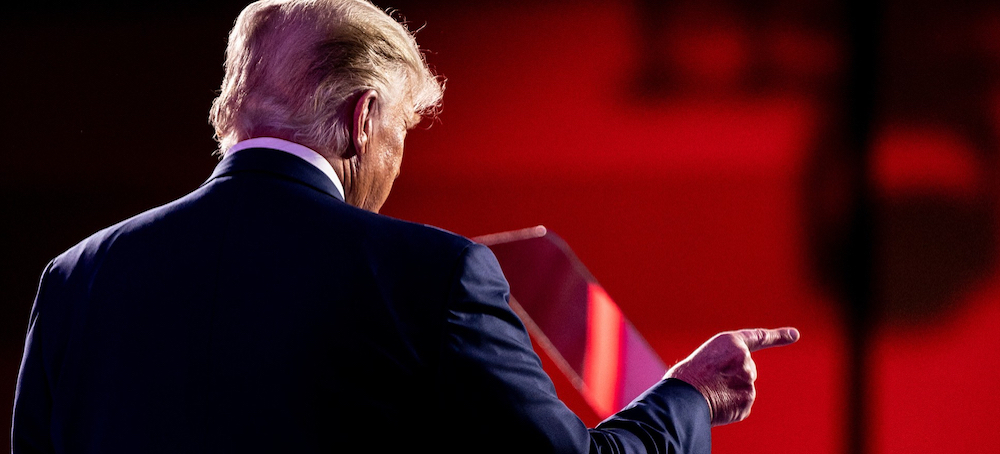
The Strongman FantasyDonald Trump. (photo: Erin Schaff/NYT/Redux)

18 march 24 (RSN.org)

Quite a few Americans like the idea of strongman rule. Why not a dictator who will get things done?

I lived in eastern Europe when memories of communism were fresh. I have visited regions in Ukraine where Russia imposed its occupation regime. I have spent decades reading testimonies of people who lived under Nazi or Stalinist rule. I have seen death pits, some old, some freshly dug. And I have friends who have lived under authoritarian regimes, including political prisoners and survivors of torture. Some of the people I trusted most have been assassinated.

So I think that there is an answer to this question.

Strongman rule is a fantasy. Essential to it is the idea that a strongman will be your strongman. He won’t. In a democracy, elected representatives listen to constituents. We take this for granted, and imagine that a dictator would owe us something. But the vote you cast for him affirms your irrelevance. The whole point is that the strongman owes us nothing. We get abused and we get used to it.

Another pleasant illusion is that the strongman will unite the nation. But an aspiring dictator will always claim that some belong and others don’t. He will define one group after another as the enemy. This might feel good, so long as you feel that you are on the right side of the line. But now fear is the essence of life. The politics of us-and-them, once begun, never ends.

We dream that a strongman will let us focus on America. But dictatorship opens our country to the worst the world has to offer. An American strongman will measure himself by the wealth and power of other dictators. He will befriend them and compete with them. From them he will learn new ways to oppress and to exploit his own people.

At least, the fantasy goes, the strongman will get things done. But dictatorial power today is not about achieving anything positive. It is about preventing anyone else from achieving anything. The strongman is really the weak man: his secret is that he makes everyone else weaker.

Unaccountable to the law and to voters, the dictator has no reason to consider anything beyond his own personal interests. In the twenty-first century, those are simple: dying in bed as a billionaire. To enrich himself and to stay out of prison, the strongman dismantles the justice system and replaces civil servants with loyalists.

The new bureaucrats will have no sense of accountability. Basic government functions will break down. Citizens who want access will learn to pay bribes. Bureaucrats in office thanks to patronage will be corrupt, and citizens will be desperate. Quickly the corruption becomes normal, even unquestioned.

As the fantasy of strongman rule fades into everyday dictatorship, people realize that they need things like water or schools or Social Security checks. Insofar as such goods are available under a dictatorship, they come with a moral as well as a financial price. When you go to a government office, you will be expected to declare your personal loyalty to the strongman.

If you have a complaint about these practices, too bad. Americans are litigious people, and many of us assume that we can go to the police or sue. But when you vote a strong man in, you vote out the rule of law. In court, only loyalism and wealth will matter. Americans who do not fear the police will learn to do so. Those who wear the uniform must either resign or become the enforcers of the whims of one man.

Everybody (except the dictator and his family and friends) gets poorer. The market system depends upon competition. Under a strongman, there will be no such thing. The strongman’s clan will be favored by government. Our wealth inequality, bad enough already, will get worse. Anyone hoping for prosperity will have to seek the patronage of the official oligarchs. Running a small business will become impossible. As soon as you achieve any sort of success, someone who wants your business denounces you.

In the fantasy of the strongman, politics vanishes and all is clear and bright. In fact, a dreary politics penetrates everything. You can’t run a business without the threat of denunciation. You can’t get basic services without humiliation. You feel bad about yourself. You think about what you say, since it can be used against you later. What you do on the internet is recorded forever, and can land you in prison.

Public space closes down around you. You cannot escape to the bar or the bowling alley, since everything you say is monitored. The person on the next stool or in the next lane might not turn you in, but you have to assume they will. If you have a t-shirt or a bumper sticker with a message, someone will report you. Even if you just repeat the dictator’s words, someone can lie about you and denounce you. And then, if you voted for the strongman, you will be confused. But you should not be. This is what you voted for.

Denunciation becomes normal behavior. Without law and voting, denouncing others helps people to feel safe. Under strongman rule, you cannot trust your colleagues or your friends or even your family. Political fear not only takes away all public space; it also corrupts all private relationships. And soon it consumes your thoughts. If you cannot say what you think, you lose track of what you believe. You cease to be yourself.

If you have a heart attack and go to the hospital, you have to worry that your name is on a list. Care of elderly parents is suddenly in jeopardy. That hospital bed or place in a retirement home is no longer assured. If you draw attention to yourself, aged relatives will be dumped in the street. This is not how America works now, but it is how authoritarian regimes always work.

In the strongman fantasy, no one thinks about children. But fear around children is the essence of dictatorial power. Even courageous people restrain themselves to protect their children. Parents know that children can be singled out and beaten up. If parents step out of line, children lose any chance of going to university, or lose their jobs.

Schools collapse anyway, since a dictator only wants myths that justify his power. Children learn in school to denounce one another. Each coming generation must be more tame and ignorant than the prior one. Time with young children stresses parents. Either your children repeat propaganda and tell you things you know are wrong, or you worry that they will find out what is right and get in trouble.

In a dictatorship, parents no longer say what they think to their children, because they fear that their children will repeat it in public. And once parents no longer speak their minds at home, they can no longer create a trusting family. Even parents who give up on honesty have to fear that their children will one day learn the truth, take action, and get imprisoned.

Once this process begins, it is hard to stop. At the present stage of the strongman fantasy, people imagine an exciting experiment. If they don’t like strongman rule, they think, they can just elect someone else the next time. This misses the point. If you help a strongman come to power, you are eliminating democracy. You burn that bridge behind you. The strongman fantasy dissolves, and real dictatorship remains.

Most likely you won’t be killed or be required to kill. But amid the dreariness of life under dictatorship is dark responsibility for others’ death. By the time the killing starts, you will know that it is not about unity, or the nation, or getting things done. The best Americans, betrayed by you when you cast your vote, will be murdered at the whim and for the wealth of a dictator. Your tragedy will be living long enough to understand this.

The Truth Is Simple and Simply Stated, So Why Is There Endless Discussion?

How to realize your true nature and end suffering

Vic Shayne

Vic Shayne

Published in ILLUMINATION-Curated

2 days ago (Medium.com)

Photo by Federico Abis, pexels.com

The sense of self — that which we call “me” — is complicated, complex, dynamic, insecure, confused, fearful, and conflicted. All of these traits keep it from understanding the simple truth about its own essence. This seems to necessitate an endless flow of words in writing and verbal discussions trying to explain the ultimate truth about life and who we are beyond the self.

A clear mind is free of thought.

A clear mind is one that is beyond thoughts that reinforce the sense of self and perpetuate its illusion.

Stated simply, if we were to remove all attachments, thoughts, ideas, memories, suppositions, identities, emotions, fears, and judgments — all of which color what we take ourselves to be — then we would clear the mind enough to see what we really are beyond the self.

In Sanskrit, this process of elimination is called neti, neti — not this, not this. Remove all that you are NOT to find what you really are.

What makes it so difficult?

What is the difficulty? Why can’t people realize their true nature as easily as breathing or meditating? Thought is the problem. It is the ultimate imprisoner.

The self is the offspring of psychological conditioning. It has placed itself at the controls even though it is not really steering the ship.

The self is like a computer that has been programmed, full of information that tells it what it is and informs it how to act, think, and behave. How can the self ever hope to change and wake up if it is stuck in a programmed loop that cannot see beyond its own self?

The sense of self is the very obstacle that keeps itself in inertia, and it is the same illusory entity that tries to pull itself out of the mire.

Enquiring into the self

On rare occasions, a person may sense that life is not how it seems and that there must be another way to live without all the suffering, worry, confusion, and mental anguish.

And so begins an exploration of what she is, her relationships, how thoughts come about, and so on. This process of self-inquiry can take a lifetime, several years, or even an instant.

In actuality, seeing the truth is an instantaneous realization. But the self makes it an ordeal and a journey, because it has been inculcated into believing that everything must take time and effort. We are constantly fighting ourselves, thwarting ourselves and causing our own conflict and friction.

It’s not you, it’s me

In every generation there have been a few who have broken through the metaphorical barrier of the self to find the clarity of mind called illumination or enlightenment.

These guides or gurus try to pass along what they know so that others may benefit and find out for themselves what lies at the heart beyond the limited and self-limiting sense of self.

But their message isn’t always so clear to those who desire it the most. Yet, at other times, it is very clear, but for some reason, the listener cannot grasp it. There are times when the message is not communicated well enough to be of much use.

To the one who has awakened, there is a simplicity to waking up that is obvious only to herself.

Can you wake up right now?

What does it take to wake up to the ultimate reality of your own true nature? This requires no thinking, belief, information, or mentation; it is a direct realization. The irony, however, is that the simplicity of illumination is only recognized after the realization has occurred.

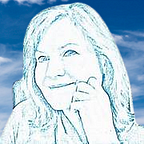
This is analogous to one of those memes (below) of a young woman, in which we see only one way until someone points out that there is another way to look at it, and then we suddenly see an old woman in the same image. Both images have been there all along. Similarly, the ultimate “you” has always been right here and now and is not something you must cultivate or attain.

When illumination takes place it is in an instant and everything falls into place with unequalled clarity so that there is no doubt, confusion, or thought. It is not an experience or intellectual understanding; it is simply a matter of permanent clarity.

Image public domain

Knowing what you are, fundamentally, is quite simple. The difficulty is letting go of all the conditioning that the self has accrued.

The self is both the captor and the captive.

Ironically, it is the self that senses something is amiss and that there must be more to life than all the ideas that get in the way.

And it is also the self that seeks a solution to its suffering and imprisonment. Seeming to play a dual role, the self believes it is both the tourist and the tour guide.

Freedom begins when consciousness (the clear mind) prevails to see that the tour guide and the tourist are one and the same entity.

Vic Shayne

Written by Vic Shayne

·Writer for ILLUMINATION-Curated

NY Times bestselling author writing about reality beyond thought, consciousness, philosophy, psychology, and the self to alleviate suffering; vicshayne.comFollow

Russia Election: Anti-Putin Protests in Moscow on Final Day of Voting

Bloomberg Television • Mar 17, 2024 Russians are voting in the final day of the presidential election with Vladimir Putin poised to clinch a new term. Video distributed by the AP showed queues at polling stations in Moscow and at the Russian embassy in the Armenian capital Yerevan. At one polling station in Moscow, Boris Nadezhdin of the Civic Initiative party called on voters to renounce Putin. “I believe that the Russian people today have a chance to show their real attitude to what is happening,” Nadezhdin, who was barred from running in the election, said.

The Long, Strange History of ‘Manifesting’

GUEST ESSAY

March 9, 2024 (NYTimes.com)

A drawing of a woman holding a bright pink thought cloud.
Credit…Stephan Dybus

By Tara Isabella Burton

Dr. Burton is the author of “Self-Made: Creating Our Identities From da Vinci to the Kardashians” and the novel “Here in Avalon.”

Reality is what you make it — at least according to those who believe in manifesting, the art and quasi-spiritual science of willing things into existence through the power of desire, attention and focus.

Want to improve your health or make more money or get more Instagram followers? Believe hard enough, a host of TikTok “manifesting” influencers insist, and the vibes of the universe will bring what you desire into existence.

In some ways, this is a new trend. The idea of manifesting as it is understood today rose to popularity as part of a boom in online spiritualism and self-help philosophy that emerged during the pandemic. According to Google data, online searches for “manifesting” rose more than 600 percent during the first few months of the pandemic.

But while the idea of manifesting may seem modern, the instinct to conflate spiritual forces, political and economic outcomes and our own personal desires is part of a longstanding American tradition that dates back much, much farther than the pandemic.

To understand today’s manifesting culture and what it means, we need to look deeper into history — beyond the 21st century and back to the 19th, to a little-known but once extraordinarily popular American religious tradition known as New Thought, or the “mind cure.”

Sign up for the Opinion Today newsletter  Get expert analysis of the news and a guide to the big ideas shaping the world every weekday morning. Get it sent to your inbox.

New Thought can be traced back to the 1800s and a New England faith healer named Phineas Parkhurst Quimby. Quimby wondered why, when given the same treatment, some of his patients got better and others didn’t. The answer, he concluded, had to do not with a fault in his methods but rather with a discrepancy in his patients’ mind-sets. Some people simply wanted to get better more than others did. Those who wanted it badly enough were able to essentially get in touch with and harness the energy of the universe to will themselves to heal. Those who didn’t, well, simply died.

Quimby’s theory — which was embraced early on by his followers, including Mary Baker Eddy, the founder of the Christian Science movement — soon proliferated wildly. By the turn of the century, it was ubiquitous.

Dozens of self-help books, including William Walker Atkinson’s “Thought-Force in Business and Everyday Life” and James Allen’s “As a Man Thinketh, emerged, arguing that the universe’s mysterious energies could be mastered by the human will. The idea of the “mind cure” began to merge in popular consciousness with other then-novel discoveries like electricity and Darwinian evolution, all of which seemed to support the theory of the human mind’s dominance over nature. For what was survival of the fittest if not proof that will triumphs over all?

By the late 19th century — in that era of staggering inequality known as the Gilded Age — the influence of New Thought had begun to seep into economic theory and became a popular frame through which to make sense not only of sickness but also of poverty. Nobody who truly wanted to be rich, a new wave of books claimed, would ever end up poor.

Editors’ Picks

Nikolaj Coster-Waldau Wonders About the Past 2 Million YearsWhat a Breast Cancer Risk Calculator Can and Can’t Tell You‘The Notebook’ Review: A Musical Tear-Jerker or Just All Wet?

As one New Thought advocate, Charles Benjamin Newcomb, wrote in his tellingly titled 1897 book “All’s Right With the World,” “none is really shut out of the feast [of life] except the self-exiled.” Those who wanted in on “the banquet” had only to repeat to themselves the following mantra, which frankly sounds a lot like something you might find on TikTok today: “I am well. I am opulent. I have everything. I do right. I know.”

In this way, the capitalist pursuit of profit was swiftly recast as a religion whose only tenet was desire.

But this Gilded Age optimism about human potential had a dark side. After all, if anyone could achieve health, wealth and success simply by wanting it badly enough, logic held that the converse was also true: The poor, the sick and the vulnerable had brought their conditions upon themselves by failing to possess the requisite will to change.

Unsurprisingly, throughout the 20th century, New Thought ideology was frequently invoked to justify the denial of social services to the poor — on the ground that it would interfere with the purposeful workings of the energies of the universe, which wished to reward only those at the top of the proverbial heap.

“If we lack anything,” wrote another New Thought writer, Charles Fillmore, “it is because we have not used our mind in making the right contact with the supermind.” God (or nature or the universe, or whatever higher power you chose) wanted people to be rich. And in turn, people could become rich — or healthy or famous — simply by wanting it.

New Thought offered a convenient economic theodicy: a way of explaining and justifying wealth inequality as a kind of spiritual hierarchy, with the wealthy at the top and the suffering at the bottom. And it’s notable that manifesting, New Thought’s modern descendant, should rise to prominence at a moment when economic inequality is once again at an all-time high.

While New Thought may not be alive in the same form today, its legacy is clearly visible in American life. In evangelical circles, it has alchemized into the Prosperity Gospel: the idea that prayer (and tithing) will be rewarded by material success in this life. According to one study, three-fourths of American Christians say they agree with the statement “God wants us to prosper financially.” Its effect can be traced to maxims found in the philosophies of wellness brands like Goop and gurus like Oprah Winfrey and Tony Robbins and in self-help best sellers like Norman Vincent Peale’s “The Power of Positive Thinking” and Rhonda Byrne’s “The Secret.”

Echoes of New Thought are visible in our politics, too — where self-invention, and the idea that reality can and should bend to belief, has never been more in vogue. The most notorious recent example is the former New York congressman George Santos, whose preposterous fabrications got him elected to public office. (He later defended them, claiming to be a “self-made man,” which, in a sense, he certainly was.) And of course, there’s the former president and current Republican front-runner, Donald Trump, whose legendary delusions of grandeur helped lead him to the highest office in the country.

Today, as in the 19th century, the belief that we can will things into reality comes with a dark side, too. In an era when outlandish lies can and do influence elections, manifesting has become as much about exerting influence over others as it is about improving one’s finances, or healing from illness, or self-actualization, or vibes.

It is only by understanding the religious and occult tradition from which the concept of manifesting descends that we can see it for what it truly is: a spiritualized gloss on the same deluded logic that suggests that poverty is a choice, and that underpins so much political disinformation. After all, if reality is only ever what we make it, then those who possess the fewest scruples about conforming to the truth are the ones who will have the most power to shape the future.

(Contributed by Helen Dower)

A Soldier’s Statement (1915)

First World War soldier and poet Siegfried Sassoon In uniform

The poet Siegfried Sassoon (1886-1967) was a soldier during World War I. In 1915 he joined the British Army, as
did his brother Hamo, who was killed during the Gallipoli Campaign in the same year. Sassoon fought in France
and during the hard years of conflict, his poetry became more and more critical against war. In 1917 he was
seriously wounded by a bullet. While he was recovering, he wrote this letter to his Commanding Officer accusing the
government of prolonging the war unnecessarily. By writing the letter, he risked being condemned to prison (or to
death) by court martial, but the trial never took place due to his physical condition.
In the letter, the poet expresses his sense of responsibility towards all soldiers, describing their suffering and
denouncing the folly and uselessness of war.

I am making this statement as an act of wilful defiance1
of military authority, because I believe the war is
being deliberately prolonged by those who have the power to end it. I am a soldier, convinced that I am
acting on behalf of soldiers. I believe that this war, upon which I entered as a war of defence and liberation,
has now become a war of aggression and conquest. I believe that the purposes for which I and my fellow
soldiers entered upon this war should have been so clearly stated as to have made it impossible to change
them, and that, had this been done, the objects which actuated us would now be attainable by negotiations.
I have seen and endured the suffering of the troops, and I can go no longer be a party to prolong these
sufferings for ends which I believe to be evil and unjust. I am not protesting against the conduct of the war,
but against the political errors and insincerities for which the fighting men are being sacrificed.
On behalf of those who are suffering now I make this protest against the deception which is being practised
on them; also I believe that I may help to destroy the callous complacence with which the majority of those
at home regard the continuance of agonies which they do not share, and which they have not sufficient
imagination to realise.

(deascuola-nephila-bucket-prod.s3.amazonaws.com)

Tender

By Heather Williams, H.W., M. (with permission)

March 16, 2024 (TheProsperos.org)

TENDER = soft, easily injured, delicate, young

QUESTION: Do you feel a tenderness in your heart?

STORY: When I approach my world with tenderness, I feel like a child. My five senses are alive: my eyes look and see; my ears hear and listen; my tongue and lips moisten and taste the flavor of the moment. My nose sniffs and smells. My skin relaxes and feels the temperature of the air. Tenderness in my body is when my stomach and shoulders relax. I feel connected with others rather than separate, different. My little dog, Clair, is a combination of a dachshund and a chihuahua. She loves it when I gently rub her neck and back. We used to have 6 chickens. Four of them just loved it when I played rooster and petted their tail feathers. They love to gobble up the mealworms I give them. It is so important for young people today to connect with the natural world. Hey! No matter how old we are, we can always consciously connect and feel the tenderness in our heart.

QUOTES

“A mother’s arms are made of tenderness and children sleep soundly in them.” ~Victor Hugo

“Real fearlessness is the product of tenderness. It comes from letting the world tickle your heart. You are willing to open up without resistance or shyness and face the world. You are willing to share your heart with others.” ~ Chogyam Trungpa; \\

“Care is a state in which something does matter; it is the source of human tenderness.” ~Rollo May

EXERCISE

STOP.

Sit quietly. Assume an erect posture.

Sense the breath. Sit calmly. Relax.

When ready, open your eyes & imagine that you’re looking at your world through your inner child’s eyes. The child looks at something and tenderly asks a question like: Why are you here? Where did you come from? What can I learn from you?

Get your pen and paper and write words or draw lines expressing your tender, child-like curiosity about things in your world.

Move forward into your day feeling tender and child-like.

This Might Hurt – Trailer for Documentary about Chronic Pain

This Might Hurt • Premiered Jul 29, 2022 Stream the 80-minute film at https://www.thismighthurtfilm.com Official selection: Austin Film Festival, Freep Film Festival, Spirit Film Festival This Might Hurt is a documentary that offers solutions to reduce and unlearn chronic pain. The film follows three chronic pain patients who have spent years searching for answers. Desperate for relief, they enter a new medical program — run by Dr. Howard Schubiner — that focuses on uncovering hidden causes of pain, and retraining their brains to switch the pain off. This new paradigm for diagnosis and treatment was found to be effective in several randomized trials, and was listed as a “best practice” by the HHS’s task force to combat the opioid epidemic. Rooted in the cutting-edge neuroscience of pain, one study found that it cured 66% of people with back pain and profoundly rewired their brains. This Might Hurt provides an intimate exploration and suggests a path to healing for millions. // This film has stories of people overcoming chronic pains such as Complex Regional Pain Syndrome (CRPS), migraine headaches, abdominal pain and spasms, back pain, neck pain, and fibromyalgia. It features the work of Dr. Howard Schubiner in Detroit, Michigan, and includes interviews with Doctors Lorimer Moseley, Daniel Clauw, Joel Saper, Andrew Kolodny, Clive Segil, and Matthew Weiner. This is an alternative Health, holistic, mind-body treatment. The film is relevant for people suffering with chronic back pain, headaches, migraines, irritable bowel syndrome, abdominal pain, Long Covid, POTS (postural orthostatic tachycardia syndrome), and several other syndromes. A full list can be found at https://www.thismighthurtfilm.com

What Is Beyond Fear?

These lessons can help you uncover the wisdom of fear so that you learn, grow, and come out the other side

✨ Bridget Webber

Bridget Webber

Published in Mystic Minds

Mar 6, 2024 (Medium.com)

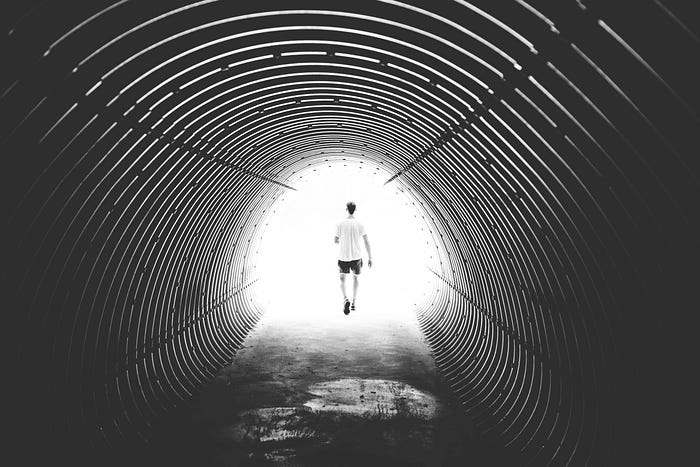
Someone walks out of a fear tunnel and out the other side.
Photograph by Kasuma,m Pexels

No one escapes fear. You can’t run away from it. But once you understand it, it becomes your teacher. Fear’s lessons can lead to wisdom, self-improvement, and spiritual development.

Rather than get stuck in our fears, which cause suffering incessantly, we can shift beyond them. First, though, we need to accept and understand them, and then we can use them to our advantage.

We are all fearful at times, and always for good reasons. Even when what we are afraid of isn’t dangerous in a practical sense and stems from the imagination, our emotion offers an important message that can bring growth and transformation when we listen and respond.

Fear is an energy that demands your attention

The first step to overcoming fear is the willingness to accept it exists, and we can take this scary step by recognizing our fears as energy. Indeed, all emotions are energetic in nature. Until we see them as such, we label them as good or bad, and naturally, we place fear on the negative end of the emotional spectrum.

Fear can be uncomfortable or downright paralyzing, so we may feel the urge to bury it or push it out of sight. If you imagine it as a cork that you hold underwater, you soon realize that repressing it takes tremendous effort. Doing so steals your attention and energy, stopping you from enjoying the moment.

Attempting to subdue your fears or getting lost in them means you don’t attend to the present fully. Later, you become weary of holding them down, and they vigorously pop to the surface of your mind, demanding attention.

I find recognizing fear as energy is helpful because it means I don’t automatically resist it. Instead, I respect it as a reaction to an event that demands consideration. Then, I can explore it to discover how it’s manifesting in me and find out what it wants to say.

Fear affects your body and your mind

Understanding the symptoms of fear is helpful. It teaches you to quickly recognize the moment fears arise so you can pinpoint their cause. Comprehending how your fear manifests will also help you realize when you move through it to the pleasanter emotions beyond it.

The physical symptoms of fear might include a rapid heartbeat, sweating, clenched muscles, a headache, stomachache, and feelings of panic. You may hold your breath on autopilot and experience the feeling of restriction in your body. Think of an animal that’s afraid and tightens into a ball to make itself smaller and protect itself. Your response could be similar.

It’s also worth noting that sometimes people run toward what they fear, hoping to make it disappear and defeat it. Hence the term fight-or-flight. We’re designed to flee from what we fear, defeat it, or remain motionless (freeze).

Your emotional symptoms might include brain freeze, whereby you can’t think straight about what to do. Or your fear might change to anger or blind panic. Fear’s physical and emotional symptoms seem drastic, but they are strong energy to grab your attention.

Someone hides fearfully beneath cushions on a sofa.
Photograph by Pixabay, Pexels

Fear offers a helpful message

Fear exists for good reasons. Sometimes, it wants to tell you to stay away from something dangerous or stop taking a course of action that could harm you. Think of the terror you may experience when you look down from a great height, come close to a venomous snake, or witness a wildfire. In such cases, fear is instinctive. Its job is to help you stay safe.

Fear can also arise from your stories about what’s happening. Often, such narratives are off course from the truth. They could be exaggerations, fantasies, or based on misinformation. Fears that involve repetitive negative stories create paralyzing mental states, including confusion and a sense of powerlessness.

In short, fears tell you you’re in danger. If they are based on genuine challenges, their message is to take action; this could be to stop doing something, avoid some situation, or change your actions to procure a positive outcome.

When your fears arise from your imagination, they still impart a helpful message. They could, for example, tell you that you’ve misread a situation, have made assumptions, need support or more knowledge, or have unresolved issues that you need to handle.

Fear from a spiritual perspective

When viewed from a spiritual perspective, fear allows you to transform. Listening to its lessons can help you better understand yourself, avoid danger, and improve your inner narrative to serve your greatest good.

A woman casts her eyes to the sky, spiritually managing her fears.
Photo by Marcos Paulo Prado on Unsplash

According to the Toltec tradition, long-term fear is disabling because it reduces people’s strengths and abilities. When you see it as a helpful energy straight away, it has the opposite effect, helping you grow and evolve into your best self.

Fear may also be viewed differently depending on other spiritual beliefs. For example, from a Christian outlook, it could be a call to develop trust in God. From a Buddhist view, fear is the root of the ego and can be transmuted by bringing your attention to the present.

Then, if you’re in immediate danger, you can act. Or, if you fear the future, returning your mind to the present transforms your fear because you’re okay at the moment.

When fear arises from the imagination, ask empowering questions

I like to ask myself these questions if I’m creating negative, fear-based stories in my mind. Perhaps they’ll help you, too.

# Am I making assumptions?

On occasions when I’m unable to sleep due to worrying, I often alleviate my concerns by asking myself whether I’m assuming something negative will happen. If so, I remind myself that I don’t know what will occur and that I’m making up unhelpful stories.

# Am I exaggerating challenges?

I know my mind enjoys hyperbole. Recognizing I place a metaphorical magnifying glass over challenges, exaggerating their size, helps me drop my fears.

# Has an event triggered an unhelpful belief?

I see that some fears aren’t based on my current reality. Instead, a present event might have triggered an old, unresolved experience I’ve yet to handle. Or it may signify I have unhelpful beliefs, like I’m not good enough or things don’t go my way. Recognizing unhelpful perspectives gives me opportunities to uproot them.

# Do I have enough information?

Sometimes, I realize I don’t have enough information to warrant worrying. So, rather than run through potential future difficulties, I relax and accept not knowing.

Spiritual tools to aid calm and alleviate fear.
Photo by petr sidorov on Unsplash

Spiritual practices to overcome fear

While asking yourself empowering questions can alleviate your fears, these spiritual practices are also beneficial.

1: Accept and integrate your emotion

Your mind and body work together in symbiosis, and your fear may subside if you recognize and work with it in your body. For example, consider where your fear arises and what form it takes. Is it spiky, soft, sticky? Is it large, small, or medium-sized? Can a color represent it? Scent? Or movement?

As a trained counselor and Neuro-linguistic programmer, I sometimes use such descriptions to change emotions. If someone describes their fear as hard and spiky, I ask them if they can imagine it becoming softer and smoother. If they can’t, I may ask what would need to happen for their fear to transform.

Alternatively, I can ask them to picture their fear getting so small that it disappears or turns into something they find empowering, like a lion, if they believe it represents courage. These ideas correlate somewhat with the antidotes to fear offered by author José Luis Stevens, Ph.D. in Shamanic Practice.

Stevens suggests creative visualization practices involving metaphors like sunshine melting ice and making friends with a jaguar. Maybe you can picture your fears melting or getting acquainted with your emotions and taming them.

2: Raise gratitude

Practicing gratitude is a way to move beyond fear because it connects you to your strength. Your courage and positivity will grow as you create feel-good hormones. I like to begin by mentally listing five things I’m thankful for in the moment. But you could take any approach that works for you, like writing in a gratitude journal or painting a picture of something that encourages gratitude to arise.

3: Practice breath meditation

Fear makes the body constrict and shut down, so open up, widen your perspective, and reduce fight-or-flight. This will help you think straight, have clarity, and make wise decisions.

Sit quietly, close your eyes, and take deep breaths. Focus gently on the breath as it moves in and out of your body. If your thoughts stray, calmly bring them back to the breath. Your worries will lessen, and your body will tell your brain you must be okay; otherwise, you wouldn’t be breathing so calmly.

4: Be mindful

Mindfulness can help you focus on the present so you don’t dwell on the past or future potential challenges. Use your five senses to keep you in the moment. You might listen to birdsong, for instance, watch the sky, smell the air, touch the bark of a tree, or concentrate on tasting an apple.

5: Say a prayer

If you are a Christian, you might like to offer your worries to God via a prayer. Or, you may follow another religion or have another spiritual belief system and think of a different way to pray that will alleviate your fears. For example, you could pray to Source or Mother Nature or pay homage to Buddha.

6: Build compassion

I always feel better after acting like my life coach and best friend. One way I do this is to self-soothe with words of compassion. I speak kindly to myself to reduce my suffering.

You could do likewise or employ another practice, like using your imagination to send compassion to someone else who needs help. When we help others, we also help ourselves because our kind thoughts generate happy chemicals in our systems.

Fear can be a painful, scary emotion. But, once you recognize it exists to help you learn and grow, you can uncover its wisdom and undergo its lessons. Acceptance, empowering questions, and various spiritual practices can put your worries into perspective and show you the light beyond fear.

The Art of Not Responding When Someone Treads on Your Toes

Not saying much is challenging

medium.com

✨ Bridget Webber

Written by ✨ Bridget Webber

·Writer for Mystic Minds

Freelance writer, avid tea-drinking meditator, and former therapist interested in spiritual growth, compassion, mindfulness, creativity, and psychology.Follow

Vote underway in Ukrainian regions illegally annexed by Russia • FRANCE 24 English

Polls open in Russia’s presidential election as Ukraine launches border attacks

Russia began voting on Friday in an election set to prolong President Vladimir Putin’s rule by six more years, as Kyiv branded the vote a “farce” and launched a barrage of deadly attacks on border regions.

Issued on: 14/03/2024 – 23:55

A woman casts her ballot at a mobile polling station during early voting in Russia's presidential election in Donetsk, Russian-controlled Ukraine, amid the Russia-Ukraine conflict on March 14, 2024.
A woman casts her ballot at a mobile polling station during early voting in Russia’s presidential election in Donetsk, Russian-controlled Ukraine, March 14, 2024. © Stringer, AFP

By :NEWS WIRES

Video by: FRANCE 24Follow|FRANCE 24

Officials in Moscow warned against any protests during the March 15-17 presidential vote, after calls from the opposition for anti-Putin demonstrations on Sunday.

The Kremlin says the vote will show that the country is fully behind his assault on Ukraine and polling stations have been set up in Russian-held territories.

Ahead of the election, Kyiv ramped up its aerial bombardment of Russian regions just across their shared border.

And the Russian national guard said it was fighting off attacks from pro-Ukrainian militias in Kursk, the latest in a string of border clashes.

“I am convinced: you realise what a difficult period our country is going through, what complex challenges we are facing in almost all areas,” Putin said in an address to Russians on the eve of the vote.

“And in order to continue to respond to them with dignity and successfully overcome difficulties, we need to continue to be united and self-confident.”

Polling stations opened in Russia’s easternmost Kamchatka peninsula at 8:00 am local time on Friday and are set to close at 8:00 pm (1800 GMT) on Sunday in Kaliningrad — a Russian exclave bordering Poland and Lithuania.

‘Border clashes’ 

All of Putin’s major critics are dead, in prison or in exile, and authorities blocked the few genuine competitors who tried to stand in the contest.

Alexei Navalny, Putin’s most high-profile opponent over the last decade, died in February in an Arctic prison colony. He was serving 19 years for “extremism”, a sentence widely seen as retribution for his campaigning against the Kremlin leader.

Moscow prosecutors warned against protests during the election.

“The organisation of and participation in these mass events are punishable by virtue of the legislation in place,” they said in a statement posted on Telegram.

Navalny’s widow, Yulia Navalnaya, has called for rallies outside polling stations on Sunday, the final day of voting.

Kyiv has this week launched some of its most significant aerial attacks since the start of the two-year conflict.

The governor of Russia’s Belgorod region, Vyacheslav Gladkov, said that at least three separate waves of aerial attacks had killed two people, wounding several others.

He accused Ukraine of trying to “sow panic, distrust, anger and resentment, in order to break the unit of our society”.

Pro-Ukrainian paramilitaries also claimed to be escalating attacks and incursions in Russian border regions.

Read moreAnti-Putin Russian groups stage new cross-border raids into Russia

In a joint statement, three pro-Kyiv volunteer groups — claiming to consist of anti-Kremlin Russians who have taken up arms — called on authorities to evacuate civilians from the regions of Belgorod and Kursk.

“Civilians should not suffer from the war and any casualties in the process of fighting will be on the conscience” of the regions’ governors, they added.

Russia has denied militias’ claims to have gained ground.

The national guard said its units had beaten back one such attack near the village of Tyotkino in Kursk.

The defence ministry said it had fended off another by Ukrainian forces trying to enter Belgorod via the village of Spodariushino, without saying when the clash had happened.

‘Not to stray’ 

Election victory will allow Putin to stay in the Kremlin until at least 2030, a longer spell in power than any Russian leader since Catherine the Great in the 18th century.

He called on Russians to use the vote to show their unity behind his leadership.

“We have already shown that we can be together, defending the freedom, sovereignty and security of Russia,” he said in a video message, flanked by flags of the Russian tricolour and the president’s state insignia.

“Today it is critically important not to stray from this path,” he said.

Early voting was already underway in occupied territories of Ukraine. The vote will also take place in Crimea, the peninsula annexed by Moscow in 2014 — a move that most of the international community refuses to recognise.

US State Department spokesman Matthew Miller condemned the voting in Russian-held areas.

“The United States does not and will never recognize the legitimacy or outcome of these sham elections held in sovereign Ukraine,” he said.

In the Russian-controlled Ukrainian city of Mariupol, election officials on Thursday opened pop-up polling stations at small tables in the street and on the hoods of cars.

Banners were unfurled sporting a red, white and blue “V” logo — an army symbol used as a sign of support for the military offensive.

Ukraine’s foreign ministry on Thursday urged the international media and public figures “to refrain from referring to this farce as ‘elections’ in the language of democratic states”.

(AFP)