Mercury Conjunct Chiron – The Story Of Your Wound

On March 20th, 2024 (Astrobutterfly.com)

Mercury is conjunct Chiron at 18° Aries

Mercury conjunct Chiron is an opportunity to dig deep into wounds, identify self-sabotaging patterns, and reframe our understanding of ourselves.

Mercury Conjunct Chiron In Aries – Why It’s Important

Mercury conjunct Chiron in Aries is not your typical Mercury transit.

Why? 

Because Mercury will spend an unusually long time in Aries due to its upcoming retrogradation.

Mercury will stay within the conjunction orb with Chiron and the North Node for a very long time, activating opportunities to revisit and rewrite self-sabotaging patterns of thinking. 

During this transit (which is active until May 7th, 2024), we can find healing by addressing old wounds and embracing new perspectives that align with our highest potential.

The Mercury-Chiron conjunction on March 20th, 2024 is the first conjunction in a series of 3. The other conjunctions happen on April 15th, 2024, at 20° Aries (with Mercury retrograde) and the 3rd on May 7th, 2024, at 21° Aries. 

While the exact dates mark the energy peak of the transit, Mercury conjunct Chiron is active for the whole period – from now until mid-May. This is an intense transit that will influence every single one of us. 

Mercury Conjunct Chiron In Aries – The Identity Wound

The Mercury-Chiron conjunction happens in the sign of Aries. Aries is the sign of “I am”. Aries is our identity.

Therefore, Mercury conjunct Chiron will be triggering our identity wound

No matter how confident and accomplished we are, we all have a deeply ingrained identity wound, because we all suffered at some point from feelings of rejection and abandonment. 

Whenever someone abandoned or rejected us, it inherently questioned our existence. “Do I have the right to be here?” “Does my existence really matter?” “Who am I?” 

These are the fundamental questions that the Mercury-Chiron conjunction in Aries will bring to the surface.

Mercury Conjunct Chiron – The Story Of Your Identity Wound

Mercury in astrology represents the ‘general narrative’ – the way we make sense of the world, the overall accepted ‘story’, what we tell ourselves, what we believe to be true. 

Therefore, Mercury conjunct Chiron will reveal the ‘general narrative’ or the story of our Chiron wound. More precisely, the story of our identity wound (Chiron in Aries). 

The story of our wound can be traced through our family lineage, potentially spanning generations back.

North Node in Aries  is also involved in this transit; Mercury is not only conjunct Chiron, but also the North Node. 

Lunar Nodes show up all the time in family dynamics, highlighting patterns that are inherited through generations. If the South Node is past karma that needs to be released and transformed, the North Node is the opportunity to change our karma, and rewrite our destiny. 

When Mercury aligns with Chiron and the North Node, we have a unique opportunity to delve into the deeply ingrained patterns inherited from our family, and understand the ways they have affected our sense of individuality and purpose.

Here are examples of Mercury-Chiron in Aries narratives that may arise in the next weeks:

I am flawed

This is when the person believes – due to real experiences of rejection or interpreted cues from their family, that they are flawed, perhaps because their family wanted a child with different qualities, of a different gender, or with a different appearance. 

This rejection drives them to alter their personality so that they conform to what is expected. This approach is, of course, self-defeating because we can only be ourselves, NOT someone else.

I am a burden

The child was born ‘by accident’, or in a family with material problems or other types of burdens. The child was either abandoned in the hands of other family members or caregivers and/or was made feel like a burden. 

They might have been told “I have sacrificed myself for you”, basically accused of being an obstacle, preventing the parent from fulfilling their own goals. 

I am a carbon copy of my family

In this narrative, the child was expected to adopt the family’s values, beliefs, social behavior, or social status. Any deviation from the ‘norm’ was seen as a betrayal. 

Unconsciously, the child believes their existence is validated only within the context of the family ‘story’, and that they cannot ‘exist’ outside this story. Therefore, their unique individuality is invalidated and denied.

The child grappling with this narrative believes they can’t surpass their family members. For instance, if no family member went to university, the child may sabotage themselves and ‘fail’ the exams to enter university so that they don’t change the family narrative.

I am a sinner

In this narrative, the child internalizes a sense of wrongdoing or guilt associated with natural impulses, desires, or pleasures. 

Due to sexual repression, religious or cultural beliefs, the family’s imposition of restrictive norms leads the child to perceive their innate instincts and desires as sinful or morally wrong. 

This internal conflict inhibits the child from fully embracing life, trusting their instincts, and realizing their potential.

In all these narratives, the Aries-like qualities of assertiveness, independence, and self-expression are stifled. 

These scenarios are not meant to foster resentment towards our family, nor to make us feel like victims. 

In fact, the more we look into these family dynamics, the more we understand the deep roots of these patterns. Our parents have likely inherited these stories from their own parents, and this goes back through generations.

However, just because these stories exist for decades – or even centuries – this doesn’t mean we must continue to perpetuate them.

Mercury Conjunct Chiron In Aries – Healing The Identity Wound

The good news is that the upcoming Mercury-Chiron transit – accompanied by the North Node – is a unique opportunity to 1) understand the deeper dynamics of this identity wound and 2) rewrite this script that has been passed down for generations.

Your family (his)story has shaped you, but it does not define you. You can break the cycle. You can rewrite the script. 

You are not flawed. You are you – a unique individual who may or may not resemble what your family expects or desires. Your worth is inherent and not defined by others’ perceptions of you.

You are not a burden. There are a myriad of factors that need to align for a child to be born. You are here for a reason; the fact that you were born in some difficult circumstances does not invalidate your existence.

You are not a carbon copy of your family. While we share DNA with our relatives, we are all unique individuals, with a unique story and individual mission to fulfill. Your identity is not confined to the expectations or limitations set by your family.

You are not a sinner. Pleasure is the portal to our essence and personal creativity. You CAN trust your impulses and your creative genius. They will direct you toward fulfillment and authenticity.

Mercury Conjunct Chiron – The Gift Inside The Wound 

You may wonder – then why all these struggles? Why do we have to experience the wound and the challenges associated with it?

Because there is a hidden treasure in the wound.

It’s all the things we do to heal, all the lessons we learn, and all the strengths we develop to overcome adversity that shape our unique potential, eventually transforming our wound into our greatest gift.

The upcoming Mercury-Chiron conjunction on March 20th, 2024 is just the beginning of the unveiling of the ‘wound story’. More and more layers will be revealed as the transit develops over the next few weeks. 

https://content.leadquizzes.com/lp/GfN5F5z_tQ?embed=1

In addition to Mercury conjunct Chiron and North Node, we have two powerful eclipses; a Lunar Eclipse in Libra on March 25th, 2024, with Mercury conjunct Chiron and the North Node, and a Solar Eclipse in Aries on April 8th, 2024, exactly conjunct Chiron. 

These transits come with a once-in-a-lifetime opportunity to rewrite our karmic patterns. 

This time we can truly break the cycle.

The upcoming weeks will offer more clues on what exactly we need to do to rewrite the story of our wound so we can unlock our full potential, and live the life we are meant to be living. 

A Bronx Teacher Asked. Tommy Orange Answered.

When the author received an impassioned email, he dropped everything to visit the students who inspired it.

Tommy Orange, in a sweatshirt, baseball cap and sneakers, sits in front of a high school classroom. Students are arrayed around him. The back wall is covered in art and posters.
What drew Tommy Orange to reading, he said, was the “feeling of not being as alone as you thought you were.” Students found in his work a similar sense of belonging.Credit…Hiroko Masuike/The New York Times
Elisabeth Egan

By Elisabeth Egan

Elisabeth Egan is still in touch with her high school English teachers.

March 18, 2024 (NYTimes.com)

Leer en español

Tommy Orange sat at the front of a classroom in the Bronx, listening as a group of high school students discussed his novel “There There.”

A boy wearing blue glasses raised his hand. “All the characters have some form of disconnection, even trauma,” Michael Almanzar, 19, said. “That’s the world we live in. That’s all around us. It’s not like it’s in some faraway land. That’s literally your next-door neighbor.”

The class broke into a round of finger snaps, as if we were at an old-school poetry slam on the Lower East Side and not in an English class at Millennium Art Academy, on the corner of Lafayette and Pugsley Avenues.

Orange took it all in with a mixture of gratitude and humility — the semicircle of earnest, engaged teenagers; the bulletin board decorated with words describing “There There” (“hope,” “struggle,” “mourning,” “discovery”); the shelf of well-thumbed copies wearing dust jackets in various stages of disintegration.

Tommy Orange is seen in the foreground, his profile blurry, while two students, sitting at their desks, are in focus, in the background.
When Orange spoke, students paid close attention. Many identified with the characters in Orange’s book “There There” and with the world it portrayed. Credit…Hiroko Masuike/The New York Times

His eyebrows shot up when a student wearing a sweatshirt that said “I Am My Ancestors’ Wildest Dreams” compared the book to “The Road,” by Cormac McCarthy. When three consecutive students spoke about how they related to Orange’s work because of their own mental health struggles, he was on the verge of tears.

“That’s what drew me to reading in the first place,” Orange said, “The feeling of not being as alone as you thought you were.”

It’s not often that an author walks into a room full of readers, let alone teenagers, who talk about characters born in his imagination as if they’re living, breathing human beings. And it’s equally rare for students to spend time with an author whose fictional world feels like a refuge. Of all the classroom visits he’s made since “There There” came out in 2018, the one at Millennium Art Academy earlier this month was, Orange said later, “the most intense connection I’ve ever experienced.”

The catalyst for the visit was Rick Ouimet, an energetic, pony-tailed English teacher who has worked in the fortresslike building for 25 years. Ouimet is the kind of teacher students remember, whether it’s for his contributions to their literary vocabulary — synecdoche, bildungsroman, chiasmus — or for his battered flip phone.

Orange is in the background, sitting on a chair and reading from a book. In the foreground one can see the back and profile of a couple of students, who are following along on their own books. One has a sweatshirt that reads, “ I am my ancestors’ wildest dreams.”
In the three years since Orange’s novel became a part of the Millennium Art curriculum, students’ performance on the A.P. literature exam improved.Credit…Hiroko Masuike/The New York Times

He first learned about “There There” from a colleague whose son recommended it during the pandemic. “I knew from the first paragraph that this was a book our kids were going to connect to,” he said.

The novel follows 12 characters from Native communities in the lead-up to a powwow at a stadium in Oakland, Calif., where tragedy strikes. “Orange leads you across the drawbridge, and then the span starts going up,” a critic with The New York Times, Dwight Garner, wrote when it came out. The novel was one of The Times’s 10 Best Books of 2018 and was a finalist for the Pulitzer Prize. According to Orange’s publisher, over one million copies have been sold.

Ouimet’s hunch proved true: “Students love the book so much, they don’t realize they’re reading it for English class. That’s the rare find, the gift of gifts.”

Some relevant statistics: Attendance rates at Millennium Art are below the city average. Eighty-seven percent of students are from low-income households, which is above the city average.

In the three years since Orange’s novel became a mainstay of the Millennium Art curriculum, pass rates for students taking the Advanced Placement literature exam have more than doubled. Last year, 21 out of 26 students earned college credit, surpassing state and global averages. The majority of them, said Ouimet, wrote about “There There.”

Orange is shown speaking, with the classroom wall in the background.
Orange said he wasn’t much of a reader in high school: “Nobody handed me a book and said, this book is for you. I also had a lot going on at home.” Credit…Hiroko Masuike/The New York Times

When three students in the school’s art-bedecked hallway were randomly asked to name a favorite character from “There There,” they all answered without hesitation. It was as if Tony, Jacquie and Opal were people they might bump into at ShopRite.

Briana Reyes, 17, said, “I connected so much with the characters, especially having family members with alcohol and drug abuse.”

Last month, Ouimet learned that Orange, who lives in Oakland, was going to be in New York promoting his second novel, “Wandering Stars.” An idea started to percolate. Ouimet had never invited an author to his classroom before; such visits can be pricey and, as he pointed out, Shakespeare and Zora Neale Hurston aren’t available.

Ouimet composed a message in his head for over a week, he said, and on Monday, March 4, just after midnight, he fired it off to the Penguin Random House Speakers Bureau.

“The email felt like a raw rough draft, but I didn’t agonize,” he said. “It was my midlife college essay.”

The 827-word missive was written in the go-for-broke style Ouimet encourages in his students’ work, full of personality, texture and detail, without the corporate-speak that infiltrates so much Important Professional Correspondence.

Teacher Rick Ouimet, in a button-down blue shirt and slacks, stands in front of a classroom holding a book in his hand. Behind him is a wall full of art and posters, and a board with notes about the book. Next to him is Tommy Orange, sitting down.
According to Rick Ouimet, his students loved the book so much, they forgot they were reading it for class.Credit…Hiroko Masuike/The New York Times

Ouimet wrote: “In our 12th-grade English classroom, in our diverse corner of the South Bronx, in an under-resourced but vibrant urban neighborhood not unlike the Fruitvale, you’re our rock star. Our more than rock star. You’re our MF Doom, our Eminem, our Earl Sweatshirt, our Tribe Called Red, our Beethoven, our Bobby Big Medicine, our email to Manny, our ethnically ambiguous woman in the next stall, our camera pointing into a tunnel of darkness.”

Orange, he added, was a hero to these kids: “You’ve changed lives.” There was Tahqari Koonce, 17, who drew a parallel between the Oakland Coliseum and the Roman Colosseum; and Natalia Melendez, also 17, who noted that a white gun symbolized oppression of Native tribes. And then there was Dalvyn Urena, 18, who “said he’d never read an entire book until ‘There There,’” and was now comparing it to a Shakespearean sonnet.

He ended with: “Well, it was worth a shot. Thanks for taking the time to read this — if it ever finds its way to you. In appreciation (and awe), Rick Ouimet.”

“I took a chance,” Ouimet said. And why not? “My students take a chance every time they open a new book. There’s groaning, and they open the page. To see what they gave this book? The love was palpable.”

Students are shown in their classroom, arranged in three rows: some on the ground, some in desks, and some sitting or standing behind them. Most have books in front of them.
Orange found a way to work a visit to the high school into a packed, 24-city tour for his new book, “Wandering Stars.”Credit…Hiroko Masuike/The New York Times

Within hours, the message reached Orange, who was in the midst of a 24-city tour with multiple interviews and events each day. He asked Jordan Rodman, senior director of publicity at Knopf, to do whatever she could to squeeze Ouimet’s class into the mix. There would be no fee attached. Knopf donated 30 copies of “There There” and 30 copies of “Wandering Stars.”

In a big, bustling school full of squeaky soles, walkie-talkies and young people, moments of silence can be hard to come by. But when Orange cracked open his new novel, you could hear a pin drop.

“It’s important to voice things, to sound them out, like the way we learn to spell by slowly saying words,” Orange read.

He went on: “It’s just as important for you to hear yourself speak your stories as it is for others to hear you speak them.”

The students followed along in their own copies, heads bent, necks looking vulnerable and strong at the same time. Their intentness proved that, like the spiders described in “There There,” books contain “miles of story, miles of potential home and trap.” On this nondescript gray Thursday, Orange’s work offered both.

After the 13-minute reading came the questions, fast and furious, delivered with refreshing bluntness: “What even inspired you to write these two books?” and “Did Octavio die?” and, perhaps most pressing, “Why did ‘There There’ end that way?” Not since “The Sopranos” has an ambiguous denouement caused more consternation.

“We were like whaaaat?” a student said, holding the last word in a high note.

“It was a tragic story,” Orange said. “Some people hate it, and I’m sorry.”

Students are lined up in a wide semicircle, posing for a photo. Orange is among them, knee on the ground, in the front row. Ouimet is standing in the back row. Many hold up copies of Orange’s new book.
The class held up copies of Orange’s new book, “Wandering Stars.”Credit…Hiroko Masuike/The New York Times

He admitted that he hadn’t been a reader in high school: “Nobody handed me a book and said, This book is for you. I also had a lot going on at home.” He talked about how he staves off writer’s block (by changing points of view), how he reads his drafts aloud to hear how they sound. Orange shared his Cheyenne name — Birds Singing in the Morning — and introduced a childhood friend who is traveling with him on tour.

Through it all, Ouimet stood quietly at the side of the room. He shot gentle stink eye at a gaggle of chatty girls. He used a long wooden pole to open a window. Mostly, he just beamed like a proud parent at a wedding where everyone is dancing.

The truth is, “There There” didn’t cast a spell only on his students: It also had a profound effect on Ouimet himself. When he started teaching the book, he’d just given up coaching soccer and softball after 22 years.

“I was afraid: If I don’t have coaching, am I still going to be an effective teacher? ‘There There’ was this kind of renaissance. I don’t want to get too sappy,” he said, “but it was a career-saver in some way.”

Eventually the bell sounded. The students pushed back from their desks and lined up to have their books signed by Orange, who took a moment to chat with each one.

Over the din, to anyone who was still listening, Ouimet called: “If you love a book, talk about it! If you love a story, let other people know!”

Audio produced by Tally Abecassis.

Elisabeth Egan is a writer and editor at the Times Book Review. She has worked in the world of publishing for 30 years. More about Elisabeth Egan

A version of this article appears in print on March 19, 2024, Section C, Page 1 of the New York edition with the headline: Bronx Students Embraced A Book That Spoke to Them. Order Reprints | Today’s Paper | SubscribeREAD 221 COMMENTS

(Contributed by Michael Kelly, H.W.)

George Saunders on How to Live an Unregretting Life

By Maria Popova (themarginalian.org)

The price we pay for being children of chance, born of a billion bright improbabilities that prevailed over the staggering odds of nothingness and eternal night, is the admission of our total cosmic helplessness. We have various coping mechanisms for it — prayer, violence, routine — and still we are powerless to keep the accidents from happening, the losses from lacerating, the galaxies from drifting apart.

Because our locus of choice is so narrow against the immensity of chance, nothing haunts human life more than the consequences of our choices, nothing pains more than the wistful wish to have chosen more wisely and more courageously — the chance untaken, the love unleapt, the unkind word in the time for tenderness. Regret — the fossilized fangs of should have sunk into the living flesh of is, sharp with sorrow, savage with self-blame — may be the supreme suffering of which we are capable. It poisons the entire system of being, for it feeds on the substance we are made of — time, entropic and irretrievable. It tugs at our yearning for, in James Baldwin’s perfect words, “reconciliation between oneself and all one’s pain and error” and stings with the reminder that eventually “one will oneself become as irrecoverable as all the days that have passed.”

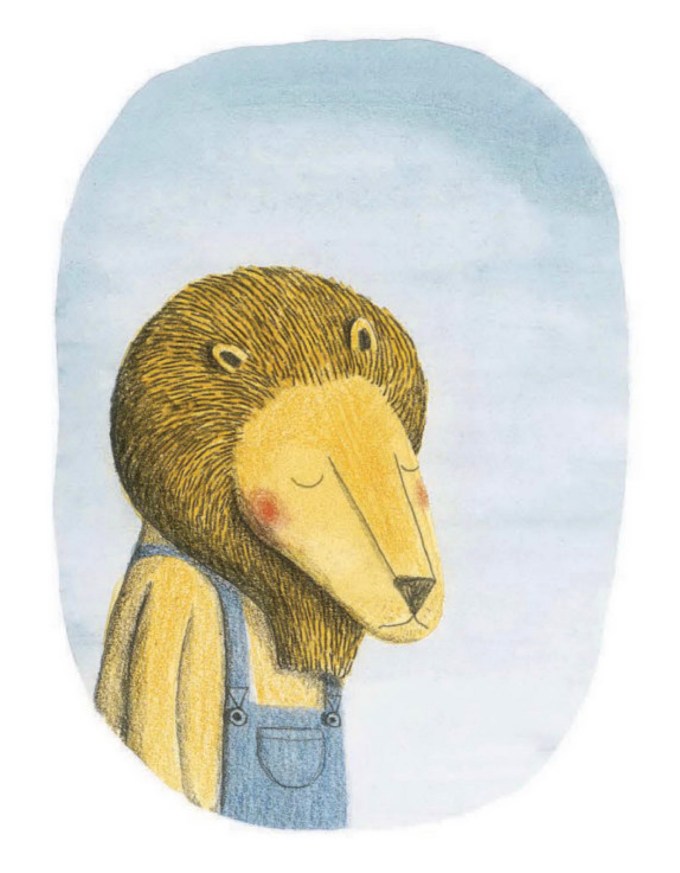
Art by Marianne Dubuc from The Lion and the Bird

There is, therefore, no mightier spell against unhappiness than moving through the present in a way that preempts regret in the future — with integrity, with humility, with wholeheartedness.

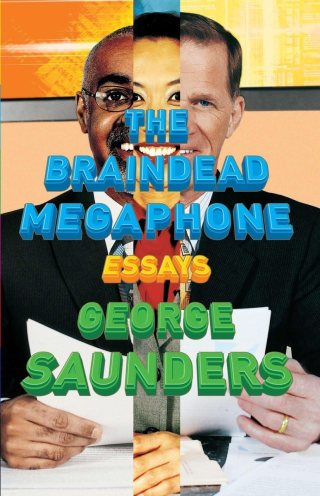
That is what George Saunders reckons with in some lovely passages from his prophetic 2007 essay collection The Braindead Megaphone (public library).

In one of those tangents that give the essay form its fractal splendor, he writes:

You know that feeling at the end of the day, when the anxiety of that-which-I-must-do falls away… That moment when you think, Oh God, what have I done with this day? And what am I doing with my life? And how must I change to avoid catastrophic end-of-life regrets?
[…]

At the end of my life, I know I won’t be wishing I’d held more back, been less effusive, more often stood on ceremony, forgiven less, spent more days oblivious to the secret wishes and fears of the people around me.

In a sentiment he would later deepen in his moving 2013 Syracuse commencement address, he adds:

So what is stopping me from stepping outside my habitual crap?

My mind, my limited mind.

The story of life is the story of the same basic mind readdressing the same problems in the same already discredited ways.

In a wonderful aside from another essay, he offers what may be the best recipe for breaking out of the mind’s recursive and limiting stories:

Don’t be afraid to be confused. Try to remain permanently confused. Anything is possible. Stay open, forever, so open it hurts, and then open up some more, until the day you die, world without end, amen.

Couple with artist Maira Kalman’s illustrated meditation on how to find joy on the other side of remorse and Ellen Bass’s superb poem “How to Apologize,” then revisit George Saunders on the courage of uncertainty.

We Are Free to Change the World: Hannah Arendt, the Power of Defiant Goodwill, and the Art of Beginning Afresh

By Maria Popova (themarginalian.org)

“We speak of four fundamental forces,” a physicist recently said to me, “but I believe there are only two: good and evil” — a startling assertion coming from a scientist. Beneath it pulsates the sensitive recognition that it is precisely because free will is so uncomfortably at odds with everything we know about the nature of the universe that the experience of freedom — which is different from the fact of freedom — is fundamental to our humanity; it is precisely because we were forged by these impartial forces, these handmaidens of chance, that our choices — which always have a moral valence — give meaning to reality.

Whether our cosmic helplessness paralyzes or mobilizes us depends largely on how we orient to freedom and what we make of agency. “The smallest act in the most limited circumstances,” Hannah Arendt wrote in The Human Condition, “bears the seed of… boundlessness, because one deed, and sometimes one word, suffices to change every constellation.”

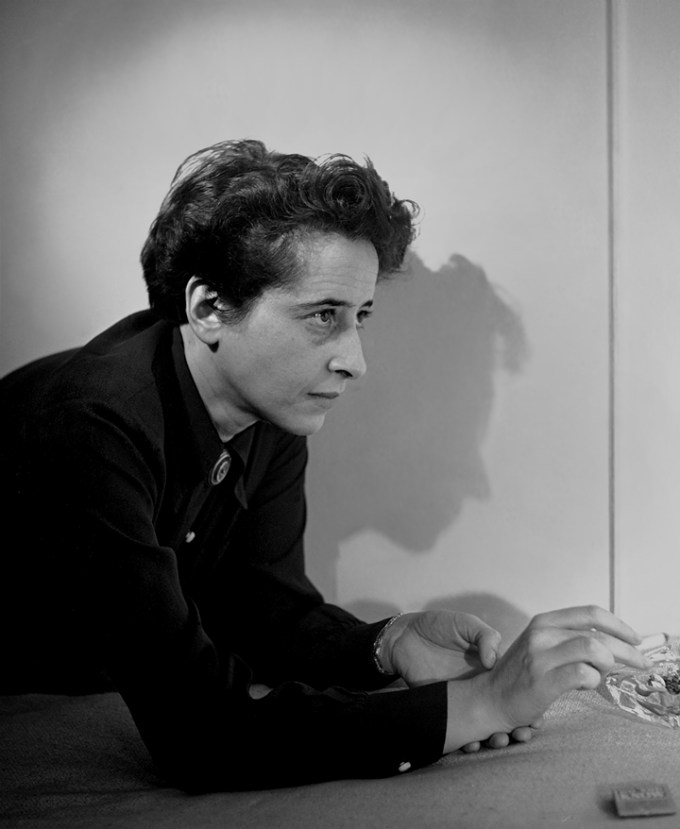
Hannah Arendt by Fred Stein, 1944. (Photograph courtesy of the Fred Stein Archive.)

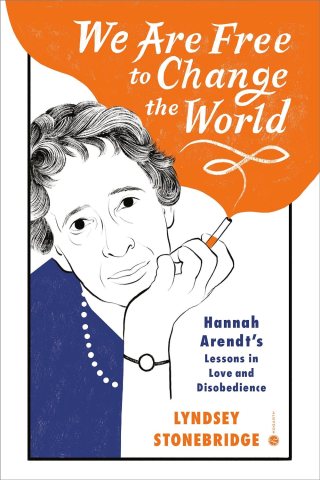
Arendt’s rigorously reasoned, boundlessly mobilizing defiance of helplessness and “the stubborn humanity of her fierce and complex creativity” come abloom in We Are Free to Change the World: Hannah Arendt’s Lessons in Love and Disobedience (public library) — Lyndsey Stonebridge’s erudite and passionate celebration of what Arendt modeled for generations and goes on modeling for us: “determined and splendid goodwill, refusing to accept the compromised terms upon which modern freedom is offered and holding out for something new.”

Stonebridge, who has been studying Arendt for three decades, writes:

Hannah Arendt is a creative and complex thinker; she writes about power and terror, war and revolution, exile and love, and, above all, about freedom. Reading her is never just an intellectual exercise, it is an experience.

[…]

She loved the human condition for what it was: terrible, beautiful, perplexing, amazing, and above all, exquisitely precious. And she never stopped believing in a politics that might be true to that condition. Her writing has much to tell us about how we got to this point in our history, about the madness of modern politics and about the awful, empty thoughtlessness of contemporary political violence. But she also teaches that it is when the experience of powerlessness is at its most acute, when history seems at its most bleak, that the determination to think like a human being, creatively, courageously, and complicatedly, matters the most.

She too lived in a “post-truth era,” she too watched the fragmentation of reality in a shared world, and she saw with uncommon lucidity that the only path to freedom is the free mind. Whether she was writing about love and how to live with the fundamental fear of loss or about lying in politics, she was always teaching her reader, as Stonebridge observes, not what to think but how to think — a credo culminating in her parting gift to the world: The Life of the Mind.

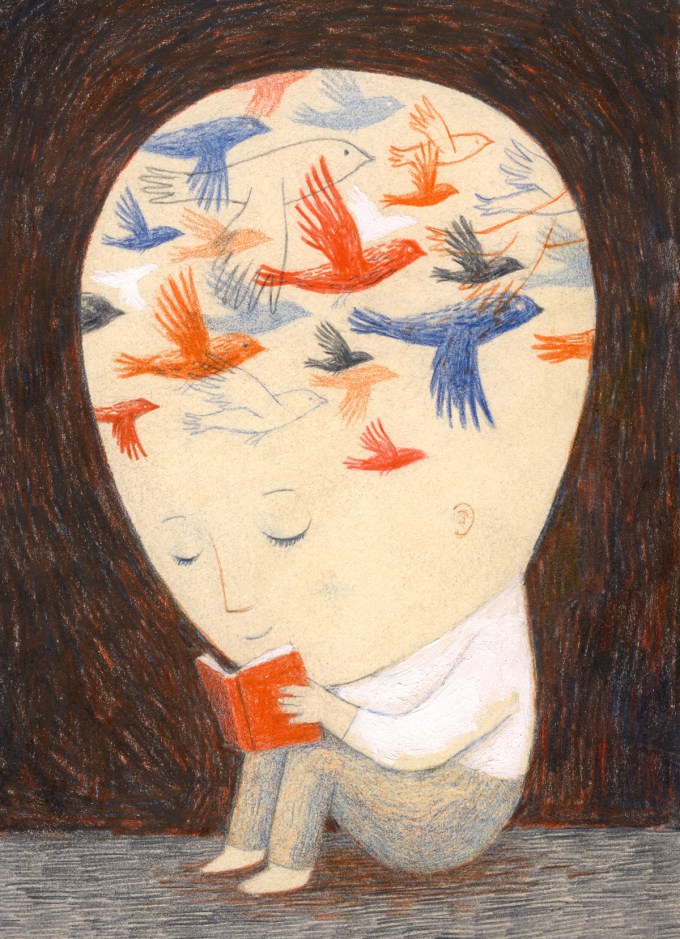
Art by Ofra Amit from A Velocity of Being: Letters to a Young Reader. Available as a print.

In consonance with George Saunders’s lovely case for the courage of uncertainty and his insistence that possibility is a matter of trying to “remain permanently confused,” Stonebridge writes:

Having a free mind in Arendt’s sense means turning away from dogma, political certainties, theoretical comfort zones, and satisfying ideologies. It means learning instead to cultivate the art of staying true to the hazards, vulnerabilities, mysteries, and perplexities of reality, because ultimately that is our best chance of remaining human.

Having “escaped from the black heart of fascist Europe and its crumbling nation states,” having witnessed the horrors of the Holocaust and the rise of totalitarian regimes around the world, Arendt never stopped thinking and writing about what it means to be human — an example of what she considered the “unanswerable questions” feeding our “capacity to ask all the answerable questions upon which every civilization is founded.”

Celebrating Arendt as a “conservationist” who “traveled back into the traditions of political and philosophical thought in search of new creative pathways to the present,” Stonebridge reflects:

Fundamental questions about the human condition are not beside the point in dire political times; they are the point. How can we think straight amidst cynicism and mendacity? What is there left to love, to cherish, to fight for? How can we act to best secure it? What fences and bridges do we need to build to protect freedom and which walls do we need to destroy?

In my own longtime immersion in Arendt’s world, I have often shuddered at how perfectly her indictment of political oppression applies to the tyranny of consumerist society, although Arendt did not overtly address that. In this passage from Stonebridge, one could easily replace “Nazism,” “totalitarianism,” and “the Holocaust” with “late-stage capitalism” and feel the same sting of truth:

Nazism was undoubtedly tyrannical, and self-evidently fascist in its gray-black glamour, racist mythology, and disregard for the rule of law. However, Arendt argued that modern dictatorship had an important new feature. Its power reached everywhere: not a person, an institution, a mind, or a private dream was left untouched. It squeezed people together, crushing out spaces for thought, spontaneity, creativity — defiance. Totalitarianism was not just a new system of oppression, it seemed to have altered the texture of human experience itself.

[…]

The moral obscenity of the Holocaust had to be recognized, put on trial, grieved, and addressed. But it could not be made right with existing methods and ideologies… You cannot simply will this evil off the face of the earth with a few good ideas, let alone with the old ones that allowed it to flourish in the first place. You have to start anew.

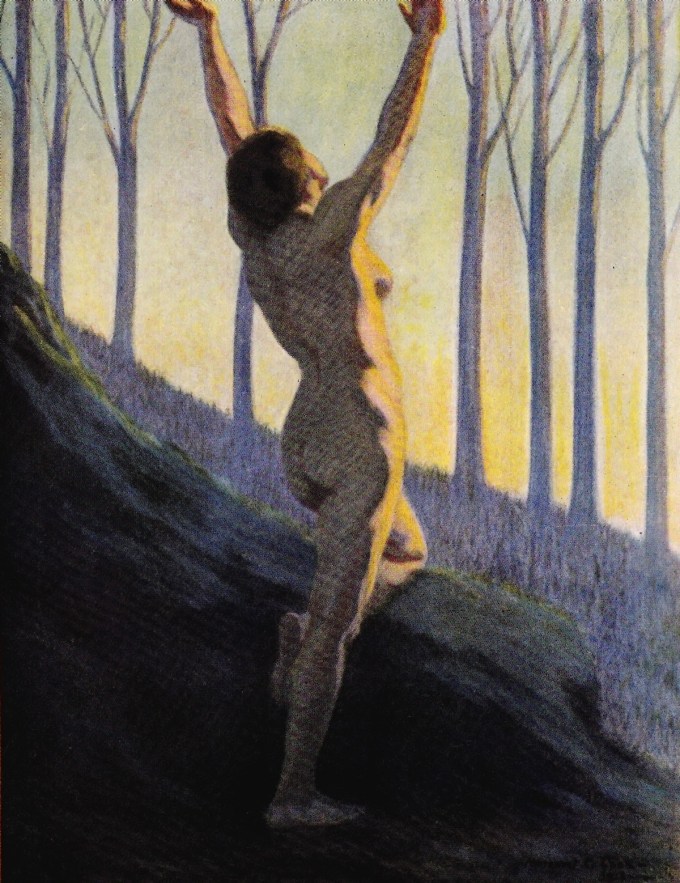
One of English artist Margaret C. Cook’s illustrations for a rare 1913 edition of Walt Whitman’s of Leaves of Grass. (Available as a print.)

This belief that “we are free to change the world and to start something new in it” animated Arendt’s life — a freedom she located not in what she termed reckless optimism (the divested shadow side of Rebecca Solnit’s notion of hope as an act of defiance), but in action as the crux of the pursuit of happiness — what Stonebridge so astutely perceives as “the determination to exist as a fully living and thinking person in a world among others.” She writes:

Freedom cannot be forced; it can only be experienced in the world and alongside others. It is on this condition that we are free to change the world and start something new in it.

Echoing Albert Camus’s insistence that “real generosity toward the future lies in giving all to the present,” she adds:

Learning to love the world means that you cannot be pleasantly indifferent about its future. But there is a wisdom in knowing that change has come before and, what is more, that it will keep on coming, often when you least expect it; unplanned, spontaneous, and sometimes, even just in time. That, for Hannah Arendt, is the human condition.

Couple We Are Free to Change the World — a superb read in its entirety — with James Baldwin on the paradox of freedom, John O’Donohue on the transcendent terror of new beginnings, and Bertrand Russell on the key to a free mind, then revisit Arendt on how we invent ourselves and reinvent the worldthe power of being an outsider, and what forgiveness really means.

MY FIRST ENCOUNTER WITH SELF-REMEMBERING

In my case, bumping into the idea of self-remembering was like bumping into an old friend with whom one had lost contact for decades…

In my case, bumping into the idea of self-remembering was like bumping into an old friend with whom one had lost contact for decades, whom one barely recognizes at first, but by virtue of some distinguishing mannerism—a grin, a gesture, a toss of their hair—one suddenly remembers them quite unmistakably.

I shudder at the notion that this chance encounter could have easily never happened. For a long time, I had been searching for meaning. I could find nothing praiseworthy in myself, and although I thought myself smart, it was a futile kind of smartness always bent on wittiness and self-glorification. Strangely, I could see this but not change it, and this frustration powered my search. I could conceive of myself acting differently but could not take any practical steps to do something about it. Was there not more to being human than being endowed with the capacity for ineffectual self-reflection? I determined to find out.

I scoured bookstores and libraries in search of literature on psychology and philosophy. The idea that others had searched like this before me was itself some consolation, although none so far seemed to have found anything substantial. Some equated human potential with physical discipline: yoga exercises, strict diets, breathing techniques, and the like. Following their suggestions did improve my physical well-being, but that was not what I had been after. I remained the same selfish, arrogant and witty fool, with even more energy to power my folly. Others wrote off the prospect of a ‘search’ as a futile intellectual endeavor. It was our human birthright to experience love, empathy, and kindness—emotions that altogether eradicated the need to ‘search’. I could agree with this in principle but could only pretend to live up to these noble emotions—and strongly suspected that those advocating them were not always practicing what they preached. Try as hard as I may, I could not bring myself to cover my deeply embedded weaknesses with a dishonest smile or show of empathy. Others steered the search for meaning towards philosophical debate and argument. The more complicated their theories, the more difficult they were to apply. Even if by a strong mental effort I could fathom some of their reasonings, I remained unchanged; the same self-indulgent, witty, fool I had always been. And so, the accounts I was reading seemed to be memoirs of seekers who had—in my opinion—despaired midway in their search and compromised, like knights whose forlorn skeletons now lined the path to some Holy Grail, the existence of which I was beginning to doubt.

Perhaps the truth could not be found in books? Perhaps I should venture to distant lands in search of teachers, or secret brotherhoods? But where would I go, and what if these attempts would also lead to dead ends? The hours wasted on fruitless reading would be nothing compared to the weeks, months, and years I’d be wasting in fruitless journeys.

Meanwhile, the door of opportunity seemed to be closing. I sensed I could not continue this search indefinitely, especially because it was pressing me against the reality of my own weaknesses. The more advice I was exposed to, the more I saw how I couldn’t follow it, in which case, what was I really searching for? Even if I came upon some truth, some sound formula for actualizing the latent potential in human beings, was I not too scattered, too inconsistent, and too lazy, to put this into practice? Was my search, then, merely an escape from acknowledging my fundamental inadequacy?

Was I uncorrectable?

“Read this,” said an acquaintance one day, dropping a book on my desk. “It’s not for everyone, but some find it a good last resort.”

The book lay untouched for a while before I came around to opening it, and when I did, I found it engaging. The author cut straight to the point. He called for self-observation as a natural remedy for self-ignorance. My pride was quick to brush this aside, convinced that I already knew myself quite well. Nonetheless, the teaching he presented laid out very specific instructions about what to observe. The reader was being given a map. This was somewhat new to me, and I thought it worthy of respect, although it still didn’t address the fundamental problem of my inconsistency. I was not lacking in good instruction, I lacked the ability to apply it. I urgently needed a tool for change, a mantra that would take away my sense of impotence, a handle with which to firmly grasp my laziness and turn it around.

Just as the flame of my interest was beginning to flicker, the book took a surprising turn. As if taking back what he had said so far, the author plainly stated that if one were to try to follow this map, one would discover that one could not. This sounded true and painfully familiar—and a bit unusual for an author to disqualify the value of everything he had presented so far. My curiosity was rekindled. “However,” he continued, “by trying to observe ourselves we stumble upon an important fact—that generally we do not remember ourselves.”

I was overcome by a powerful sense of recognition and slammed the book shut.

The word self-remembering exploded in my mind sending shivers down my spine and flooding my eyes with tears. This is the missing link. If I could remain aware of myself—as vividly as I was aware right then—I would be able to catch my laziness, inconsistency, and wittiness in real time, and do something about them. This was the handle I had so desperately searched for.

The shock was not only in the profundity of the idea my eyes had just read , but also its familiarity. Had I heard this before? Certainly not, or I would have already begun practicing it. Yet why was this concept so familiar? And how did I know to recognize its value so unmistakably? Nothing in my past could explain this recognition. Beyond doubt, beyond any rational explanation, I was keenly aware that this marked the end of my search.

And that I had just experienced a miracle.

About the Founder

Asaf Braverman is the founder of beperiod.com, a worldwide community of people dedicated to self-development.

Translation Class March 23-24

Don’t Miss Out on Translation® Class in March!

March 23-24, 2024

Richard Hartnett, H.W., M., is presenting a live Translation® class on March 23 and 24th, 2024 via Zoom. Class runs from 10:00 a.m. PST to 4:30 p.m. PST both days.

Translation® provides an easy-to-use method for stripping away false ideas and releasing the innate wholeness and integrity which is your birthright.

Class fees are $195 for new to class and $75 for review. Fees cover the two-day class, class PDF / workbook, and a follow-up workshop! Those new to class also receive a one year membership with the Prosperos.

Want to learn more or to register?

You can visit online: https://www.theprosperos.org/prosperos-events/translation202403


Hear the exciting podcast episode where Richard discusses what Translation® is, how it has impacted his life, why you will want to learn or renew your knowledge of this tool, what his favorite word track is, and so much more!

https://www.theprosperos.com/podcast/2024/03/07-hartnett-translation

“Within each person is a unique goodness that will come forth”

Can You Change & Save the World by Changing Yourself?

This seemingly very personal work is actually among the most important things we can do to save the world, because as we become grounded in the present, we gain the power to create change.

THOM HARTMANN

MAR 17, 2024 (wisdomschool.com)

Image by Karin Henseler from Pixabay

Then I saw that the wall had never been there, that the “unheard of ” is here and this, not something and somewhere else, that  the “offering” is here and now, always and everywhere—“surrendered” to be what, in me, God gives of Himself to Himself.

—Dag  Hammarskjöld (1905–1961), Secretary General of the United Nations 1953–1961, personal diary entry, 1954

Upgrade to paid

I remember a summer when I was around five or six years old. My parents had recently purchased a hammock and put it in our backyard, and I was lying on it on a bright sunny afternoon. The sky was a deep blue, with thin wispy clouds, and I could smell the fresh-mowed grass crushed by the green-painted metal frame of the hammock. I could feel the ropes of the hammock against my back through my T-shirt and pressing against my bare legs below my shorts, and hear the melodic sounds of birds singing in the trees that surrounded the yard. One of the birds was repeating over and over a three-note call, while others chirped randomly.

I stared at the sky, noticing little specks in my field of vision and how they’d jump when I moved my eyes and then slowly settle when I held my sight on a particular bit of cloud. There was a gentle wind blowing, and I could hear it rustling the leaves of the huge old maple tree about thirty feet from me; the hammock rocked very slightly, a soothing motion that made the sky seem to tilt slightly from side to side.

I took a deep breath and noticed how breathing deeply seemed to brighten the sky, and smelled the blooming roses and hollyhocks and flowers along the edge of the yard, mingled with the fresh-laundry smell of the pillowcase on the pillow under my head. My fingers interlaced across my stomach, I felt the warmth of the sun on my bare arms, legs, and face.

Turning my head to my left, I noticed that I was 10 feet from a stand of pink, white, and yellow hollyhocks, covered with blossoms and standing 5 feet tall. The thick white stamens erupted from the waxy, colored petals, and honeybees and bumblebees moved lazily from flower to flower gathering pollen. I could hear them buzzing, as if they were humming their pleasure at finding the pollen.

As I looked at the way colors flowed from pink to white on the flower petals, noticed how the sounds of the birds had changed with the movement of my head, felt the sun now full-warm on the right side of my face, I was washed over with a sense of total Now. I saw that the flowers were alive, the bees were alive, the tree and the birds were alive, and I was alive. The air was crystal clear, and I noticed the empty space between me and the flowers, the distance between me and the grass, the next house over, and the tree. Even the empty spaces vibrated with life.

“Wow,” I said softly, then heard the sound of my own voice, and that was another miracle, amazing me all over again. It was a perfectly ordinary moment, yet filled with Spirit.

In its simplest and in its most complex forms, that is one of the most powerful forms of meditation, a touching of the presence of Life itself.

Einstein wrote about how past and present are only concepts we form in our minds but having no ultimate reality. Everything that exists and happens is only in the ever-constant now, and now is the only time that exists.

Einstein also said that he rarely thought things through with his intellect, but instead achieved his most important realizations in flashes of insight, moments of intuitive knowing. He was describing, both in his concept of time and his descriptions of how he came to see new concepts, a form of meditation.

Viewing the past

If you look back over your life, back over the years you’ve been alive on this planet, year by year and decade by decade, you’ll probably notice there’s a vast gray sea of recollection, and embedded in it are a few crystal clear moments of vivid memories.

These remembered times often seem idiosyncratic: Why would I carry around all my life the memory of an afternoon on a hammock? Or walking down the street in New York City in 1973, or sitting by a pond when I was 16, or a day in Miss Hemmer’s biology class in the seventh grade when she talked about the cycles of ATP/ADP/AMP?

What’s so special about them? Why are those memories so much more vivid than the “really important” things, the things I wanted to remember, such as how to do quadratic equations, the name of that reporter I’m meeting this week, or the directions to a place where I have to give a speech?

Sometimes, the things we choose to remember make perfect sense: who could forget their wedding, or the birth of their children, or their first day of school?

But the idiosyncratic and the reasonable memories share something in common, and that something  is at the core of the meditative state: it’s what I call presence.

If you re-examine any of those memories from your past—big or little—the one thing you’ll find they all share is that at the moment a particular memory was imprinted in your brain, you were not talking to yourself in your head. You were not thinking or worrying or imagining or comparing or judging: you were being. You had set aside the stories, and were only experiencing.

Lying in that hammock, as I felt the sun on my skin, heard the birds and the breeze, and saw the life in those flowers,  I was so shocked by the vitality and reality and aliveness of it all that I stopped thinking about it for a moment and simply experienced it. I was there, then. This sense of presence is at the core of the meditative and the mystical experience. It is the time when we are not thinking, but are instead alive and aware.

Achieve presence

Different people achieve this by different routes, but all methods have the effect of shutting down the thinking apparatus, which then allows our true consciousness to wake up and look around and see, hear, feel, taste, and smell the world.

Saint John of the Cross, for example, had a particularly difficult route to this experience. Born in 1542 in Fontiveros, a town in the Castilian region of Spain, he was the son of an impoverished weaver who was forced to convert from Judaism to Roman Catholicism. His father died when he was very young, and Juan helped support his mother by begging and working with her on her loom. Around the age of 21, he joined the Catholic order of the Carmelites and took on the name of Juan de Santo Matías.

Shortly after this time, he met Teresa of Avila, another Spanish mystic, who was trying to reform the Carmelite Order, moving them toward vows of poverty and mercy and away from the pomp, glamour, and power of the church. She was in her fifties at the time, and enlisted this young man’s aid in her reformation of their order.

Because of Juan’s support of Teresa’s reformation, he was arrested by the church and kept for a year in a cell made from a converted cupboard. There was no light most of the day, and he couldn’t stand up straight. He was not allowed to wash or change his clothes for six months, although he was infested with lice and fleas, and every day during this period of his imprisonment he was subjected to the Church’s “circular discipline.”

Daily, he would be removed from his cupboard and stripped of his shirt. Scraps of bread, a cup of water, and an occasional sardine were thrown on the floor, and as he kneeled to eat them, a group of monks walked in a circle around him, bursting the skin on his back with leather and wooden whips. They stripped the skin from his back and shoulders so many times, occasionally also breaking his shoulder and rib bones, that he was crippled for the rest of his life.

After six months of this, his lashings were reduced to once a week, lest he die from loss of blood. A new jailer took mercy on him and gave him paper and pen, and allowed the door to the cupboard to be open far enough to let in some light from the room so he could write.

It was during this time that he wrote some of his most profound and insightful works, including Cántico Espiritual, La Noche Oscura.

Consider this stanza from his poem “Sin arrimo y con arrimo” (“Without  Help  and With  Help”), about how he was touched (“helped”) by divinity even in his moments of greatest darkness:

Without help and with help
Without light and living in the darkness
Everything  consumes me. My soul  is in threads.
From  everything,  something  is grown
And uplifted  by itself
Into a life filled with ecstasy  and richness.
Only a being God helped
For that reason, it will be said, The thing I most cherish
That my soul  see itself  even  now, Without help and with help.
¹

John used his privations and pain as a tool to turn off his thinking mind. In that quiet place—which he wrote about extensively in Dark Night of the Soul—he  met the love, light, and presence of pure consciousness, what he called God. It was his form of meditation.

When we understand that this—finding that quiet place within where thinking ends and consciousness begins—is the most important goal and purpose of meditation, then it’s easier to understand and use the various forms of meditation.

Nearly every spiritual tradition on Earth has developed some form of meditative practice, and each is intended to arrive at the same place. Because each practice is rooted in the culture and assumptions and traditions of a particular time and place in the world, each has a different flavor and energy.

While many books and teachers will tell you that meditation is about reducing your blood pressure or calming your jangled nerves or improving your health, those are all just side effects. They do happen, as has been confirmed in study after study, and meditation can be a powerful tool for physical or emotional healing . . . but that’s  not where its real value rests. The true power of meditation—and the reason for meditating—is to become awake in this very moment.  And from that place—that here-and-now touching of the power of life—we can find the ability to transform ourselves and others in ways that can and will transform the world.

This seemingly very personal work is actually among the most important things we can do to save the world, because as we become grounded in the present, we gain the power to create change. We also acquire and radiate a spiritual strength—the solidity and reality of spirit that tribal people have known about and used for millennia.

It’s amazing to think that it’s possible to change the world by changing ourselves, by changing the way we think, live, and experience every moment, but that’s been the core message of almost every religion in history, from the most ancient and primal to the most modern. You can change and save the world by changing yourself. And that begins with waking up to the power of life in the present, and finding there the presence of our Creator and all creation.

Ceasefire Talks to Resume as Hamas Softens its Position

Samy Magdy/Associated Press

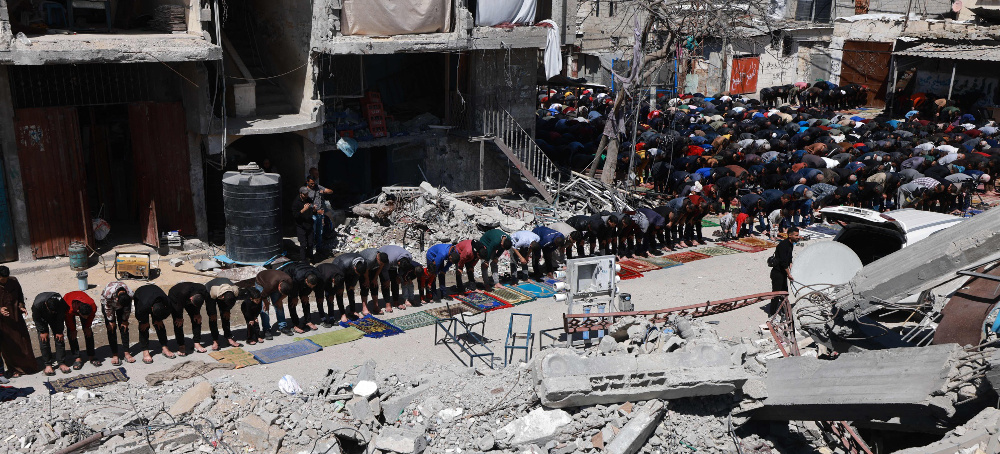
Ceasefire Talks to Resume as Hamas Softens its PositionPalestinians pray in front of the ruins of Al-Farouq Mosque on March 15. (photo: Mohammed Abed/Getty)

17 march 24 (RSN.org)

ALSO SEE: Latest Hamas Response to Gaza Deal: Dismissed by Netanyahu as ‘Ludicrous,’ Officials Say It Has Major Advances for Israel

Stalled talks aimed at securing a cease-fire in the Israel-Hamas war are expected to resume in earnest in Qatar as soon as Sunday, according to Egyptian officials.

The talks would mark the first time both Israeli officials and Hamas leaders join the indirect negotiations since the start of the Muslim holy month of Ramadan. International mediators had hoped to secure a six-week truce before Ramadan started earlier this week, but Hamas refused any deal that wouldn’t lead to a permanent cease-fire in Gaza, a demand Israel rejected.

But both sides have made moves in recent days aimed at getting the talks, which never fully broke off, back on track.

Hamas gave mediators a new proposal for a three-stage plan that would end the fighting, according to two Egyptian officials, one who is involved in the talks and a second who was briefed on them. The officials spoke on condition of anonymity because they weren’t authorized to reveal the contents of the sensitive discussions.

The first stage would be a six-week cease-fire that would see the release of 35 hostages — women, those who are ill and older people — held by militants in Gaza in exchange for 350 Palestinian prisoners held by Israel.

Hamas would also release at least five female soldiers in exchange for 50 prisoners, including some serving long sentences on terror charges, for each soldier. Israeli forces would withdraw from two main roads in Gaza, let displaced Palestinians return to northern Gaza, which has been devastated by the fighting, and allow the free flow of aid to the area, the officials said.

Nearly one in three children under 2 years old in the isolated north have acute malnutrition, the U.N. children’s agency said Friday.

In the second phase, the two sides would declare a permanent cease-fire and Hamas would free the remaining Israeli soldiers held hostage in exchange for more prisoners, the officials said.

In the third phase, Hamas would hand over the bodies it’s holding in exchange for Israel lifting the blockade of Gaza and allowing reconstruction to start, the officials said.

Talks were expected to resume Sunday afternoon, though they could get pushed to Monday, the Egyptian officials said.

Israeli Prime Minister Benjamin Netanyahu called the proposal “unrealistic” but agreed to send Israeli negotiators to Qatar. His government has rejected calls for a permanent cease-fire, insisting it must first fulfill its stated goal of “annihilating Hamas.”

Thousands of people demonstrated Saturday night in Tel Aviv to show their impatience with Netanyahu’s government and demand a deal to free hostages. Some expressed support for U.S. Senate Majority Leader Chuck Schumer’s sharp criticism of Netanyahu’s handling of the war and his call for a new election.

“I think that we are in a situation where they are completely right, that we have a war that is continuing well beyond what is necessary,” protester Yehuda Halper said.

Netanyahu’s office said Friday he approved military plans to attack Rafah, the southernmost town in Gaza where about 1.4 million displaced Palestinians — more than half the enclave’s population — are sheltering. Israel wants to target Hamas battalions stationed there.

Many fled to Rafah when Israel attacked Gaza following the Oct. 7 Hamas attack on southern Israel that killed 1,200 people and left another 250 hostage.

The United States and other countries have warned that a military operation in Rafah could be disastrous.

Netanyahu’s office didn’t give details or a timetable for the Rafah operation, but said that it would involve the evacuation of the civilian population. The military has said it planned to direct civilians to “humanitarian islands” in central Gaza.

“Many people are too fragile, hungry and sick to be moved again,” World Health Organization Director-General Tedros Adhanom Ghebreyesus said on social media, adding that there are no fully functional, safe health centers they can reach elsewhere in Gaza. “In the name of humanity, we appeal to Israel not to proceed.”

The Gaza Health Ministry said at least 31,553 Palestinians have been killed in the war. The ministry doesn’t differentiate between civilians and combatants in its count, but says women and children make up two-thirds of the dead.

An Israeli strike early Saturday flattened a house in the urban Nuseirat refugee camp in central Gaza, killing at least 19 people, including nine children, according to records at the al-Aqsa Martyrs hospital. An Associated Press journalist there saw the bodies.

Israel’s offensive has driven most of Gaza’s 2.3 million people from their homes. A quarter of Gaza’s population is starving, according to the U.N.

As part of efforts to deliver desperately needed aid, a ship inaugurated a sea route from Cyprus on Friday and offloaded 200 tons of humanitarian supplies sent by the aid group World Central Kitchen destined for people in northern Gaza.

The group said it was preparing another vessel in Cyprus with hundreds of tons of aid.

Also on Saturday, Germany joined a group of countries, including the U.S. and Jordan, in conducting airdrops of aid over Gaza. The U.S. also has announced separate plans to construct a pier to get aid in.

Displaced Palestinians living in tents along the Mediterranean coast remained hungry and bleak.

“The situation is so bad that no one can imagine it, and the ship, even if it helps, will be a drop in the ocean,” said Zahr Saqr in Muwasi. “We run like dogs behind air drops.”

The Earthquake That Could Shatter Netanyahu’s Coalition

Yair Rosenberg/The Atlantic

The Earthquake That Could Shatter Netanyahu’s CoalitionIsrael’s ultra-Orthodox don’t serve in its armed forces. That’s getting harder than ever to justify. (photo: Ilia Yefimovich/Getty)
17 march 24 (RSN.org)

Israel’s ultra-Orthodox don’t serve in its armed forces. That’s getting harder than ever to justify.

The most controversial Israeli comedy sketch of the current war is just 88 seconds long. Aired in February on Eretz Nehederet, Israel’s equivalent of Saturday Night Live, it opens with two ashen-faced officers knocking on the door of a nondescript apartment, ready to deliver devastating news to the inhabitants. The officers are greeted by an ultra-Orthodox Jewish man who is similarly stricken when he sees them.

“I’ve been terrified of this knock,” he says. “Ever since the war began, I knew it would eventually come for me.” But before the pained officers can continue, he interjects: “Listen, there is no situation in which I will enlist—forget about it.”

It turns out that the officers have the wrong address. This is not the home of a fallen soldier, but of one of the many thousands of ultra-Orthodox Jews who do not serve in Israel’s army, thanks to a special exemption. As the officers depart to find the right family, the man calls after them, “Tell them that we prayed for him! We did everything we could.”

The gag struck a nerve. Channel 14, Israel’s pro-Netanyahu equivalent of Fox News, ran multiple segments denouncing the satire. Commentators for right-wing media outlets called it “incitement,” a term typically applied to pro-terrorist speech in Israeli discourse. Why did a short sketch warrant such an overwhelming response? Because it took aim at the most vulnerable pressure point of Benjamin Netanyahu’s coalition—one with the potential to cause the current government’s collapse.

Since Israel was founded in 1948, it has fielded a citizens’ army with mandatory Jewish conscription—and one very notable exception: Ultra-Orthodox, or Haredi, yeshiva students do not serve. This dispensation dates back to David Ben-Gurion, the country’s first prime minister. A secular Jewish socialist, he saw Israel’s ultra-Orthodox as the dying remnant of an old world, and when the community’s leadership requested an exemption from the draft, Ben-Gurion calculated that it was a small price to pay for their support. At the time, the ultra-Orthodox constituted about 1 percent of Israel’s population, and the exemption applied to just 400 young men in religious seminaries.

That was then. Today the Haredi community numbers some 1.2 million, more than 13 percent of Israel’s total population. And because this community has the highest birth rate in the country, its ranks will only swell. In other words, the fastest-growing group in Israeli society does not serve in its armed forces. Since October 7, the divide has been thrown into stark relief. After Hamas massacred 1,200 Israelis and kidnapped hundreds more, the country initiated one of the largest mobilizations in its history. Children and spouses departed their families for the front, leaving fear and uncertainty in their absence. Nearly 250 soldiers have since been killed, and thousands more injured. Many Israelis spend their evenings at home fretting about that ominous knock on the door.

Meanwhile, Haredi life has largely continued as usual, untouched by the war and its toll. Yeshiva students have even been photographed enjoying ski vacations abroad while their same-age peers are on the battlefield. Some ultra-Orthodox individuals do voluntarily serve in the army, and others act as first responders, but their numbers are small enough to be a rounding error. In February, a record-high 66,000 military-age Haredi men received exemptions; just 540 had enlisted since the war began. Put another way, more Arab Israelis serve in the Israel Defense Forces than ultra-Orthodox Jews.

The Haredi carve-out has long rankled Israel’s secular citizens. Yair Lapid, the center-left opposition leader and past prime minister, rose to prominence in 2012 on a campaign that promised “equality of the burden.” Before him, the right-wing politician Avigdor Lieberman built his secular Russian constituency on a similar pledge. But what has changed since October 7 is that this discontent is no longer emanating solely from the usual suspects, such as the left-wing Eretz Nehederet, but from supporters of the current governing coalition, including the more modern religious right.

Unlike the ultra-Orthodox, Israel’s religious Zionist community is fully integrated into the country’s army and economy. Sympathetic to Haredi piety, it has typically sat out the debates over conscription—but no longer. In early January, a religious Zionist educator from Jerusalem published an “Open Letter to Our Haredi Sisters.” In it, she implored ultra-Orthodox mothers to encourage their sons to enlist in the IDF. “This reality is no longer tolerable,” she wrote. “For those who think that their son is not suited for military service, we say: Many of our children are not suited to be soldiers. None of them are suited to die in war. None of us are suited to sending a child to risk his life. We all do this because it is impossible to live here without an army … and we are all responsible for one another: it cannot be that others will take risks and risk their children for me, and I and my children will not take risks for them.” The letter now has nearly 1,000 signatures.

The grassroots pressure on this issue from the non-Haredi religious community has risen to the point that Bezalel Smotrich, the ultra-nationalist politician and finance minister who has courted Haredi votes, joined the anti-exemption campaign, at least rhetorically. “The current situation is outrageous and cannot continue,” he said last month. “Israeli society’s claim against the [Haredi] community is just.” But this demand may be one that Netanyahu cannot satisfy.

Much has been written about Netanyahu’s dependence on the Israeli far right to remain in power. But the backbone of his coalition for many years has actually been the ultra-Orthodox political parties. They stuck with the premier after he was indicted on corruption charges, and they refused to defect to the opposition even after Netanyahu failed to form a government following successive stalemate elections. Today, the far right provides 14 of Netanyahu’s 64 coalition seats; the Haredi parties provide 18. The Israeli leader has richly rewarded this loyalty by ensuring an ever-growing flow of public subsidies to ultra-Orthodox voters and their religious institutions. Because Haredi men can maintain their military exemption only by remaining in seminaries until age 26, they rarely enter the workforce until late in life and lack the secular education to succeed in it. As a result, nearly half of the ultra-Orthodox community lives in poverty and relies on government welfare—an unsustainable economic course that is another perennial source of Israeli angst.

The Israeli public—and especially the Israeli right—was previously willing to look the other way on Haredi enlistment to advance other political priorities. But now, in a time of perceived existential conflict, Haredi enlistment has become a prime concern. Israel faces war with Iranian proxies—Hamas in the south and Hezbollah in the north—and it needs more soldiers, not more people who can’t be drafted. To cope, the country has extended reserve duty for current enlistees, further underscoring the disparity between their experience and that of the ultra-Orthodox. A long-standing fault line in Israeli society has now produced an earthquake.

Recent polls show that Israeli Jews—including majorities on the political right and center right—now overwhelmingly oppose blanket Haredi exemptions. A February survey found that an astonishing 73 percent were against exemptions—up 11 points from November. A poll released this week similarly found that 73 percent of Israeli Jews, including a majority of people who voted for the Netanyahu government, oppose the billion-shekel subsidies to Haredi institutions that are included in the government’s current budget proposal.

Unfortunately for Netanyahu, he’s running out of time to solve this problem, and his usual stalling tactics may not suffice. That’s because not just the Israeli public but the Israeli Supreme Court has put the issue on the agenda. Back in 1998, the high court ruled that the ultra-Orthodox exemption violated the principle of equality under the law, and ordered the Parliament to legislate a fairer arrangement to replace the existing regime. Since then, successive Israeli governments have tried and failed to craft such a solution, constantly kicking the can down the road. Months before the war, the current government set a March 31 deadline for passing its own legislation to resolve the Haredi-draft issue. This was widely expected to be yet another exercise in equivocation, leaving most of the ultra-Orthodox exempt so as to keep the coalition together, and likely setting up another showdown with the Supreme Court. In other words, more of the same.

But more of the same is no longer enough after October 7. With the public incensed at what many see as Haredi privilege, Netanyahu is facing revolt within his ranks. Most notably, Defense Minister Yoav Gallant has publicly called for an end to the exemptions and said he will not support any legislation on the matter that is not also approved by Benny Gantz, a centrist opposition lawmaker and rival to Netanyahu who sits in the country’s war cabinet. But any Haredi-draft bill that satisfies Gantz and Gallant is unlikely to satisfy the Haredi parties, who perceive enlistment as a threat to their cloistered way of life. And if no new legislation is passed, the IDF will be required to begin drafting the ultra-Orthodox on April 1.

As this deadline approaches, tensions have exploded into the open. This past week, Yitzhak Yosef, the Sephardic chief rabbi of Israel, declared that “if you force us to go to the army, we’ll all move abroad.” The ultimatum drew widespread condemnation, even from within the hard-right government. “Drafting to the military: A good deed!” retorted Smotrich’s party. “Army service is a huge privilege for a Jew who defends himself in his country and a great deed,” added the far-right faction of National Security Minister Itamar Ben-Gvir. It’s not clear that these worldviews can be reconciled, and the failure to bridge them could bring down the government.

Polls show that the overwhelming majority of Israelis want Netanyahu to resign, either now or after the war; that most Israelis want early elections; and that the current hard-right coalition would be crushed if those elections were held tomorrow. U.S. Senate Majority Leader Chuck Schumer, surely aware of those surveys, called yesterday for Israel to go to the polls to choose new leadership. The problem for the Israeli public is that no external mechanism forces Netanyahu to hold new elections, and the terrible polls for his coalition give its members every incentive to swallow their differences and keep the government afloat rather than face voters. Haredi conscription is perhaps the one issue that could shatter this cynical compact.

It’s never wise to bet against Netanyahu, Israel’s ultimate survivor. He will pursue every possible avenue to paper over this problem. But if he fails, his ultra-Orthodox allies could be compelled to leave the coalition, breaking it from within to force elections and freeze the status quo until a new government is sworn in. And if that happens, Israel’s other civil war may claim its first casualty: Netanyahu’s political career.

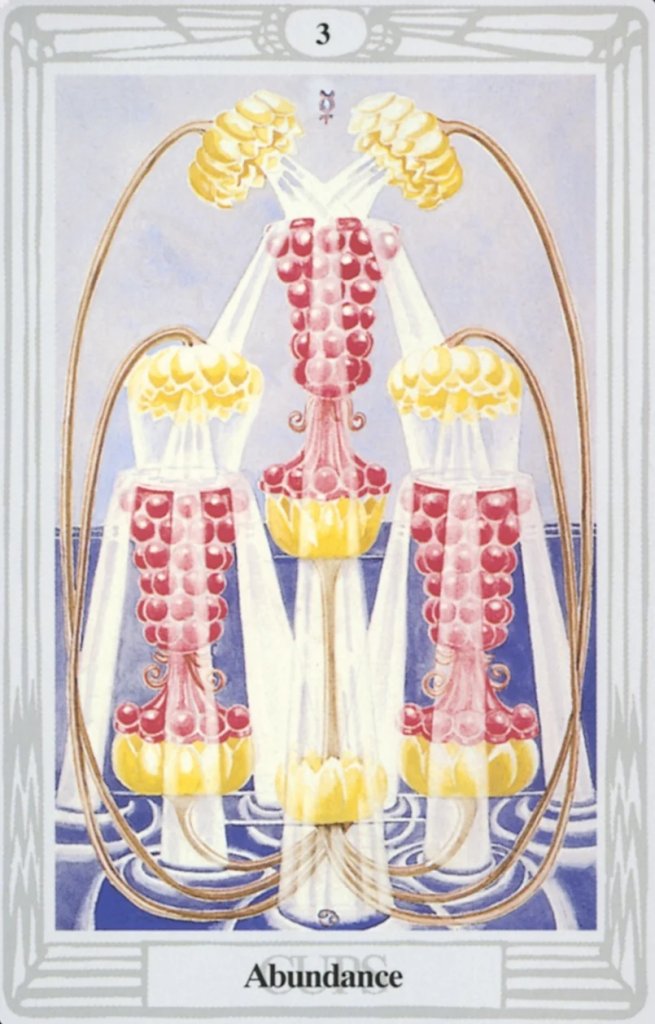
Tarot Card for March 18: The Three of Cups

The Three of Cups

The Lord of Abundance is a warm and joyous card, which indicates a rare and precious type of love – a love which, once experienced, reminds us of the richness of shared emotion and commitment.It is also a card which refers to the wellspring of fertility, whether spiritual or material. Here we see the first seeds sown of a bright and bountiful harvest. Accordingly, the card will sometimes come up to indicate high days of celebration – like weddings or other intimate celebrations of love.The emotional quality represented by this card is deep and unusual – indicating the love felt not only by lovers, but also the love between close friends, or family. These relationships are gifts, which need to be cared for with great respect and gratitude.The Lord of Abundance offers one word of warning – this type of love cannot be created, nor engineered. When it occurs in our lives we are lucky and blessed. Some people spend a lifetime looking for such depth of emotion. And sometimes, people try to pretend it exists where it does not. So when you raise this card in a reading be aware that you are fortunate indeed!