Free Will Astrology: Week of January 25, 2024

BY ROB BREZSNY | JANUARY 23, 2024 (Newcity.com)

Photo: Stefano Zocca

ARIES (March 21-April 19): Aries author Dani Shapiro has published six novels, three bestselling memoirs, and a host of articles in major magazines. She co-founded a writer’s conference, teaches at top universities, and does a regular podcast. We can conclude she is successful. Here’s her secret: She feels that summoning courage is more important than being confident. Taking bold action to accomplish what you want is more crucial than cultivating self-assurance. I propose that in the coming weeks, you apply her principles to your own ambitions.

TAURUS (April 20-May 20): Throughout history, there has never been a culture without religious, mythical and supernatural beliefs. The vast majority of the world’s people have believed in magic and divinity. Does that mean it’s all true and real? Of course not. But nor does it mean that none of it is true and real. Ultra-rationalists who dismiss the spiritual life are possessed by hubris. Everything I’ve said here is prelude to my oracle for you: Some of the events in the next three weeks will be the result of magic and divinity. Your homework is to discern which are and which aren’t.

GEMINI (May 21-June 20): Several wise people have assured me that the pursuit of wealth, power, popularity and happiness isn’t as important as the quest for meaningfulness. If you feel your life story is interesting, rich and full of purpose, you are successful. This will be a featured theme for you in the coming months, Gemini. If you have ever fantasized about your destiny resembling an ancient myth, a revered fairy tale, a thousand-page novel or an epic film, you will get your wish.

CANCER (June 21-July 22): “Life as we live it is unaccompanied by signposts,” wrote author Holly Hickler. I disagree with her assessment, especially in regard to your upcoming future. Although you may not encounter literal markers bearing information to guide you, you will encounter metaphorical signals that are clear and strong. Be alert for them, Cancerian. They might not match your expectations about what signposts should be, though. So expand your concepts of how they might appear.

LEO (July 23-Aug. 22): I wrote a book called “Pronoia Is the Antidote for Paranoia: How the Whole World Is Conspiring to Shower You with Blessings.” Among its main messages: There’s high value in cultivating an attitude that actively looks for the best in life and regards problems as potential opportunities. When I was working on the book, no one needed to hear this advice more than me! Even now, I still have a long way to go before mastering the outlook I call “crafty optimism.” I am still subject to dark thoughts and worried feelings—even though I know the majority of them are irrational or not based on the truth of what’s happening. In other words, I am earnestly trying to learn the very themes I have been called to teach. What’s the equivalent in your life, Leo? Now is an excellent time to upgrade your skill at expressing abilities and understandings you wish everyone had.

VIRGO (Aug. 23-Sept. 22): In 1951, filmmaker Akira Kurosawa made a movie adapted from “The Idiot,” a novel by his favorite author Fyodor Dostoevsky. Kurosawa was not yet as famous and influential as he would later become. That’s why he agreed to his studio’s demand to cut ninety-nine minutes from his original 265-minute version. But this turned out to be a bad idea. Viewers of the film had a hard time understanding the chopped-up story. Most of the critics’ reviews were negative. I bring this to your attention, Virgo, with two intentions: 1. I encourage you to do minor editing on your labor of love. 2. But don’t agree to anything like the extensive revisions that Kurosawa did.

LIBRA (Sept. 23-Oct. 22): I have selected a poem for you to tape on your refrigerator door for the next eight weeks. It’s by thirteenth-century Zen poet Wu–Men. He wrote: “Ten thousand flowers in spring, the moon in autumn, / a cool breeze in summer, snow in winter. / If your mind isn’t clouded by unnecessary things, this is the best season of your life.” My wish for you, Libra—which is also my prediction for you—is that you will have extra power to empty your mind of unnecessary things. More than ever, you will be acutely content to focus on the few essentials that appeal to your wild heart and tender soul.

SCORPIO (Oct. 23-Nov. 21): Psychologist Carl Jung wrote, “Motherlove is one of the most moving and unforgettable memories of our lives, the mysterious root of all growth and change; the love that means homecoming, shelter and the long silence from which everything begins and in which everything ends.” To place yourself in rapt alignment with current cosmic rhythms, Scorpio, you will do whatever’s necessary to get a strong dose of the blessing Jung described. If your own mother isn’t available or is insufficient for this profound immersion, find other maternal sources. Borrow a wise woman elder or immerse yourself in Goddess worship. Be intensely intent on basking in a nurturing glow that welcomes you and loves you exactly as you are—and makes you feel deeply at home in the world.

SAGITTARIUS (Nov. 22-Dec. 21): In a set of famous experiments, physiologist Ivan Pavlov taught dogs to have an automatic response to a particular stimulus. He rang a bell while providing the dogs with food they loved. After a while, the dogs began salivating with hunger simply when they heard the bell, even though no food was offered. Ever since, “Pavlov’s dogs” has been a phrase that refers to the ease with which animals’ instinctual natures can be conditioned. I can’t help but wonder what would have happened if Pavlov had used cats instead of dogs for his research. Would felines have submitted to such scientific shenanigans? I doubt it. These ruminations are my way of urging you to be more like a cat than a dog in the coming weeks. Resist efforts to train you, tame you or manipulate you into compliance.

CAPRICORN (Dec. 22-Jan. 19): Before poet Louise Glück published her first book, “Firstborn,” it was rejected by twenty-eight publishers. When it finally emerged, she suffered from writer’s block. Her next book didn’t appear until eight years after the first one. Her third book arrived five years later, and her fourth required another five years. Slow going! But here’s the happy ending: By the time she died at age eighty, she had published twenty-one books and won the Pulitzer Prize and the Nobel Prize for Literature. By my astrological reckoning, you are now at a phase, in your own development, comparable to the time after Glück’s fourth book: well-primed, fully geared up, and ready to make robust progress.

AQUARIUS (Jan. 20-Feb. 18): “All good writing is swimming under water and holding your breath,” wrote author F. Scott Fitzgerald. I’d like to expand that metaphor and apply it to you, Aquarius. I propose that your best thinking and decision-making in the coming weeks will be like swimming under water while holding your breath. What I mean is that you’ll get the best results by doing what feels unnatural. You will get yourself in the right mood if you bravely go down below the surface and into the depths and feel your way around.

PISCES (Feb. 19-March 20): In honor of this pivotal time in your life story, I offer four pronouncements. 1. You can now be released from a history that has repeated itself too often. To expedite this happy shift, indulge in a big cry and laugh about how boring that repeated history has become. 2. You can finish paying off your karmic debt to someone you hurt. How? Change yourself to ensure you won’t ever act that way again. 3. You can better forgive those who wounded you if you forgive yourself for being vulnerable to them. 4. Every time you divest yourself of an illusion, you will clearly see how others’ illusions have been affecting you.

Homework: Release yourself from the pressure to live up to expectations you don’t like. Newsletter.FreeWillAstrology.com

Men are going to brutal boot camps to reclaim their masculinity. How did we get here?

Charles Trepany

USA TODAY January 22, 2024

Video: https://www.usatoday.com/videos/news/2022/11/02/beards-and-mustaches-making-comeback-no-shave-november/8248000001/

They crawl slowly up a hill on their stomachs, covered in grime. One man moans after an instructor yanks him by the ankles back down the hill. Still, he keeps crawling.

One man lies on his back while an instructor sprays hose water in his face. Another, wearing big chains across his torso, shivers during an expletive-laden rant from a bearded man, who calls him a disappointment.

These men aren’t prepping for an elite military mission.

They’re trying to become better men, they say.

“Man camps,” or all-male experiences designed for men’s self-improvement, have gained attention on social media, where more extreme versions of these programs, such as the Modern Day Knight Project in Southern California, share videos of the treatment participants endure, often to the tune of hundreds of thousands of views.

Though men’s psychology experts are skeptical of the extreme iterations of man camps, they say the growing awareness of them points to a loneliness and need for community men face in modern society.

“Men are seeking out difficult experiences,” says Erik Anderson, a licensed marriage and family therapist. “They’re seeking out groups. They’re seeking out tribes. They’re seeking out some sort of social bonding and sense of social capital. And they’re turning to these groups that, to me, feel like they’re giving people a bit of a false sense of that.”

What are ‘man camps’ − and why are they getting attention?

There are many different kinds of man camps. Some function like group therapy, some like workout classes, others are boot camp-style trainings.

The Modern Day Knight Project, also known as “the Project,” falls into the last category.

Billed online as a “75-hour crucible,” the experience involves grueling physical challenges under the instruction of military veterans. Those who make it through get access to a year-long coaching and mentorship program called the Modern Day Knight Mastermind Program. It costs $18,000 to attempt.

The Project’s goals, per its website, are to get men to shatter their self-doubt, ​see their purpose clearly, heal their trauma and uncover what’s holding them back. USA TODAY’s interview request for Bedros Keuilian, the founder of the project, went unanswered.

Video: https://www.instagram.com/reel/CyRC-L1Rsmx/embed/captioned/?cr=1&v=12&wp=1116&rd=https%3A%2F%2Fwww.usatoday.com#%7B%22ci%22%3A0%2C%22os%22%3A11637.40000000596%7D

Ronald Levant, professor emeritus of psychology at The University of Akron and co-author of “The Tough Standard: The Hard Truths about Masculinity and Violence,” says extreme man camps like the Modern Day Knight Project sell men on the idea that if they adhere to a hardened vision of masculinity, their lives will improve.

“They feel that their lives are not what they want them to be, and they believe that if they were more masculine, more macho, more ‘beast,’ their lives would be better,” Levant says. But that’s rarely the case, he says.

Jimmy Rex, founder of the men’s community We Are The They, signed up for the Project in 2022 for fun.

About six hours in, he says, the instructors had participants stand and share their reasons for being there. One man said he cheated on his spouse and wanted to become a better man. Another said his wife was cheating on him and he wanted to get his family back. Another said he’d served a years-long prison sentence and wanted to prove he was a new person.

Though he passed the fitness test to qualify, Rex said he felt unprepared for the intensity of the program. His left knee popped during a hike a couple hours into it, and he quit shortly after. He said his knee still bothers him.

The Misogi Challenge with We Are The They involved 12 hours of grueling physical activities.

Overall, he views his man camp experience positively and says the program he did accomplishes what it sets out to do. Rex held a similar event called the Misogi Challenge with his organization, which involved 12 hours of grueling physical tasks.

“They show the videos of what it is. They’re not hiding, making it seem like it’s something it’s not,” Rex says of the Project. “If it’s not for you, it’s not for you. But people willingly go to do it. They know what they’re signing up for.”

Why are men doing this?

Though psychologists aren’t sold on boot camps as a solution, they say the prevalence of man camps in general points to a real problem men are facing: loneliness.

In a 2021 survey by the Survey Center on American Life, only 21% of men said they received emotional support from a friend within the past week, compared to 41% of women. Just 25% of men said they told a friend they loved them within the past week, as opposed to 49% of women.

“A lot of men are lonely because they lack the ability to put emotions into words, which makes it hard for them to form relationships,” Levant says. “The inability to put their emotions into words leads to failures in relationships, leads to loneliness, leads to their seeking out these experiences.”

Though psychologists aren't sold on extreme man camps as an all-encompassing solution, they do say their prevalence points to a real problem facing men: loneliness.

Man camps offer an opportunity for men to bond with other men − and that isn’t necessarily a bad thing, especially when these programs make mental health a priority.

One such program is MPowered Brotherhood in Austin, Texas, which offers weekly workouts and other events for men. In addition to helping men improve their physical fitness, Stefanos Sifandos, a founder of MPowered Brotherhood, says the organization incorporates emotional practices, vulnerability exercises, breathwork, grief circles and more.

He says it strives to give men a support network and show them they’re worth more than their achievements and accolades.

“It’s an opportunity to be more of themselves without judgment, without shame,” Sifandos says. “We really meet each other with compassion and non-judgment and in healthy ways.”

More:Lloyd Austin didn’t want to share his prostate cancer struggle. Many men feel similarly.

MPowered also offers an intense boot camp called “Activate Your Alpha,” but Sifandos says it approaches what it means to be an “alpha” from a “holistic” perspective. The boot camp includes exercises around relationships and trauma, and participants receive 24/7 access to professional mental health support during, as well as before and after, the camp, which Sifandos says is key.

“There has to be deep emotional and psychological work that goes with it,” he says. “Otherwise, it just becomes an exercise in mental fortitude, which only gets you so far.”

Overall, Anderson says man camps show society needs to do more to address men’s emotional and mental health. Levant adds that, when men give voice to their feelings, their relationships tend to improve.

“We need to have a broader conversation about men’s need for belonging in our society and have other rituals that provide some way of satisfying that men’s need for belonging, that men’s need for trial, the men’s need for tribe,” Anderson says.

Boys and men are lonelier than ever.What can we do about it?

How to Be Un-Dead: Anaïs Nin and D.H. Lawrence on the Key to Living Fully

By Maria Popova (themarginalian.org)

“When you surrender, the problem ceases to exist,” Henry Miller wrote in his stunning letter to Anaïs Nin (February 21, 1903–January 14, 1977). “Try to solve it, or conquer it, and you only set up more resistance.”

But we, the controlling species, the conquering species, have a hard time with this notion of surrender; we, the conflicted species, spend our lives resisting it yet craving its liberations.

Anaïs Nin

Nin herself — a woman uncommonly liberated from the common traps of convention, control, and self-consciousness — took up the spiritual mechanics of this paradox in her first published book, D. H. Lawrence: An Unprofessional Study (public library), composed when she was still in her twenties.

With an eye to D.H. Lawrence (September 11, 1885–March 2, 1930) and his “philosophy that was against division,” his “plea for whole vision,” she writes:

When the realization came to the moderns of the importance of vitality and warmth, they willed the warmth with their minds. But Lawrence, with the terrible flair of the genius, sensed that a mere mental conjuring of the elemental was a perversion… Lawrence believed that the feelings of the body, from its most extreme impulses to its smallest gesture, are the warm root for true vision, and from that warm root can we truly grow. The livingness of the body was natural; the interference of the mind had created divisions, the consciousness of wrong-doing or well-doing.

In a sentiment central to my own animating ethos, she adds:

Life is a process of becoming, a combination of states we have to go through. Where people fail is that they wish to elect a state and remain in it. This is a kind of death.

It was Lawrence’s own writing that awakened in her this awareness of ongoingness and the urgency of total aliveness — the way “livingness is the axis of his world, the light, the gravitation, and electromagnetism of his world.”

In his 1924 novel The Boy in the Bush, Lawrence makes a stunning case for the indivisibility of it all — the beauty and the sorrow, the ache and the astonishment:

All real living hurts as well as fulfils. Happiness comes when we have lived and have a respite for sheer forgetting. Happiness, in the vulgar sense, is just a holiday experience. The life-long happiness lies in being used by life; hurt by life, driven and goaded by life, replenished and overjoyed with life, fighting for life’s sake. That is real happiness. In the undergoing, a large part of it is pain.

D.H. Lawrence

This was the foundational philosophy of Lawrence’s worldview — the pulse-beat that makes his writing so resonant and eternally alive, the way all great spiritual texts are. He distilled this view in an especially beautiful passage from his 1923 novel Kangaroo, reckoning with the most universal reality of life — the reality we spend our lives fighting, yet the one that peeks through in all of our greatest works of art and highest triumphs of the creative spirit. Echoing Whitman’s defense of our inner multitudes, often at odds with each other, he writes in an era when every woman was a “man” purely as a matter of linguistic convention:

If a man loves life, and feels the sacredness and mystery of life, then he knows that life is full of strange and subtle and even conflicting imperatives. And a wise man learns to recognize the imperatives as they arise — or nearly so — and to obey. But most men bruise themselves to death trying to fight and overcome their own, new, life-born needs, life’s ever strange imperatives. The secret of all life is obedience: obedience to the urge that arises in the soul, the urge that is life itself, urging us to new gestures, new embraces, new emotions, new combinations, new creations.

In the same epoch when Hermann Hesse so beautifully defended the wisdom of the inner voice, Lawrence’s protagonist makes a passionate case for listening to the song of life as it reverberates through the singular cathedral of each self, yours and mine, as it did for Nin and Lawrence and every other great mind long sung out of existence:

I offer no creed. I offer myself, my heart of wisdom, strange warm cavern where the voice of the oracle steams in from the unknown; I offer my consciousness, which hears the voice; and I offer my mind and my will, for the battle against every obstacle to respond to the voice of life.

Complement with Mary Oliver on how to live with maximum aliveness and Henry Miller on the measure of a life well lived, then revisit Nin on the meaning of maturity and how reading awakens us from the trance of near-living.

Tarot Card for January 25: The Queen of Disks

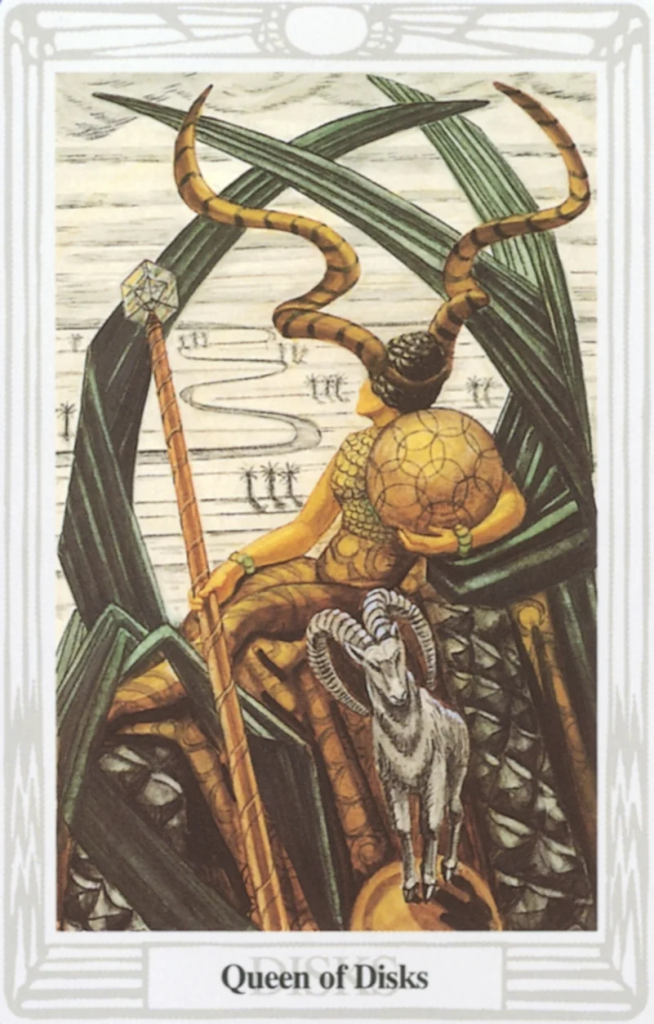
The Queen of Disks

As the Queen of the Suit most connected to the home environment, families, materiality and fecundity, the woman represented by the Queen of Disks will most likely be a person whose attention centres upon the family environment. Here, she will excel, gaining a great deal of pleasure from providing a secure haven where she and others can feel cosseted and cared for.In modern times the qualities for which this Queen stands have tended to be devalued and downgraded (‘I’m only a housewife’). This causes difficulties for the woman who feels most fulfilled expending her energies in a home situation, working with her family and a close circle of friends.Yet the contribution that this sort of work makes to the lives of anyone who comes into contact with it cannot be underestimated. We all want to feel welcome and warm in our own homes. We want to feel nurtured and secure. So perhaps it’s time to re-instate the Queen of Disks to her rightful place – Regent to the Empress, and important to everybody. Furthermore, maybe we need to invoke our own caring qualities more readily so that we all pour our unique energies into our domestic surroundings.If the Queen of Disks is ill-dignified in a reading, she will generally have lost sight of her position – or, perhaps, is being taken for granted by others. At that point the weaker side of her personality will show through. She may become dependent and clingy, believing herself to be unable to stand alone. She might manipulate by adopting a passive victim’s role.Though usually the type of woman indicated by the Queen of Disks is a gentle soul, when angered she can become a fierce enemy, particularly where she sees injustice done to her family and friends. She’s loyal and willing to help, rooted in the practical aspects of life.Her concept of spirituality centres on the nourishing aspects of her personality – she is therefor a facilitator, quietly assisting others on their journey, though often her contribution will go unnoticed.She is often interested in, and involved with, the healing arts, being a willing and generous healer. When she is ambitious it is usually for others, again in her facilitator role. She maintains a strong link with Nature, loving plants, trees and animals.

What the mass L.A. Times layoffs just told us about the future of journalism

Even large news outlets can’t avoid the economic reality that news is dying and that journalists of color likely will be hurt the most

By Justin RayJan 24, 2024 (SFChronicle.com)

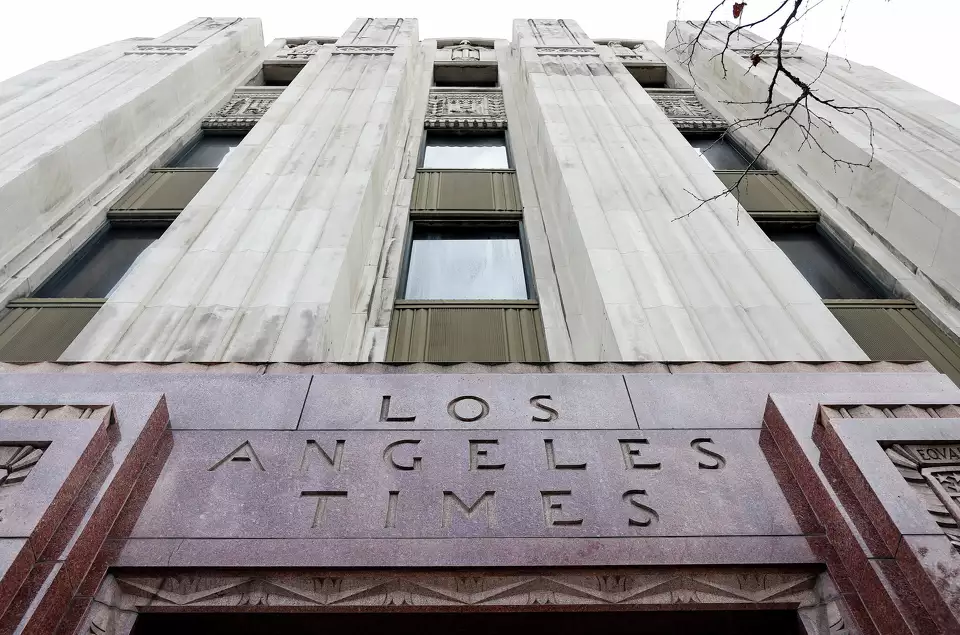
The Los Angeles Times name remains visible on the newspaper’s former downtown headquarters building. On Tuesday, the paper laid off nearly 100 of its newsroom staff.Mario Tama/Getty Images

As a former Los Angeles Times journalist, Tuesday was a difficult day. More than 100 employees at the newspaper were laid off in one of the biggest cuts in the paper’s history. 

While much of the focus is understandably on the job losses, one of the biggest conclusions to be made from the tragedy is that even large news outlets can’t avoid the economic reality that news is dying and that journalists of color likely will be hurt the most.

The Los Angeles Times Guild, the union that represents the paper, revealed that these cuts disproportionately hit Black, Latino and Asian American employees. A joint statement from the L.A. Times Guild Black, Latino, Asian American and Pacific Islander, and Middle Eastern North African and South Asian caucuses echoed this sentiment: “Our newspaper’s ownership made a promise to bring in talented journalists from diverse backgrounds so that our staff reflects the city we cover, in the most populous state in the country. These proposed cuts would severely damage what incremental progress has been made.”

Several journalists reported that entire desks were decimated: among them, the Times’ Washington D.C., bureau — a stunning development during an election year and on the day of the New Hampshire primary. Nick Baumann said on social media that he was hired last year as deputy bureau chief to lead the paper’s coverage of the 2024 election. He was laid off Tuesday. 

Dr. Patrick Soon-Shiong, the paper’s billionaire owner, stated that the cuts were necessary due to the Times’ inability to absorb annual losses of $30 million to $40 million without increasing readership for advertising and subscriptions. If true, it’s hard to imagine a way to turn those losses around that doesn’t involve a magic lamp and three wishes.  

“It did not have to be this way,” the Guild wrote in regards to the layoffs. For its part, the union blamed management for the paper’s financial predicament, describing it as “a fiscal crisis of our company’s own making.” The union called the cuts “the fruit of years of middling strategy, the absence of a publisher, and no clear direction.”  

That all may be true, but the reality is many, many, many other publishers are struggling too. 

On Tuesday, more than 400 Condé Nast employees walked off the job, in protest of planned layoffs. Over the past year, the Washington Post, NPR, CNN and Vox Media have also had layoffs and buyouts, according to the Associated Press. The wire service also reported that, according to the employment firm Challenger, an estimated 2,681 news industry jobs were lost in 2023 through the end of November. This sum was more than the full years of 2022 and 2021. 

The news industry faces assaults on many fronts. Rising income inequality may contribute to consumers eschewing news subscriptions. Many people are getting their news from social media, and those platforms have deprioritized newsPrint advertising is disappearing. Behemoth news outlets like the New York Times have cannibalized subscribers from smaller outlets by becoming one-stop shops for news junkies, having amassed a sizable staff that allows the paper to cover just enough of everything. 

And just think: The news industry is struggling this much to keep journalists employed, and we haven’t yet seen a wide adoption of artificial intelligence technologies in newsrooms. 

All of this is bad for democracy. As more antidemocratic political candidates seek office, we’re losing the people who are at the frontlines of holding them accountable. We’re also seeing more disreputable sites presenting information to the public and misinforming the electorate.

If we lose journalism, we may lose free and fair elections. 

Where journalism and journalists go from here is unclear. When I left my role at the Los Angeles Times, I ended up without a job for a year due to a paucity of open positions. It made me question the viability of the field for most. I struggled during this time to land a position in the media, while seeing plenty of openings in other healthier job markets. While I eventually did land a new position in journalism, I can’t help but wonder if perhaps it was a sign that maybe I should switch career paths. 

While it seems likely that journalism will continue, increasingly it looks like only a select few will have the privilege to make a career out of it.

For journalism’s sake, I hope the Times’ union is right about blaming the paper’s issues on management. But I fear that thinking avoids a much more painful truth: that all journalists face treacherous waters. The issue may not be that you chose the wrong ship; it may be that you decided to board at all. 

Justin Ray is a Los Angeles-based journalist who has written for the Los Angeles Times and Columbia Journalism Review. He currently works for the independent environmental news outlet Grist.

Jan 24, 2024

By Justin Ray

About Opinion

Guest opinions in Open Forum and Insight are produced by writers with expertise, personal experience or original insights on a subject of interest to our readers. Their views do not necessarily reflect the opinion of The Chronicle editorial board, which is committed to providing a diversity of ideas to our readership.

Leo Full Moon, January 25, 2024

Wendy Cicchetti

Leo Full Moon

The Full Moon in Leo demands attention, pulling on our heartstrings with emotional dramas at almost every turn. Perhaps a friend, colleague, or family member is having a meltdown, or we fend off fear-based sarcasm from an insecure associate. It’s a time to be prepared for the boxing ring, while also being the most supportive pal to those we care about. We can pull all this off, because there’s something about the mix of swashbuckling pizzazz and charming warmth that allows Moon in Leo to manage more than one dynamic task, as if unraveling the plot of a movie.

The determination of the fixed nature of Leo can be a blessing when our focus is positive, but potentially a curse when an attitude remains negative, since like tends to attract like. The Sun in Aquarius reminds us of this natural flow with its inbuilt, “reap what you sow” fairness. This doesn’t mean we should put up with bad behavior from someone else, even if disguised as harmless jesting; we can joke back just as well! The softer side of Leo can equalize the balance in a stylish, lighthearted way.

The Full Moon is more complicated, however, by linking in a fixed t-square with Jupiter in Taurus, which intensifies feelings of determination, or in some cases, of just being stuck. We should remember that squares contain an element of challenge. Our trick is to harness the space for movement, while getting the timing right. This is akin to vehicles waiting at a junction; more than one going forward at the same time could result in a collision. Instead, a signaling and patience protocol needs to happen, with strict rule adherence, so smooth transitions can occur, and all reach their destinations intact.

Jupiter has a frank, uncomplicated agenda, with the ability to cut through any hampering, sticky red tape. Yet frankness can also rub us the wrong way; the truth hurts, or maybe we just don’t like someone’s tone. The t-square requires tact, unless we’re ready for a fight. We can choose how we wish to proceed.

The looming presence of Pluto conjoins the Aquarius Sun and opposes the Moon. What Pluto represents is usually complex and hidden, and we may experience its presence through atmospheres and odd feelings: here is the realm of psychic attack, for example. Or maybe we’ve acted in ways someone didn’t expect and we receive an indirect kick back. But we don’t have to sit in this energy (possibly experienced as nausea, vertigo, tiredness, or curious body pains). If we suspect we know the source of these wonky vibes, we can simply ask the cosmos to send them back! We can also draw on existing tools and knowledge to help, such as Reiki or rituals. If we possess a crystal collection, black obsidian and the fire-purifying quality of smoky quartz may be useful to absorb negativity. The positive and loving vibes of rose quartz may be helpful as well: rather than buying into negative behaviors or attitudes, we simply reverse polarities.

There can be decided upsides to difficult Plutonic experiences. One is that we get to know more about our own subtle power; we learn more of our capability with personal mastery. Another is that we may finally see where we need to make a change in how we handle matters. This may be the art of detaching from negative energy, while also managing to maintain the connections that matter for us. Sometimes we want to be part of a group, for example, but struggle individually with one particular character or energy source. If we can find a way to cut through the energy exchange, then we are changing personal dynamics in a way that works for us, without disengaging from the entire establishment.

This article is from the Mountain Astrologer by Diana McMahon Collis

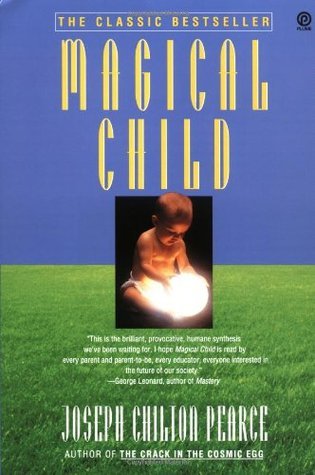
Book: “Magical Child”

Magical Child

Joseph Chilton Pearce

“An innovative, philosophical restructuring of modern child psychology.”

Magical Child, a classic work, profoundly questioned the current thinking on childbirth pratices, parenting, and educating our children. Now its daring ideas about how Western society is damaging our children, and how we can better nurture them and oruselves, ring truer than ever. From the very instant of birth, says Joseph Chilton Pearce, the human child has only one concern: to learn all that there is to learn about the world. This planet is the child’s playground, and nothing should interfere with a child’s play. Raised this way, the Magical Child is a a happy genius, capable of anything, equipped to fulfill his amazing potential.

Expanding on the ideas of internationally acclaimed child psychologist Jean Piaget, Pearce traces the growth of the mind-brain from brith to adulthood. He connects the alarming rise in autism, hyperkinetic behavior, childhood schizophrenia, and adolescent suicide to the all too common errors we make in raising and educating our children. Then he shows how we can restore the astonishing wealth of creative intelligence that is the brithright of every human being. Pearce challenged all our notions about child rearing, and in the process challenges us to re-examine ourselves. Pearce’s message is simple: it is never too late to play, for we are all Magical Children.

(Goodreads.com)

Full Moon In Leo – An Old-Fashioned Lady Is Confronted By A Hippie Girl

(Astrobutterfly.com)

On January 25th, 2024 we have a Full Moon at 5° Leo. The Full Moon is opposite Pluto in Aquarius, and it is square Jupiter in Taurus. 

The dynamic tension of the Full Moon opposition (Sun in Aquarius, Moon in Leo) seeks release through the planet at the apex of the T-square, Jupiter. 

We basically have a fixed T-square with Sun in Aquarius, Moon in Leo, and Jupiter in Taurus. Fixed T-squares are VERY intense, because fixed signs are the most resistant to change.

Yet, the inherent tension of the T-square presses precisely for change.

Something’s got to give. 

Full Moon In Leo And The Opposition Aspect

A Full Moon, by definition, is an opposition aspect. A Full Moon is THE most important opposition aspect because it engages the 2 fundamental parts of ourselves – our Yang, Solar identity, and our Yin, lunar identity.

To create life, we need energy and matter, we need Yin and Yang, we need day and night.

To bring the potential of the New Moon conjunction to life, we need to become aware of the inherent duality of our nature. We need to be able to “see” these 2 entities within us. 

The Sun and the Moon put this story on display for us every month: when we have a New Moon (Sun conjunct the Moon) the Moon is invisible. A seed has been planted, yet we are not aware of it, in the same way we can’t see the Moon, which has disappeared in the glare of the Sun. 

It’s only when the Sun and the Moon are at the maximum distance from each other – at a Full Moon – that we can see the full disk of the Moon. 

The opposition comes with the paradox where on one hand we have full clarity and are fully aware of the energies at play. Yet, because these energies are at the maximum distance from each other, we relate to them as if they were 2 separate entities.

Full Moon In Leo – Projection And Paradox 

In psychology, the process of becoming aware of one’s paradoxical, dual nature starts with the so-called mechanism of projection. Projection means we take aspects or qualities of ourselves that we find difficult to accept or acknowledge and attribute them to others.

We split our internal landscape into dichotomies. There is “me” and there is “them”. There is “good” and there is “bad”. There are values we resonate with, and values we despise. 

If we identify with one pole of the spectrum (let’s say with the Sun), we automatically reject the other pole of the spectrum (let’s say, the Moon). 

If we resonate with one particular value, we then feel compelled to align ourselves with all the supporting values and ideas associated with that primary value.

If we support a sports team, we will like everything about that team, and dislike other competing teams.

If we support a political party, we support all the individuals within that party (and feel animosity toward everyone else) and all the ideas promoted by that party – even when they contradict our personal values.

And it does make sense to take this approach – at least to some extent. There’s that part of us that is Jupiter. This “Jupiter part” likes coherence. It likes direction. It likes to have 1 clear answer. Finds it easier to relate to 1 big truth. 

But there are times when Jupiter’s coherence becomes Jupiter dogma – a hideaway from our own resistance to change, an easy way to (not) deal with our internal paradoxes, and the complexities of our existence.  

When we get stuck in our initial narrative – without questioning it – we end up on a wrong path, distancing ourselves from the very thing we tried to seek in the first place: the truth. 

How do we solve this riddle? 

By embracing our internal paradoxes. By owning our darkness, or the ‘less desirable’ traits. And even more importantly, by owning our light – all that we could become, all that we could grow into. 

If we don’t like something about someone, that’s likely because 1) we don’t like that thing about ourselves 2) there’s something about the positive qualities of that person that reminds us of our own unfulfilled potential, triggering feelings of inadequacy or insecurity. 

Full Moon In Leo – A Conservative, Old Fashioned Lady Is Confronted By A Hippie Girl

The Sabian symbol of the Full Moon in Leo is “A conservative, old fashioned lady is confronted by a hippie girl”.

The Sabian symbol speaks of the collective, cultural and social crisis that challenges us to accept the relativity of social values – which in turn, helps us embrace the relativity of our own personal values (Full Moon square Jupiter). 

What needs to change? It largely depends on the individual, on your own story, reflected by the natal houses and planets triggered by the Full Moon in Leo.

Pluto – closely aspecting the Full Moon – is now in Aquarius. 

The Full Moon in Leo has a Pluto in Aquarius message for every single one of us.

We are living in a fully digitalized world, yet there are still people who don’t know how to send an email because they are “not into this tech stuff”, or because “tech is too difficult”. 

Yet, tech and computers are part of our everyday life – our whole society is now built around tech, whether we like it or not.

Even if we choose to live in remote areas, without a Wi-fi signal, – unless we choose total isolation, or live in an ashram-type of community, – there are still times when we need to make a phone call or send some documents through electronic means. 

Full Moon In Leo And Pluto In Aquarius

This first Full Moon in Leo with Pluto in Aquarius will raise our awareness of who we are as an individual in this new Pluto in Aquarius era. 

Is there a way to be true to one’s self (Leo) while adapting to the changing realities of the world we live in (Aquarius)? 

What aspects of yourself require acknowledgment and acceptance? What paradoxes must you reconcile to embrace the transformative potential of this new Pluto-in-Aquarius era?

What conflicting values do you need to reassess and integrate to bridge the gap between your individual truth (Leo) and the shifting realities of the world (Aquarius)?