
Monthly Archives: November 2023

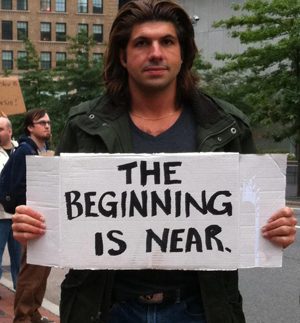
“The Beginning is Near”
The power of unconventional thinking
David McWilliams | TED2023
• April 2023
From World War I to the 2008 economic collapse and beyond, history shows that economists don’t always see the future as clearly as they think they do, says economist David McWilliams. Using the words of W.B. Yeats, McWilliams makes the case for embracing unconventional thinkers – poets, artists and musicians – and offers a creative path towards a world filled with less confirmation bias and more understanding.
About the speaker
David McWilliams strives to demystify economics and make the topic accessible to audiences worldwide.
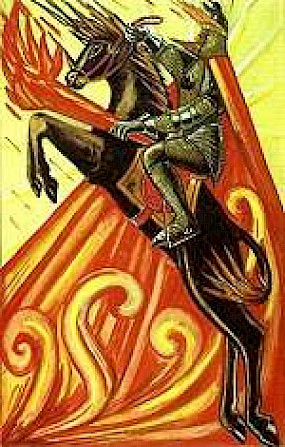
Tarot Card for November 3: The Knight of Wands
The Knight of Wands
The man represented by the Knight of Wands will be a loving and open-hearted person, with a strong sense of morality and a great sense of humour. He will be active, energetic and willing to help. You often find these types of men in the healing professions, or in other areas where they are required to assist, guide and support others.
He’s a man with a deep respect for life and all living things, attuned to Nature and to the creatures of the earth. He has a deep well of compassion which spills over readily to anyone who needs his help, but he also has the restraint to know when too much assistance is a bad thing. Then he will act to enable and empower, rather than to assisting.
He’s a faithful, and dedicated family man, being fully engaged in the domestic situation. His life reflects his high ethical standards, though he is not given to sermonising, nor standing in judgement on others. He could be defined as an idealistic realist – accepting the frailties of the race, whilst doing his best to strengthen it.
His faults spring from his good points – for instance, he dislikes causing pain, and will therefore delay when he needs to act if he thinks it will hurt other people. He will sometimes remain in limiting or painful circumstances because of this. His sense of rightness and duty is intense, and sometimes drives him to make foolish choices and decisions. He will shy away from conflict and unpleasant situations, especially when these arise as a result of his own needs, though he will never walk away from a struggle on behalf of somebody else.
If you are regarding this card as a spiritual change, then see it as an indication that the warrior of right and light is required – you’ll need to stand up for something that matters, and which is unable to defend itself.
(via angelpaths.com and Alan Blackman)
The Dilemma of Immortality
A pill that makes you live forever might be the worst idea ever

Published in ILLUMINATION
Oct 8 (medium.com)
If there’s anything every human agrees on, it’s this; everybody dies.
It’s one of the inevitable features of our existence that we’ve come to accept. We’ve fought diseases, navigated oceans, dammed rivers, and explored space. In some ways, the history of human existence on Earth is the history of how we have conquered, dominated, or subdued nature. But death is one part of nature that we seem to have resigned ourselves to. We have and continue to experiment with how to create life using the basic building blocks, we have produced medicine and technology to extend our lives by years, allowing us to live till ages that our ancestors could only dream of. But there are almost no experiments on how to beat death and live forever. Instead, we have hopelessly accepted death as our inevitable fate, and have given up trying to escape it.
But what if we could?
Imagine that there was a medical procedure that could confer immortality; you do this medical procedure, and you’d live for as long as you want to. Imagine that aside from accidents, terminal illnesses, and the sort, this medical procedure was the key to living forever. Imagine that one day; you were offered the opportunity to have this medical procedure, a chance to live forever, would you take it?
Imagine that this medical procedure had always been around; for thousands of years. A person who underwent this procedure 300 years ago would have lived through the many wars in England and Europe, the Industrial Revolution, the American Civil War, the Spanish flu epidemic, colonization and decolonization, World War 1, World War 2, the Cold war and every other event that has come afterwards. This is an awfully long time to have lived; this person wouldn’t need to read history, they would be a walking repertoire of world history. Compare life on earth and 300 years ago, and life on earth presently. For this person, it would be like being in a giant but excruciatingly slow time machine for the last 300 years.
There are real ramifications for our experimental person who has lived 300 years on Earth. We can apply the same principles that we use to measure our lives on the things that matter to us on Earth. For example, would this person have enjoyed their life on earth? For normal humans who live 70-odd years on Earth, knowing that your life on Earth is short and ephemeral provides you with a sense of purpose, a driving force to live a meaningful life — however, you define that. For a person who knows they can live forever, where will they derive their sense of purpose? What reason does this person have to get up from bed every day and get ready for work or even stress over anything since they know they have all the time in the world to live?
There are also emotional and psychological scars. Living on earth for 70 years is no mean fit; all the experiences we go through leave a lasting effect on us. People who live through wars, famines, terrorist attacks, pandemics, all these things leave scars that cumulate. A person who lives through these comes out a different person on the other side. Now imagine that you’ve had through live through all the bad events that have happened in the world over the last 300 years; the holocaust, multiple wars, pandemics, deaths, the near misses, all of it.
When you go down our little thought experiment, and consider the ramifications of an immortal life on earth, it becomes obvious why we have resigned ourselves to death, or at least quietly accepted it. Life on earth can be a scary adventure. Immortal life is even scarier. It’s even scarier because no one has experienced it, which means we don’t have the least idea of what it’s like. There are no previous experiences against which to judge our insecurities, and our fears, or build a model of what immortal life on earth would be like. Immortal life in heaven or paradise? — sure; because those places are supposedly pure and perfect. But immortal life on earth, with all its flaws, is a different ball game.
At this point, you are probably wondering what the point of this essay is. It boils down to a single question, the question that was the seed idea which eventually blossomed into a 700+ word essay. That question is this; what would it feel like to be immortal?

·Writer for ILLUMINATION
Medical doctor, writer, dreamer, achiever, and so much more….
David Bohm on the oneness of consciousness

The Golden Age of AI Complementarity?
By Pia Malaney
OCT 30, 2023 | LABOR | TECHNOLOGY & INNOVATION (ineteconomics.org)
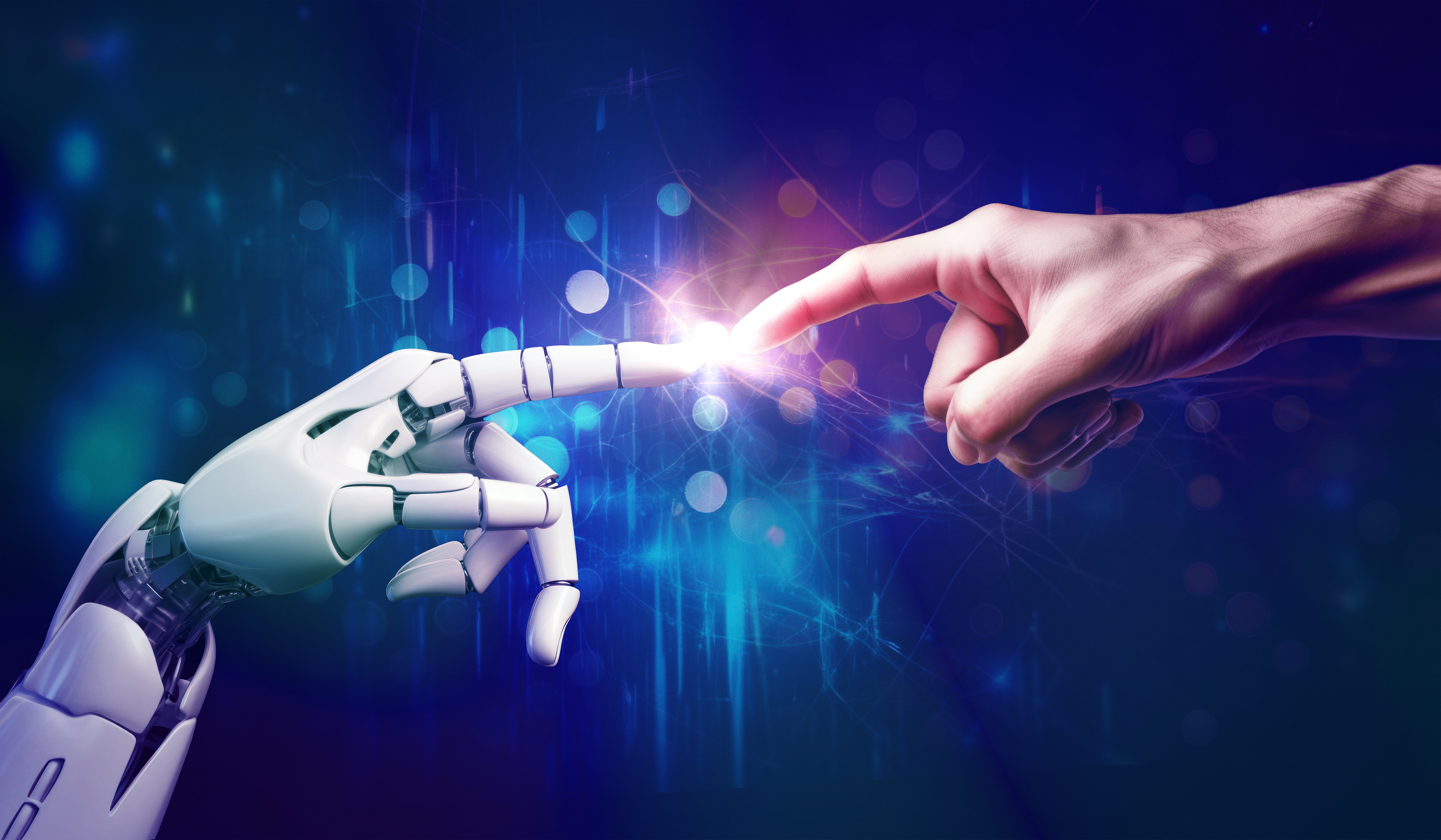
Recent developments in AI have added fuel to debates that have long simmered amongst economists, which could lead to a rethinking of economics itself.
AI and Humanity: First the Good News
In markets hungry for the next big breakthrough the latest generation of Artificial Intelligence (AI) technologies has emerged as a potentially revolutionary force, offering a wide array of transformative benefits to humanity. With capabilities in processing data, making predictions, and automating tasks that would once have seemed like science fiction, AI is already altering the ways we live, work, and interact.
What does it mean for a doctor in an underserved area with limited resources to have access to AI systems that facilitate diagnoses based on symptoms and streamline care recommendations? For surgeons to have AI analyze a brain tumor in real-time so that they can decide how much to remove? Big data is already playing a significant role in drug discovery and development; researchers in many areas of academia, including economics, find analysis simplified and expedited.
There is increasing evidence that we are already seeing transformative changes in industries ranging from healthcare to finance. As AI can personalize cancer treatments,[1] identify and diagnose tumors mid-surgery,[2] and rapidly increase the discovery of new molecules that form the basis of drug discovery,[3] its lifesaving impacts are already being felt. In financial markets, it is being used to drive data analytics, data retrieval, predictions, and forecasting.[4] Innovation, often spearheaded by AI and machine learning, has given rise to new products, services, and business models. In education, the possibility of tailoring a curriculum to the needs and pace of each individual student could perhaps transform learning.
Even areas most associated with human creativity are tapping into the productivity benefits of AI. For example, journalists have been experimenting for the past few years with AI-generated content: the Associated Press has been using Natural Language Generation to produce narrative reports on earnings data and sports games, leaving journalists to focus on “critical qualitative articles.” In creative fields, imaging programs are turbocharging the productivity of designers and artists.
In many areas of the knowledge economy, current technological developments with Large Language Models like ChatGPT and Lama 2 and image developers like Dall-E, Stable Diffusion, and MidJourney as well as other rapidly developing areas of AI, are changing the productivity, efficiency, and every approach to work that we use, transforming what we are able to achieve.[5]
Which Way AI?
These developments have added fuel to at least two debates that have long simmered amongst economists. The first explores why the computer revolution never seemed to have the kind of obvious dramatic and long-term effect on global productivity that major innovations like electricity or the internal combustion engine and whether this time will be different.[6] The “Long Bet” between economists Robert Gordon and Erik Brynjolfsson epitomizes this, with Gordon proclaiming that AI is nothing new and that much of the economy will remain immune from its effects, while Brynjolfsson sees AI as a broad-purpose technology destined to affect every aspect of productivity.[7]
A similar debate rages between economists and technologists on the effects of AI on labor. Many economists, looking at the long arc of history, conclude that while technological change can cause job market disruptions, labor eventually gets reabsorbed in new tasks resulting in more and better-paying jobs.[8]
A recent study by McKinsey Global Institute attempted to quantify the effects of AI on labor markets by decomposing jobs into component tasks, evaluating those tasks that were most likely to be replaced by AI. It concluded that up to 30 percent of all hours currently worked across the US economy could be automated by 2030, requiring 12 million “occupational transitions.”[9] This fits with the approach many economists have taken in assessing the impact of technology on the labor market, pointing to the examples of Henry Ford shifting to assembly lines or the introduction of ATM machines, technological advances that created fear of major unemployment but instead resulted in increased employment, just in different tasks.
The reality, however, is that in the past three decades or so, despite the computer revolution and rapid technological change, median wages have remained stagnant while inequality has skyrocketed. A series of studies have found that automation of lower to middle-skill jobs has been a significant factor in job loss and wage inequality, much as Keynes predicted in 1930 when he highlighted the fear of “technical unemployment”. For example, Acemoglu and Restrepo (2017) find that the introduction of industrial robots in the US has had a significant negative effect on employment and wages [10] and Bonfiglioli et al (2023) find robust negative effects of AI on employment in US industrial zones, which are especially negative for low skill and production workers.[11]
It is also worth taking a moment to recognize what the process of reallocation of tasks looks like in reality. There are positive examples, as in the case say of the health insurance company Anthem, where digital automation has eliminated 10 million phone calls, handling those customer questions through digital channels. Rather than replacing its customer service workers though, Anthem has provided them with additional training, transforming them into “Care Navigators,” resolving customer problems directly rather than passing them on.[12] A very different experience can be found in an industry like metalworking. In a study of Italian metalworkers, economist Nadia Garbellini finds that with the introduction of AI, workers require less knowledge to perform assigned tasks, which are increasingly to operate complex machinery that is programmed by computer scientists and engineers outside the company, leading to an ever-increasing decline in workers’ feelings of autonomy.[13] Further, simply creating the AI algorithms that are being used requires thousands of people to train and label data. This is work generally being carried out in the global south, by what has been referred to as a “vast tasker underclass”, thousands of workers poorly paid for what is often tedious and repetitive labor.[14]
A useful approach to resolving some of the uncertainties is to build on the distinction some economists make between technology that substitutes for labor, thereby increasing unemployment, and that which complements labor, improving productivity without replacing humans. The current advances in LLMs seem, in many cases, to have led to a blossoming of productivity as many knowledge and creative workers learn to use this new technology to improve their output and increase their efficiency, replacing not just mundane repetitive tasks, but also creative ones. Anyone who has played with ChatGPT or MidJourney, for example, can verify that a few simple prompts can result in stories or artwork that are sometimes hard to distinguish from human output. There are, of course, the horror stories where LLMs fail at even the most basic math and make up facts out of whole cloth – the most colorful example perhaps being that of the lawyer who used ChatGPT to help prepare for a case and found himself citing fake cases in front of a judge, resulting in the threat of sanctions.[15] Ethan Mollick and others refer to this as the Jagged Technological Frontier, the combination of extreme capabilities and surprising weaknesses found in current AI technologies, pointing to a greater need to understand how to work effectively with them.[16] But as knowledge workers in various fields experiment with incorporating this new technology into their day-to-day work and the techniques improve, it is hard not to see the potential for a dramatic productivity and efficiency boost.
And studies are emerging that reinforce this picture. A recent paper by Brynjolfsson, Li, and Raymond finds that access to an AI-based conversational assistant for customer support agents improved productivity by 14%, with the lowest impact on low-skilled and novice workers.[17] Nielsen (2023) found that in a series of case studies the use of generative AI improved workers’ performance in customer service, routine business document creation, and coding projects by an average of 66%. And Mollick’s work with highly skilled consultants finds AI augmentation improves productivity by 17% to 43%.
If, indeed, the belief of many economists that AI will follow the path of other technological innovations so far, and that humans will adapt and find new ways to incorporate AI into our production models and simply find new tasks that humans can do that work with technology in more efficient ways that increase our productivity in the long term, then the only costs we may be looking for is a short to medium turn transition cost. By investing in education, promoting collaboration, redesigning work, and prioritizing ethical considerations, it could be possible to create a future where technology enhances human potential and well-being.
AI with Bette Davis Eyes
But what if instead we later look back on this time as “The Golden Age of Complementarity,” a time when both high- and low-skilled knowledge workers are finding ways to rapidly incorporate AI into daily tasks and increase their productivity? And what if, as with all golden ages, it is ephemeral? If, in fact, rather than being like ATMs or cars, AI by virtue of the fact that it can learn at arbitrary speeds over all areas of intelligent endeavor, is an entirely different kind of technology, and thus cannot be measured against previous innovations?
What if AI is instead like the understudy Eve Harrington, in the 1950s movie All About Eve, to humanity’s Margo Channing, patiently waiting in the wings for its moment to shine as it prepares to take over the lead actor’s role? In other words, that this is a time when AI is quietly honing its skills and learning the nuances of its craft to build its capability to step into the spotlight when the time is right.
Just as understudies learn their lines and cues from star performers, AI systems tirelessly observe and learn from the lead actor, training on vast amounts of data. Over time, AI may well become intimately familiar with the intricacies of the task it’s designed for, whether it’s speech recognition, image analysis, or autonomous decision-making, continuously improving and refining its abilities. It undergoes constant training and refinement and adapts to changing circumstances, learning from its mistakes and evolving in response to new challenges.
And AI has the perfect potential to outperform its human counterparts. It has the capacity to achieve levels of precision, speed, and consistency that humans can only dream of. It can process vast amounts of data in fractions of a second, make complex decisions based on multiple variables, and do so without fatigue or emotion. Furthermore, it is adaptable and versatile, seamlessly transitioning from one role to another, handling a wide range of tasks with ease. This versatility positions AI as a valuable asset in a variety of industries, from healthcare to finance, manufacturing to entertainment.
Same as it ever was? The displacement circle of life
During the first stages of any truly disruptive technology, there is usually a period of adaptation. Even after the handheld calculator was introduced by Jack Kilby in 1967, there were nine years of new US slide rules being produced to meet market demand until July 1976. While automobiles may have been introduced in the 1880s, only after 30 years of development did they displace horses in the streets of Manhattan.
The reason for this has to do with the fact that newer truly disruptive technologies almost always debut in brittle, clunky, and expensive forms with limited utility before standardization takes place. During this period the old mature technology co-exists with the newer aspirant until the advantages of the older technology are so insignificant that a general displacement takes place. San Francisco struggles daily with the co-existence of fleets of self-driving, AI-controlled cars sharing the streets with old-fashioned human-driven vehicles, with a host of attendant problems. But is there really a question about the direction in which this will be resolved? The charming horse-drawn carriages in New York’s Central Park are now simply a luxury good, ala Thorsten Veblen’s theory of the leisure class through the “Conservation of Archaic Traits” where they are valued as a form of conspicuous consumption.
So far what we mostly see is that ASI or Artificial Specialized intelligence has obviated the need for human labor in highly specialized occupations such as “chess player” or “Assistant Radiologist.” This is very much in keeping with past innovations that chase humans from one specialized niche into other areas of the labor market. However general intelligence and super intelligence will have a common signature across disciplines not only affecting the niche from which one is fleeing but also the other niches which would normally act as an absorber of labor.
Beyond Efficiency, Capitalism and Socialism: Does AI require a new economics?
While there is much discussion now about steering AI towards greater complementarity with humans and the need for reskilling and upskilling of labor to adapt to changing technologies, the bigger question is perhaps really one of time horizons. Every golden age eventually comes to an end. In the medium term, incentivizing innovation that prioritizes human-complementing technologies, and investing in education and development will be important in ensuring that the benefits of technological change can be broadly shared. In the longer term, though, we need to consider whether our current economic systems have the ability to sustain a fair and equitable society as the marginal product of median human labor declines below a living wage.
This, perhaps, is the main opportunity presented by the Golden Age of AI Complementarity. It is our time to think carefully about our systems of economic organization and what it would require to build a system that will find an accommodation for human intelligence and purpose when and if humans can no longer rely on superior intellect and creativity to create productive purpose within a market context for the fruits of our labor and ambitions.
Of course, that day may somehow never come. But if it does, our simplistic ‘efficiency biased economics’[18] may predictably return the answer that human beings have become a clunky albatross hanging from the neck of a machine made by Boston Dynamics.
Notes
[1] Ce, M. et al. March 2023. “Artificial Intelligence in Brain Tumor Imaging: A Step towards Personalized Medicine.” Current Oncology 2023 Mar 30(3): 2673-2701 https://pubmed.ncbi.nlm.nih.gov/36975416/
[2] Pasheva, E. July 2023. “AI Tool Decodes Bran Cancer’s Genome During Surgery” Harvard Medical School News. https://hms.harvard.edu/news/ai-tool-decodes-brain-cancers-genome-during-surgery
[3] Chopra, Y. May 2023. “The power of AI in Biotechnology: Revolutionizing Innovation.” https://www.datatobiz.com/blog/ai-in-biotechnology/ ; Vora, L. et al. July 2023. “Artificial Intelligence in Pharmaceutical Technology and Drug Delivery Design”. Pharmaceutics 2023 Jul; 15(7): 1916 https://www.mdpi.com/1999-4923…
[4] See for example Schroer, A. October 2023. “31 Examples of AI in Finance”. https://builtin.com/artificialintelligence/ai-finance-banking-applications-companies
[5] See for example Chen, T. May 2023. Wall Street Journal. “To Work Fewer Hours, They Put AI on the job.” https://www.wsj.com/articles/using-ai-shorten-work-day-b7e7126f ;Brynjolfsson, E., Li D., and Raymond L.R. 2023. “Generative AI at Work”. NBER Working Paper No. 31161. https://www.nber.org/papers/w31161 ; CNN July 12, 2023. “This CEO replaced 90% of support staff with an AI Chatbot” https://www.cnn.com/2023/07/12/business/dukaan-ceo-layoffs-ai-chatbot/index.html ; Dell’Acqua, F. et al. 2023. Harvard Business School Technology and Operations Mgt, Working Paper No. 24-013. “Navigating the Jagged Technological Frontier: Field Experimental Evidence on Knowledge Worker Productivity and Quality.” https://mitsloan.mit.edu/sites/default/files/2023-10/SSRN-id4573321.pdf ; Nielsen, J. July 2016. “AI improves Employee Productivity by 66%” https://www.nngroup.com/articles/ai-tools-productivity-gains/ ; Looney, M. Sept. 2023. “How Generative AI is changing the way creatives work.”. https://readwrite.com/how-generative-ai-is-changing -the-way-creatives-work/
[6] See for example Gordon, R., 2016. The Rise and Fall of American Growth. Princeton University Press.
[8] E.g., Autor, D.H., 2015. “Why are there Still So Many Jobs? The History and Future of Workplace Automation”. Journal of Economic Perspectives 29(3). https://pubs.aeaweb.org/doi/pdf/10.1257%2Fjep.29.3.3
[9] McKinsey Global Institute. 2023. Generative AI and the Future of Work in America. https://www.mckinsey.com/mgi/our-research/generative-ai-and-the-future-of-work-in-america
[10] Acemoglu, D. and Restrepo, P. 2017. “Robots and Jobs: Evidence from U.S. Labor Markets.” NBER Working Paper No. 23285. March. https://www.nber.org/papers/w23285
[11] Bonfiglioli, A. et al., 2023. “Artificial Intelligence and Jobs: Evidence from US Commuting Zones” CESifo Working Paper No. 10685. https://papers.ssrn.com/sol3/papers.cfm?abstract_id=4608807
[12] Lohr, S. May 2022. “Why isn’t New Technology Making Us More Productive” New York Times May 5th, 2022. https://www.nytimes.com/2022/05/24/business/technology-productivity-economy.html
[13] Parramore, L. 2023. “Labor Economist: AI May Bring a Book in Horrible Jobs.” INET Blog August 28, 2023. https://ineteconomics.org/perspectives/blog/labor-economist-ai-may-bring-a-boom-in-horrible-jobs
[14] Dzieza, J. June 2023 “AI Is a Lot of Work.” New York Magazine https://nymag.com/intelligencer/article/ai-artificial-intelligence-humans-technology-business-factory.html
[15] Bohannon, M. 2023. “Lawyer Used ChatGPT in Court-And Cited Fake Cases. A Judge is Considering Sanctions.” Forbes Magazine. June 2023. https://www.forbes.com/sites/mollybohannon/2023/06/08/lawyer-used-chatgpt-in-court-and-cited-fake-cases-a-judge-is-considering-sanctions/?sh=1fe689fb7c7f
[16] Dell’Acqua, F. et al. 2023. Harvard Business School Technology and Operations Mgt, Working Paper No. 24-013. “Navigating the Jagged Technological Frontier: Field Experimental Evidence on Knowledge Worker Productivity and Quality.” https://mitsloan.mit.edu/sites/default/files/2023-10/SSRN-id4573321.pdf
[17] Brynjolfsson, E., Li D., and Raymond L.R. 2023. “Generative AI at Work”. NBER Working Paper No. 31161. https://www.nber.org/papers/w31161
[18] Weinstein, E. 2016. Anthropic Capitalism and The New Gimmick Economy https://www.edge.org/response-…
One Earth, One Family, One Future
New Economic Th • Nov 1, 2023 Rohinton Medhora (INET’s Board Chair, member of our Commission on Global Economic Transformation, and Distinguished Fellow at CIGI) discusses global social healing, India and the G20 with INET President Rob Johnson. Learn more at https://www.ineteconomics.org/researc…
Music and the Body: Richard Powers on the Power of Song
By Maria Popova (themarginalian.org)

In a lifetime of living in this body, I have known no more powerful a homecoming than music — nothing roots us more firmly into the house of being, nothing levitates us more buoyantly to that transcendent place beyond marrow and mind. Stripped of its nihilistic drama, there is an elemental cry of truth, for me at least, in Nietzsche’s pronouncement: “Without music life would be a mistake.” Even Edna St. Vincent Millay, for all her lyrical love of life, echoed the sentiment: “Without music I should wish to die. Even poetry, Sweet Patron Muse forgive me the words, is not what music is.”
Every writer unblinded by ego will concede this.
No writer has conceded it more beautifully or with more rapturous reverence for the life of the body in the life of music than Richard Powers in his exquisite 2003 novel The Time of Our Singing (public library).
Art by Kay Nielsen from East of the Sun and West of the Moon, 1914. (Available as a print and as stationery cards.)
One of the novel’s protagonists — a young black woman in 1930s Philadelphia — becomes an emissary of the power of music as an instrument of self-discovery and self-possession, a living testament to song as the pulse-beat of the soul:
Delia fell in love with singing. Singing was something that might make sense of a person. Singing might make more sense of life than living had to start with.
Delia sang fearlessly. She threw back her head and nailed free-flying notes like a marksman nails skeet. She sang with such unfurling of self that the congregation couldn’t help but turn and look at the teenager, even when they should have been looking skyward.
[…]
Delia could feel them as she sang, the hearts of the flushed congregation flying up with her as she savored the song’s arc. She sheltered those souls in her sound and held them as motionless as the notes themselves, in that safe spot up next to grace. The audience breathed with her, beating to her measure. Her breath expanded sufficiently to take her across even the longest phrase. Her listeners were in her, and she in them, so long as the notes lasted.

Art from German opera singer Lilli Lehmann’s 1902 field guide to singing
When Delia marries a German-Jewish physicist who plays the piano and consider music “the language of time,” music takes on a richer meaning — or, rather, it is stripped down to its elemental raw material — for without the arrow of time, without being able to tell one moment from the next, there could be no melody and no rhythm. This is what makes music our supreme laboratory for feeling and time.
Eventually, the couple’s sons discover music on their own terms, in their own time. One of them — the novel’s first-person narrator — encounters its power and tenderness harmonized in a soul-stilling performance of ancient music by a choir at The Cloisters — the medieval monastery turned museum in the uppermost reaches of Manhattan, just past Harlem. The small boy, untainted with concepts, experiences music in its purest form, pouring out of the singers like daybreak, like something of another world, yet saturated with pure translucent presence, in that peculiar way transcendent experiences have of taking us both beyond and deeper into ourselves:
It doesn’t occur to me, at the age of seven, that a person might luck upon such a song only once a lifetime, if ever. I know how to tell sharp from flat, right singing from wrong. But I haven’t yet heard enough to tell ordinary beauty from once-only visits.
[…]
There is a sound like the burning sun. A sound like the surf of blood pumping through my ears. The women start by themselves, their note as spreading and dimensionless as my father says the present is. Keee, the letter-box slots of their mouths release — just the syllable of glee little Ruth made before we persuaded her to learn to talk. The sound of a simple creature, startling itself with praise before settling in for the night. They sing together, bound at the core for one last moment before everything breaks open and is born.
Then reee. The note splits into its own accompaniment. The taller woman seems to descend, just by holding her pitch while the smaller woman next to her rises. Rises a major third, that first interval any child any color anywhere learns to sing. Four lips curve upon the vowel, a pocket of air older than the author who set it there.
I know in my body what notes come next, even though I have nothing, yet, to call them. The high voice rises a perfect fifth, lifting off from the lower note’s bed. The lines move like my chest, soft cartilage, my ribs straying away from one another, on aaay, into a higher brightness, then collapsing back to fuse in unison.
I hear these two lines bending space as they speed away from each other, hurling outward, each standing still while the other moves. Long, short-short, long, long: They circle and return, like a blowing branch submitting again to its shadow. They near their starting pitch from opposite sides, the shared spot where they must impossibly meet back up. But just before they synchronize to see where they’ve been, just as they touch their lips to this recovered home, the men’s lines come from nowhere, pair off, and repeat the splitting game, a perfect fourth below.
More lines splinter, copy, and set off on their own. Aaay-laay Aaay-laay-eee! Six voices now, repeating and reworking, each peeling off on its own agenda, syncopated, staggered, yet each with an eye on the other, midair acrobats, not one of them wavering, no one crashing against the host of moving targets. This stripped-down simple singsong blooms like a firework peony. Everywhere in the awakened air, in a shower of staggered entrances, I hear the first phrase, keyed up, melted down, and rebuilt. Harmonies pile up, disintegrate, and reassemble elsewhere, each melody praising God in its own fashion, and everywhere combining to something that sounds to me like freedom.

Art by Kay Nielsen from East of the Sun and West of the Moon, 1914. (Available as a print and as stationery cards.)
Toward the end of the novel, decades and disillusionments later, Powers returns to music as the supreme instrument of our self-knowledge:
Complement with the poetic physicist Alan Lightman on music and the universe and violinist Natalie Hodges on the scientific poetics of sound and feeling, then revisit the remarkable story behind Beethoven’s “Ode to Joy.”
Tarot Card for November 2: The Aeon
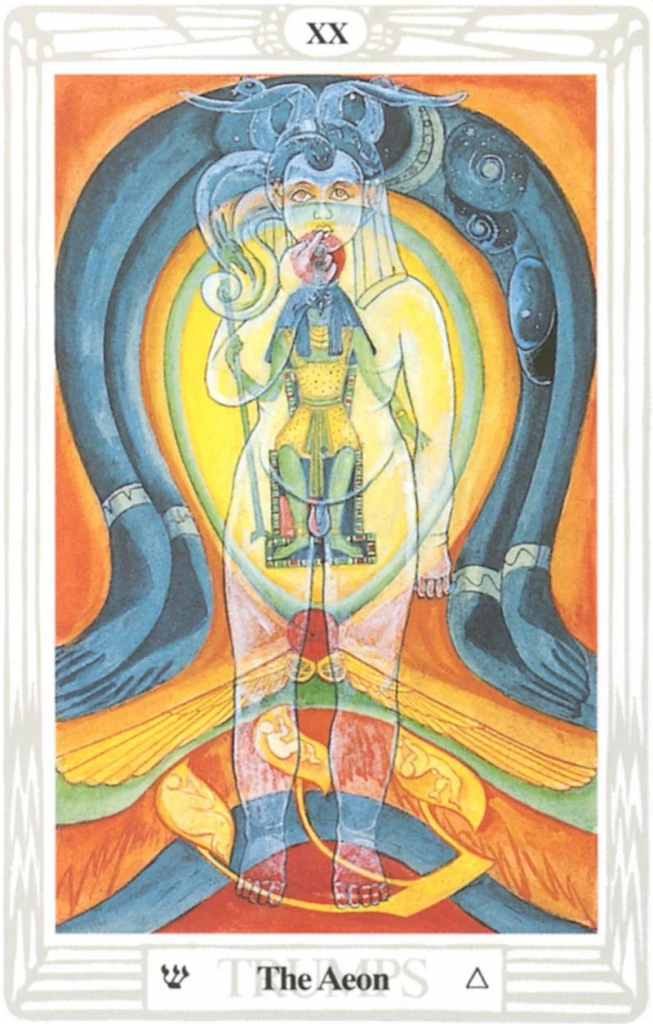
| The Aeon The Aeon (or Judgement, Last Judgement, Atonement, Resurrection) is numbered twenty and often shows figures arising from graves in answer to the clarion call of an angel. The Thoth deck veers away from the Christian overtones and instead we see the goddess Nuit, a primal sky goddess from the beginning of creation. Her body is arched above our heads and curves to imply the ankh cross, a symbol of immortality and life. A child-like male figure stands within the ankh’s loop with his finger to his lips in the traditional mystical gesture of silence. A seated regal figure is behind him. Both figures are said to represent Horus, first as child and then as ruler.Horus was the son of Osiris and Isis. When his father was murdered by his brother Set, Horus was protected and raised by Isis. Horus’ ascension to manhood triggered a series of battles with Set, culminating in his assumption to the throne of Egypt. Set was sent away defeated and thus Horus is seen as a god of redemption.The Aeon forces us to acknowledge that our actions set up a chain of cause-and-effect for which we are solely responsible. Here we pass through the fire of purification, shedding dead and dying wood as we go. We judge ourselves frankly, forgive, and leave the past behind. And then we are free to step into the light.This is a card of healing, especially on an emotional level. It promises hope and happiness, along with a new sense of safeness, protection and recovery. We are at the place where miracles happen. |
(via angelpaths.com and Alan Blackman)