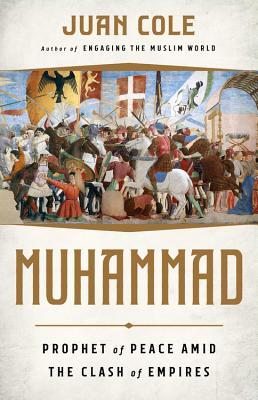
In the midst of the dramatic seventh-century war between two empires, Muhammad was a spiritual seeker in search of community and sanctuary.
Many observers stereotype Islam and its scripture as inherently extreme or violent-a narrative that has overshadowed the truth of its roots. In this masterfully told account, preeminent Middle East expert Juan Cole takes us back to Islam’s-and the Prophet Muhammad’s-origin story.
Cole shows how Muhammad came of age in an era of unparalleled violence. The eastern Roman Empire and the Sasanian Empire of Iran fought savagely throughout the Near East and Asia Minor. Muhammad’s profound distress at the carnage of his times led him to envision an alternative movement, one firmly grounded in peace. The religion Muhammad founded, Islam, spread widely during his lifetime, relying on soft power instead of military might, and sought armistices even when militarily attacked. Cole sheds light on this forgotten history, reminding us that in the Qur’an, the legacy of that spiritual message endures.
A vibrant history that brings to life the fascinating and complex world of the Prophet, Muhammad is the story of how peace is the rule and not the exception for one of the world’s most practiced religions.
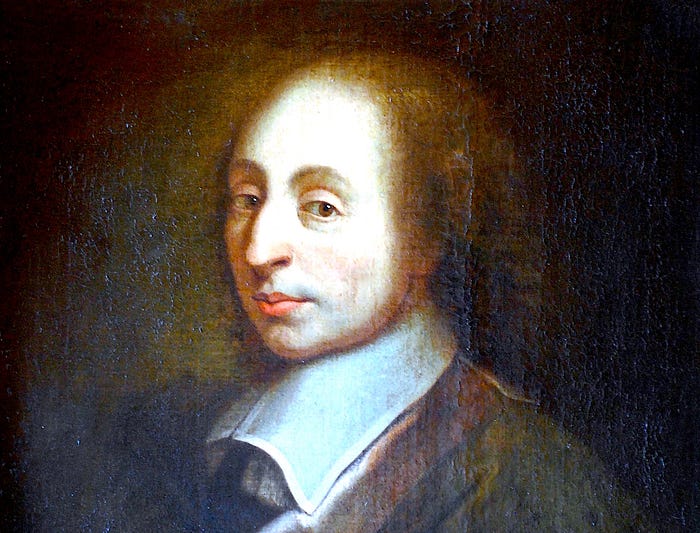
Great thinkers set out many insights that can prove quite useful for us. From time to time, I produce short podcast episodes mining and refining those insights. Here’s one from the early philosopher Blaise Pascal that I’ve found quite helpful in my work and life!
Tyranny consists in the desire of universal power beyond its scope. There are different assemblies of the strong, the fair, the sensible, the pious, in which each man rules at home, not elsewhere. And sometimes they meet, and the strong and the fair foolishly fight as to who shall be master, for their mastery is of different kinds. They do not understand one another, and their fault is the desire to rule everywhere. Nothing can effect this, not even might, which is of no use in the kingdom of the wise, and is only mistress of external actions.
So these expressions are false and tyrannical: “I am fair, therefore I must be feared. I am strong, therefore I must be loved.”
Tyranny is the wish to have in one way what can only be had in another. We render different duties to different merits; the duty of love to the pleasant; the duty of fear to the strong; the duty of belief to the learned.
We must render these duties. It is unjust to refuse them, and unjust to ask others. And so it is false and tyrannical to say: “He is not strong. therefore I will not esteem him. He is not able, therefore I will not fear him.
What Pascal is calling “tyranny” here can be understood in a political sense — he has the examples of different people clashing over who should rule — but I think we can extend this to the entire realm of relationships. And we can talk about other places besides that of royal chambers, or the law courts. We could talk about the marketplace. We can talk about workplaces.
We can talk about the attention-economy: who gets listened to, who gets paid homage as a a celebrity, and therefore also treated as an expert on all sorts of things that they’re not experts on. To have a certain kind of value, and to expect other people to recognize your value in other ways that you don’t actually have value in. So for example, to be a celebrity because of your good looks, and to think that people should listen to your book recommendations is, from what Pascal is saying, tyranny.
We can say that this infects and affects many relationships. It poisons things when people want to be heard and heeded, beyond the scope of where that is appropriate. And you notice that there is a diversity here that Pascal is signaling. None of us have all of the attributes. We all are lesser. We all are deficient in some, and at the same time we have something to bring to the table. And we should expect treatment according to what it is that we actually have.
The Tyrant is one who demands more than is really owed to them, more in a mode that is not appropriate to them. What do they do? Sometimes they get what they want if it is like fear, or affection, or getting their name chiseled on some marble at some monument.
But do they really get what they want from others? No. Generally they’re actually pushing them away. Being identified as a tyrant is, in some respect, a way of isolating and insulating the person who behaves tyrannically
If you’d like to year more useful insights, you can check out the other Sadler’s Shorts podcast episodes here.
president ReasonIO | editor Stoicism Today | speaker philosophical counselor & consultant | YouTube philosophy guy | co-host Wisdom for Life | teaches at MIAD
We were never promised any of it — this world of cottonwoods and clouds — when the Big Bang set the possible in motion. And yet here we are, atoms with consciousness, each of us a living improbability forged of chaos and dead stars. Children of chance, we have made ourselves into what we are — creatures who can see a universe of beauty in the feather of a bird and can turn a blind eye to each other’s suffering, creatures capable of the Benedictus and the bomb. Creatures who hope.
A generation after Maya Angelou held up a cosmic mirror to humanity with “A Brave and Startling Truth,”Pattiann Rogers — who writes with uncommon virtuosity about the intersection of the cosmic and the human, and whose poems have therefore been a frequentpresence in The Universe in Verse — offers a poignant cosmogony of our self-creation in the stunning final poem of her book Flickering (public library).
HOMO SAPIENS: CREATING THEMSELVES by Pattiann Rogers
I.
Formed in the black-light center of a star-circling galaxy; formed in whirlpool images of froth and flume and fulcrum; in the center image of herring circling like pieces of silver swirling fast, a shoaling circle of deception; in the whirlpool perfume of sex in the deepest curve of a lily’s soft corolla. Created within the images of the creator’s creation.
Born with the same grimacing wrench of a tree-covered cliff split wide suddenly by lightning and opened to thundering clouds of hail and rain.
Cured in the summer sun as if in a potter’s oven, polished like a stone rolled by a river, emboldened by the image of the expanse beyond earth’s horizon, inside and outside a circumference in the image of freedom.
Given the image of starlight clusters steadily silent above a hillside-silence of fallen snow… let there be sleep.
II.
Inheriting from the earth’s scrambling minions, images of thorn and bur, fang and claw, stealth, deceit, poison, camouflage, blade, and blood… let there be suffering, let there be survival.
Shaped by the image of the onset and unstoppable devouring eclipse of the sun, the tempestuous, ecliptic eating of the moon, the volcanic explosions of burning rocks and fiery hail of ashes to death… let there be terror and tears. Let there be pity.
Created in the image of fear inside a crawfish skittering backward through a freshwater stream with all eight appendages in perfect coordination, both pincers held high, backing into safety beneath a fallen leaf refuge… let there be home.
III.
Made in the image of the moon, where else would the name of ivory rock craters shine except in our eyes… let there be language.
Displayed in the image of the rotting seed on the same stem with the swelling blossom… let there be hope.
Homo sapiens creating themselves after the manner and image of the creator’s ongoing creation — slowly, eventual, alert and imagined, composing, dissembling, until the right chord sounds from one brave strum of the right strings reverberating, fading away like evening… let there be pathos, let there be compassion, forbearance, forgiveness. Let there be weightless beauty.
Of earth and sky, Homo sapiens creating themselves, following the mode and model of the creator’s creation, particle by particle, quest by quest, witness by witness, even though the unknown far away and the unknown nearby be seen and not seen… let there be goodwill and accounting, let there be praise resounding.
Jorge Agustín Nicolás Ruiz de Santayana y Borrás, known in English as George Santayana (December 16, 1863 – September 26, 1952), was a Spanish-American philosopher, essayist, poet, and novelist. Wikipedia
Nearly 200 pages, a hybrid of sorts, combining my art work over the last 2 decades with chronicles of adventures along the path as well.
It has been a long time coming. I started discussing this book with Dale & Laura Pendell around 2010-2011, and started assembly 6 years ago. I gave up on it a few times, changed direction and when I finished up on the design, I sent it to, Tria Prima a very interesting publishing house on the recommendations of the writer, P.D. Newman. They answered in under 24 hours, saying that they wanted to publish it. Amazing really. When I sent my last one to New Traditions, I didn’t even get a rejection notice.
There are distinct sections in the book. Illustrations done for the Invisible College (a review I have been publishing for 15 years or more. It was started on the recommendation of the late great artist Robert Venosa & his wonderful partner Martina Hoffmann). There are sections as well for my visionary work, and for Radio EarthRites, another project spanning 17 years.
The writing covers various adventures from the mid 60’s to the present. Some of the entries are entheogenically fueled, others not so much.
This book is the first in a series of three that I have been contemplating producing. The second one is now in the works.
I will let everyone know when this edition is finally published, and available!
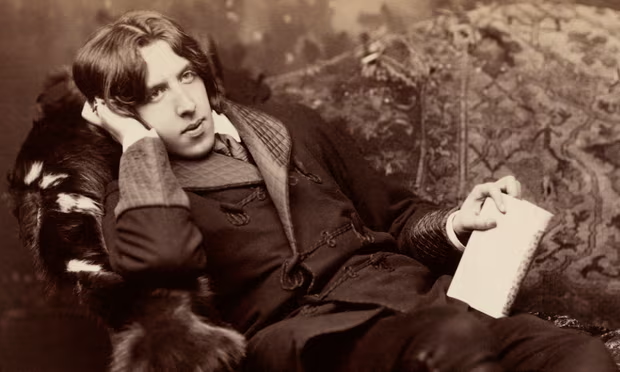
Oscar Wilde and others envisaged a future in which technology removed the drudgery of work and led to shorter working hours. Photograph: Heritage Images/Getty Images
Oscar Wilde thought hard work “the refuge” of those with nothing better to do while he envisaged a society of “cultivated leisure” as machines performed the necessary and unpleasant tasks.
Karl Marx’s dream was of a society regulated general production that allowed liberated workers to “hunt in the morning, fish in the afternoon, rear cattle in the evening, criticise after dinner” without the drudgery of being tied to one job.
The 19th-century socialist activist William Morris advocated for more pleasurable work, believing that once the profit motive of the factory had been abolished, less necessary labour would led to a four-hour day.
So Elon Musk’s suggestion to Rishi Sunak that society could reach a point where “no job is needed” and “you can do a job if you want a job … but the AI will do everything” revives a debate on the issue of how we work that has long been discussed.
Yet a world without work, experts question, may be more dystopian than utopian.
“This is an old, old story that never actually happens,” said Tom Hodgkinson, co-founder of the Idler magazine, which for three decades has been a platform to examine issues surrounding work and leisure.
“There was a poem in ancient Greece saying, ‘Isn’t it wonderful that we have invented the watermill so that we no longer have to grind our corn? The women can sit around doing nothing all day from now on.’ It’s that kind of recurrent idea.
“People like Bertrand Russell were talking about this in the 30s. What would we do without work? One view is people wouldn’t know what to do because people are more or less slavish. That they would just sit around watching daytime TV or porn all day.”
In fact, given more free time, such as on furlough during Covid, “they start living better”, Hodgkinson said. “They are starting neighbourhood groups, doing more gardening, doing up the house, spending more time with family, doing creative things, playing music, writing poetry, all the things that are part of what I would call a good life.”
Despite that, he said, studies had shown that paid work was beneficial for mental health, for status and identity.
“I think we need to do some sort of work. We should be moving towards a shorter working week, and more leisure-filled society,” Hodgkinson said, adding that a radical overhaul of our economic and education models would be needed to eliminate work on the scale that Musk predicted.
One significant body of research in 2019, led by Brendan Burchell, professor in social sciences and a former president of Magdalene College, Cambridge, established that eight hours of paid employment a week was optimal in terms of benefit in mental health, and that no extra benefit was subsequently accrued.
Setting aside the “awful jobs that really screw you up”, Burchell said, “your average job is good for you” in terms of social interaction, working collectively, giving structure and sense of identity.
A world without work “is a terrible idea of what society would look like for all sorts of reasons, as well as people’s mental health”, he said.
The labour market, as a way of distributing money around the economy, would have to be transformed, as would the education system, “to teach people how to fill their days, by writing poetry or going fishing or whatever, instead of going to the factory or the office”, Burchell continued.
Shifting to shorter working hours was shown to have “massive benefits for people”, said Burchell, but he added: “If we move to a society where lots of people are completely excluded from the labour market, then I get very worried that’s going to be a very dystopian future.”
In his book Making Light Work: An End to Toil in the 21st Century, David Spencer, professor of economics at the University of Leeds, also makes the case for less work, but not its elimination. “It would leave us bereft potentially of things that we value in work,” he said, citing communal enterprise, personal relationships and the development of skillsets.
So in essence, we would be a poorer, sadder, less skilled society. “Yes, there will be some loss through loss of work,” Spencer said. “I realise not all work is good. So we ought to automate drudgery, seek to use AI to reduce the pain of work, and therefore leave work which is good.”
He draws from Morris, who talked about bringing joy to work. “Skilful work is good work and it has a role in the creation of a better society,” said Spencer. “We ought to use technology to create less and better work. In that sense, the future can be really positive.
This was, he added, the future imagined by “Oscar Wilde, William Morris, and a lot of utopian positive thinking, where technology makes work lighter. It’s not eliminating work – it’s bringing light to work.”
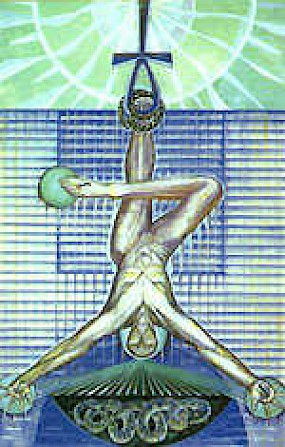
The Hanged Man is numbered twelve and is depicted as a figure, usually male, hanging upside down from a tree or branch. He often has his hands behind his back, as though tied (though as you can see the Thoth interpretation moves away from this aspect of apparent helpnessness). Usually one leg is tucked behind the other to form a triangle shape. Strangely though, he tends to look quite happy and content with his situation.
Not a very popular card, the Hanged Man deals with sacrifice, delays and waiting – and also being bogged down and helplessness. We sacrifice every time we make a choice – reading this web page means you have sacrificed reading the alternatives. Since sacrifice can mean giving up one thing of value for another thing of equal or greater value, this card can easily be seen as representing the natural and normal function of disposing of something that no longer suits its purpose as well as its replacement will.
The Hanged Man is totally vulnerable, his attitude is “whatever will be, will be”. He accepts everything that happens with equanimity and courage – he is, after all, simply giving in to his destiny. He can sometimes represent the person who has waited too long, who is perhaps scared to change. We should endure with strength and inner peace, but also be courageous enough to take action when destiny calls.
In the “last times,” said the late Rev. Jerry Falwell, “You’ll be riding along in an automobile… When the trumpet sounds, you and other born-again believers in that automobile will be instantly caught away… the car suddenly crashes.… Other cars on the highways driven by believers will suddenly be out of control and stark pandemonium will occur.”1
He was speaking of the Rapture, an integral part of his belief in Armageddon and the return of Christ. He spoke with confidence; did he have any reason to do so?
Around AD 95 a Christian convert called John, exiled by the Roman authorities to the Greek island of Patmos, had a vision of Christ’s return: not the compassionate Christ of the Gospels but a violent one, stained with the blood of his enemies and about to battle against the Antichrist at Armageddon – a site in the Jezreel valley, northern Israel, beneath the brooding ruins of ancient Megiddo.
John wrote a furious and violent text, his Revelation, which after several hundred years was finally included in the New Testament as its final book.
John was certain that the end was coming at any moment. Indeed, he believed that some who had witnessed the crucifixion would still be alive. John was wrong but his apocalyptic prediction of the last days has reverberated through the centuries. Even today there are those who think they will live to witness it.
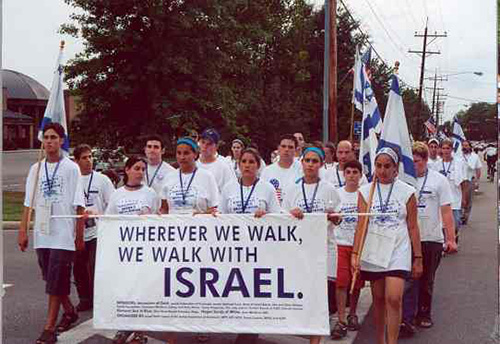
Christian Zionists in the United States express their adoration and support for the State of Israel.
Fifty-nine percent of all American Christians – according to polls in 2002 – believe that the events described in Revelation will occur in their lifetime; amongst fundamentalist Christians the figure reaches seventy-seven percent. In the last days, they believe, the Messiah – Jesus – will return, win the great battle against Satan (the Antichrist, the Beast) and convert the entire world to Christianity. Thereafter he will rule from Jerusalem.
Beliefs can create events. Ideas are powerful and linger well-entrenched and active in the cultural consciousness. And if those who share these beliefs are serving in an army in the Middle East and think that the ultimate enemy is Satan, what then?
“And the enemy is a guy called Satan”
US Lieutenant General William Boykin, in June 2003, during the Iraq war, laid out such an explanation at a church in Oregon.
“We… are in a spiritual battle, not a physical battle… the battle this nation is in is a spiritual battle, it’s a battle for our soul. And the enemy is a guy called Satan.… Satan wants to destroy this nation.”2
Lieutenant General Boykin has a history: in 1980 he was in the Iranian desert as operations officer for the attempt to free the United States Embassy hostages; in 1989 he was in Panama with the operation to capture President Noriega; in 1993 he was in Colombia with Delta Force, chasing Pablo Escobar, the cocaine baron. That same year Boykin was an adviser on the confrontation with the Branch Davidian sect at Waco, Texas, and by October he was in Somalia, commanding the Delta Force group and was present during the battle of Mogadishu, the subject of Black Hawk Down.
He was appointed head of the Special Operations Division at the Pentagon, moved to the CIA as Deputy Director of Special Activities and then placed in charge of the United States Army Special Forces Command. In 2003–2004 he was involved with the notorious Abu Ghraib prison in Baghdad.
Boykin was not a lone eccentric: when, in 2004, Lieutenant Colonel Gareth Brandl was leading his men in an assault on Falluja, in mid-Iraq, he inspired them by proclaiming, “The enemy has got a face. He’s called Satan. And we’re going to destroy him.”3
Of course, fundamentalist Christians have an escape card that they can play: the Rapture. It is a very simple concept, if you are on the side of Jesus, then you get whisked away by God before the troubles start. If you are somewhere else in the vast realm of religious aspiration then you don’t.
When you get taken there is no warning that allows you to park your car or finish brushing your teeth. God grabs you and you are gone. Implicit in the story is that those left behind actually deserve whatever happens. They are sinners who must be punished. The Rapture does not “do” compassion.
But curiously the Rapture is not mentioned in Revelation. Neither is there any such teaching in Judaism. Islam too is silent on the subject. Nor does Roman Catholic, Orthodox or mainstream Protestant theology contain its story.
In fact, the Rapture is a relatively recent spin on cherry-picked biblical extracts. It has its origins in two sources: the writings of John Nelson Darby (1800–1882), the founder of the Plymouth Brethren and in the commentaries of the Reverend Cyrus Ingerson Scofield (1843–1921) in The Scofield Reference Bible, 1909. The modern picture of the Rapture with its crashing cars and aeroplanes dates from the 1950s and was first launched to a large public audience by fundamentalist preacher Hal Lindsey in 1970 with his book The Late Great Planet Earth.
The Biblical Prophecy Industry
Hal Lindsey
During the morning of 7 June 1967 the future of the Middle East changed dramatically. The Temple Mount was taken by Israeli forces. With the Old City and the Temple Mount in Jewish hands, the Christian fundamentalist prophecy industry went into overdrive. These events, they said, provided direct proof that their understanding of biblical prophecy was correct and that the last days were closing in.
During March and April of 1967 Hal Lindsey was lecturing on college campuses throughout California on the apocalyptic events prophesied in the Bible. His talks centred on the three great events concerning the Jews that would be signs of the return of Jesus and the final defeat of the Antichrist: firstly, the gathering of Jews together to reform their ancient nation; secondly, the possession of Jerusalem and the holy places by Israel; thirdly, the rebuilding of the Temple.4
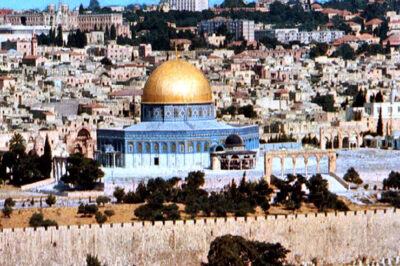
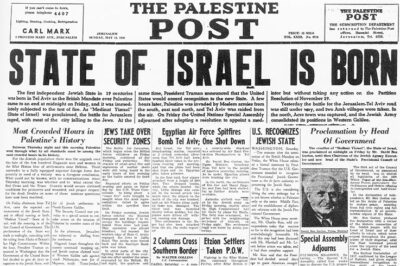
The first sign was fulfilled on May 14, 1948, with the creation of the modern state of Israel. One can imagine Lindsey’s excitement when Israel took Jerusalem and its holy places, thereby fulfilling the second sign. Would the third event take place? Lindsey had no doubt at all that it would despite his admission that the Dome of the Rock on the Temple Mount was an “obstacle.”
When the Israeli paratroopers took the Temple Mount they assigned one of their young brigade chaplains, Yisrael Ariel, to guard the entrance to the Dome of the Rock. He later recalled thinking that he was simply minding the site until army engineers could come and tear the structure down.5
The expectation of the hard-line fundamentalists was that the Israeli state would take this opportunity to return the Temple Mount to Jewish worship. But the engineers never arrived; the site was maintained as an Islamic place of worship.
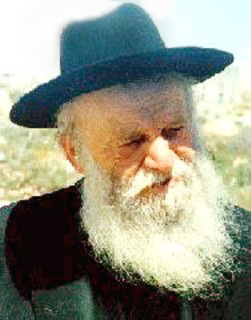
Rabbi Tzvi Yehuda Kook (1891–1982)
Ariel had studied under a messianic teacher, Rabbi Tzvi Yehuda Kook, who saw the influx of Jews into Israel as part of a divine plan and opposed any Arabs holding land that was once Jewish. Kook felt that the time of the Messiah was coming closer; the events in the world about him were a prelude to the last days.
In 1974 a number of Rabbi Kook’s followers organised the West Bank settler movement, the Gush Emunim, whose members flooded into the West Bank and built heavily defended communities. Ariel, by then a rabbi, moved to the hard right of religious Zionism joining the violent and racist Kach political party; in the 1981 elections Ariel was on the Party list. He despised those Jews who did not want to rebuild the Temple and he stated his belief that Christians and Muslims were idol worshippers who, by Jewish law, were forbidden to live in Israel. Then, in 1984, Ariel founded the Temple Institute. Its registration documents state that its long-term aim is to rebuild the Temple.
I first encountered the Temple Institute in January 1992 while on a break from cave-exploration in the high cliffs bordering the Dead Sea. I decided to visit them and hear what they had to say.
There, Rabbi Chaim Richman told a story that left me shaken: members of the Institute wished to remove the Dome of the Rock and the al-AqsaMosque so that the Temple of Solomon could be rebuilt. And to serve the Temple they were training priests in the tradition of blood sacrifice. Richman carefully explained the Institute’s mission:
“The Temple represents harmony; it will bring harmony to the world.”6
He later wrote that Jerusalem would be recognised “as the spiritual centre of all humanity.”7
“Israel,” he added, has the divine mission of being a “kingdom of priests and a holy nation.”8
And this brings us to their interest in the “red heifer.”
A Perfect Red Heifer
Of the many enigmatic stories in the Old Testament, there are few stranger than that related in Numbers 19:1–22 which concerns the sacrifice of, “a red heifer without fault or blemish.” This animal was slaughtered and burned, its ashes gathered and kept in a ritually clean location. These ashes were the most powerful substance known in ancient Judaism to ensure ritual purity.
The orthodox Jews wishing to build the Third Temple today cannot risk entering the Temple Mount in case they inadvertently step upon the site once occupied by the Holy of Holies. Since no one knows exactly where this stood there is only one way of proceeding: to purify the site using the ashes of the red heifer.
As they enter the Temple Mount they will sprinkle sacred water mixed with the ashes of the red heifer to ensure that they do not lose their ritual purity. In this way they can begin the demolition of the Islamic structures.
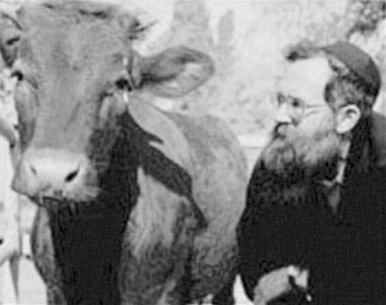
Rabbi Chaim Richman poses with the red heifer named Melody.
No such perfect red heifers exist today but Rabbi Richman mentioned a cattle-breeding programme being conducted in the United States with the help of fundamentalist Christian groups that also await the Messiah – for them, Jesus. But Richman was adamant that there was no possibility of Jesus being the Jewish Messiah.
A key figure in this breeding programme was a Christian Pentecostal rancher, the Rev. Clyde Lott of Canton, Mississippi. In 1989 he realised that the Red Angus breed might produce the required animal. Lott and Richman quickly joined forces. During 1991 and 1992 they instituted the breeding program, initially on ranches in the United States but later in Israel. However, producing a perfect heifer proved difficult.
In 1996 a red heifer – named Melody – was finally born on a farm near Haifa though by 1997 she was pronounced unworthy of sacrifice. Since that time a number of others have been born but all have proved less than perfect.
Nevertheless, the Temple Institute presses on. In 2007 they gave an explanation of the importance of the red heifer, commenting that, “A perfect heifer, born and raised under a controlled environment, would be fit to be used for the Temple. And that is precisely what is being done today.”9
I returned to the Temple Institute in 2007, paid my fee and slipped down to join the small group of US Christians. Next to me was Mark from Texas. We were taken to a room containing a large model of the Temple. Our lecturer began explaining the various elements. I noted, leaning against the rear wall of the room, a framed colour photograph of a red heifer. I wondered why it was not hanging on the wall. It seemed oddly disrespectful. And curiously, our lecturer didn’t mention it at all.
As we exited the Temple Institute and were walking up the street, I approached Mark from Texas and asked, “Didn’t Jesus’ death remove the need for animal sacrifices in the Temple?”
“Yes,” replied Mark from Texas with a knowing smile, “He was the sacrificial Lamb of God and stopped animal sacrifice for all time. The Jews don’t recognise that Jesus stopped the animal sacrifices.”
Mark from Texas had touched upon a major difficulty that accompanies Christian support for those Jewish groups wishing to rebuild the Temple. The Christians want the Temple rebuilt because this brings the second coming of Jesus closer. The Jewish groups are happy to accept their patronage since it represents backing for Israel as well as significant financial aid. In addition, of course, both groups are also choosing to ignore that the fundamentalist Christians are intent upon convincing all the Jews that Jesus is the Messiah.
And there is more to worry about: in ancient times there was a Jewish religious authority operating in parallel to the Roman administration, the Sanhedrin, the ultimate authority in matters of the interpretation of Mosaic law and which had the power to impose the death penalty.
After the Temple’s destruction in AD 70, the Sanhedrin moved through a series of sites, the last being Tiberius, around AD 425. And so it was in Tiberius, in 2004, that the new Sanhedrin was convened.
One of the Sanhedrin’s aims is to influence the political direction of Israel, seeking power to veto any laws that it deems incompatible with biblical Jewish law. A leadership council of seven prominent members was formed; this included Rabbi Yisrael Ariel, the founder of the Temple Institute along with his colleague Rabbi Chaim Richman.10 It is no surprise to find that “the Sanhedrin is researching ways to renew the deepest roots of our faith – to renew Temple service.”11
The Mahdi and Jesus Return for the Last Days
The relevance of events of June 1967 was not missed by the Muslims. Their traditional enemies were now in possession of the third most sacred site in Islam. The defeat of the Arab armies ushered in radical Islam which believes the only solution is a world united in a great Islamic state under a Caliph based in Jerusalem ruling by sharia law.
For most Muslims who await the caliphate its appearance would be the sign of the last days when the Messiah – the Mahdi – will appear. And at his side, they believe, will stand Jesus.
But before the Day of Judgment can begin, according to one widely accepted hadith dating from the ninth century AD, all Jews must be slaughtered. This has become an integral part of Middle Eastern politics: the 1988 foundation charter of Hamasstates explicitly that the organisation seeks “to implement Allah’s promise” that the Day of Judgment will not come until the Muslims have killed all the Jews.12
The aim is to ensure that not a single member of the Jewish race survives, then to seize Jerusalem which will become the messianic capital of Islam; to take over all the technology developed by the West and put it in the hands of the true believers and finally, to convert the whole world to Islam, placing Allah’s people into their rightful position – in charge. That, in essence, is the Islamic apocalyptic vision of the last days.
But the Mahdi and his armies are not just fighting a coalition of disparate races; there is a single directing force acting behind them – the Antichrist, the Dajjal.
Modern Islamic writers have gone far beyond traditional texts in the search for material to justify their last days prophecies and the Christian book of Revelation has proved a rich mine to plunder. Material has also been drawn from many other sources, ranging from early Gnostic texts through the prophecies of Nostradamus to modern Western UFO literature.
Best-selling Egyptian author Muhammad Isa Da’ud would have us believe in the existence of, “the Antichrist army of Jinn [spirits] and demons, which kidnap unfortunates who wander into the area of the Bermuda Triangle. Those who are kidnapped are taken down into his fortress castle far beneath the waters.”13
In 1997 Muhammad Izzat Arif, who considered rather more plausibly that this Bermuda Triangle base was above water, explained that, “The truth is that the Antichrist is a power chained on a remote island, sending his orders through demons subordinated to him, and working before him as servants,”14 adding that, “They inspire Jews, and their slaves the Masons.”
These demons under the control of the Antichrist have another specific role: they pilot the UFOs the Antichrist uses. In 1996 writer Hisham Kamal ‘Abd al-Hamidexplained that the flying saucers were not from extraterrestrial sources but rather from the earth, which he reminds us is inhabited by both humans and jinns. He concludes, as we noted earlier, that the “people of flying saucers are demons in human form.”15
Perversely, as noted, much of the material comes from Christian sources, which seem well known to the Islamic writers. Jerry Falwell’s writings are frequently referred to by Muslim apocalyptic writers and he is considered an authority on the end of the world.
Others who receive a mention in the Islamic sources are Caspar Weinberger, Jimmy Swaggart, Jim Bakker, Pat Robertson, Oral Roberts, Kenneth Copeland, Richard De Haan, Billy Graham, and, surprisingly, the Scofield Bible.16
These radical Muslims assume that the world will convert to Islam; the extremist Christians assume the world will convert to Christianity; the Jewish fundamentalists care only that Jews serve on the Temple Mount, they don’t seem to be concerned how the rest of the world shakes out. But all three religions claim Jerusalem as the centre for their Messiah’s rule.
It appears that these apocalyptic writers from the three Abrahamic religions have more in common with each other than with the moderate majority within their own traditions, a majority who generally have no great arguments with each other.
The certainty, self-confidence, and aggressiveness of the fundamentalists is shifting their faith’s centre of gravity toward the rigid and intolerant edges. The hardliners are deliberately encouraging a focus upon differences instead of seeking points of similarity, accord, and mutual understanding. A separation is being created, which, in time, may become too wide to bridge.
What worries me about all this is the breathtaking arrogance and willful ignorance of spirituality by the fundamentalists of the three faiths. There is no room for any other spiritual systems, no room for Buddhism, Hinduism, Taoism, or the many other perfectly valid paths by which spiritually minded people journey toward knowledge of matters divine.
Fundamentalist Christian authors Tim LaHaye and Jerry Jenkins are blunt, “The idea that all religions point to the same god is blasphemy. So is the idea that there are many ways to God. Buddha, Mary, Gaia, Muhammad, and Christ are not in the same category.… Just one was God’s ‘only begotten Son’, and only He gives us access to God through prayer.”17
The concept of a divine Jesus is a problem for Judaism and Islam. For Muslims, the failure of the other two religions to recognise Mohammed as the last prophet represents an additional conflict point. For the Jews, the failure to recognise the importance of the Temple and its priesthood as a conduit between God and earth is a crucial difficulty. The three positions seem irreconcilable.
Can we continue to live with this or should we reconsider our position towards the anthropomorphic god of the Abrahamic religions? Should we really accept all authority deriving from a vengeful and jealous god who claims to be unique? Should we just sit back and watch as the fundamentalist religious teachings leak inexorably and dangerously into our politics?
We have found ourselves across the Rubicon, by default rather than design. The question is: what are we going to do about it?
If you appreciate this article, please consider subscribing to help maintain this website.
Footnotes
1. Ronnie Dugger, “Reagan’s Apocalypse Now,” Guardian (reprinted from Washington Post), April 21, 1984, 19.
2. Esther Kaplan, WithGod on Their Side, New Press, New York, 2005, 21.
3. Paul Wood, “Hunting ‘Satan’ in Falluja Hell,” BBC News, November 23, 2004, quoted in John Gray, Black Mass: Apocalyptic Religion and the Death of Utopia, Penguin, London, 2007, 28.
4. Hal Lindsey, The Late Great Planet Earth, Zondervan, Grand Rapids, 1970, 50–51.
5. Gershom Gorenberg, TheEnd of Days, Free Press, New York, 2000, 100.
6. Richman, personal communication, January, 1992.
7. Chaim Richman, A House of Prayer for all Nations: The Holy Temple of Jerusalem, Temple Institute, Jerusalem, 1997, 7.
12. Noted in a submission by the World Union for Progressive Judaism to the fifty-ninth session of the United Nations Commission on Human Rights, February 18, 2003, 5. File No. E/CN.4/2003/NGO/226.
13. David Cook, Contemporary Muslim Apocalyptic Literature, Syracuse University Press, Syracuse, 2005, 78.
14. Ibid, 188.
15. Ibid, 81.
16. Ibid, 92nn9,10, 11.
17. Tim LaHaye and Jerry B. Jenkins, Are WeLiving in the End Times?, Tyndale, Wheaton, 1999,176.
Michael Baigent (1948-2013) graduated with a bachelor’s degree in psychology from Canterbury University, Christchurch, and had a master’s degree in mysticism and religious experience from the University of Kent in England. Baigent was been published in 35 languages and the author of From the Omens of Babylon, Ancient Traces, and the New York Times bestseller The Jesus Papers; coauthor of the international bestsellers Holy Blood, Holy Grail and The Messianic Legacy (with Henry Lincoln and Richard Leigh); and coauthor of The Temples and the Lodge, The Dead Sea Scrolls Deception, Secret Germany, The Elixir and the Stone, and The Inquisition (with Richard Leigh).
The conflict between Israel and the Palestinians has barely been out of the news since the State of Israel was created in 1948. Few people are aware of the secret wheeling and dealing that went on behind the scenes in the lead-up to the fateful decision of the British government to announce its support for the creation of a Jewish homeland.
The critical events discussed in the following article took place during World War I, the first global conflict in which millions of young men died on the battlefield. Jim Macgregor and Gerry Docherty, authors of the book Hidden History: The Secret Origins of the First World War, have previously appeared in New Dawn, writing about the real power behind the war, the group they identified as “The Secret Elite” – made up of bankers and politicians.
In the following exclusive article, they expose the shocking truth behind the controversial Balfour Declaration that justified the creation of a Jewish homeland in Palestine, and subsequently the State of Israel.
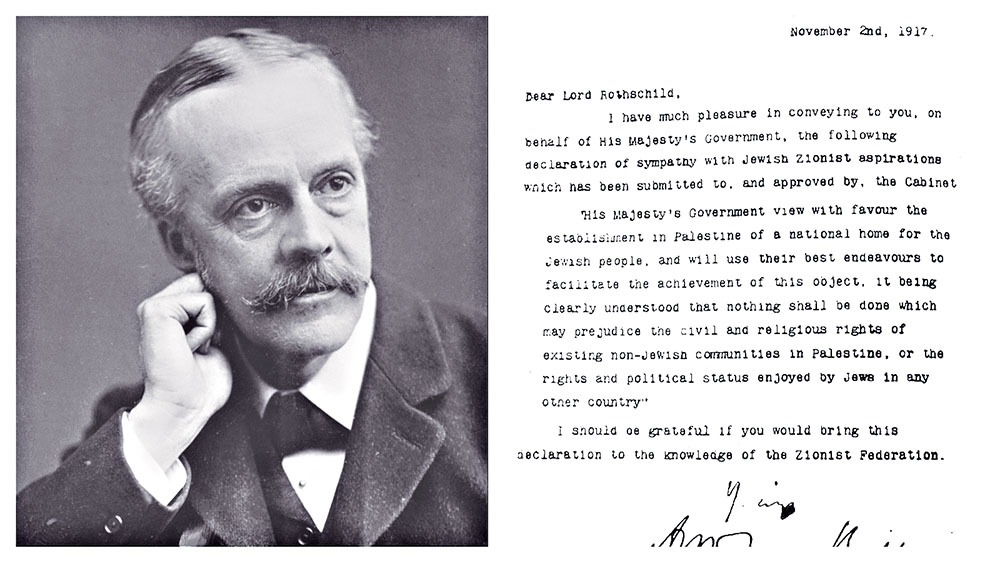
LETTER FROM ARTHUR BALFOUR TO LORD WALTER ROTHSCHILD
Foreign Office, November 2 1917
‘Dear Lord Rothschild,
I have much pleasure in conveying to you on behalf of His Majesty’s Government the following Declaration of sympathy with Jewish Zionist aspirations which have been submitted to and approved by the Cabinet:
His Majesty’s Government view with favour the establishment in Palestine of a national home for the Jewish people, and will use its best endeavours to facilitate the achievement of this object, it being clearly understood that nothing shall be done which may prejudice the civil and religious rights of existing non-Jewish communities in Palestine, or the rights and political status enjoyed by Jews in any other country. I should be grateful if you would bring this Declaration to the knowledge of the Zionist Federation.
Yours sincerely, (signed) ARTHUR JAMES BALFOUR’1
Arthur James Balfour’s letter to Lord Walter Rothschild, the first public statement by the British government during World War I announcing support for the establishment of a “national home for the Jewish people” in Palestine.
The above letter was released by the British Foreign Office and printed in The Times on 9 November 1917.
Why at this critical juncture did the British War Cabinet decide publicly to favour Palestine as a national home for the Jewish people? There was a war on, and it wasn’t going particularly well. What was their purpose? Where did this fit into the Secret Elite’s strategy to crush Germany and advance its globalist ambition? How had it come about that a homeland for one specific religious group appeared on the agenda as if it was a solution to an unstated problem? Even if anyone believed the lie that the Allies were fighting for the rights of smaller nations, why had religious identity suddenly become an issue of nationhood? Had anyone considered giving Catholics such rights in Ireland or Muslims such rights in India? Was the world to be divided into exclusive religious territories? Of course not.
Lord Walter Rothschild
To complicate matters further, one nation (Britain) solemnly promised a national home to what would become in time a second nation (the Jewish State of Israel) on land which belonged to another people (Palestinian Arabs) while it was still an integral part of a fourth (the Ottoman/Turkish Empire).2 In pandering to a relatively small group of Zionists, the Balfour Declaration was bizarre, deceitful and a deliberate betrayal of the loyal Arabs fighting in the desert war against the Turks. Perfidious Albion had rarely plumbed such duplicitous depths.
The absolute destruction of Germany and her Ottoman allies promised to pave the way for a post-war re-drawing of maps and spheres of influence which would advance the Secret Elite’s overall strategy – namely the control of the English-speaking elect over the world. The strategic sands of Arabia and the oil-rich lands of Persia, Syria and Mesopotamia had long been prime targets. These were the first in a number of prerequisites which would shape the Middle East after 1919 to the advantage of Britain in particular. Critically, as a neutral, America had to be very careful about open intervention even after she had entered the war in 1917, and to an extent Britain acted as her proxy in putting markers down for a new world order. It is important to remember that when early discussions about the future of a Jewish homeland in Palestine were in progress, little mention was made of American involvement. The truth is otherwise. America was directly involved in secret intrigues.
So, too, were small but influential groups of politicians and businessmen, English, American, French, Russian, men and women of the Jewish faith spread literally across the world, who supported a growing movement to establish a permanent homeland in Palestine. They were called Zionists. Take care with this term. Initially it included a range of Jewish groups which held different views and aspirations. Some saw Zionism as a purely religious manifestation of ‘Jewishness’. A small but intensely vocal group fostered political ambitions. This latter form of Zionism included those determined to ‘reconstitute’ a national home for their co-religionists. In the words of the former Viceroy of India, Lord Curzon, “a national home for the Jewish race or people” implied a place where the Jews could be reassembled as a nation, and where “they [would] enjoy the privileges of an independent national existence.”3
There were a small number of suggested sites for the proposed new homeland, including one in Uganda, but in the first years of the twentieth century a more determined Zionist element began to focus their attention on the former land of Judea in the Middle East. They spoke of the creation in Palestine of an autonomous Jewish State, a political entity composed of Jews, governed by Jews and administered mainly in their interests. In other words, the recreation of a mythical Jewish State as was claimed to exist before the days of the so-called ‘diaspora’.4 Few voices were raised to ask what that meant, on what evidence it was predicated, or how it might be justified? It was an assumed biblical truth. Not every Jew was a Zionist; far from it, and that’s an important factor which must be borne in mind.
Frequently, historians write versions of history which imply an event ‘just happened’. In other words, they begin at a point that creates the impression there was no essential preamble, no other influence which underwrote the central action. One example is the assassination of Archduke Ferdinand in Sarajevo on 28 June 1914. For generations, school pupils have been taught this murder caused World War I. Such nonsense helped deflect attention away from the true culprits. Another example can be found in the usual interpretation of the Balfour Declaration which has been described as the British Government’s note of approval for the establishment of a national home for the Jewish people, as if it turned up one day on the Foreign Secretary’s desk and was signed like the other items in his out-tray. It has been downplayed, granted but a minor mention in the memoirs and diaries of the politicians who carefully orchestrated its single sentence. The Balfour Declaration was much more than a vague promise made by British politicians under the pressure of war’s contingency. Such a simple interpretation has conveniently masked the international pressures which the hidden powers on both sides of the Atlantic asserted in favour of a monumental policy decision that opened the door to the eventual establishment of the State of Israel.
‘The Zionist Movement’
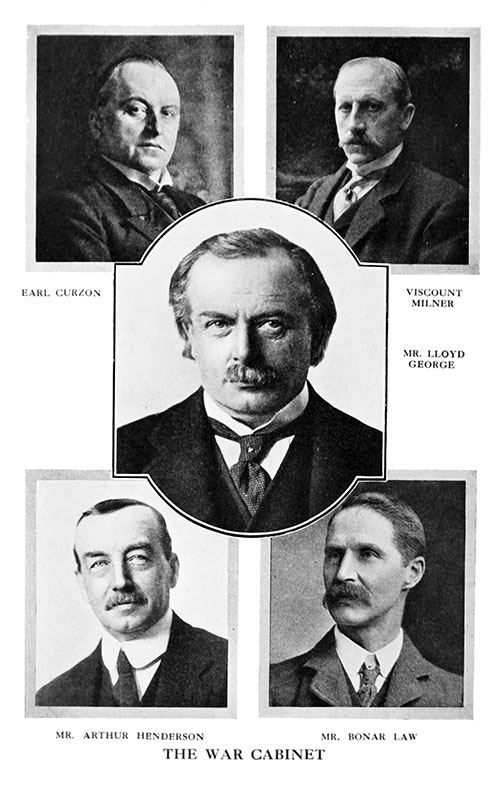
At the 261st meeting of the British War Cabinet on 31 October 1917, with Prime Minister Lloyd George in the Chair, the membership comprised Lord Curzon, Lord Alfred Milner, Andrew Bonar Law, (Conservative leader) Sir Edward Carson, G N Barnes (Labour Party), the South African General Jan Smuts and Foreign Secretary Arthur Balfour. This was the inner-circle formed mainly from the Secret Elite’s political agents to run the war.5 They remained behind the closed doors of 10 Downing Street after other war business had been completed. The military and naval representatives were dismissed before the War Cabinet’s inner cabal proceeded to discuss the on-going issue of ‘The Zionist Movement’. As always, Lloyd George’s War Cabinet secretary, Sir Maurice Hankey, recorded the minutes. This coterie of British imperialists, and Secret Elite members and associates, agreed unanimously that “from a purely diplomatic and political point of view, it was desirable that some declaration favourable to the aspirations of the Jewish nationalists should now be made.”6 To that end a carefully constructed form of words was tabled and the War Cabinet authorised Foreign Secretary Balfour “to take a suitable opportunity of making the following declaration of sympathy with the Zionist aspiration.” It was no co-incidence that some five days previously the editor of The Times had urged them to make this statement.7
Members of the British War Cabinet (July 1917).
Two days after the War Cabinet’s decision, a letter was sent from the Foreign Office to Lord Lionel Walter Rothschild (2nd Baron Rothschild) in London asking that he “bring this Declaration to the knowledge of the Zionist Federation.” It was signed Arthur James Balfour, and henceforth was known as the Balfour Declaration, though it was the product of many more minds than solely that of the British Foreign Secretary.8 Its precise wording was publicised across Jewish communities who hailed the letter as the beginning of a new epoch in their history. Despite the apparent care with which the War Cabinet attempted to lay down conditions to protect non-Jewish communities, in particular the rights of the Palestinian Arabs to whom the country belonged, the event was celebrated by Zionists across the world as a National Charter for a Jewish homeland.9 The genie was out of the bottle.
In truth, the letter was the product of years of careful lobbying in both Britain and America. It was neither a beginning nor an end-point. Though the communication was essentially between the British government and the Zionist Federation in Britain, it had an almost casual feel to it as if it was simply a letter between two members of the English gentry, Balfour and Rothschild. The Declaration was far from casual and much more contrived than a gentleman’s agreement.
By all known processes of law and morality, it was ridiculous. Consider the unprecedented nature of the proposal. Britain held no sovereign right whatsoever over Palestine or authority to dispose of the land.10 As if this would not cause sufficient confusion, the British Foreign Office had already promised parts of Palestine to the French, to the Arabs who owned the land, and finally, to the international Jewish community. Was there ever a better example of the wanton arrogance of the British imperialist ruling class? The very wording of the Balfour Declaration was ambiguous; the conditions set were impossible. What was meant by the phrase, “a national home”? It had no clearly defined meaning in international law. How could a foreign government promise to achieve world-wide approval for a national home for Jews in an Arab country without automatically prejudicing the rights of the Arabs whose ancestors had lived there for thousands of years?11 Its vagueness gave rise to interpretations and expectations which were certain to cause bitter dispute. What was going on?
Secret Discussions
The answer can be found by examining earlier versions of this controversial document and the extent to which Zionists on both sides of the Atlantic strove to nurture and protect it. Far from any notion of their sudden conversion to Zionism, the political drive to establish a Jewish homeland in the sands of the desert, British politicians had been engaged in such discussions for several years. This fact had been conveniently omitted from official histories, memoirs and government statements.
A previous War Cabinet meeting on 4 October 1917 had considered an almost identical draft declaration from Lord Alfred Milner, the most influential leader of the inner circle of the Secret Elite. He included the words “favour the establishment of a National Home for the Jewish Race.”12 The capitalisation of the term National Home was later altered, as was the very Milnerite phrase, “Jewish Race.” Lord Milner was a very precise thinker. While the words National Home implied that the Jewish people throughout the world should have a defined area to call their own, his version favoured “the establishment” of such a place. It did not imply a return to a land over which they had assumed rights. Secondly, Alfred Milner held race in great esteem. He defined himself with pride as a British “Race Patriot.”13 His wording was a mark of respect. Others feared it was a dangerous phrase which might be interpreted aggressively. It clashed with the concept of Jewish assimilation, like Jewish-Americans, and hinted that as a faith group, Jews belonged to a specific race of peoples. Consequently, his version was toned down.
Secretly, the War Cabinet decided to seek the opinion on the final wording of the declaration from both representative Zionists (their phrase) and those of the Jewish faith opposed to the idea of a national homeland. It is crucial to clearly understand that inside the international Jewish community there was a considerable difference of opinion, in favour of and against, this idea of a Jewish ‘homeland’. That these groups were apparently given equal standing suggested the Jewish community in Britain was equally split on the issue. They were not. The number of active Zionists was relatively small, but very influential.
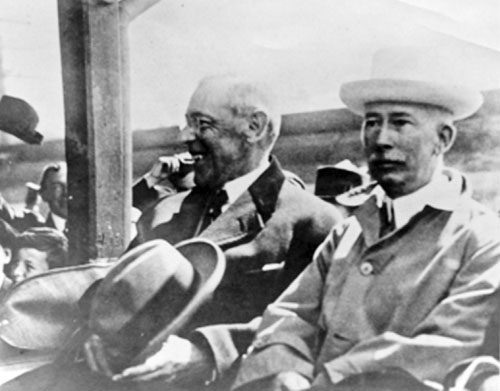
US President Woodrow Wilson, with his “alter ego” Colonel Edward Mandell House (right).
Furthermore, the War Cabinet sought the American President’s opinion on the proposed Jewish homeland in Palestine.14 The minutes of the 245th meeting of the War Cabinet in London revealed that Woodrow Wilson was directly involved in the final draft of the Declaration. So, too, was his minder, Colonel Edward Mandell House,15 and the United States’ only Jewish Chief Justice, Louis Brandeis,16 both of whom telegrammed different views to the British government.17 On 10 September, Mandell House indicated that the President advised caution; on 27 September, Judge Brandeis cabled that the President was in entire sympathy with the declaration. Much can change in politics over two and a half weeks.
As each layer of the onion is slowly peeled away from the hidden inner core of the eponymous Declaration, it becomes apparent that the given story has glossed over key figures and critical issues. There are hidden depths to this episode that mainstream historians have kept from public view and participants have deliberately misrepresented or omitted from their memoirs.
Secret Elite Fully Involved
The minutes of the War Cabinet Committee held on 3 September 1917 show that the earlier meeting had also been crammed with Secret Elite members and associates including Leo Amery, formerly Milner’s acolyte in South Africa.18 Item two on the agenda revealed that “considerable correspondence… has been passed between the Secretary of State for Foreign Affairs [A J Balfour] and Lord Walter Rothschild… on the question of the policy to be adopted towards the Zionist movement.”19 What? “Considerable correspondence” had been exchanged between Lord Rothschild and the Foreign Office; not a letter or enquiry, but considerable correspondence. A copy of one of these letters sent from the Rothschild mansion at 148 Piccadilly on 18 July 1917 has survived in the War Cabinet minutes. What it reveals shatters the illusion that the British government’s promise of support for a Jewish national home in Palestine stemmed exclusively from the Foreign Office under the pen of Arthur Balfour. Lord Rothschild’s letter began:
“Dear Mr. Balfour,
At last I am able to send you the formula you asked me for. If his Majesty’s Government will send me a message on the lines of this formula, if they and you approve of it, I will hand it on to Zionist Federations and also announce it at a meeting called for that purpose…”20
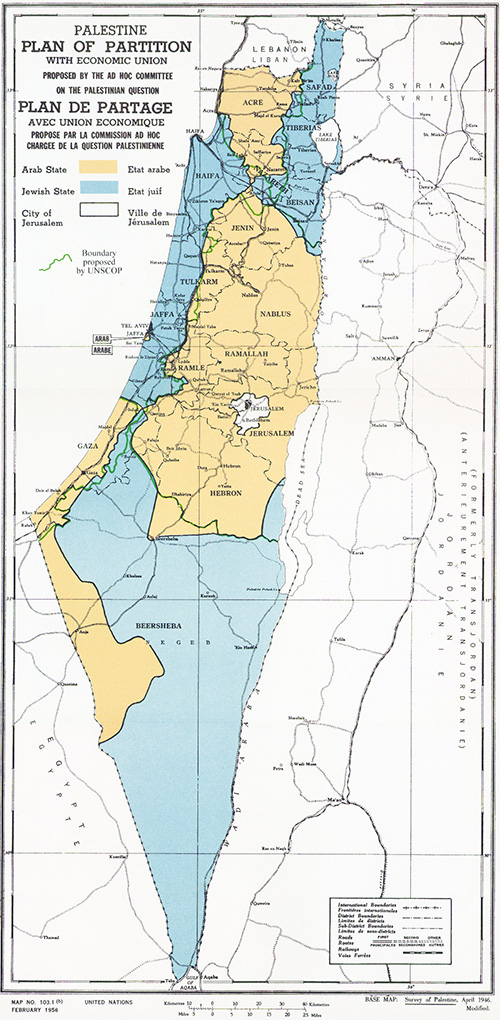
The United Nations General Assembly decided in 1947 on the partition of Palestine into Jewish and Arab states, with Jerusalem to be an internationalised city. Due to the outbreak of hostilities the plan was abandoned.
He enclosed his (Rothchild’s) recommendation for a draft declaration. It comprised two sentences: “(1) His Majesty’s Government accepts the principle that Palestine should be reconstituted as the National Home of the Jewish people. (2) His Majesty’s Government will use its best endeavours to secure the achievement of this object and will discuss the necessary methods and means with the Zionist Organisations.”21
Balfour’s reply “accepted the principle that Palestine should be reconstituted… and will be ready to consider any suggestions on the subject which the Zionist Organisation may desire to lay before them.” What? How do you “reconstitute” a country? It might be interesting to consider the precedent that was being set. Could this mean that one day America might be reconstituted as a series of native Indian reserves or parts of England as Viking territory? Astonishingly, the Zionist movement was invited to dictate its designs for British foreign policy in Palestine.22 This was not some form of loose involvement. It was complicity. Lloyd George’s government, through the war cabinet, colluded with the Zionist Federation to concoct a statement of intent that met their (Zionist)approval. Furthermore, it was agreed that such an important issue, namely the future of Palestine, should be discussed with Britain’s allies, and “more particularly with the United States.”23 This action had all the hallmarks of an international conspiracy.
How many lies have been woven around the design and origins of the Balfour Declaration? Lord Walter Rothschild was the chief intermediary between the British government and the Zionist Federation. In this capacity he had been involved in the process of creating and formulating a new and explosive British commitment to the foundation of a Jewish home in Palestine. More than that, Rothschild and his associates sought to control “the methods and means” by which it would be created.
The Balfour Declaration was part of a process which was not bound by the convenience of time frames that shunts history into segments. Politically it served the Secret Elite ambitions both in the short and long terms. They understood that a pro-British Palestine would protect the vital sea route along the Suez Canal; that a declaration in support of Zionism would unlock the treasures which they desperately needed to crush Germany; that in both America and Britain, young Jewish men would come forward to join the dwindling rank and file in their armies. In all of this it is generally forgotten that unless powerful figures supported the Zionist claims before the war ended and established some vehicle through which they could influence the carving up of the Ottoman Empire, a rapid end to World War I would have been disastrous to their long-term ideals.
In our book Prolonging the Agony, this whole question is carefully dissected to reveal the double-dealing and double standards which were cruelly visited on the Arabs of Palestine, and the rank complicity of the British and American governments. Most pertinently we produce documented evidence that clearly shows the manner in which an early attempt to encourage the Turkish Ottomans to abandon the war in 1917 was stopped dead in its tracks because no basis had yet been established for Zionist inclusion in any post-war settlement.
The Balfour Declaration was no gentleman’s agreement.
GERRY DOCHERTY was born in 1948. He graduated from Edinburgh University in 1971 and was a secondary school teacher by profession. He taught economics and modern studies, developed a keen interest in the theatre and has written a number of plays with historical themes. One of these plays was the powerful story of two cousins from his home town of Tillicoultry who were both awarded the Victoria Cross at the Battle of Loos in 1915. Energised by the research he had undertaken to write this play, he was intrigued by Jim Macgregor’s work on the First World War, and their mutual interest developed into a passion to discover the truth amongst the lies and deceptions that the official records contained. JIM MACGREGOR was born in Glasgow in 1947 and raised in a cottage in the grounds of Erskine Hospital for war disabled. There he witnessed the aftermath of war on a daily basis and, profoundly affected by what he saw, developed a life-long interest in war and the origins of global conflict. Jim graduated as a medical doctor in 1978, and left the practice in 2001 to devote his energies full-time to researching the political failures in averting war. His numerous articles have been published on subjects such as miscarriages of justice, the Iraq War, global poverty, and the rise of fascism in the United States. His powerful anti-war novel The Iboga Visions was published to critical acclaim in 2009.
THE HEAVENS—Mumbling the words “Why hast thou forsaken me?” as He thrashed about in His bed shortly after midnight Thursday, Jesus Christ, the King of Kings, reportedly woke up in a cold sweat after yet another nightmare that He had returned to earth for the second coming completely naked. “It’s terrible—in the dream, I’m descending from the heavens to raise the righteous dead and reward the faithful Christians by taking them back to heaven with Me, when suddenly I look down and realize I’m buck-naked with My dong hanging out,” said Christ, adding that it was the third night in a row He had dreamt that after coming again in glory to judge the living and the dead, people were pointing and laughing at their Lord and Savior’s small, limp member. “What makes it so mortifying is that it’s Judgment Day, it’s My big moment, and instead of inspiring awe among all who behold Me, I’m this laughingstock who’s screaming and trying to hide His genitals. Then everybody in the dream tells Me they don’t want to be Christian anymore, and they kick Me out of the earthly realm and back up into heaven.” Still shaking, Christ added that it was worse than the dreams He used to have about Pontius Pilot coming after Him with a chainsaw.
Consciousness, spirituality, biography, sexuality, androgyny, futurism, space, the arts, science, astrology, democracy, humor, books, movies and more





 HOMO SAPIENS: CREATING THEMSELVES