
The blessing of the LORD, it maketh rich, And he addeth no sorrow with it.
Proverbs 10:22


Published in Mind Cafe
Aug 8, 2023 (Medium.com)

Carl Jung had an insatiable desire to understand life and his unique position in it all.
But after many years, he concluded: “Only the paradox comes anywhere near to comprehending the fullness of life.”
That paradox, according to many other spiritual teachers, is a process of looking inside as much as it involves looking outside.
It’s this combination that seems to make life whole and there have been few people who have embraced the totality of life more than Carl Jung.
As any good psychologist will confess, the devil was in detail. And Carl Jung spent decades peeling away the layers of his subconscious mind to seek the truth of existence.
“As far as we can discern, the sole purpose of human existence is to kindle a light of meaning in the darkness of mere being” — Carl Jung
What did Carl Jung mean by in the darkness of mere being?
For me, it’s twofold.
There’s the physical side of life, the part that involves getting old. The part that involves our teeth decaying, our joints calcifying, our hair greying, our eyes blurring, our muscles aching, and our slow and steady movement toward death.
Then there’s the troubled human psyche that contains all kinds of negative thoughts — jealousy, fear, sadness, shame, regret, guilt, greed, hate, selfishness, and more.
This is the darkness of mere being that I believe Carl Jung was getting at and unless we actively choose a different approach “it will direct your life and you will call it fate.” (Carl Jung)
Well, that brings me back to looking within.
Before I ever meditated or practiced breathwork I used to live in a world where I felt separate from others, where I measured, compared, and competed against others. Ultimately, this caused me to judge myself and others more and I often found myself walking around with lots of the negative emotions I mentioned above.
When I did my first breathwork session, however, my physical body dissolved yet “I” remained.
This not only broke down the idea of separation but it also changed my beliefs around death. The “I” that remained was a universal I, one that contained all beings and had no start or end point.
In the months that followed, I had to consistently ask myself these two questions:
And:
It was the first time in my life when I had experienced that everything in life was happening now, expressing itself through a billion different eyes in a billion different moments simultaneously. I was just one of those pairs of eyes witnessing life from my own unique perspective.
“You are not a drop in the ocean, you are the ocean in a drop” — Rumi
That doesn’t take away the aches, pains, and woes of being human, it just helps me become less attached to my physical body and mental emotions. This makes things less terminal and more transient and ultimately, creates less suffering.
This is one of the gifts of Carl Jung’s work because he highlighted this point over and over again while reminding me that I am, like you, a vital part of this physical world but that I/we are also a part of something much bigger and more beautiful.
That’s why I continue to breathe every day as it reminds me of this truth.
This is how Carl Jung found the meaning of life many other people missed and luckily for us, he was willing to share his wisdom with the world.
“One does not become enlightened by imagining figures of light, but by making the darkness conscious.” — Carl Jung
This is an extremely personal question and luckily, there is no right or wrong answer.
If you choose to live your life in the beauty of the outside world, there will be a million and one adventures to go on. If you decide to go within, on the other hand, there will be a whole cosmos to explore.
My own personal preference is to dance somewhere in the middle. To sit in meditation and go on scuba diving trips. To breathe a kaleidoscopic universe to life through my daily breathwork practice and keep my eyes wide open to the beauty all around me.
Another powerful way is the practice of 50/50. This practice works on the principle that both our internal experience and our external environment are of equal importance because both combine to make up the life that we know and love.
My external environment might be a conversation I’m having with a friend or a task I’m completing at work. My internal experience might be observing an emotion, sensation, or thought that’s arising in my body. Whatever it might be, the goal is to keep 50% of my awareness on both worlds simultaneously.
Try it for yourself and see how you go.
If 50/50 feels too much, try 70/30 instead or 80/20. Even 90/10 works. As long as some of your awareness remains on both worlds simultaneously, the percentage split doesn’t really matter.
So, as with all things in life, find your way, connect to your truth, and honour your needs. Because…
“The privilege of a lifetime is to be who you truly are” — Carl Jung

·Writer for Mind Cafe
Spreading joy through writing and breathwork https://www.somabreath.com/#a_aid=AndyMurphy

Published in Paul Austin Murphy’s Essays on Philosophy
Aug 29, 2023 (Medium.com)
The logical positivist Rudolf Carnap (1891–1970) deemed science’s domain to be unlimited. His position perfectly captures what critics later called scientism. So it must be said that the term “scientism” is often used as little more than a term of abuse… This essay asks questions about science’s domain. It’s also about whether or not many non-scientific questions (at least the debated ones) can ever be answered. In other words, are many religious, philosophical, aesthetic, ethical, etc. questions unanswerable? Alternatively, are my own questions about questions an implicit (perhaps explicit) reversion to (some new kind of) logical positivism?

“When we say that scientific knowledge is unlimited, we mean ‘there is no question whose answer is in principle unattainable by science.’”
— Rudolf Carnap
Many people are shocked by the position advanced by Rudolf Carnap (1891–1970) above. Or at least they’re shocked by similar positions expressed by other philosophers and scientists.
Some philosophers are shocked too.
William P. Alston, for example, wrote (in his paper ‘Yes, Virginia, There is a Real World’) that it was “a piece of outrageous imperialism” to believe (or claim) that scientific knowledge is the only kind of knowledge, or that only the sciences can answer certain relevant questions.
On the other hand, many other people will strongly support Carnap’s position (at least in various qualified ways).
In any case, the opening passage perfectly captures the (or a) logical-positivist position (see ‘Logical positivism’) as it was expressed in the late 1920s. (This was published in Carnap’s 1928 book Der logische Aufbau der Welt — The Logical Structure of the World.)
Carnap’s words also perfectly capture what people now take to be scientism.

When Rudolf Carnap’s words above are quoted, they’re done so almost exclusively in relation to what the authors call “scientism”. Consequently, these words have been quoted many times (see here.) For example, you’ll find them in the book Scientism: Science, Ethics and Religion, as well as in Science Unlimited?: The Challenges of Scientism. (It can be suspected that these authors found this passage from Carnap in the writings of other critics of scientism, not from Carnap’s own book, The Logical Structure of the World.)
So it’s a little odd that these new(ish) books are relying on a passage from 1928 to summarise the (or a) scientistic position. (See the last section of this essay for some more very-retrospective bashing of logical positivism.)

To sum up this essay’s particular take on Rudolf Carnap’s words.
The opening passage states that scientific knowledge is “unlimited”. Indeed, Carnap’s definition (“there is no question whose answer is in principle unattainable by science”) is an explicit reference to science’s unlimited (or unrestricted) role. In other words, there is “no question” (or subject or issue) which is beyond science.
This is where Carnap’s position must be both qualified and explained a little.
There are indeed some (even many) questions which cannot be answered by the sciences. However, that’s because they are — perhaps sometimes (almost) by definition — unanswerable.
In other words, no answers outside the sciences can ever be confirmed, tested, verified, quantified, etc. Consequently, they’re never conclusive. Indeed, it’s that lack of conclusiveness which takes such questions (or even their answers) beyond science.
Now some critics of scientism may freely acknowledge this. That is, they may admit that (some of) the questions which the sciences can’t answer aren’t unanswerable by any other discipline either…
However, that isn’t usually the case.
Many people believe that their own chosen religion, philosophy, or theory can indeed answer such questions. It’s just that the sciences can’t.
So can we ever know that an answer has been provided by religion, philosophy, etc?
History has often shown us that this isn’t the case.
Thus, the questions which are answered by non-scientific domains aren’t really answered by them at all. They remain in perpetual dispute.
Such is the case with most — even all — religious, philosophical, political, aesthetic, etc. answers to those questions which aren’t — or which can’t be — tackled by the sciences.
All that said, this isn’t simply a scientific take on (possibly) unanswerable questions. There are many other ways to approach this issue.
Take the American-English philosopher Gordon Park Baker (1938–2002).

In his ‘φιλοσοφια: εικων και ειδος’ (which can be found in Philosophy in Britain Today), Baker wrote:
“We should [] make serious efforts at raising questions about the questions commonly viewed as being genuinely philosophical. Perhaps the proper answers to such questions are often, even if not always, further questions!”
All sorts of questions have been deemed to be profound, deep and worthy of serious thought. These questions are usually also deemed to be “beyond science”. So perhaps it’s just as important — and indeed just as philosophical — to ask questions about these questions. Or as Gordon Baker put it:
“The unexamined question is not worth answering.”
Baker added:
“To accept a question as making good sense and embark on building a philosophical theory to answer it is already to make the decisive step in the whole investigation.”
Note that those words aren’t the views of a scientist.
They aren’t part of science either.
Relevantly, Gordon Baker’s positions certainly aren’t “scientistic”.
So perhaps these particular questions about questions are partly Wittgensteinian in nature. Indeed, Baker makes more Wittgensteinian points in the following passage:
“[T]o suppose that the answers to philosophical questions await discovery is to presuppose that the questions themselves make sense and stand in need of answers (not already available). Why should this not be a fit subject for philosophical scrutiny?”
Carnap and other logical positivists (i.e., well before Gordon Baker) did believe that these non-scientific questions were a fit subject for philosophical scrutiny. And, since then, such questions have been scrutinised by other philosophers too.

Recall that Carnap concluded that “there is no question whose answer is in principle unattainable by science”.
So if the argument is that some answers aren’t attainable by the sciences, then by what discipline, philosophy, theory, domain or group/person are they attainable by?
It can be supposed that this depends on the question or the precise subject.
So, to start off with a trivial example, would we expect the sciences to have an answer to this question? –
What is the the greatest rock song of all time?
Or:
What is the true religion?
More strongly:
Is war ever right?
Let’s just say that the sciences can’t give us answers to these questions.
That may be because there can’t be a answer to them (at least not a conclusive answer). That said, the sciences may help with data, arguments, evidence, facts, etc. The problem is that these things alone will still never provide an answer.
More specifically, which facts, data, evidence, etc. would establish what the greatest rock song of all time is? Some people may offer certain facts, data or evidence to help their case, but would they alone establish this?
Say that someone states that ‘Making Your Mind Up’ (by the “power combo” Bucks Fizz) is the greatest rock song ever because it has sold the most. Thus, we can make the point that the rock song that sells the most is by definition the greatest rock song ever. However, that’s a mere stipulative definition. There’s no reason why everyone — or even anyone — should accept this definition of the greatest rock song ever.
So other people will define the greatest rock song ever in other ways and by other standards.
The problem is that these other accounts won’t be conclusive (or definitive) either.
This is the reason why the sciences may have a problem with providing answers to these questions. Again, this isn’t because the questions (or subjects/issues) “transcend science”. It will be because, in a strong sense, there are no answers at all. Thus, it’s because there are no answers at all that such questions are deemed to transcend science. It’s not that answers are indeed forthcoming, and those answers transcend science.
Or, rather, there are many answers that many people will give to these questions. However, none of them can be established as being true or even correct.
The same goes for the question, “Is war ever right?”.
Apart from it being a highly generalised question, it supposedly transcends the sciences not simply because it belongs to the unique realm of philosophy, religion, ethics or morality. It transcends the sciences because no tests, data, observations, evidence, facts, etc. could ever establish a (conclusive?) answer to that question. Again, that’s because, in a strong sense, there is no answer…
Or, rather, there are many answers that many people will give to this question. However, none of them can be established as being true.
So, in these cases, it’s not that there are questions which fall to domains other than the sciences because they transcend science in some strange or indefinable ways. Rather, no genuine answers to these questions will ever be forthcoming whichever religious person, philosopher, theorist, etc. claims to have the answers.
As for putting Carnap’s opening passage in its general context.

All the above isn’t a categorical defence of Rudolf Carnap’s logical positivism.
So, sure, there are problems with both Carnap’s own positions, and with logical positivism generally.
Is that a surprise?
For example, it’s easy to find Carnap’s views about the extremely circumscribed role of philosophy to be a little off-putting. (The same can be said about Wittgenstein’s positions on philosophy from the 1920s to his death in 1951.) Similarly, Carnap’s views on the “immediately given” — and how such a thing was once believed to provide the fundamental basis of science — seems a little old-fashioned today.
That said, perhaps most — or even all — philosophical positions from the 1920s seem a little old-fashioned today. Similarly, perhaps almost all philosophical views from today will seem a little old-fashioned at the beginning of the 22nd century… and probably long before that!
What’s more, there are problems with other philosophical movements and positions from the 1920s and beyond, just as most other people will have problems with other movements and other positions from that period and beyond.
What’s more, it was former logical positivists, the admirers of logical positivism and those philosophers who were very sympathetic to science who (to be rhetorical for a moment) destroyed logical positivism. In other words, religious (or “spiritual”) commentators, idealists, postmodern philosophers, poststructuralists, etc. didn’t destroy logical positivism. Rather, these people simply sneered at logical positivism long after philosophers such as Quine, Popper, Putnam, Strawson, Goodman, Ayer, etc. had already dealt with many of its flaws. In other words, many religious, postmodernist, poststructuralist, idealist, etc. critics of logical positivism simply picked up the crumbs which had been left for them by those aforementioned philosophers — all of whom were very positive toward science generally.
To sum up.
What the logical positivists wrote and claimed (from the 1920s to the 1940s) is gone over with a fine tooth comb by self-styled advocates of anti-scientism. To such critics, then, it’s as if logical positivism was the only philosophical movement which took wrong turns and claimed things which can be disputed.
·Editor for Paul Austin Murphy’s Essays on Philosophy
MY PHILOSOPHY: https://paulaustinmurphypam.blogspot.com/ My Flickr Account: https://www.flickr.com/photos/193304911@N06/
Jennifer Doudna | TED2023
• April 2023
You’ve probably heard of CRISPR, the revolutionary technology that allows us to edit the DNA in living organisms. Biochemist and 2023 Audacious Project grantee Jennifer Doudna earned the Nobel Prize for her groundbreaking work in this field — and now she’s here to tell us about its next world-changing advancement. She explains how her team at the Innovative Genomics Institute is pioneering a brand new field of science — precision microbiome editing — that uses CRISPR in an effo…SHOW MORE
Nobel Laureate, biochemistSee speaker profile
The founder of the Innovative Genomics Institute, Jennifer Doudna earned the 2020 Nobel Prize in Chemistry for her work developing the groundbreaking genome-engineering technology CRISPR-Cas9.
Luaka Bop Sep 5, 2023 Pre-order now: luakabop.lnk.to/Pharoah Follow the research uncovered through this project: pharoahsanders.com/harvesttime ”Love Will Find a Way” is the first single from Pharoah Sanders’ seminal record from 1977 PHAROAH, soon to be rereleased in an embossed 2 LP box set. With Pharoah Sanders’ blessing, this new box set presents the definitive, remastered version of PHAROAH—the first since its original release—along with two previously unreleased live performances of his masterpiece “Harvest Time.” The accompanying 24-page booklet includes rarely seen photographs, interviews with many of the participants, and a conversation with Pharoah himself. Described as a love letter to his then wife Bedria, “Love Will Find a Way” is a passionate missive from an artist channeling the heightened emotions of a deep and true devotion. We share the backstory on his website: https://www.pharoahsanders.com/harves… PHAROAH is out September 15, 2023. Learn more about the secrets of life: LuakaBop.com
BY ROB BREZSNY | SEPTEMBER 26, 2023 (NewCity.com)

Photo: José Martín Ramírez Carrasco
ARIES (March 21-April 19): Author Diane Ackerman says it’s inevitable that each of us sometimes “looks clumsy or gets dirty or asks stupid questions or reveals our ignorance or says the wrong thing.” Knowing how often I do those things, I’m extremely tolerant of everyone I meet. I’m compassionate, not judgmental, when I see people who “try too hard, are awkward, care for one another too deeply, or are too open to experience.” I myself commit such acts, so I’d be foolish to criticize them in others. During the coming weeks, Aries, you will generate good fortune for yourself if you suspend all disparagement. Yes, be accepting, tolerant and forgiving—but go even further. Be downright welcoming and amiable. Love the human comedy exactly as it is.
TAURUS (April 20-May 20): Taurus comedian Kevin James confesses, “I discovered I scream the same way whether I’m about to be devoured by a great white shark or if a piece of seaweed touches my foot.” Many of us could make a similar admission. The good news, Taurus, is that your anxieties in the coming weeks will be the “piece of seaweed” variety, not the great white shark. Go ahead and scream if you need to—hey, we all need to unleash a boisterous yelp or howl now and then—but then relax.
GEMINI (May 21-June 20): Here are famous people with whom I have had personal connections: actor Marisa Tomei, rockstar Courtney Love, filmmaker Miranda July, playwright David Mamet, actor William Macy, philosopher Robert Anton Wilson, rockstar Paul Kantor, rock impresario Bill Graham, and author Clare Cavanagh. What? You never heard of Clare Cavanagh? She is the brilliant and renowned translator of Nobel Prize Laureate poet Wislawa Szymborska and the authorized biographer of Nobel Prize Laureate author Czeslaw Milosz. As much as I appreciate the other celebrities I named, I am most enamored of Cavanagh’s work. As a Gemini, she expresses your sign’s highest potential: the ability to wield beautiful language to communicate soulful truths. I suggest you make her your inspirational role model for now. It’s time to dazzle and persuade and entertain and beguile with your words.
CANCER (June 21-July 22): I cheer you on when you identify what you want. I exult when you devise smart plans to seek what you want, and I celebrate when you go off in high spirits to obtain and enjoy what you want. I am gleeful when you aggressively create the life you envision for yourself, and I do everything in my power to help you manifest it. But now and then, like now, I share Cancerian author Franz Kafka’s perspective. He said this: “You do not need to leave your room. Remain sitting at your table and listen. Do not even listen, simply wait. Do not even wait, be quite still and solitary. The world will freely offer itself to you to be unmasked. It has no choice. It will roll in ecstasy at your feet.”
LEO (July 23-Aug. 22): Let’s talk about changing your mind. In some quarters, that’s seen as weak, even embarrassing. But I regard it as a noble necessity, and I recommend you consider it in the near future. Here are four guiding thoughts. 1. “Progress is impossible without change, and those who cannot change their minds cannot change anything.” —George Bernard Shaw. 2. “Only the strongest people have the pluck to change their minds, and say so, if they see they have been wrong in their ideas.” —Enid Blyton. 3. “Sometimes, being true to yourself means changing your mind. Self changes, and you follow.” —Vera Nazarian. 4. “The willingness to change one’s mind in the light of new evidence is a sign of rationality, not weakness.” —Stuart Sutherland.
VIRGO (Aug. 23-Sept. 22): “The soul moves in circles,” psychologist James Hillman told us. “Hence our lives are not moving straight ahead; instead, hovering, wavering, returning, renewing, repeating.” In recent months, Virgo, your soul’s destiny has been intensely characterized by swerves and swoops. And I believe the rollicking motion will continue for many months. Is that bad or good? Mostly good—especially if you welcome its poetry and beauty. The more you learn to love the spiral dance, the more delightful the dance will be.
LIBRA (Sept. 23-Oct. 22): If you have ever contemplated launching a career as a spy, the coming months will be a favorable time to do so. Likewise if you have considered getting trained as a detective, investigative journalist, scientific researcher or private eye. Your affinity for getting to the bottom of the truth will be at a peak, and so will your discerning curiosity. You will be able to dig up secrets no one else has discovered. You will have an extraordinary knack for homing in on the heart of every matter. Start now to make maximum use of your superpowers!
SCORPIO (Oct. 23-Nov. 21): Have you been sensing a phantom itch that’s impossible to scratch? Are you feeling less like your real self lately and more like an AI version of yourself? Has your heart been experiencing a prickly tickle? If so, I advise you not to worry. These phenomena have a different meaning from the implications you may fear. I suspect they are signs you will soon undertake the equivalent of what snakes do: molting their skins to make way for a fresh layer. This is a good thing! Afterward, you will feel fresh and new.
SAGITTARIUS (Nov. 22-Dec. 21): According to legend, fifth-century Pope Leo I convinced the conquering army of Attila the Hun to refrain from launching a full-scale invasion of Italy. There may have been other reasons in addition to Leo’s persuasiveness. For example, some evidence suggests Attila’s troops were superstitious because a previous marauder died soon after attacking Rome. But historians agree that Pope Leo was a potent leader whose words carried great authority. You, Sagittarius, won’t need to be quite as fervently compelling as the ancient Pope in the coming weeks. But you will have an enhanced ability to influence and entice people. I hope you use your powers for good!
CAPRICORN (Dec. 22-Jan. 19): Singer-songwriter Joan Baez has the longevity and endurance typical of many Capricorns. Her last album in 2018 was released fifty-nine years after her career began. An article in The New Yorker describes her style as “elegant and fierce, defiant and maternal.” It also noted that though she is mostly retired from music, she is “making poignant and unpredictable art,” creating weird, hilarious line drawings with her non-dominant hand. I propose we make Baez your inspirational role model. May she inspire you to be elegant and fierce, bold and compassionate, as you deepen and refine your excellence in the work you’ve been tenaciously plying for a long time. For extra credit, add some unexpected new flair to your game.
AQUARIUS (Jan. 20-Feb. 18): Aquarian author and activist Mary Frances Berry has won numerous awards for her service on behalf of racial justice. One accomplishment: She was instrumental in raising global awareness of South Africa’s apartheid system, helping to end its gross injustice. “The time when you need to do something,” she writes, “is when no one else is willing to do it, when people are saying it can’t be done.” You are now in a phase when that motto will serve you well, Aquarius.
PISCES (Feb. 19-March 20): I invite you to spend quality time gazing into the darkness. I mean that literally and figuratively. Get started by turning off the lights at night and staring, with your eyes open, into the space in front of you. After a while, you may see flashes of light. While these might be your optical nerves trying to fill in the blanks, they could also be bright spirit messages arriving from out of the void. Something similar could happen on a metaphorical level, too. As you explore parts of your psyche and your life that are opaque and unknown, you will be visited by luminous revelations.
Homework: What’s your best secret? Is there a way you could capitalize on it? Newsletter.FreeWillAstrology.com
Carnivorous plants fascinate as much now as when their gruesome diet was first discovered. Molecular biology is helping botanists trace the origins of their predatory ways.
By Stephanie Pain 03.02.2022 (knowablemagazine.org)
Support sound science and smart stories
Help us make scientific knowledge accessible to all
Donate today
Toward the end of the 19th century, lurid tales of killer plants began popping up everywhere. Terrible, tentacle-waving trees snatched and swallowed unwary travelers in far-off lands. Mad professors raised monstrous sundews and pitcher plants on raw steak until their ravenous creations turned and ate them too.
YOU MAY ALSO LIKE
The young Arthur Conan Doyle stuck closer to the science in a yarn featuring everyone’s favorite flesh-eater, the Venus flytrap. Drawing on brand-new botanical revelations, he accurately described the two-lobed traps, the way they captured insects, and how thoroughly they digested their prey. But even his flytraps were improbably large, big enough to entomb and consume a human. Meat-eating, man-eating plants were having a moment, and for that you can thank Charles Darwin.
Until Darwin’s day, most people refused to believe that plants ate animals. It was against the natural order of things. Mobile animals did the eating; plants were food and couldn’t move — if they killed, it must only be in self-defense or by accident. Darwin spent 16 years performing meticulous experiments that proved otherwise. He showed that the leaves of some plants had been transformed into ingenious structures that not only trapped insects and other small creatures but also digested them and absorbed the nutrients released from their corpses.
In 1875, Darwin published Insectivorous Plants, detailing all he had discovered. In 1880, he published another myth-busting book, The Power of Movement in Plants. The realization that plants could move as well as kill inspired not just a hugely popular genre of horror stories but also generations of biologists eager to understand plants with such unlikely habits.
Today, carnivorous plants are having another big moment as researchers begin to get answers to one of botany’s great unsolved riddles: How did typically mild-mannered flowering plants evolve into murderous meat-eaters?
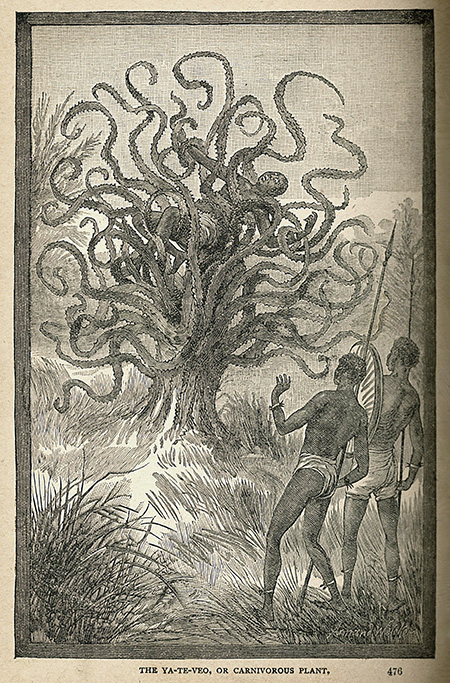
Since Darwin’s discoveries, botanists, ecologists, entomologists, physiologists and molecular biologists have explored every aspect of these plants that drown prey in fluid-filled pitchers, immobilize them with adhesive “flypaper” leaves or imprison them in snap-traps and underwater suction traps. They’ve detailed what the plants catch and how — plus something of the benefits and costs of their quirky lifestyle.
More recently, advances in molecular science have helped researchers understand key mechanisms underpinning the carnivorous lifestyle: how a flytrap snaps so fast, for instance, and how it morphs into an insect-juicing “stomach” and then into an “intestine” to absorb the remains of its prey. But the big question remained: How did evolution equip these dietary mavericks with the means to eat meat?
Fossils have provided almost no clues. There are very few, and fossils can’t show molecular details that might hint at an explanation, says biophysicist Rainer Hedrich of the University of Würzburg in Germany, who explores the origins of carnivory in the 2021 Annual Review of Plant Biology. Innovations in DNA sequencing technology now mean that researchers can tackle the question another way, searching for genes linked to carnivory, pinpointing when and where those genes are switched on, and tracing their origins.
There’s no evidence that carnivorous plants acquired any of their beastly habits by hijacking genes from their animal victims, says Hedrich, although genes do sometimes pass from one type of organism to another. Instead, a slew of recent findings point to the co-option and repurposing of existing genes that have age-old functions ubiquitous among flowering plants.
“Evolution is sneaky and flexible. It takes advantage of preexisting tools,” says Victor Albert, a plant-genome biologist at the University at Buffalo. “It’s simpler in evolution to repurpose something than make something new.”

Quirky though it is, carnivory has evolved repeatedly over the 140 million-plus years that flowering plants have been around. The adaptation arose independently at least 12 times, says Tanya Renner, an evolutionary biologist at Penn State.
Each time, the driving force for evolution was the same: the need to find an alternative source of vital nutrients. Carnivorous plants grow in swamps and bogs, in nutrient-poor bodies of water or on thin tropical soils, all habitats short on the nitrogen and phosphorus essential for growth. Protein-packed insects and other small invertebrates are rich sources of both, as well as other elements plants need to flourish. “A Venus flytrap can live for three weeks on a single large insect,” says Hedrich. “If it captures lots of insects, it produces more leaves and more traps.”
Today there are some 800 known carnivorous species. Some, like pitcher plants and many sundews, are passive receivers of prey — albeit with ingenious adaptations such as slippery rims and gluey-tipped hairs that help to secure a meal. Others are more active: Some sundews curl inward, nudging prey into the trap’s stickier center, while a few have an outer ring of fast-moving tentacles that hurl victims to their doom. Most sophisticated of all is the Venus flytrap, Dionaea muscipula, with its sensitive trigger hairs and snap-traps that can distinguish the touch of an insect from a falling raindrop or dead leaf and can judge the size of prey and respond accordingly.
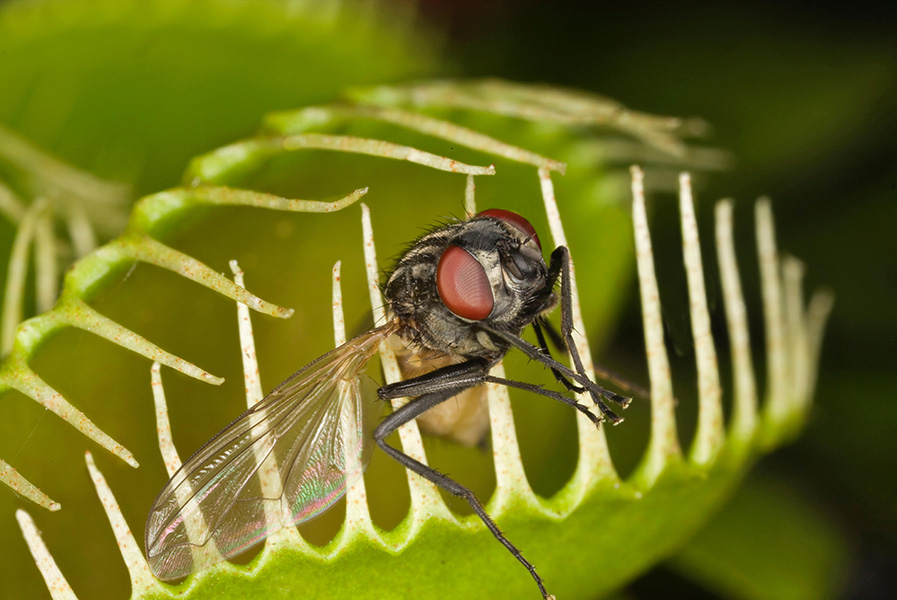
Despite huge differences in shape and form and mode of killing, all traps are modified leaves or parts of leaves. “That means these plants not only get nutrients from a different source but by a different route, primarily through their leaves rather than their roots,” says Renner.
How did leaves come to perform such un-leaf-like functions? To find out, researchers have turned to a mix of “omics” techniques — genomics, transcriptomics and proteomics. They compare genomes of carnivorous and non-carnivorous plants; sequence the RNA transcripts that carry a gene’s instructions to see which genes are switched on where and when; and draw up inventories of proteins to find out which ones the traps manufacture at mealtimes.
Many features of the carnivorous lifestyle have yet to give up their genetic secrets. But studies of two of its grislier elements — digestion and absorption — are revealing how evolution repurposed existing genes, putting some to work in new places and giving others new functions and the odd tweak to suit them better to their new roles. In many cases, plants that evolved carnivory entirely independently have repurposed the same genes. Faced with the problem of consuming flesh, they all hit on the same solution, Albert says. And central to the transformation was the plant’s age-old system of defense.
Back in the 1970s, researchers recognized that the digestive fluid they found in traps contained enzymes that functioned in very similar ways to many of the chemical weapons that plants wield against harmful bacteria, fungi and hungry herbivorous insects. Initially, it wasn’t clear whether carnivorous plants made the enzymes themselves or if microbes living in their traps did. Since then, botanists have confirmed that carnivorous plants do produce many of those enzymes and have discovered dozens more. Today’s fast and cheap sequencing technology has enabled molecular scientists to identify many of the genes encoding these digestive enzymes and to monitor their activity as plants trap and process prey.
The roster of enzymes includes chitinases, which break down the chitin of insect exoskeletons; flesh-dissolving proteases, which break down proteins; and purple acid phosphatase, which enables plants to extract usable phosphorus from their victims’ deconstructed corpses. All played roles in the ubiquitous and ancient defenses of flowering plants. “The genes for those enzymes were repurposed when plants started to eat the things they were originally protecting themselves from,” says Albert. “Chitinases most likely were for defense against fungi, which have chitin in their cell walls. Later, after arthropods evolved, they helped defend against them.” Protein-digesting enzymes also helped to repulse attackers.
Evolution’s tendency to adopt and adapt existing tools goes beyond digestion. As chitin, proteins and DNA are broken into smaller molecules, the trap must move them from the outside world to the inside of the plant. In ordinary plants, uptake of nutrients is the job of a root, where transporter proteins continually shuttle them from the soil into the plant. “You might not expect to find those proteins working in a leaf,” says Renner.
Yet that’s precisely what Hedrich’s colleague Sönke Scherzer found in the Venus flytrap as it processes prey: He recently identified transporters for two of the most vital plant nutrients, nitrogen and potassium. To enable a leaf to absorb nutrients, it seems, evolution co-opted root genes and put them to work somewhere new. The difference is that transporter genes are always active in roots, but in traps they are switched on only once nutrients begin to flow from decomposing prey.
Co-option is an important driver of evolutionary innovation, and often begins with the accidental duplication of genes during cell division. Most duplicate genes serve no purpose and are eventually lost. But if spare genes acquire useful mutations, that can pave the way for a change in function. “Duplication of genes is always happening and sometimes it’s highly adaptive,” says Albert. This seems to have been the way carnivorous plants evolved their meat-eating abilities — at least for those genes examined so far.
What came as more of a surprise was the discovery that whenever and wherever a new line of carnivores arose, evolution worked on the same genes.
In 2017, evolutionary biologist Kenji Fukushima, Hedrich’s colleague and coauthor of the 2021 Annual Review article, joined Albert and an international team of researchers to sequence the genome of an Australian carnivorous plant called Cephalotus follicularis. Like many carnivores, it traps prey in pitchers — in this case, small, squat, toothy-mouthed pitchers — but it sits on its own separate branch of the plant family tree.
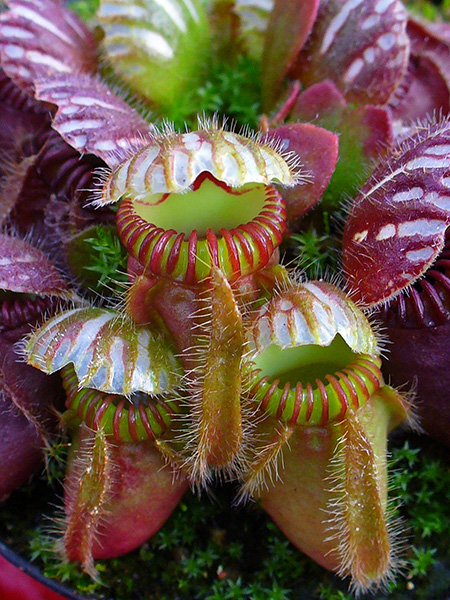
The team identified many genes linked to different aspects of its meat-eating habits, from how the plant attracts prey to how it makes the inside of its pitchers too slippery for insects to escape. The big surprise came when they probed the origins of digestive enzymes in Cephalotus and three more, unrelated, species: Nepenthes alata (an Asian pitcher plant), the North American pitcher Sarracenia purpurea and a sundew, Drosera adelae. All of them, it turned out, had repurposed the same ancient enzymes — matching ones identified previously in the Venus flytrap. Between them, these five species represent three independent lines of carnivores. This was a classic case of convergent evolution, says Albert. It suggested there were only limited pathways to becoming a carnivorous plant.
Delving deeper, Fukushima discovered that convergent evolution went beyond co-opting the same genes. Once enzymes had taken on their new, carnivory-related roles, they continued to evolve, swapping some of their amino acids for others that improved their performance, probably by prolonging their activity in an inhospitable stew of protein-busting chemicals. Fukushima found the very same amino acid substitutions in unrelated plants.

Stay in the Know
Sign up for the Knowable Magazine newsletter today
As they continue to explore carnivory, researchers are identifying many more enzymes. “But time and time again we’re finding that they have similar functions across distantly related species,” says Renner, who heads a major investigation into the role of co-option in the making of meat-eaters. Yet while that bolsters the idea that carnivorous plants acquired their new digestive skills in much the same way, there’s growing suspicion that the same might not be true for the all-important mechanism that controls the whole operation by switching on the right genes at the right time.
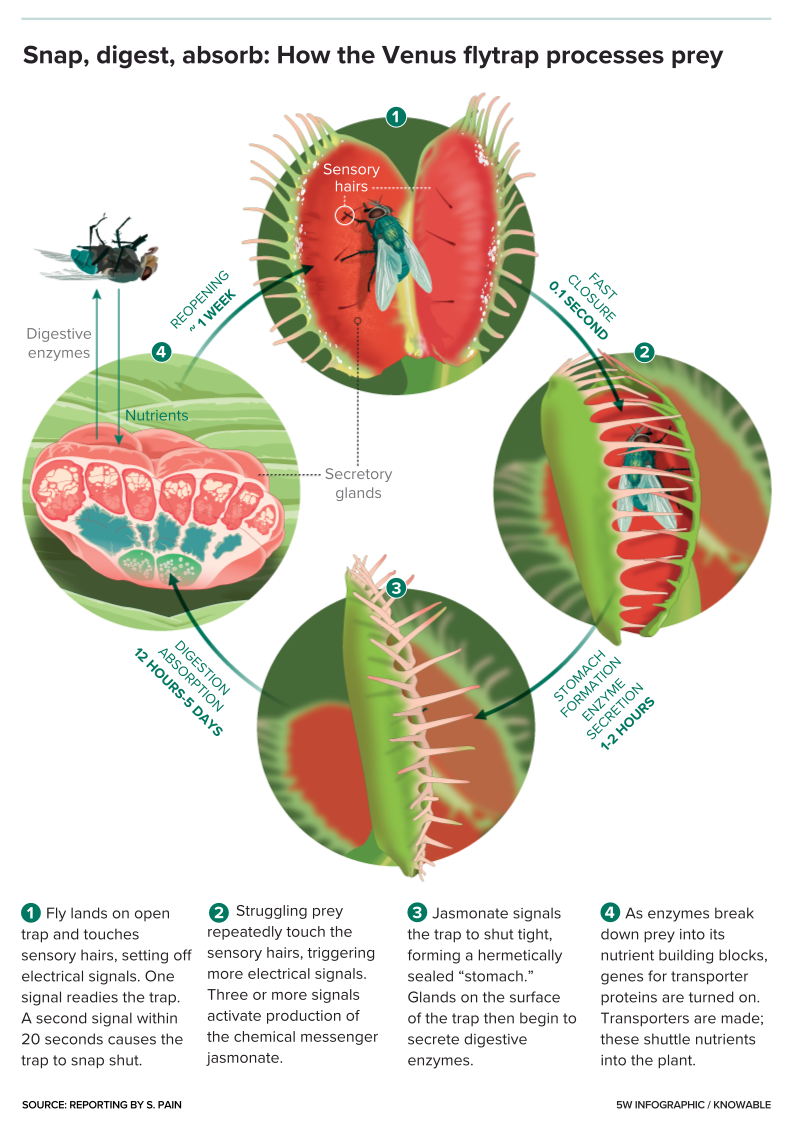
The chain of events in trapping and digestion is best understood for the Venus flytrap, the most scrutinized of carnivorous plants. If an unwary insect settles on one of its traps and touches one sensory hair, it triggers an electrical signal. If it touches a second hair — proof that it’s prey and not a speck of dirt or dead leaf — then the trap snaps shut.
As the insect struggles and sets off more electrical signals, the trap also begins producing chemicals called jasmonates, which provide the signal to seal the edges of the trap and start filling it with enzymes. As the insect corpse breaks down, the trap ratchets up its output of enzymes and starts production of nutrient transporters, again under the control of jasmonates. It’s a direct steal from the plant defense system, which responds to an insect attack by sending electrical signals to raise the alarm in neighboring cells — which then synthesize jasmonates, which then activate production of defensive proteins.
As it’s ubiquitous to all flowering plants, the jasmonate defense response is a prime candidate for recruitment to the cause of carnivory. In fact, says Renner, “our initial expectation was that the control process might be the same in all carnivorous plants.” And it does turn out to be the same for Nepenthes pitcher plants and sundews as well as flytraps, but those three belong to the same order of plants, so that’s not entirely surprising. Look beyond this trio, however, to the somewhat neglected butterworts, and there’s a tantalizing glimpse of otherness.
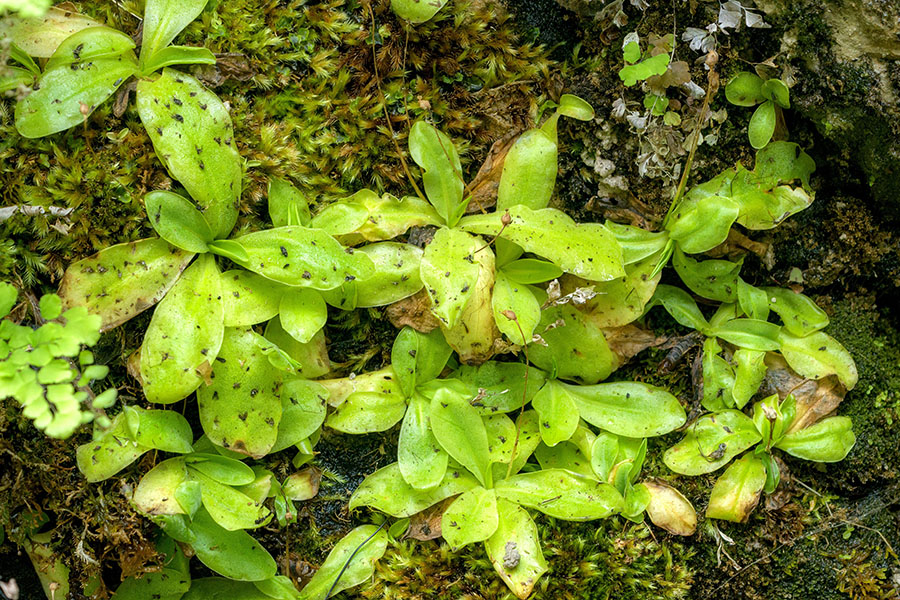
Butterworts (Pinguicula) are unshowy plants, with small rosettes of leaves covered in tiny glands that ooze sticky mucilage and digestive enzymes. Most butterworts are entirely passive, although a few can curl the edges of their leaves inward, covering more of the insect in lethal goo. In 2020 the butterwort began to attract a lot more attention following a report from Andrej Pavlovič’s biophysics lab at Palacký University in the Czech Republic.
Pavlovič and his colleagues found that when they fed butterworts a generous helping of fruit flies, the plants responded by churning out enzymes, many of them the same as those identified in other carnivorous plants. So far, so similar. But when it came to the role of jasmonates in switching on production of enzymes, the story was very different.
As in other flowering plants, jasmonates orchestrate the butterwort’s defense against its enemies. Jabbing leaves 10 or 15 times with a needle to mimic attack by an insect prompted a big buildup of jasmonates in the leaves. Prey, on the other hand, triggered almost no response. The team tried another tactic, spraying jasmonate directly onto leaves: In Venus flytraps and sundews that produces a surge of digestive enzymes. In butterworts — zilch.
So butterworts do things differently, although exactly what they do is not yet known. “Butterworts have left us scratching our heads,” says Renner. “The question is, how many other carnivorous plants have figured out their own way?”
If Darwin were here today, he’d pile right in to solve the remaining mysteries of his “most wonderful plants.” He wouldn’t recognize the techniques modern investigators have at their disposal and would be amazed at the quantities of data that can be processed in seconds. But when it comes to designing elegant ways to test theories, he’d be on familiar ground. “Sequencing genomes, counting and analyzing genes are not enough,” says Renner. “You still have to do experiments to find out what genes do, and how they work.”
And that means feeding hungry plants. Darwin fed his on roast meat and hard-boiled egg, cheese, peas and other protein-packed morsels. Today the menu more often consists of less appetizing-sounding “substrate” dosed with precisely measured amounts of nitrogen — but there’s little doubt that Darwin would feel right at home.
10.1146/knowable-030122-1
Stephanie Pain writes about the natural world from an urban oasis in Brighton, UK.
In December of 1940, a little more than two years before he created The Little Prince on American soil and four years before he disappeared over the Bay of Biscay never to return, Antoine de Saint-Exupéry (June 29, 1900–July 31, 1944) began writing Letter to a Hostage (public library) while waiting in Portugal for admission into the United States, having just escaped his war-torn French homeland — a poignant meditation on the atrocities the World War was inflicting at the scale of the human soul, exploring questions of identity, belonging, empathy, and the life of the spirit amidst death.
One of the most timelessly moving sections of the book, both for its stand-alone wisdom and for its evident legacy as a sandbox for the ideas the beloved author later included in The Little Prince — home, solitude, the stars, the sustenance of the spirit — is the second chapter, written while Saint-Exupéry was traveling aboard the crowded ship that took him from Lisbon to New York:

I lived three years in the Sahara. I also, like so many others, have been gripped by its spell. Anyone who has known life in the Sahara, its appearance of solitude and desolation, still mourns those years as the happiest of his life. The words “nostalgia for sand, nostalgia for solitude, nostalgia for space” are only figures of speech, and explain nothing. But for the first time, on board a ship seething with people crowded upon one another, I seemed to understand the desert.
Saint-Exupéry contemplates the psychology of boredom which, far from the creative force Susan Sontag believed it to be, takes on a wholly different meaning in the desert:

One of Saint-Exupéry’s original watercolors for The Little Prince
He reflects on the Sahara’s peculiar place in the cultural history of silence:
There is silence of the noon, when the sun suspends all thought and movement. There is a false silence when the north wind has dropped, and the appearance of insects, drawn away like pollen from their inner oasis, announces the eastern storm, carrier of sand. There is silence of intrigue, when one knows that a distant tribe is brooding. There is a silence of mystery, when the Arabs join up in their intricate cabals. There is a tense silence when the messenger is slow to return. A sharp silence when, at night, you hold your breath to listen. A melancholic silence when you remember those you love.
He considers how the vastness of the desert anchors one to a sense of belonging and pulls that inner wholeness apart at the same time:
So you feel strained and enlivened by the field of forces which attract or repel you, entreat or resist you. There you are, well-founded, well-determined, well-established in the center of cardinal directions.
And as the desert offers no tangible riches, as there is nothing to see or hear in the desert, one is compelled to acknowledge, since the inner life, far from falling asleep, is fortified, that man is first animated by invisible solicitations. Man is ruled by Spirit. In the desert I am worth what my divinities are worth.
What beautiful symmetry between this meditation and Saint-Exupéry’s most famous line from The Little Prince: “What is essential is invisible to the eye.”
One of Saint-Exupéry’s original watercolors for The Little Prince
Saint-Exupéry, who opens the chapter by observing that “the essential is that somewhere there remains the relics of one’s existence,” returns to the complexities of home and belonging:
[…]
The Sahara may be more lively than a capital, and the most crowded city is deserted if the essential poles of life lose their magnetism.
Small as it may be, Letter to a Hostage is a monumental read and the most direct surviving glimpse of Saint-Exupéry’s boundless mind and spirit. Complement it with his original watercolors for The Little Prince, which exude a great deal of the Sahara sensibility he so cherished.

“When it comes to mental health, all options need to be on the table.”
September 26, 2023 (news.va.gov)
By Hans Petersen
VHA News Editor and Air Force Veteran
An audio-only version of podcast can be found here.
VA is committed to safely exploring all avenues that promote the health of our nation’s Veterans. In line with this goal, VA conducts studies under stringent protocols at various facilities nationwide to identify if psychedelic compounds can treat Veterans with post-traumatic stress disorder (PTSD) and potentially other mental health conditions.
In the new podcast series, New Horizons in Health, Dr. Shereef Elnahal, VA under secretary for Health, leads a candid discussion on psychedelic assisted therapies for Veterans experiencing a number of mental health conditions.
A Marine and Army Veteran who participated in a research trial nine years ago describes the experience and his life after recovery from PTSD and suicidal ideation.
Elnahal is joined by VA subject matter experts who describe in detail the research experience for Veterans and the many safeguards in place to allow Veterans to participate in the programs.
Research trials include medical monitoring with proper medical and psychiatric screening done in advance. The researchers also make sure Veterans have the necessary social support and structure around them during the trials.
The panel discusses some of the risks with the drugs used and how to manage expected side effects and the monitoring of Veterans during the therapy.
A very important issue discussed is self-medication with the drugs mentioned. The risk for serious injury or death from using drugs that are not prescribed under the care of a medical professional is too high. The research protocols also ensure a Veteran receives the essential psychotherapy component of the treatment needed to achieve positive results.
VA is excited about the potential of these treatments and getting the scientific questions answered. If the science supports it, we want to bring the best and most innovative therapies to Veterans across America.
If you’re a Veteran having thoughts of suicide or concerned about one who is, reach 24/7 crisis support through the new Veterans Crisis Line (VCL) number: Dial 988, then Press 1.

