
New Thinkin Sep 29, 2023 This video is a special release from the original Thinking Allowed series that ran on public television from 1986 until 2002. It was recorded in about 1989. One of the most widely read writers in the field of philosophy and religion, Huston Smith’s classic book The Religions of Man has sold over two million copies. In this stimulating program Dr. Smith discusses the relation between psychedelic experience and religious practice, the god within and the cultivation of psychic experiences within religious and shamanic traditions. Now you can watch all of the programs from the original Thinking Allowed Video Collection, hosted by Jeffrey Mishlove. Subscribe to the new Streaming Channel (https://thinkingallowed.vhx.tv/) and watch more than 350 programs now, with more, previously unreleased titles added weekly. Free month of the classic Thinking Allowed streaming channel for New Thinking Allowed subscribers only. Use code THINKFREELY.
Monthly Archives: September 2023
Quantum physics, Buddhism, Aquinas and the nature of the human soul

Published in The Infinite Universe
1 day ago (Medium.com)
Modern scientism denies the existence of a soul because it fails to understand what is meant by the human soul from a philosophical perspective. Because religion adopts the concept of the soul for its own purposes, it is considered to exist within the realm of belief in the supernatural. Yet, the human soul is both a theological and a philosophical concept.
The Encyclopedia Britannica says that the soul is
the immaterial aspect or essence of a human being, that which confers individuality and humanity, often considered to be synonymous with the mind or the self.
There is no hint of religion or the supernatural in this definition. And it is reasonable to ask these four questions:
- Is there an immortal, immaterial aspect to a human person?
- Is that aspect a uniquely human essence or Soul?
- What is that essence?
- What happens to it upon the death of the body?
Quantum physics provides some answers to how a person’s essence could survive the death of the body. In fact, whole books have been written on Quantum Immortality.
Most authors have focused on the Many Worlds Interpretation of quantum physics to construct a speculative narrative for human immortality based on world splitting.
It is sometimes called the Quantum Suicide thought experiment but need not include actual suicide. Examples include Robert Lanza of Biocentrism fame who argues that our consciousness cannot die but only appears to die because of quantum world splitting.
Even more fanciful mystical ideas have been tied to quantum theory, the only outcome being to enrich the authors at the expense of the scientifically and philosophically illiterate.
Such arguments as quantum immortality and the melding of eastern mysticism with quantum theory, however, are entirely speculative and make for better science fiction than philosophy.
The soul is fundamentally a body’s “lifeforce”. Indeed, the word for soul used in the New Testament is psuche which means “breath of life”.
From a modern physics perspective, inanimate bodies require two general things to be animate: energy and information. Energy is physical in that it has mass. Information, however, is immaterial. It and its cousin entropy have no mass.
Information gives matter its substantial form and is at the heart of how energy and matter self-organize into life.
If anything can be called “the breath of life” it is information, particularly information that enables emergent phenomena, that which is more than the sum of its parts.
But can the soul be considered to be made of information?
First let’s ask if people even have souls.
No-Self means no Soul
Many Buddhists claim to deny the existence of a Self or Soul. This is the concept of “no-self” or anatman in Sanskrit. This was a major departure from Hinduism, the ancestor religion of Buddhism.
On the other hand, Buddhists also largely believe in reincarnation, which supposes some element of a person survives death.
Buddhists don’t deny that a person’s consciousness can inhabit other bodies. Rather, No-Self derives from two beliefs (1) our inability to perceive anything that can be considered to be the Self and (2) the compound nature of what we think of as the Self.
No thought, perception, or physical object is part of the Self. What we consider to be the Self is an illusion based on a combination of constantly changing perceptions.
Then, do Buddhists believe that consciousness is the Soul or Self? No, because consciousness itself has no uniqueness and is universal.
Take as an example, if you say, “I see the red car”. Nowhere in this statement is an expression of Self. “I” is an artificially constructed ego that the brain uses to differentiate itself from the rest of the world. “To see” expresses the type of conscious experience, vision. And the red car is clearly not the self.
Conscious experience, sometimes called qualia, for example, what it is like to see something, may not distinguish you from anyone else. Thus, while you have existence, i.e., Dasein or “Thatness” your “Whatness” or Sosein has nothing to do with you! It is sort of like a movie playing in a theater with nobody watching.
Not all things in the universe are impermanent and changeable, however. As far as we know from quantum theory, information can change, but it is always conserved and recoverable.
Information conservation is a feature of all “complete” interpretations of quantum theory that assume that Schrodinger’s equation is fundamentally correct (including the MWI.)
Thus, the information content of the universe is changeless. It is merely the form it takes that changes. One can always apply processes to move that information forward and backward in time.
Thus, the information that becomes you, your body and your mind, always existed and always will exist.
Assuming that information conservation is an absolute law of the universe, i.e., quantum theory is “unitary”, then, we can answer the first question: is there an immortal, immaterial aspect of you, in the affirmative.
While Buddhists would deny that this immortal aspect carries personal uniqueness, they don’t deny it exists. Rather they claim it means you are just part of everything else.
Is our information theoretic essence a human soul?
To address the second question, that a unique essence or Soul exists, we have to look at Aristotle with a little help from Thomas Aquinas.
In order for the Self to be unique, it has to have distinguishing features which, in Aristotlean philosophy, are called its “substantial form”. These are features that are part of the object itself and not mere names that we give to those features.
More over, these are features that give a thing its identity. They are part of its essence.
While many modern philosophers, taking after Immanuel Kant, believe that substantial form is an illusion and that all properties of objects are subjective, that idea may be based on faulty premises derived from a classical, rather than quantum, mindset.
Unlike classical systems, where information is a bit of a fuzzy concept, quantum systems encode information within themselves in very specific ways (as sequences of qubits or quantum bits based on discrete quantum properties). Information is not subjective but objectively real and measurable.
This suggests that substantial form is real at the quantum level and, if it is real in the quantum realm, it must scale up to the human scale and beyond.
When you scale up, there is so much information in trillions of atoms that the substantial form is far too complex to put into human language.
Long before quantum theory, we developed broad linguistic categories in order to simplify those trillions of atoms, e.g., dog or cat instead of referring to the total information content of those creatures.
This abbreviated way of conceiving of the world made philosophers believe, mistakenly, that because those categories are artificial, there are no objective concrete categories!
There are but they are exceedingly complex.
The body manifests you as a whole, unique person but can’t be considered your essence or soul. Your essence must be much less.
Since the brain is part of the body, you need your body in order to have uniqueness. If your mind were to inhabit another body, it would have a whole new set of differentiating features. What would be left of the “you” you were before?
That is why I laugh at the concept of movies like Freaky Friday where people swap minds, as if that can be accomplished without physical changes. This is a good example of Platonism or Cartesian dualism.
What is actually being swapped here? All the unique neural circuitry so that the people still understand who they are, even their memories, is swapped but the brain continues to know how to operate the body, so that part hasn’t been swapped. The swapped part, however, is not only a swap of information. It is a physical modification of the brain.
The body needs to have physical substance to manifest in the world of course but its physical substance is not what makes it unique. Rather, it is its organization. Its organization is an immaterial aspect that includes the information encoded in DNA as well as life experiences that make each person unique.
This information not only encompasses the whole person or animal or plant, but has a unity and completeness that allows that person, animal, or plant to be a distinct individual.
All of this information is what makes you, you.
Therefore, the information content in you is immortal, immaterial and makes you unique.
What we have not established is whether there is one soul or many and whether the soul can be cut into pieces.
Is the soul divisible?
Aquinas rejected the common medieval notion that the soul is made of many parts. But it seems as if, by asserting that the soul is quantum information, we are supporting that the soul contains many, many parts.
Therefore, we need to restrict what we call the soul to an emergent property and not every quantum state of your body.
An emergent property is the embodiment of the motto E Plurbus Unum, from many one.
A good example is a tornado. A tornado is made a trillions upon trillions of air molecules. Each molecule has a position and velocity. Normally, in calm air, the positions of velocities of air molecules are random, but in a tornado they all align into a circular motion. How can that be? How can every molecule “know” which way to go?
The reason is because of temperature, pressure, and humidity differences that encourage the molecules to travel in a circular direction.
The tornado therefore has a unity that obtains from something external (warm moist air interacting with cool dry air and a wind shear caused by pressure differential).
Humans, animals, and plants are the same. Their components, down to the quantum level, have a unity that makes the individual emerge.
Yet, in the case of a tornado, what is the essence of that tornado as molecules drift in and out, it changes size and shape, and moves about?
Aquinas would say that the essence of the tornado is not everything about it, but rather its “tornadoness”. In other words, essence is generic not specific, and it has unity, not parts.
The same goes for human beings.
Thus the soul is not all your quantum information but a higher level derivative of it that, unlike individual qubits, has unity.
We observe phenomena like this in superfluids like liquid helium as well as superconductors. Many atoms or pairs of electrons suddenly behave like one big atom or pair of electrons. Unlike the tornado example such phenomena are true physical examples of from many one.
Entanglement, where multiple individual bits of matter and their qubits become connected to one another in a way that is subject to interpretation, is another example.
This is why the late Sir Roger Penrose proposed the idea that consciousness may be a quantum phenomenon. It appears to have an indivisible character reminiscent of quantum effects such as entanglement.
What separates us from the animals?
Aquinas further argued that at death all living things lose their soul except for human beings. Human beings, through their capacity for abstract thought, continue on.
Aquinas therefore considered the mind or intellect to be this essence. In other words, the action of the fundamental principle by which the human emerges versus something else like a cow is the intellect.
Modern neuroscience doesn’t give a clear answer but does point out that the mind appears to be an emergent process.
Aquinas supports a type of dualism in the Cartesian sense that he does not identify the mind with the body although he argues the mind is both inherent and separate from the body.
His concept of the mind is much smaller than Descartes’s or Plato’s.
Aquinas claims that animals do not have this dualism because they do not think. Neuroscience, however, contradicts him. Animals do think, but they lack the human capacity for abstraction.
This is a small matter, however, because Aquinas hits on a more important point which is that “it is clear that a human being is not a soul alone, but something composed of a soul and a body.”
He reasons that the soul alone is “human being” in a generic sense “but that a particular human being ── Socrates, say ── is not the soul”. (Summa Theologicae, Question 75, Article 4).
Here Aquinas carves a middle way between the generic consciousness of reincarnation and Plato’s assertion that the soul is a particular person.
He claims instead that human souls are unique to humans as a species but otherwise generic. Your soul and my soul are like two identical electrons. They are the same until placed in a body.
He is not however arguing for a “world soul”. Each soul belongs to a single person and can act like a diminished sort of person even without a body.
Can the soul be destroyed?
Aquinas argues that our soul is “incorruptible” meaning indestructible and unchangeable. He argued this because thinking is carried out “without a bodily organ”.
It is hard to understand what he means by this. A knee-jerk reaction would be to say that those medievals didn’t understand what the brain’s function was.
Later philosophers have in fact been frustrated with Aquinas because he wants to have his cake and eat it too. He wants the soul to need the body to be a person but also be separable from the body and still work like a mind.
His reasoning is that, because the mind can contemplate universal abstractions which are immaterial and non-sensory, the mind is an immaterial thing that contemplates immaterial things and therefore is completely separate from the body. Anything material like how an apple tastes or what a rainbow looks like is handled by the brain.
Because, he says, the mind operates on its own, with or without a body, therefore, it must be incorruptible. It must never die.
A modern paper gives a rough outline of Aquinas’ argument. It says that because consciousness is simple and unchanging it must be unable to fall apart into pieces and so must be incorruptible.
From a quantum perspective, this is not true. Any statement about incorruptibility is really a statement about conservation not indivisibility. Even stable fundamental particle or group of entangled particles such as electrons are simple and unchanging but nevertheless they can become other particles or can break their entanglement. Only the information content in them remains unchanging.
For Aquinas the incorruptibility of the soul is important because the soul is essential for salvation. If a human being were without a soul, he or she would have no hope beyond this life.
Do we remember anything of our past life after we die?
You would think from all this that Aquinas would argue that the soul, separated from the body, knows nothing, but he says that is not true.
When the soul is separated from the body, it understands the world differently, albeit no less muddled than a human would.
Here Aquinas distinguishes from sensory and intellectual knowledge. The disembodied soul loses all sensory knowledge upon death. This means that how things look, taste, smell, sound, and feel are no longer a part of it. That includes most memories.
If you have seen how a person with dementia such as Alzheimer’s slowly loses their memory, the soul does not recover those sensory memories after death.
It does retain, however, intellectual knowledge. For example, it would not remember what a person it saw in life looked like or felt like but would retain universal, abstract ideas about that person, in particular, knowledge of that other person’s soul.
Does the soul sleep after death?
Aquinas argues that the soul, meaning the intellect, is still “alive” after death. It continues to think, suffer, delight, make choices, and contemplate universals.
Aquinas is a survivalist in the philosophical sense of someone who believes the mind survives death intact.
A person who believes the soul sleeps until its body is resurrected is called a corruptionist.
Quantum immortality arguments based on the MWI are a kind of survivalist philosophy because they propose that consciousness cannot cease but they also don’t assume that the mind can separate from the body.
Quantum mystics such as Deepak Chopra are even more strongly survivalist and have claimed that the “quantum soul” can persist outside the body, existing nonlocally.
If this is true, then that would mean your soul persists as entangled quantum information spread over light years and also time.
For example, if you fell into a black hole, you would die and your matter and information, including any information theoretic soul, would be integrated into the singularity. According to the latest research on the black hole information paradox, your soul would be radiated back out over a googol years as Hawking radiation.
That Hawking radiation would remain entangled with the black hole.
If your soul is incorruptible, no matter what quantum processes are applied to it, it persists. Your mind could be composed of quantum information that is contained in matter that has been transformed into other particles and spread over lightyears.
I remain skeptical of this until I see a mathematical proof of exactly how an emergent process can survive any quantum transformation. This would require that the individual mind be a conserved property of the universe deriving from a symmetry group.
Aquinas, however, doesn’t concern himself with how the soul persists as our scientific age demands, only that it persists in a metaphysical sense.
While I haven’t read Chopra’s book on this idea, I will say that such an intellect would have to obey Aquinas’s restrictions in that it would have no sensory experience. It wouldn’t perceive itself as spread over light years because it would have no concept of space and time at all.
Many modern philosophers solve this problem by proposing panpsychism, that all matter is conscious to some extent. I think Aquinas would strongly disagree with that since it is very close to the idea of a universal soul that he fought hard to disprove.
Conclusion
We live in an age of materialism as well as Cartesian mind-body dualism, and we find it hard to escape from thinking about mechanisms, what things are made of, processes and so on.
While ours is the age of “how does it work?”, the past was an age of “what exists?”.
That is important because often when we try to answer how something works, we find that things we thought existed don’t and things we didn’t know existed, do.
For Aquinas and pre-Cartesian philosophers the world was divided into matter and form. It was perfectly reasonable for something immaterial such as a form to exist independently of any matter.
The big question for philosophy, particularly those who study Aquinas, who are called Thomists, has been: what is the interface between the material and the immaterial? How does that work?
Information theory, particularly quantum information theory with the addition of entanglement information and emergent phenomena, answers this question.
What isn’t clear is whether St. Thomas’s conclusions will survive being integrated into quantum theory. That would be a miracle.

Written by Tim Andersen, Ph.D.
·Editor for The Infinite Universe
1.2M views. Principal Research Scientist at Georgia Tech. The Infinite Universe (2020). andersenuniverse.com; https://timandersen.substack.com/
There Should be Harsher Penalties for Child Abuse
Children are innocent, and when that is taken away abusers need to be punished

Published in ILLUMINATION
3 days ago (Medium.com)

Children are precious and innocent, and as the adults in their lives, it is our duty to keep them safe from harm. We trust other adults in our lives with our children’s safety, from family members, clergy, school teachers and babysitters. When that trust is betrayed and our children’s safety is threatened, there need to be steep consequences.
In many instances, it is parents themselves that are harming their own children. Child abuse is rampant in our society, and the pandemic has made it worse. When children were home and in online school, they had less time spent with trusted adults who are mandated reporters of abuse.
There have been many instances in recent years of children suffering religious abuse. This can happen in the home, or in the church.
Homeschool Children and Religious Abuse
Often times, parents who abuse children come from fundamentalist backgrounds who believe such things as “spare the rod and spoil the child” and take this as an excuse to harm vulnerable children in the name of religion.
According to the Coalition for Responsible Home Education,
In the vast majority of states, there are currently no protections in place for children who are homeschooled. This is the case despite a 2014 study finding that 47% of children who experience child torture were removed from school to be homeschooled (and another 29% were never enrolled in school), and a 2018 Connecticut study found that 36% of children removed from school to be homeschooled were subject to past child welfare reports.
These troubling statistics show a trend of removing children from contact from other caring adults when they are being abused in the home. Parents take children out of school, so that they won’t be able to reach out for help to a teacher or school counselor about what is happening.
According to Child Protect, here are some additional facts about child abuse:
- Approximately 5 children die every day because of child abuse.
- 1 out of 3 girls and 1 out of 5 boys will be sexually abused before they reach age 18.
- 90% of child sexual abuse victims know the perpetrator in some way. 68% are abused by a family member.
- Most children become victims of abuse and neglect at 18 months or younger.
- In 2010, 1,537 children died of abuse or neglect. 79.4% were under the age of 4 and 47.7% were under the age of 1.
- Boys (48.5%) and girls (51.2%) become victims at nearly the same rate.
- 3.6 million cases of child abuse are reported every year in the U.S.
- Abused and neglected children are 11 times more likely to engage in criminal behavior as an adult.
- About 80% of 21-year-olds who were abused as children met criteria for at least one psychological disorder.
- 14% of all men and 36% of all women in prison were abused as children.
- Abused children are less likely to practice safe sex, putting them at greater risk for STDs. They’re also 25% more likely to experience teen pregnancy.
- For every incident of child abuse or neglect that’s reported, an estimated two incidents go unreported.
- Child abuse occurs across all socioeconomic levels, ethnic and cultural lines, and religions and education levels.
- Neglect, the most widespread form of child abuse, makes up more than 59% of abuse cases.
These children have suffered badly at the hands of people whose care they were entrusted to. It is an unforgivable offense, and one that should have harsher penalties in our society. Caring for all of our children is of paramount importance, and it is our job to make sure that they are being treated with dignity and respect.
Children are vulnerable, and when they are harmed from a young age, it can cause problems with their brain development, social development, education, and cause disorders such as CPTSD to develop which can cause a lifetime of heartbreak.
Many people who are diagnosed with PTSD in adulthood have suffered abuse or neglect in childhood. Living in constant fear as a child can impede normal brain development. It makes the child have an insecure attachment to their caregivers, which can cause difficulties with relationships later in life as well.
Doing our best to prevent child abuse, and to remove children from the care of people who are abusing them is of paramount importance. As someone who was abused as a child myself, I can attest to the harm that it does to your psyche and your future when you live in constant fear of your parents.
Penalties for Child Abuse
Unfortunately, many cases of child abuse go unreported every year. The perpetrators never face any consequences for their actions. In many instances, it isn’t until a child reaches adulthood and is able to get away from their abuser that they are able to speak up about the abuse that they endured.
If someone is convicted of child abuse, some of the penalties, according to NOLO are:
- Incarceration. Jail or prison sentences are very common with child abuse convictions. A misdemeanor conviction may bring a few days, months, or up to a year in jail, while felony convictions can lead to several years in prison.
- Probation. Probation sentences are often included with less serious child abuse sentences. Probation terms typically last at least six months but can last a year or more. If a person violates the probation terms in that time, the court may then impose the original jail sentence, fines, or additional probation.
- Fines. A conviction for child abuse can result in a substantial fine. State laws differ widely on the fines imposed for a child abuse conviction, but fines of several hundred to several thousands of dollars are common.
- Other penalties. When child abuse involves a parent, guardian, or someone with legal custody of a child, a court can also limit parental rights. Courts can impose restraining orders, place a child in protective custody with a state agency or foster family, require that the parent only visit the child with the supervision of a court-appointed monitor, order individual or family therapy and parenting classes, or even remove a parent’s right to care for the child.
Not all instances of child abuse or neglect are treated the same way. It may depend on the severity of the abuse, and if the abuser was a parent or someone else. Depending on the state where the abuse happens, there are different penalties.
According to Connecticut General Assembly, the penalty for child abuse can vary widely by state. Most states will incarcerate the abuser for at least 6 months to a year. However, only a year in prison for destroying a child’s future doesn’t seem like enough.
You can also consider that in the cases of abuse by a parent or guardian, child services will often insist on family counseling, and will attempt to reunify children with their families after the parents have gone through treatment.
According to AEI, in cases in Philadelphia,
Even if the city had identified the sexual abuse of the girls earlier, they may have been reunified anyway. Based on our analysis of federal data, of children exiting foster care in 2019 who were removed due to sexual abuse, nearly half were reunified.
This is an outrage that is being perpetrated against children by social workers in the child welfare system. Children’s needs should be put first. It isn’t always, perhaps even often, a good idea to reunite children with parents who have been abusive in the past.
Advocates argue that children will have the best outcomes when they grow up if they are in their family of origin, but it is hard to see the truth in such an argument when in 50% of cases, children are just being returned home to be abused again.
In the Philadelphia cases, it was noted that the ‘errors’ in placing the children back at home with abusers was partially due to high staff turnover in the child welfare office. This is no excuse for children being abused again by the same offenders who had done so the first time.
In order to protect vulnerable children from abuse, we need to seek harsher penalties for those who are abusing children.
One organization that is advocating for harsher penalties for child abuse is Justice for Children, which states:
Justice for Children has proposed and drafted legislation to improve the laws pertaining not only to child abuse and child protection, but also laws concerning the funding for protective services. We have also presented legislation designed to make the legal process more child-friendly.
In many cases that have been recorded in terms of child abuse, the ‘protective parent’ of the child will often dissolve a marriage with an abuser and petition the court to have the child removed from the offending parent. However, there is still visitation granted in many cases to parents who have been abusive in the past.
There need to be changes to both the family court system to ensure the protection of children, and to the criminal justice system to ensure that abusers are incarcerated longer.
In the UK, they passed the Domestic Abuse Act, which is designed to help victims to receive more fair treatment in family courts. Something similar could be done in the US as well. Unicef and other international organizations acknowledge that the court system is failing children worldwide when it comes to child abuse.
It can be frightening for children to have to testify in court, and can cause further trauma for them. The system needs to be changed to show more empathy and compassion for child victims.
According to the World Health Organization, there are 7 strategies that can help to end violence against children:
INSPIRE: Seven strategies for ending violence against children identifies a select group of strategies that have shown success in reducing violence against children. They are: implementation and enforcement of laws; norms and values; safe environments; parent and caregiver support; income and economic strengthening; response and support services; and education and life skills.
We all need to work together to help create a society where all children have the right to a safe upbringing that is free from violence and abuse. This is crucial in ensuring a bright future for all our children. If more instances of child abuse can be prevented, and more abusers can be more harshly punished for their offence and removed from care of children, then we can help to make the world safer for our children.
To report suspected child abuse:
In the UK, If a child or young person needs confidential help and advice direct them to Childline. Calls to 0800 1111 are free and children can also contact Childline online or read about domestic abuse on the Childline website.
In the US, If you suspect child abuse, contact the National Child Abuse Hotline at 1–800–4-A-CHILD (1–800–422–4453).
You can find additional resources, including worldwide child hotline numbers on the Resources tab.
April 2022 is Child Abuse Prevention Month, Learn How to Help.
You can learn the signs that a child may be being abused, and what you can do to help. The more we all get involved with helping all children, the sooner we will be able to end the epidemic of child abuse and neglect worldwide.

·Writer for ILLUMINATION

Spiritual Life Coach | Blogger | Author | Contact me at coloradogirl750@gmail.com
5 easy mindfulness exercises to do at your desk to help regulate your emotions, according to a psychologist
Sep 27, 2023, 2:45 PM PDT (Insider.com)
- Emotional dysregulation is when you feel swept away by your emotional reactions.
- A psychologist recommended a few simple exercises to try when you feel dysregulated.
- They involve flexible thinking, positive thinking, and mindfulness.

NEW LOOK
Sign up to get the inside scoop on today’s biggest stories in markets, tech, and business — delivered daily. Read previewEmail addressSign up
By clicking “Sign Up”, you accept our Terms of Service and Privacy Policy. You can opt-out at any time.
Everyone experiences intense emotional reactions from time to time. But if you find yourself feeling swept away by emotions to the point where it’s impacting your relationships and quality of life, you may be struggling with emotional dysregulation.
Emotional dysregulation isn’t just being hot-headed. Common in people with ADHD, autism, and borderline personality disorder, it’s also linked to other symptoms like rejection sensitivity and impulsive behavior.
But by learning to regulate your emotions, you can feel calmer around people and more grounded in your decisions, a therapist told Insider.
Dr. Lara Honos-Webb, a clinical psychologist, previously told Insider that cognitive behavioral therapy (CBT), emotion-focused therapy (EFT), and exercise can all help with emotional dysregulation symptoms.
But sometimes, a strong emotion hits us before we have time for an outdoor run or therapy session. That’s where some simple thought exercises can come into play, and they’re easy enough to do wherever you are.
Honos-Webb shared five quick, easy ways to self-regulate when it feels like your emotions are spiraling out of control.
1. Picture yourself in the future
Honos-Webb said that all these exercises promote “flexible thinking,” or encouraging yourself to see things in a new light.
For example, in the thick of intense feelings, it’s difficult to remember that a hard moment isn’t forever, but just a blip in your life. This exercise can help you remember that.
“Imagine yourself in the future five, 10, or 20 years from now,” Honos-Webb said. “What would that self say to you now about your current situation and emotional reaction?”
For example, if you’re overwhelmed at work and tempted to yell at your boss, do you think future-you will see it as sticking up for yourself? Or will you likely see it as an overreaction that puts your job at risk?
2. Imagine a loved one’s reaction
To help you step outside of yourself more, Honos-Webb suggested imagining the perspective of someone in your life who truly cares about you, such as a family member, close friend, or partner.
If they saw you abruptly exit a group chat because no one responded to your text about hanging out, would this person agree with you? Or would they ask more questions and encourage you to not assume the worst?
3. Give yourself a set time to feel everything
Sometimes, there’s just no getting around it: you feel devastated, and need to let it out.
To keep big feelings from taking over your entire day, Honos-Webb recommended grabbing a journal and setting a timer for 15 minutes. “Give yourself permission to write everything you feel and then commit to only diving into that emotion for 15 minutes,” she said.
If you need to revisit that same feeling, you can do it for 15 minutes the next day. It helps you notice the feeling, but practice setting boundaries around how often you let it consume you.
4. Change the negativity channel
Honos-Webb said that emotional dysregulation often leads to “discounting the positives.” Instead, you only focus on the things that are going wrong.
In an exercise she calls “changing the channel,” you can try to acknowledge that you feel bad while also pushing yourself to look for alternate, positive perspectives.
For example, let’s say you were rejected from your top-choice of graduate school programs. Once you’ve processed the disappointment of being rejected, you can move on to different ways of looking at it. Maybe it would’ve been too expensive anyway, or maybe you were unsure about that life path and now you get to explore another one.
Honos-Webb said this practice aids in “shifting emotional focus after processing distressing feelings,” so that you can find solutions instead of remaining stuck.
5. Engage in mindfulness
Honos-Webb said that mindfulness, which “involves self-observation and self-compassion,” is a key practice for emotional regulation. Regularly meditating, even for short bursts of time, can teach you to accept your feelings as they come up, which reduces self-blaming and the intensity of your emotional pain.
To practice this, try meditating once a day for just five minutes. After a week, lengthen it to 10 minutes, then 15 minutes. If you need help, there are many free meditation apps that can walk you through guided meditations, or you can even ask ChatGPT to write a meditation schedule for you.
John O’Donohue on happenings sent to awaken us

Astrology Forecast October 2023
The Astrology Podcast Sep 29, 2023 Monthly Astrology Forecasts Discussing the astrology forecast for October 2023, and explaining the upcoming eclipses in Libra and Taurus plus lots of Pluto aspects, with astrologers Chris Brennan, Austin Coppock, and Nicholas Polimenakos. We spend the first hour of the show talking about the astrology of recent stories in the news, including new birth times for Dua Lipa and Elon Musk, the end of the writers strike, and the synastry between Taylor Swift and Travis Kelce. Then in the second and third hour of the show we do a deep dive into the astrology of October, and give our predictions for the major transits and planetary alignments coming up this month. At the beginning of the month we see the end of the Venus and Mercury retrograde periods, with Venus finally departing from Leo and moving into Virgo, and Mercury departing from Virgo and moving into Libra. In October we also move into eclipse season, with the first in a new series of solar eclipses in the sign of Libra, and the last of a series of lunar eclipses in the sign of Taurus. Pluto stations direct in Capricorn this month and begins heading towards a return to Aquarius early next year, and this also marks the final pass of the Pluto return of the United States.
Tarot Card for September 29: Death
Death
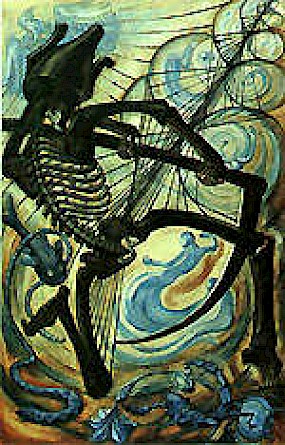
Death is numbered thirteen and is the most feared card in the deck. We see the Grim Reaper depicted as a dark and powerful figure, sometimes on horseback and at other times on foot. He usually carries a scythe and leaves bodies, limbs and so on in his wake. Whoever we are, Death will claim us eventually.
The Death card signifies endings, but not necessarily shocking and disruptive ones. In any case, endings always lead to new beginnings and Death itself symbolises a sweeping away of the past. If we rid ourselves of past garbage then we are free to set out on an entirely new path
When Death appears it almost always signifies a major change in one’s life. Sometimes the change will appear disruptive and unexpected, sometimes it will be a breath of fresh air – clearing away obstacles and allowing you to surge forward. So do not assume that Death is a negative card – it is often just what we need in order to progress when fear is holding us up.
(via angelpaths.com and Alan Blackman)
Lucid Dreaming webinar on October 7
 |
 |
| LUCID DREAMING Saturday, October 7, 2023, 10:00 AM to 3:00 P.M. Pacific Presented on ZoomRegister at https://tinyurl.com/vtf7k5j We’re all swimming in our subconscious mind when we dream. With Lucid Dreaming, we bring the conscious mind to be aware that we’re dreaming (while we’re in the subconscious mind) and amazing things can happen. Come to class and learn the process of becoming a Lucid Dreamer. Lucid Dreaming will help to Release the Power of your Dreams • Accelerate your Personal Growth • Understand the route to your conscious evolution • Solve Problems • Realize those “not so secret” messages in your unconscious mind. • Gain ideas to help in waking life • Turn up your creativity • Learn to interpret your dreams • Practice methods to remember dreams • Review of the Latest scientific information on sleep, dreaming and health What you’ll receive with the Class • 5 hour class delivered via an online webinar. • Class Notes and resource Links • Workshop • Invitation to the weekly Dream Group • Dream interpretation session with HughJohn After registering you will be sent a Zoom meeting link to join. Email me, HughJohn.Malanaphy@TheProsperos.org with any questions you have and I’ll be looking forward to having you in class. Register at https://tinyurl.com/vtf7k5j |
Aries Full Moon, September 29, 2023
Wendy Cicchetti
Aries Full Moon
Energies and projects set in motion around a New Moon often enter the spotlight at the ensuing Full Moon after having a chance to develop and ferment. The Full Moon is a crisis point where the original New Moon issues are reflected back to us. And this Aries Full Moon faces us with the detailed, fussy attitudes present at the previous Virgo New Moon. If such precision gets us lost in the minutiae and we find that we’re not making clear decisions or taking confident actions, the Aries Full Moon helps us to cut to priorities. We can quickly see how to get immediate results or make faster progress.
We now have a speedy, impatient energy vibration, which cuts through any fog or worry, and helps us be direct and clear in our initiatives. Like the energy of spring, we can make a bold, positive start with something new or simply start afresh in a situation that’s feeling stale. Perhaps we close the book on a storyline that’s come full circle.
A Full Moon inherently implies that some sort of contradiction or paradox needs attention. In this case, the Moon’s opposition to the Sun in Libra may require that we seek or participate in some exercise of balance. Someone around us may have slowed down due to illness, work changes, or other life challenges, for example, requiring that we hurry and pick up the slack whilst they recuperate or adjust. We will be practicing teamwork, although maybe not managing parallel tasks. In this respect, everyone’s individual energy output is valid, even if the rates are quite different.
An opposite experience may be where we have to break away from certain tasks to attend to someone else’s needs, which slows us down. Yet, this is part of the grand plan of reassessing priorities, and it could provide a refreshing breather from anything that has been rather weighty, worn out, or monotonous.
The only classic, major aspect with other planets in this lunation is a wide Moon–Pluto sextile, which hints at the potential for fresh energy to help close the door on projects that have dragged on and no longer hold interest or promise. We can feel greater courage and confidence when we hit the “delete” button on that which no longer feels urgent or, indeed, relevant.
That said, noting Pluto remains retrograde in Capricorn, an issue may reappear for one more go over before we finally decide it’s dead. This is rather like the situation where a wooden match can appear extinguished, yet the flame can reignite given the right conditions. We can choose to be aware of this and potentially catch any flare-up — and then decide whether that’s an energy with full life left or merely a final attempt at producing something tangible.
The Moon’s disposition planet is Mars in Libra, somewhat echoing the same Aries/Libra opposition, but in a slightly different way. A facet of similarity lies in the traditional classification (from Greek astrologer Ptolemy) of Sun and Mars in detriment in Libra. Although that may sound ominous, all it really means is that the planets can’t or don’t express their full strength, or in the typical ways we would expect. We could say they get sidetracked, maybe through pressure or a desire to take other people’s preferences and their initiatives into account. Whether we feel such diversions are positive or negative will depend a great deal on contextual issues, including our physical energy levels, emotional states, and social bonds. It could be helpful to remember what matters to us personally in the grand scheme of things, whilst aiming to keep interactions with others simple but peaceful.
This article is from the Mountain Astrologer by Diana McMahon Collis
Weekly Invitational Translation Group
Translation is a 5-step process of “straight thinking in the abstract.” The first step is an ontological statement of being beginning with the syllogism: “Truth is that which is so. That which is not truth is not so. Therefore Truth is all there is.” The second step is the sense testimony (what the senses tell us about anything). The third step is the argument between the absolute abstract nature of truth from the first step and the relative specific truth of experience from the second step. The fourth step is filtering out the conclusions you have arrived at in the third step. The fifth step is your overall conclusion.
The claims in a Translation may seem outrageous, but they are always (or should always) be based on self-evident syllogistic reasoning. Here is one Translation from this week.
1) Truth is that which is so. That which is not truth is not so. Therefore Truth is all that is. Truth being all is therefore total, therefore complete, therefore full, therefore plentiful, therefore infinite resource. I think therefore I am. Since I am and since Truth is all that is, therefore I am Truth. Since I am Truth, therefore I am total, complete, full, plentiful, infinite resource. I being mind and I being Truth, therefore Truth is Mind (Consciousness).
2) Girls can be mean.
Word-tracking:
girl: originally meaning a child of either sex, not yet of age, immature,
mature: fully developed, good, ripe, timely, early
mean: ordinary hence inferior, stingy, common
inferior: under world
ordinary: usual, normal
age: aeon, eternity
entropy: measure of disorder, measure of unavailable energy
kind: well-born
3) Truth being one cannot be divided into male and female, man and woman, boy and girl, therefore Truth is androgynous. Truth being all there is, there is nothing over or under Truth, that is, there is nothing superior or inferior to Truth OR there is no heaven, there is no hell. There is just Equality being. Truth being all is thus limitless, therefore without the limits of beginning or ending, so there is no young or old truth, mature or immature truth. Therefore Truth is immortal, eternal, birthless, deathless, mature. But everything has a beginning, a middle and an ending, doesn’t it? Well, since Truth is all that is, and since Truth is without beginning and without ending, birth and death can only be reminders of the immortality of being. OR There is no entropy. There is no disorder to measure. There is no unavailable energy to measure. OR Truth is immeasurable order and immeasurable energy. Since birth and death are only reminders of the immortality of Being, we are all kind or “well-born”
4) Truth is androgynous.
There is just Equality being.
Truth is immortal, eternal, birthless, deathless, mature.
Birth and death can only be reminders of the immortality of being.
There is no entropy.
Truth is immeasurable order and immeasurable energy.
We are all kind or “well-born”
5) We are all “well-born,” well-endowed, androgynous natives of Ageless Energy Being.
For information about Translation or other Prosperos classes go to: https://www.theprosperos.org/teaching